Posted by: deejayoh

27 responses

  1. This chart pretty clearly shows that the sales volume has dropped year over year in the lower priced zip-codes while the high-end “tail” of the distribution has remained fairly consistent.

    I’m not so sure about that….from this chart, there’s no way to tell if the change in price distribution is a function of increasing home prices (overall), or declining sales in cheaper neighborhoods.

    It does appear that there have been fewer sales between $200k and $500k in 2007 than in 2005-2006, but then again, 2007 is only half-way finished. 2005 and 2006 are comprable in this range — with a notable $50k shift in almost all prices.

    Since you have this data for many zip codes, it might help to make a series of similar plots, where the lines represent different neighborhoods.

  2. Nice work. Maybe adjust by average annual appreciation, to make it easier to compare the distribution across years.

  3. We’ve been looking to upgrade from a Ballard condo to a home for the last year, and have been focusing on Renton Highlands. Last spring, we couldn’t find anything below $525k that we would be willing to live in. In the last month, we’ve found many places that meet our criteria for around $425.

    What’s more, immediately after the latest lending rules went into effect, there has been a sudden change in the amount of houses on our Redfin favorites list that have sold. In fact, only a handful have gone to “Contingent”. The email updates from Redfin mostly only consist of new listings and $20k price drops.

    I know it’s only anecdotal, but I think the deflation of the bubble has finally begun in earnest.

  4. I agree with MisterBubble. This data does not support the mix shift — you can get the same chart if the price for every zip increases at the same speed.

    Can you share the Excel so we can see the price change in each zip code? If we can prove that the price does not move within each zip code it will be more convincing.

  5. This blurb from the WSJ (sorry, subscription required):

    An auction of about 135 foreclosed homes in San Diego Saturday provided more sobering news for mortgage lenders. Ramsey Su, an investor and former real-estate broker who attended, calculated that the high bids for the homes averaged 67% of the prices they fetched when they were last sold, mostly in 2004 or 2005.

  6. I think this is very informative. Remember, there are mean, median, and mode averages. This graph gives an excellent view of the mode. Notice that in all three years, the mode is in the lower end. This tells you cheaper houses are purchased more than expensive houses.

    In 2005, mode is around $275k. In 2006, mode is about $350k. But in 2007, the mode actually falls to about $325k. Also, the number of sales at that most popular point drops in almost halve from 2006 to 2007. It looks to me like very strong evidence that purchases of ’starter homes’ are in massive decline, and it even causes me to question if starter home valuations are already in decline.

    So what say others? Is mode an interesting average to investigate? It would be intriguing to compare historical modal price against Case-Shiller and see if those values correlate strongly. I suspect they will more consistently correltate than Case-Shiller and median do.

  7. deejayoh, that is a great chart (although I’d use straight lines between data points, instead of the smoothed lines which makes it appear as if there’s more data than there really is). Thanks for the hard work. It very clearly shows (MisterBubble, you can eyeball the average from the shape of the curve) lower sales in the low end and prices creeping up at the high end.

    What would be most interesting is to see a similar chart for a city that’s already in a bust (San Diego, Boston, whatever) from both before and after prices started going down.

  8. MisterBubble, you can eyeball the average from the shape of the curve

    Yes, you can, but that wasn’t my point.

    My point is this: given these plots, you can’t tell the difference between price increases due to appreciation, and price increases due to a drop-off in low-end sales. All you know is that more homes sold for more money in 2006 than did in 2005.

    This plot does not show that “sales volume has dropped year over year in the lower priced zip-codes”, which is what DJO wrote at the bottom of the post. At least, not as far as I can tell from the labels and the axes….

  9. I agree with MisterBubble – with the plot, it is not possible to distinguish between appreciation and a change in the balance of low-end/high-end sales. In either case, the “mass” of the plot will shift to the right, but there’s not a way to tell why the mass of sales has shifted.

    I have a suggestion that might give some insight into whether the quality of housing that’s selling has changed over time across the region.

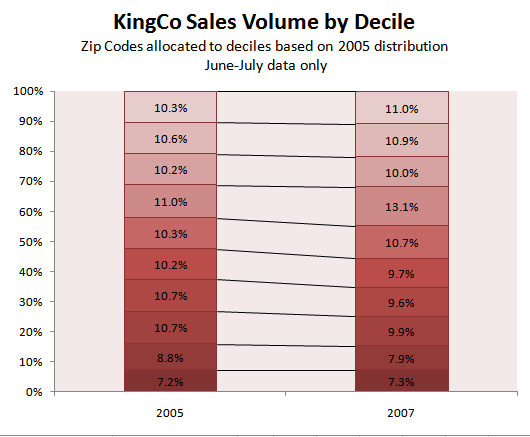
    Using the 2005 average price per zip code, assign each zip code to a bin. Generate the same histograms above, but create the 2006 and 2007 histograms by assigning the 2006/2007 sales to bins according to their 2005 price.

    In this approach we use the 2005 average price to classify a zip code as low/medium/high-end. Then the 2005/2006/2007 histograms may give a sense of how the mix of housing sold may be changing over time. In this case, a shift of the “mass” of the plot would seem to suggest a change in the mix of housing sold and the effect of appreciation on the histogram is negated.

    This approach assumes that the low-end/high-end nature of the housing stock in a zip code is uniform and does not change over time. Both assumptions may be false. ;)

  10. DEEJAYOH: ITS CLEAR FROM YOUR EXCELLENT ANALYSES

    Real statistics don’t lie but MSM liars totally twist statistics in Seattle .

  11. I think an analysis of the median inventory price listings would be telling. If the mix is really a strong variable in the median house price, then the median or average price for the available inventory should be dropping (i.e. less of higher price stuff and more lower priced inventory). While this is not exact and somewhat overstated due to not including final prices, I think the result would yield the answer. I’d also throw out the top and bottom 10 listings to normalize the data. If i was a better number cruncher, I’d do it myself.

  12. Deejayoh-

    Great work! please check your messages in the forum.

    Thanks!

  13. Very nice. It might be easier to see DJs point with a pure relative histogram where the curves are aligned at the first “bump”. It would more cleary show the change in distribution.

  14. (Was just trolling, and just had to comment after looking at this graph)
    That updated graph makes somebody’s point very clear.
    But your method is too hard for me to figure out so I used a way that required no math skills.
    instead of using zip codes, I used the new irregular mapping feature in the mls to draw out a neighborhood of “starter homes” I know very well along geographic boundaries where all the homes are about the same value, then restricted the search in that area to 3 bedrooms in the 1200-1800 size, then ran the CMA feature to find the median for each month, once set up just changed the month, Jan, Feb, April…. And so on.
    I found a small increase in the median price in June followed be a drop in the median starting in July, I wonder how august will turn out, but should wait until the end of the month BC most closing are between the 20th and 30th of each month.
    (And now my theory on the data)
    July was the first month to show the Sub-prime crunch by a lower median selling price; although April and May were the months that Sub prime programs where first cut, most lenders were given a last chance to lock their sub prime files in may, with a 30+ day lock, so lenders slammed all their loans in for a June closing, so that accounts for a slight increase in June, then a drop in July, a few stragglers may have closed in July, so august will be the first month to feel the full effect of the missing sub prime buyers, then give sellers about 2 to 3 months to reduce their prices, that should show in October-November this year, and this is only the “starter home market” after a lag time of about 3-6 months those in the “higher-end markets” in spring of 2008 will have to drop, starter homes need to be sold so others can move to the head of the house class, or….. pyramid.
    But I hope none of this happens, somebody prove me wrong!!! Please

  15. Deejayoh –

    I like the way you broke down and presented the data using deciles. I think it makes a more clear and precise presentation than a histogram.

    This feels to me like solid evidence that the distribution of sale prices is changing.

  16. I checked data for zip code 98021 (Bothell)

    The database shows 36 sales for the ENTIRE YEAR of 2005, then 246 sales for just the month of January of 2006.

    Obviously, the data is incomplete or incorrect.

    Garbage in garbage out.

  17. It’s based on a database that is incomplete.

    If you find a note on their website that states that the data includes EVERY sale in King county then you have something. I doubt they make any guarantee that it is complete. It could very well be that it was easy for them to collect data of a particular price range (hypothetical case). Their customers are just looking for a long list of addresses, not “completeness”

    Just because you don’t see a similar problem in the zip codes that you used doesn’t mean they are complete or even accurate.

    In science, statistical analysis is subject to peer review. When a problem is found a conscientious author interested in the truth would find it “constructive”.

    It seems likely that your charts qualitatively reflect reality. But with suspect data you can’t be certain. Nothing personal.

    Regards,
    Jeff

  18. It’s seems like the Seattle re-industries crown jewel is the Eastside. The comments about Seattle being special is multiplied regarding the Eastside. Isn’t this an interresting target for a possible myth debuncting by SBB? The commonly accepeted view is that the Eastside homes are “move-up” homes that are purchased with boat loads of cash and thereby will hardly be impacted by the current turmoil in the mortgage market. Driving around on the Eastside however I do not get the impression that the median home would be a “move-up” home for the affluent. Those homes are in majority west of I-405 but the main part of the East-side is east of I-405 where the majority of houses more look like first time buyer homes to me. It would surely be interresting to know what the median home on the Eastside looks like. How big, how old, how many garages etc and see if it is a “move-up” Mcmansion or not.

  19. HI PATIENT:

    Just a quick comment from a Seattlite that’s been here since birth and seen it all. Bellevue, the jewel of low income [yes, Bellevue was originally built in the 50s for low incomes] flats is a bit better than Seattle’s tiny $600K variety….but when you say “moving on up homes” do you mean $400K apartments/condos? LOL

  20. softwarengineer, I was thinking of SFHs. Mainly becuase the Eastside seems to be more of a family oriented SFH area and also since I would think SFHs are the most common starter homes for the suburbs.

  21. Countrywide may be bought out, but they are going to remain in business.

    Countrywide took 1 billion in subprime loans off the market as they would not accept 80% book value for the loans.

    It seems like the subprime CDO’s that have been sold went for about 90% of their book value. 10-20% reductions in the book value on the highest risk mortgage assets does not lead me to believe we are in for a prononunced crash.

    The question I have is when will the computerized risk models used exensively by hedge funds going to be updated and trusted again. Without those models only very traditional insurable mortgages can be resold easily.

  22. ….The question I have is when will the computerized risk models used exensively by hedge funds going to be updated and trusted again….

    Another good question – When will anybody buy the equity tranche of a CDO again?

Leave a Reply

Do you want a nifty avatar picture next to your name, instead of a photograph of Tim's dog? Just sign up with Gravatar, and make sure to use the same email address in the form below. It's that easy!

Sponsors


Seattle Real Estate :: Brent Fosso

Sponsors

  • Home Improvement Forums
  • East Bellevue Real Estate
  • For Sale By Owner
  • Home Builders

Tip Jar

Archives

Performance Optimization WordPress Plugins by W3 EDGE