Seattle Bubble

News & discussion about real estate & the housing bubble in the Seattle area.

Seattle Bubble - News & discussion about real estate & the housing bubble in the Seattle area.

Housing Crisis Not Over, Just Starting in Seattle

Posted by The Tim on May 7th, 2008 at 10:21 AM · 53 Comments

A couple people pointed out a piece in the Wall Street Journal yesterday titled The Housing Crisis Is Over. I don’t doubt that the mere fact that it was printed in the WSJ makes it gospel to some folks. I am not interested in writing a rebuttal to this piece, as that has already been handled quite well by our friends at Calculated Risk. All I would like to add is to point out that this is an opinion piece, not a news article. In the opinion of a guy that runs a hedge fund and stands to profit healthily from the recovery of the housing market, the crisis is over. Not exactly a shocking revelation.

Meanwhile, Fannie Mae, “the nation’s largest buyer of home mortgages” announced huge losses today, and forecasts “a steeper drop in home prices this year.” Yeah, the crisis is over folks, nothing to see here, move along.

In other news, Les Christie of CNNMoney.com is singing a bit of a different tune than she was in mid-2006, when she was touting our “strong fundamentals” and declaring Washington State to be the “next hot market,” or just last summer, as the local market was hitting its peak, when she declared that in Seattle, “the housing boom goes on.” Her latest headline is not quite as positive: Bulletproof housing markets get hit.

Some of the last, best housing markets - the ones that continued to climb even as the rest of the country cratered - have turned south lately.

Seattle, Portland Ore., Charlotte, NC, and Salt Lake City all posted home price gains during 2007, even as more than half of the 150 markets tracked by the National Association of Realtors registered declines. Now they’ve joined the losers.

Of course, the Seattle market was never “bulletproof,” just late.

Speaking of the local decline, Zillow released their latest Quarterly Home Value Reports this week, which contain some interesting information about our area’s market. Of particular interest is the chart showing the approximate percentage of homeowners who bought each year that now have negative equity:
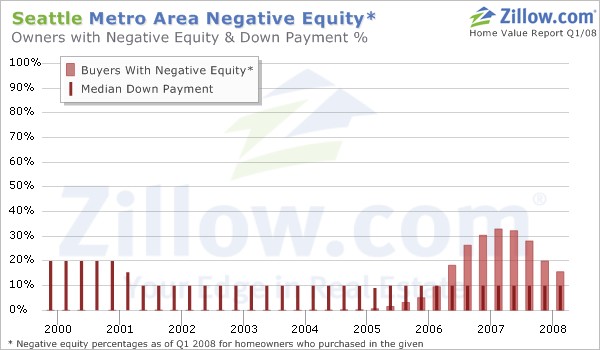
Seattle Negative Equity

There’s also a corresponding map on the charts page showing how all that negative equity is distributed around the region. Interesting stuff.

I think that’s enough to digest in one post.

(Cyril Moulle-Berteaux, The Wall Street Journal, 05.06.2008)
(CR, Calculated Risk, 05.06.2008)
(Les Christie, CNNMoney, 05.06.2008)
(Quarterly Home Value Reports, Zillow, 05.05.2008)

Categories: News
Tags: , , , , , , ,

Related Posts:

53 responses so far ↓

  • 1 Garth's avatar Garth // May 7, 2008 at 10:33 am

    The negative equity maps are fun!!

    Look at San Diego:

    http://www.zillow.com/static/images/quarterlies/2008-Q1/Negative-Equity-SanDiego-CA.jpg

    The seatttle one starts with 8%, the san diego one starts at 47%.

  • 2 Ray Pepper's avatar Ray Pepper // May 7, 2008 at 10:47 am

    Thats It!!! I’m moving to San Diego. Between these gray days, this blog, yelling realtors, my hair is falling out in clumps. I want to just lay on the beach, eat El Pollo Loco, and flush it all down with In/Out Burger. I will just have to increase the rental rates another 20% to afford my new lavish lifestyle.

    Ray Pepper
    http://www.500Realty.net

  • 3 vboring's avatar vboring // May 7, 2008 at 10:58 am

    were median down payments really 10%?

    does that include purchases with two loans or only people who bring real paper money that they personally own to the deal?

    i just don’t know how many entry-level-house-buying people keep $30k in liquid cash.

    and who would sell their stocks, when they could just get a second loan at 5% instead?

  • 4 The Tim's avatar The Tim // May 7, 2008 at 11:20 am

    Fun J. Lennox Scott quote from the 2006 CNNMoney article: “Microsoft announced it’s hiring 10,000 more people.” He cited this in support of predicted price growth over the next few years. Recall that as of February, home prices in the Seattle area were sitting at July 2006 levels. So much for price growth.

    According to Microsoft’s facts page, total worldwide headcount increased 7,393 between 2006 and 2007. If we make the assumption that they’re hiring at roughly the same rate in all their locations, roughly 45% of those were here. That means they added a total of 3,342 new hires in the Puget Sound region. Not quite 10,000.

  • 5 tacomarenter's avatar tacomarenter // May 7, 2008 at 11:21 am

    Wow the Pierce County area suburbs (Puyallup, Sumner, Fed. Way) are getting hit the hardest. While the good part of Tacoma (West and North side) are holding up ok. This is interesting because in the boom years people fled to these areas because they supposedly were a “better value”. I guess they weren’t such a good value after all.

  • 6 alex's avatar alex // May 7, 2008 at 11:25 am

    Any tech jobs in San Diego?

  • 7 Everett_Tom's avatar Everett_Tom // May 7, 2008 at 11:30 am

    Thats It!!! I’m moving to San Diego. Between these gray days, this blog, yelling realtors, my hair is falling out in clumps. I want to just lay on the beach, eat El Pollo Loco, and flush it all down with In/Out Burger. I will just have to increase the rental rates another 20% to afford my new lavish lifestyle.

    Better increase those rates by at least 30% Ray, I plan on following you down and freeloading. (oh, and get a place with at least one extra bedroom.. or a guest house .. That’d be nice…).. From sounds of it, so does Alex…(see if Ray pays, it doesn’t matter if there are tech jobs…)

  • 8 b's avatar b // May 7, 2008 at 11:53 am

    alex -

    A lot more than most people think actually. I live in silicon valley and know several people who have gone to or come from san diego for tech jobs. I have never been there myself, but I am told it is basically paradise.

  • 9 Civil Servant's avatar Civil Servant // May 7, 2008 at 12:18 pm

    From the CNNMoney article:

    “Unlike bubble markets such as San Francisco and Miami, these areas actually remained affordable for most residents despite years of price appreciation.

    For example, the median home price in Seattle, the most expensive of the four, was $370,000 in February. And about a quarter of all homes sold there during the last three months of 2007 were affordable to families earning the area’s median household income of nearly $76,000…”

    So after price declines have begun, we are still looking at an income-to-house-price ratio of almost 4.9:1, only a quarter of which houses met affordability criteria for those who bought them during the quarter. Doesn’t her second point directly contradict her first (”remained affordable for most residents”)? This sort of thing drives me up a tree.

    Also, relatedly — the same article notes that Seattle is not a bubble market whereas SF and Miami are. Is there a definition, loose or otherwise, of what constitutes a bubble market? Some such lists I see include Seattle and some do not.

  • 10 Egat's avatar Egat // May 7, 2008 at 12:34 pm

    b -
    but I am told it is basically paradise.

    Yeah, the weather and beaches are sublime, it’s just all the people that make it a hellhole.

  • 11 Scotsman's avatar Scotsman // May 7, 2008 at 12:38 pm

    Well, this data clearly proves the Realtor’s contention that negative reporting in the media has been driving prices down. I boldly predict further price declines as a result of today’s post. ;-)

  • 12 Moe Ronn - Realitor®'s avatar Moe Ronn - Realitor® // May 7, 2008 at 12:47 pm

    Sure Ray, just keep increasing your rental rates by double-digit percentages. That outta keep potential renters coming in droves. Smug doesn’t look good on anyone, dude.

  • 13 Ira Sacharoff's avatar Ira Sacharoff // May 7, 2008 at 1:19 pm

    ,Ray Pepper said” my hair is falling out in clumps”.

    You still have some left to fall out?

  • 14 singliac's avatar singliac // May 7, 2008 at 2:25 pm

    Hellhole? Really? I’m not sure if you are referring to the quantity of people, or the quality. For quantity, it doesn’t feel crowded like Los Angeles, and the traffic is no worse than Seattle. As for quality of people, it’s a matter of preference. San Diego has its fair share of superficial “beautiful people,” but Seattle has plenty of self-righteous yuppies.

  • 15 biliruben's avatar biliruben // May 7, 2008 at 2:39 pm

    Where do all the beautiful yuppies go?

  • 16 Slumlord's avatar Slumlord // May 7, 2008 at 2:59 pm

    Bellevue

  • 17 biliruben's avatar biliruben // May 7, 2008 at 3:02 pm

    Really? Dang.

    I’ve never been there, but everyone told me that was where the superficial self-righteous people were.

    There should be well marked maps for this sort of thing, so the everyone ends up in the right place.

  • 18 Garth's avatar Garth // May 7, 2008 at 3:05 pm

    In general a 10% decline is refered to by the media as a downturn, 20% or more is a bubble popping.

  • 19 johnnybigspenda's avatar johnnybigspenda // May 7, 2008 at 3:11 pm

    this was posted on SmartMoney.com

    Top 5 Cities Surviving the Housing Bust

    Seattle

    In Seattle, grunge rockers and tree-huggers have given way to well-paid techies. Microsoft (MSFT: 29.21, -0.49, -1.64%) is based in Redmond, some 15 miles outside of Seattle. It employs a huge chunk of the city’s residents, says Chinloy. In fact, Seattle’s employment rates far outpaced the national average in 2006, according to the Census Bureau. Some 72% of its residents made up the work force (vs. 65% across the U.S.) and median family income was $82,867, 30% more than the national average.

    Out of the five best-performing cities, Seattle experienced the biggest housing bubble. Single-family home values grew a whopping 92% between January 2000 and August 2007. Steady employment, however, helped keep home values relatively stable even as the bubble burst. Single-family homes lost just 2.7% of their value from February 2007 to February 2008.

  • 20 biliruben's avatar biliruben // May 7, 2008 at 3:27 pm

    The employment rate compares favorably because our bubble is just bursting. As construction jobs dissipate, the rate will go up.

    If home values are relatively stable then, by definition, the bubble didn’t burst.

    -Dumbmoney.com.

  • 21 Alan's avatar Alan // May 7, 2008 at 3:41 pm

    in 2006 [...] median family income was $82,867

    Wow. I think in 2005 it was listed closer to $65k. Could we be above $100k median family income in 2008?

  • 22 laxtosnoco's avatar laxtosnoco // May 7, 2008 at 4:32 pm

    Bigspenda’s right. The census has median family household income at ~$83k.

    Much of the confusion about differences in income numbers stems from the difference between household, family, and per capita income. A household can include unrelated/unmarried people who live together, while a family only includes related parties. Not to sound too much like an elitist, but unrelated/unmarried people shacking up with a mix of children generally earn less than a married family unit. Less than half of the households in Seattle are defined as ‘families,’ so family income is not a particularly useful measure here.

    The definition makes a big difference; the Seattle median household income is only $58k for 2006.

  • 23 Mirtika's avatar Mirtika // May 7, 2008 at 4:45 pm

    Did someone just say that a 370K home was affordable to folks with a household income in the 75K range? Under what calculation is that affordable? Personally, I think that would still be an onerous mortgage.

    As far as Seattle, San Diego–hubby got offered a job with MSFT, and he’s off to interview with QualComm in S.D. I prefer the idea of sunshine and lots of Hispanics in So Cal, but hate the state income tax there. I love the idea of cool weather in the PNW, but the grayness sounds depression. Honestly, I don’t like the rental prices in either city, or the fact that we’d be trading one crappy traffic area we’re familiar with for another crappy traffic area we’d have to learn to navigate.

    I wish MSFT would get this urge to migrate south. :D

    On the sad side: Just found out today from a pal weeping on the phone that she and hubby are in negative equity. He became disabled last year, so this is depressing as heck for them. Here, I feel great sympathy (and have and will heljp $$ wise).

    On the hard to sympathize side: An acquaintance (affluent) traded up a couple years ago from a perfectly roomy and attractive home with an ENORMOUS yard, valued at 3/4 of a million (making a huge pile as it had doubled in value in a few years) for a million plus, huge, luxury property with a gigantic pool. I’m guessing they’re seriously in negative equity by now. As a case of buying ridiculously up when need was not present, I find my sympathy reserves in this case are zip.

    Mir

  • 24 The Tim's avatar The Tim // May 7, 2008 at 4:48 pm

    laxtosnoco,

    That’s why I always use “median household income,” as a measure of local incomes. It encompasses much more people.

  • 25 jon's avatar jon // May 7, 2008 at 5:07 pm

    That zillow data is fascinating.

    For some reason the Boston market apparently never stopped requiring 20% down, and it kept the overall region from going into negative equity (graph) and so their bubble pop has been gradual. Riverside, CA people don’t seem to know what a down payment is (graph), so their popup is huge, although inventory has been dropping for months.

  • 26 Ray Pepper's avatar Ray Pepper // May 7, 2008 at 6:36 pm

    HEY MOE RON! I was joking…………If you don’t see it you are beyond help.

    Yes, Ira I do have a bit of a hair problem. The “clumps” actually fell out years ago during the dot com boom. But, in 2002 I started ordering Rogaine after seeing people grow hair on TV. In 2006 I noticed a few hundred hairs starting to emerge. Now in 2008 I’m bald as hell. I blame it on this blog, realtors, weather, my kids, and mostly myself for stopping the Rogaine treatment.

    I’m now certain this market will recover when I wake up and have a head of hair like Don King.

  • 27 rose-colored-coolaid's avatar rose-colored-coolaid // May 7, 2008 at 7:32 pm

    #21/#22 Regarding household income. Of course it will skyrocket. Look at it this way. The Average Working Joe or Joy was making $45k a year at their good job. They lived with a spouse who was working part-time pulling in another $15k. Or something like that, and that’s how you get $60k household.

    But then the economy sours. Joe/Joy loses his/her job, but find another one working at Starbucks Safeway. He/she is only making $25k a year now and the spouse is still working part time. But wait! Two of their young adult kids come back to the nest to weather the hard times. And they take in a renter they met at church. Suddenly they have 5 pretty bad incomes in that household instead of 1 good one and one low one. With an average income of $20k per worker, the household now makes $100k a year. To quote WaMu’s horrible ads. Wahoo!

  • 28 magnolia44's avatar magnolia44 // May 7, 2008 at 9:56 pm

    so rose-colored you then join the ranks of the family and are making 25k a year since you lost your good paying job as well, you then wont be able to buy a house anyway so it wont really matter. The family that bought a house loses theirs and it evaporates, they have a foreclosure on record you wont… you both in the end cant own a home.

    dooms day scenario huh?

    got rice?

  • 29 Dave0's avatar Dave0 // May 7, 2008 at 10:19 pm

    Wow, if you think Seattle is bad, check out the negative equity graph of Vallejo, CA:

    http://www.zillow.com/static/images/quarterlies/2008-Q1/Graph-Negative-Equity-VallejoCA.jpg

  • 30 economist's avatar economist // May 7, 2008 at 11:00 pm

    Is there a definition, loose or otherwise, of what constitutes a bubble market?

    Market price of property exceeds present discounted value of net rental income.

    That’s the definition of a bubble for any asset (substitute “earnings” for “net rental income” for stocks).

    More loosely, market price is over 150x market rent. For condos, use 100x.

  • 31 SeattleMoose's avatar SeattleMoose // May 7, 2008 at 11:10 pm

    Just heard on the radio this morning that Vallejo CA has declared bankruptcy and they can’t afford their police and fire fighters. Hmmmm…..ya think THAT could help fuel the collapse?

  • 32 Steve Tytler's avatar Steve Tytler // May 8, 2008 at 1:20 am

    The zillow map shows why I predicted in my newspaper column last Fall that home prices in the Puget Sound region would drop by an average of 10-20% by the end of this year from their peak 2006-2007 values.

    Some neighborhoods appreciate/depreciate faster than others, so it’s highly inaccurate to lump the entire region into one single number.

    The zillow map clearly shows that some neighborhoods are doing much worse than others.

    Home sellers are still reluctant to let go of their dreams of getting that “top of the market price” for their homes, so it will take some more time for the full effects of the market slowdown to work their way through the area’s housing supply.

    As the prime home buying/selling months of March, April and May come to a close I expect to see the pace of home price drops accelerate due to a lack of buyers.

    As the map shows, the farther a home is located away from the primary job centers, the greater the decline in home values is likely to be.

  • 33 Buceri's avatar Buceri // May 8, 2008 at 6:44 am

    rose-colored-coolaid - Wow, you should have a novela made out of that.

  • 34 Demersus's avatar Demersus // May 8, 2008 at 7:17 am

    “HEY MOE RON! I was joking…………If you don’t see it you are beyond help”

    Whether you were joking or not, you still appear to be a shill and most of us don’t really like your constant pitching of your business here. I’m not the first to say it and even I remember Tim telling you to tone it down a bit in the past.

  • 35 Ray Pepper's avatar Ray Pepper // May 8, 2008 at 7:31 am

    As I tell everyone. If you do NOT like my posts move onto the next. Its a blog. Were here to express opinions and new ideas. Just be happy I’m here. Someday you, a friend, or a family member will be buying. You will always remember there is a choice.

    Ray Pepper
    http://www.500Realty.net

  • 36 Demersus's avatar Demersus // May 8, 2008 at 7:58 am

    Correction, Ray; If I don’t like what you say, I’ll exercise my freedom to express it.

  • 37 Demersus's avatar Demersus // May 8, 2008 at 7:59 am

    …and if don’t like my responses to your shill post, move on to the next one. You seem to think that’s good advise, why not use it yourself.

  • 38 garth's avatar garth // May 8, 2008 at 8:27 am

    Anybody understand denver at all?

    http://www.zillow.com/quarterlies/QuarterlyThumbs.htm?msa=Denver+Aurora+CO

    What on earth went on there?

  • 39 matthew's avatar matthew // May 8, 2008 at 8:54 am

    Garth,

    Denver is a mystery to me as well. It’s an area that had a high percentage of foreclosures despite a seemingly healthy economy and stable housing values.

  • 40 Civil Servant's avatar Civil Servant // May 8, 2008 at 9:14 am

    Economist @ #30 — hey, thanks.

  • 41 Gill's avatar Gill // May 8, 2008 at 10:17 am

    I’m sorry, but if interest rates have such a MINOR impact on the decision to buy a home, then how come so many people bought in the last 7 years based on zero down, low interest rate ARM loans when housing prices were going through the roof? No one seemed to care about the price to income ratio very much.

    The arguement made by Calculated Risk against the WSJ article in this respect doesn’t seem to hold much water if we look at the trends in the past decade. ???

    Gill

  • 42 TJ_98370's avatar TJ_98370 // May 8, 2008 at 10:40 am

    Gill - I agree with you. I believe most buyers of real estate are most influenced by whether or not they can meet the monthly payment. Overall purchase price is a secondary consideration. Also, alot of buyers got caught up in the “real estate always appreciates” mentality during the last 7 years.

  • 43 Joel's avatar Joel // May 8, 2008 at 11:15 am

    Re: Denver

    From what I can gather from posts on CR and various news stories Denver didn’t have big price runups, but they’re very overbuilt. They should’ve seen big price declines during the bubble years and now that financing is tighter they’re seeing the delayed effects of oversupply.

  • 44 Gill's avatar Gill // May 8, 2008 at 11:20 am

    Yes — if the monthly payment is desirable/managable and a buyer really wants to get into a home, they will accept a slightly higher than desired purchase price and and a common justification for this thought process is the “real estate always appreciates” theory. Arguing that this is somehow not a factor or a minor one just doesn’t hold water historically. Now, factor in the 70’s and 80’s (when my parents bought their first home and their mortgage rate was 12.5% (STAGFLATION!)) and it gets even weirder.

    I realize that taking the hedge fund gentleman’s argument at face value would be ridiculous, but on the other hand the calculated risk response was far from disproving all of his arguments and just fell flat on some as well– so I think we need to take that one with a grain of salt as well.

  • 45 Sandy's avatar Sandy // May 8, 2008 at 11:25 am

    Re: the Denver map it’s interesting but not surprising that the areas of Denver with the most negative equity are the areas between downtown and the airport. This is also the area with the most new construction, thus, not a big surprise.

    I’ve spent time in Denver and do not like it, as a city. Everything is a chain store, and I don’t like cities that have not hills. I don’t like being able to see for miles in any direction. It’s not natural.

  • 46 Mirtika's avatar Mirtika // May 8, 2008 at 12:01 pm

    Funny, Sandy, I’m just the opposite. After leaving NY, I loved that about Miami–flat, huge sky uncluttered by tall buildings or hills or mountains. (As a stargazer, this was a big plus.) Loved that I could sit on my porch and see so much sky.

    Which is why I detest the last decade’s crazy build-up for 20, 30, 50+ storey-buildings blocking the sky. If I were Empress, I’d make it illegal to build anything above two storeys and block out the sky.

    M

  • 47 Ira Sacharoff's avatar Ira Sacharoff // May 8, 2008 at 12:11 pm

    Mirkita,
    I’m with you. I’d be knocking down big buildings and installing organic farmland.

  • 48 Sandy's avatar Sandy // May 8, 2008 at 12:39 pm

    I think it is from having never lived anywhere flat. Now, if the flat area is near an ocean, I can deal with it. But if it’s just a flat expanse of dirt for as far as the eye can see, to me that has very little appeal. I guess I just require a certain amount of variety in my topography! :-)

  • 49 economist's avatar economist // May 8, 2008 at 12:49 pm

    An acquaintance (affluent) traded up a couple years ago from a perfectly roomy and attractive home with an ENORMOUS yard, valued at 3/4 of a million (making a huge pile as it had doubled in value in a few years) for a million plus,

    You don’t make any money selling one house and buying another in the same market (unless it’s cheaper), any more than you make money selling 1000 shares of MSFT and then buying 1000 again.

  • 50 Sniglet's avatar Sniglet // May 8, 2008 at 1:51 pm

    Regarding the issue with Denver, I think their predicament is the result of poor creation of high-paying jobs over the last decade combined with the credit bubble which kept their economy from tanking earlier.

    Now that the credit bubble is deflating, there is little else left to keep Denver’s economy afloat. Those lucrative construction and realtor jobs just aren’t to be found anymore.

    This is a great case study as to how the credit bubble had major impacts even in regions that never saw a real-estate “bubble”. The credit bubble actually masked much of the underlying rot that was occuring in many regions. Yes, not every country may have seen home prices skyrocket, but easy credit allowed people to use their homes as ATMs, and find jobs in the real-estate industrial complex. Now that homes are no longer working as ATMs, there is just nothing left to hold up the economy in vast stretches of the nation.

  • 51 Mirtika's avatar Mirtika // May 8, 2008 at 4:24 pm

    Tons of organic farmland sounds great to me, Ira. But we need to have houses so we can cook that organic fare then sleep well without bugs in our hair. I’m not a tent in the woods sort. I need walls and electrical outlets and a good, working john. But a one-storey house with big windows and a garden suits me fine. And, well, we need houses so you and other RE peops can make a living. :D

    :)

    M

  • 52 Joel's avatar Joel // May 9, 2008 at 1:22 pm

    Sandy,
    Finally someone that agrees with me about Denver. I was totally dissappointed when I first visited Denver. I thought it would be more green and natural, but it really was just like Utah only with the mountains to the west instead of east.

  • 53 Sally's avatar Sally // May 16, 2008 at 12:46 am

    Thanks to my favorite astrologer, I put my house up in May 06 on an island north of Seattle. Taxes were ever rising, upkeep and so on after my husband passed away 11 years earlier. My atm was running dry. I needed to sell before the fall. I listed on line with a company that charged $120 as I recall for the listing fee. One of 3 realtors that showed it, called with an offer within 3 weeks of listing. His buyer offered 18k less than I was asking. I said I’d think it over. I called him the next day and said I’d take 5k less. He said he’d discuss it with his buyer and get back to me. I expected we’d play numbers for a few days but I was prepared to accept his offer if he didn’t counter. I did not plan to lose him . Much to my surprise, the realtor called back in 10 minutes and said he’d be right over to have me sign the papers as his buyer agreed. I needed to downsize at my age and my income. I owed 250k on the mortgage. We closed in mid July. I bought a manufactured home also on an acre and 1/2 for half the price of my home. My husband retired from Boeing and the Air Force and we left Bellevue for the island. We bought 2 1/2 acres for 44k, with a 2 1/2 car garage and loft, well, septic and an older single wide mobile in 1990. We had our home built on the other half of the property, after selling half the trees to make room for the house in the middle of the woods. We then sold the half with the mobile/garage etc for 60k. At that point we had our $ back and made a bit. Mainly we gained our acre & 1/4 free, valued at 25k after the land was split . Our builder said we stole the place as the garage would cost 15k to build, the very deep well 10k etc. We had our house built for 130k and put in lots of landscaping, a fish pond and so on. I sold it for 360k. The escrow office I contacted once in August, said I was very fortunate to sell when I did as sales came to a halt Aug 06 on the island, except for property under 200k.

    My cousin and my friend’s daughter/son in law listed their homes in Bellevue for 880k and 915k the first week in March. My cousin and husband put theirs up June 07 and by October, they took it off the market till this past March. Two couples looked at it in 5 months!! They’re baby boomers and all their money is in their home for retirement. They lost $ when he was laid off during the tech bust after 10 years with the company. My friend’s son in law bought their house Jan 06 for 750k. He got a job in Tulsa of all places. I’m afraid they may lose big time. His company is paying the rent on their condo till 9/1 to give them a chance to sell their home. I so hope both couples sell and soon but there are so many homes for sale on the east side of the lake. It may be a rough ride for all 4 of them. I begged my cousin to put their home up when I did but the timing wasn’t right for them. I thank my stars literally that I got out just before it all started to go downhill.

Leave a Comment

Do you want a nifty avatar picture next to your name, instead of a photograph of Tim's dog? Just sign up with Gravatar, and make sure to use the same email address in the form below. It's that easy!

XHTML: You can use these tags in your comment: <a href="" title=""> <abbr title=""> <acronym title=""> <b> <blockquote cite=""> <cite> <code> <del datetime=""> <em> <i> <q cite=""> <strike> <strong>

Read the comment policy before submitting comments.