The local unemployment rate continues to rise sharply, according to the August data that was just released.
As economic thunderstorms lash Wall Street and soak most of the rest of the country, Seattle and Washington state have managed to stay fairly dry. But beware: The skies are darkening quickly.
Unemployment in Washington state took a big jump last month, more evidence that the local economy is sliding toward recession. And though inflation abated a bit, prices for food, fuel and shelter are still considerably higher than a year ago.
The statewide jobless rate hit 6 percent in August, after adjusting for seasonal variations, versus a revised 5.6 percent in July, the state Employment Security Department reported Tuesday. That was just below the national rate of 6.1 percent.
The last time the state jobless rate was this high was October 2004, when the state was coming out of its last economic downturn. Now, however, unemployment is rising rapidly: As recently as February, the jobless rate stood at just 4.5 percent.
Unemployment also rose sharply in the Seattle metro area, to 4.8 percent from 4.3 percent in July.
Here’s a long-term chart of Seattle-area (King/Sno) unemployment going back to 1990, to provide some context for the latest report:
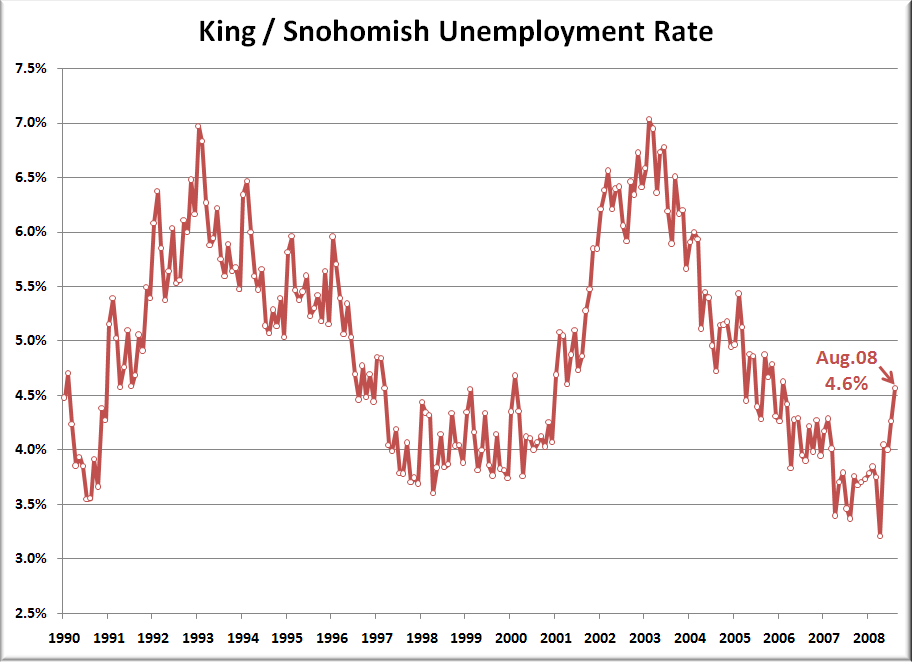
Uunemployment is still relatively low, but the rate is definitely climbing quickly. From December 2000 to March 2002, local unemployment shot up 2.5 points. That’s an average rate of 0.17 points per month. This time around, the rate has gone up 1.4 points so far in the last four months, for an average increase of 0.35 points per month.
In other words, unemployment is rising at twice the rate it did leading into Seattle’s last recession. If this rate of increase keeps up, we’ll hit 7% local unemployment by March.
We’re only four months into the current spike, so I wouldn’t read too much into this data, but it’s certainly not very reassuring.
Source: Workforce Explorer


Jump to the bottom to add your comment. ↓
35 responses so far ↓
1
crispy&cole
// Sep 17, 2008 at 12:14 pm
1st inning folks…now the game begins
2
Markor
// Sep 17, 2008 at 12:17 pm
So unemployment rose sharply until 1992, then it sunk to a low point and stayed there until 2000, then it rose sharply until $3 trillion was borrowed & spent on the Iraq war and other wasted stuff, after which unemployment fell, and now the economy is falling apart at the seams and unemployment is rising sharply again. What the heck happened in 1992 and 2000?
3
pfft
// Sep 17, 2008 at 12:24 pm
It’s a great time to buy! people are losing their jobs. people are worried about their insurance company. homes are unaffordable and prices are falling. it’s a great time to buy!
4
Yesler Hill
// Sep 17, 2008 at 12:43 pm
I know that a lot of attention is paid to the areas major employers; but it would seem to me that as credit is tighter, and the big companies are less able to move software and airplanes overseas, the real trickle down is the impact on the small businesses that I still think produce the most jobs, even here in MS/Amazon Seattle-area? And if the smaller employeers can not maintain current employment levels, I think this will really be the hit that hurts the Seattle area.
The nouveau riche slow down their dining and shopping, this directly hits the small business employees. And those are the people that are already pinched by high rents, so as their jobs go away, they will be under even greater economic/social pressures; downward pressures.
5
singliac
// Sep 17, 2008 at 1:16 pm
“what the heck happened in 1992 and 2000?”
People started buying these little grey boxes called computers. As much as we downplay the effect of MS bolstering our economy around here, the mid-nineties were HUGE for them. As unsexy as MS is nowadays, I was still blown away by windows 95 back in the day. Computers became mainstream in the 90’s and we bought lots of expensive software from MS. Then the internet startups came (and then died).
6
Markor
// Sep 17, 2008 at 1:18 pm
Another day, another 4% drop in the Dow. And a money market fund broke $1. Nothing to see folks. Keep dumping money into your 401Ks.
7
Markor
// Sep 17, 2008 at 1:31 pm
Wow, there must’ve been some big computer-related event on November 7, 2000. The S&P 500 hit 1431 that day, then promptly plummeted, and didn’t hit 1431 again until 2007–six years and $3 trillion borrowed later! What was special about Tuesday, 11/7/2000? Can anyone help?
8
Everett_Tom
// Sep 17, 2008 at 1:34 pm
And there it goes:
http://dealbook.blogs.nytimes.com/2008/09/17/washington-mutual-begins-auction-to-sell-itself/
9
TJ_98370
// Sep 17, 2008 at 1:39 pm
Markor asked:
.
What the heck happened in 1992 and 2000?
.
1992 - end of cold war, defense industry took a hit
2000 - tech bubble burst, dot com / techie jobs took a hit
10
The Tim
// Sep 17, 2008 at 1:41 pm
We get it, you hate Bush. A lot. He’s the incarnation of pure evil, etc. etc.
It should be noted that the S&P peaked in early September 2000 at over 1,500, and had therefore been falling for over two months prior to the election. Also, the election wasn’t even really decided until December, after the S&P had already fallen over 13% from its September peak.
11
Thomas B.
// Sep 17, 2008 at 1:46 pm
WAMU up for sale. I wonder if this is true.
http://www.marketwatch.com/news/story/wamu-puts-itself-up-sale/story.aspx?guid={95475577-D0E8-407B-9B28-D302430FE9BB}
12
Thomas B.
// Sep 17, 2008 at 1:49 pm
The link above doesn’t work. Just go to marketwatch.com.
13
Markor
// Sep 17, 2008 at 1:55 pm
I also recall that Gore was the expected winner, and on Wed. November 8, 2000, it was clear that Bush could end up the winner instead. On that day I emailed a friend and said “watch out, a recession may be on its way.” By December it was clear that the country would be put further in hock for no good reason, and the S&P reacted accordingly.
In any case, with the latest drop in the Dow it’s now obvious that Seattle area unemployment is going to continue to rise, a lot. Sniglet could end up accurate on that 80%-off prediction.
14
deejayoh
// Sep 17, 2008 at 2:17 pm
please show me the link between unemployment rates and home prices.
15
The Tim
// Sep 17, 2008 at 2:23 pm
deejayoh @14,
Hey, I’m with you (as I’m sure you know). It’s just a general indicator of the local economy, and it seems you can’t discuss housing without the conversation crossing over into the economy, no matter how little direct correlation can be shown between a specific indicator like unemployment and home prices.
16
deejayoh
// Sep 17, 2008 at 2:30 pm
I get your point. I was more reacting to Markor’s linking of your post to Sniglet’s price prediction. I agree that the local economy is definitely weakening - but unemployment rates are a pretty weak predictor of home price behavior.
17
david losh
// Sep 17, 2008 at 2:48 pm
Construction employment.
Housing starts and building permit intakes are both down. In my opinion some parts of the country had entire economies based on the construction jobs building housing tracts, Henderson Nevada comes to mind.
With construction comes, washers, dryers, ranges, and refridgerators,; durable goods.
Mortgages, credit cards, consumers goods, are all lower when people stop decorating the new home.
We had a housing economy that is coming to an end.
BTW 2000 was the federal ruling against Microsoft as a monopoly.
18
Joel
// Sep 17, 2008 at 2:49 pm
A bubble can only burst if there was a bubble in the first place. Did Bush create the internet bubble? Hey, I’m not a Bush fan, but it’s a reeeeal stretch to say he caused the internet bubble.
19
deejayoh
// Sep 17, 2008 at 3:16 pm
FIWI - here’s the same data Tim used above plotted against home prices. The relationship is weak and to the extent the fit line slopes in the right direction (e.g. increasing unemployment is generally associated with lower home price appreciation) the slope is flat showing the relationship is pretty inelastic
http://img229.imageshack.us/my.php?image=unempratesvshomepricesgs6.png
20
Dave
// Sep 17, 2008 at 3:25 pm
Nah - give cedit due where it was due. The tech bubble was almost entirely a Clinton thing (if anyone was responsible) - am I’m a democrat.
Dave
21
singliac
// Sep 17, 2008 at 3:50 pm
I know this is a stretch, but Isn’t it possible that dot-com bubble burst because they were based on crappy business models? The whole “get big fast” strategy ultimately didn’t work, and I don’t think it’s because of Clinton or Bush. More likely, it was too much time playing Foosball and video games in the office.
22
Ray Pepper
// Sep 17, 2008 at 4:16 pm
911+Greenspan Put+ Agents and Mtg Reps as found in RCG= Current state of affairs! Its just that simple! But, hey I’m not pointing fingers……..
23
Seeker
// Sep 17, 2008 at 4:31 pm
MS is still aggressively hiring contractors..
24
Thomas B.
// Sep 17, 2008 at 5:11 pm
Shhh… don’t say that too loud. I want to start up a tech company so I can buy a foosball table and an old pacman machine with venture capital money.
25
b
// Sep 17, 2008 at 6:23 pm
tim -
the unemployment rate for seattle-metro is *4.8%* not 4.6% according to the quoted article.
26
richie
// Sep 17, 2008 at 10:22 pm
WaMu will be bought or go under by the coming weekend. The unemployment rate for September will go much higher than August.
Nobody wants to buy WaMu because no one knows the exact amount of contigent liabilities. WaMu’s executives still keep lying. I beleive that it will take over by FDIC this weekend and a buyer like JPM will buy the prime assets from FDIC at deep discount. Everybody wants to follow the model of Barclay not Bank of America.
27
The Tim
// Sep 17, 2008 at 10:34 pm
b - I’m aware that the article says 4.8%. Since Mr. DeSilver doesn’t define what he’s referring to as the “Seattle metro area,” I can’t explain why that is. All I know is that the data available for download at Workforce Explorer is what I used to generate the chart. That data defines King + Snohomish Counties as “Seattle Metro,” so that’s what I used.
28
patient
// Sep 17, 2008 at 10:50 pm
richie, my guess is about 50/50 between a buyout prior or after FDIC takeover. If you want to keep the customer base intact you need to buy prior FDIC or people will take their FDIC payouts and choose between many banks from there. As a buyer you might only get a fraction of the customer base. If you buy prior to FDIC must step in your customer growth targets for the next decade is met. You probably don’t need to spend one dollar on advertising to attract no customer in a decade. The question is, can you balance sheet stomach WaMus portfolio of crappy loans…probably not so I change my outlook to 80/20 in favour of the FDIC route. I was at WaMu today to limit our exposure. There was surprisingly enough no queue at all. The masses are srill clueless or savings above $100k are extremely rare.
29
What goes up must come down
// Sep 17, 2008 at 11:26 pm
deejayoh,
so let me get this straight low unemployment helps housing but high unemployment doesn’t hurt housing? I mean really not everything has to have twelve charts somethings are common sense if people are unemployed they don’t buy houses, in fact if people become unemployed a lot of time they sell the house because they can’t afford it, relocate, etc…
Unemployment rising will hurt housing which was already out of whack with incomes — no doubt.
30
economist
// Sep 18, 2008 at 1:18 am
There was surprisingly enough no queue at all. The masses are srill clueless or savings above $100k are extremely rare.
Maybe the people with a clue use Internet transfers?
31
Buceri
// Sep 18, 2008 at 4:36 am
“please show me the link between unemployment rates and home prices.”
Tim, DJ -
The recent (last 20 years) unemployment slumps in the region have been relatively short. I can see how a 2 income family household with kids in school that suffered a layoff could have “managed” by cutting daycare and discretionary spending. But this worked with home prices about 30 to 40% lower than today.
Fast forward to today and that family’s income is about the same as 8 years ago but the mortgage payment is about 50-80% higher (buyer in the last 3 years) . I am not sure they can hold on for as long a during the last slumps.
As economists have kept reminding us during the last week: “we are truly in uncharted territory”.
Yesler Hill said : “I know that a lot of attention is paid to the areas major employers; but it would seem to me that as credit is tighter, and the big companies are less able to move software and airplanes overseas, the real trickle down is the impact on the small businesses that I still think produce the most jobs, even here in MS/Amazon Seattle-area? And if the smaller employers can not maintain current employment levels, I think this will really be the hit that hurts the Seattle area.”
Excellent point; even though compared to most other regions of the country, Seattle is indeed dominated by impressive corporate names, the small business still employs a significant percentage of the population. And that small employer needs credit to weather a crisis like the one we are having right now.
32
deejayoh
// Sep 18, 2008 at 7:17 am
No, unemployment has almost no direct relationship to home price changes whatsoever. I tried to post a chart showing the comparison but I think it got caught in the spam filter.
33
Markor
// Sep 18, 2008 at 7:42 am
I limited my exposure yesterday by depositing a WaMu check at another bank.
34
Markor
// Sep 18, 2008 at 7:45 am
That could be because other factors are at play, like easy money for mortgages. If people en masse can’t pay their mortgage, it’s a safe bet that home prices will drop.
35
Sniglet
// Sep 18, 2008 at 7:53 am
I can’t say how real-estate prices have tracked employment numbers. However, common sense would indicate that confidence in our local market would be severely shaken should Boeing and Microsoft institute lay-offs. It wouldn’t even take a huge firing binge to change the psychology (i.e. convincing people that our local economy wasn’t exactly “safe”).
Jump to the top of the comments. ↑
Leave a Comment