Posted by: The Tim

Tim Ellis is the founder of Seattle Bubble. His background in engineering and computer / internet technology, a fondness of data-based analysis of problems, and an addiction to spreadsheets all influence his perspective on the Seattle-area real estate market.

25 responses

  1. Calculated Risk puts up monthly Price/Rent and Price/Income ratios using CS prices.

    Both are good for long term trend info b/c they automatically correct for inflation of incomes and rents.

    The same for Seattle might be a good addition for the day after doing the tiers breakdown, if decent quality local rent and income info is available.

  2. Thanks as usual.

    The Seattle/Portland indecies declined slightly more than I expected for September. (The September CSI uses data from three months: July, August and September 2008).

    Because credit markets seized up in late September/October, and stock markets began diving in October — and because October/November/December is a weak time of year for Seattle Real Estate — we can’t expect to see Seattle’s rate of CSI decline improve anytime soon.

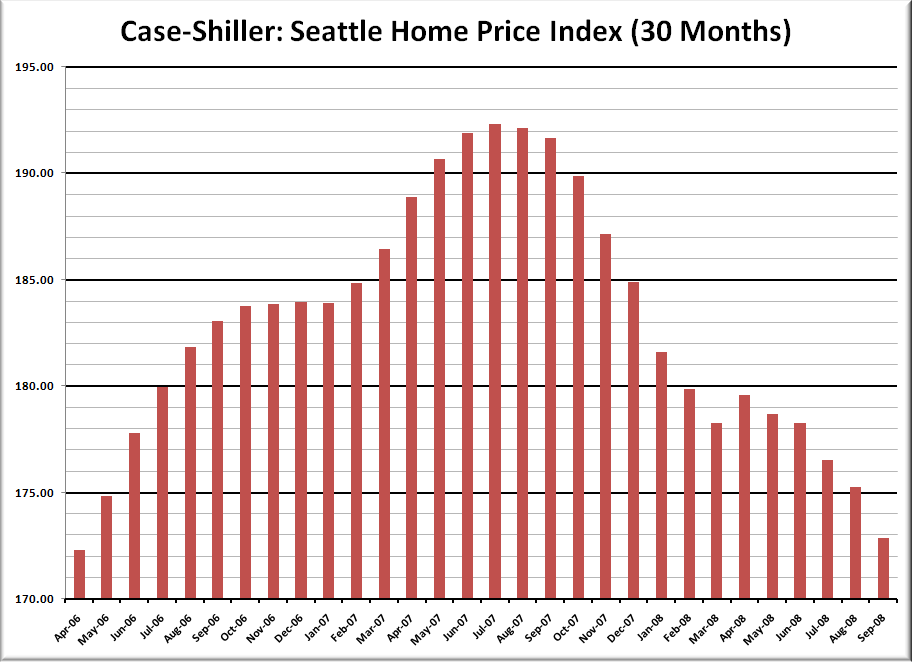
    Seattle’s index number is now at 173, the same as the national 20-city index. (i.e. both Seattle and 20-city homes are priced 73% higher than they were in January 2000).

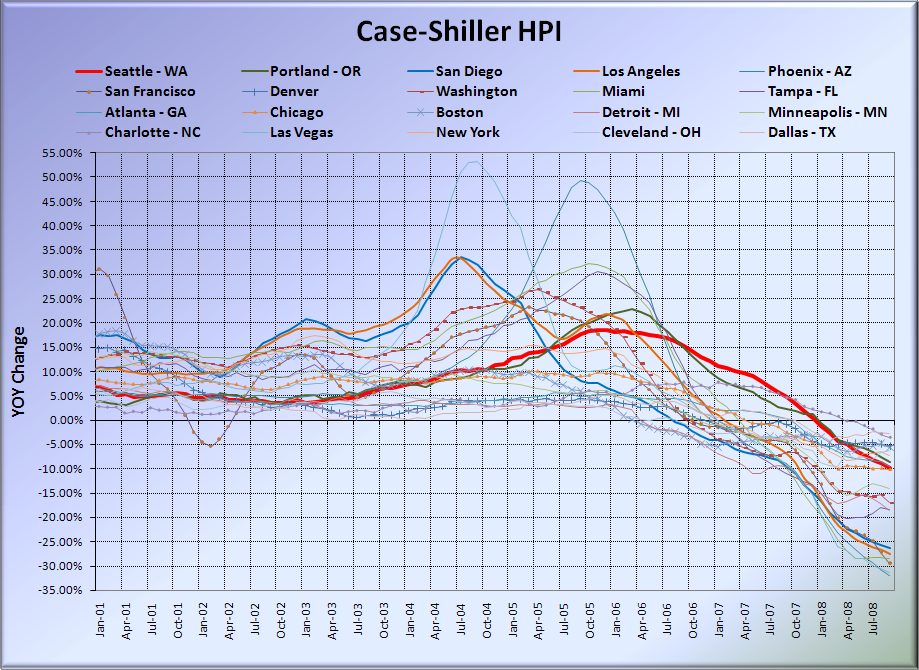
    Looks like the biggest bubble markets (Phoenix, Miami, LA, etc.) will continue to preview what’s going to happen in Seattle. The downward slope is easing a bit and maybe we’ll see a bottom in *those* markets within the next year.

  3. I was actually thinking the same thing as vboring – it would be great if you could add to both the C-S posts and the NWMLS median posts a chart that tracks the price/rent ratio using the BLS rent index (comes out monthly as well I believe). To the extent one is able to “predict” how much lower we have to go, that’s probably the best (simple) measure.

  4. Not. Bad considering economic conditions. I posted earlier how the govt will do everything they can to try and place a bottom.
    7 trillion dollar backstop to financials …. Check.
    There is more to come and they will throw the kitchen sink at housing.

    One more thing is they interviewed the guy who does the report on CNBC this am, he noted the pacnorthwest and said how we did not rise as much in the peak and something to the affect of holding up somewhat in comparison.

    Its not the right thing but its a must, we will see how low we fall until that backstop is in place.

    Good luck to us all, its a mess out there.

  5. The price to rent ratio on my house, I rent currently, is 12 according to the tax appraisal value.

  6. “the guy who does the report on CNBC this am, he noted the pacnorthwest and said how we did not rise as much in the peak”

    Yeah, we did not rise as much as the biggest bubble markets, but Seattle is exactly on the 20-index number for current vs. 2000 values. So Seattle is more typical than people think.

    The only thing atypical about the Northwest is its timing: late peak, and probably a later bottom.

  7. I know I am preaching to the converted but I think we will see a big drop through Q1 2009.

    Real estate is seasonal and look at what happened last year to the Case Schiller numbers for Seattle after September when the CS dropped by ~14 from September through till March. Given the CS is a lagging indicator we already know from the more current NWMLS numbers and the broader macro-economic environment that there will be a big fall in the next 3 months. Also, it is going to take another 4, maybe 5 months, for the CS to truly reflect the turmoil we encountered in September and October (the 2 month lag and the 3 month methodology used by the CS).

    My guess is that the CS for Seattle will drop by 14 points to 158 by the end of Winter 2009.

    It will be interesting to see if we get any resistance to the drop around March or April like we did last year. If we do not see any resistance or if that resistance breaks quickly prices may well go into free fall as I believe many of the sellers have hunkered down for winter believing they will sell in Spring. If that proverbial, or is that metaphorical, line they have drawn breaks in Spring a new psychology will take hold in both new and existing sellers and certain amount of panic may set in.

    As for the government backstop, they need to focus on buyers not sellers. There are and will continue to be plenty of sellers but there is an actual shortage of buyers. The government needs to incentivizes buyers with tax breaks, an increased conforming rate, lower interest rates etc. They need to make home prices cheaper for buyers by not reducing the price of houses but through the financing incentives on offer. After that they, the Government, needs to keep these incentives in place till time/inflation heals the housing market.

  8. G4George,

    I too would appreciate buyer incentives and would re-examine my house-buying plans if they were significant enough, but do we really want more gov’t intervention in the housing market?

    We already have the best loans in the world (nobody else gets 30yr fixed), non-recourse (also quite rare internationally), tax deductible interest payments, and ridiculously low interest rates. All that these affordability measures have done so far is lead to asset price inflation.

    Do we really want more gov’t price manipulation? Is there any reason to think that it wouldn’t just lead to more price inflation?

  9. I, too, have been wondering about G4George’s observation about what will happen in the Spring. As I said in another post, a RE agent at an open house recently told me that his seller’s were going to pull the house from the market at the end of Nov. and relist at the end of Jan. My guess is that there are many frustrated homeowners waiting until Spring to list or relist their house.

    However, are there going to be more buyers in the Spring? Will there be a typical Spring selling season this year? From everything I have been reading, sales have pretty much slowed to a standstill at this point. I.e. how much of the current standstill is seasonality and how much is the economic forecast?

  10. the Tim,

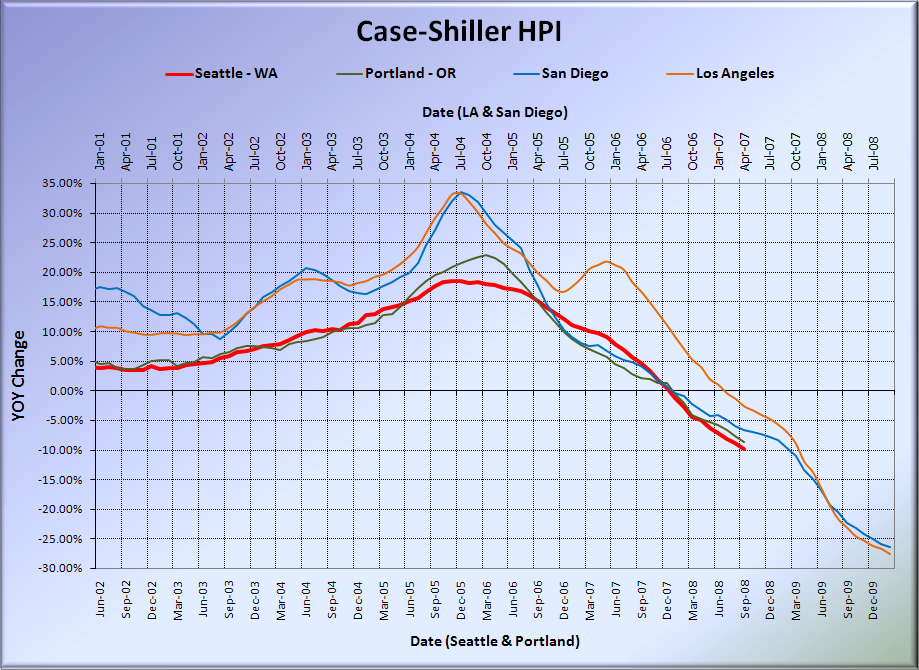
    Just one time, could you post the CS city graphs *without* the 17 month time offset?

    Seems to me that people are kindof getting ho-hum about the declines on the CS… maybe time to freshen up the conversation with a little bit of a different perspective?

    I know its not a huge mental leap to picture the graphs in a longer timescale instead of superimposed on each other, but I just feel that it might allow us to look at the big picture more clearly.

    Please? Just this one time…

    (if anyone else thinks this might be interesting, please pipe up)

  11. Jonny@5

    Figure 2 shows the CSI cities with no offset.

    Colors are held the same for each city.

  12. last months prediction was that September 2008 ->173.48, an error of 0.37%

    here’s predictions for the next few months
    October 2008 170.42
    November 2008 168.21
    December 2008 166.23
    January 2009 164.06

    It appears that S&P finally is publishing a seasonally adjusted index. The CS index everyone worships should be tossed because it’s not seasonally adjusted.

    I sent TIm a spreadsheet about a year ago that showed how to seasonally adjust the data but he apparently wasn’t interested.

    To predict the CS with pretty good accuracy perform these steps:

    remove their ridiculous 3 month average with arithmetic.

    apply a table of 12 multipliers – one for each month of the year – periodically

    use an iterative method such as “SOLVER” to adjust the table so that the standard deviation of the output is minimized and the product of the 12 table values is 1.

    apply a trend function to the result into the future (also using the seasonal adjust table)

    re-apply the 3 month average

  13. Every month, someone complains about the chart with the offset. And every month, Seattle tracks that 17 month offset more and more closely – following San Diego and LA down the tube.

    Wake up and smell the coffee people. The trend is pretty obvious. And hzg’s prediction shows pretty much where the next 4 months are going.

    Pretty soon we will be right back at the level (156) we were when Tim started the blog (Aug 05), and we can have a big boomerang party where we act like the last 3 1/2 years never happened. Rentersarelosers and Meshugy can be guests of honor.

  14. ^ Best post ever!

  15. deejoyah-

    that’s optimistic…the pendulum will fall further than ‘05 prices. Those prices were based on a strong economy. Now we have no financing, less jobs, and 1099 earners are making far less.

  16. Yes, I agree we’ll shoot through that – but at last at that point even the most thick-headed won’t be able to point to any appreciation that occurred after Tim started blogging. Some people – based on their comments – seem to feel a bubble site has no merit unless it was started at the top of the market – not as a warning for people during the “inflation” period. I don’t get it, personally

  17. I still miss the posts by Meshugy :

    “Hi Tim,

    YOY appreciation in Ballard is up 17% this year, my house is worth 200k more than it was when you started this website!”

    Where did the Shuggster go???

  18. Any look at Redfin will show you how much some areas appreciated since 1998-2000 in this city. I dont want better rates, I want cheaper houses in good areas, and those are still flying off the shelves when priced under 400k.

  19. Whether you like the graph or not the 17 month lagging chart for LA and SD is going to appear to be correct for at least the next 6 months.

    As I said in an earlier post today we already know from other more current data, like the NWMLS data, that there will be at least another 5% drop that will be showing up in the CS over the coming months. Therefore, if you extend the red line out till March 09 for Seattle and plot it at 15% we will still appear to be tracking the Californian cities.

    I do not think we will see a YOY change of -30% in Seattle though so I would expect the Seattle line to start to flat line or even go up a little in later 2009 and cross the SD/LA plot line at some point. That is not me being Bullish, if we are seeing any negative YOY price change, especially if it is a multi-year YOY decrease of -15 to 20%, the bubble is still deflating pretty quickly. We will still be seeing a 30% drop from peak pretty soon in Seattle.

  20. “However, are there going to be more buyers in the Spring? Will there be a typical Spring selling season this year? From everything I have been reading, sales have pretty much slowed to a standstill at this point. I.e. how much of the current standstill is seasonality and how much is the economic forecast?”

    Sellers cannot cope up with the giant inventory in Spring.. Eventually one way or another, they will bring down their prices… 04 is the realistic range… Let’s all be a bit more patient.

Leave a Reply

Do you want a nifty avatar picture next to your name, instead of a photograph of Tim's dog? Just sign up with Gravatar, and make sure to use the same email address in the form below. It's that easy!

Sponsors


Seattle Real Estate :: Brent Fosso

Sponsors

  • Home Improvement Forums
  • East Bellevue Real Estate
  • For Sale By Owner
  • Home Builders

Tip Jar

Archives

Performance Optimization WordPress Plugins by W3 EDGE