By The Tim on November 27, 2008
Happy Thanksgiving everybody. I hope you are enjoying it with family and/or friends. We’ve all got a lot to be thankful for.
No post today. Consider this an open thread for any of you that are hanging around here today.
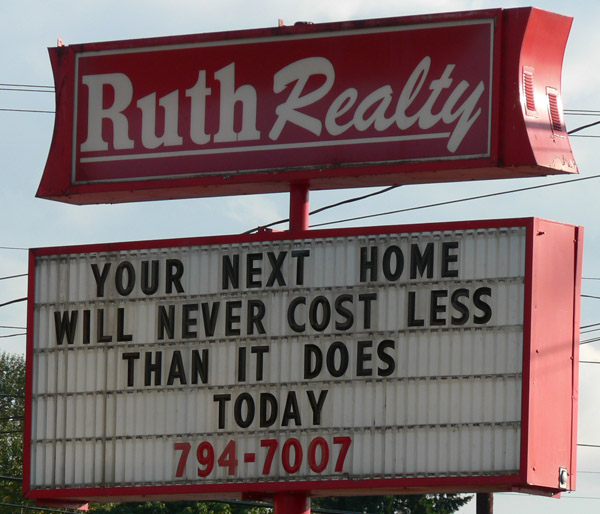
Photo taken August 10, 2006
Posted in Administrative, Open Thread | Tagged Open Thread, open_thread
Tim Ellis is the founder of Seattle Bubble. His background in engineering and computer / internet technology, a fondness of data-based analysis of problems, and an addiction to spreadsheets all influence his perspective on the Seattle-area real estate market.
For some reason I also took this shot of the real estate office that sported the above sign in August ’06. It amuses me, so I thought I’d share it.
Also, click the picture in the post for an amusing look at what the sign sported earlier this year when the Google Street View car drove by. Heh.
Rate this comment:
0
0
When prices finally started to go down in Seattle, certain RE agents made the case that it was still a great time to buy because, although prices were coming down, mortgage rates were about to skyrocket. Thus, it was cheaper to buy now than wait. I guess they forgot to tell their clients that treasury yields decrease in deflationary recessions, and mortgage rates are tied to treasury yields.
Let’s face it, according to certain RE agents, it’s always a great time to buy. There will never be a scenario where it is a poor time to buy a house. So get your wallet out. Oh, you don’t have any money. Don’t worry, you can get an FHA loan.
On another note, is it just me, or does anybody else think it’s extremely weird that Obama’s 10-year-old daughter still believes in Santa Clause? His teaching people to ignore the truth and to instead believe in fairy tale delusions is a very bad sign IMHO. Let’s hope our entire country is not about to embark upon the same fairy-tale chasing scheme. It’s nice to dream, but it’s imperative to keep the dream within the bounds of what is achievable by the physical laws of our universe. What concerns me the most is believing in Santa Clause is not that far away from believing you can borrow and spend enormous amounts of money and not suffer dire consequences in the future.
Okay, on to subject #3. I’m seeing an increase in high-end homes come on the market that the builder couldn’t quite finish before the home got foreclosed. Right now I’m looking at a bank-owned 4000 square ft. home in a high-end neighborhood for $399k that’s tax assessed at over $600k. This situation appears to be occurring more frequently. The builder involved is typically a mom and pop shop that got over-extended at the peak of the boom. I expect to see more of this type of thing as the housing downturn continues to rip the smaller contractors to shreds. The weird thing about it is even though some of these situations represent buying opportunities, I cannot pull the trigger and buy because watching the other guy get hurt reminds me of how I will be hurt if I buy the house and then lose my job. Thus, a lot of us are sitting on the sidelines these days, not because we’re being smart about the situation, but because we’re scared to death of borrowing relatively large amounts of money at a time when the solvency of our government is becoming increasingly questionable.
Rate this comment:
0
0
Joneness-
Don’t over analyze the O’bama situation. You clearly have never had a daughter.
Interesting point in the foreclosure- have you found a good source for looking into bank owned foreclosures?
Rate this comment:
0
0
But when deflation happens, unemployment goes up – if the govt borrows from the Fed (not the public because that would curtail supply of money) – and spends then it is the right thing to do. Even printing money will fly if done carefully and maybe ideally if not everybody knows about this.
You can the easily get rid of deflation, increase debt more and start some inflation that can be controlled and can help with getting rid of debt.
Now is the time to increase supply of money in order to avert a disaster. The govt faces prospect of dwindling tax revenues (companies stop employing people, people spend less)- so it makes sense to increase debt. This will probably the biggest debt building we have ever had. And if push comes to shove you start the printers rolling and pay off the Chinese this way. They can have all the money straight from the printing press – they will be at least fresh and not wrinkled.
Rate this comment:
0
0
You can the easily get rid of deflation, increase debt more and start some inflation that can be controlled and can help with getting rid of debt.
It;’s easy to get rid of consumer price deflation, but not asset price deflation. Because rising inflation causes bond prices to fall (asset price deflation) which affects other asset classes such as stocks and RE.
Look at Japan, which has had very slight consumer price inflation post-1990 but massive asset price deflation.
Rate this comment:
0
0
Happy Thanksgiving. I’m thankful that Ruth Realty is not my realtor.
Rate this comment:
0
0
and dumbest comment I’ve seen in quite some time goes to
Ding ding Jonness with the Obama daughter comment LOL, you can’t be serious.
Have a good one, I know I will,
Rate this comment:
0
0
China is in a tougher spot than the US is. They are trying to keep their growth going strong because they have such great poverty and people aren’t willing to put up with it any more. They can try to stimulate local spending, but that means they don’t have money prop up our economy by buying our debt, and they can’t grow their exports if our economy continues to decline.
One scenario I see that is bullish for next year is that national inventory of new houses is dropping pretty fast. It looks like sometime next year that is going to hit its normal level, and prices will stop dropping. At that point the bailout borrowing can stop, but the deflation that is masking the money being pumping into the banks will stop. Right now people are parking their money in Treasuries while house prices drop. Once prices stop falling, people will no longer be happy with current low rates on treasuries. They will move back into RE, and interest rates will rise. The treasury will have to keep printing new bonds (effectively the same as printing cash) to pay the increased interest cost on the bailout borrowing, and that will drive inflation, making RE that much more attractive.
Of course that won’t happen if protectionism sets in because of some bonehead move by China or, worse, by the US to protect Detroit congressmen.
Rate this comment:
0
0
Good call, Robert. That is exactly what Obama seems to have in mind. Increase debt, spend like crazy and sprouce things up a bit.
Its the right move to prevent a disaster, but its going to kill the Dollar. The aftermath?…Unfortunately, given the globilization that continues to develop, we will likely drop significantly in purchasing power thus lose our place as the super power. Oh well…at least we’ll have food on the table.
Rate this comment:
0
0
and interest rates will rise. The treasury will have to keep printing new bonds (effectively the same as printing cash) to pay the increased interest cost on the bailout borrowing, and that will drive inflation, making RE that much more attractive.
No it won’t. Reread the first five words of the quote above.
Rate this comment:
0
0
CK and others don’t realize is that infrastructure, energy spending is at an all time low. We blew literally 3 trillion dollars on infrastructure in another country, over the last 6 years. Had that money been used to build sustainable energy, infrastructure improvements it would have been different.
Rate this comment:
0
0
“Reread the first five words of the quote above.”
The bubble was driven by low interest rates that were possible because of Wall St. stupidity and fraud. The next rise in RE will be because people will buy RE as a way to protect their wealth from inflation and rising taxes needed to payback the bubble bailout. The high cost of borrowing is not a problem for people who are moving cash out of bonds and into RE. What will be a problem is that the high cost of borrowing will make investment difficult, and so unemployment will be high.
Rate this comment:
0
0
Captain:
You are quite astute in your realization that I’ve never had a daughter. However if I did, I’m not sure my beliefs would change on this subject.
Eric Berne (the creator of Transactional Analysis) wrote in one of his books that his role as a therapist was to dispel his (adult) patients’ belief in Santa Clause. He noted that when he was able to do this, the patients would become extremely agitated and upset. However, this was a stage in healing, and once the patients were on the other side of it, their anger diminished and they began to live in and accept reality and heal.
When it comes to perpetuating family scripts, I completely agree with Berne. Please understand I was taught about Santa Clause as a child, and I have memory of learning otherwise.
Rate this comment:
0
0
“This will probably the biggest debt building we have ever had. And if push comes to shove you start the printers rolling and pay off the Chinese this way. They can have all the money straight from the printing press – they will be at least fresh and not wrinkled.”
Please correct me if I’m wrong, but I believe much of our debt is internal to the U.S., and I suspect this ratio will increase throughout this downturn as people continue to pull their money from volatile markets and seek stable investment strategies. Thus, as the government rolls those presses, it will be us that gets pennies on the dollar. Thus, perhaps your strategy will be great for people who have taken on heavy debt, but it won’t be friendly to savers. Thus, if all the “real” money in the U.S. becomes valueless, what separates it from the third world countries? It seems to me there is no such thing as “free money from the printing presses.”
Rate this comment:
0
0
Captain Kirkland –
Commercial banks create money almost out of thin air by depositing and loaning money. So the supply of money is determined also by commercial banks that participate in the process of creating money. When banks do not loan money and velocity goes down so does supply of money.
If jobs are being lost – it makes sense for govt to borrow even more money from the Fed to boost supply of moeny ASAP. Businesses, people all need adequate supply of money to keep the engine burning.
People talk so much how bad debt is – but the fact is that you can incease it as you please. And then you have inflation to kind of deal with the debt because you constantly need to increase supply of money which has been happening.
With some equiliribium – the houses in Kirkland will stop loosing value. If people loose jobs – it will be a bad thing for real estate. The sooner we reach price stability the better it is for the economy.
Right now we are in a weird cycle where it pays to actually not buy a house because you can buy the same house in the future for less……That makes the price dip even further. So hopefully with the new added spending and some optimism – this whole thing can just blow away – so it can be business as usual.
And if push comes to shove – we can always print some money to keep China happy with having dollars.
Rate this comment:
0
0
My eleven year old daughter kept saying she knew Santa was real till I told her that I had talked to his helper, and his helper told me that she was too old to get gifts from Santa. I told her that I would now get her the gifts that Santa used to buy her, that although Santa would no longer bring her any gifts, she would get the same amount of gifts, just now from Dad. She said “I knew he as not real a few years ago when you forgot to take off some price tags.” Kids are smarter than you think.
Rate this comment:
0
0
Hey Jonness – I think that most of the debt is internal to the US but the issue is that if the debt slows spending to an extent that the economy is in danger of going into a severe depression or recession – then what do you do? It is then in the interest of “savers” to bailout the people in debt.
But also the US can borrow a bit from Chinese. They keep lots of dollars in their accounts. In fact the US is privelaged in that way. They can borrow USD from the Chinese. The Chinese cannot borrow Yang or whatever it is from Japan.
It is just like with GM. You let them fall and then they get punished. But along with this the govt tax revenues go down, the US looses prestige, unemployment goes up and so benefits go up etc etc. But the other side of the story is – you bailout irresponsible companies and consumers and they will keep acting even more irresponsibly because they know that the govt is kept in check. In this sense if the govt guarantees that I will get a bailout – heck – I am all for buying couple of shacks in Kirkland and see how things go.
I am sure they will figure out a way where the savers who hoard some few dollars in their Key bank account – they will still have some money after this. But the economy has got to start moving and moving fast.
Rate this comment:
0
0
“Kids are smarter than you think.”
Can’t disagree with that. It’s their parents lack of intelligence that concerns me.
Rate this comment:
0
0
Magnolia:
First I apologize if I have brought forth concepts that have threatened your desire to maintain the life scripts affectionately handed down to you by your parents. Please allow me to explain.
Berne observed that people need strokes, the units of interpersonal recognition, to survive and thrive. Your comment @7 would have been more self serving had you attempted to receive a stroke. But, unfortunately it is actually a “game.”
Berne defined certain socially dysfunctional behavioral patterns as “games.” These repetitive, devious transactions are principally intended to obtain strokes but instead they reinforce negative feelings and self-concepts, and mask the direct expression of thoughts and emotions. Berne tagged these games with such instantly recognizable names as “Why Don’t You, Yes But,” “Now I’ve Got You, You SOB,” and “I’m Only Trying to Help You.”
I suspect you played the game due to hearing an idea that has threatened your belief system, which was handed down to you as a script by your parents. Since the childhood brain is rapidly wiring during the early development period (neural plasticity) but slows down as an adult, it is very difficult to recognize and break scripts as an adult.
Berne proposed that dysfunctional behavior is the result of self-limiting decisions made in childhood in the interest of survival. Such decisions culminate in what Berne called the “life script,” the pre-conscious life plan that governs the way life is lived out. Changing the life script is the aim of transactional analysis psychotherapy.
Fortunately, I self-concluded there was no Santa Clause when I was 5-years-old; thus, my rapidly wiring childhood brain was able to overcome the damage. Eric Berne became quite famous for spending his life attempting to get others to come the realization that life was not a fairy tale in which a magic savior would come to the rescue. Thus, one is responsible for the outcome of his own actions and decisions. Having said that, truthfully, I’m all for Obama coming down my chimney and ending this horrible economic downturn so I won’t have to suffer. I would love to exist peacefully with you amidst all the fuzzy feelings we got back when we were kids at Christmas. However, Berne would argue that it’s very important to live in and accept reality.
OK, don’t take this post too seriously. As was yours, it’s obviously intended to be a game as opposed to an attempt at receiving a stroke.
Rate this comment:
0
0
National Inventory is falling eh? Well don’t be too sure about that. A friend of mine who’s been trying to sell his house for a year already was asked by the realtor to remove it from the market. Oh, its still ‘available’ (wink, wink, nudge, nudge) but it no longer shows up on the listings. It even had a looker/peeper come by a week or two ago. You know, brought over by the realtor even. But not listed doncha know!
Nope, Relitters aren’t too happy with high inventory numbers and they’re doin’ sumpin about it alright!
Rate this comment:
0
0
You can say that actual inventory is higher than reported, but part of that inventory is people who would like to sell simply because prices are falling. Once inventory levels off and prices stop falling, some of those people won’t want to actually sell.
Rate this comment:
0
0
Happy Thanksgiving to all! Gobble, gobble!!
Rate this comment:
0
0
The high cost of borrowing is not a problem for people who are moving cash out of bonds and into RE.
The marginal buyer of RE is debt-ridden J6P, not people with net cash positions.
Inflation and higher interest rates are not positive for RE going forward. That should be obvious.
The only thing that is positive for RE going forward is higher real wages.
Rate this comment:
0
0
Peter Schiff (The man who predicted the housing crash) on Fast Money. Watch this!
http://www.youtube.com/watch?v=pGHODRNJqRo
Please watch this and then look at all his stuff on You Tube. It is worth it and will educate all of my fellow bubble people!
Please – all of you owe it to yourselves. Understand why this spend and borrow economy is causing this mess. Watch!
I agree with everything he has said to date. This borrow and spend economy is going to collapse!!!!!! Housing prices will be down 50-70%.
Now watch these
http://www.youtube.com/watch?v=TP_aJ7LcAAA
http://www.youtube.com/watch?v=coaI3d89kuA&feature=related
Peter Schiff has been right since 2005. Housing and the U.S. Economy is based on paper – we need to get back to basics…
Rate this comment:
0
0
I’ve said this before, and I’ll say it again: Peter Schiff has been completely wrong regarding the US dollar, commodities, and foreign markets. His funds have had simply abysmal performance this year.
Schiff completely mis-understands how badly off emerging markets are, and how debt creation effects the money supply.
We are entering a period of severe deflation that will last for YEARS and will see the dollar appreciate against virtually every other asset there is (commodities, real-estate, stocks, foreign currencies, etc).
Low interest rates on mortgages are nothing to be happy about. Rates are low because investors are fleeing to the safety of US treasuries and government securities, and the massive de-levering under way is creating a wave of demand for US dollars unlike anything that’s ever been seen
I expect mortgage rates will drop even more over the next few years, but that will be cold comfort to people watching the value of their homes drop more than 10% every year.
This deflation game has barely even begun. 80% declines in Seattle area real-estate media prices are just ahead (after 3 or 4 years).
Rate this comment:
0
0
What’s this nonsense about no Santa Clause! There most certainly is a Santa Claus! He just trimmed his beard, wears a business suit, and goes by the name of Ben Barnanke now.
Rate this comment:
0
0
Gotta agree, Schiff has been right on the domestic market structure, domestic real estate, and equities. But he has blown it on the dollar devaluation and emerging markets. He thought foreign markets would decouple from the USA and show strength while we went under. The reality is that we may be hurting, but foreign markets are going to hurt much worse. As a result his fund has significant loses, but his reputation as a forecaster lives on.
Rate this comment:
0
0
It’s people like Robert Wojciechowski that scare me, and would probably scare most people who want the country to be prosperous and viable twenty years from now. Sure, it seems easy and even fashionable to print money and shower it on people and businesses which are the absolute dregs of capitalism (ie: the speculators, debt-consumers, and top-heavy wasteful mismanaged decrepit businesses), all in the name of getting the economy “going” and “getting back to normal”.
That fact, though, is that the economy has been living on borrowed time for a while, and now we’re getting a scare. It’s like the 400lb man who’s been gorging on cheeseburgers and milkshakes for 20 years, and just had a serious heart attack. You have basically two choices: try to clean up your life and live a lot longer, or get patched up and continue what you were doing before. Except in this case, we’re going for option 3: start injecting ourselves with speed at the same time, so we can keep partying again immediately as we “just get back to normal”.
FYI, enormous crippling national debt is bad, and the country cannot just increase it as they please (although they will act like they can). At some point we’ll have currency collapse, and it could happen sooner than anyone imagines, and when it happens it will be bad times in the USofA. Also, for reference, over 50% of the national debt is now owed to foreign individuals and governments; but given your previous commentary, I doubt you grasp the significance. I can only hope that for the good of the country, you don’t vote.
Rate this comment:
0
0
“Inflation and higher interest rates are not positive for RE going forward. That should be obvious.”
This graph shows the CSI for a 120 year period.
http://graphics8.nytimes.com/images/2006/08/26/weekinreview/27leon_graph2.large.gif
Housing prices went up, even adjusted for inflation during the 1970s. I think that is what it will be like during the next few years: high inflation and unemployment.
Increasing real wages are not essential, because you pay back a loan with inflated dollars. Interest rates are high, but that means the deduction is high as well and becomes very significant. We haven’t seen them recently, but mortgages can be indexed to have payments that rise over time with inflation.
Rate this comment:
0
0
For 2009 I predict…………….. Boeing layoffs!
China to delay aircraft delivery -report
Thu Nov 27, 2008 9:40pm EST
HONG KONG, Nov 28 (Reuters) – The Chinese government will ask mainland airlines to delay delivery of new aircraft and may stop approvals of new purchases of aircraft amid a slowdown in air traffic demand, the South China Morning Post reported on Friday.
The Civil Aviation Administration of China (CAAC) is preparing to ask carriers to negotiate with aircraft leasing firms and makers such as Boeing (BA.N: Quote, Profile, Research, Stock Buzz) and Airbus (EAD.PA: Quote, Profile, Research, Stock Buzz) on delaying delivery of new orders, the newspaper said, quoting Xiamen Airlines general manager Hu Bin.
“A meeting has been called by CAAC at the beginning of next month to discuss an adjustment of the delivery schedule,” Hu said.
“The market is flooded with excess supply, resulting in ruthless price cuts in airfares and shrinking sales,”
Rate this comment:
0
0
RobWoj,
You need to understand that the .gov is not “printing” money in the quantities needed to come anywhere near combating inflation. It is impossible.
All the flaws in your analysis descend from this misunderstanding.
We are in the throes of the worst deflation in several hundred years and the US.gov is powerless to stop it.
Rate this comment:
0
0
Oops,
I meant to say, “combating deflation.”
Happy Thanksgiving to all my SB brethren (even you, Jonness). I’m pretty certain T-day 2009 is going to be very different than what you observed today (and I’m not talking about the SeaChickens.)
Rate this comment:
0
0
OPEN THREAD! ??
A good friend just went in for surgery and it reminds me to REMIND ALL MY FELLOW BLOGGERS to keep your health in check.
Keep up on your annual physical!
http://www.youtube.com/watch?v=xHKTE75dgE4
Rate this comment:
0
0
I think someone linked to this very interesting post, but since people are talking about printing money and that debt is not a big deal I wanted to post a few highlights:
“So, yesterday the media finally added up all the money and guarantees promised in all the alphabet soup programs in the past year. The tally? More than $7.7 trillion! And this morning we learn we get to add another $800 billion for a new total of $8.5 trillion!
$8.5 trillion! How much money is that? Well, the 7th Day Economists say, “it’s only a little more that half a year’s GDP!”
And here’s my response to that: Yes, but let’s get out our calculators, shall we? Let’s divide $8.5 trillion by the size of the entire population of the United States…
$8.5 trillion divided by 305,160,073 (current as of today) = $27,854 FOR EVERY MAN, WOMAN AND CHILD IN THE UNITED STATES.
For my family of four? That’s $111,416! Let me ask you this? Can the average family support that debt? If the answer is no, where do you think this all ends? But wait, that’s just the recent debts and obligations.
And before I get too far, I want to remind people that when it comes to comparisons to GDP, my bull**** flag is flying a mile high! WHAT DOES DEBT HAVE TO DO WITH GDP ANYWAY? The answer is NOT A golly THING! There is NO relationship, no tie whatsoever between debts and GDP and to make that comparison is pure ALICE IN WONDERLAND.
Here’s the same Alice in Wonderland argument, but in a different way: Let’s say that you live in a neighborhood of 100 homes. You and your spouse earn $100K per year (which is way above average). In addition to the $500k you owe on your house, you owe another $1,000,000 on credit cards! But you say, “in comparison to the GDP of my entire neighborhood, that $1 million is just a drop in the bucket so it doesn’t matter!
HUH? You owe a million bucks in unsecured debt but only earn one tenth that? How does that compare to the output of your neighborhood? It doesn’t!
……. Ah ha! Foreigners hold nearly SIX TIMES the debt as our own “Federal” banks – niiice…..
Now it’s time to talk about the future obligations of Medicare and Social Security. Before I get into the numbers, YES, WE CAN simply eliminate those programs and make them go away. WILL WE? YES, WE CAN cut our military spending in half to get back within some level of sanity… after all, we do spend MORE MONEY ON OUR MILITARY THAN THE REST OF THE WORLD COMBINED. But WILL WE? And again, who is the insane one in this fantasy that unfortunately is no fantasy at all?
Conservatively our own government admits that the obligations of Medicare and Social Security add up to about $56 TRILLION with Social Security being the much smaller problem of the two at “only” about $10 Trillion. Heck, President Bush spent more than $13 trillion with one signature when he signed Medicare Part D into law! By the way, when others calculate these obligations, they come up with numbers as high as $100 trillion, but let’s stick to the more conservative $56 trillion number, okay?
Now we’re talking some serious numbers, 56 followed by twelve zeros. Do the math, that adds another $183,510 for every man, woman, and child in the United States!!
Add that figure to the previous and now we are up to $246,332 for every person or $985,328 for my family of four.
…………….
DERIVATIVES:
Three decades ago modern derivatives did not exist. By 2006 the notional value of the world’s derivatives had grown to over $500 trillion and the highest report just prior to the latest collapse put the world’s notional value of derivatives at an astounding $1.4 QUADRILLION.
Now, just for comparison, the total output of all men and women of the entire globe last year was a GDP of a little over $60 trillion. $1.4 quadrillion is approximately 23 times global GDP! This is a very squishy number and is most likely much smaller now that the financial system is imploding, but it is still an unfathomably large number, in the many hundreds of trillions.”
Reading this post and checking some of the data really made me come to the conclusion that we as a nation are in deep, deep do-do. Either we default on the debt or we pay it and based on the numbers I don’t see how we pay it.
Rate this comment:
0
0
Peter Schiff has been right more times than wrong – dead right in fact. He mentions the rally in the dollar as being completely temporary – I would agree. Our currency is fodder. No foriegn government is going to bank roll us – all we do is borrow and spend. Social Security and Medicare are a sham. Our current liabilities exceed $60+ trillion after this bailout!
By the way, John Paulson – the hedge fund guy who made about $5 billion last year – shorting the LCDX and MBS market was of a contrarian view as well. He was down nearly 50% before going up 350%.
Long term view Sniglet – although we agree on Real Estate prices in this rat hole of an area. Hopefully, the dollar will hold up so we can pay cash for out next home! I’m looking in Gig Harbor and the whole place is for sale. All these poor families living in hyper inflated homes. I am praying for the collapse so that I can start buying property with my hard earned money. Cash – NO MORTGAGE. The mortgage market is slavery for a phony dream. I’m not dumping my hard earned money – like most of these phony real estate agents want you to.
I’m in awe of seeing New York real estate prices here. People here make approximately 50-80% less than New Yorkers, but pay just a little less (about 20% less) for Real Estate. NUTS!
Rate this comment:
0
0
I just got back from a wild Thanksgiving party. It was a blast.
I see a lot of predictions of deflation and some predictions of inflation. It would help me to understand the situation better if some of you would spell out a bit more of the mechanics behind your predictions so that I can get a better handle on how you perceive the big picture. Or at least link me to a good article or website that represents your views fairly closely.
That way maybe I can perhaps ask a few relevant questions and get to understand your viewpoints a little better.
Thanks. :)
Rate this comment:
0
0
well it looks like the other part of real estate is about to tank — since WAMU or should I say formally WAMU will be dumping commercial real estate this seems to be right on topic for Seattle:
http://news.yahoo.com/s/ap/20081128/ap_on_bi_ge/meltdown_coming_soon
Rate this comment:
0
0
People are saying that the US does not produce anything when it is not true – it is just easy to look at google or Microsoft. Many breakthroughs are actually happening here in the US. Companies like Microsoft or Google or even Boeing export things. The US can also export arms so people can kill each other in more efficient ways during times of turbulence. But obviously the balance is a bit out of whack for now.
But it is the Chinese or other countries that are loaning the money – they are at risk here and maybe Americans who hod the debt because in the future the govt may simply print the money or start inflation to help combat any crisis. So people who loan money should be afraid. And the govt has really good HP printing machines – they are very efficient at printing new money. They can also do electronic transfers in order to conserve the environment. So the US govt will do everything to make sure the debt stays managable.
The way to make the system keep going the way it is – and Barrack Obama will want to make sure to keep people happy – is to bail out everybody and boost spending like crazy. This way you get rid of deflation. You keep people in jobs and hence the govt revenue does not go down.
And yes by doing a total bailout you do encourage even more reckless management and reckless spending. Maybe GM after this bailout will produce even less efficient cars that churn 1 gallon for every 10 miles.
But – the alternative is total collapse of the country – a meltdown. Massive unemployment, soup kitchens and depression and not a recession. So it is for the good of all people to make sure everybody gets a bailout ASAP. You inflate the market even more.
If the govt starts the presses going – the hous prices may even soon stabilize or go up.
The Chinese govt needs to quickly step in also and give all the money they were hoarding for such a long time to the US so that the US can prop its economy ASAP.
Rate this comment:
0
0
RW,
What kind of crack are you smoking? “bail out everybody”…There are some serious flaws to your logic. How does boosting spending to increase jobs stop govt revenue from dropping? And what does that have to do with deflation? Then there’s the fear issue, give us all bailouts or were doomed… What is the point of re-inflating this market for some brief short term gains? And why would China give us money? I’m truly hoping your post was perhaps just a satire, which I didn’t get.
Rate this comment:
0
0
If increasing national debt leads to inflation, at what point does that inflation overwhelm deflation? If the bailouts for Bush’s buds hit $10 trillion on Monday and $15 trillion on Wednesday, would you still be saying that we’ll see deflation for years? Seems to me that gov’t is trying real hard to create inflation. Can’t they just borrow enough fast enough to create it?
Rate this comment:
0
0
Also in my opinion Obama would be risking having his head chopped off by the hoard of frustrated people if he starts kicking off savings programs. When you get to 20% unemployment people get frustrated because they don’t know what they have done wrong. And you want to avoid at all costs.
So I am sure the policy will go along the lines – substantially increasing govt spending, even more debt, more printing money. And maybe if they make a mistake and get inflation out of hand or the $$ value starts evaporating – then maybe they will try to defend the old system less. For now I am sure they will go into the mode of printing and bailing out. This could help stabilize real estate prices or may even make them go up if people sniff that the $$ is worthless.
Rate this comment:
0
0
Robert W I think you ate way too much turkey because you seem to be morphing into one.
Rate this comment:
0
0
Actually, an increase in national debt is DEFLATIONARY. It sucks money out of the rest of the economy, causing asset prices to decline even more (i.e. “deflation”).
The key thing to keep in mind is that debt is deflationary, and is not the same thing as printing money. At some point debt has to be repaid. Sure, increasing debt can also increase the money supply, but it also will lead to a contraction as well (i.e. when the debt is repaid). If the government was actually just “printing” money, instead of borrowing it, then I would agree we might be headed to a period of high inflation. But this is not what is happening.
Also, it is important to keep in mind that all this increased government spending (and the debt to back it) is a drop in the bucket when compared to the amount of debt creation which has VANISHED from the private sector. The global credit markets have been operating in the tens of trillions of dollars range for years ($40 to $60 trillion per annum), and this spigot of debt creation has virtually ceased to exist over the last 10 months. All the increased stimulus/spending of the world’s governments doesn’t come close to making the difference.
Consequently, this leads us towards deflation, since the velocity of money is contracting at a furious rate.
Even the people who are railing on banks to start lending more completely miss the point. As a matter of fact, the world’s banks have INCREASED their lending dramatically this year. The problem, however, is that it just doesn’t make up for the loss of the private credit markets. But this phenomena is very opaque, and difficult for people to understand.
A given bank may actually be initiating a lower total volume of loans this year, but a FAR higher percentage of those loans are staying on the bank’s books. Over the last 20 years banks have begun to HEAVILY rely on the private credit markets to goose their lending capacity. A bank may lend $10 million to a company wanting to expand it’s manufacturing capacity, and then turn right around and re-sell that loan to mutual funds on the private market. In this way the bank becomes little more than a retailer, making a commission for the initial under-writing and on-going servicing of the loan. The actual loan itself, however, is owned by a 3rd party, and isn’t on the bank’s books at all.
Many companies became reliant on going directly to the private credit markets themseles, and side-stepping banks altogether, to get credit. Many firms became reliant on constantly selling their recievables as asset backed securities, and continuously rolling over that debt with new recievables every month. Unfortunately, this has almost completely ceased to happen over the last year, driving borrowing costs for these firms up enormously as they now have to go directly through banks (which always charged higher rates than the private markets).
In the last year, however, banks have had to place almost all the loans they write on their own books. The total loans the banks have on their books is increasing dramatically, but the actual value of the the loans that they issue is down.
This is why we are facing deflation. The global credit markets are MASSIVE, and the virtual disappearance of them is a problem that no amount of stimulus or government spending can replace. The US government could undertake another $5 trillion in stimulus spending and it still won’t help.
Rate this comment:
0
0
If deflation starts happening I am sure they will start printing money or increasing spending rapidly. The problem with deflation is that it discourages spending. You can buy sthg for a lower price later. So this creates a bad chain of events where unemployment has to go up. No govt wants this.
Rate this comment:
0
0
Well, deflation is happening, and governments are increasing their spending dramatically. But this clearly isn’t working. As I said earlier, all this increased government spending isn’t anywhere near enough to compensate for the collapsed private markets. There is no clearer signal that we in the grip of major deflation than the extremely low treasury and mortgage rates.
Unfortunately, the world’s government’s really don’t have the option of just “printing” money. If the US government began actually printing cashh in any significant quantity, the dollar would become worthless almost overnight as everyone rushed for safety. T-bill rates would skyrocket to the moon, and the US government would be unable to borrow anymore. There would be no delayed lag effect as in ages past, when previous governments have run the printing presses (e.g. the Weimar Republic, France in the 1700s, etc). All this would happen almost immediately.
Printing presses (and their electronic equivalents) are like an aresenal of nuclear missiles during the cold war. In theory, the weapons can be used, but in reality no leader will ever press the button that initiates global thermonuclear war.
Rate this comment:
0
0
Housing prices went up, even adjusted for inflation during the 1970s. I think that is what it will be like during the next few years: high inflation and unemployment.
House prices went up in the 70′s because real household incomes were rising. Real household incomes have been falling for years and will continue to fall for years.
Rate this comment:
0
0
Thanks for the education, Sniglet! It makes sense now.
Rate this comment:
0
0
Sniglet- I agree with most of your posts, but do you really see 80% depreciation? I’m a real estate cynic, but that seems like a stretch.
Rate this comment:
0
0
Robert Woj-
I don’t see your reasoning. Let me get this straight: Print more money..and prices neutralize in Kirkland? Print money and China is happy with having dollars.
Printing money kills the dollar and ticks off our creditors (China).
Also, your increased debt = stabilization reasoning does not consider that banks issue debt (not the govt ) to consumers… and they are all on the verge of Chapter 11 due to the easy credit of the past 5 years. Do you really think they will be quick to issue loans for overpriced McMansions any time soon?
The Eastside is a mess right now….and its only going to get worse. They govt can throw these incentives out all they want to try to ease the pain, but the reality is that income does not measure up to home prices…and until those align appropriately, this mess will continue.
My unsolicitated advice to potential sellers:
Lower your price 5% a month until some idiot buys it. Prices will never be as high as they were 18 months ago…not in our lifetimes. You may think that you’re low balling yourself, but in fact, you’ll look like a genius in 5 years as prices continue to collapse. I sold my house last year, and I’ll be renting for at least 3 years while this works itself out.
Rate this comment:
0
0
Actually, I believe we will see a greater than 80% decline in median prices of Seattle area real-estate when we finally hit bottom.
Manhattan saw a 40% decline in average prices from the late ’80s through early ’90s, and that was without the help of a global credit bust and economic decline. As always, I refer to Japan as an example for significant price drops too (with urban areas losing 80% of value from peak ’89 prices). What we are facing now is a credit contraction the likes of which has never been experienced, unless you go back to the 1930s. The only way we will climb out of this mess is when debt is significantly reduced, and people have started saving again. Unfortunately, the only way those things will happen is with the application of massive amounts of pain (i.e. as people/companies default, go bankrupt, etc).
I am not just talking about real-estate. The Dow will be in the sub 2000 range before it hits bottom as well. Of course, all this will take YEARS to unfold. Along the way we will undoubtedly experience nose-bleed stock rallies that last for a few months, and periods where home sales seem to be improving as another wave of bottom feeders are brought in from the side-lines hoping to get a bargain (only to see their dreams go poof when house prices tank even more).
The simple reality is that we have a higher percentage of Seattle area home-owners with little or no equity than has ever been seen. As prices decline, and the economy worsens, these equity poor homeowners become exceedingly vulnerable to default (i.e. they have no cushion should any negative economic event occur in their lives). There is just no easy way around the fact that spent the last 20 years lowering lending standards to such a point that vast numbers of home-owners can’t really afford the homes they live in. This has NOTHING to do with “sub-prime” per-se. The majority of the equity poor home-owners are actually people with good credit and prime mortgages: it’s just that they bought an $800,000 home when they really should have only been considering $400,000 ones.
Rate this comment:
0
0
Can’t say that I disagree, but I hope you’re wrong. IIn the mean time, ‘ll be happily renting and shorting stocks.
Rate this comment:
0
0
By the way, this discussion about deflation inspired me to write up a “case for deflation” article on my blog (http://www.surkan.com). I also posted a podcast about bank lending at http://msurkan.podbean.com, if you are interested in even more discussion about what is happening to the credit markets.
Rate this comment:
0
0
Well… I guess this is an example of real estate agent “ethics”.
Rate this comment:
0
0
Sniglet:
Thanks for the great explanation. I get most of it, but I’m not quite seeing where you are getting the 80% drop in Seattle real estate prices. Historically speaking, houses have been shown to be affordable at 3 or perhaps 4 times income. So if prices drop 80% of the peak of $407K, the median priced house would be $81K.
Are you implying that we will see massive wage deflation as well as asset deflation? If so, what approximate range do you see the peak unemployment rate in the U.S. hitting during this downturn (which I take it you believe will turn into a full-blown depression)? Do you suppose deflation will also drastically lower the costs of building materials such that the cost of building new houses stays in line with depreciating existing homes?
Thanks :)
Rate this comment:
0
0
Real estate prices in the Tokyo region dropped 80% from the ’89 peak yet they never experienced massive unemployment OR wage deflation. The average Tokyo incomes of today aren’t substantially less than they were in ’89.
When deflation hits, and people expect prices to keep dropping, the bottom can be very deep indeed.
Yes, building materials, and costs of construction, will drop substantially. We are already seeing materials like wood, steel, and concrete come down hugely in price. Construction wages are also falling precipitously as developers force across the board rate deductions on all their subs. Keep in mind that assets can easily sell for less than the cost of production for long periods of time, until materials/labour come back into line with actual prices. This phenomena happens with commodities and manufactured goods and housing is no different.
Unemployment will clearly rise substantially, and will certainly be in excess of 10% (15% is more likely), which will keep pressure on wages as well as over-all demand.
Rate this comment:
0
0
If you want to read more about the case for deflation you can check out my blog at http://www.surkan.com. This thread inspired me to write up my arguments.
Rate this comment:
0
0
I have also posted some podcasts on contracting credit and the paradoxical increase in bank lending at http://msurkan.podbean.com.
Rate this comment:
0
0
What a pity that truth in advertising laws don’t apply to those parasites.
Rate this comment:
0
0
Sniglet:
Thanks. BTW, great blog and podcasts!
Rate this comment:
0
0
GREAT BLOGS EVERYONE, LOTS OF VIEW POINTS OVER THIS HOLIDAY WEEKEND AND POSITIVE AGRREEMENTS/DISAGREEMENTS TOO
I’m the type of guy that will turn 180 degrees on any issue [conservative or liberal or none of the above]; if given new facts. I’m thankful for this blog and the great job Tim and his cohorts have done digging up interesting factoids not in MSM.
On printing more cash though, its not just done with a printing press….government bonds are sold [at an interest rate the fed pays back] and if inflation occurs, bonds [like the stocks] collapse in value [no one wants them]. Why keep a 0.25% interest rate bond to be patriotic and bailout rich banks and greedy buyers? Any takers for cheap bonds out there? Nada, I thought so.
As far as Detroit not making fuel efficient cars, that’s total nonsense. All foreign and domestic car manufacturers average a horrid 20 mpg per unit sold in America [that's what we want to buy and none of bloggers are going to change the cold hard facts]; +/- 2 mpg. As gas hits $1.80/gal [definitely something to be thankful for] +/- 2 mpg isn’t gonna amount to more than a few Starbucks brews per month anyway. Can I or Detroit force Americans to start buying their 37 mpg domestic subcompacts? Hades no, if your dad bought a Chevy or a Toyota, chances are you’ve been brainwashed to buy a Chevy or a Toyota….politics and buying patterns get passed on to the next generation, whether we admit it or not.
Sometimes that’s not something to be thankful for….lol
Rate this comment:
0
0
AFTER THANKSGIVING SALES IN SEATTLE
I drove the I-5 through the Convention Center in light [yes, very light] traffic at 6PM, then drove to the University Mall [parking lot was half full gang]. Perhaps the morning sales were more heavy, perhaps not.
I’ve lived in Seattle all my life and can’t remember an after Thanksgiving crowd this grim in 30 years. To tell you the truth, I’ve never seen I-5 so sparce in traffic on a Friday night since I was a kid [riding around in a big 1967 Chrysler] and the population was 20% of today’s Seattle area population.
The MSM media can’t duck Christmas sales figures out in January….I predict a Bear market when the profit figures come out. I read in a consumer magazine to put off electronics purchases [like laptops] until after Christmas and the stores are desparate to unload unsold inventory. But I wouldn’t buy the VISTA product until the US Government replaces their XP computers [they haven't yet]. They’re hoping to skip over VISTA and cross their fingers the next generation O/S isn’t the same S/W compatibility monster VISTA is. I’m thinking, let the next generation O/S past VISTA prove itself for a couple years before you go running to to Circuit City for that $299 laptop….lol
Rate this comment:
0
0
As we see holiday shoppers are buying everything and there is a sense of frenzy out there….. So US consumers are determined not to pull back. If they do we risk the collapse of this system – people will loose jobs, companies will go bankrupt. You really do not want this bloodshed.
And some people are concerned that printing $$ will tick off China…. But what can they do? They rely on US companies sending them the know how and if US consumers pull back – who will they produce the toys for? So it is in the interest of China to have a strong US – period. At least for now. They will likely cooperate on everything.
And say you do not give a bailout to say GM. Then you prove a point. Bad management, spending in a stupid way ends up in bankruptcy. But that also results in say 15% unemployment in America. So who needs that? The president will likely try to defend the old system for as long as it is possible. After bailout it is likely GM will boost CEO bonus and will spend like a lunatic on stupid things because govt rewards stupidity. But it’s all just difficult.
When it comes to debt – noone sane probably thinks that govt will pay off the debt. It will likely try to pay off some debt and take in even more debt.
Rate this comment:
0
0
I am very curious to hear about which stores were seeing this buying frenzy. I was at the Kirkland Costco today and was surprised at how moderate the crowds were. There was plenty of parking near the doors and it was easy to navigate around the store without running into other carts.
This is the first time, for as long as I can remember, when Costco was not jammed to the gills on a week-end. The check out clerk mentioned that things were pretty slow on Friday too.
Rate this comment:
0
0
RW,
You continue to make false assumptions with flawed logic. How do you know consumers are buying everything? This we won’t know until analysis of sales and comparison to previous years(I’m guessing gonna be way low). Also, most consumers don’t spend to stimulate the economy (the common good), they buy stuff they feel they need. Why such arrogance towards China (“US companies sending them the know how”), they’re not stupid. If nobody thought the US would pay its debt, then treasury bonds/bills would be plummeting as we speak.
Rate this comment:
0
0
The black Friday sales info are notoriously mis-leading (and innacurate). All too often retailers have reported great Friday sales but the actual final holiday sales tallies showed things weren’t nearly so rosy.
Rate this comment:
0
0
Sniglet,that’s the key point and it can’t be made often enough. The bubble mania can (and probably will) go in the other direction. Even if the fundamentals look solid by 2009 or 2010 will there be buyers?
I’d guess this market will stabilize when buyers feel like they’re not getting ripped off. Maybe when sellers slash prices to 2002 or 2003 levels that will help?
Rate this comment:
0
0
Look at this article – http://money.cnn.com/2008/11/29/news/economy/holiday_shopping_sat/index.htm?postversion=2008112915
Obviously we will see what is going on with consumer spending in say 2-3 weeks time.
When it comes to China and emerging markets – there is a big difference between China and the US. The US innovates and China is playing the catch up game. So it implements what has already been implemented in the West. I am not saying that Chinese people are stupid or anything – Americans would probably do the same in the same situation. Maybe in 10-15 years time you will see lots of innovation there – for now it is producing toys for American companies using technology that was developed here years ago. As long as the pace of innovation slows down which kind of did – the US has a tremendous advantage and can build a robust economy. So it is in the interest of Chinese to make sure people buy those toys here in the US. I am sure they will be willing to forgive any printing of money and will be more than willing to loan money. But this is a conjecture. The US can always finance debt by going into further debt but trying to create a larger economy based on innovation.
Rate this comment:
0
0
I think we should stop posting about miscellaneous economic issues and stick to housing.
Judging by the posts on this thread, we’re got considerably better insight about house prices.
Rate this comment:
0
0
Actually, the two are inextricably linked. The direction of housing prices is intimately tied to what transpires in the economy. The more bullish you are for the broader economy, the more bullish you will be on housing (and vice versa).
I don’t think it is any coincidence that those who argue that Seattle area housing prices won’t see massive price declines are generally the same as those who think that Microsoft and Boeing will continue to do well, or that our recession will be rather short in duration.
My view of housing prices is mainly based on my view of the global macro-economic environment, and the massive contraction in debt that I see sweeping the planet. The “local” circumstances of the Seattle area are almost beside the point.
Rate this comment:
0
0
It would be interesting to implement some sort of rating system on here for people’s postings. It would be difficult to implement though because people would just trash ratings of people with differing opinions. But it would be nice for newer people to somehow be able to identify the crackpots on here that just spew random garbage.
Rate this comment:
0
0
The new OS looks kewl. I liked it. Not a huge improvement over Vista though.
SOFTWAREENGINEER,
I was at Bellevue Square, and Pacific Center in Sea yesterday. Could not park period. Both of these locations were full just like every year. Maybe you need glasses?
Rate this comment:
0
0
um, you mean, as opposed to now?
Rate this comment:
0
0
“But it would be nice for newer people to somehow be able to identify the crackpots on here that just spew random garbage.”
I think it’s important to keep in mind Nouriel Roubini was viewed as a “crackpot” in 2006. Now that his predictions of the housing bubble popping have come true, he’s recognized as a guru on the matter. The chief economists in other countries are even consulting him in an attempt to get their economies turned around.
Thus, it’s probably a good idea to let the bubble-newbies use their own brains to determine who is and who is not worth listening too as opposed to allowing them the power of validating and ranking the long term posters’ opinions.
If you must have a ranking system, perhaps a better idea would be to make a economics and housing test. If you can pass the test with a 95% or higher, you get a special icon to allow newbies to know you have legitimate knowledge on the subject matter. That way, a diversity of opinion can be maintained among the most knowledgeable posters and there will be no incentive to conform to the blah world of mass opinion just to get a higher ranking from a bunch of newbies who know little to nothing about the subject matter. For the newbies who feel they must be allowed to rank, keep in mind, we allow them to vote for the President of the U.S. It’s not as if they’re being left out of the loop.
Rate this comment:
0
0
I would argue that Roubini, Schiller and the like did not spew random garbage, rather they supported theories with data. But you are likely correct that if there was a rating system, that they would likely have been skewered over the last few years.
Rate this comment:
0
0
cheapseats:
I agree 100%. I’m just trying to say that being popular and being right about the future don’t always mix. I think Maxwell Planck put it well when he said, “A scientific truth does not triumph by convincing its opponents and making them see the light, but rather because its opponents eventually die and a new generation grows up that is familiar with it.”
Thus, there is a danger in judging the predictions of those who have a lot of knowledge in the subject matter but have unpopular opinions. I’m probably more guilty than anyone about being pig-headed about my beliefs. But somehow , I still believe diversity of opinions is what makes a group of people strong.
Rate this comment:
0
0
I think this discussion was great – I benefited a lot. I hope that there is a chance for having a discussion on economy in general as it relates to real estate and Seattle real estate in general.
Most people that come to this site think that debt is bad when it goes over a certain amount? What is the amount deemed to be safe? I think this would help out a lot of folks and also would help people brush up on their econ skills!
Thanks for having this great web site!
Rate this comment:
0
0
Sniglet wrote: “Actually, the two are inextricably linked. The direction of housing prices is intimately tied to what transpires in the economy. The more bullish you are for the broader economy, the more bullish you will be on housing (and vice versa).”
I disagree. If I was bullish on the economy, I’d still be bearish on housing.
I also disagree that the health changes in the economy are causing housing prices to fall. Housing prices started to fall in 2006 when the economy was just fine as part of an inevitable correction, and would be falling if the economy were healthy right now, possibly at the same rate.
Housing prices are dragging down the economy, rather than the other way around.
Rate this comment:
0
0