The time has come for our regularly scheduled monthly check on the Case-Shiller Home Price Index. According to December data,
Down 3.6% November to December.
Down 13.4% YOY.
Down 16.7% from the July 2007 peak
Last year prices fell 1.2% from November to December and year-over-year prices were up 0.5%.
It’s interesting to look at the month-to-month changes over the last three months of 2008:
October: -1.4%
November: -2.5%
December: -3.6%
It certainly appears that the price drops are really beginning to accelerate. In 2007 the same months saw month-to-month changes of -0.9%, -1.4%, and -1.2%. So it’s not entirely a seasonal effect going on here.
Unfortunately I’m away from the home office until later this afternoon. I will update this post at that time with the usual graphs.
In the mean time, here’s an ugly chart of the ugly month-to-month numbers:
(Update: Changed the chart above from an area chart to a column chart.)
Update: As promised, here are your regularly scheduled Case-Shiller graphs.
Here’s the usual graph, with L.A. & San Diego offset from Seattle & Portland by 17 months. Portland and Seattle traded places again in December, with the city that still has an NBA team turning in a very slightly smaller year-over-year loss. The YOY declines in SoCal also continued the upward trend that began last month, falling “just” 24.8% in San Diego and 26.4% in Los Angeles.
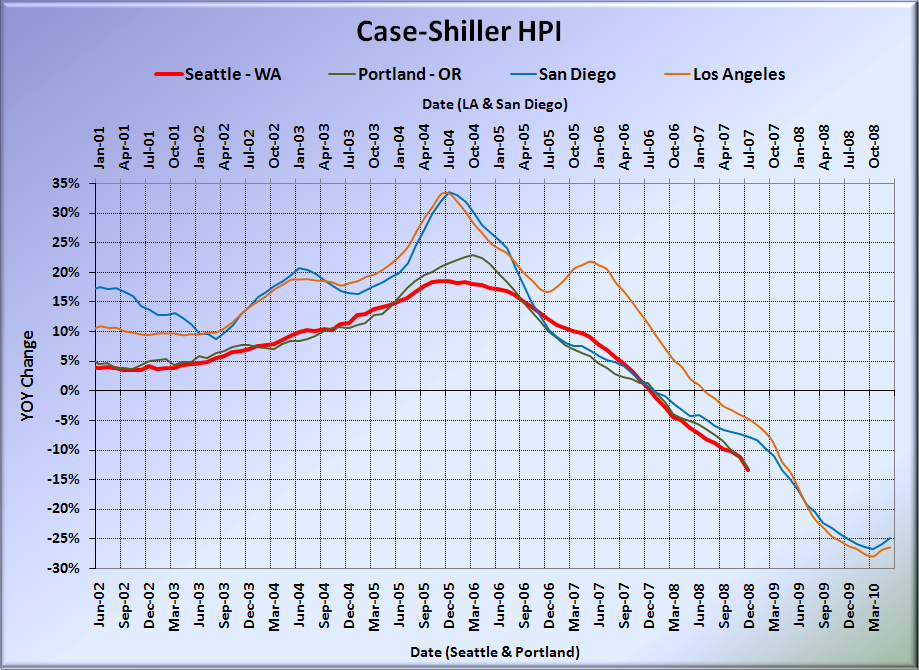
Note: This graph is not intended to be predictive. It is for entertainment purposes only.
Here’s the graph of all twenty Case-Shiller-tracked cities:
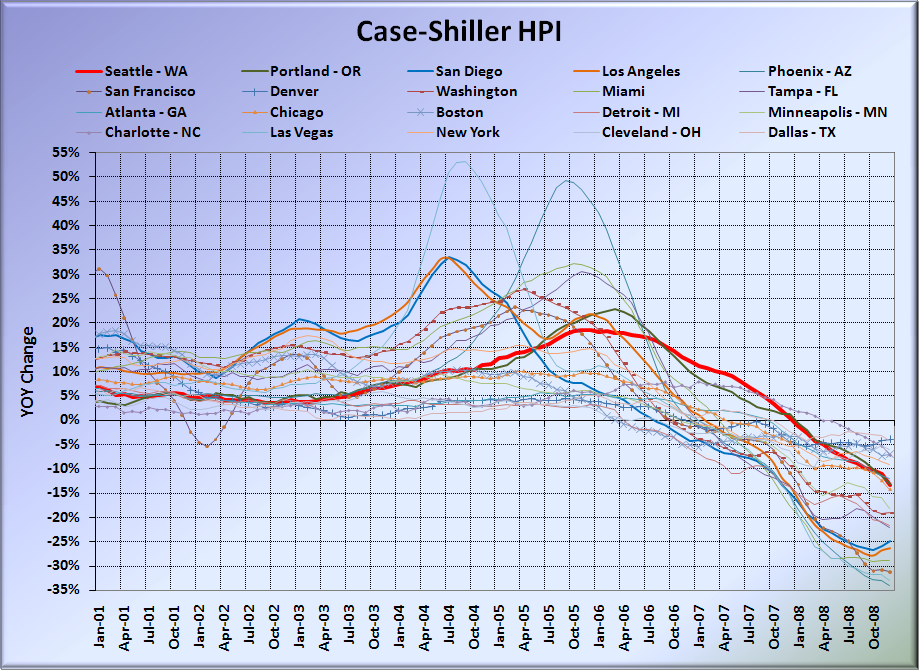
In December, eight of the twenty Case-Shiller-tracked cities experienced smaller year-over-year drops than Seattle (two more than in November). Denver at -4.0%, Dallas at -4.3%, Cleveland at -6.1%, Boston at -7.0%, Charlotte at -7.2%, New York at -9.1%, Atlanta at -12.0%, and Portland at -13.1%. Phoenix had the largest year-over-year drop yet again, with prices falling barely short of 34% in a single year.
Here’s an update to the peak-decline graph, inspired by a graph created by reader CrystalBall. This chart takes the twelve cities whose peak index was greater than 175, and tracks how far they have fallen so far from their peak. The horizontal axis shows the total number of months since each individual city peaked.
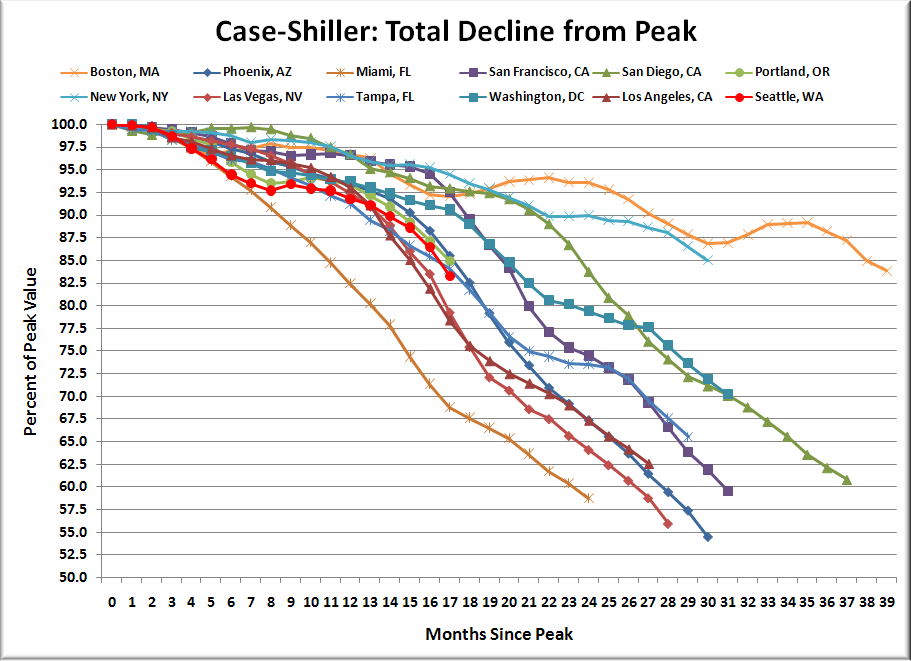
In the seventeen months since the price peak in Seattle prices have declined 16.7%. The decline in Seattle deviated from the trail blazed by Phoenix 13 months earlier, for the worse. Seattle’s present rate of decline from the peak is most similar to that seen in Tampa, Florida.
Here’s the “rewind” chart. The horizontal range is selected to go back just far enough to find the last time that Seattle’s HPI was as low as it is now. This gives us a clean visual of just how far back prices have retreated in terms of months.
Seattle’s Case-Shiller value for December 2008 of 160.19 came in just above its September 2005 value of 158.99. In one month, prices gave up four months of prior gains. Prices have now “rewound” over three years.
Check back tomorrow for a post on the Case-Shiller data for Seattle’s price tiers.
(Home Price Indices, Standard & Poor’s, 02.24.2009)


Shin'ichi » Feb 24, 2009 at 6:58 am
We’re on our way back to 1997: 50-60% off the 2007 Seattle peak.
Buyers beware: Wait till 2012 unless you’ve got money to burn.
patient » Feb 24, 2009 at 7:45 am
3.6% decline in one month!? That’s a staggering number.
Some notes:
- 43.2% annualized decline rate.
- If you bought in October 08 with 5% down you were already under water on your mortgage by January 09.
Staggering.
peckhammer » Feb 24, 2009 at 7:54 am
Not to worry, Ardell called the bottom. This won’t continue.
wanting to buy! » Feb 24, 2009 at 7:55 am
All asset classes are declining. Stock markets there is a buyer for every seller at some price hence 50% plus decline. Real estate for every seller there may not be buyer. Prices have a lot to come down and rents will come down as well. We will see 500k houses selling for 250k. I waited this long so why not wait another year or so!
Steve Tytler » Feb 24, 2009 at 8:13 am
Tim,
You know I couldn’t resist the chance to pop in one more time and point out
that my prediction (published in late 2007) that home prices would fall by an average of 10-20% in 2008 (depending on neighborhood) was right on the money.
As for 2009, I am predicting another 5-10% drop in home prices … but the economy is a major wild card. I think the economy is going to get MUCH worse this year than many of the “experts” predict, so that could cause much worse drops in real estate prices. So I am taking a wait-and-see approach. My prediction of a 5-10% drop in home values is based on a more normal real estate cycle. The economy could make those numbers much worse.
But if my prediction of a 10% home value drop in some areas this year, on top of the 20% drop last year is true, that’s a total drop of 30% from peak values which is a HUGE drop in Puget Sound area home values based on historical averages.
Steve Tytler
Everett Herald Real Estate Columnist
The Tim » Feb 24, 2009 at 8:19 am
Hey Steve. You were certainly right on the money for the Case-Shiller #s for 2008. As far as 2009 goes, the whole point I’ve been trying to make to you in our previous discussions is that we’re not in a “normal real estate cycle.” That’s been evident to me since shortly after I started this site.
Gene » Feb 24, 2009 at 8:20 am
RE: Steve Tytler @ 5:
30% down is no more HUGE than the run ups recently, so I don’t see why that would be surprising. Bubbles also tend to drop below where they should. I think 30% down from peak is going to be a best case at this point.
Joel » Feb 24, 2009 at 8:39 am
RE: Steve Tytler @ 5 –
You initially predicted at most a 10-20% drop from the peak, so if it does drop a total of 30% will you be coming here every month to proclaim how wrong you were?
Also note that the 10-20% off prediction only came after prices started to drop. Before that it was always “prices will be flat because of the stairstep pattern”. Then as prices started to come down, “flat” was suddenly redifined to mean “down 10-20%”.
deejayoh » Feb 24, 2009 at 8:43 am
I dunno, 30% down reverses a 42% increase. Puts us back at mid 2004 prices. Case Shiller was up 92% for Seattle since Jan 2000. A 48% decline wipes that out.
These are bad numbers, no doubt – but isn’t December always the worst month for real estate prices? I wouldn’t annualize
Chris » Feb 24, 2009 at 8:52 am
I’d agree with deejayoh @9 on the inability to annualize December numbers because of the generally slower sales. Year-to-year should soften that somewhat, but the crazy snowstorm that hit for a week or so in December certainly didn’t help the numbers either.
That’s a wicked drop regardless though.
Steve Tytler » Feb 24, 2009 at 8:53 am
Tim,
I agree that this is not a normal real estate cycle.
If it were, we would have bottomed by now after the 20% drop last year.
I am not nearly as confident in my prediction for this year because of the economy. For the record, I am in the “doom and gloom” camp because I think we we are in the beginning of a worldwide financial collapse. Dow 5000 here we come!
But how will that affect home prices?
Home prices do not necessarily follow stock prices or a bad economy.
Check out the famous “Boeing Bust” of 1970.
Everybody knows how bad the economy was in Seattle at that trime, but if you look
at the home prices during that period you will find that they did not decline anywhere close to the 20% drop we have already seen so far in this “bust.”
So a bad economy by itself does not necessarily cause housing prices to crash.
The reason this bubble is so unusual is primarily due to the “mortgage bubble.”
As you know, I have stated that home prices have traditionally increased in sort of a “stair step” pattern, with a couple up years followed by a few flat years.
If we had followed according to form, we should have had a flat period in the middle of this decade. But the real estate market got a major boost from very low mortgage rates in 2003 followed by the subprime lending boom in 2004-2006 which included making zero down loans to people with a 500 FICO score based on “stated income”!!
At the time, many of us in the mortgage industry were saying “This is INSANE!”
So a bunch of people bought houses who would not normally be able to afford a home. That caused an artificial spike in demand that drove prices up.
Those people are now being washed out of the system.
The bottom line is the Puget Sound real estate market was following a normal pattern through about 2002. It didn’t get “crazy” until after the 2003 drop in mortgage rates.
So we may drop back to 2002 price levels, although my feeling has been that 2004-2005 price levels are more likely.
We shall see.
The Tim » Feb 24, 2009 at 8:56 am
RE: Chris @ 10 – There is no way the December snowstorm affected these Case-Shiller numbers. Case-Shiller looks only at the prices of repeat sales of the same houses. Sales volume has nothing to do with it. Also, the data in this month’s update is likely from homes that went pending in November.
softwarengineer » Feb 24, 2009 at 8:56 am
BUY NOW BEFORE THE REAL BIG SEATTLE HOME PRICE COLLAPSES IN 2010
DavidB » Feb 24, 2009 at 9:00 am
I was playing around with some of the CS numbers this morning and what was surprising to me was that Seattle home prices declined the most during the last quarter of 2008. The last half of the year was when most of the annual decline occurred.
The data certainly shows that the price drops are accelerating. We’re quickly catching up with the rest of the nation.
query_squidier » Feb 24, 2009 at 9:00 am
“an ugly chart of the ugly month-to-month numbers”??
I think they’re beautiful. :)
Acerun » Feb 24, 2009 at 9:02 am
Sell now or you may be stuck in the market forever!
masaba » Feb 24, 2009 at 9:05 am
I have never seen this chart before. My first impression is, wow, look at January 2004 through December 2006. The heyday of the Bubble clearly sticks out.
The second thing I noticed was the staggering drops in late 2007 through 2008. The magnitude of the November/December 2008 price drop dwarfs anything else in this figure. In other words, the recent drops dwarf any month to month gain during a bubble that was caused by a ‘perferct storm’ of real estate speculation.
This really makes me wonder if there is anything that the government can do to make this a ’soft landing.’
PublicEnemy#1 » Feb 24, 2009 at 9:05 am
RE: Steve Tytler @ 5 –
Steve,
Thanks for coming by… Aren’t you the one who was going on and on about how Seattle is a stair-step market a couple of years ago or was that someone else up in Everett? (Edit: Steve was the guy, by his own admission).
I think the point being made by the numbers we are now seeing (and by “the Tim”) is that past performance is not an indicator of future results.
You yourself are pointing out how big a wild card is at stake here and the potential it may have on the Seattle RE market.
Please stick around until Jan. 2010 so we can chat again and see how right, or wrong, you were.
Steve Tytler » Feb 24, 2009 at 9:08 am
Joel,
Tim can verify that all or my predictions have been published in the Everett Herald and I have discussed this with him personally several times over the years.
To recap, here are some of my published predictions …
In late 2005 I said the housing market was peaking and appreciation would
come to an end in 2006 (this turned out to be true).
In late 2006, I said that there would be a flat market in 2007 with virtually no appreciation (again, this turned out to be true).
In late 2007, I said that home prices would fall an average of 10-20% in 2008 (depending on neighborhood) from the peak home values of 2007 (again, this was true).
Late last year, I said home prices would fall another 5-10% in 2009.
We’ll see how close I am … but keep in mind that this time I specifically said in my published predictions that the economy is a major wild card and I’m not sure what is going to happen this year.
Bottom line, I am 3 for 3 in terms of accurate real estate predictions over the past
3 years.
I challenge you to find any other published real estate “expert”, reporter or columnist in this area that came anywhere close to the accuracy of my past predictions.
Even “The Tim” did not predict the 2008 home price drop as accurately as I did (Sorry, Tim). I believe Tim was expecting prices to drop less than 10%, but please corect me if I am wrong.
Now of course, nobody really KNOWS what is going to happen in the future, you are welcome to argue with me, but you can’t dispute that I have been right for the past 3 years in a row.
My track record speaks for itself. I am not perfect and I am very leery of trying to guess what will happen this year due to the terrible economy, but at least I have the guts to make a prediction and stick with it.
Kary L. Krismer » Feb 24, 2009 at 9:34 am
By Chris @ 10:
The snowstorm affected January and February sales more than December. Only cash buyers would have been affected for December.
Case-Shiller has become practically irrelevant compared to the much more timely NWMLS numbers. The reason? No volume data. Volume is far more critical (and crippled) right now compared to price.
Kary L. Krismer » Feb 24, 2009 at 9:36 am
By DavidB @ 14:
Why would that be surprising? Paulson’s bailout talk started in September. That scared the hell out of just about everyone.
Kary L. Krismer » Feb 24, 2009 at 9:38 am
By Steve Tytler @ 19:
I’m not that familiar with Snohomish numbers, but neither of those predictions were true for King County. We peaked in July, 2007, and 2007 was hardly flat.
The Tim » Feb 24, 2009 at 9:41 am
By Steve Tytler @ 19:
I predicted a 5% to 10% drop, which as I have pointed out before, was specific to the King County SFH median, as reported by the NWMLS. That was in fact quite an accurate guess.
As for your track record and the accuracy of your past predictions, I just want to point out a few quotes from our email exchange in May 2007:
and
For reference, December’s Case-Shiller HPI for Seattle was between the September and October 2005 values, and as I mentioned in the post, price declines appear to be accelerating, not slowing.
Sniglet » Feb 24, 2009 at 9:42 am
A Dow 2000 is more likely (over the next 4 years). A massive decline in stocks will almost certainly have impacts on real-estate. Don’t forget that stocks were rising during the bubble years at the same time as real-estate (and almost all other asset classes). The credit bubble that led to asset appreciation is now running in reverse. Look at how real-estate and stock prices have been collapsing in Japan over the last 20 years. I don’t see why a similar thing can’t happen in the US.
Comparisons to the ’70s downturn in Seattle, and the Boeing bust, are irrelevant seeing as how this depression is global in scope. Moreover, the percentage of vulnerable Seattle area home-owners (i.e. with no equity and toxic mortgage products facing huge resets) is higher than at any time in recorded history. An 80% decline in real-estate prices (when we hit bottom) is starting to look optimistic.
Of course, if you want to get a more in-depth understanding of the case for deflation, check out my podcast.
http://surkanstance.blogspot.com/2009/01/deflation-101-podcast.html
WestSideBilly » Feb 24, 2009 at 9:42 am
By Steve Tytler @ 5:
Actually, a 20% drop followed by a 10% drop would be a 28% drop from peak, not 30%.
Kary L. Krismer » Feb 24, 2009 at 9:57 am
By Sniglet @ 24:
WestSideBilly » Feb 24, 2009 at 9:58 am
By Kary L. Krismer @ 20
Actually, it’s the other way around. The volume is so low that the NWMLS numbers are easily skewed by a small number of high price sales. 99 sales for $200k and one for $2M averages out to $218k – which would seem like a nice jump over the prior month with 100 sales at $210k.
Case-shiller’s strength is that whether there is 1 sale or 1000, the index is always representative of the market as a whole.
Kary L. Krismer » Feb 24, 2009 at 10:29 am
Another comparison to NWMLS figures (although admittedly apples and oranges because the NWMLS numbers I’m using are King County only). These Case Shiller numbers are it finally catching up to the NWMLS numbers. It had been lagging.
Now the Case Shiller and the NWMLS (both mean and median) are showing between 83 and 84% of the peak (rounded to the nearest 10th of a percent).
Going forward into January, where we know the NWMLS numbers, they are 80% (median) and 76% (mean). We’ll see in a month where Case Shiller comes in, but I wouldn’t be surprised to see them lagging again.
Maths » Feb 24, 2009 at 10:32 am
Steve,
I’m trying to reconcile your claim that you are “3 for 3″ on your real estate predictions. I’m sorry, but you must be delusional.
In October of 2007 you said that it would be flat over the next couple of years. You were WRONG. You said that it might drop up to 20%. 0 to 20% is a HUGE range. When the actual results are equal to the outside limit of your “unlikely” scenario of the price actually dropping, that does not make you right. It makes you WRONG.
You also said that Spring of 2008 would be a great time to buy a house. How has the prediction panned out?
Either get off your high-horse or ride it somewhere else. Not only is your attitude distasteful, but your claim to having such an attitude is laughable.
Kary L. Krismer » Feb 24, 2009 at 10:42 am
By WestSideBilly @ 27:
That’s why you look at both mean and median. In that situation the median would be $200k. I’ll take your word that the mean is $219k.
Also, a small number of high priced sales is not what’s driving the NWMLS numbers right now. There are very few sales above $2,000,000.
B&W Nikes » Feb 24, 2009 at 10:59 am
Looking backward at major stock market indices, it seems like something significant happened to change trends and begin an upward shot in 1994-95 that then broke even harder between 1998 and 2007. Estimating a very crude trend line from the late 70s and through the 80s places index numbers sort of close to where they are settling currently. Not including normal healthy and reactionary over-correction, where the markets are now in February 2009 may be close to where they might have been valued without the institutional indiscretions of the last dozen years. Does anyone have any idea what happened around 1995?
My thinking is if home prices followed a similar projection, does anyone have a good idea of where winding back to using pre-1994 trends would place current or future KC average prices – approximately? It looks to me like somewhere about 250-300k, but I am admittedly not the brightest bulb in the room with this kind of stuff.
PublicEnemy#1 » Feb 24, 2009 at 10:59 am
RE: Steve Tytler @ 19 –
Steve,
Ever hear that pride goeth before a fall?
DaveyDave » Feb 24, 2009 at 11:14 am
There is a sweet graphic of the 20 CS cities that you can flip through on the NYT Business section front page. Nothing like a good graphic to distill information and trends…
(Edited by The Tim to include direct link to the chart.)
Joel » Feb 24, 2009 at 11:23 am
RE: Steve Tytler @ 19 –
Wrong. Up until October of 2007 you constantly repeated, on this blog even, that prices in Seattle follow a stairstep pattern where prices go up for several years and then prices are flat for a few years before continuing upwards. Then in Oct. 2007 “flat” suddenly was redefined to mean “10-20%” down. Apparently down is the new flat? Now, I can’t profess to have read everything you’ve ever written, so if you made it clear before Oct 2007 that flat can also mean down then please correct me.
So now you’re predictions have gone from “flat” to “10-20% down” to (from your first comment above) up to 30% down. And then you come to this blog monthly to brag about how prescient you are.
You are not “3 for 3″. You were wrong about prices being “flat”. You were right about 2008. And it looks like you’ll be wrong about your revised prediction of “10-20%” total off the peak, but the jury is still out on that one.
Your track record does speak for itself, which is why I guess you need keep coming here to lie about it.
Pierce County Resident » Feb 24, 2009 at 11:50 am
Washington unemployment rate (7.8%) surpasses the national unemployment rate (7.6%):
http://biz.yahoo.com/ap/090224/wa_wash_jobless.html?.v=1
As you bubbleites said, our economy and housing market are not special. Too bad most of the local real estate special interests are still busy trying to sell us pink ponies.
rent for now » Feb 24, 2009 at 12:13 pm
1995 started some extreme multiple expansion in the valuation of stocks.
Chris » Feb 24, 2009 at 12:16 pm
By The Tim @ 12:
Thank you kindly for the correction. Looks like I have some Case-Shiller reading to do.
Greg » Feb 24, 2009 at 12:34 pm
In analyzing CS data for another city I find the month to month data nearly useless. There is so much seasonality that needs to be factored in. For instance, was the month-month change Nov->Dec more, less than that same period in prior years. Also, the underlying data set is an amalgamation of two months average numbers. Much more telling is YOY same month trend over time. Whatever else, taking a one month delta and then projecting it alone out into a year long price trend is just not correct. Just a thought from another city.
deejayoh » Feb 24, 2009 at 12:45 pm
My point was seasonality, not the weather last December. Here are the average M2M appreciation figures for Seattle for 18 years of Case-Shiller records
Average M2M Appreciation for Seattle
Month Total
1 -0.05%
2 0.34%
3 0.97%
4 1.22%
5 1.16%
6 0.87%
7 0.50%
8 0.35%
9 0.19%
10 0.14%
11 -0.13%
12 -0.20%
Average 0.45%
Stdev 0.50%
So it is true in terms of price performance that December is the worst month of the year – ~1.5 standard deviations worse than the mean. That ’s why I wouldn’t use it as indicative of full year performance, irrespective of the weather.
And the story is the same in terms of relative performance even if you leave out 2008 data.
1 0.05%
2 0.42%
3 1.08%
4 1.25%
5 1.26%
6 0.93%
7 0.58%
8 0.41%
9 0.27%
10 0.22%
11 0.00%
12 -0.01%
Average 0.54%
Stdev 0.48%
B&W Nikes » Feb 24, 2009 at 1:12 pm
RE: rent for now @ 36 – Yeah, I hope someone better versed in these things than me can identify it. It seems that we are still treating external symptoms and not the body. Culturally we intuit and accept that extreme phenomena happened in 2000 and 2008, but neither were instantaneous or isolated events. The changes beginning around 1994-95 look really odd to me.
Ray Pepper » Feb 24, 2009 at 1:40 pm
Steve Tytler can also predict your first borns gender and assist you with Keno numbers at Tulalip.
You know what really grinds my gears? I’m gonna tell you!! I cannot believe there is a Brokerage that will not make offers on properties that exceed 15% off the list price. I found this out last night and I was floored. The reasoning behind this “policy” is that statistical analysis dictates that offers in excess of 15% have a higher % chance of not closing! Can you believe this?
Listen, I’ve always been a big fan of Red Fin and they helped pave the way for many of us but it appears they have placed their own financial problems in front of their customers. I would immediately terminate any Agent who would not submit my offer. I have 6 offers from buyers currently that are waiting it out, for their offers that are 25-50% off the list price. If they wait long enough 1 or maybe all will score their GEM!
Some absolutely horrible policies are being implemented now and all Buyers need to educate themselves and remember if your offer is not accepted…just wait…the odds are you will get a 2nd/3rd chance in the coming year and it will most likely end up as a short sale or foreclosure anyway.
I’m not here bashing Red Fin. Just a policy that was explained on their forums. I would much rather use any Brokerage that would offer my price then 1 that limits me to a certain offer price. Even ……….gulp……..Windermere or JLS…..Ouch that hurts………. Do they NOT realize we are in a depreciating environment and comps are “out the window.” It appears their “bottom line” is what needs to be maintained in order to continue functioning. I CAN understand this but it still caused me some chafing last night.
Ira sacharoff » Feb 24, 2009 at 1:52 pm
I agree with you Ray, and I think it shows the state of the economy. Redfin is operating in a difficult environment,and I guess they feel they need to have some control of the percentage of offers made that eventually close.
It may help them survive as a real estate brokerage, but it’ doesn’t seem to serve the buyers they represent.
buystocks » Feb 24, 2009 at 2:12 pm
ray pepper @41,
I agree. Redfin uses statistics to argue that offers below a certain % of listing price rarely go through. The problem is that these statistics are based on a historical real estate market with markedly different tenets than the current market. As far as I’m concerned, these statistics are just garbage in and garbage out. When I do buy a house in the future, I will not even consider redfin if they continue with this stupid policy.
SandyK » Feb 24, 2009 at 2:37 pm
1995 is also right around the time when people/companies started figuring out how to monetize the internet and other new technology. I think a lot of what has happened in the last 10 – 15 years is similar to what happened in the 20s with the radio. New technology creates overconfidence, followed by a fall when everyone remembers that businesses actually have to post a profit, you can’t ride indefinitely on future prognostications. Remember that part of what drove up housing prices from 2002-2007 was money flowing out of tech stocks and into housing (supposedly a stable asset).
Ray Pepper » Feb 24, 2009 at 3:02 pm
Its not just Red Fin. If ANY agent would not present MY offer based on ANY ANALYSIS I would walk. I advise this to anyone who chooses to utilize an Agent in their purchase.
Good God! Doesn’t this go without saying? I can’t believe I even have to mention this.
SandyK » Feb 24, 2009 at 3:11 pm
Hey Ray – any analysis? What about no analysis? Someone wants you to offer $30,000 on a house that comps at $500K, would you do it? Or would you explain to that client that they are probably wasting their time?
Theoretically I’m with you, I just have trouble with blanket statements.
David Losh » Feb 24, 2009 at 3:12 pm
RE: SandyK @ 44 –
Thank you Sandy and Welcome!
Windows 95 was the first operating sytem advancement made for the common folk. Many people caught the computer bug by uploading thier first major revamp of the Windows operating system.
My brother in law at the time has a motorcycle shop. He invested $60K in computer program to track all of his parts. Another person set the system up but he was able to handle the day to day operation. The system paid for itself the first year, and after that it added $60K to $100K to his bottom line.
Those were great years for business.
As Microsoft went to court and lost a monopoly case with the Federal Government around 2000 many people thought the computer operating business was going down in flames. There was in my opinion a noticable shift in investments from stocks to Real Estate.
If you go back to 1987 you see a sharp incline in stock prices with what I think was the anticipation of computers being used more and more in business applications. Many businesses benefitted from the use of personal computers. Many businesses made more profits.
SandyK » Feb 24, 2009 at 3:22 pm
Dave – thanks for the welcome, I’ve posted here before I just don’t tend to be very regular. I lurk mostly.
I came out of the tech industry before real estate and though I think technology has made a huge contribution to the lives of those who can afford to use it, it’s also been disruptive as well. Just as with automation, there have been changes to how people work that have caused a lot of money to move around. Jobs eliminated, new jobs created, huge profits made and losses taken. Entire economies (think India) changed with the ability to do business from half a world away. We’re more one world than we have ever been in human history, with all the good and bad that comes with that. That accounts for a lot of why the last 10 – 15 years have been such a wild ride.
IMHO of course.
B&W Nikes » Feb 24, 2009 at 3:32 pm
RE: SandyK @ 44 – I had wondered about that too, except that the bump happens everywhere across most every traded stock. Remember, in 1995 MS was barely recognizing the existence of an internet business model and Win95 was released 3Q of 1995, not fully adopted until quite sometime later, and the real internet mania didn’t swing into measurable effect until 97-98. The NYSE was electronically enabled in 1984. I’m still left wondering what the bump could have been in response to.
98115_Renter » Feb 24, 2009 at 3:39 pm
RE: B&W Nikes @ 49 –
Well, remember indices can kick out and bring in new corporations, so all DOW or S&P need to do is get rid of some poor performers (Like C, BAC, GM currently are) and bring in some healthy companies and the index is manipulated that way. They don’t track the same components forever.
SandyK » Feb 24, 2009 at 4:02 pm
BWN – It’s natural for a person on a Seattle message board to be thinking in terms of Microsoft, but I wouldn’t focus exclusively there. This was the timeframe that I remember everything was starting to be computerized and networked. MS might have been only just recognizing the existence of an internet business model in 1995, but plenty of other companies beat them to the punch. Amazon was founded in 1994, went live in 95. They are one among many, but probably the best example.
Keep in mind that one of the things that many people object to about Microsoft is that they are not a creator of new technology, they “embrace and extend” what other companies have created. Just ask Apple. They tend to be a 2nd or 3rd entrant into any given market, and then through sheer size they are able to dominate.
I had a job waiting tables in 1994 – and used my first computerized order entry system at that time. I was part of the switchover from writing it down on a pad of paper, to entering orders on a touch screen. We thought it was pretty cutting edge at the time, but within a couple of years you would see this at the majority of big restaurants.
I still think that was the big change. Like Dave mentions, computerization and networking allowed all types and sizes of companies to become more profitable, so you would see the bump happening in all industries, not just tech stocks. Computers were in place in many larger businesses prior to the ’90s, but that was when it came into reach for the majority, even small businesses, and it was simultaneous with other advances, such as the internet , that allowed businesses to make more money.
There’s probably other things that play into it too but I think this was a pretty big cultural shift.
Interloper » Feb 24, 2009 at 4:29 pm
RE: patient @ 2 – I’m shocked. I did not think 3.6% decline was possible for December.
And since CSI uses a three-month rolling average, we can’t expect January to be much better.
David Losh » Feb 24, 2009 at 4:38 pm
RE: B&W Nikes @ 49 –
Geez,
Between 1995 and 2001 the Internet experienced what is now referred to as the dot-com bubble, which was the time dot-com companies and websites were making an enormous amount of money primarily off of stocks until the bubble started to burst in 2000 and Internet companies started going under.
Kary L. Krismer » Feb 24, 2009 at 4:39 pm
By Interloper @ 52:
Especially since the NWMLS has already posted numbers for January that were far below December.
I wonder how C-S deals with the geographic aspect of sales? With the December snow and low volumes, the geographic mix of properties should be different than prior years or months.
EconE » Feb 24, 2009 at 4:42 pm
RE: David Losh @ 53 –
Agreed.
Weren’t we also coming out of a mini-recession at that time also?
seawaterszzz » Feb 24, 2009 at 4:44 pm
I don’t often post to this site, but I could not resist introducing a small ray of sunshine into this gloomy thread. The bright ray is based on an NPR interview with Richard Koo, chief economist with the Nomura Research Institute. You can listen to his interview here: http://www.npr.org/templates/player/mediaPlayer.html?action=1&t=1&islist=false&id=101066132&m=101082257
According to Mr. Koo, when Japan entered its lost decade in the early 90’s, real estate prices plummeted but the government was able to sustain both GDP and a low unemployment rate through various government-funded stimulus measures. I was not a believer in the potential effectiveness of the U.S. government stimulus measures until I listened to this interview. I’m still not a believer, but now I’m halfway there. If the U.S. follows in Japan’s path, and the stimulus works, U.S. real estate assets and stock prices may remain low or go even lower, but at least unemployment figures may stabilize in the not-too-distant future.
Ray Pepper » Feb 24, 2009 at 4:55 pm
RE: SandyK @ 46 –
Yes, Sandy….I would present it. Verbally of course. But, the key is knowing your Buyers. We work with nobody unless we have a signed Buyers Agency Agreement on file and a Pre Approval letter less then 60 days old. I could only wish all Agents screened their buyers as good as we do.
David Losh » Feb 24, 2009 at 5:07 pm
RE: EconE @ 55 –
1993 Clinton outlined a deficit reduction in his State of the Union, 1994 he had made reductions to the deficit and proposed a more agressive plan to present to Congress. He cut spending then asked the people to kick in an extra $100 a year for deficit reduction. Bold moves villified by Newt Gingrich.
Angie » Feb 24, 2009 at 5:51 pm
Pierce County Resident at #35–yep, the overall Washington State unemployment rate is 7.8, higher than the national average. However the Seattle Times reports that in Seattle, the rate is 6.8, see the story at
http://seattletimes.nwsource.com/html/businesstechnology/2008780477_webjobs24.html
Since the population of Seattle is a lot bigger than anywhere else in the rest of the state, I take that to mean that the unemployment rate outside of Seattle (or maybe the metro area) must be greater yet than 7.8…
Looks like Seattle is still a little island of specialness. Just sayin’.
98115_Renter » Feb 24, 2009 at 5:52 pm
RE: seawaterszzz @ 56 –
I heard that too, but I instantly thought to myself that our unemployment rate is already several % points higher than Japan’s ever got.
B&W Nikes » Feb 24, 2009 at 5:57 pm
RE: SandyK @ 51 – RE: David Losh @ 53 – I totally agree and am right there with you in recognizing both the technology driven cultural shift and the institutional speculation during the time period. By no means am I intending to minimize either significant historical point, it’s just that the trend changes trajectory significantly for all sectors in 1994-95 then the trend begins to really take off and charge much steeper in 1997, and peaked wildly in 2000 before collapsing into the origins of the credit bubble.
I’m not intending to rehash history for the sake of it, but I really wonder if the institutional speculation that occurred then wasn’t also a byproduct of something else changing in the rules of the game. If so, it might shed some light on what to expect for future growth without massive speculation in play for a little while. Or it might instruct us to throw our arm up and catch the next ride. It’s really hard for me to believe that all of those trillions burned through in the dot bomb were representative of cash that had been sitting on the sidelines just waiting for an opportunity to be spent.
Unchecked institutional speculation played a heavy hand in both the dot bomb and housing bubbles and probably won’t be back for a while yet. Life still goes on outside the casino.
WestSideBilly » Feb 24, 2009 at 6:14 pm
By Kary L. Krismer @ 54:
That’s the great thing about C-S… it doesn’t matter. House to house sales only. No sales of garbage condos, no new construction. No effect from “tier shifting”.
Tejas » Feb 24, 2009 at 6:43 pm
What I find interesting in the Decline from Peak graph is that Seattle is dropping faster than all the other areas except three of the most infamous bubble towns! (Miami, Vegas, and L.A.)
Not long ago, “There is no bubble”; and Seattle was somehow “immuned” to the market forces that other areas were seeing. Now the only thing keeping us from being another poster child is the fact the media has become inured to precipitous drops in housing.
Oh, how far we have come in such a short time….and a ‘hat tip’ to Tim for keeping the faith all these years.
Joe the Bumbler » Feb 24, 2009 at 7:03 pm
RE: B&W Nikes @ 40
What happened around 94/95 that would define America for years to come and that would end with the onset of the current crisis?
I didn’t come up with this theory and I don’t necessarily subscribe to it but it’s rather coincidental and interesting the overlap of this time period with the so called Republican Revolution. The 1994 midterm elections heralded the first time that Republicans had controlled since 1952. In January 1995 the House would elect Newt Gingrich as Speaker.
deejayoh » Feb 24, 2009 at 7:09 pm
By 98115_Renter @ 60:
Judging by the guys I saw living in the park in Tokyo I would bet that unemployment is vastly under reported in Japan. the story I was told by a local was that they were laid off in the 90’s, and it was so shameful that they never went home. They were dead to their families. Not sure if it was true, but it was odd to see these guys in suits living in blue tents 10+ years later in a downtown park.
dailyt » Feb 24, 2009 at 7:49 pm
RE: B&W Nikes @ 31 –
BWNikes,
I’m not a macro guy, but I would look into a few things which would affect stocks:
1) US Trade policies, and growth in global trade (Think China)
2) Foreign and domestic financial policies.
3) Mutual fund & market participation by individuals via the internet.
Deejay,
I would agree with you that Japan does understate their unemployment. But a few things to keep in mind: Japan is a very thick social welfare state. (National healthcare, pensions, etc)
They effectively made sure that their stimulus would smother the fall, by creating part-time jobs, contract work, etc. People were able to work to feed themselves. Now the US is a completely different animal when it comes to providing social benefits… as some previous threads on SB have shown…
seawaterszzz » Feb 24, 2009 at 7:55 pm
Replying to Dejayoh at 65 that Japan may under-report unemployment, that’s possible but — having lived in Japan since 1996 and traveled throughout the country during that time — I do not think there has been either significant unemployment or significant under-reporting of unemployment during that entire period. The Japanese government last week disclosed to the world that its GDP had shrunk in the previous month at an annualized rate of 12.7%, so it seems doubtful to me that the Japanese government would be too embarassed too report — reasonably accurately — unemployment data. I, too, see homeless people in some parts of Tokyo but I spot them just as frequently on annual visits to Seattle. tRE: deejayoh @ 65 -
rose-colored-coolaid » Feb 24, 2009 at 8:19 pm
By Kary L. Krismer @ 20:
Please Kary. Volume is not especially relevant unless your livelihood depends on making sales. For the 97% of the population who are neither builders, brokers, nor real estate agents, the CS numbers are much more interesting than volume data.
For the other 3% of you, you’re right though.
AMS » Feb 24, 2009 at 8:26 pm
By patient @ 2:
Because of transactional costs, if you bought with 5% down, then you are underwater right after purchase. The decline in market value only makes matters worse.
David Losh » Feb 24, 2009 at 8:28 pm
RE: B&W Nikes @ 61 –
Of course you’re right.
Banking deregulation I’m sure is what you’re referring to.
Sept 30, 1995: Congress enacts Truth in Lending Act “reform,” easing regulations on creditors; bill powered through by Rep. Bill McCollum (R-Fla.), a key recipient of finance, insurance, and real estate (fire) donations ($136,000 in 1993-94).
Dec 22: As part of Newt Gingrich’s Contract With America, Congress enacts a measure making it more difficult to sue companies for securities fraud.
Aug 2, 1996: Office of Thrift Supervision issues rule preempting almost all state laws regulating S&L credit activities.
The list goes on and culminates with
Nov 1999: Gramm-Leach-Bliley Act guts Glass-Steagall, setting off wave of megamergers among banks and insurance and securities companies. Driving force is Sen. Phil Gramm (R-Texas), who has received $4.6 million from fire sector over previous decade.
This has been discussed on other threads and it does infect the entire business culture in the United States.
AMS » Feb 24, 2009 at 8:30 pm
RE: Kary L. Krismer @ 20 –
Please note that C-S uses a paired sale methodology.
rose-colored-coolaid » Feb 24, 2009 at 8:34 pm
RE: Kary L. Krismer @ 54 – Kary, from your comments I gleam that you don’t understand the methodology that CS uses. Your arguments against it seem to be based on the fact that it’s less timely, and ergo a less accurate measure. But, housing is a slow market. Why does it matter if it takes a couple months for accurate numbers? Official numbers for unemployment and GDP are often revised 1-2 months after their initial release.
Does anyone have a link to the CS methodology that Kary could read so he would know what it’s real strengths and weaknesses are?
David Losh » Feb 24, 2009 at 8:44 pm
RE: Steve Tytler @ 19 –
Hello Steve,
Thanks for stopping by for a little self promotion.
Let’s see, as I recall 2005 and 2006 were years of double digit appreciation, I’d look it up, but why bother with facts. I think it was 14% and 17% for a two year total of a little over 30%.
If you had a prediction that the real estate market would give up those two years worth of appreciation that seems like a very safe bet.
So you’re saying that by retelling a known fact that some how that consitutes a prediction.
What would have been astounding is if you would have, as a mortgage professional, predicted the “credit crisis.”
You were making predictions weren’t you? You want us to turn to you as an all seeing all knowing kind of oracle don’t you?
So if you saw that house pricing was soooo over valued why did you continue to originate loans on properties you knew were over priced?
cheepseats » Feb 24, 2009 at 8:54 pm
Kary has had this discussion with others on other blogs. Well others have at least defined the merits of the CS on the blogs which Kary regularly posted to.
Jonness » Feb 24, 2009 at 9:23 pm
Hang on because things are going bad in a hurry. The WA unemployment rate shot past the national rate and has reached a whopping 7.8%. Keep in mind that, historically, the real estate bottom has came after the peak in unemployment. Here’s the news release:
“Washington’s unemployment rate up again in January
OLYMPIA – Washington’s seasonally adjusted unemployment rate increased to 7.8 percent in January 2009, up from December’s rate of 7.1 percent, according to the state Employment Security Department.
The rate usually is supplied each month by the federal Bureau of Labor Statistics (BLS). However, BLS data for January has been delayed due to a computer project, so Employment Security calculated the number using a computer model that historically has closely matched the official number.
In January, the state lost an estimated 7,000 non-agricultural jobs, seasonally adjusted.
Industries with the most job growth included merchant wholesalers of nondurable goods, with 1,000 new jobs, general merchandise retail stores, which added 1,100 jobs, real estate and rental leasing, up 800 jobs, and arts, entertainment and recreation, with 1,100 new jobs.
Job losses were seen in most industries, but the largest declines were in manufacturing, which cut 4,900 jobs, information services, down 3,300 jobs, construction, down 2,400 jobs, motor vehicles and parts dealers, down 1,400, truck transportation, down 1,300, merchant wholesalers of durable goods, down 1,000, computer-system design and related services, down 1,000, and accommodation and food services, which lost 900 jobs.
Year over year, Washington had 56,000 fewer jobs last month than in January 2008, a 1.9 percent decrease. Nationally, employment declined by 2.9 percent over the past year.
An estimated 303,570 people (not seasonally adjusted) in Washington were unemployed and looking for work in January – the largest number ever in this state.
“These are rough times for the unemployed, but it’s also an opportunity to get some training for a new career,” said Employment Security Commissioner Karen Lee. “Everyone who has lost a job recently should check with WorkSource to see if they qualify for any of our training assistance programs.”
For example, someone laid off from a “declining industry” may be eligible to receive unemployment benefits, tuition assistance and other aid to retrain for another occupation. Lee noted that, in this recession, more and more occupations are being added to the declining-industries lists.
Job seekers can find out about training programs and get help looking for work at Employment Security’s affiliated WorkSource offices across the state, where a variety of employment services are offered, including free help with interviewing skills or résumés and with job referrals. In addition, nearly 15,000 current job openings are posted on http://www.go2worksource.com.
Locations of local WorkSource offices are listed in the blue pages of telephone books and online at http://www.go2worksource.com. Assistance also is available by phone at 877-872-5627. “
Kary L. Krismer » Feb 24, 2009 at 9:26 pm
By WestSideBilly @ 62:
Wrong. That’s impossible. If for example, 90% of the sales were from Snohomish County, then the numbers would be different than if 90% of the sales were from King County. They have to account for what’s selling where somehow.
Jonness » Feb 24, 2009 at 9:28 pm
My previous post showed up, so I’ll edit this one. In short, this is getting wild! The news just keeps getting worse and worse with no end in sight. Some of the pioneer gloom and doomers around here are starting to look like prophets.
Kary L. Krismer » Feb 24, 2009 at 9:29 pm
By rose-colored-coolaid @ 68:
Actually, volume is very important to buyers and sellers too. It’s only not important maybe if you just think about buying or selling real estate, with no plans to actually do either.
Kary L. Krismer » Feb 24, 2009 at 9:30 pm
By AMS @ 71:
Yes, I know that. But it also deals with a three county area. Even within each county properties don’t move up and down in concert. They need to somehow deal with where properties are selling and what properties are selling.
Kary L. Krismer » Feb 24, 2009 at 9:36 pm
By rose-colored-coolaid @ 72:
Because today is February 24. They’re reporting on sales in December that were largely written up in October and November. Giving us information that we largely knew sometime before January 10. Giving us information for an area that is too large to be useful to anyone (an argument I’d make for the NWMLS King County data too). And not giving us any idea of volume, which at times is a lot better gauge of the health (or lack thereof) of the market.
If you guys are looking for the perfect judge of market price, you’re not going to find it with Case-Shiller. You’re not going to find it anywhere except looking at comps of similar houses in close proximity to property you’re interested in valuing.
Oh, and don’t assume I don’t know anything about how Case-Shiller works. I know that if a property goes up too much to fit within their model, they assume it has been changed and exclude it.
Kary L. Krismer » Feb 24, 2009 at 9:42 pm
By cheepseats @ 74:
Yep, and unfortunately some people still think Case-Shiller is some sort of a useful tool despite all its shortcomings. I use is more as a tool to see if there are any big discrepancies with the NWMLS data–whether they might be somehow skewing the data. For the past several months there was no indication of that with price, because the NWMLS was more pessimistic than C-S. Unfortunately I have no such tool to judge volume by.
Kary L. Krismer » Feb 24, 2009 at 9:54 pm
BTW, if you want a third source of data, there’s “Realist” which is a tool the NWMLS makes available to agents through First American. There’s a similar time lag for it, in that it too is only reporting December today. Here are their numbers:
Month Volume SFR and Median
Dec 2008 1,014 $399,000
Dec 2007 1,451 $435,000
Note that they’re reporting about 85 more sales than the NWMLS at a median that is $4,500 lower. Unfortunately they don’t report their criteria, so I don’t know if the difference is FSBOs, or FSBOs and foreclosures, etc. I’d guess just the former given the small difference. For November the volume difference was smaller, but the price difference greater.
Anyway, it’s a useful tool in that it can also be used to compare to NWMLS data, but unlike C-S, it can also be used to look at volume.
td » Feb 24, 2009 at 9:59 pm
Thought i would share a pic i just came across that reminded me of SB… a small price to pay for a pink pony!
http://www.lifeandlimb.net/store/index.php?main_page=product_info&cPath=23_16_25&products_id=81&zenid=ogdrgpmhqmnd9uda0ars42mod1
ps sorry if the link doesn’t work I am not very versed in formatting these things.
Jonness » Feb 24, 2009 at 10:12 pm
Steve: As Joel pointed out, you predicted a maximum 20% decline from peak to trough, and you predicted this after prices already started to decline. Changing to 30% now is not fair unless you admit your previous blunder. Also, you stated you thought seattlebubble.com bloggers were off the mark and overly pessimistic. Perhaps you now owe them some credit. Let’s face it, without having read seattlebubble, you would have predicted higher than 10-20%. Based on your previous predictions, the influence of your ideas is quite obvious.
From your article October 2007:
“Home prices may drop an average of 10 to 20 percent during the correction, but keep in mind I am talking about dropping from the very peak of housing boom prices.”
“I don’t buy into the “gloom and doom” scenarios being promoted by blogs such as seattlebubble.com, which has been predicting the imminent collapse of the local real estate market for a long time. While I give it credit for pointing out that many people in the Seattle media were overly optimistic about the Puget Sound real estate market during the boom, I think the bubble bloggers tend to be overly pessimistic.”
Shameer » Feb 24, 2009 at 10:23 pm
By DavidB @ 14:
I think that partly reflects the underlying pattern of relatively higher summer prices. This is also why during the bubble years, prices rose faster in the first half of the year as they built up to a summer peak. We should see the price declines lessen after Jan and pick up again in the second half of the year.
-Shameer (long time reader, first time poster :))
AMS » Feb 24, 2009 at 11:07 pm
By Kary L. Krismer @ 79:
To solve the problem, a simple technique might be weighted averages.
what goes up must come down » Feb 24, 2009 at 11:20 pm
It is nice seeing people call out Steve with facts, funny that he hasn’t responded.
patient » Feb 24, 2009 at 11:54 pm
By AMS @ 69:
So, if you bought with 10% down on Oct 08 you were already under water in Jan 09….pretty brutal since you will just find yourselves in a deeper and deeper hole.
Case Shilller is by far the most relevant measure out there for home valutation.
economist » Feb 25, 2009 at 12:43 am
Not so. For RE there is also a buyer for every seller at some price (well maybe not in Detroit, but certainly in Seattle).
The RE market just “looks” different from the stock market because for the stock market both the asks and the bids are online, but for the RE market only the asks (properties for sale) are online. The bids aren’t visible. But obviously there are far more people willing and able to pay, say, 100K for a house in Seattle than there are houses for sale. The issue is not a lack of bids, but unwillingness of those trying to sell properties to meet bids. In other words they are asking too much.
AMS » Feb 25, 2009 at 2:14 am
RE: economist @ 89 –
On a micro level, everything has some monetary value, even if it is negative. For example, you pay to get rid of garbage (negative economic value). There are time people pay for the land, and the buildings have negative value, since they are going to be razed, so the cost must be deducted from the value of the land without the buildings. On a macro level, entire towns do go ghost.
economist » Feb 25, 2009 at 4:00 am
Well sure, that’s why I said I was talking about Seattle, not Detroit.
There is a willing buyer for every property for sale in the metro right now. Only question is how much they are willing to pay.
As I said, the misconception that there is an excess of sellers over buyers in the RE market is a result of properties for sale being listed publicly but not buyers. If there was a “buyer’s MLS” where buyers could list their bids, it would be obvious that there is never a shortage of buyers per se. It would also be obvious what price sellers would have to accept to make a sale, just as in the stock market. Not exactly of course due to lack of product uniformity, but you get the idea.
ElPolloLoco » Feb 25, 2009 at 6:03 am
By rose-colored-coolaid @ 68:
I disagree. The only interest people really have in home price trends is the answer to one question: “How hard will it be for me to unload this place if/when I want/need to?”
It (probably) doesn’t help me as a prospective seller if a tiny number of houses are selling for 350% what they sold for a year ago, while the rest are languishing on the market for months on end. The value of an investment can’t be completely understood without considering sales volume and its corollary, time on market.
Kary L. Krismer » Feb 25, 2009 at 6:41 am
By AMS @ 86:
The do use methods to try to compensate for a lot of things. For example, if a house hasn’t sold for 20 years, that sale is given less weight than a sale of a house that sold 5 years ago. The thought is change in condition is likely to be greater over 20 years.
But I’ve yet to hear or see how they deal with the geographic issues. Just as an example, roughly a year ago sales in Auburn and other parts of south King County were way off in volume and price compared to the rest of the county. But the number of houses in that area probably increased slightly due to new construction. If they didn’t account for the volume change relative to the rest of the county, those few sales that did occur would understate the declines in those areas.
Kary L. Krismer » Feb 25, 2009 at 6:45 am
By what goes up must come down @ 87:
On other fact sort of related to that. He claims he predicted 2007 would be flat. From January to the peak in July the increase was over 11%. Now part of that is seasonal, but my point was more of the 20% or so decline since the peak, roughly half of that is the increase that came during 2007. So even assuming he said prices would fall 20%, he would only have been right because he didn’t see over 10% of the increase. Or stated differently, the fall would have been roughly 10% from when he said 20%.
Kary L. Krismer » Feb 25, 2009 at 6:51 am
By economist @ 89:
That lack of information is part of the reason the real estate market moves slower than stocks. Even with direct access to the NWMLS data (not the slower published reports) there’s roughly a 30-45 day delay in knowing what happened in a given area.
David Losh » Feb 25, 2009 at 8:14 am
Good Morning Kary,
Number one Case Schiller is the Holy Grail here on the Seattle Bubble. It’s free.
There is no discussion about the numbers because no body cares. It shows a decline in housing prices that’s based on actual data. That’s it, end of story.
As far as the NWMLS goes there is a previous comment from economist and discussed with AMS that Real Estate is between a buyer and seller.
It makes no difference what a seller is asking, the buyer makes the deal. Any ammunition is fair game in a negotiation.
Case Schiller, Trends Graphix, NWMLS, or Realist it’s all the same, nobody cares, it’s between the buyer and seller.
I have a rant in here about agents not taking low offers, or not letting agents present thier offers, but hey, that can wait for another day. I don’t need to go into every thought I have about the subject.