Let’s make our regularly scheduled monthly check on the Case-Shiller Home Price Index. According to March data,
Down 2.0% February to March.
Down 16.4% YOY.
Down 22.5% from the July 2007 peak
Last year prices fell 0.9% from February to March and year-over-year prices were down 4.4%.
Here’s the usual graph, with L.A. & San Diego offset from Seattle & Portland by 17 months. Portland extended its streak to three months of turning in a smaller YOY loss than Seattle. The YOY declines in Los Angeles and San Diego both continued the upward trends that began with November’s data.
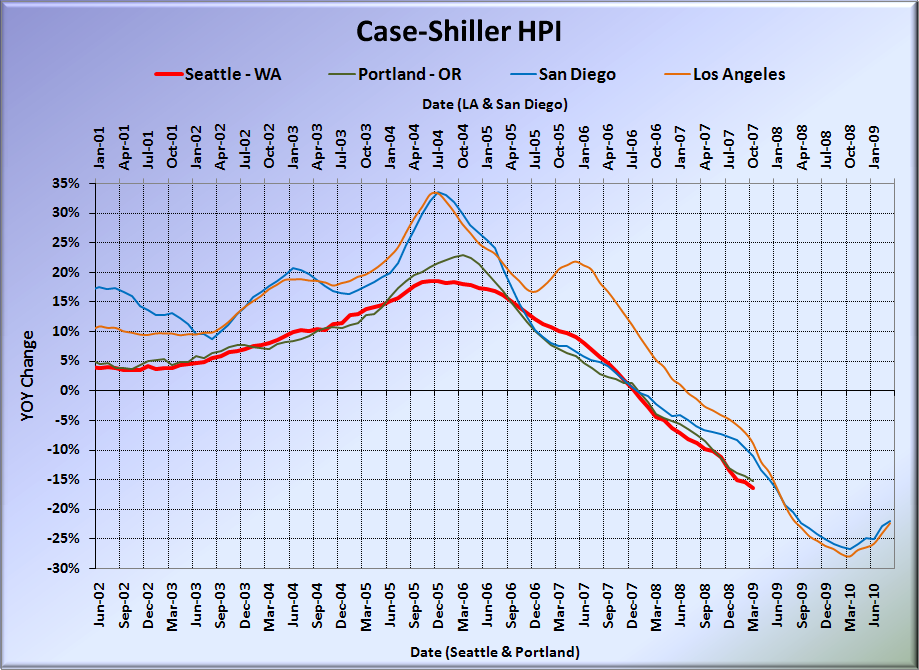
Note: This graph is not intended to be predictive. It is for entertainment purposes only.
Despite the above disclaimer, I can’t help but continue to find it interesting how closely Portland and Seattle are continuing to follow the path of Los Angeles and especially San Diego on the way down. If the trend continues (a big if), it looks like there’s a good chance Seattle’s YOY trend may reverse course sometime around March of next year.
Here’s the graph of all twenty Case-Shiller-tracked cities:
In February, eight of the twenty Case-Shiller-tracked cities experienced smaller year-over-year drops than Seattle (the same number as the previous three months). Denver at -5.6%, Dallas at -5.6%, Boston at -8.0%, Cleveland at -9.0%, Charlotte at -9.3%, New York at -11.8%, Portland at -15.3%, and Atlanta at -15.8%. As usual, Phoenix had the largest year-over-year drop, with prices falling 36% in a single year, forcing me to adjust the y-axis in the above chart.
Here’s an update to the peak-decline graph, inspired by a graph created by reader CrystalBall. This chart takes the twelve cities whose peak index was greater than 175, and tracks how far they have fallen so far from their peak. The horizontal axis shows the total number of months since each individual city peaked.
In the twenty months since the price peak in Seattle prices have declined 22.5%. Seattle’s price decline this far from the peak improved slightly from the trendlines of Phoenix and Tampa. Speaking of Phoenix, prices have now fallen over 50% both there and in Las Vegas.
Here’s the “rewind” chart. The horizontal range is selected to go back just far enough to find the last time that Seattle’s HPI was as low as it is now. This gives us a clean visual of just how far back prices have retreated in terms of months.
Seattle’s Case-Shiller value for March 2009 of 149.03 came in just above its May 2005 value of 148.97. Prices are presently “rewinding” at about the same monthly rate they increased during early 2005.
Here’s an added bonus that I posted last month in the comments. The following chart takes the post-bubble years of 2007, 2008, and 2009 and indexes each January’s Case-Shiller HPI to 100 so we can get a picture of how this year’s declines compare to last year:
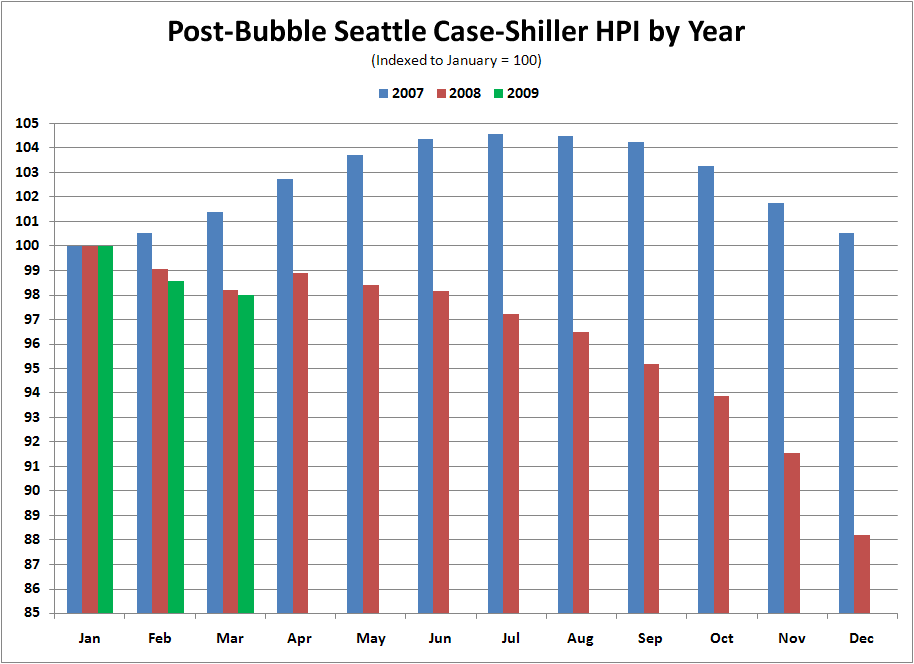
So far prices are falling slightly faster than they did in 2008. If the trend follows last year, we can expect to see a slight uptick in next month’s numbers.
Lastly, here’s the month-to-month trend for Seattle that I posted this morning, with all March values highlighted:
Check back tomorrow for a post on the Case-Shiller data for Seattle’s price tiers.
(Home Price Indices, Standard & Poor’s, 05.26.2009)


NoMoreWork » May 26, 2009 at 10:58 am
Look out below!
Joel » May 26, 2009 at 11:00 am
Correct me if I’m wrong, but wasn’t March the last month of the foreclosure moratorium?
jon » May 26, 2009 at 11:00 am
That month to month % change chart is interesting. I hope you update that in coming months.
patient » May 26, 2009 at 11:05 am
A 7% decline in home values the first three months of 2009 and about 15% the last six months. Seems like listing high and wait to see if “anyone bites” can be an expensive strategy.
Kary L. Krismer » May 26, 2009 at 11:18 am
RE: patient @ 4 – It was for that period anyway. Hindsight is 20/20. But it probably wasn’t for everyone. I’m still seeing some sales go through where I can’t understand why the price was so high. Perhaps a visit to the property would explain it, I don’t know, but like anything else, your mileage may vary.
Scotsman » May 26, 2009 at 11:30 am
RE: Kary L. Krismer @ 5 – “. I’m still seeing some sales go through where I can’t understand why the price was so high.”
Ignorance (for buyers) is bliss?
I haven’t been to RCG for some time- has Ardell revised her bottom call yet? If she sees this she’ll fall over in a dead faint.
jon » May 26, 2009 at 11:35 am
RE: Scotsman @ 6 – Isn’t this CSI data from back when she did call the bottom? This is called the March CSI, but it really is Jan, Feb and March data averaged together. A drop of 2% is saying that March was 6% lower than December, assuming the volumes are about equal.
justin » May 26, 2009 at 11:40 am
So where does everyone think the bottom is for the eastside? 30% from peak? More?
deejayoh » May 26, 2009 at 11:57 am
RE: justin @ 8 – 34.5% ;^)
Ira Sacharoff » May 26, 2009 at 11:58 am
By justin @ 8:
I don’t think the eastside has shown particular strength, and I don’t think it’s significantly different than the general area’s 22% decline from the peak at this point.
So if they were to have fallen 30% from the peak, that would require only another 8% decline, which at this rate could happen in a few months..
So I think it’s unlikely that prices on the eastside will bottom out at only a 30% decline from the peak. I can’t envision prices falling less than another 10% before we hit bottom, an additional 15% decline is certainly plausible, and an additional 20% decline wouldn’t shock me..
patient » May 26, 2009 at 11:59 am
By justin @ 8:
Personally I think it’s much, much lower than that. The eastside has ample space for new construction, it is not an “island type of area” like Manahattan or even Queen Anne. Most homes have no particular views or cultural centras. I think the eastside will be ground zero for our bubble pop. A lot of new hoods were built with standard type of houses that were ferociously overpriced. Many older hoods are worn and gernerally unappealing. There are exceptions as waterfronts and “upper class” areas that have some more sustainable value but in general I think it will be a blood bath.
Ray Pepper » May 26, 2009 at 12:03 pm
From August 2006 it closely resembles the GM chart.
http://finance.yahoo.com/echarts?s=GM#chart1:symbol=gm;range=2y;indicator=volume;charttype=line;crosshair=on;ohlcvalues=0;logscale=on;source=undefined
waitingforseattletocool » May 26, 2009 at 12:06 pm
RE: patient @ 11 –
so we should take mercer island off the list of eastside homes, which it is currently classified since technically speaking it is an “island type of area”
NoMoreWork » May 26, 2009 at 12:06 pm
RE: justin @ 8 – Lower. I’d say >40% off from peak due to an over correction on the way down. I think there is a huge shift in first-time buyer mentality right now. The Seattle area needs first-time buyers to support these (still) outrageous home prices.
Take my situation for example, as I am the first-time buyer agents drool over. My fiance and I are both college educated, Mid 20s, working at large local companys (with steady employment) and pulling in 6-figures combined with a sizeable chunk saved for purchase and good credit. All my life I’ve heard from the generation before mine that housing is the road to riches. Problem is I’ve started doing some thinking of my own lately and noticed I’m not alone in discovering the current reality.
So I’m content with renting in Wallingford at a SUBSTANTIAL discount until I see YOY INCREASES. Yes, you read that right. I don’t mind “missing the bottom” as long as it from the late side, not the early one. Since I believe I’m not alone, I think we still have plenty of room to fall… Plus, I’ll probably just move to San Diego anyhow.
patient » May 26, 2009 at 12:11 pm
By waitingforseattletocool @ 13:
Imo yes, over time it should have a relatively more sustainable value. Though high-end has it’s own problems now with many big earners in the financial companies being flogged.
DrShort » May 26, 2009 at 12:11 pm
By Kary L. Krismer @ 5:
I’m curious if appraisers are seeing the same thing. And, if so, are they killing these sales? It’s a dynamic I don’t see discussed much, but it could be really important.
Cheap South » May 26, 2009 at 12:14 pm
The eastside has been grossly overpriced for quite sometime; and it very well could be “bubble central” for the area. 50% off peak starts looking possible.
I can’t imagine MSFT not moving more positions to India; I know it’s happening with my principal. All my company’s order entry and quoting tools have been developed and are being supported from India.
Bangalore does not have the views, it smells funny; on the other hand….does not rain as much.
waitingforseattletocool » May 26, 2009 at 12:15 pm
RE: patient @ 15 –
we agree on something, let’s have a beer sometime
biliruben » May 26, 2009 at 12:24 pm
RE: DrShort @ 16 –
I don’t know. Maybe with the new appraisal law.
Both the house I bought 5 years ago, and the one I bought 2 months ago happened to both appraise at exactly the purchase price. When I asked about the “coincidence”, I didn’t get a satisfactory answer.
I don’t think appraisers are killing deals. At least when there is decent money down.
Racket » May 26, 2009 at 12:25 pm
I know a builder that had to take $50k hit when a house he built appraised for $50k under the sales price.
Unless the buyer has a ton of cash the appraisers can kill the deal.
Kary L. Krismer » May 26, 2009 at 12:36 pm
By DrShort @ 16:
I’m sure they are seeing them. What do you think they use for comps on refinance appraisals.
There are always sales that fall outside the normal distribution for properties of the type. Sometimes the reason is ignorance, as referenced in an earlier response. Sometimes it’s something else (e.g. a rare property trait the buyer was having a hard time finding), and sometimes it’s even something criminal.
Kary L. Krismer » May 26, 2009 at 12:38 pm
RE: biliruben @ 19 – I think that means that the appraiser came in within spitting distance of your price, and was willing to round it up. If you pay $382,000 and the appraiser things 380,000, they’ll likely round (per an appraiser I listened to once).
Dave0 » May 26, 2009 at 12:44 pm
By DrShort @ 16:
Maybe this explains part of the “pending sales” problem?
Kary L. Krismer » May 26, 2009 at 12:51 pm
RE: Dave0 @ 23 – Maybe, but on a short sale it’s more likely the bank’s broker price opinion that would hold things up. I haven’t heard a lot about appraisals messing with deals (yet). I have heard of some delays in getting appraisals done because of the new appraisal assigning out rule.
I had a bankruptcy/short sale where the bank’s BPO came in above my sale price considerably, even though my listing was the highest sales price of four nearly identical houses built at the same time by the same builder in the same neighborhood. That bank ignored the difference, so it wasn’t an issue, but it was clearly high.
Greg Perry » May 26, 2009 at 12:53 pm
Re: the Eastside
As of last week (7 days ending on 5/20)
There were 1009 ACTIVE listings priced over $1 million with 11 Pending sales for 21 MOS.
There were 1797 ACTIVE listings priced between $500k and $1 mil with 82 Pending sales for 5 MOS.
There were 993 ACTIVE listings priced under $500,000 with 67 PENDING sales for 3.4 MOS.
It’s is very possible that median prices could fall off peak >30%. The market is bottom loaded.
It does not mean homes under $500k will go 30% off peak. Especially if these homes are in neighborhoods close to I 405.
(statistics not compiled or published by NWMLS)
Hugh Dominic » May 26, 2009 at 12:54 pm
Wow, the drop off continues and accelerates….
One a similar note, the Zillow numbers on the houses I am tracking are tanking in line with the CS numbers. Has anyone looked at the correlation between the two?
Hugh Dominic » May 26, 2009 at 12:56 pm
By Greg Perry @ 25:
Thanks Greg. Seems like there is a big build up in inventory at the higher levels with a much higher MOS…look out below.
Hugh Dominic » May 26, 2009 at 1:00 pm
RE: NoMoreWork @ 14 –
“Yes, you read that right. I don’t mind “missing the bottom” as long as it from the late side, not the early one.”
I think this is a great point – when final decline could realistically be between 35-50%, why would you risk trying to catch the falling knife?
Unless you have money to burn and losing your downpayment wont cause you to blink, still looks like waiting is the best bet…
Eastside Westside Its All Good » May 26, 2009 at 1:01 pm
A Tale of 4 Cities, or an analytical view on why there is no end yet (based on CSI)
Los Angeles
30 months since peak, down 41%
17% value lost against peak in last 12 months
currently pricing at August 2003
San Francisco
34 months since peak, down 46%
23% value lost against peak in last 12 months
currently pricing at June 2000
San Diego
40 months since peak, down 42%
16% value lost against peak in last 12 months
currently pricing at July 2002
Seattle
20 months since peak, down 23%
15% value lost against peak in last 12 months
currently pricing at May 2005
IF there are any doubters out there (which excludes most posters on this blog), more food for thought.
TheHulk » May 26, 2009 at 1:04 pm
Seriously, sellers, get out now. Price drops are accelerating, every single month you wait brings down prices by a further 1-2%. That is a mindboggling statistic. Call me a bubblehead, but when each 3 months price drop for my target houses exceeds my rent for the whole year (and no maintenance/taxes to worry about) its a no brainer.
Give it another couple of months people and this year’s spring selling season will be officially dead in the water. Add the horrid economy and the fact that most jobs lost in this recession are not coming back, we will really and truly be in deep chocolate by the time the holidays roll around.
TheHulk » May 26, 2009 at 1:29 pm
RE: Greg Perry @ 25 –
Greg, Biased or not, this is a fundamental difference between you and the bubbleheads on this blog (including myself). Think of all of us travelling on a road. You are looking out of the windshield and all you see is blue sunny skies ahead. We bubbleheads are looking in the rear view mirror and are dumbfounded by your inability to see the hurricane that is following us.
To each his own, but this Case Schiller is documenting the destruction of the housing bubble while you seem to be singing la-la-la pendings pendings la-la-la with your fingers in your ears.
Scotsman » May 26, 2009 at 1:29 pm
RE: Eastside Westside Its All Good @ 29 – Great point, we haven’t generally seen these declines as remaining behind the curve. I know Tim lags his charts to make the similarities easier to see. But the fact that we started late, and will likely continue after, has gotten lost in the noise lately.
DrShort » May 26, 2009 at 1:32 pm
By TheHulk @ 30:
I wouldn’t be surprised to see the Case Shiler numbers for April/May up month to month due to the seasonality of the numbers. But I do think we’ll resume the drops during the second half of the year.
Scotsman » May 26, 2009 at 1:36 pm
In other news, the government hit the treasuries market with the first third of their needed sales and drove the 10 year rate from 3.3% to 3.54%, and oil continued its climb from $35 to now $62. As the consumer and mortgages get squeezed harder, what happens to home sales going forward?
patient » May 26, 2009 at 1:40 pm
RE: Scotsman @ 34 – 30y treasuries at 4.5%, how many of these sales do they plan to execute?
DrShort » May 26, 2009 at 1:42 pm
By TheHulk @ 31:
I don’t understand why these are two opposing things. Increased sales activity doesn’t mean prices can’t keep falling. Sales activity was increasing strongly 12 months ago in California and it didn’t turn prices around. In fact, as prices fall more and more, you should see a spike in sales activity because homes become more affordable.
The MOS of supply figure is pretty meaningless in these times though. Pending sales falling through, shadow inventories, REOs, short sales, etc. make the figure useless. I do like his weekly pending numbers though.
Flying Ape » May 26, 2009 at 1:57 pm
RE: Scotsman @ 32 –
In addition to the consumer and mortgage rates getting squeezed, this lag should drive prices even lower than expected since we will not benefit from the stimulus monies. If we hit bottom much later than the national average any accommodation from the government (i.e. rebates, Fed assisted lower mortgage rates) will be pulled before the recovery has any traction driving prices lower.
Kary L. Krismer » May 26, 2009 at 2:01 pm
By Hugh Dominic @ 26:
Zillow is more neighborhood specific. I was looking at a house we sold end of 2007 in Snohomish County, and it fell about 20% since then per Zillow. My own house bought about the same time in King County only dropped <10% per Zillow. The other house was only about $100,000 more than mine, so same general price area.
softwarengineer » May 26, 2009 at 2:04 pm
ITS SPRING/SUMMER, WHEN SALES/PRICES PEAK TOO
Look out for September 2009 – Mar 2010; that’s when the cow manure really hits the fan based on the Tim’s charts from history. Look at the huge blue bar “Month to Month” price declines when the Seattle’s rains hit last winter.
TheHulk » May 26, 2009 at 2:05 pm
RE: DrShort @ 36 –
I agree with your assessment, although prices are nowhere in touch with reality (even in the local foreclosed areas, we still have another 20% to fall before that happens).
Greg’s pending posts imply “Pendings are rising which means the market is getting hot again. Get in now!!! “. I resent that implication, especially when it is not at all valid for homes that are listed at more than 350K.
Greg Perry » May 26, 2009 at 2:10 pm
By TheHulk @ 31:
What do you see in comment 25 that bothers you?
Eastside Westside Its All Good » May 26, 2009 at 2:18 pm
RE: Greg Perry @ 25 –
‘It does not mean homes under $500k will go 30% off peak. Especially if these homes are in neighborhoods close to I 405.’
I have problems with this statement, Greg. Nothing suggests that one segment will be spared, less the majority of the market (which <$500k is).
In fact, if the overall market drops 40-50% – no longer unlikely in light of CA prices – I would not expect a pocket to survive at 20% off. In context it defies all reason.
Greg Perry » May 26, 2009 at 2:29 pm
By Eastside Westside Its All Good @ 42:
Interesting. To clarify what I think you are saying, do you think the market falls uniformly regardless of price and location?
Brad » May 26, 2009 at 3:23 pm
Incomes follow a regular distribution and the broader regional housing stock has a continuous distribution in quality, location and amenities. What possible mechanism could produce a major discontinuity in pricing? People who would be buyers for the supposedly protected tier will buy instead slightly less nice houses for much less money until the gap is closed. Also consider that foreclosures, underwater mortgages and drops in the low end are killing the move-up market, putting even more price pressure on the higher end homes.
The only way to sustain the logic of a given tier not falling is if the great majority of owners in that socioeconomic class have sufficient reserves to wait-out selling ‘until the market recovers’. Lots of people think they are doing that right now; maybe they’ll be able to, but I doubt it. The market isn’t ever going back to the bubble levels and most families have very little put away.
Scotsman » May 26, 2009 at 3:42 pm
RE: patient @ 35 – It’s a bit of a moving target, but this was for the first $40B of what is expected to be $100B per month from now to the end of the year. It’s a huge chunk for the market to swallow. Rates will have to go up for the market to absorb this. There’s a decent chance some money will move over from the stock markets, but who knows at this point? The current disconnect between earnings and market prices is straight out of “Alice In Wonderland.”
Remember, a 1% increase in the interest rate drops the amount you can borrow for the same payment about 10%. For $2150 per month you can borrow $400K @ 5% or $360K @ 6% (approx.). So rising interest rates will put significant downward pressure on home prices.
DrShort » May 26, 2009 at 4:02 pm
By Scotsman @ 45:
More than that, all lot of the people who were expecting to get his with a painful interest rate reset on their ARMs this year actually did OK because rates are so low. There are still a lot of ARMs out there and they will get nailed when short term rates go back to normal.
Scotsman » May 26, 2009 at 4:12 pm
RE: DrShort @ 46 – Good point- they did get a pass this time around. And the government’s funding needs are worse than I originally stated- they are now looking for $900B, or $200B per month between now and September. And the U.S. isn’t the only country trying to fund deficit spending- there’s a lot of competition out there for available funds. The $40B that hit the markets today is less than 5% of what we need. Interest rates are going to have to pop to bring the funding the feds need.
waitingforseattletocool » May 26, 2009 at 4:17 pm
RE: TheHulk @ 30 –
For the record, I think median price and CS will continue to drop in Seattle area for some time.
I am neither in the 5% camp nor the 80% camp, but 20%-30% further drop is certainly not out of the question.
Just a question, do you think the majority of sellers would sell if they thought prices were going to drop 20% more unless they had to sell (divorce, relocation, loss of income, etc.) AND their end game was to get back into the market at some later time?
For a $500K house, it is fair to say that between commission, excise tax, moving expenses, and inspection items that have to be fixed, a seller would net about $450K after the sale. This doesn’t include how much you have to discount the house to sell in 30 days vs. 70 or 80 day market time to get ahead of the next 2% drop in Case-Schiller.
If your argument assumes prices will drop 30% or more additionally, it makes sense.
Kary L. Krismer » May 26, 2009 at 4:45 pm
By softwarengineer @ 39:
Have you already forgotten Paulson’s announcements regarding the economy being on the verge of systemic collapse? It wasn’t the rains or mere seasonality.
Kary L. Krismer » May 26, 2009 at 4:47 pm
By DrShort @ 46:
I don’t know if that’s true. A lot of ARMs are set to go up no matter what, and are only limited by how fast they’re allowed to go up. Teaser rates.
DrShort » May 26, 2009 at 4:57 pm
By Kary L. Krismer @ 50:
Those teaser rates would certainly increase, but most arms for non subprime were something like 2.75% + the 1 year constant maturity t-bill or LIBOR. Those have been so low recently that someone who took out a “normal” 3/1 ARM in early 2006 probably saw or will see their rate reset lower.
Lake Hills Landlord » May 26, 2009 at 5:00 pm
Just to give an anecdotal data point for everyone to chew on, my rental house appraised at $480k on 6/2007 and $355k as of today (5/2009). That is about a 27% drop in two years. This is in the 98008 zip code. It is a well kept house on the edge of where a nicer neighborhood meets condos and commercial zoning. Incidentally, Zillow and the King County median both seem to track the value of this house very closely. Zillow marks it as $357k and I believe the King County median is around $350k. I found this to be true from the time I purchased until now.
If I had been reading Seattle Bubble back in late 2006 or early 2007, I hope I would have sold.
For the record, I expect an additional decline in value of at least 30%, probably much higher.
Eastside Westside Its All Good » May 26, 2009 at 5:01 pm
RE: Greg Perry @ 43 –
No, Greg. I am saying that <$500k is the overwhelming majority of the market and that if we are headed to 40-50% off of peak, that MOST of <$500k is going to head that way as well. Markets do not move uniformly. But looking at some other metros that lead us as an example, it was the more expensive/desireable properties that have held value longer, NOT the least expensive.
While less expensive property is easier to purchase, the market segment that would purchase the less expensive product is also the most impacted by the economic downturn and losing assets disproportionately.
The <$500k product is the most likely to be:
- evaluated in a rent/buy decision;
- evaluated in a condo/house decision;
- most likely to greater qualification issues
- evaluated in a stay in SEA/move to SD/LA/SF decision;
Anyway, I think your analysis of where <$500k will go is more a function of emotion rather than how the market behaves.
Brad » May 26, 2009 at 5:21 pm
“Holding value” is a very misleading way to put it – look at the collapse in volume. Yes, there is no supply in the higher end at greatly reduced prices (yet), which makes comps look better, but there is also little to no demand. The market is a few lucky bailers finding even fewer suckers that are desperate to buy. That higher-end homeowners are able to live longer in this kind of “mark to model” fantasy land doesn’t mean there’s still real value in their home. Only a liquid market can determine that accurately, and with >30% of people wishing to sell “as soon as the market recovers” according to Zillow, we are a long way off from that.
Scotsman » May 26, 2009 at 5:30 pm
RE: Lake Hills Landlord @ 52 – What does it rent for, if you don’t mind telling? How does it fit into the rent/buy scenario as a valuation technique?
Greg Perry » May 26, 2009 at 5:55 pm
By Eastside Westside Its All Good @ 53:
So……where does the law of supply and demand enter the picture?
My first example was the Eastside. You mentioned metro markets. Overall the metro areas of 140,380,385,390,700,705,710,715,720 came in at 2.8 MOS for all areas/ all prices for the same period in comment 25. 75% of all pending sales in this metro area were <$500k.
Area 710 had a staggaring 0.99 MOS (138 ACTIVE/32 PENDS) < $500k and 1.5 MOS for all price ranges (332 A/ 46 PEND)
Area 705 had 1 MOS (263 vs. 58) < $500k and 2.0 MOS in all price ranges.
These ratios are as fast as they were the 2005,2006 bubble markets and these ratios turned on virtually over night in the last week of March and have continued to build steam. (Just like they turned off virtually over night in the 3rd quarter of 2007).
<3MOS = Seller’s advantage
3-6 MOS = Balanced market
6+ MOS = Buyer’s advantage.
Emotion? The numbers are the numbers.
So on the Eastside, the numbers on the top tier suck
The mid tier not so good.
<$500k, inventory IS absorbing.
(Stats not compiled or verified by NWMLS)
The Tim » May 26, 2009 at 6:03 pm
By Greg Perry @ 56:
Just a side note to your discussion… I wouldn’t put too much faith in the so-called “law” of supply and demand. I consider it to be more of the “suggestions” of supply and demand.
If supply and demand were really the primary driving factor for the real estate market, I never would have even started this site. There’s a lot more psychology in play here than you may think, which is regrettably something none of us can really quantify with graphs or tables of numbers.
deejayoh » May 26, 2009 at 6:06 pm
By Lake Hills Landlord @ 52:
hope this isn’t a double post… first try got lost.
I’m curious – if you hope you would have sold if you knew there was going to be a 27% drop, are you on the market now given that you expect a 30% further drop?
Greg Perry » May 26, 2009 at 6:08 pm
By Brad @ 54:
Brad, that’s what sales ratios tell us — the rate of sale within a price range. Sales ratios work when the market is going up. Sales ratios work when the market is going down. (And people griped about them when the market was going up, and again when it was going down and now again that inventory is absorbing).
I tracked the ratios (by area and price range) during the bubble and during the collapse. The ratios tell us where there is little to no demand and when and where inventory starts to absorb.
Here’s a pop quiz for the group: WHY is the <$500,000 price range absorbing so quickly?
Scotsman » May 26, 2009 at 6:15 pm
RE: Greg Perry @ 59 –
“Here’s a pop quiz for the group: WHY is the <$500,000 price range absorbing so quickly? ”
Because there’s a sucker born every minute?
Because real estate sale people are SO DAMM GOOD?
Because that’s all anxious moms-to-be overwhelmed by nesting instinct can afford?
I give up. Really. Why is anyone buying a house now?????
Greg Perry » May 26, 2009 at 6:17 pm
By The Tim @ 57:
Tim, I respectfully disagree.
In ecomonics there is a law of supply and a law of demand, and it does work in real estate. Yes there are psychological factors in markets, as well as market drivers (money supply, scarcity and employment the big 3). The market factors are the drivers (not supply and demand), and when they line up and inventory abosrbs, prices will first stabilize then rise. As I mentioned in the comment above, I’ve tracked ratios going up and down. The prices at this point have always followed (never preceded) the sales ratios.
I would never debate the law of supply and demand in any market. Market drivers? Until the cows come home.
TheHulk » May 26, 2009 at 6:19 pm
RE: waitingforseattletocool @ 48 –
Just a question, do you think the majority of sellers would sell if they thought prices were going to drop 20% more unless they had to sell (divorce, relocation, loss of income, etc.) AND their end game was to get back into the market at some later time?
The answer to that would depend on how much a person paid for the house, when they purchased it.
Any person/family who purchased a house as an “investment” any time between 2000 and 2004 should get out right now. The theme “Your house is an investment” wont be coming back for a couple of decades. You were lucky enough to purchase before the bubble (although 2004 prices are increasingly looking bubblicious these days). I would urge all those people to get out right now and just start renting again until the market stabilizes. They have nothing to lose.
Any first time buyer after 2004 should be very scared right now. Locally we saw the biggest run ups in prices from 2004 onwards. I would seriously recommend considering a short sale or even a foreclosure.
Greg Perry » May 26, 2009 at 6:20 pm
By Scotsman @ 60:
How about a sucker with an $8,000 tax credit? The only one thing that really changed that I can see.
(Hmmmm artificial props to a market (Tim — a Government market driver) —– where have we seen this one before?)
Oh, the sales ratios will again change quickly. Watch what happens when the tax credit ends (and interest rates rise).
Hugh Dominic » May 26, 2009 at 6:30 pm
By Scotsman @ 60:
There is definitely something to that….
Greg Perry » May 26, 2009 at 6:36 pm
By Hugh Dominic @ 64:
That was a good one.
WaileaKid » May 26, 2009 at 7:19 pm
Greg,
I have been reading your posts for a past couple of months. You have been very optimistic in claiming that the market has switched ON, the inventory is absorbing and so on. The data that you cite is not wrong but I think the conclusion you draw is flawed.
Instead of arbitrarily dividing the market in price ranges, divide it in groups of percentiles. That will tell you how the prices and demands are behaving.
Here’s an example that would outline the flaw in your logic:
Consider that in a year 100 homes sold for under 500K and 100 sold for betweek 500K and 1M. Let’s also assume that the distribution was even too i.e. 50 sold in 0-250K range and 50 in 250K to 500K range.
Now the prices dropped 20% next year and if the same amount of houses sold again with even distribution, the demands will look something like this:
100 sold for under 400K
100 sold for 400K-800K
But if you compare the sales under 500K this year to sales under 500K last year, you will see something like this:
125 sold under 500K (100 in 0-400?K + 25 in 400K-500K)
75 sold over 500K
Now do you think this means that the market has suddenly heated up in under 500K range? NO! It only means that the prices dropped! The right way to analyze is to not divide the market into some fixed numbers (under 500K, over million etc) but divide into percentile (e.g. compare the prices of bottom 30% sold last year to bottom 30% sold this year and see what the demand and the proces look like in that range.)
That’s why the tiers in case shiller stats and the median price are so important when tracking the pricing behavior.
Eastside Westside Its All Good » May 26, 2009 at 7:22 pm
RE: Greg Perry @ 56 –
So……where does the law of supply and demand enter the picture?…These ratios are as fast as they were the 2005,2006 bubble markets and these ratios turned on virtually over night in the last week of March and have continued to build steam. (Just like they turned off virtually over night in the 3rd quarter of 2007).
<3MOS = Seller’s advantage
3-6 MOS = Balanced market
6+ MOS = Buyer’s advantage.
…<$500k, inventory IS absorbing.
As mentioned before Greg, I think we are speaking about different measures of the market. Absorption is not price stability. Absorption is a metric that only interests those in the real estate tranaction business. As a prospective buyer, where PRICES are going is the only metric that matters. While transactions may be up – no evidence yet as your interim closing numbers reported here don’t add up to much of an increase over April – if prices are still falling, the ONLY people who think the market is in good shape are realtors.
I am talking about prices falling – something you have yet to refute and which the CSI above supports. Prices falling=bad time to buy.
In the stock market there is a common term ‘capitulation’, the point where the last of the bulls give up and try to get out of the market, driving up volume and driving down prices. Until that point, there is no bottom. For RE is Seattle, we have not had a capitulation yet. Too many sellers and realtors who think there is still one more sucker out there (someone who will overpay for their house/listing).
I’ve been out with a realtor numerous times who is expecting me to eventually get emotional about a house and throw out all reason in my pursuit of it. It’s a ridiculous expectation. But its source is the belief that the market rebound is just around the corner.
To main point of my first post on this thread (and everyone since) – we are not [at bottom] yet. It doesn’t mean volume won’t go up. It can. But that is not bottom.
Racket » May 26, 2009 at 7:51 pm
“I’ve been out with a realtor numerous times who is expecting me to eventually get emotional about a house and throw out all reason in my pursuit of it. It’s a ridiculous expectation. But its source is the belief that the market rebound is just around the corner.”
If you have no intention of purchasing anything, why waste their time?
Alan » May 26, 2009 at 7:51 pm
RE: Greg Perry @ 59 –
Here’s a pop quiz for the group: WHY is the <$500,000 price range absorbing so quickly?
Because that is all most households can afford.
Here is another pop quiz: WHY is the $1M price range absorbing so slowly?
Greg Perry » May 26, 2009 at 8:20 pm
RE: WaileaKid @ 66 –
How refreshing that someone doesn’t dispute the data, but the conclusions! Feels like victory of some sort :)
I agree with some of your conclusions on how some of the inventory found it’s way in the under $500,000. Also I do look at the percentage of sales in each category compared to years past. The percentage under $500k is much greater this year.
The fact remains that now that the inventory is there, this segment of the market is currently absorbing at a brisk rate. THE LAW OF SUPPLY AND DEMAND WILL KICK IN HERE. If the sales ratios remain consistent. Market time will dramatically reduce. Prices will stabilize and start to creep up. Most every multiple offer causes a house to sell for more than it would have without the competing offer, whether it makes it asking price or not. As inventory tightens, even the banks will see multiple offers on their REO’s and short sales will start to escalate.
And here’s exactly WHY you should not buy a home based on today’s reported median price. Look closely at C/S and median price charts in the year 2007. If you were looking at these charts in September 2007 and making a decision at that time what to offer an a house, you would be looking at the peak with several consecutive months of MOM gains leading to it. YOU WOULD NOT HAVE A CLUE THAT THE MARKET HAD SHIFTED based on the C/S chart or median chart. All you had was history.
Yet, if you were my client, you would see the sales ratios and we would have offered accordingly. I knew the market had shifted (and reported on it at the time in the SREP blog)
As a working agent, I can break these sales ratios down to zip codes, neighborhoods and right down to house styles. If for instance, you owned a clean rambler style house and I see that overall ratios are tight AND I see that ramblers are selling as quick as they hit the market with few competing ACTIVES, I would suggest an aggressive starting price and be reasonably sure to get it for you. But, if your house was a split, you wouldn’t like the sales ratio so much, as reaming inventory may mostly be splits.
I have years of these ratios by area, by price point to look upon. I’ve tracked them in up markets and down markets, and they work (and work on behalf of my clients)
Now for pop quiz number 2: Median prices:
2A: What actually is the median price?
2B: How would a lack of sales in one market segment …..like the high end…..affect overall median prices?
2C: What is the relationship between KC median prices and a house in Ballard?
BTW, I”m currently trying to kill values in Bellevue. I’m advising my clients to stick at a price which is about 12% off asking (split entry). Came to the offer the table with history, real time stats and sales ratios, — we’re close to a deal!
deejayoh » May 26, 2009 at 8:20 pm
RE: Scotsman @ 60 – Three letters: F H A
Eastside Westside Its All Good » May 26, 2009 at 8:28 pm
RE: Racket @ 68 –
I never said I was not interested in purchasing. I am interested – on terms that I think make sense. But I will not respond to traditional realtor positioning tactics. When the right house comes in at the right value, then I will move. That could be tomorrow or 10 months from now.
To clarify Racket, I’m not dragging a realtor around opening ten houses at a time for me. I’ve probably looked at 8-10 with a realtor and added more than that in open houses. But I don’t see why you are reacting. An informed consumer will shop before buying. Unfortunately when shopping for homes, we are not able to examine the product by ourselves in most cases – we need an escort. I did not set up those rules – realtors did. So I refuse to be shy about or apologize for approaching the process methodically.
Acting otherwise is not in one’s self interest.
Greg Perry » May 26, 2009 at 8:29 pm
RE: Eastside Westside Its All Good @ 67 –
I don’t get up in the game of calling the bottom. The issues are too complex. We’ll not hit bottom on $1mil plus for long time. Also Seattle will hit bottom before KC, KC before Snohomish and on it goes. Every time I hear an agent declare we’ve hit bottom, I want to puke.
I really focus on the ratios to see what the market is doing today, and to pick up trends.
Remember, guys and gals, nobody else wrote about the week that pendings started taking off. And some here still don’t think they have!
mukoh » May 26, 2009 at 8:33 pm
By Greg Perry @ 70:
Greg, That is very professional.
Racket » May 26, 2009 at 9:20 pm
“An informed consumer will shop before buying. Unfortunately when shopping for homes, we are not able to examine the product by ourselves in most cases – we need an escort. I did not set up those rules – realtors did. So I refuse to be shy about or apologize for approaching the process methodically.”
I completely get what you are saying. I have no intention of buying at current market prices but a serious discount off of them may be appealing.
You made it sound like you had no interest in buying at all.
on another note.
Greg, Whats the deal w/ split level houses why are they less desirable?
S-Crow » May 26, 2009 at 9:22 pm
Greg, like yourself, I’ll look forward to see how many pendings actually close and whether sustained sales will continue throughout the remainder of the year. And, if those sales will create a solid floor in housing prices that can be sustainable for the future, not a temporary seasonal sales push. I wish I were more optimistic.
Racket » May 26, 2009 at 9:25 pm
you guys may find this interesting
http://www.realtor.com/realestateandhomes-detail/370-Beech-Street_Highland-Park_IL_60035_1109385563
Ira Sacharoff » May 26, 2009 at 9:39 pm
RE: Eastside Westside Its All Good @ 72 –
But do you feel like your Realtor is actually looking out for your best interests, or is he/she just trying to make a sale?
Eastside Westside Its All Good » May 26, 2009 at 9:43 pm
RE: Greg Perry @ 73 –
I don’t get up in the game of calling the bottom. The issues are too complex
Got it Greg. Please understand that when I am talking about bottom in pricing and you are talking about bottom in activity, we are speaking past each other and not engaging in any dialogue.
But I am confused. Because in speaking of activity you are suggesting that the bottom is near.
The fact remains that now that the inventory is there, this segment of the market is currently absorbing at a brisk rate. THE LAW OF SUPPLY AND DEMAND WILL KICK IN HERE. If the sales ratios remain consistent. Market time will dramatically reduce. Prices will stabilize and start to creep up. Most every multiple offer causes a house to sell for more than it would have without the competing offer, whether it makes it asking price or not. As inventory tightens, even the banks will see multiple offers on their REO’s and short sales will start to escalate.
There is nowhere else to go with this. You are looking at this market in a vacuum. You look at week to week numbers and say “Look! Improvements!” I won’t disagree with your statements.
I am saying “Look! LA -41%! SD -42%! SF -46%! SEA -23%!”
I am saying we can’t be near bottom if this is the relationship in value between these cities. Look at the long-term value relationship – Seattle always stabilizes below these markets. That’s my point.
Scotsman » May 26, 2009 at 9:52 pm
Greg says: “The fact remains that now that the inventory is there, this segment of the market is currently absorbing at a brisk rate. THE LAW OF SUPPLY AND DEMAND WILL KICK IN HERE. If the sales ratios remain consistent. Market time will dramatically reduce. Prices will stabilize and start to creep up.”
I believe in supply and demand as the primary drivers of price. What I find interesting is your contention that just because supply is absorbing, prices must go up. I think this is similar to the old correlation doesn’t mean causation debate. Because it’s pretty easy to find situations where prices drop while supply disappears. Look at any dying industry, especially those characterized by over capacity where over time supply, demand, and price all drop to zero. It’s not too much of a stretch to suggest housing has over capacity (20 million vacant units) and while supply may be dropping (absorbing) prices are continuing to fall too. As much as many might like to believe things are about to turn around,looking at the data (CS, vacancies, monthly sales, etc.) shows the opposite is true. But I appreciate your positive attitude! ;-)
Greg Perry » May 26, 2009 at 9:57 pm
By S-Crow @ 76:
Tim, I don’t think the uptick is as much seasonal influence this year as it is fueled by the stimulus. We start seeing the seasonal push as early as the 2nd week of January and Feb and both those months in 2009 were abysmal. Without that stimulus, combined with the low interest rates, this market would look very different.
Will the stimulus be the primer to start a sustained market? or will the market fizzle as fast as the stimulus is removed?
We also have some upcoming interest rate issues to deal with. Many pot holes in the road, ahead.
DrShort » May 26, 2009 at 10:03 pm
Greg,
You’ve posted a lot about strong pendings, but from the warranty deed filings with King County, I don’t expect closed sales for May to be that much higher than April. Are you seeing the same thing in the MLS data? Considering April pendings were well above March, I would have expected more closed sales.
Greg Perry » May 26, 2009 at 10:03 pm
RE: Eastside Westside Its All Good @ 79 –
Keep a keen eye on market times and your ear to the ground for the anectdotal stories of multiple offers.
Time will tell.
Eastside Westside Its All Good » May 26, 2009 at 10:04 pm
RE: Scotsman @ 80 –
I believe in supply and demand as the primary drivers of price
As do I Scotsman. I am trying to share the broader view that when looking at supply and demand for a whole metro, you need to add some extra variables including job growth (by itself and relative to other metros) and migration patterns – aside from organic population growth, what cities send the most families to Seattle (hint: they are all in California).
There is more, but you can tell most of the story with these.
DrShort » May 26, 2009 at 10:06 pm
By Greg Perry @ 81:
It’s also worth noting that the pendings really heated up about 2 – 3 weeks after the stock market began to rebound strongly. I think that had a big impact on the psychology of potential buyers. I know it impacted the news cycles.
DrShort » May 26, 2009 at 10:15 pm
By Eastside Westside Its All Good @ 79:
It should be noted that those CA cities also had much bigger run ups from 2000. They were all well into the 200s on the Case Shiller whereas Seattle peaked around 191. I’m not saying the relationship between Seattle and San Diego prices is where it should be, but in the end, those cities will probably have a bigger total decline.
Greg Perry » May 26, 2009 at 10:15 pm
RE: Eastside Westside Its All Good @ 79 –
From the perspective your talking about, YES, I think homes priced under $500k, in KC, based on continued tight ratios will stabilize and start to rise. As I mentioned above, watch market times in this market segment. I have close to zero confidence that high end sales will improve significantly. Prices will continue to erode here.
Your stats about the shortfalls in other cities mean nothing to this market at this time. There was an artificial prop to the market that was introduced by the Gov. that at least for the time being, changed the game, especially in the <$500k range.
Greg Perry » May 26, 2009 at 10:17 pm
By DrShort @ 85:
Yes, very good point. I’m sure that added some to consumer confidence.
jasonwarren » May 26, 2009 at 10:44 pm
RE: Scotsman @ 60 –
I’m signing on a SFH tomorrow. Why? Because I’m getting what I believe to be a very good deal.
Here are the details:
- Snoqualmie Ridge SFH, 3000 sq ft, 4/2.5, easy walking distance to school and downtown
- Originally sold for $325k in mid-2000
- Last sold for $575k in 2007
- Foreclosed this year, owned by a Lehman Bros subsidiary
Identical homes are currently listed in the neighborhood for $465k-$520k. The appraisal for this place came back at $440k.
I’m paying $375k, with the seller covering all closing costs. This is 35% under the 2007 sales price, and only 15% more than the original sales price from 2000. My mortgage payment (not including taxes, etc.) will barely exceed the rent I’ve been paying for the last 5 years.
Yes, the market is still dropping. But I feel like I’ve negotiated down a decent chunk of the ‘likely’ future depreciation – probably not all, but quite a bit. If this home had followed the 22.5% King co SFH average decline since 2007 it would be ‘worth’ $445k. This is where the subtle detail of serial percentages comes in – even if the market declines another 20% in Seattle, which I believe it possible, that $89k drop is only an incremental 15% as measured from the start of the previous drop. As prices get lower, serialized (n+1, 2, 3, …) price moves as presented in percentages mask the true drop from earlier valuation data points. I’ve already negotiated a 16% discount off the theoretical $445k valuation, leaving little downside unless the most bearish macro scenario plays out.
I’m happily helping the market ‘absorb’ deals like this – hopefully I’m not a sucker. Time will tell.
Jonness » May 26, 2009 at 10:45 pm
“Here’s a pop quiz for the group: WHY is the <$500,000 price range absorbing so quickly?”
Because of the $8K tax credit, the 25% drop in prices, the historically low interest rates, the BS media spin, and the massive shadow inventory held by the banks that’s making things look a lot better than they really are.
“Oh, the sales ratios will again change quickly. Watch what happens when the tax credit ends (and interest rates rise).”
And the effects of the mortgage moratorium being lifted takes effect, the unemployment rate continues to go up, and the shadow inventory starts to supply the market…
I think perhaps 60% of people these days are thinking before they buy, but there’s still a fair amount of people who will buy if someone is stupid enough to loan them the money. The tide is soon to go out, and the buyers acting on impulse, instead of logic, will get caught swimming naked. This could lead to a whole new round of (FHA-related) foreclosures in the future. There are so many impulsive people in this country that we might not ever get out of this mess. This could easily turn into Japan’s lost decade, or worse.
mukoh » May 26, 2009 at 10:54 pm
By Jonness @ 90:
You talk about this shadow inventory and etc.. Can you bring up examples? I haven’t seen any such as bank foreclosing then not listing a month or two later?
WaileaKid » May 26, 2009 at 11:04 pm
RE: Greg Perry @ 70 –
Greg, you either did not understand what I was saying or you chose to ignore it completely. :)
I am saying that though the number of pendings and actives that you are quoting are right, what you are trying to deduce from it, is completely garbage.
You mentioned that you are also comparing percentiles. Care to post how that has changed since the stimulus was announced?
Arwen » May 26, 2009 at 11:14 pm
@Greg Parry – Mohican at “Housing Analysis” out of Vancouver shows that our MOI and price reductions track quite well, so I get your point.
With your numbers, I would guess that the greatest price movements in the near term would be in the high end.
But a sinking tide lowers all boats; price compression is another serious factor in supply/demand, and “tiers” get realigned.
House prices are sticky enough that I’d think the egg will take awhile to work through the snake.
In Vancouver a lot of speculative gentrification went sliding all over the city causing serious market-out-of-balance price compression; I imagine the expensive areas up here will retain a greater percentage of their value than the others that were mainly crappy but quickly gentrifying. I don’t know the Seattle market, but if you were like us, I’d guess some of that costly inventory is traditionally worth more, and some of it is – as it were – nouveau riche and likely to suffer a higher drop. At which point it will form the ceiling for the next tier, etc.
Look out below.
( Of course, I say that while sitting in the last bubble city in North America to peak – we only peaked in June of last year. Sigh. If it really IS different in Vancouver, I’m moving to Seattle. *g*)
Scotsman » May 27, 2009 at 12:26 am
RE: jasonwarren @ 89 –
I can understand the temptation to buy, I’m just not biting yet. If the home I rent reached 2003 prices and could be purchased in a short sale, I might go for it simply because that would be the point where the rent/buy differential zeroed out. But that’s not to say rents won’t be decreasing in the next couple of years, and it’s still possible to lose quite a bit of money.
Despite the fancy percentage calculations, your home is worth exactly what you paid for it, not some construct calculated off the CS index or other guidance. I think too many forget this as they look at foreclosures, short sales, etc. and think they have somehow beat the system. It all reminds me of the ads that say “buy now and get instant equity!” How does that work- you just paid a market price. Another concern for me and any purchase decision is what if my circumstances change and I want to move, or take a hit to my income, etc. as an uncertain future unfolds? Short of a cash purchase, renting offers me the most flexibility and security going forward. It’s not impossible to envision a scenario where houses can’t be sold at all or equity recovered for some period of time. If we are heading into GD2 I don’t imagine there’ll be much of a market for homes or any other item dependent on financing.
Enjoy your new digs. SR is a great family area, great views of Mt. Si, neat little downtown, good health club (my wife and daughters go) and closer to town than many know… ;-)
Greg Perry » May 27, 2009 at 6:22 am
By WaileaKid @ 92:
I got your point loud and clear. As I mentioned it’s good to see someone acknowledge the that the current pending sales are really happening. As for the rest, you have your opinion and I have mine and we both get to keep them.
Currently approx 50% of pending sales on the Eastside are under $500k In Metro Seattle about 75%.
This is about the same as it was in 2003.
During the bubble, these percentages were roughly 35% on Eastside and 50-60% in Metro.
Kary L. Krismer » May 27, 2009 at 6:25 am
RE: DrShort @ 86 – And a lot of those California cities have also been more volatile in pricing. I’m not sure what causes that on the upside. On the downside it’s presumably weaker local economies.
But most the cities with huge declines had huge runups in just the year or two prior to their particular peak. Seattle was just starting that type of action right when the August 2007 mortgage mess hit.
Kary L. Krismer » May 27, 2009 at 6:46 am
RE: DrShort @ 86 – I’d also add (from memory, so I might be wrong), since the date that C-S picked as 100, only three cities have done better than Seattle: L.A., NYC and DC. I can understand the last one, but I find the other two rather surprising. I’d like to see some population data for those places.
Angie » May 27, 2009 at 7:49 am
Coming to the game a little late, but I haven’t seen anyone address the most obvious reason for what Greg’s reporting (inventory <500K is selling, everything above that is sitting): financing.
Isn’t the “jumbo” breakpoint somewhere around 500k? Didn’t the terms (rates, down payments) for jumbo loans get a whole lot more stringent last winter, much more so than loans below that limit?
At the credit union where I do most of my banking, they list interest rates for loans up to $417K. Used to be there was a separate interest rate table for loans larger than that, but no longer–they either must not offer them any more, or so rarely that they don’t advertise it broadly.
I have to think that all-cash transactions are rare anywhere across the price spectrum and that the vast majority of purchases require financing. Once you get over, what, $600K or so, even if a buyer can put 20% down, the loan becomes much more expensive than at lower price ranges, if not harder to find altogether…
patient » May 27, 2009 at 8:02 am
I wouldn’t worry one bit about running out of supply and causing some sort of sustainable price stabilization. It seems like the pendings are already about 1/3 short sales. We are moving into the bubble city phase where short sales and reos are becoming the main part of sales ( much quicker than I expected ). For every percent the home values drop there is a new large chunk of owners finding themselves under water and with every increase in unemployment there are owners who can’t pay the mortage. Sad in many cases but it will likely ensure that supply is ample to prevent price stabilization. Sorry Greg.
Racket » May 27, 2009 at 8:41 am
Where does this “seems like 1/3″ come from?
Lake Hills Landlord » May 27, 2009 at 9:05 am
RE: deejayoh @ 58 –
RE: Scotsman @ 55 –
I’m stuck with this house now. Not enough equity to refinance or sell. I’m not sure what I will do if it ends up having a market value of half the mortgage. I suspect I will continue to pay the mortgage as long as I can.
It rents for $1500 (market price for the area), but I may not continue to rent it out. I had hoped to keep it as a rental, but will feel better about being underwater if I am living there. It never penciled out as a rental, but I originally thought that with even modest appreciation (4%) and good renters that I would be happy with the ROI over a 5-10 year period.
Live and learn!
Greg Perry » May 27, 2009 at 9:47 am
By Angie @ 98:
Great points
patient » May 27, 2009 at 9:50 am
By Racket @ 100:
It’s the likely reason given by the nwmls and agents for the > 40% discrepancy between pendings and closed sales. I.e that it’s short sales that takes longer to close. Only 1-2% were attributed to the changes in the pendings definition, the rest was explained to be short sales.
Alan » May 27, 2009 at 11:13 am
RE: Racket @ 75
Every time I show my wife a house that looks like a good value to me (with respect to today’s market) she responds, “Yuck. It’s a split level.”
There is a reason the “good” values are largely split levels.
hzg » May 27, 2009 at 7:11 pm
Something like 15 references to “bottom” in the previous 100 posts of this thread and who knows how many in previous threads.
For those that are interested in determining when there is a bottom here is what you look for:
When interest rates are very HIGH 8..9..maybe 10 percent AND they have recently been HIGHER 9..10.maybe 11 percent THEN and only then you will have your bottom.
Intuition tells me that more readers will believe this truth if they figure out “why” for themselves, instead of being spoon fed the reasons why this is the way it will happen.
Sorry if it wasn’t what you wanted to read.
Friday Free-for-all! | Vancouver Condo Info » May 28, 2009 at 8:46 pm
[...] met with demand to lower rent. Success. -Will ‘rookie’ homebuyers save the market? -Las Vegas and Phoenix house prices down more than 50% -Green shoots or yellow weeds? [...]
Jonness » May 28, 2009 at 8:47 pm
RE: mukoh @ 91 –
Google is your friend:
We believe there are in the neighborhood of 600,000 properties nationwide that banks have repossessed but not put on the market,” said Rick Sharga, vice president of RealtyTrac, which compiles nationwide statistics on foreclosures. “California probably represents 80,000 of those homes. It could be disastrous if the banks suddenly flooded the market with those distressed properties. You’d have further depreciation and carnage.”
In a recent study, RealtyTrac compared its database of bank-repossessed homes to MLS listings of for-sale homes in four states, including California. It found a significant disparity – only 30 percent of the foreclosures were listed for sale in the Multiple Listing Service. The remainder is known in the industry as “shadow inventory.”
“There is a real danger that there is much more (foreclosure) inventory than we are measuring,” said Celia Chen, director of housing economics at Moody’s Economy.com in Pennsylvania. “Eventually those homes will have to be dealt with. If they’re all put on the market, that will add more inventory to an already bloated market and drive down home prices even more.”