Here’s a brief quote from a post that appeared here in 2006 titled The Monthly Payment Buyer:
In my opinion, it’s no wonder that home prices have gotten so out of whack with true fundamentals, when the first question someone asks in the home buying process is not “Is this house worth $XXX,000?” but rather “Can I afford $X,000 per month (no matter what kind of financing it takes)?” Obviously a monthly payment must be affordable, but should that really be the sole determining factor in whether a house is worth buying?
With interest rates bouncing up in the last few weeks from their artificial lows in the 4s, it’s interesting to consider how this might affect the housing market.
Following is a chart that shows how the monthly payment (principal + interest only) on a $350,000 mortgage grows as interest rates rise:
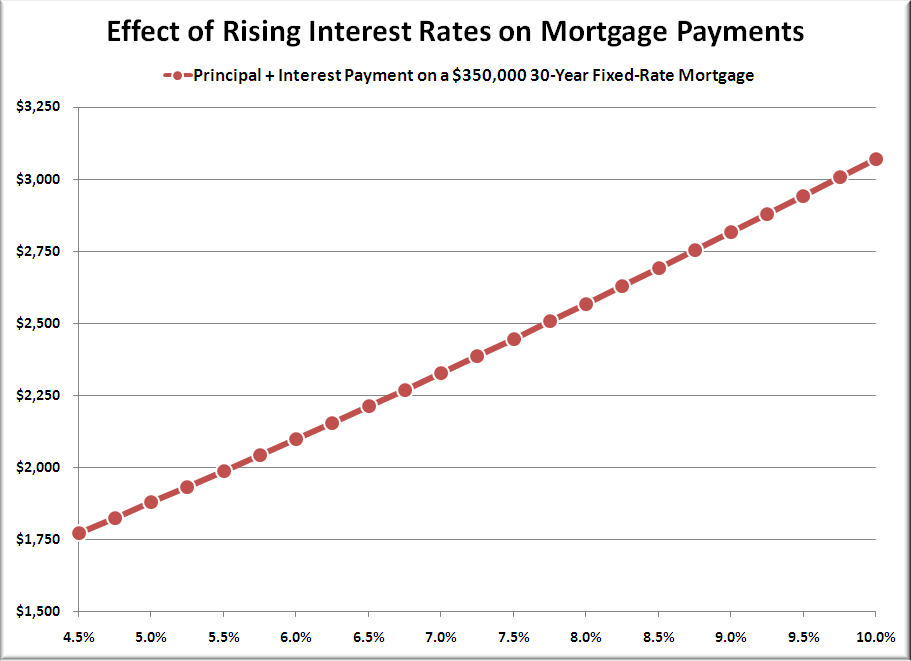
Since most people are still “monthly payment buyers” when it comes to buying real estate, perhaps more informative is the following chart, which shows how much mortgage a fixed $1,750 payment (principal + interest only) buys as interest rates rise:
A mere 1-point jump in interest rates from 4.5% to 5.5% drops the amount that can be afforded by over 10%. Another 1-point jump up to 6.5%—a rate considered great just a few years ago—knocks another 10% off.
If suddenly everyone in the buying pool can afford 10% less for a home, what effect do you suppose that might have on prices?


ElPolloLoco » Jun 12, 2009 at 11:46 pm
I’m a little unclear on why there’s so much opprobrium attached to the idea of shopping for big-ticket items based on their monthly cost. If I’m going to stay in a house for a long time, or keep a car for a long time — both of which are considered wise — then both of those payments are going to have a significant impact on my monthly budget. In fact, together, house and car payments typically determine a household’s discretionary budget.
Conversely, the difference between $400,000 and $500,000 is rather abstract and meaningless. After all, I’m not supposed to view my primary residence purely as an investment, right? What do I care what my house is worth? That’s just a number in a database somewhere, which might go up or down over ten or fifteen years due to factors beyond my control. My house and car are either “worth” what they’re costing me on a month-to-month basis, or they aren’t.
Scotsman » Jun 13, 2009 at 12:25 am
RE: ElPolloLoco @ 1 –
Ironically, I think your argument made Tim’s point. The fact that people do focus so heavily on payment affordability as opposed to value only ensures that prices will adjust that much more rapidly to changes in interest rates. As rates go up, the buyer pool shrinks with a certainty and speed that no argument about value can overcome. If the monthly payment can’t support the value, what can? What else besides the moonthly payment really matters in a society where financing is required by most for any purchase that exceeds the weekly grocery bill?
David Losh » Jun 13, 2009 at 12:40 am
The mortgage industry began insunuating themselves into the Real Estate Industry in the late 1980s and early 1990s. It was the spike in interest rates that in my opinion started the whole thing. When rates went back down to 10% it was a gift.
Over that course of time affordability became a long equation of money in and money out. Return on Investment became a common phrase.
Today with the falling prices those who started investing less than say fifteen years ago are pretty well stuck. If your portfolio started in the past ten years, forget about it.
This is a very huge point to the global economy. Those monthly payments are the back bone of our financial markets. I should say European financial markets. Some countries use cash and in some cultures usary is forbidden.
Kary L. Krismer » Jun 13, 2009 at 5:59 am
It’s rather obvious that increased interest rates have a negative effect. But that’s only one of the factors that affect prices. Rates and prices can go up simultaneously if other factors are driving up prices more than interest rates are driving them down. But if prices would have gone down without the increase, they’ll go down more with an increase.
The monthly payment factor though I think has another effect. At 6% interest every additional $10,000 only costs a buyer about $60 a month more. Some people pay 2-3x that amount to Comcast. I’ve mentioned before that it’s sometimes hard to hold a buyer back, and that’s especially hard once they figure out that they can get what they want for only another $60 a month. One buyer does that and it sets a comp $10,000 higher. The next does it . . . ., etc.
David Losh » Jun 13, 2009 at 8:10 am
RE: Kary L. Krismer @ 4 –
Good Morning,
That’s exactly what happened. For an extra $400 a month you can get so much more. As interest rates came down prices went up. It was the payment factor inflation.
It’s the same for a plasma TV. While credit is easy the price goes up. The monthly payment is only X so why not buy it. No interest, no money down, and no payments for a year make it an easier purchase. What I noticed is that prices for Plasma are starting to come down. Paying cash is a forced savings program.
The payment is going to be a huge topic of discussion in the next ten years. Over on the foreclosure post you pointed to an “investor” buying a house for $80K. If the investor saves $50K in the next couple of years they will be paying cash for the same property.
If, as I suspect, lending becomes risky, or riskier, money will move to other avenues of return, maybe something productive this time around.
jdc98119 » Jun 13, 2009 at 9:33 am
RE: Kary L. Krismer @ 4 –
Negative effect? Your colors are showing.
Ira Sacharoff » Jun 13, 2009 at 9:54 am
I don’t think it’s quite so cut and dried. Unfortunately, there’s a lot of psychology that happens in home buying.
Certainly with higher interest rates, some buyers will not be able to buy the same house that they were previously qualified for, or not be qualified at all.
But…at the same time as rates rise some potential buyers freak out and decide they need to buy right now before rates rise even higher.
Jonness » Jun 13, 2009 at 10:07 am
“After all, I’m not supposed to view my primary residence purely as an investment, right? What do I care what my house is worth?”
We’re not supposed to view our homes as investments? Who says, the local neighborhood RE agent? The reason $400K is better than $500K is because you will earn a finite amount of money over your lifetime, and that extra $100K costs you $200K when financed.
So what’s the big deal about that? :”Without a steady paycheck, 50% of Americans say they could not meet their financial obligations for more than a month – and, of that, a disturbing 28% couldn’t support themselves for more than two weeks of unemployment.”
http://consumerist.com/5168314/50-of-americans-2-paychecks-away-from-having-big-financial-problemos
So the question becomes, what do you consider affordable? I feel comfortable being able to live a couple of years if my income were to halt completely. Others apparantly think being 2 paychecks away from bankruptcy is no big deal. I guess it’s a personal preference thing, but giving half of the income I make over the course of my life to banks (as interest on debt) seems like a big deal to me.
I’m not saying that you personally cannot afford your house and car payments, because you very well might have placed them within your window of affordability (as have many people). I’m saying that half of Americans get into this month to month thinking and end up a couple paychecks away from bankruptcy. At a minimum, they will sacrifice half of everything they earn to banks (interest on debt). That to me is appalling.
Then there’s the matter of my having to compete with these people when I go to buy a house, and they’re bidding it up to the stratosphere, only to end up in bankruptcy a few years later. Then I have to pay for their bailout in the form of higher taxes. This brings up certain ethical concerns.
But if I continue to save money and collect interest instead of paying it, a time will come where these debt sheep can max themselves out on a home loan and still not be able to compete with my cash offer. So in the end, my way is the better way.
pfft » Jun 13, 2009 at 10:27 am
At the rate interest rates are going and the fact that seattle is behind on the house decline party, none of this is good for a seattle recovery or seattle prices.
jdc98119 » Jun 13, 2009 at 10:31 am
RE: Jonness @ 8 –
You’re spot on. Markets eventually work, but real estate isn’t exactly a free market so it is not very efficient. It takes 10-15 years to run through a cycle, so patience is key!
One Eyed Man » Jun 13, 2009 at 10:38 am
RE: Scotsman @ 2 – Very funny oo7. Just remember there are those forces that would not moorn your untimely demise.;-)
Scotsman, can Treasury move some of its future offerings to the short end of the curve to take pressure off the 10 year? Last time I looked, the demand for the short end was still strong and rates were holding for those maturities. I think it would be too obvious (a la the Fed announcement to buy Treasuries) if they switched a scheduled issue to a shorter term. But for auctions where the maturities had not yet been announced, it might be reasonable. Do you know how far out they make the decision on which maturity lengths to offer at each auction. If so, I would think they would go back to most if not all short term offerings again like they did a few years back. If you or somebody doesn’t know off the top of their head, I’ll try to look up the process and timing later. I don’t have time to look right now.
Kary L. Krismer » Jun 13, 2009 at 11:25 am
By Ira Sacharoff @ 7:
I think we’re seeing some of that now.
Scotsman » Jun 13, 2009 at 11:25 am
RE: One Eyed Man @ 11 –
Right now the average maturity for treasuries is about 4 years, much shorter than it’s historical average. The danger in focusing on the shorter term is that we’re more vulnerable to rate increases- an increase in rates puts a large and immediate dent in any federal budget plan. Up until about 20 years ago the average term was much longer, but pressure to reduce deficits along with falling rates drove the feds to the short end of the curve. It saved a ton of money, but exposed the country to significant risk should rates start to climb.
Interesting you mention Treasury messing with maturities. The last week has seen a lot of confusion and mixed signals about where the market thinks rates are headed. Many of the recent t-bill auctions/buys don’t make sense, so the pundits are out screaming market manipulation and putting on their tin foil hats. What does seem certain is that the debt markets are starting to shift or destabilize. And while the general expectation was that rates would start to move up, the evidence suggests a number of players are setting up for a collapse and long term deflation. In this kind of market any grand plans the Fed/Treasury set up may not play out as planned. What they have done is REDUCE the number of planned new issues, perhaps waiting for clearer signals about expectations. But with a $trillion+ of new debt needed to keep the government going this year they can’t put it off much longer or too much will have to hit the markets at once.
It’s hard being boxed in, like standing on top of the Space Needle and wondering which way to jump.
Scotsman » Jun 13, 2009 at 11:30 am
RE: Jonness @ 8 –
Remember the computer generated posters/art that were popular some time ago, where if you looked at them just right you could see a completely different second picture hidden in the first? Some people never could see the hidden image. That’s what it’s like with interest- some people never see the hidden costs, they just see the pretty primary item. I’m with you 100%.
mukoh » Jun 13, 2009 at 11:58 am
Anybody else feel strange about these people?
http://finance.yahoo.com/insurance/article/107188/aig-balks-at-Claims-from-jet-ditching-in-hudson
Their lives were saved by a stroke of luck and skill of the pilot, yet they are trying to go after liability insurance when there is no liability on the airlines part?
More and more people want someone to pay for whatever accidentally happened that was an act of nature or physics. Just because it was a large airline even though to no fault of its own is getting hit with claims.
Softwarengineer » Jun 13, 2009 at 12:07 pm
RE: Jonness @ 8 –
VERY WELL PUT
I grew up after graduate school in 1978 competing with younger baby boomers for scarce money/homes that insane investors were grabbing up at 1 income pays the house payment and 1 income buys the groceries mentality. At that time home mortgage rates topped 15%. I road the insanity out and invested in 18% money markets [was drawing in half my net in interest each month when I got laid off by PACCAR in 1982]. Thank God I didn’t follow the lemmings over the cliff.
By 1990, I bought a Bellevue home with just my income, after the 80s bubble, from my in-laws for a sweetheart deal [0% interest]. I sure played my cards right, just renting as the lemmings bought in earlier for the insane 100% of an income monthly payments on early 80s Seattle homes [that I couldn't afford or qualify for on my high professional single household income].
Softwarengineer » Jun 13, 2009 at 12:13 pm
RE: One Eyed Man @ 11 –
HI ONE EYED MAN:
Yes, the feds are buying their own treasuries for stimulus debt as I blog. Do you know how they do it?
It doesn’t come from IRS revenue, that’s down 44% for 2008….it comes right out of the Social Security and Medicare/Medicaid revenue. Paying debt on potential health reform costs will be robbing the Medicare Peter to pay the Health Reform Paul; and Peter’s Social Security retirement too.
But we need more growth with less jobs…LOL
Kary L. Krismer » Jun 13, 2009 at 12:15 pm
RE: mukoh @ 15 – I actually hit on that one on the Times site. Absent common carrier type liability, I don’t see any reason the insurer should pay, and there may also be contractual limitations on the liability of the airline. They already got $5,000, plus their lives because the pilot did a super job, but they want more. Insurance doesn’t pay for everything.
Edit: This isn’t the open thread.
Softwarengineer » Jun 13, 2009 at 12:18 pm
RE: Scotsman @ 13 –
YES SCOTSMAN
Another example definition of the economic mess America is in right now is being boxed in the Grand Canyon, with no exit out. Yet, the evil money lords sold their shares or collected their bonuses before all th exits were blocked.
Softwarengineer » Jun 13, 2009 at 12:23 pm
RE: mukoh @ 15 –
SPEAKING OF SHADY/BANKRUPT INSURANCE COMPANIES
I hear the insurance companies, like METLIFE, are putting a lion’s share of their premiums into bad investments, commercial real estate…..kiss your insurance coverage good-bye…..commercial real estate is either close or a year or two from a major subprime type loan mess, far worse than private real estate too. Most economists wouldn’t argue with me at all.
Nick » Jun 13, 2009 at 2:11 pm
I gotta kinda disagree with the sentiment, Tim. If your buying a house with primarily borrowed money, the interest rate (and terms of the loan) are an equal factor in the total cost (with the actual cost). The nominal cost doesn’t make any difference to the buyer in the absence of the loan rate and terms, nor should it: your total cost (of which monthly payment is just a derived value) is inseparably dependent on both.
Consider this: say I told you I’d sell you a house for $1500/month for 30 years, or another for $2000/month for 30 years; which one is cheaper for you (assuming you had no other purchase variation options)? Would it really matter to you if the nominal cost for the house with the smaller monthly payment was less (other than for tax / insurance / other purposes)?
I’m not saying I favor or approve of the subsidized artificially low interest rates, but they do enable buyers who are borrowing most of the money to pay higher nominal prices for houses, and that’s normal. It makes the current correction all the more notable, in that prices are falling even with interest rates at ridiculously low artificially subsidized levels.
Mike Carpenter » Jun 13, 2009 at 4:49 pm
Hey Tim,
I do agree that payment is a major concern for buyers. It has always been as most buyers always seem to buy at the upper end of what they can afford. A 1% increase in payment can have a huge effect of that buyer (especially first time buyers) can justify paying.
Sadly, rates popped up on Wednesday the 27th. and continued an upward trend for several days raising interest rates from the high fours to mid fives. They have been trending downward slowly for about a week now however I personally do not think we are going to see the mid to high fours again for sometime if ever.
However rates are still exceptionally low, historically and it is still a great time to buy. One can never time the stock, real estate or rate market perfectly. Here is a link to an article I wrote recently on why now is a good time to buy and why the possibility of inflation might soon erode buying power.
I feel that history will proved that the period we are in right now will one of the greatest buying opportunities. Here is a link to an article I wrote recently on why now is a good time to buy and why the possibility of inflation might soon erode buying power.
Buyers need to know that even though rates did move up a little recently, they still have it very good right now and may be regretting not moving now when inflation hits hard in the future.
[personal business link removed by The Tim per comment policy]
Here is a WSJ article on the forces that caused the recent spike in rates. While this is old news to the blog-o-sphere, it is still quite topical.
Enjoy ~
http://online.wsj.com/article/SB124346921018160569.html
Mike Carpenter
Mike the Money Man
[personal business link removed by The Tim per comment policy]
jesse » Jun 13, 2009 at 5:06 pm
Rates were pretty low in 2003 as well. Hey — what were prices back then, BTW? I agree with others that the “link” between interest rates and prices is not that cut and dried. As long as people are still speculating on housing — that is, not looking at the income the asset produces compared to its price — I think the link is larger than it would be otherwise. In falling markets I don’t think lower rates will stop the tide, merely make a small dent with the few that “need” to buy, and those who do buy will just be advance purchases.
nutterbutter » Jun 13, 2009 at 5:53 pm
RE: Ira Sacharoff @ 7 – from your lips to God’s ears, Ira.
;-) (speaking as a person whose house is for sale, of course. there’s got to be someone out there who doesn’t read this blog and will buy my house…)
Kary L. Krismer » Jun 13, 2009 at 6:06 pm
The one thing about rates is people do hear when they are high or low. It’s probably the one piece of news the general population keeps up on more than anything, except maybe gas prices.
The Other Ben » Jun 13, 2009 at 6:29 pm
“I gotta kinda disagree with the sentiment, Tim. If your buying”
RE: Nick @ 21 – aaaand I stopped reading right after “your(sic)”.
Jonness » Jun 13, 2009 at 6:40 pm
Scenario 1:
$400K @7% interest, zero down – $2661 mo (not including taxes and ins)
-Bought at market bottom, so no depreciation takes place
-refinancable in future for much lower monthly payment if mortgage rates drop
-Amount owed after 10 years of payments – $344K
Scenario 2:
$525K @4.5% interest, zero down – $2660 mo (not including taxes and ins)
-Depreciates to $400K
-Not refinancable in future because interest already so low
-amount owed after 10 years of payments – $422K
Since most people move after about 10 years, which person got the better deal?
Sniglet » Jun 13, 2009 at 11:12 pm
I couldn’t agree more. If rates were all important to the health of the real-estate market, then we shouldn’t have seen any price declines in the last year (i.e. since rates are even lower they were at the peak of the bubble).
What matters far more than rates are 1) the ability qualify for loans 2) the down payment required and 3) expectations for future appreciation.
If the pool of qualified buyers shrinks (i.e. due to tightening lending restrictions and demands for larger down-payments), then there is little lower rates can do to goose the market. Lastly, expectations for gains are a key factor in the health of the real-estate market. When most people think prices will appreciate substantially, they are willing to undertake far greater risks than they might be able to prudently afford. By contrast, when people begin to expect prices will decrease, then it is "golly"ably tought to get anyone to make a purchase, even if they can qualify for a mortgage at a low rate and have a hefty down-payment.
As I’ve commented here before, I think there is a good chance mortgage rates may stay low, and even fall substantially from the lows we saw in early 2009 over the next several years. But I think that will be of little consolation to home-owners who see prices continue to decline and the rate of defaults skyrocket.
I will go so far as to predict that we will inevitably see some kind of reckoning occur at the GSEs (i.e. Fannie Mae, Freddie Mac) and FHA, when the defaults on even new home purchases grow to such untollerable levels that they are forced to tighten lending standards a great deal, putting even more pressure on the markets.
jeff » Jun 13, 2009 at 11:57 pm
‘It doesn’t come from IRS revenue, that’s down 44% for 2008….it comes right out of the Social Security and Medicare/Medicaid revenue. Paying debt on potential health reform costs will be robbing the Medicare Peter to pay the Health Reform Paul; and Peter’s Social Security retirement too.’
JC, FICA taxes go into the general fund, along with everything else. Treasury is monetizing the debt: quantitative easing is nothing but printing money. We should have massive inflation except we’ve had a massive debt bubble burst and the velocity of money is near zero.
China and Japan are freaking out, and are only buying the short end of the yield curve. Russia is buying IMF bonds instead of treasuries. When this administration puts the last nail in the coffin of the reserve status of the dollar, the last thing you’ll be worried about is what the value of your property is.
Scotsman » Jun 14, 2009 at 1:58 am
RE: Mike Carpenter @ 22 – RE: Jeff @ 29 –
Jeff, Jeff, Jeff! Please! Shsssssh! You’ll rile the masses with that kind of talk.
Besides, it’s worse than that. Now some yahoo CB is buying the long end of the curve because they’re pretty sure that the whole mess is headed straight into the crapper in one spectacular collapse. There isn’t even going to be a brief rise in interest rates to help nail down the lid on that coffin. Nope, it’s straight down, with three times the leverage thank you very much!
Scotsman » Jun 14, 2009 at 2:08 am
RE: Mike Carpenter @ 22 –
Well let’s see, from a little Google search:
“Mike is the money man. He’s professional, thorough, an expert in his profession, and a snappy dresser.”
Lots of referrals from Mac McCoy- I won’t touch that one with a ten foot pole…..
And my favorite, from his site:
“I have often said that this may well prove to be the most fortuitous time to buy or refinance a home. A combination of the recent economic downturn combined with the events that will likely occur over the next two to five years….”
Yup, as he’s OFTEN said, it’s always a good time to buy… or refinance… or look into a debt consolidation loan… or take out a second for that dream vacation.
Mikey, I’d eat your lunch and have you for dinner, but it’s late, and I have much to do later today. Wow.
Kary L. Krismer » Jun 14, 2009 at 6:59 am
By Sniglet @ 28:
All those things are factors, and there are probably at least 20 more. None controls, and it’s crazy to think one factor would control. Using interest rates, why should people run out in mass and buy homes at low interest rates, when the Secretary of the Treasury is warning of systemic collapse of the economy and consequences so dire he won’t even state what they are publicly?
Okay, maybe I’ll take part of that back. When the Secretary of the Treasury does that, that one factor probably does control. ;-)
David Losh » Jun 14, 2009 at 7:30 am
RE: Sniglet @ 28 –
I respect your comments a lot and read them any time they come up . I also visted your site for the podcast which is excellent. I wish you would put the link in a comment so that more people can listen to it. Just kidding about the link, I know people give you a hard time about that, but I do think it’s important information.
You have shown how broken the Real Estate system is. You are deferring back to the lender repeatedly in your comment. We should give the lender tighter restrictions on free trade? We should pay the lender for giving us the gift of a thirty year debt obligation? Appreciation? Up in value, down in value?
The lender makes money by lending money. They are lending more money because the prices have gone up sooooo much we need to borrow obscene amounts of money to make a home purchase.
What lenders did, instead of taking interest income, is they bundled, sold, secured, traded, and made immediate profits. Now we have a mess of over priced properties.
Insanity is doing the same thing expecting a different result. We just saw what happened with interest rates. Lenders are so petty, and greedy, that they could not resist askiing for another point of ineterst in a very fragile market place.
We need to get the bank out of the home buying process. OK, that’s asking too much, but they should be put in thier place.
Banks are lending on an asset. The asset is either worth the loan or not. The borrowers ability to pay is the borrower’s business. The banks asked for and got the recourse of foreclosure. They lend on the value of the asset and through appraisal they determine, let me say that again because people get confused about this, the bank appraises the property to determine value, they determine the recourse is secured.
if the bank is concerned about the value of the asset they can ask for a higher down payment. No one should give the bank a down payment unless they want to reduce the principle balance, but hey we all have choices.
Ray Pepper » Jun 14, 2009 at 7:34 am
RE: Mike Carpenter @ 22 –
great website! I was actually entertained. However, you do not address the primary outcome of unrelenting effects of home value depreciation due to increasing short sales and foreclosures.
15-20% drop is truly nothing compared to the 80-250% rise we have experienced in many areas. Mike speaking for many homes that sold in the 98332,98406, and 98407 zip codes just 7 years ago these homes were 80k-100k. They recently hit a high over 275k! The same for 98332,98335 with gains of well over 150%.
The astute Buyer will make some great Buy’s in the coming decade but your website implies the time is NOW and that waiting longer will prove to be incorrect due to inflation and rising home prices. I strongly disagree.
Until we clear out all these upside down Mtg’s, they will keep coming back keeping a lid on any possibility of real estate appreciation. Keep looking buyers. Focus on the short sales and foreclosures. If you don’t get your price………move on to the next one…………They will surely continue down in due time.
I assure you there is no rush to buy ANYTHING………
David Losh » Jun 14, 2009 at 7:34 am
RE: Kary L. Krismer @ 32 –
Holy cow what happened to you?
“when the Secretary of the Treasury is warning of systemic collapse of the economy”
Come on, we are relying on you to be the voice of reason here.
Kary L. Krismer » Jun 14, 2009 at 7:39 am
By David Losh @ 33:
I’m coming to the conclusion appraisals are more about fraud prevention than valuation. As Mack McCoy likes to say, the buyer and seller value the property best. The appraisal just makes sure the buyer and seller actually doing that, and not just working together to get more money out of the bank. Also, the recorded property records do not entirely control–the bank needs to get someone out to the property to make sure there isn’t a third party present who could claim ownership.
What gets me more to that conclusion is how little appraisers apparently get under the new rules. Apparently as little as $200. Even at $500 there’s a limit to what an appraiser can do. If appraisals were really about determining the value of the collateral, the banks wouldn’t accept such cursory reviews.
Kary L. Krismer » Jun 14, 2009 at 7:41 am
RE: David Losh @ 35 – I’m referring to Paulson in September. Did you forget about that?
Kary L. Krismer » Jun 14, 2009 at 7:51 am
Here’s what I said about Paulson back in November: http://blog.seattlepi.com/realestate/archives/155705.asp
David Losh » Jun 14, 2009 at 9:49 am
RE: Kary L. Krismer @ 36 –
With all do respect to Mack McCoy the phrase “a property is worth what some one is willing to pay for it” is contrary to bank solvency.
Banks went broke by lending more than the value of properties. Banks bundled and sold these loans for quick profits.
Underwriting loans based on appraised value is the tool banks have in determining if a loan is well secured.
Borrowers lose jobs, die, divorce, and go crazy every day. Pinning the value of a bank stock on the underwriter looking at W2s is foolish. The only thing that is actual security is what the property will sell for at a fire sale, or in foreclosure.
You take the fire sale price of a property, plus what ever you can get out of the borrower and determine the return on investment. You bundle that all together and it has value based on probability.
Bits_of_Real_Panther » Jun 14, 2009 at 11:35 am
The fundamentals on mortgage rates are tied to supply of and demand for long term money, so basically if rates get too high people will just wait for them to come down. It’s obviously much more complicated then that but to me this looks much more like a headfake to the high side on rates than a trend change, much like the recent stock market runup. We’ll see, I don’t have a skin in the game anyway, just trying to keep learning
Kary L. Krismer » Jun 14, 2009 at 4:01 pm
The rates were artificially low to promote refinances, IMHO (an alternative to the original TARP plan). I’m not sure the government has that much motivation to continue the program much longer, even assuming they have the ability. At some point they just have to say, if you haven’t refinanced already, you missed your chance.
Geek » Jun 15, 2009 at 9:20 am
I still don’t understand how people are supposed to be able to pay 30% of their before-tax income on mortgage (+property taxes), let alone how people earning under 100k/yr ever have kids and own a house at the same time.
Maybe 30% of after-tax, after-401k income…? That’s about what I’m paying in rent right now, with my better half.
Anyway, as your average renter (ha ha), I definitely look at house prices and iterest rates together to get monthly payment. If I pay 1750/month for 30 years, no matter the original price of the house (no early payments, etc), I’ve payed 630k. If the original price of the house was 350 vs 200, I might have got a better deal. Sure I’ve payed an extra 50-60k in property taxes, depending, but that’s still 2x price paid vs. 3x price.
If I’m lucky, a 350k house will be worth more than 630k 30 years later too.
Still, what a racket. 630 to borrow 350, or less.
Racket » Jun 15, 2009 at 10:27 am
By Kary L. Krismer @ 41:
Why would they want refinances? How does banks collecting less interest help our economy (besides maybe stopping foreclosure).
I see it acting as a stopgap to keep housing prices from completely going down the crapper.
Kary L. Krismer » Jun 15, 2009 at 10:41 am
RE: Racket @ 43 – Because originally the powers that be wanted to buy the toxic assets from the banks. The Congress stopped that. This is a work around. They’re effectively buying the good stuff by having the best loans refinanced. That way the banks have a better idea that’s what’s left is likely to be some level of junk.
jon » Jun 15, 2009 at 11:00 am
RE: Kary L. Krismer @ 44 – I think the refinancing is just a side effect of injecting money into the banking system to keep it afloat. The spike in interest rates was probably a result of the Fed slowing down the reserve injections when the new unemployment claims data flattened out.
Last I heard only a small part of the stimulus money has been spent so far. If our government was less pork-fueled there would be some hope that they wouldn’t spend it all if it wasn’t really needed to stabilize things.
Stimulating existing houses sales and refinancing is nothing but rearranging deck chairs. The only thing that will bring back the construction industry is more people or fewer houses.
anony » Jun 15, 2009 at 11:06 am
RE: Geek @ 42 –
RE ElPolloLoco, Nick, and Geek. If you are 100% positive you will keep the property and loan for the full 30 years (no refinances or moves), sure, the monthly payment is all that matters.
If you sell before then, you will come out with a certain amount of equity which may help you move into another place (if the equity is a positive number greater than the ~10% transaction costs). The equity you have is the market value (which you can’t control) minus the principal amount of the loan (which you do control). The rate doesn’t factor in. In other words, the house price determines how much you take away if you move before the 30 years are up, and whether you are even able to move without being foreclosed or doing a short sale.
Also, If you buy in with high rates, low price, it is pretty likely you will be able to refinance to lower rates sometime in the next 30 years, giving you an even lower payment. (People who bought with double digit rates in the 80s still get the 4.x% now). If you buy in with historically low rates and high prices, it is not likely you will be able to refinance into a lower rate ever. It is likely the rate will get higher, forcing the market value down (if most people buy on monthly payment like you guys do). Then you may be unable to sell for the mortgage amount + transaction costs.
A lot can happen in 30 years. How can you be sure that house, location, and payment will fit your needs in 2039?
alex » Jun 15, 2009 at 12:49 pm
Will higher interest rates drive prices down? Maybe… but it could also happen like this:
==> Rather than driving a harder bargain to keep his monthly payment constant, the “typical buyer” just accepts a more modest house for the same monthly payment!
I think this mentality is what drove prices up to 2007 levels.
I hope more and more people get informed (via SeattleBubble, or the hard way, via foreclusure), and stop being “monthly payment buyers”.
Kary L. Krismer » Jun 16, 2009 at 7:55 am
RE: jon @ 45 – But what I’m saying is uncertainty is what was keeping the banks from lending. They didn’t know what their assets were worth. The original Tarp would have bought the good with the bad. What happened instead is creating more certainty by creating more certainty that what is left is bad.
On the interest rate/price issue, clearly it’s better to buy at a lower price with a higher interest rate, assuming you’re going to have the same monthly payment either way. But I really don’t think many purchase timing decisions are made on such an analysis. It’s not like couples decide to have another kid because they think interest rates will be heading up.
Mike Carpenter » Jun 18, 2009 at 9:09 pm
Hey Scotsman,
If you want to eat my lunch, my lunch is out on the table. I’ll even re-heat it for you!
“Well let’s see, from a little Google search”
The reason you were able to do a Google search on me is because I put myself out there. My name is Mike Carpenter. I work for Elliott Bay Mortgage and I have been doing loans that the real estate industry has relied on to complete transactions for more than ten years. When I do a search for Scotsman I don’t get anything. I do not operate under a pseudonym when I blog. Why? Because I believe in what I have to say.
“Mike is the Money Man. He’s professional, thorough, an expert in his profession and a snappy dresser.”
I did not write that. A client that I have known for seven years and who I have done four loans for since I have come to know him, wrote that about me unsolicited. I thought it would be funny to include it on my website. BTW, I am a snappy dresser!
Lots of referrals from Mack McCoy- I won’t touch that one with a ten foot pole…..
Yup, Lots of ‘em! In ten years I have met a couple thousand real estate agents and I have kept every one of their business cards in a jar on my desk. Two-thirds or more of them are no longer in business. Most were not even worth the time I spent meeting them. So far Mack and his wife are among the handful that were worth my time. Interestingly, he also does not operate under a pseudonym when blogging either.
And my favorite from his site:
“I have often said that this may well prove to be the most fortuitous time to buy or refinance a home. A combination of the recent economic downturn combined with the events that will likely occur over the next two to five years….”
I did write that and I do believe it. The intent of that article was to emphasize that inflation might be the result of the Fed’s actions today. Nice job taking things out of context Scotsman. Let’s see some material you have written!
Yup, as he’s OFTEN said, it’s always a good time to buy… or refinance… or look into a debt consolidation loan… or take out a second for that dream vacation.
I actually did not say any of that. For the record, I have probably done somewhere in the neighborhood of 1,500 loans and 98% of them have been straight, boring 30-year fixed purchase-money loans. These again, are the same ol’ loans that the entire industry from agents, sellers and buyers to the county recording office have relied on to keep the industry rolling. I have never done a debt consolidation loan for anyone unless I was asked to do so. Nor have I ever done a negative amortization or reverse mortgage loan. I have never encouraged anyone to take money out of their home to take a “dream vacation”. If you actually knew me you would know that the words “dream vacation” have never passed my lips.
Someone once told me that rule number one in blogging is “Don’t feed the trolls” and “Avoid the gutter snipe”. I however, had to respond, as I am sure you could not resist the fresh fish!
Contratray to what you might think not all mortgage brokers are self serving, money-grubbing scumbags. Just as not all realtors, car salesman, contractors or politicians are either.
BTW Scotsman, I thought the rules were to stay on topic.
David Losh » Jun 18, 2009 at 9:34 pm
RE: Mike Carpenter @ 49 –
Very few rules, thank you Mike.
A part of the charm is being piled on. You get used to it.
Don’t be offend, it’s a learning curve.