Let’s check in on an update of how the sales volume is breaking down among the different price tier regions around the county. For a more in-depth explanation of the process and reasoning behind this data, hit this post.
As of July, this is where the median prices were for our regions:
- low end (South Co.): $227,500—$324,712
- mid range (Seattle / North Co.): $282,750—$566,000
- high end (Eastside): $392,500—$1,060,500
The following chart shows the percentage of each month’s closed sales that took place in each of the three regions.
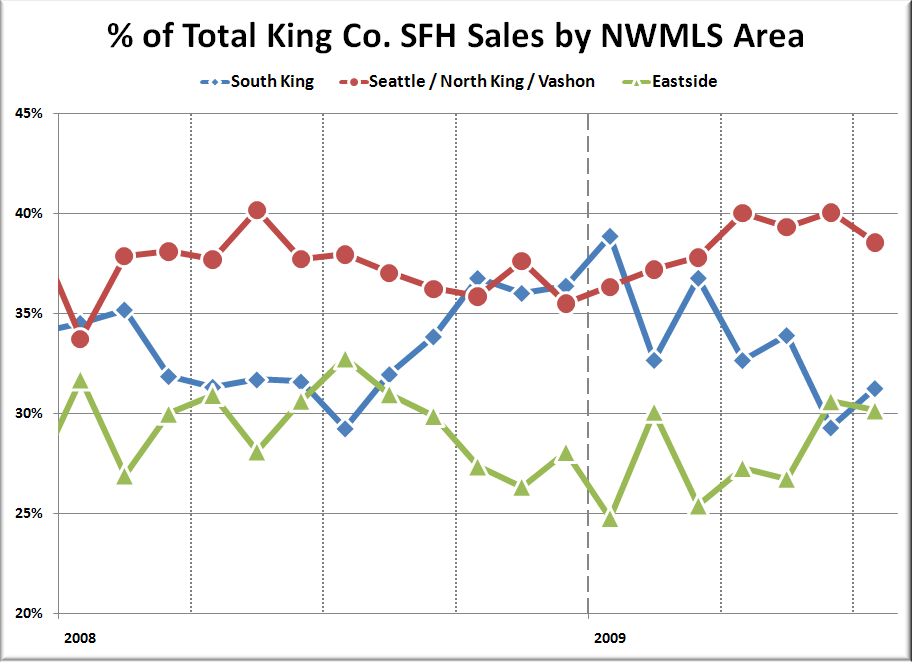
Here’s how much of the total sales each of our three regions accounted for in July:
- low end (South Co.): 31.3% of sales
- mid range (Seattle / North Co.): 38.6% of sales
- high end (Eastside): 30.2% of sales
The mid-priced region (Seattle) continued to take up a larger-than-usual portion of the sales in July, with the low and high-priced regions see-sawing again, but to a lesser degree than the dramatic spike seen from May to June.
Here’s a close-up of this year’s movement in bar-chart format:
I suspect that as we continue to see prices fall, there will be a continuing pattern of more sales in the close-in Seattle neighborhoods. When homes became too ridiculously expensive during the bubble, many people employed the “drive ’til you qualify” tactic when purchasing. Now that prices are coming back down to earth, it would appear that the strategy has shifted to “wait until the neighborhood you want to buy in falls into your price range.”


softwarengineer » Aug 18, 2009 at 7:38 am
Actually Tim, your bar charts look flat in price in just an “eye ball” regressive analysis sense
IMO flat sales during the Summer from Winter is horrifying in a RE sense, where’s the summer bounce….or, LOL [to mimic some of the blogs], where’s the groves of summer knife catchers?
Indy » Aug 18, 2009 at 7:47 am
Well, I’m not sure I see a strong trend signal in those graphs, they look fairly noisy to me. At the end of the day when the system gets closer to equilibrium, it’s still going to be cheaper to live farther away, so neighborhood preference will always have additional cost, and the main question is whether that cost is worth the benefit.
Now, it could be that if all prices fall 20%, then that differential has also fallen 20% and if someone’s preferences are more static and still worth, say, another $100 per month, then the gap has been bridged by a general decline in prices.
But, of course, that would bid up prices in the preferred neighborhoods relative to less desirable locations, which increases the gap again, etc… The distribution of house prices and who resides in what parts of the given housing stock must, eventually, have some relationship to the distribution of incomes and wealth. Top/bottom 20% areas are going to be occupied by top/bottom 20% earners in the long run, though perhaps there are some current imbalances and opportunities for tier-mobility in the short run.
biliruben » Aug 18, 2009 at 8:26 am
I think you need to continue to include the longer-term graphs in order to show the trend, to satisfy the skeptics too lazy to click through to your old post.
I really like this post. I missed it last month.
ray pepper » Aug 18, 2009 at 9:09 am
Talk about hot Seattle neighborhoods. I had two seperate clients lose out on their offers in Laurelhurst. 1 finally accepted yesterday from another client. Beautiful area and location.
Ira Sacharoff » Aug 18, 2009 at 9:31 am
A couple of questions/ random thoughts:
1. Are the number of places for sale roughly equivalent in the three ranges, and has that changed?
2. Is it simply a matter of distance, or are there other factors involved? For example, a couple of years ago, loans were being given to practically anybody out there with a pulse. Which resulted in higher sales in the lower tier. Now that one actually has to have things like jobs and downpayments to qualify for a home loan, doesn’t that mean that some people who were formerly able to buy lower tier homes are now unable to, hence the smaller percentage of sales in the lower tier?
Larry » Aug 18, 2009 at 3:33 pm
[This comment was both completely off-topic and blatantly incendiary toward a specific individual, both of which are plain violations of our comment policy. The comment was therefore deleted. -The Tim]
Hugh Dominic » Aug 18, 2009 at 3:38 pm
RE: ray pepper @ 4 – laurelhurst is really sterile. And it’s just trying to hold out until the 520 expansion destroys the lake views. Lots of MILFs though.
back2reality » Aug 18, 2009 at 6:54 pm
Tim, your statement about buyers waiting for falling close-in neighborhood prices is dead-on. In this market, I don’t see much financial incentive to buy a house that I’m not absolutely in love with.
waitingForABreak » Aug 18, 2009 at 8:31 pm
North Capitol Hill, which is solidly upper price range, seems to be completely frozen. Large houses that people poured cash into trying to get 2007 asking prices. Many sellers are wealthy enough to keep their houses listed indefinitely which is the current state. There seem to be zero buyers in the $2M range for the big and fancy places.
The lower end ($1M) has had sales but that’s the exception. Hard to call it a buyers market yet when there’s nothing priced to move.
The Market Wrap-Up For July | Redfin Seattle Sweet Digs » Aug 21, 2009 at 4:08 pm
[...] Look at sales volume in July [...]