It is time once again for our annual predictions post, where your host goes on record with crazy shots in the dark about what might happen in the Seattle real estate market over the next calendar year. For those of you following along with this game at home, here are the predictions of record for the past three years: 2007, 2008, & 2009.
First up, let’s see how everyone from 2009′s post did.
The Contenders:
- Matthew Gardner, local land-use economist
- Steve Tytler, Everett Herald Real Estate Columnist / owner, Best Mortgage
- J. Lennox Scott, Chairman and CEO of John L. Scott Real Estate
- Tim Ellis, editor-in-chief, Seattle Bubble
| Gardner | Tytler | Scott | Ellis | King Co. SFH | |
| Prices: | “essentially flat” | -5% to 10% | “stabilized” | “about -10%” | -5.8% |
This year’s winner for the closest prediction is Steve Tytler, whose guesses have consistently been the closest of anyone actually in the industry. My price guess looks like it will probably end up being the closest if you use Seattle’s Case-Shiller data (October was down 12.4%), but to be fair and consistent, we’re sticking with the NWMLS median, so Steve gets the prize this year.
Here is the text of my predictions on inventory, sales, and prices last year:
My guess is that inventory in 2009 will be flat to slightly down from 2008 for most of the year. I am betting that the double-digit YOY drops in sales will not last beyond the first or second quarter, but will eventually flatten out and maybe even show YOY gains.
…
As far as a specific prediction on prices, my guess is about another 10 percent drop in 2009, which would put December 2009’s median at $363,150.
Inventory did indeed end the year down, and sales showed YOY gains. Overall, my biggest shortcoming was in failing to foresee the February implementation of the $8,000 tax credit, which clearly provided a short-term boost to the market.
The Real Estate Non-Market
This brings me to my giant caveat for 2010. The excellent real estate analyst Rich Toscano wrote a great piece in November about the increasing difficulty of Forecasting the Real Estate Non-Market that I feel is quite relevant.
…the real estate “market” is now as much a political entity as it is an economic entity. The government has gone to amazing levels of effort to prop up the housing market. …huge amounts of money are being borrowed or simply created out of thin air and shunted directly into the housing market through multiple channels. Even as demand is thus boosted, supply is being constrained by foreclosure moratoria and opaque and arbitrary financial industry bailouts.
The net effect is that government intervention is exerting an enormous influence on the housing market. So one can’t just look at fundamentals as in the good old days. Instead, one is forced to practice a sort of real estate Kremlinology in an attempt to figure out how fiscal and monetary policy will affect, or cease to affect, the market.
Looking Back at Where We Have Been
Of course, it’s still fun to make wild guesses, even if we don’t know what the government will pull out of their future taxpayer-funded hat next. But before we get to this year’s predictions, I thought it might be informative to drop a few charts. The following three charts go back through 1993, which is as far back as I have been able to locate consistent NWMLS data on home prices.
First up is King County’s median SFH sale price, adjusted for inflation in November 2009 (the latest CPI data) dollars.
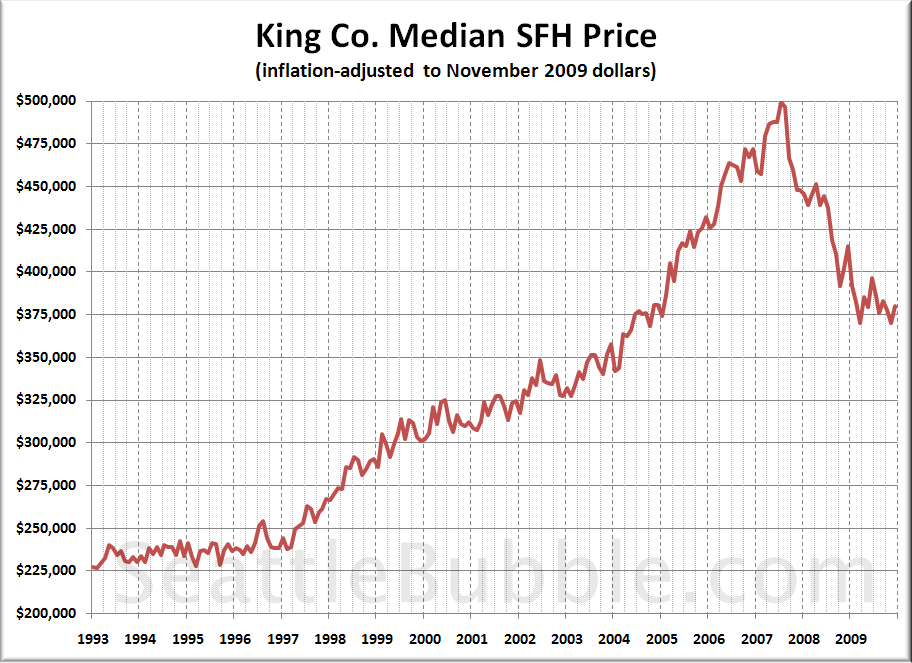
In November 2009 dollars, the July 2007 peak was just barely shy of $500,000, peaking at $499,545. December 2009 came in 24% off that peak. Next, here is a chart of home prices and King County median household incomes, indexed to January 1993.
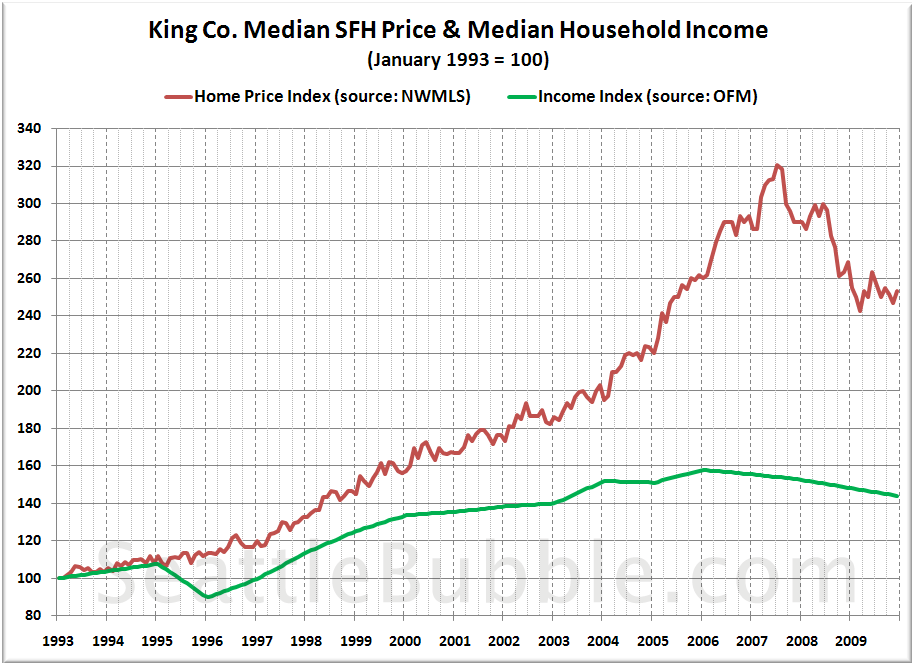
Something still seems a bit, shall we say, off about that. Lastly, here is King County’s affordability index:
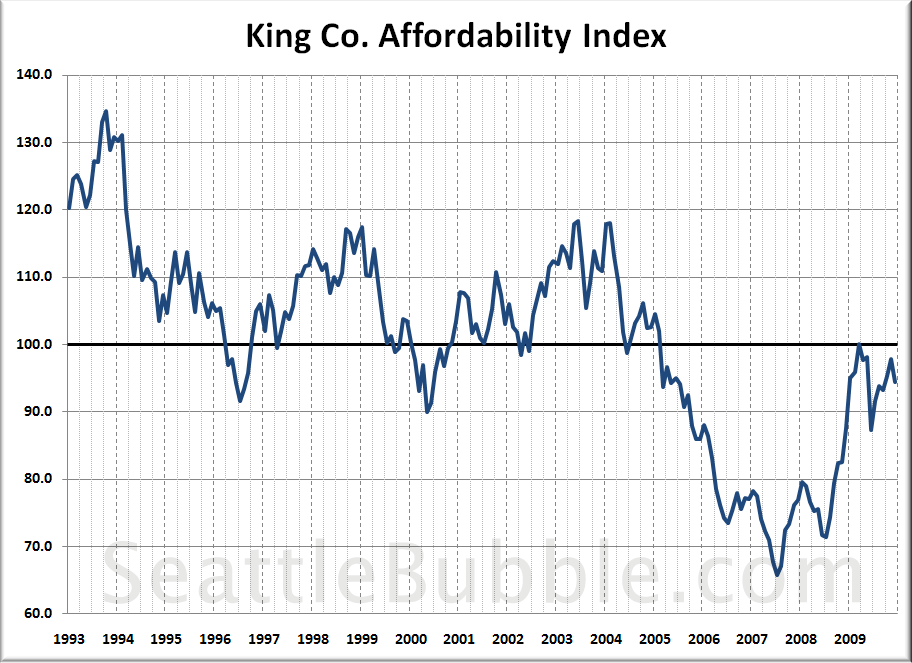
Definitely an improvement there, but a lot of what is keeping that above 90 is the crazy low interest rates, being held there thanks to the government. See above.
The Crystal Ball Gets Murky
So, let’s see what predictions we can find from the usual suspects for 2010.
Oddly enough, it seems that fewer and fewer local real estate professionals are willing to step out on a limb with predictions. The only article I was able to find that referenced 2010 and quoted Gardner, Crellin, and Scott was Eric Pryne’s piece in the Times: Tax credit fuels home-sales bounce, but will it be just a blip?.
Here’s all those three had to say in that article:
In February, Congress approved an $8,000 tax credit for first-time homebuyers in hopes of kick-starting moribund home sales.
“It worked,” Lennox Scott, chairman and CEO of John L. Scott Real Estate, said at a recent industry forum. “That’s what completely activated the market.”
…
After plummeting 20 percent in 18 months from its summer 2007 peak, the median price of a single-family home sold in King County slipped only slightly more in 2009.
…
And next year? “They’re not going to go up,” Jill Wood, Windermere Real Estate president, said of home prices. “They’ve probably leveled off for now.”Even that assessment may be optimistic, others say. Glenn Crellin, director of the Washington Center for Real Estate Research at Washington State University, said it’s more likely that prices will continue to decline through midyear.
…
The question now is, how many prospective buyers remain? “Were we stealing future demand?” Seattle land-use economist Matthew Gardner asked at a recent forum.
So we’ve got no prediction from Scott, an ambiguous forecast of a decline from Crellin, and a question from Gardner that he likely already knows the answer to. We did also get a bonus forecast from Jill Wood of prices having “leveled off.”
The only commentator I’ve found still willing to join me in predictions is perennial Seattle Bubble favorite Steve Tytler. Here’s his piece: Forecast for 2010 housing market: slow decline
I think average home prices will continue to drop a little, but the pace of depreciation will continue to slow. Overall, average home prices may fall about 5 percent, but as always the rate of depreciation will vary from neighborhood to neighborhood. In general, highly desirable neighborhoods, especially those close to major job centers, will do better than outlying areas.
Will we hit the housing market bottom in 2010? Maybe. You can only know for sure that a market has bottomed in retrospect when you can look back at housing prices on a graph and see the point where they stopped going down and started going up and stayed up. We may very well hit that point some time next year, probably late spring or summer.
Kudos to Steve for still being willing to stick his neck out there.
The Tim on 2010
So finally we get to my predictions for the coming year. Keeping in mind that unknown future government meddling will probably throw off any guesses I make today, my outlook for 2010 is pretty similar to what I saw for 2009. I don’t think Seattle home prices have bottomed yet. If allowed to adjust to market fundamentals, they’ve probably got at least another 10% to fall, maybe a bit more. I would expect most of that to come this year.
Barring any additional free money giveaways, sales will probably show YOY gains during the first part of the year, and be more or less flat for the second half. I suspect that interest rates will rise, possibly up into the sixes, which when combined with the borrowed sales thanks to the tax credit, will end up supressing sales as the year winds down. Inventory will probably be flat to down slightly.
There you have it, The Tim on record for 2010. Now lets’ hear your predictions in the comments, as well as in this poll:
What's your King County SFH median price prediction for 2010?
- Down more than 20% (4%, 19 Votes)
- Down 20% to 15.1% (4%, 19 Votes)
- Down 15% to 10.1% (14%, 68 Votes)
- Down 10% to 5.1% (41%, 205 Votes)
- Down 5% or less (24%, 121 Votes)
- Up less than 5% (11%, 53 Votes)
- Up 5% to 10% (1%, 6 Votes)
- Up more than 10% (1%, 3 Votes)
Total Voters: 494


RE: ARDELL @ 71 –
First Ardell, I believe that the predictions in this post are being judged based upon the change in Residential NWMLS median price from Dec 2008 to Dec 2009. If you pull the stats, you can confirm the change for that period is -5.8%. I grant you that it may well be a smaller decrease if Jan 2009 to Jan 2010 were used but that’s not the time period being used as the criteria.
As The Tim pointed out in this post, the decrease would likely be greater if the decrease in the Dec 2008 to Dec 2009 Case/Shiller Index were used. The Tim also says he thinks he would probably win if CS were used but I think that’s not necessarily true either. If one uses -7.5% for Steve Tytlers prediction, then -8.75% would be the mid point between the perdictions of Steve and The Tim. I think that its even money on which one is closer to the CS because I think -8.75 is pretty close to what the change in the CS will end up being for that period. I won’t go thru the math unless someone wants me to but my logic isn’t very complicated.
Although I appreciate Scotsmans point of view and acknowledge his conclusion that economic issues will cause housing prices to trend lower for an extended period, I also commend you for standing by your guns regarding your prediction. While I think that MLS median is less relevant than the CS Index, even the CS Index has been flat for the last 8 months (all be it with tax credit help). Clearly there are also seasonality issues which have helped your prediction. But never the less, the March low which was a 23% drop has held until now.
But we’ll see what happens with the normally slow winter season, the increases in REO’s and short sales and the end of the tax credit, assuming it isn’t extended again this spring. You’ve got to admit that these items could push prices lower, and although the economy is in better shape than Oct 2008, it’s still not very rosey.
Rate this comment:
0
0
RE: Civil Servant @ 99 –
First of all, I’m fair game. Feel free to pick on me.
But when I said “, felt comfortable that I could easily afford a few hundred dollars extra per month in order to do so”..
I meant that in feeling comfortable you’d also feel that your source of income was secure. If I felt that there was a chance that I was going to lose my job, I’d continue saving money and renting.
Of course, something can always happen. You could get run over by a streetcar and suffer brain damage, preventing you from going to work. But if co-workers were getting laid off, if I saw that my employer was bleeding cash, if I was involved in an industry whose technology was being quickly supplanted, I’d stay a renter.
Rate this comment:
0
0
RE: Scotsman @ 100 –
The best predictive mechanism that can be used on raw historical data alone is a monte carlo analysis. It doesn’t matter what your data set is, when it comes to the economy and the markets, this is the only tool that offers any level of statistical significance when it comes to predicting the future. Anything less has already been proven by the scientifical community to be like throwing darts at a dartboard.
Rate this comment:
0
0
RE: Researcher @ 103 – Monte Carlo Analysis has its limitations too.
Essentially your putting some form of trend analysis against the Efficient Market Hypothesis (EMH).
Rate this comment:
0
0
RE: Scotsman @ 100 –
Remember back in 2007 when she claimed she could “smell the appreciation” for 2008 in Kirkland?
I wonder how many of her past clients will end up losing their homes?
If/when they do…how will they get their pound of flesh from Ardell?
What’s that saying…
“Revenge is a dish best served cold”
I’d hate to be a realtor these days. Will our tax dollars be used for the “realtor relocation protection program”
;^)
Rate this comment:
0
0
RE: AMS @ 104 – RE: Researcher @ 103 –
Well yeah, but..! And there’s the dilemma- at this point economics doesn’t work like a true science where relationships always hold true, probably because we can’t or don’t adequately define all of the inputs and their subsets and relationships. I was lucky enough to take some econ classes from Paul Samuelson when he was around. One point he kept hammering home was that econ would probably never be neatly quantified- there was too much to try and capture. While some of the gross parameters could be modeled (and I worked in this area) there was a bit to much humanity involved to ever come up with a full set of reliable causal relationships. In short, it was good to look at the data, but we had to think our way forward from there using the data as guidelines along with our knowledge of the human condition and psychology/sociology to at best determine a range of possible outcomes. Seen another way, it’s not that hard to pick the direction and eventual destination, but the actual path is nearly impossible to know. I think most would agree that’s where we find ourselves now- we know the direction, we have some idea of where the bottom may lie, but we have little certainty in discerning how we’ll get there, or when.
Rate this comment:
0
0
RE: EconE @ 105 –
RRPP? Smells like realtor spirit?
Starving realtor- the new grunge.
Rate this comment:
0
0
When I’m finding places in Medina that I can afford, I’m thinking prices aren’t going much lower
Rate this comment:
0
0
RE: deejayoh @ 108 –
Medina’s a big area, and yes you should have always been able to buy there.
Rate this comment:
0
0
RE: Scotsman @ 106 –
So Scotsman, are you a Beaver? The closest I got to Samuelson was the royalty he got on my text book, but one of my high school buddies was Eric Rosenfeld’s room mate in the early 1970′s. Rosenfeld’s name may not ring a bell, but he was one of the Long Term Capital guys.
Rate this comment:
0
0
RE: EconE @ 105 –
That was referring to April 2005 not 2007 or 2008. Glad you remembered, but remembering it correctly would be better.
Rate this comment:
0
0
RE: AMS @ 92 –
“Also if prices linger for a long period of time below $362k, such as $350k for 4 or 5 months, the bottom call won’t look so good.”
I totally agree. How could I not.
Rate this comment:
0
0
RE: ARDELL @ 111 –
I wasn’t even around in 2005.
Here’s your 2007 post after asked what you “smelled” for 2007
I’ll start with Eleuas post…
http://raincityguide.com/2007/02/26/seattle-area-appreciation/#comment-101551
Then…Mark asked…
http://raincityguide.com/2007/02/26/seattle-area-appreciation/#comment-101553
To which you replied…
http://raincityguide.com/2007/02/26/seattle-area-appreciation/#comment-101565
You were “smelling” 2007 in that post.
Rate this comment:
0
0
By David Losh @ 109:
I’m at a loss for words. Perhaps you have it confused with Kent.
Rate this comment:
0
0
RE: deejayoh @ 114 – A guide.. Redfin’s list of currently least espensive homes in Medina. . Maybe this two bedroom one bath $578,000 is what David had in mind?
Rate this comment:
0
0
RE: deejayoh @ 114 –
Dang! I was sure the Gates mansion was on Lake…..Meridian?
Rate this comment:
0
0
By Everett_Tom @ 115:
Apparently, $688 a square foot is very affordable. After all, it’s only, what – about 3X the average for the area?
I don’t pretend to understand what he has in mind.
Rate this comment:
0
0
RE: One Eyed Man @ 101 –
“First Ardell, I believe that the predictions in this post are being judged based upon the change in Residential NWMLS median price from Dec 2008 to Dec 2009. If you pull the stats, you can confirm the change for that period is -5.8%.”
However I refute the implication that the market went down 5% to10% in 2009, because it didn’t. The market was flat not down in 2009, with a low point of $362,000 and a high point of $400,000 that started and ended at $380,000. To take a one month variance from Dec 08 to Jan of 09 and call it 2009′s performance level is misleading at best.
2009:
Jan 09 – $380k
Feb 09 – $377k
Mar 09 – $362k
Apr 09 – $380k
May 09 – $380k
Jun 09 – $399k
Jul 09 – $375k
Aug 09 – $385k
Sep 09 – $374k
Oct 09 – $379k
Dec 09 – $380k
Rate this comment:
0
0
By ARDELL @ 118:
From Redfin’s King County stats page:
Sorry, that’s not “flat.” Oh, and March wasn’t the bottom, either.
Rate this comment:
0
0
RE: ARDELL @ 118 – Ardell, this friendly competition has been running for years with the same criteria, to change it after the results are in would have been unfair and misleading, get over it.
Rate this comment:
0
0
RE: ARDELL @ 118 – That’s not all 12 months! You’re missing the starting point.
2009:
(EOM) Jan 09 – $380k
…
(EOM) Dec 09 – $380k
= 11 months.
(And you didn’t include November in your original post, but EOM Jan 09 to EOM Dec 09 is 11 months–How much did prices change in January?)
Rate this comment:
0
0
RE: ARDELL @ 118 – Also, Zillow charts (only updated through Nov.) look similar:
Raw median (all sales, not just NWMLS):
Median Sale Price
Median $/sqft:
Median Sale Price / sq. ft.
Rate this comment:
0
0
RE: patient @ 120 –
I Still Hear This From Some Homeowners Still in Bubble Denial
My home is special and it actually went up in price, my assessment proves it. The homeowner was standing next to a haughty realitor smiling and shaking his head “yes”.
I countered to both of them the fact that home appraisors either work for the seller/buyer to bank loan qualify or work for the owner to lower property tax in court…..the results are totally different [IMO, one assessment includes foreclosed and short sales and the other conveniently omits the low neighborhood data].
They read the newspapers too, about bad bank loan approvals based on bad assessments….the haughty realitor walked away and the homeowner in denial quickly changed the subject. LOL
Rate this comment:
0
0
RE: softwarengineer @ 123 – “I Still Hear This From Some Homeowners in Still in Bubble Denial”
More potential members for my new Church of Real Estate. If you think prices have gone down, it’s only a test of your faith in Real Estate!
Rate this comment:
0
0
RE: The Tim @ 122 – Let’s see if she’ll add the starting point so all 12 months are present. It’s her attempt at a sleight of mathematics to exclude the starting point. Many unsuspecting people might fall for it, ignoring the starting point, initial value.
Rate this comment:
0
0
RE: Scotsman @ 100 –
I agree Scotsman that there is always a difference between someone working in the field applying a myriad of factors to the end result, and simply using data. But if data were the only method, then all markets would be predictive via computer. I think we both agree they are not.
There comes a point where you say “given all that” (data) what should we do today, and what can we reasonably expect to happen? You call that “shoot from the hip”, and maybe it is. When I received all the data with regard to given stocks and sectors from analysts back in my former career, it was my job to apply that data effectively to each portfolio. Who should buy what and when did not rely entirely on the data, but on the data coupled with the specifics of each person and portfolio’s objective. Real estate is really no different.
I absolutely agree that you are most always right, because you are dealing from a total return basis compared to alternative investments. But the reality of residential real estate is that most people do not buy and sell homes based on total return factors. No one likes to lose money regardless, but they also do not like to buy that which will give them the best total return. If one would determine that the best total return was in Bellingham, it wouldn’t make everyone want to move to Bellingham.
To take a residential market and ignore the factors that move it is like trying to force a large square peg into a small round hole. Wanting a market to operate based on statistical calculation and ignore emotional factors, will not make it so. I am largely influenced by “the prudent man rule” which never equated to moving everyone to an all cash position. Translated to real estate, it never equals no one should buy or no one should sell. The “shoulds” usually fall on the emotional side, taking into account statistical and empirical evidence.
It is never my “job” to convince people to buy or sell homes. It is only my job to help people who want to do those things, consider all of the factors and make informed decisions.
As much as people may see a bias in me toward people buying and selling, I see a bias in many who want no one to buy, so that prices will go down to a point where they can buy cheaper. Where once peers looked down on renters, now peers look down on those who are buying and blame them for prices not going down to where they want them to be. There is no observation without bias.
Perhaps it is an underlying bias for all bubble blogs to want to stack the data toward the negative and for all agent blogs to want to stack the data toward the positive. Perhaps we can never be purely objective…we agent blogs or we bubble blogs. But to suggest a bubble blog has no bias and only an agent blog has bias, well…it just isn’t so. Perhaps a bubble blog ignores any positive news as much as an agent blog ignores negative…no more and no less.
Rate this comment:
0
0
RE: ARDELL @ 126 – Are you going to give us the starting point, or shall we just dismiss your claims based on an attempt at a sleight of mathematics?
Rate this comment:
0
0
RE: ARDELL @ 118 –
Correcting for the “missing” month:
***
However I refute the implication that the market went down 5% to10% in 2009, because it didn’t. The market was flat not down in 2009, with a low point of $362,000 and a high point of $400,000 that started and ended at $380,000. To take a one month variance from Dec 08 to Jan of 09 and call it 2009’s performance level is misleading at best.
2009:
Jan 09 – $380k
Feb 09 – $377k
Mar 09 – $362k
Apr 09 – $380k
May 09 – $380k
Jun 09 – $399k
Jul 09 – $380k
Aug 09 – $375k
Sep 09 – $385k
Oct 09 – $374k
Nov 09 – $379k
Dec 09 – $380k
****
For those who say that is not 12 months, let’s agree to disagree on that. That is a 365 day period and 12 months to me. It is a flat year that began and ended in the same place with 5% fluctuation this way and that during the year.
To study “a market” one must determine when it is moving in and out of norms and expectations. To do otherwise is misleading, and capitalizing on sensationalizing modest and expected movements. “It’s UP; It’s Down!” is erroneous within a given pattern of expectation. Technically correct, but as ludicrous as yelling everyday that the Dow isn’t a constant.
People do not “day trade” in residential real estate markets. The natural ebb and flow of a 12 month period should be a non issue. As long as the market stays between $360,000 and $400,000 as to median, there’s not much to say. 5% this way or that from $380,000 is my current expectation. Some consistent evidence outside that vs a minor monthly aberration, will be something to take note of.
Until then we bobble along the bottom.
Rate this comment:
0
0
RE: ARDELL @ 128 –
1. In February 2009 prices went down $3k. [=$377-$380]
2. In March 2009 prices went down $15k. [=$362-$377]
3. In April 2009 prices went up 18k. [=$380-$362]
4. In May 2009 prices didn’t go up or down. [=$380-$380]
5. In June 2009 price went up 19k.
6. In July 2009 price went down 19k.
7. In August 2009 prices went down 5k.
8. In September 2009 prices went up 10k.
9. In October 2009 prices wen down 11k.
10. In November 2009 prices went up 5k.
11. In December 2009 prices went up 1k. [=$380-$379]
-3k-15k+18k+19k-19k-5k+10k-11k+5k+1k = ZERO, but note we only have 11 months.
What happened during January 2009?
Rate this comment:
0
0
RE: EconE @ 113 – RE: EconE @ 113 –
Econ E – There is always a backlog of buyers in January waiting for inventory to increase and for better things to come on market. That is true both in weak markets and strong markets, and is as true today as it was then. The expansion of inventory in that quoted year moved median price from $430,000 to $485,000 by August. Did I predict that in August the mortgage criteria would institute a dramatic change in qualifying criteria? No. But I see nothing in your “quote” of me that was incorrect.
I do have to say it freaks me out a bit that you seem to be my personal transcriber having access at will to just about everything I have said to anybody. Feels a bit stalkerish :)
Rate this comment:
0
0
RE: AMS @ 129 – Technical correction:
Add +0k, which clearly does not change the sum:
-3k-15k+18k+0k+19k-19k-5k+10k-11k+5k+1k = ZERO, but note we only have 11 months.
Now all 11 months are present.
Once we know what happened during January 2009, we’ll have the full 12 months of the calendar year 2009.
Rate this comment:
0
0
RE: ARDELL @ 130 – “I do have to say it freaks me out a bit that you seem to be my personal transcriber having access at will to just about everything I have said to anybody. Feels a bit stalkerish :) ”
Google is your stalker!
Rate this comment:
0
0
Without specifying why this thread brought it to mind, I’m reminded of a quote from Casino, where the Robert DeNiro character is firing a flunkie:
“Listen, if you didn’t know you’re bein’ scammed, you’re too f-wordin’ dumb to keep this job. If you did know, you were in on it. Either way, you’re out. Get out! Go on. Let’s go. “
Rate this comment:
0
0
RE: ARDELL @ 128 – Aaah, the negative ninny, tin hat etc. attempt to discredit bubble blogs as negative pops up again. What is probably true is that bubble blogs tend to focus on what is Positive for consumers ( lower prices for example ) and agent driven sites tend to focus on what they think are positive for them. The inconvinience for agents though is that they mainly been spectaculary and conistently wrong about home prices and the bubble while bubble bloggers have mainly proven to be right.
Rate this comment:
0
0
RE: deejayoh @ 114 –
You are obviously a man of means so I figure you can afford just about anything.
Just kidding.
There are homes along the water in Medina, Hunts Point. area that should command a premium price. In my opinion this is one of those areas where appraised value can splill over into all housing units in an area.
Why would a house in Medina, that is not on the water command such a high price per square foot? I think in time reason will win the property value argument.
By the way, what is the added value for a home in Medina?
Rate this comment:
0
0
RE: patient @ 134 –
Patient,
You say: “bubble blogs tend to focus on what is Positive for consumers ( lower prices for example )”
I absolutely agree, and that is my claim, that bubble blogs have a bias toward prices being and getting lower, as you state. That is a bias toward the negative, and possibly a small one, but a bias nonetheless. I am not “discrediting” Tim or myself to say that we each have a slight bias. To suggest neither of us has any bias, is not likely realistic. I accept our bias is about the same in opposite directions, and we each strive to omit that bias, but eradicating it entirely may not be possible.
Rate this comment:
0
0
RE: ARDELL @ 128 – “To take a one month variance from Dec 08 to Jan of 09 and call it 2009’s performance level is misleading at best.”
Initially I didn’t understand what you were talking about here. Now I get it.
Kobe Bryant has often been called a “Buzzer Beater.” You know, he makes the game winning shot just before the buzzer. Why play the whole game? Instead, why not just hand Kobe the ball and give him one shot?
If he makes the shot, the Lakers win the entire game.
If he misses, it’s a tie game.
Why is it that the entire game comes down to that last shot? Why don’t shots after the buzzer count?
Rate this comment:
0
0
RE: ARDELL @ 136 – I am not so sure that The Tim has a bias toward 13 months in a calendar year.
Rate this comment:
0
0
RE: AMS @ 129 –
AMS,
You ask: “What happened during January 2009?”
In the 1st week closed sales had a median price of $352,500
In the 2nd week closed sales had a median price of $363,700
In the 3rd week closed sales had a median price of $408,000
In the 4th week closed sales had a median price of $375,000
In the final days closed sales had a median price of $399,000
The net result being that January 09 median price for closed sales came in at $380,000 the same as December 09.
Rate this comment:
0
0
RE: AMS @ 138 –
I do have a bias toward there being 12 months in a calendar year. I’m odd that way :)
Rate this comment:
0
0
RE: ARDELL @ 139 – I don’t get it. If January 1 was $380k, just like January 31, why has it been so long coming with the data? You kept claiming that the start of January had nothing to do with the year’s numbers, and now it’s exactly the same as the end of the month? Even if it had nothing to do with the numbers, you could have come forward with the $380k and suggested it makes no difference, since the beginning is the same as the end… So, no change in January 2009, huh? I smell a deception here.
Rate this comment:
0
0
I’d say down 10% or so… Look for rising interest rates to put additional pressure on prices.
Rate this comment:
0
0
RE: AMS @ 141 – RE: AMS @ 141 –
AMS,
Sorry, no. I haven’t been “long coming with the data. I started with the premise that the year started at $380,000 and ended at $380,000 and so was flat.
The last ten days of December 2008 were also at $380,000. (well $379,000 to be exact) so anyway you slice it, 2009 was not a year of 5% or 10% declines as has been initimated. 2008 was a down year, 2009 was not. There really is no other way to look at it, unless you are looking for a way to say 2009 was down. It simply was not a down year.
There are times when the issue is gray: And we may run into that in the near future:
http://www.realtown.com/Ardell/blog/tracking-the-market/what-you-need-to-now-about-the-real-estate-market
As you can see in the graph in the above link, if we run into early 2005 territory, we can argue the point of whether that is 2005 or 2004 prices. But as to 2009, there is no ambiguity. It started and ended in the same place. That graph also pinponts 2009 activity and its seasonal variances. But all in all, 2009 was the year of nada movement one way or the other.
Rate this comment:
0
0
RE: AMS @ 137 –
“the buzzer” of 2008 was $379,000. close enough to $380,000 to call it a wash.
Rate this comment:
0
0
RE: ARDELL @ 143 – Simply put, I’m not buying it. You’ve played your games, and now it’s over. Buzz.
Rate this comment:
0
0
The point about the median price was nice, but it is only one indicator. Tim put in some charts that haven’t been addressed, i put in some charts that were never addressed, and there is a large contingent of other opinions that think that prices will decline 10% this year.
My point was, and still is, that the selling season last year lifted housing unit prices about 3%, about the price of the tax credit. It was artificial, but a pretty safe bet to say that prices had stabilized. In my opinion that was the point of the government intervention.
Now with Obama asking for repayment of TARP money, and a tax on banks, I think that banks will move further away from residential lending to punish us all. I think they will continue to cherry pick the buyer pool, and more importantly stock holders will want to see that the assets used a collateral have a marketable value.
I’m going over to the foreclosure thread now because foreclosure prices are going to be a greater indicator of what actual value is, or will be in the near future.
Rate this comment:
0
0
One of the factors keeping core inflation under control is housing costs. They dropped 0.3 percent for the 12 months ending in December, the biggest annual decline on records dating to 1968. A glut of single-family homes on the market and record apartment vacancy rates have put pressure on housing prices.
Rate this comment:
0
0
RE: David Losh @ 147 – Please keep in mind that the housing costs used for inflation is based on rents. For a long time housing prices went up far faster than rents. Given the high purchase price to annual rent multiples, I suspect that housing prices will drop far faster than rents.
Rate this comment:
0
0
RE: David Losh @ 146 –
Depends how you want to stack the deck. Yes, Housing Prices can decline 10% from June median of $399,000 and still be at the same “bottom” of roughly $360,000. A better bet is will prices go lower than 2009′s bottom number, not 2009′s top top number. 5% down from 2009 median is a given as to possible and likely at some point in 2010..
Rate this comment:
0
0
RE: ARDELL @ 149 – “Depends how you want to stack the deck.”
I don’t think you’re bluffing about stacking the deck!
Rate this comment:
0
0
RE: ARDELL @ 149 –
Wow!
Rate this comment:
0
0
RE: AMS @ 92 –
Thanks for your comment.
I have a question for all of you.
What are some of the factors that might bring the home prices up in the future?
Some of the factors that I can think about are as follows:
1. The Obama recovery factor.
They have spent A LOT OF MONEY in hopes of sustaining this price level for homes in America.
Even if the tax credit expires in June, if we were to see signs of trouble, I don’t see how the gov’t would oppose bringing back the tax credit. If the gov’t simply ignores the further deterioration of the housing prices, all the efforts of Obama admin since Jan 2009 will have been simply wasted.
2. The Real estate in Seattle has not seen the bubble which is equivalent to that of Las Vegas, Pheonix,California and etc. If I am not mistakening, LV price is at 40% from its peak, Cal price is at 35% from its peak. If the Seattle price is about 25 ~ 30% from its peak, it leads me to believe that it might not be too bad from here and on.
3. Local economy
In 2008, 2009, many companies including Boeing, Microsoft announced layoffs. Although there are smaller companies having trouble, I just have not seen the increasing number of layoffs in Seattle. The uneployment rate is still high (both national and local) but there are signs of improvements.
I am a potential buyer, and I would love for home prices to go down to 2000 level. The factors for deciding to buy a property will come down to weighing the negatives vs positives.
I am a bear as well but I think we also need to think about the positives and weight the “+” vs “-”.
All of your opinions will be appreciated.
Rate this comment:
0
0
RE: Renter in Bellevue @ 152 –
The term is housing units, places to keep your carp while you are at work. Very quietly the cost of construction went down while the price for the housing went up. I’ve included the link showing inflation, construction cost and home prices http://en.wikipedia.org/wiki/United_States_housing_bubble
So let’s take thousands of town houses, at a price of $180K, that actually sold for $310K, or even $280K. Somebody made a lot of money for nothing. If you were smart you took the money and walked away. If you were stupid you continued to build the housing units, buy land, and pay on bank loans.
Once the whole appreciation in pricing stopped we were now saddled with a bunch of housing units people over paid for. So if you own a town house in Seattle, Everette, Tacoma, Puyallup, or Issaquah you’re out of luck.
People are bidding on what they think are houses. They are just buying detached housing units that will need to be maintained. for cash. No more equity to fix the roof, the flashing, the plastic plumbing, strand board sheathing, 24 inch on center construction, plastic widows, doors, MDF trim, nail pops, strand board beams, and possible sub contractor mistakes.
Let me throw in land use issues, with ground water, zoning density, infrastructure of roads that may mean traffic congestion, and the ability to build today, for less, with cheaper labor, and materials, especially when you buy the land from the bank after a foreclosure.
These new housing units will drive the price for real family homes up, for those who can afford them, but slums are developing in every city in the country by these new construction housing units.
Housing is done, over, forget about it, it’s like a 1957 Chevy or a Hyundai. You buy it, love it, refurbish it, or you buy it, use it, and throw it away. Either way it’s a drain on your resources.
Rate this comment:
0
0
RE: Renter in Bellevue @ 152 – Yes, I think we need more positive factors. The problem is that most reports of positive factors have major problems, flaws. When I see solid positive data, I report such.
This does, however, bring me to a discussion about risk. For the purposes of this discussion, risk can be in either direction: favorable or unfavorable. Also let’s take an ownership position. We could have the same discussion from a buying perspective, but prices going lower is favorable for buyers but unfavorable for sellers.
Many of us have entered into a Casino, the place were they have little blocks with dots that are tossed in a game known as Craps. There are many other ways the casino takes the players money with different games, machines, and so on. There are people who love to gamble, even if they are going to lose. Don’t ask me why, but huge buildings are built on the desire to lose. Of those who love to gamble, we know there are some people who have a problem. They know they are going to hit on the next play. It’s a sure thing. Just one more hit.
In the case of housing there is upside risk for the owner, but there is also downside risk, as we have seen as of late.
If a gambler has the money, and enjoys gambling, then what’s the big deal? When that same gamble casts tremors throughout the entire world economy, there’s a problem, even if there are some positive factors.
The other day I posted about Marin County. The information came from an article about property taxes.
http://seattlebubble.com/blog/2010/01/16/weekly-twitter-digest-link-roundup-for-2010-01-16/#comment-91996
What concerns me is not only that a median home costs 10x the median household income, but I am not sure that the household income has a great outlook of increasing.
In summary, housing prices are not on firm foundation.
Castles in the sky.
Have we reached escape velocity? …or are these efforts only slowing the descent? That sudden stop might be a killer, so we’d better delay it as much as possible. The problem is that many have on a personal level crashed, even if the future is so bright for the others.
So, yes, let’s have some positive data, but let’s be sure that it’s genuine.
Rate this comment:
0
0
“What are some of the factors that might bring the home prices up in the future?”
If sales continue to pick up, and inventory stays low, home prices could pick up, especially if employment picks up.
I don’t see it as likely anytime real soon, but it’s clearly possible.
But, back in 05′-06′, inventory was rising and sales were slowing. That was the screaming indicator to me that prices were going to drop. It just took much longer than I thought. And of course those aren’t the only factors that influence house prices.
At some point house prices will see a sustained rise. I’m guessing that if you bought a house right now it would be worth more in ten years. Still, I consider myself a bear too. Maybe not a grizzly, more like a panda.
Still, it’s hard for me to see the immediate future of home prices as being anything other than flat to down.
Rate this comment:
0
0
RE: Researcher @ 40 – Sounds a like like Software Engineer. CAN YOU TYPE LIKE THIS MORE?
Rate this comment:
0
0
RE: deejayoh @ 114 – To Dave Medina is Kent. Its like Chuck Norris.
Rate this comment:
0
0
RE: AMS @ 154 –
Thanks!!
Like I stated earlier, I am a bear.
I believe # of Foreclosure in the near future, Mortgage rate increase and unemployment rate alone should prevent the housing prices from going up (more likely going down 5% – 10% in the next year or two)
But this is what I am beginning to wonder.
1. The housing price is likely to go down another 10% in the next two years (which I believe is the consensus on this forum)
2. After two years, no one really knows what will happen but this we know.
Unemployment goes down, US economy will continue to improve, most of the foreclosures/distressed properties will have been cleaned up.
3. Thus, we don’t really have a scenario where we will see another housing price crash (barring some sort of cataclysmic event, geopolitical event, MS/Boeing going bankrupt, US economy collapse)
4. I am beginning to wonder if it might actually be a good time to buy if I am willing to take 5%-10% depreciation. (Or especially if I can get 5 – 10% discount from what I believe is today’s fair market value of the home)
Please correct me wrong if I have been wrong in any of my assumptions or my take on potentially buying a house in 2010.
I love all the debates on this forum.
Thanks!
Rate this comment:
0
0
RE: The Tim @ 122 – RE: AMS @ 154 –
Tim,
How about a POLL on “At what price would you be comfortable buying a SFR home in King County”?
1. Price in 2005
2. Price in 2004
3. Price in 2003
4. Price in 2002
5. Price in 2001
Rate this comment:
0
0
RE: Renter in Bellevue @ 158 – Let’s talk exit strategy.
I’d like to see an exit strategy with the percentage. How about 25%? If the market declines 25%, then you exit. No, I am not suggesting exactly 25%.
Part of the problem, as outlined in my Church of Real Estate, is that you never want to get whiplash buying high and selling low. The 25% exit strategy is a point where you exit because you must, unless you are a member of my Church, and then there’s no need for an exit strategy. If you have eternal faith in Real Estate, then losses are of no mortal consequence.
Then there is another factor which has been discussed. It’s the “enjoyment” factor. I’ve discussed how I walk into Starbucks to leave with a $5 cup of coffee. Without getting into more complicated issues, let’s agree the coffee is overpriced. The $5 cup of coffee is worth $0 once I accept it. Does that make it a bad buy? No, as I am going to gain more than $5 worth of enjoyment from it, or at least I think so when I made the purchase.
Imagine, for a moment, if Gates paid $2M for a $1M home. Sure he over paid by 100%, but who cares? It’s just pocket change. If he gets $2M worth of enjoyment, then it really does not matter that he overpaid by $1M. As always, rational players seek to pay as little as possible, so if Gates would have paid $1.2M he would have an even better deal, even if he still over pays by $200,000. When I over pay by a few cents, and it happened the other day at a major home improvement store, it’s no big deal. The specific situation was I needed a couple of screws. The bin was marked with the item number and price, which I carefully wrote both down. Item XXX, 15 cents each. When I arrived at the register, the price became 17 cents. I could have brought up the sign issue, and I am sure they would have adjusted the price down by 2 cents each times 2, for a total of less than a Nickel. I instantly did a computation on my time, and said to the cashier, as he was picking up the phone to call a manager, “I will pay the 17 cents each; it’s really no big deal.” I was out of there right away. I also have been known to pay 5 cents per gallon to avoid a busy station. My time is limited. Am I right or wrong, you make the call.
So, if you are buying and the finance is important, have a plan. If it’s pocket change, paying too much is not so important.
As far as your poll, I think this message outlines why everyone might have a different price level. There are some people who might be comfortable buying at 2007 prices.
What many people did, especially at the peak, was to buy as much as possible with as little down as possible. These were all potential members of my Church of Real Estate. They had eternal faith in the housing market. Many still have the faith, and that’s why my congregation, while coming under pressure, still has members.
Does this answer your question?
Rate this comment:
0
0
RE: mukoh @ 157 –
Another comment that makes no sense, but it worries me that I understand what you are trying to say.
Kent is more like Edmonds.
My point is that Medina is the water front, like Kirkland is the Marina.
The price of housing there makes no sense to me and I’m asking why anyone would pay a premium price to live there, other than on the Water, or the houses with the Views.
Rate this comment:
0
0
RE: AMS @ 160 –
1. No cup of coffee is worth five dollars, unless maybe it has whiskey in it, and…
2. People don’t have these urges to own a cup of coffee and put their mark on it. There’s not much you can do to improve a cup of coffee after you’ve purchased it, other than adding cream.But drinking it will last ten minutes, while you could have a lifetime gardening and doing creative things to your home.
If you regret buying the cup of coffee, you’re out a few dollars. If you regret buying the house, it could cost hundreds of thousands of dollars. Plus, you’re not going to be paying off the cup of coffee over thirty years, though with Starbuck’s prices, they might want to consider a seller financed option.
Rate this comment:
0
0
RE: David Losh @ 161 –
I think people who want to live in Medina put a premium on being able to ” live among their own kind”, so they don’t have to mingle with the riff raff.
Rate this comment:
0
0
RE: Ira Sacharoff @ 162 – Life is too short to drink cheap coffee.
Rate this comment:
0
0
RE: Ira Sacharoff @ 163 –
This kind of “Riff Raff?” There’s probably more of it in Medina than you know…
http://www.youtube.com/watch?v=U4D1xYoF1Pk
Rate this comment:
0
0
RE: AMS @ 160 -
I was hoping for a reply with buyer’s perspective, not a seller’s exit strategy.
But I know where you are getting at and I appreciate your comment!
Unfortunately I am not as loaded as B Gates.
I know I can’t time/pick the bottom but would like to come close to it if possible :)
Rate this comment:
0
0
RE: Renter in Bellevue @ 166 – It is written from the buyer’s perspective. The exit strategy needs to be in place before purchase.
Rate this comment:
0
0