February market stats have been published by the NWMLS. Here’s the NWMLS press release: Northwest MLS brokers say housing market in Washington State indicates recovery.
“We are entering what is traditionally our busiest home selling season,” said NWMLS director OB Jacobi, general manager of Windermere Real Estate Company. “With the first job increase since 2008 and closed sales in King County up about 45 percent, there is every indication that our market is in recovery,” he added. Jacobi reported “significant traffic” at open houses, which he attributes to the first-time homebuyer tax credit and rising consumer confidence.
Ah yes, that old statistical standby, open house traffic.
Here’s your King County SFH summary, with the arrows to show whether the year-over-year direction of each indicator is favorable or unfavorable news for buyers and sellers (green = favorable, red = unfavorable):
| February 2010 | Number | MOM | YOY | Buyers | Sellers |
|---|---|---|---|---|---|
| Active Listings | 8,115 | +7.9% | -14.8% | ![]() | ![]() |
| Closed Sales | 997 | +4.3% | +50.8% | ![]() | ![]() |
| SAAS (?) | 2.49 | +7.0% | -26.5% | ![]() | ![]() |
| Pending Sales | 2,079 | +17.8% | +64.5% | ![]() | ![]() |
| Months of Supply | 5.3 | +23.5% | -30.2% | ![]() | ![]() |
| Median Price* | $373,010 | -0.5% | -0.5% | ![]() | ![]() |
Closed sales came in pretty much spot on where I predicted on Tuesday that they would. The median price dipped slightly, and unless we see a fairly significant month-to-month drop in March, is likely to inch into positive YOY territory this month, since March 2009 was the low point for that measure at $363,850.
Feel free to download the updated Seattle Bubble Spreadsheet, and here’s a copy in Excel 2003 format.
Here’s your closed sales yearly comparison chart:
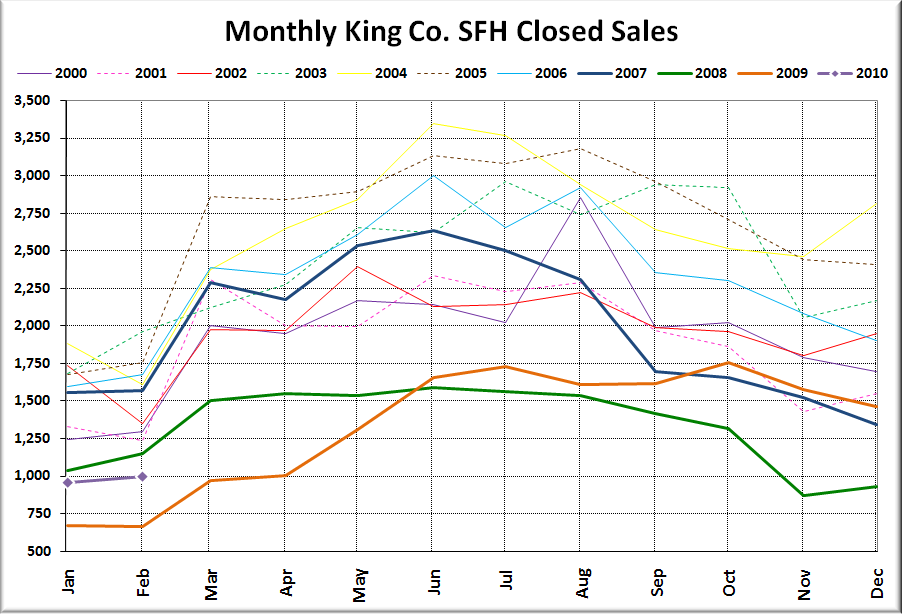
Same story as January. More sales than 2009, but less than every other year on record.
Here’s the graph of inventory with each year overlaid on the same chart.
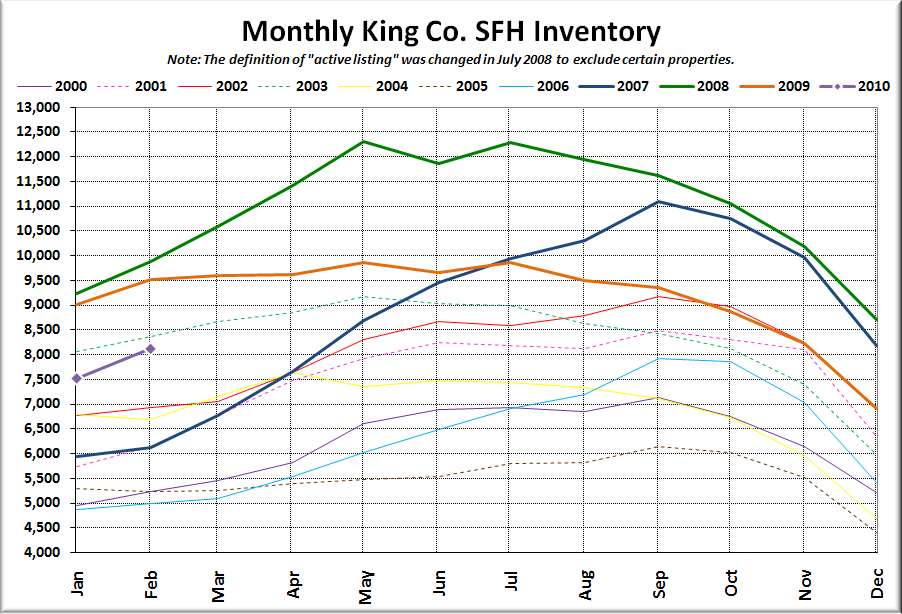
Between 2000 and 2009, the total number of listings on the market increased an average of 3.5% between January and February. This year, they jumped more than double that, rising 7.9% in a month. Perhaps more sellers are buying the recovery talk and have become convinced that it’s a good time to sell?
Here’s the supply/demand YOY graph. In place of the now-unreliable measure of pending sales, the “demand” in the following two charts is now represented by closed sales, which have had a consistent definition throughout the decade.
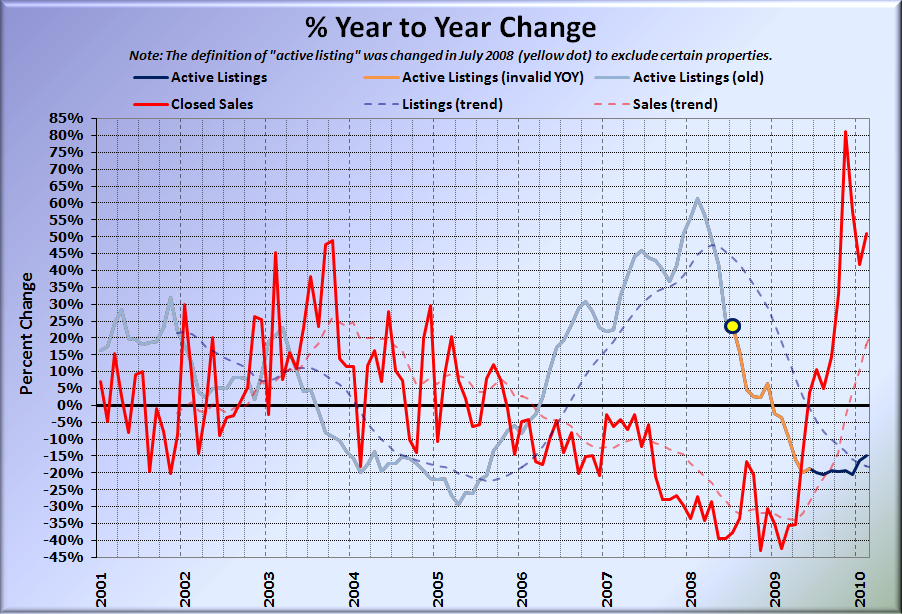
Still way up there in the positive territory, thanks to the absolutely dismal winter sales figures a year ago.
Here’s the median home price YOY change graph:
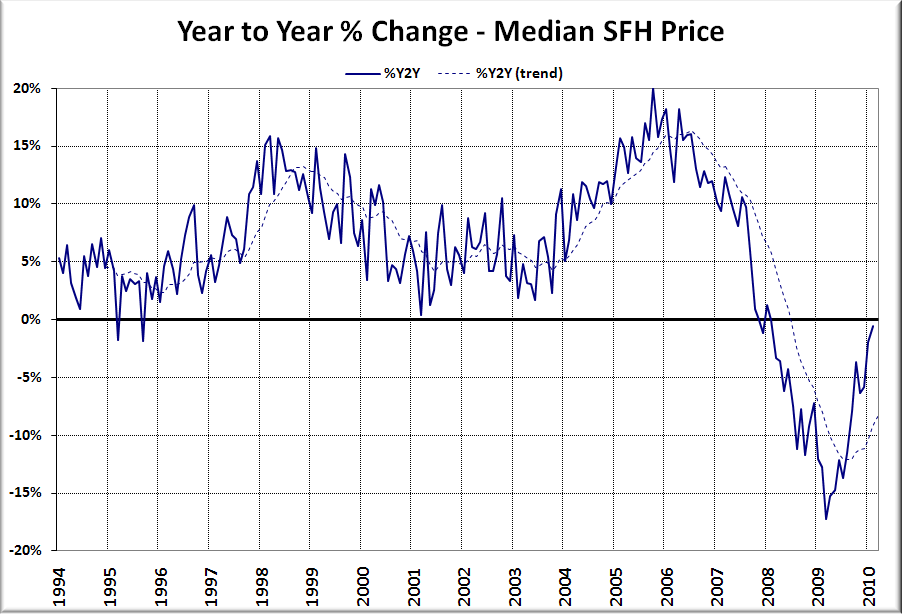
Almost back to zero there. I’m betting next month we’ll inch above zero, but who knows if we’ll stay there for long.
And lastly, here is the chart comparing King County SFH prices each month for every year back to 1994.
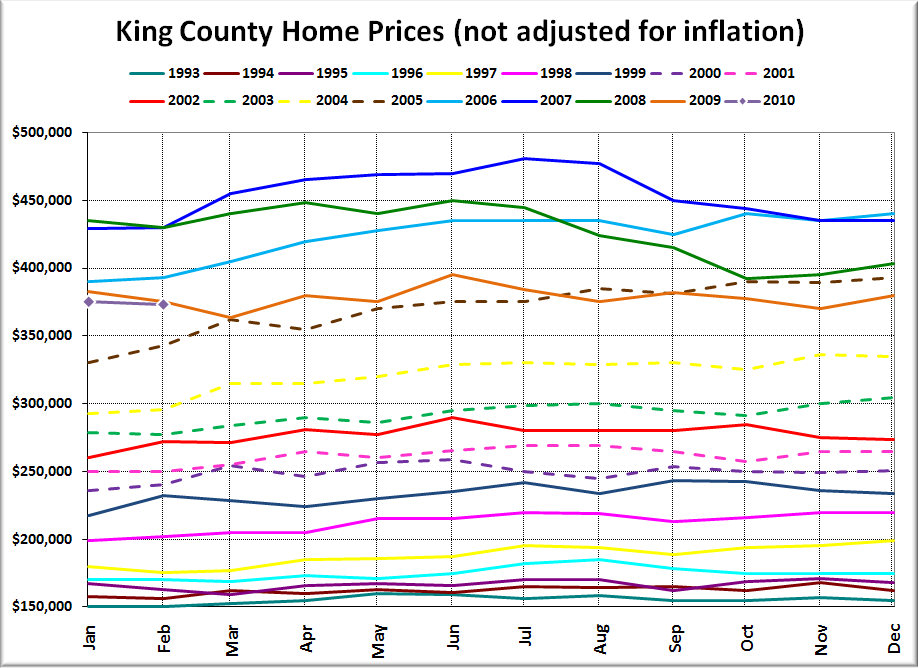
2005 was apparently a good year for home prices, so good that the market decided to revisit that level four years later and hang around for a year or so.
News blurbs to hold you over until tomorrow’s reporting roundup:
Seattle Times: King County home prices stabilize in February
Seattle P-I: Seattle home prices up over last year, report says
See, flat really is the new up.


Are the county breakouts available anywhere? Last month it looked like the in city prices were stable but outlying areas still dropping.
RE: DrShort @ 1 – The breakout links are on the upper-right of the press release.
And yeah, it looks like that’s still the case. YOY SFH median price changes:
SW King: -12.8%
SE King: -11.1%
Seattle: +1.4%
N. King: -17.2%
Eastside: +1.0%
RE: The Tim @ 2 –
Thanks. It appears my problem was that the breakouts don’t work for Safari.
I can’t believe it’s already March, start of the prime selling season. I can hardly wait for Greg Perry to swing buy to tell us that the market is now so hot that he needs to wear a flame retardant suit to work.
What can you say about Feb’s numbers other than that the market is still anemic. Below 1000 closings is hardly an evidence of a recovery or a strong market. And this with the tax buyer credit expanded to move up buyers. Weak.
Having YOY prices stabilize in Feb just before inventory ramps up is good news for everyone… buyers and sellers. Price/rent and price/income ratios are now back in line with historical norms. I doubt we’ll see much price movement one way or the other until 2012 because of non-subprime ARM resets, but it is starting to really look like we are at a bottom.
By mydquin @ 5:
Rent is falling (see e.g., http://www.calculatedriskblog.com/search/label/Rental%20Market for a national perspective) and shows no signs of switching directions, so either price needs to fall proportionately to maintain price:rent, or price:rent is going to increase. Given that, I don’t see how an assertion that price:rent is in line with historical norms supports the idea that prices have stabilized.
By Fran Tarkenton @ 6:
is it possible that rents could keep falling after housing has bottomed?
By patient @ 4:
Well it’s clearly not all that strong. I don’t think anyone has made the claim that it’s all that strong. 997 though is a lot better than 661, and the median is virtually identical to last year.
Speaking of claims, has anyone made the claim that the move up credit is doing much? I think it’s been pretty insignificant. I’m not sure that $6,500 overpowers inertia that much with people who already own a house. $4,500, or whatever the CFC number was, wasn’t enough to even get me out of a 20 year old pickup truck. It would take a lot more to get me to move into a different house, unless I was planning that already.
RE: pfft @ 7 –
“is it possible that rents could keep falling after housing has bottomed?”
Doubtful. How many would continue to buy at a fixed price as rents became ever cheaper? Given people will only pay some relatively stable premium for ownership over renting, if rents continue down home prices will continue down.
Additionally, since rental income determines the value of the asset generating the rent, as expected rental income falls the price one is willing to pay for the asset must continue to fall. Rising unemployment, reductions in discretionary income, and higher taxes on property will also work to reduce rents and home prices.
RE: Kary L. Krismer @ 8 –
Kary,
I don’t think that either of us fit the mold of the classic buyer for either vehicles or houses.
Me, I’m just too tight with my money to have anything like that small credit lure me.
If it was a 150,000 dollar move up credit, I might consider it, or a 15,000 dollar cash for clunkers credit.
By Scotsman @ 9:
I would agree those things will be negative, but I’m not sure you’ll seem them. Washington recently created net jobs (only about 2,000, but it was a positive number), and SFR real estate taxes are actually falling (probably because other classes of properties are paying more–which could easily change next year).
RE: Ira Sacharoff @ 10 – True. But for first time buyers the tax credit is attractive to people who are already leaning in that direction. And I’ve seen a bunch of such people. For the move up buyer, I think I only recall meeting one of them (not that my personal experience would be all that relevant, but I’m combining that with having not heard anyone claiming it’s been a success).
Flat really does describe the prices. As I noted, Feb/09 was $375,000. Since that time the low median was $363,850. The high was $395,000 last June, and that was a $20,000 jump up from May and by August it was back down to $375,000. But for that jump I’d call all that movement noise.
By pfft @ 7:
It’s possible. Price:rent has certainly varied over time. What I was getting at was a statement that price:rent has returned to historical norms does not support the statement that house prices have flattened because rents are continuing to fall.
By Scotsman @ 9:
no offense, but are you doubtful or do you know? do you know unemployment and discretionary income are up and down respectively or do you think that?
By Fran Tarkenton @ 14:
it should be noted that if rents are falling 2 out of the 5 areas tim posted prices for are up.
Real Estate, more to the point, home prices are a separate animal.
Housing units never change in value in relation to all things in the basket of goods. Yes rents can continue to fall which will make housing less attractive to an investor.
I’m going to say this again, prices will slide until they are in relation to all the other things a family needs to live well. The equity has already been squeezed out and will need to be paid off, or down.
It’s a dead market, very dead. The rest of the economy can go on with new bobbles to play with, but Real Estate is over built, built cheap. We can always build cheaper, and faster from now on.
The only thing keeping the Real Estate machine alive is foriegn investment. Lebanon, Singapore, Peru, and Gambia all have thriving Real Estate market places, but when that’s over, it’s over.
Did we pull demand forward with the tax credit? Will sales now fall? $100,000 per home?
“When you take away all the support from the housing market, the underlying demand for housing is a lot weaker than we thought,†said Mark Vitner, a senior economist at Wells Fargo Securities LLC in Charlotte, North Carolina. “We clearly pushed some demand forward, and there wasn’t that much demand to pull forward anyway. The housing recovery is going to be very, very slow. This is no surprise and suggests that the extension and expansion of the home buyer tax credit will probably cost taxpayers over $100,000 for each additional home sold.”
http://www.calculatedriskblog.com/2010/03/very-expensive-home-buyer-tax-credit.html
By Scotsman @ 18:
wells fargo is probably not the people to quote. in fact, the person is located in NC so they might be former wachovia people! I am pretty sure wachovia was in NC and I am pretty sure wachovia wen to wells fargo. anyone remember?
sales probably were pulled forward but we’ll see if sales fall and then stabilize like they did after cash for clunkers.
RE: pfft @ 15 -
Here’s a good discussion, starting mid page, of the drop in discretionary income and ability to take on more debt. It’s a “known.”
http://www.oftwominds.com/blogmar10/keynesians-doomed03-10.html
RE: The Tim @ 2 –
Oh shucks, the largest ARM reset wave in history is about to hit. And darn, there’s no govt stimulus money going toward creating jobs. Any optimism now is going to be GODZILLA STOMPED before the year is over.
Oh well. Try again next year maybe.
This is the quote from 1954 that keeps me alert even when (or especially because?) the pundits talk about “the recovery”:
From John Kenneth Galbraith’s 1954 book The Great Crash – 1929. It describes how the “Principle of Maximum Ruin” played out in 1929:
“A common feature of all these earlier troubles [previous panics] was that having happened they were over. The worst was reasonably recognizable as such. The singular feature of the great crash of 1929 was that the worst continued to worsen. What looked one day like the end proved on the next day to have been only the beginning. Nothing could have been more ingeniously designed to maximize the suffering, and also to insure that as few as possible escaped the common misfortune.
The fortunate speculator who had funds to answer the first margin call presently got another and equally urgent one, and if he met that there would still be another. In the end all the money he had was extracted from him and lost. The man with the smart money, who was safely out of the market when the first crash came, naturally went back in to pick up bargains. … The bargains then suffered a ruinous fall. Even the man who waited out all of October and all of November, who saw the volume of trading return to normal and saw Wall Street become as placid as a produce market, and who then bought common stocks would see their value drop to a third or fourth of the purchase price in the next twenty-four months. … The ruthlessness of [the stock market was] remarkable.” (p. 108)
RE: johnnybigspenda @ 21 –
Don’t be silly, this is the bottom. I read it on Yahoo!
” Nothing could have been more ingeniously designed to maximize the suffering, and also to insure that as few as possible escaped the common misfortune.” True, and funny in a very dark way.
Personally I don’t care if prices temporarily go up or down and the same goes for volumes, until fundamentals are inline with prices we are ultimately going down. Imo we are light years away from being in balance. There is no Countrywide, Wamu and their likes anymore to drive crazy home prices, the government are doing their best to take over as a risky lender but it’s not going to last. We are far from having corrected for that issue alone. Then we have the foreclosure situation, the unemployment situation, the national debt problem (higher taxes are likely around the corner ) and the fact that so many of the prospective move up buyers are out of equity due to the mix of falling values and abuse of cash out refis. Then we have the falling rents and change in psychology about home ownership and so on. I really don’t understand have anyone can think this is anywhere close to the bottom.
RE: Scotsman @ 18 –
Calculated Risk is another nut job blog, made for nut jobs, about nut job assertions, about a world of fear mongering. Is there a point there? Do any of the 471 people who left a comment have a point?
It’s just more Rain City Guide jibberish to sell ad space. Let’s look at the Publicola site again.
RE: Scotsman @ 18 – The tax credit is not intended to cause more home sales to occur that would have otherwise. This is a common fallacy. The tax credit was designed to add $8,000 to the price of every home sold, thus arresting the price declines.
RE: Hugh Dominic @ 26 –
The tax credit was designed to add $8,000 to the price of every home sold, thus giving Bernanke, Dodd and Frank’s bandit buddies at Goldman Sachs and co. some more time to suck on the fed teet before taking additional hits on their mortgage portfolio not to risk going bust. Fixed that for ya.
By Hugh Dominic @ 26:
That’s actually not too far off. Most first time home-buyer programs actually benefit the second time home-buyer.
RE: pfft @ 19 –
Yes, PFFT, both Wachovia and Bank of America were HQ’ed in Charlotte NC. I believe it was December 2008, that Wells Fargo finally outmanuevered Citi to purchase Wachovia, with help from the IRS, not FDIC. Can you imagine if C was successful in their bid?
By pfft @ 16:
What are you attmpeting to say? Are you questioning whether rents are falling, or asserting that price:rent is changing? (Or are you saying that there is only a weak correlation between rents and prices, which is the most logical parsing of “IF rents are falling (THEN) 2 out of the 5 areas tim posted prices for are up?”)
You take more lumps than you deserve from the ultra-bears around here, but you also do yourself no favors by expressing your positions poorly.
[...] NWMLS: Prices Flat, Sales Slowly Climbing Up From Lows (seattlebubble.com) [...]
RE: Hugh Dominic @ 26 –
Heh. I should have known that. ;-) But if the true estimated cost was $100K per home purchased, what happened to the other $92K? Does that go to GS as an advising fee?
RE: Hugh Dominic @ 26 –
Exactly. And by slowing down the price declines of home sales doesn’t that also help keep the ‘value’ of every other house from going down as well? It keeps more people from going underwater on their mortgages. It keeps the bank books a bit stronger and gives them more time to plan their strategy. The government spends a little money to slow the loss of value on every single house in the US. It is a small price to pay. If too much money is lost too quickly people start to panic.
RE: Lurker @ 33 – that’s right. It also supports/inflates the value of all the comps. And the mortgages against all properties. Since banks and the US own those mortgages, you can argue that the downstream effect is to support the values of their mortgage portfolios.
Scotsman et al have bought into the cosmetic packaging that the government wrapped the program in. The $100k figure is a canard. Creating new home sales and helping young buyers seems innocent enough. The true purpose of subsidizing home and mortgage values has clear winners and losers and the public would not have swallowed it as well.
[...] in Some NeighborhoodsBy The Tim on March 9, 2010 | Leave a responseAs we were digging through the February data from the NWMLS, some of us noticed something interesting. While the county-wide median price was basically flat [...]