Let’s check out the three price tiers for the Seattle area, as measured by Case-Shiller. Remember, Case-Shiller’s “Seattle” data is based on single-family home repeat sales in King, Pierce, and Snohomish counties.
Note that the tiers are determined by sale volume. In other words, 1/3 of all sales fall into each tier. For more details on the tier methodologies, hit the full methodology pdf. Here are the current tier breakpoints:
- Low Tier: < $262,524 (up 1.5%)
- Mid Tier: $262,524 – $401,143
- Hi Tier: > $401,143 (up 1.6%)
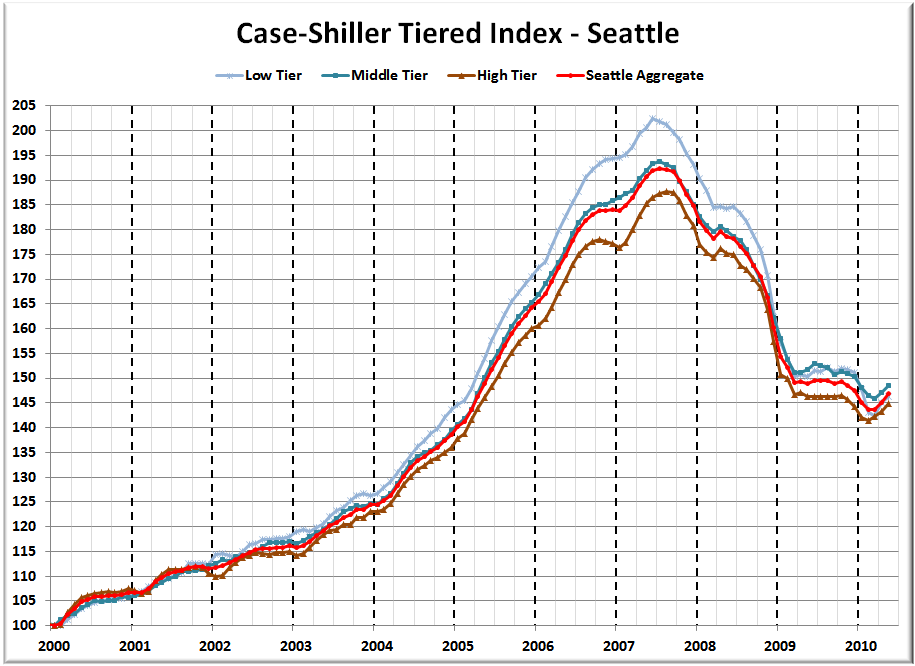
First up is the straight graph of the index from January 2000 through May 2010.
Here’s a zoom-in, showing just the last year:
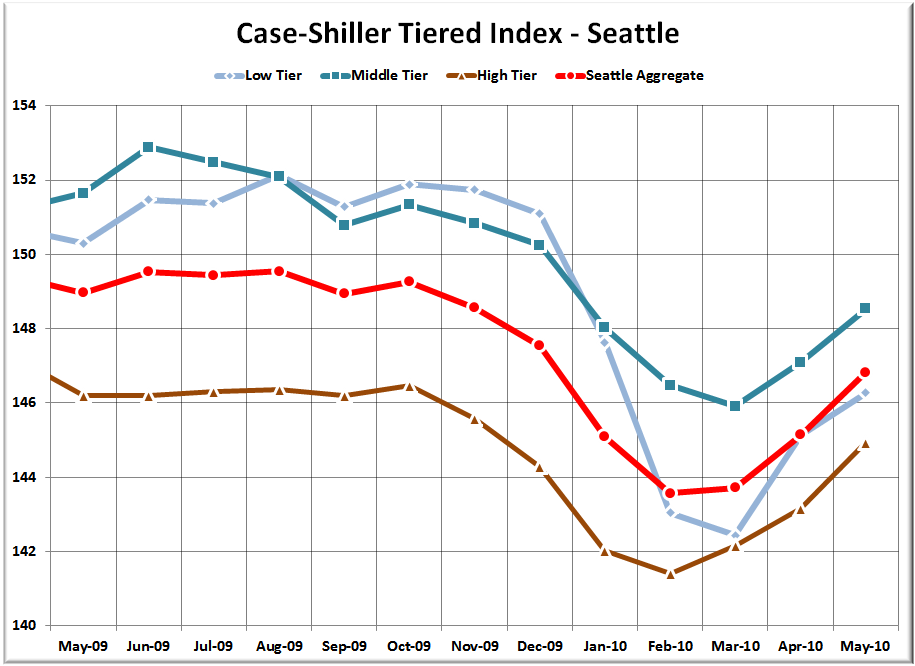
As mentioned last month, we are smack in the middle of the tax-credit-induced April through June price spike. This month all three tiers basically moved up in unison, rising 1% (±0.2%) between April and May.
Here’s a chart of the year-over-year change in the index from January 2003 through May 2010.
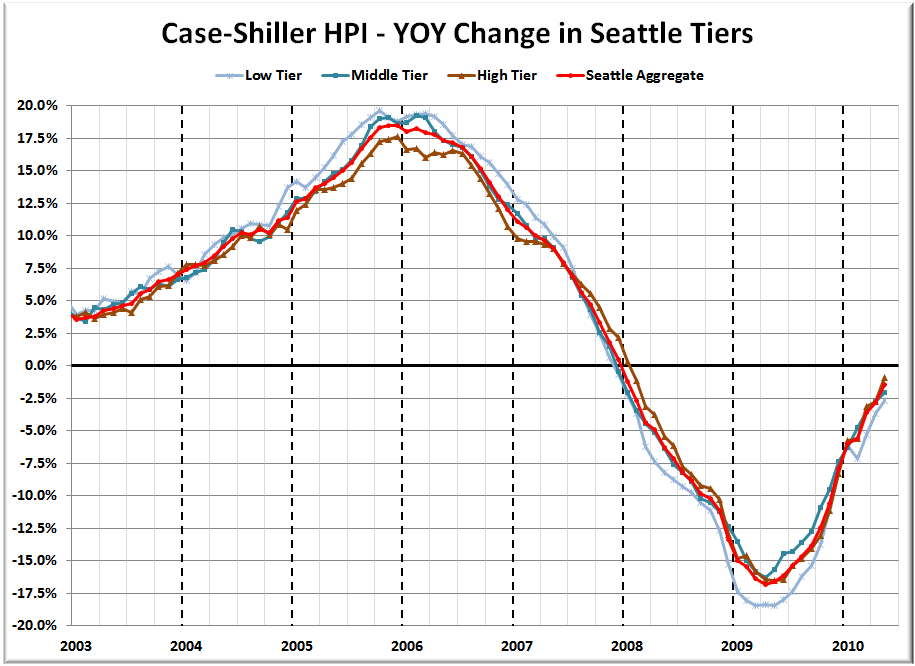
All three tiers fell less YOY than a month ago, with the high tier marking the strongest improvement. Here’s where the tiers sit YOY as of May – Low: -2.7%, Med: -2.1%, Hi: -0.9%.
Lastly, here’s a decline-from-peak graph like the one posted yesterday, but looking only at the Seattle tiers.
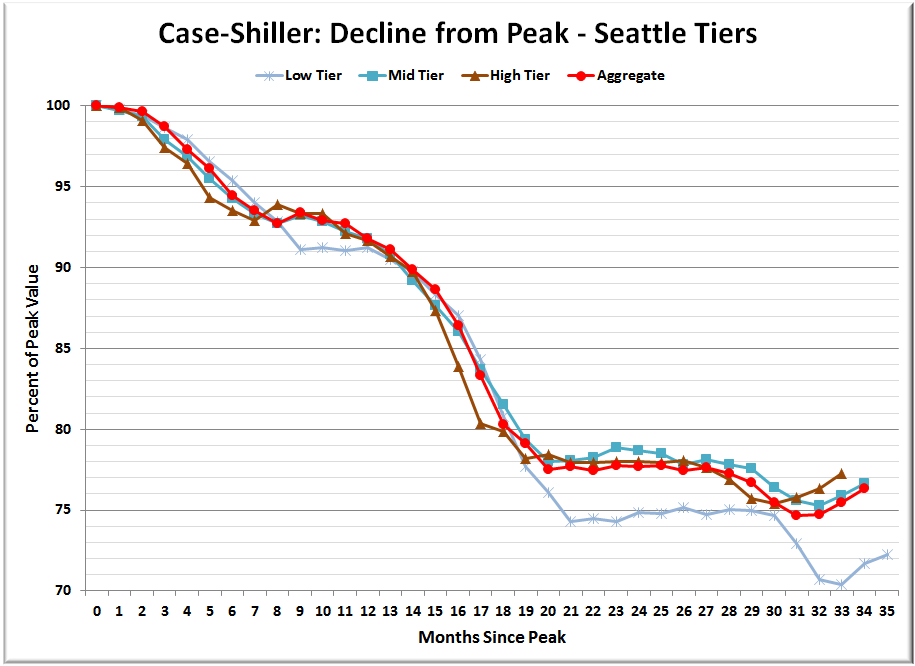
At nearly 28% off the peak, the low tier is still way out ahead of the middle and high tiers.
(Home Price Indices, Standard & Poor’s, 07.27.2010)


I’d love to hear the explanation of how the tax credit caused the high tier to rise. Lots of first time buyers in that range? Or maybe it’s a first time buyer that allowed another seller to sell, becoming a buyer, who then allowed another seller to sell, becoming a buyer, who then allowed another seller to sell? There was the move-up credit, but I don’t think I ever had a single person mention that to me (outside maybe an office meeting).
I would view the upper end move more as a consumer confidence type situation. The buyers in the above-median price ranges are starting to feel better about things in general. That alone apparently can’t sustain the market, because it didn’t in late 2007 when mainly first time buyers were the ones who lost confidence. But I really don’t think you can attribute the high end rise (which was also evident in June’s King County SFR mean) solely, or even mainly to the tax credit.
Rate this comment:
0
0
In the world of median we’ve discussed how the sudden departure of first time buyers might possibly cause the median to rise for July, not because of a strength in the market, but just because a lot of low end sales will go away.
Beyond seeing whether that actually occurs, it will be interesting to see whether that also affects these C-S tiers. Seemingly the bottom 1/3rd of sales will go up to a much higher number once we get the July and beyond numbers. (I’m not seeing the extension of the tax credit for short sales having a big impact on these two effects). I think we might need a new graph going forward! ;-)
Rate this comment:
0
0
RE: Kary L. Krismer @ 1 –
It would seem that there is an adjacency relationship between most all houses to each other relative to price/quality. Seeing as price is often determined by comparison to nearly similar products, how would you describe the swath of houses & individuals that qualified for freebies versus those that almost did? I doubt there is an invisible barrier where one situation operates independent and oblivious to another within the adjacency – they will affect each other. Outside of the super-deluxe multi-million dollar mansions or the barely livable shacks, everything else should be affected from each other somewhat. I am sure there is a math principle that exists to describe such phenomenon, such as Contiguous Pond Ripple Affect or Millipede Locomotion Transfer Ratio. Sounds like an abstract for a doctorate thesis.
Rate this comment:
0
0
Why do you keep using things like “Decline from Peak”? Why is peak a useful metric?
It’s pretty clear that, based on the first graph, if we hadn’t had the enormous bubble that started in 2004 and continued until mid 2007, and had instead maintained the rate of growth that occured between 2000 and 2004 — which weren’t exactly reasonable either — we’d be about exactly where we are now.
Looks pretty good to me. It only looks bad if you think the meteoric (and obviously unsustainable) rise of 2004-2007 should be the norm. That implies not only an overly optimistic but also reckless and short-memoried view of growth.
Rate this comment:
0
0
RE: Kary L. Krismer @ 1 – Well the graph doesn’t actually cover what the price spread is for the upper tier… For all we know most of the sales in the upper tier were in the $400-450k range since the split is based merely on sales and not sale price… A 401k+ first time home buyer (Which could actually be just anyone who hasn’t own a home in 3 years.) isn’t really all that outrageous of an idea to grasp in areas that have median home values above 450K in some cases…
While I didn’t qualify as a new-home buyer I do know that the price range I was shopping in was above the “high” end of the price range. I look at it more as, the market is likely somewhere close to the bottom, my income is stable, and prices are far more reasonable than they were 2 years ago. If I don’t want a heinous commute, or a home that is bigger than a closet and actually has some kind of yard, I have to spend 400K even in the Seattle area alone.
Pretty much unless you’ve been in your home for a good while and bought pre-boom with substantial down payment ~2002 or so you could afford to sell your house and move up. With unemployment hovering above 9% for the state, it’s probably not the greatest time to be moving up houses, let alone just selling one.
Rate this comment:
0
0
RE: Keith T. @ 4 – I find it quite useful, especially for the purpose of making low-ball offers to unrealistic sellers who still think it is 2007.
Rate this comment:
0
0
RE: Kary L. Krismer @ 1 –
Kary, It’s a Common Rule of Real Estate Throughout America
Without the first domino, the first time home buyer….real estate is mostly dead.
Even most of the upper middle class in America are up to their neck in debt and expecting even guys like Geithner to use their cash [?] to bail out his his horrifying upside down loan in real estate investments is a ludicrous pipedream.
Rate this comment:
0
0
housing is clearly in the bottoming process. it has been less bad for over a year. the rate of change for the YOY decline in prices has been plunging for a year. this is the reverse of what happened in 2006. back then the decline in the rate of change in the YOY price numbers was a warning sign. take note.
Rate this comment:
0
0
The Tabloids Are a More Reliable News Sources Than MSM News
I was watching ABC national news last night and they alleged that new home real estate prices were up 4.6% YOY in May 2010 [just about the amount of the expiring tax credit the avg national home buyers were robbed of BTW?].
Big deal, ABC news excluded the fact that existing home sales are down 5% in June 2010 and even comparing puny improvements in old May 2010 data after the tax credit: to the horrifying 2009 collapse timeframe isn’t an improvement, it’s a moot perception IMO.
It’s like comparing the 1930′s economy to 1929…..a historical perception, but over the long-run, a complete joke to call it “an improvement”.
http://www.bbc.co.uk/news/business-10730852
http://www.reuters.com/article/idUSTRE66L2RV20100723
Rate this comment:
0
0
RE: softwarengineer @ 7 – I would tend to agree that you need first time buyers too. That’s what I referenced when I said the market couldn’t deal with the lack of them in late 2007 when the press caused people to think getting a real estate loan was difficult at the time. People in the higher price ranges knew that they could get a loan, but the naive believed the press. It turned out that was probably good for them, but if more of them had known the truth the downturn probably wouldn’t have been as severe.
Rate this comment:
0
0
By RoflCatDown @ 5:
First time buyers much above $300k are relatively rare, but it does happen. Above $400,000, even less common, obviously. But even ignoring the percentages (which probably know one knows), an $8,000 credit is going to be less of an incentive for someone to buy if they are buying above $400,000.
In any case, I don’t think I’ve heard a reason not to track the C-S cutoff numbers. If the NWMLS median does go up, then these numbers could be useful to show that the increase wasn’t the result of strength in the market, but instead just a shifting market.
Rate this comment:
0
0
just remember that there is your opinion. there is my opinion. lastly there is the market’s opinion. the market wins out always.
Rate this comment:
0
0
According to Redfin, there’s been 388 closed SFH sales in Seattle in the past 30 days with a median of $455K. I believe that’s a good bit above what we’ve been seeing.
Rate this comment:
0
0
RE: DrShort @ 13 – According to the NWMLS King County Breakout for June there were 771 closed sales in Seattle in June, with a median of $371,000.
The last 30 days have seen a higher median and far lower transaction volume. This is exactly what you would expect to see when you time-shift all of 2010′s (and probably some of 2011′s) low-end home purchases into the first six months of the year.
Rate this comment:
0
0
RE: The Tim @ 14 –
I was only looking at SFH. The Seattle June numbers for that were $410K and 560 transactions.
This doesn’t surprise me at all. I was expecting the median to rise, but if a price jump does occur in July, it will probably take a lot of people by surprise.
Rate this comment:
0
0
RE: DrShort @ 15 – Oh, right. Forgot to page down in that blasted pdf. Still though, a decrease in sales and increase in the median is exactly what any educated observer should be expecting to see in July closed sales compared to June.
The problem is that most people are only interested in the catchy headline, and they neither understand nor do they care that the median says as much about sales mix as it does about actual prices.
Rate this comment:
0
0
By The Tim @ 16:
The thing is, the change in mix matters over the long term, but seldom is it all that significant over the short term. This particular end of credit event may be entirely different, or at the very least, unusual. Most things that are traumatic to the market (e.g. 9/11, the 08 Financial Crisis) affect the entire market somewhat. The tax credit affected mainly the lower end, and the effect on the higher end stuff was indirect.
Personally, I’m interested mainly in the mean for July.
Rate this comment:
0
0
RE: Kary L. Krismer @ 11 – Don’t confuse real first time buyers with the technical term for the tax credit of not having owned a home in 3 years.
Rate this comment:
0
0
RE: RoflCatDown @ 18 – I’m not, but I don’t think that’s a significant part of the market either.
Rate this comment:
0
0
We’ll know the bottom is near in Seattle when the tax adjusted costs of owning approach parity with the costs of renting.
Right now it’s not even close. We’re renting a house in the $450-500K range for $1300/month.
Last I saw there were 2-3 times as many distressed mortgages as there were active listings.
Pumping one or two Trillion into the MBS market and burning billions more in a hideously stupid scheme to put a floor under housing changed the velocity a bit but it won’t change the final destination.
Couple rising real incomes with a cost of owning that’s roughly equivalent to the price of owning and we’ll have reached an inflection point.
Right now – in Seattle? Not. Even. Close.
Rate this comment:
0
0
RE: Yaj @ 20 – I don’t think the cost of renting is ever at parity with tax adjusted cost of owning, even in down markets. Renting is just about always cheaper. But I’d agree your deal is pretty good relative to what you say the house is worth. But then, it’s also probably not worth that much!
Rate this comment:
0
0
I went through rental listings on zillow to compare the asking rent to the zestimate. I probably looked at 10 typical 3 br houses. Most zestimates were 18 to 20 times the annual rent. However, the houses were typical rentals and a little beat up and out of date so the zestimates were probably a little high.
Rate this comment:
0
0
Deejayoh:
Should have said when houses become net-cash-flow positive for investors we’ve probably seen the definitive bottom. IMO some of the hardest hit-areas in the US have already hit that threshold and are unlikely to decline much further. I also think that they’re unlikely to appreciate much further for quite some time, and that will be likely to be determined by local real wage growth * population growth relative to supply.
We’re quite a long ways from hitting that equilibrium in King county.
Rate this comment:
0
0