Notice anything… off about this infographic attached to Trulia’s Rent vs. Buy comparison?
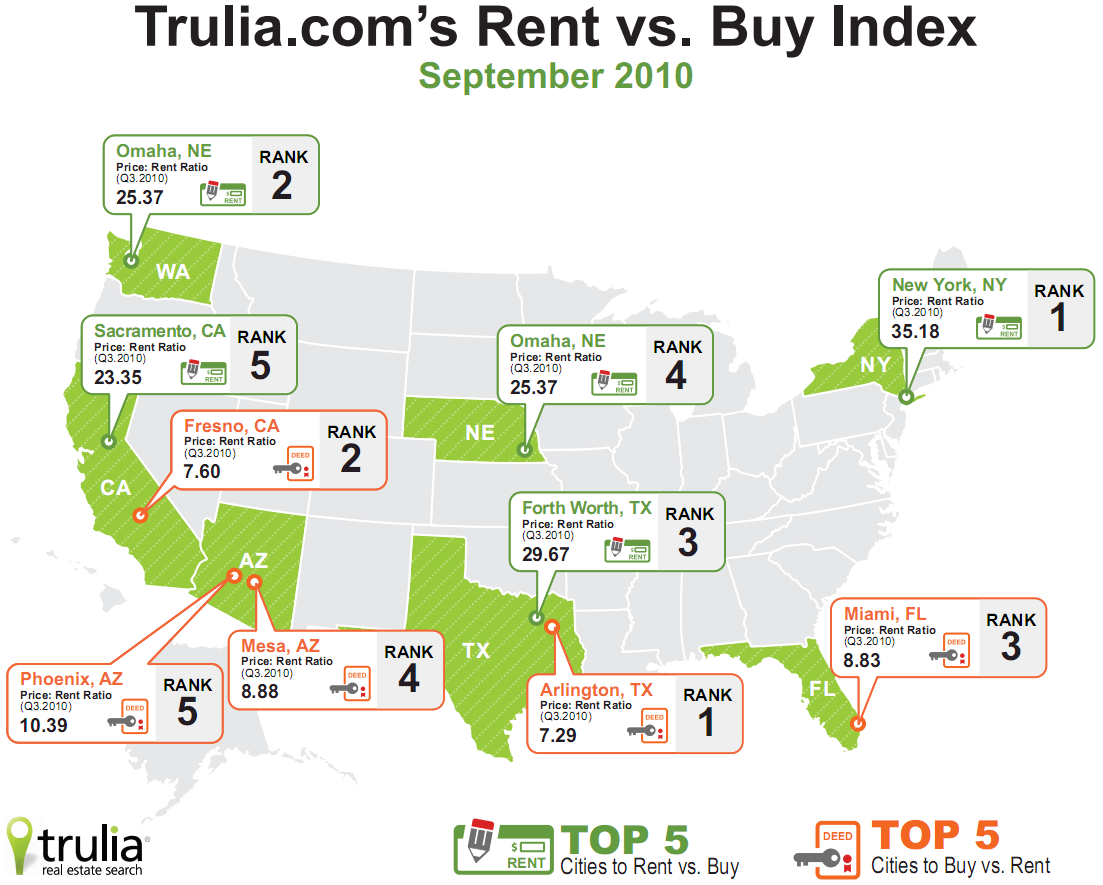
Feel free to download the original pdf from Trulia, just to make sure I’m not making this up.
Rate this post:
Notice anything… off about this infographic attached to Trulia’s Rent vs. Buy comparison?
Feel free to download the original pdf from Trulia, just to make sure I’m not making this up.
It says “Omaha” instead of “Seattle.”
Rate this comment:
0
0
Well, I was born in Omaha, so I guess you truly can go home again.
Rate this comment:
0
0
Should have been multiple choice!
Rate this comment:
0
0
Beyond the Ohama thing, I have a hard time believing that Ft. Worth and Arlington are so much different that they’re at the opposite ends of the spectrum for the whole country. Maybe one has rent control? You’d need something like that with two cities so close together.
Rate this comment:
0
0
RE: Kary L. Krismer @ 4 – The Ft Worth and Dallas areas are close in proximity but light years apart in actuality, at least when I lived there 10 years ago. The difference doesn’t surprise me at all. Even just commuting from one to the other was impossible, and the cultural differences were night and day.
Rate this comment:
0
0
RE: Lake Hills Renter @ 5 – Interesting, especially the commute part.
Rate this comment:
0
0
This was all 10 years ago, so things may have improved some by now, but the biggest issue with commuting from Ft Worth was that the jobs in Dallas are prety much on the north and east sides, so you had to commute around the city and the traffic was terrible, despite the number of freeways. In general, I saw very little intermingling between the two on any level. Ft Worth didn’t even exist for most people I knew in Dallas.
Rate this comment:
0
0
The Tim forgot to add the LOL after fail.
Rate this comment:
0
0
And I used to think San Francisco homes were expensive compared to rent!
Price-to-Rent Ratio of 21+: The total costs of owning a home in this city are much greater than the costs of renting.
Rank City State Price: rent ratio
1. New York NY 35
2. Seattle WA 31
3. Fort Worth TX 30
4. Omaha NE 25
5. Sacramento CA 23
6. Kansas City MO 23
7. Portland OR 22
8. San Diego CA 21
9. San Francisco CA 21
10. Boston MA 20
Rate this comment:
0
0
RE: Kary L. Krismer @ 4 – Interesting stratification down there in Texas.
“The Lone Star State reported interesting complexities with regard to statewide figures for the relative affordability of homeownership, as four Texas cities fell within the top 20 cities where owning is more affordable than renting. In fact, Arlington topped the list of large American cities in which buying is more affordable than renting; El Paso wasn’t far behind at number nine. However, Fort Worth ranked as the nation’s third most rent-favorable city.”
http://www.marketwire.com/press-release/Trulias-Rent-vs-Buy-Index-Reveals-Top-10-Cities-for-Renting-Owning-Homes-1331996.htm
Rate this comment:
0
0
In addition to the copy-paste FAIL with Omaha’s name and ratio in the Seattle box, it’s also worth mentioning that the Seattle dot is placed on Olympia, all the way at the south end of Puget Sound.
Rate this comment:
0
0
RE: The Tim @ 11 – Maybe they meant Olympia? ;-)
Rate this comment:
0
0
Anyone familiar with Nashville know where it sits on the buy v.s. rent spectrum? My sister currently rents down there, but the house prices she mentions are crazy inexpensive.
Rate this comment:
0
0
RE: Lake Hills Homeowner @ 13 –
Job Availability and Wages Are Another Factor
My guess is Nashville is likely hard-pressed in both areas, meaning, it doesn’t matter if the homes are all like $100K, if the lion’s share of 1st time home buyers still don’t qualify for them.
Rate this comment:
0
0
I’m actually from Arlington, Texass. That’s the #1 place to buy? Not me, not evar.
(My friends who still live there refer to it as Generica: all’s it is is strip malls and chain restaurants. *shudder* Been in Seattle 13 years now thanks be to the Flying Spaghetti Monster.)
Rate this comment:
0
0
RE: Lake Hills Homeowner @ 13 – Historically homes there have always been cheaper. It like that in 75 percent of the country. We are “special” up here. The only thing in Nashville that’s inflated are their BBQ ribs prices and Dolly. Well I think I just used the wrong term for Dolly.
Rate this comment:
0
0
By query_squidier @ 15:
The best places to buy on these sorts of things would typically be places few want to live. I’m surprise El Paso isn’t always #1. Anyway, there’s a reason the prices are where they are. That’s changed a bit with the over-building caused by the bubble.
Rate this comment:
0
0
I second the Arlington TX epithet of “Generica.” Arlington isn’t called the “Midway of the Metroplex” for nothing. There are a scant handful of attractions (Cowboys Stadium, Ballpark, Six Flags, etc.) & it is a university town of middling repute, but after that it’s a great sea of strip malls, 1 & 2 star hotels, and fast food. If you’ve ever watched “King of the Hill,” you’ve seen a too-close-for-comfort representation of how it actually is in Arlington, TX.
As far as buying vs. renting, it’s always been better to buy in Arlington because there’s nothing whatsoever to recommend it. Fort Worth by contrast is becoming more interesting by the year, so buying a home there naturally costs more and renting is fast becoming a better option, financially.
Rate this comment:
0
0
I wrote the following note to Trulia.
Dear Sirs,
You have placed “Omaha” where you meant to place “Seattle” on your map. FAIL. You FAIL. I am very upset about your FAIL of a website. FAIL FAIL FAIL.
Thank you to Tim, who is WIN and not FAIL like you are.
Yours in FAIL,
Fred.
Rate this comment:
0
0
According to their numbers, Fort Worth should be #2 and Seattle should be tied at #3.
My guess is that the name and p/r ratio are both copied over from Omaha and the #2 is correct for whatever the Seattle p/r was supposed to be.
Rate this comment:
0
0
Renter for life! Can we trade mark it?
Rate this comment:
0
0
RE: Herman @ 18 – See comment #9, Seattle has a 31 P:R.
Rate this comment:
0
0
RE: Lake Hills Renter @ 5 –
The price:rent ratio controls for factors that make certain markets overall cheaper (like commute time).
The numbers are way off for Ft Worth vs. Arlington. If houses cost an average of $100,000 in both cities, the rent would be very different: $1143 per month in Arlington versus $281 per month in Ft Worth. Of course, price is probably higher in Ft Worth, so rent is also….but hard to believe the ratios differ that dramatically with that proximity. I don’t buy it.
Rate this comment:
0
0
I can’t speak to the accuracy of the numbers, but it doesn’t seem that far off to me, at least from my experience there 10 years ago. They are two completely different worlds, and there’s no easy way between the two. It’s like having Spokane where Tacoma is, but there’s no I-5. At least that was my experience. Yours may vary.
Rate this comment:
0
0
It would be interesting to see a breakdown of the P:R ratio for the different Seattle areas.
Rate this comment:
0
0
Here’s another thing wrong with the graphics. The key is upside down! The ridges are pointed toward the ground.
It reminds me of that one commercial that drives me nuts, I think it’s for “Today’s Manufactured Homes.” They show a key at the end held the wrong way too, and everything I see that I think: If they don’t know how to install a lock, do I really want to buy something they built? ;-)
Rate this comment:
0
0
P/R ratio for surrounding areas? I live in a nice, unincorporated portion of Kirkland and my calcs put the ratio at ~ 20 ($1950 on a ~ $475k home)
hth
d
Rate this comment:
0
0
Based on the assumptions you have input:Back to Calculator
You would save approximately $46,780 (in today’s dollars) by renting, rather than buying a home, over the 30 year timeframe you have entered.
Get Free Quotes
Rent vs. Buy Analysis Rent Buy
Rent and fees $612,000
Mortgage payments $498,422
Property insurance + $0
Property taxes + $75,000
Maintenance + $0
Opportunity cost (tied-up equity) + $236,850
Tax savings (interest/taxes) - $72,030
Appreciation - $0
Total cost = $612,000 $738,241
Present value at inflation $375,198 $421,978
Difference -$46,780
Rate this comment:
0
0
By NotMe @ 23:
It is not so hard to believe for me: I know places in Germany very close to each other with huge differences. A place in Germany where lots of rich people retire is Duesseldorf. It is less than 20 miles from some industrial towns, for example Duisburg. In Duesseldorf prices are at least double, if not more.
Rate this comment:
0
0
While the joke was on Trulia’s lack of Geography I think the Tim was trying to point out Seattle price-rent imbalance here. I believe Trulia got it’s numbers from a CNN Money study (or vice versa). Here’s Seattle:
http://money.cnn.com/galleries/2010/real_estate/1010/gallery.cities_rent_buy/4.html
Seattle Stats:
Average list price: $614,762
Average monthly rent : $1,654
Price to rent ratio: 30.97
See anything wrong with this picture? (Hint, its not the average monthly rent, which for a home is a tad low but in the ballpark.) This alone nullifies any credibility to me.
Rate this comment:
0
0
By Tim Mcb @ 30:
Where can you rent a home that is worth $614,000 (besides a scraper on a large parcel) for $1645.00?? I am getting that much for houses in the mid 200′s to low 300′s
So the “imbalance” isn’t black and white.
Rate this comment:
0
0
So just for fun I did a recalculation using the median sold price (Sept. ’10) for King County using Money’s same formula.
Seattle Stats:
Average SOLD price (Sept ’10): $379,950
Average monthly rent : $1,654
Price to rent ratio: 19.14
Not nearly as sexy to talk about but closer to the truth I believe. I think Trulia/Money gets a fail for research too.
Rate this comment:
0
0
Perhaps the disparity is that the rent calculation is based on renting an apartment so the alternative would be a condo. I don’t think they calculate the cost of renting a house. Are they calculating average sold price for condos or for houses? For this reason, this calculator isn’t really helpful for me, because I’m looking for a house.
Rate this comment:
0
0
RE: D. in Ballard @ 33 –
Good point. It looks like they blended homes and condos together. Here’s an analysis on the study on Forbes.com if you want to take a closer look:
http://blogs.forbes.com/stephanefitch/2010/10/08/home-economics-trulia-and-zillow-try-rent-vs-buy-math-get-conflicting-results/?boxes=financechannelforbes
Key paragraph:
Trulia followed a classic approach. The firm divided the average for-sale listing prices in 50 of the largest cities in the U.S. by the average asking rents (annualized) in those cities. When figuring out what to use for a numerator and denominator, it hoped to avoid a false comparison between rental listings that would consist mostly of downtown 1-bedroom and 2-bedroom rental apartments and for-sale listings that would be packed with 3-bedroom and 4-bedroom suburban single-family homes with garages. So Trulia sifted its for-sale and for-rent data, plucking out only the for-rent and for-sale listings on two-bedroom condos, town homes and coops.
That’s sound. But it’s far from perfect. You could still end up with an apples-to-crabapples problem, where your rental data is packed with unrefurbished two-bedroom converted loft apartments near the local colleges and your purchase-price data is all sexy high-rise condos in downtowns. I don’t think you’d have this problem in San Francisco or New York City, where a high proportion of adults live in rental apartments. But I could see it being an issue in Kansas City or Fort Worth, where most grownups own.
Looks like the Seattle ratio could be even lower when factoring in a house/condo mix into the sold analysis though the rent data is amiss too since it only looked at townhomes and 2 bed condos and coops.
Rate this comment:
0
0
RE: Tim Mcb @ 32 –
Nice. From what I’ve experienced personally out there it seems to me the number is around 20 for SFH at the moment. It’s easier to figure out when the place is listed for sale AND for rent.
Rate this comment:
0
0
RE: Lurker @ 35 –
If I had a guess I’d put it around there too, maybe a tiny bit lower since homes for sale and rent usually have higher listing prices than what they really can sell for. Here’s another price to rent calculation done by zillow last month which puts the number for Seattle at 15.0.
http://www.zillow.com/blog/research/2010/09/21/a-better-price-rent-ratio/
I think they went a bit too far on the other side. And like D. in Ballard points out its a blended number of 2 bed SFH, Condos, Townhomes, and Co-ops. A pretty useless number. I wish somebody would do a calculation based on SFH only. I’d bet about 2/3rds of would be first time homebuyers are only looking at SFH’s in this market.
Rate this comment:
0
0
Hi all –
Nice catch – sorry about the geo-FAIL. We’ve updated the pdf so feel free to check it out. Click on the link right under the image. Thanks!
sharon
trulia.com
Rate this comment:
0
0
Generally speaking, a professional investor will pay 100-110 times monthly rent for a property. As I look around my neighborhood, Magnolia, I see house prices far higher than that. Magical thinking persists, but I wonder for how long.
Rate this comment:
0
0