Posted by: The Tim

Tim Ellis is the founder of Seattle Bubble. His background in engineering and computer / internet technology, a fondness of data-based analysis of problems, and an addiction to spreadsheets all influence his perspective on the Seattle-area real estate market.

51 responses to “Big Picture 2011: Examining Home Affordability”

  1. FirstTimeHomeBuyer

    Tim- Love the data you provide. I saw that you used 20% down as a way to figure out the Affordable Home Price. What do you propose the Affordable Home Price to be using an FHA loan at 3.5% down?

    Also, I agree that interest rates are at an unsustainable level, however isn’t Japan at 1% interest?

    Rate this comment: Thumb up 0 Thumb down 0

  2. softwarengineer

    Since 1978 Seattle Homes Have Been Completely Unaffordable

    Requiring two incomes instead of one income per household to afford. We have an average of 1.2 incomes per household today in Seattle. The chart above uses “gross pay”, not “net pay”….

    Another conundrum that makes the above affordability data not an improvement at all are current jobs scarcity in Seattle. We can’t all be working two incomes per household or we put one household in a homeless camp because we hogged an extra job to be a two income family, let’s be pragmatic and honest.

    Wake me up when we depopulate and raise wages and lower unemployment [honest count too, not Pink Pony lies].

    Rate this comment: Thumb up 0 Thumb down 0

  3. gr8day

    Softy @ 2

    Back off

    Rate this comment: Thumb up 0 Thumb down 0

  4. FirstTimeHomeBuyer

    RE: softwarengineer @ 2

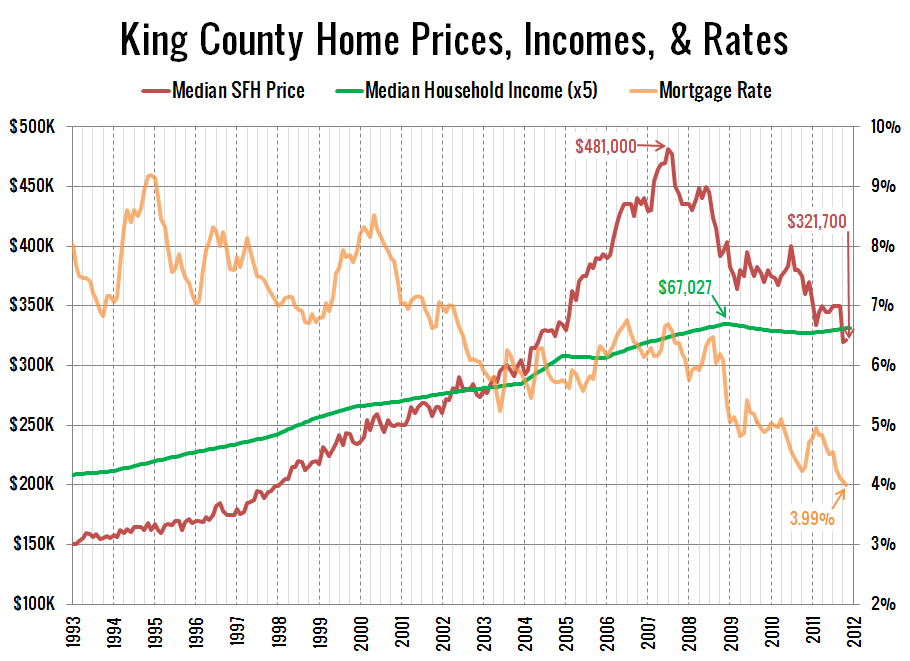
    Great observation softwareengineer! Tim – Is the $67,027 median household income Gross or Net?

    Do you think we could return to a one income per household level? My wife would be happy :)

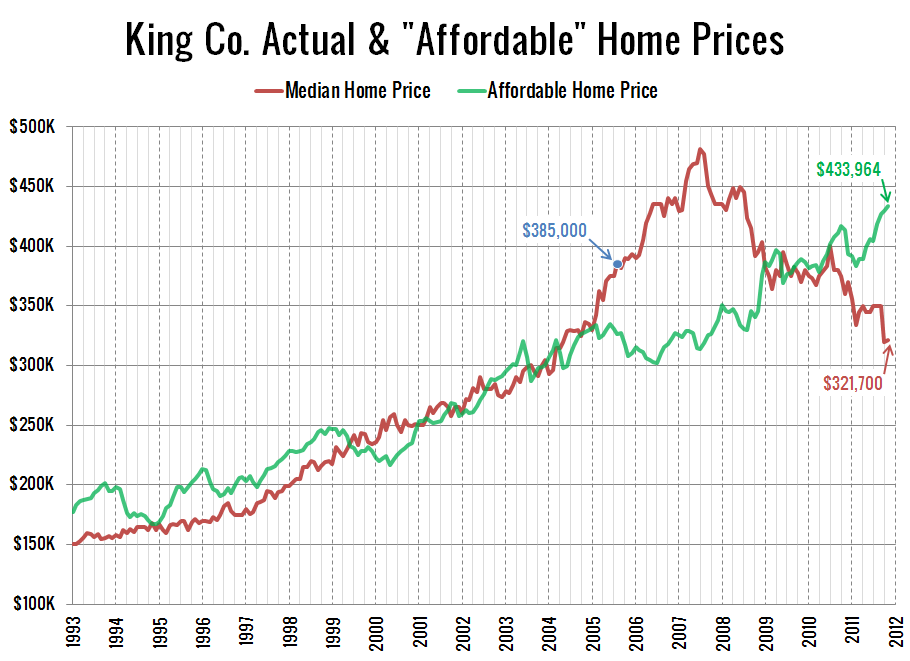
    Also, I noticed you use Median Household Income x 5 on the chart. So ($67,027 x5) = $335,135. I believe I’ve read that in a normal market a homeowner should only go to Household Income x 3.5. So I guess an Affordable Household Price would be ($67,027 x 3.5) = $234,595.

    What are your thoughts on a 3.5x multiple vs. a 5x multiple?

    Rate this comment: Thumb up 0 Thumb down 0

  5. softwarengineer

    RE: FirstTimeHomeBuyer @ 4

    I Bet You’re a Young Forgotten “Y” Generation Like My Daughter

    God bless you :-)

    Rate this comment: Thumb up 0 Thumb down 0

  6. FirstTimeHomeBuyer

    RE: softwarengineer @ 5

    Yeah I am. Its tough out there for us “Y’s”

    Rate this comment: Thumb up 0 Thumb down 0

  7. FirstTimeHomeBuyer

    RE: The Tim @ 7

    Tim you’re awesome! Thanks for the replies. Here’s some additional info if people want to know what they can afford using a 3.5% FHA if I’m understanding the charts Tim laid out above correctly. Not necessary if someone should, better to live within your means. Below is some math on it.

    So if I’m reading your charts correctly, a household making a Gross income of $67,027 can afford a home at $433,964 with a 20% downpayment. I just ran a quick calc using Zillow, they have a 3.79% 30 year mortgage rate. They say the total monthly payment is $1,944 ($1,616 Principal & Interest + $278 Taxes +$50 Homeowners Insurance).

    So if anyone wants to know (like me), if you are going FHA and doing 3.5% down. Someone can afford a House Price of $321,400. Monthly payments being the same at $1,944 ($1,436 Principal & Interest + $206 Taxes + $50 Homeowners Insurance + $252 Mortgage Insurance).

    Rate this comment: Thumb up 0 Thumb down 0

  8. JGBellHimself

    TT, there might be a couple of things we need to look at in order to understand this report, and its use of the MLS “median price”.

    While much more extreme than Seattle, these cautions apply to Phoenix:

    First, is that there has been a very large drop in REO listings, but there also is a very large number of unlisted REOs – about a years supply, it looks like. The supply of REO can, and will, be, replenished for quite a while yet.

    So, the number of REO sales must, and did, decline. But, there is evidence that the listing prices were about US$ 20K under market for all cash sales. The Lenders were buying “cash”. For example, BKofA was recently told that they had to build up their “capital position” – that takes cash.

    Second, when the REO sales dropped, that removed the bottom 10 to 20% of the lowest priced homes. What then happens statistically is that the “average” of the remaining homes sold must, and did, go up.

    But, that does NOT mean that home prices are now going up. What it means is the cheapest homes are not being sold anymore. That is very different.

    Third, “short sales” have gone up about as much as foreclosures have gone down. Might sound good, but what that really means is that the home owner/seller took a little less of a hit than if they walked away; and the bank/lender took a little less of a hit than they would if they foreclosed.

    So, while the prices for “short sales” might LOOK like they are going up, they also might not be, in fact.

    Again, while Seattle has not seen the full foreclosure bite of Seattle (pun?)[Sorry], what you DO have is a very skewed RE market – with very low priced home selling much more than high priced homes. Not as extreme as Phoenix, but not at all “normal”.

    The question have you adjusted for those changes? Should we not?

    Rate this comment: Thumb up 0 Thumb down 0

  9. FirstTimeHomeBuyer

    RE: The Tim @ 7

    Tim – I like your 15% idea. Smart, economical, conservative. Good stuff. Let me plug some numbers in for the median household income.

    So lets use $67,027 Household Median Income. So 15% of that is $10,054. So per month PITI should not exceed $838.

    Okay for a PITI of $838, the Household Median can afford a Home Price of $180,700 with a 20% downpayment at a 30 year mortgage of 3.79%. ($673 Principal & Interest, $116 Taxes, $50 Homeowners Insurance)

    If going FHA, 3.5% down @ 3.79% interest, the Household Median can afford a Home Price of $133,900. ($598 Principal & Interest, $86 Taxes, $50 Homeowners Insurance, $105 Mortgage Insurance)

    Well now I know where to begin my offering price.

    Rate this comment: Thumb up 0 Thumb down 0

  10. FirstTimeHomeBuyer

    Man this is depressing using the 15% rule.

    A house price of $280,000 would need an income of $102,000 at 20% down or an income of $136,000 at 3.5% down.

    Man I need to ask for a promotion!

    Rate this comment: Thumb up 0 Thumb down 0

  11. ChrisM

    RE: The Tim @ 7 – I second the recommendation for the Two Income Trap. A fascinating read – both on the housing bubble front, as well as the health care problem. Warren was really ahead of her time!

    Rate this comment: Thumb up 0 Thumb down 0

  12. 3rd Generation

    Gee, maybe this will help :

    NAR Realtors: We Overcounted Home Sales for Five Years
    http://www.cnbc.com/id/45659547

    Trust a Realtor.

    Welcome to the New Depression, v2.0.

    Rate this comment: Thumb up 0 Thumb down 0

  13. jfv411

    RE: FirstTimeHomeBuyer @ 8 – That works out to 35% of gross income and 44% of net (assuming 20% tax rate for those who can’t afford accountants and tax expenditures). And don’t forget that is a rule of thumb MAX. I’ve been quoted by BECU that 42% of gross income in debt is MAX.

    I prefer using 20-30% of net single income (makes more sense as I can afford less if/when taxes increase). Breaking the two income trap requires this initial assumption I believe.

    TT @ 7
    I also find using a multiple of 3.5x rather than 5x to be a more accurate representation of affordability, but then I’m a guy who doesn’t think spending 30% of gross, or 37% of net, income on housing is affordable. Unless you assume housing is more important than vacation savings, a car payment, student loans, hell any real savings.

    Finally what are realistic property tax and insurance rates. I’m using 1% and 0.5% respectively, a little conservative but not much IMO.

    Rate this comment: Thumb up 0 Thumb down 0

  14. David Losh

    RE: The Tim @ 7

    The conclusions you are drawing are bizarre.

    Number one you are using interest rates that are based on the mortgage amount, which has no bearing at all on the over all debt. Whether you put saved money into a Real Estate transaction is a misnomer. Those are after tax, savings rate real dollars. That’s expensive money that could be better used elsewhere than on a family home debt structure.

    The second thing is that in five years, or so, when a person sells the property they will run into a completely different affordability. Interest rates may well go to zero, or up to 6%, my bet is always 6%, but I have been wrong.

    Then the price of the mortgage goes up. The price of the property may go down, but I doubt it will go up using either the lower, or raised interest rate.

    So you are just paying to service the debt. You could pay the property down further with after tax present dollars, but then again there may well be better uses for the money.

    So I don’t see today’s affordability as an indication of us being closer to the bottom. You are showing why prices haven’t really dropped, and people are paying 2006 prices.

    Rate this comment: Thumb up 0 Thumb down 0

  15. David Losh

    RE: The Tim @ 13

    OK, I interjected a term “after tax, savings rate dollars.”

    Those are real, present day dollars that could do a lot of other things for a much greater return than a home mortgage. I know you’re looking at it as money you don’t need to spend 4% interest rate payments on for 30 years, but ultimately it is a dead loss of cash.

    What’s better is to take 0% down then apply the up to 20% to the principal balance, you could even do that over time.

    That way you jump start the amortization schedule, and have a greater probability of getting to free, and clear sooner.

    The fact still remains you are in a non appreciating asset, but your equity would be growing.

    Rate this comment: Thumb up 0 Thumb down 0

  16. NESeattleSeller

    RE: The Tim @ 13 – I second that.

    This is a very instructive post – not least for the reactions it elicited. Affordability is always in the eye of the beholder. I have had tenants who chose to stop renting from me (I cap eligibility at rent=1/3 gross income) to buy a house where they will be paying closer to 40% or more of gross in PITI. And I have had prospective tenants beg to rent a house at 50% of their gross. They often do, and without getting evicted for non-payment, just not from me. People feel strongly about having a nice place to live. Some are really tired of apartments/condos/townhouses. So affordable to them is a much higher percentage of their take-home, even if it means eliminating saving, doctor visits, and eating out from the budget. Under current conditions, with rents rising, home prices falling, and payments pretty close, I gotta think that those who can put together a down payment will stop renting and start buying before these trends make the difference really lopsided – but it may get more crazy before that happens. Looking forward to tomorrow’s post!

    Rate this comment: Thumb up 0 Thumb down 0

  17. S-Crow

    Drive by comment: A lot of people have been tossing around affordability commentary and ratios. If people believe that front end (household debt) and rear end (household plus house payment) debt to income ratios are lower they are mistaken. I deal with banks everyday and see rear end debt loads at 50-55% which is the limit for banks such as Wells, B of A, PNC and so on. And that’s based upon Gross income. So the real net income/DTI caps mean that there is not a lot of wiggle room for living.

    And it still astonishes me to see incomes well over $50,000 a month for some Cats and their DTI’s are atrocious. It’s the look rich but I’m broke syndrome still lives on.

    Rate this comment: Thumb up 0 Thumb down 0

  18. ricklind

    By The Tim @ 13:

    By FirstTimeHomeBuyer @ 11:
    A house price of $280,000 would need an income of $102,000 at 20% down or an income of $136,000 at 3.5% down.

    I would hope that someone making over $100k a year would be able to save up $56,000 in a few year’s time.

    It can be tough to save like that. Factor in a couple of kids and the whole thing blows up real easy. $100K seems like a lot until you have school supply fees, athletic fees, band fees, day care fees, extra gas, clothes, dental, shoes, shoes, shoes, food and a funnel, etc.
    Not to complain, wouldn’t have missed it for the world, but it do be costin’ serious money.

    Rate this comment: Thumb up 0 Thumb down 0

  19. John Bailo

    Looked at some models down in Auburn at a place called Monterrey Park. Beautiful 3 bedroom places…smallest, fully detached was only $217,000!

    http://newhomes.move.com/communitydetail/builder-10806/community-54134

    Rate this comment: Thumb up 0 Thumb down 0

  20. Macro Investor

    I don’t care what anyone says. $400,000 is not affordable. If you think so it’s because you’ve been brain washed all your life by the media, government provided schools and corporations marketing “American culture”.

    Learn to live without debt and you and your family will be a lot happier and better off. To most of you, I realize I might as well have written “live without air”.

    Rate this comment: Thumb up 0 Thumb down 0

  21. corncob

    By ricklind @ 20:

    By The Tim @ 13:
    I would hope that someone making over $100k a year would be able to save up $56,000 in a few year’s time.

    It can be tough to save like that. Factor in a couple of kids and the whole thing blows up real easy. $100K seems like a lot until you have school supply fees, athletic fees, band fees, day care fees, extra gas, clothes, dental, shoes, shoes, shoes, food and a funnel, etc.
    Not to complain, wouldn’t have missed it for the world, but it do be costin’ serious money.

    It would be easy to save that if you are a single guy writing a blog. Otherwise, lets say you make $120k/year. You have no house to write off but make a lot of money compared to Jim and Sue Midwest, so your taxes are going to be quite high (assume about 25% with SS/medicare/etc). So you have maybe $7500 take home. Just for easy multiples you have rent ($1800 for a modest house), bills (cable, phones, internet, heat, water, etc $600), student loan(s) ($400), car payment(s) ($400), health/life/car insurance ($400), 401k ($400), misc. amortized random expense (broken car, etc $200), gas ($200), food ($800). This is just the basics for a family, leaving you with $2200 of which you expect them to save about $1600 to get to the $56k goal in a few years. Good luck…

    Rate this comment: Thumb up 0 Thumb down 0

  22. Jonness

    Thanks for the link to last year’s article. It was great to see Macro Investor, myself, and others proclaiming that “It’s still too early to buy” while pffft argued the other side claiming interest rates were on the verge of going off in a 1970′s style trip to the moon. My favorite part was when I argued we were going the way of Japan, and pffft flatly said, “no we’re not.”

    Can you believe there are still people out there arguing that the housing market will not go the way of Japan? What are these people smoking? It’s not that it won’t happen. It’s that it has already been occurring for the last 4 years in Seattle and even longer in other parts of the U.S. The only question remaining is how many more years it will take until we break out of the cycle and begin to experience yearly appreciation gains?

    This correction is not only about affordability. It’s also about debt deleveraging, and there’s plenty more of that that must occur before we reach the bottom of house prices. So be prepared to see lower prices in the near future and beyond. When we see real job growth (as opposed to record numbers of people giving up), then we can begin to talk about a different picture. Until then…

    Rate this comment: Thumb up 0 Thumb down 0

  23. Jonness

    By FirstTimeHomeBuyer @ 4:

    Also, I noticed you use Median Household Income x 5 on the chart. So ($67,027 x5) = $335,135. I believe I’ve read that in a normal market a homeowner should only go to Household Income x 3.5. So I guess an Affordable Household Price would be ($67,027 x 3.5) = $234,595.

    What are your thoughts on a 3.5x multiple vs. a 5x multiple?

    The obvious problem with buying in at 5x is, that you’ll lose your shorts if you end up having to move in the next 7 years or so. In truth, the reason things seem affordable is because we are caught in a liquidity trap (ala Japan), and this forces mortgage rates down close to zero with no clear way to turn them around. Case in point, today the Fed announced it will continue to keep the rates low for another year and a half. But this is not because the Fed is comprised of nice guys. It’s because the economy is shattered,and they are nearly out of bullets to fight it.

    We’ve most likely got a few more years of this nightmare to endure, and then homes will truly be affordable. I’m not talking 5x. I’m talking bargain basement. :)

    Cash talks; BS walks.

    Rate this comment: Thumb up 0 Thumb down 0

  24. David Losh

    RE: Jonness @ 25RE: Jonness @ 24

    We won’t go the way of Japan because, number one we have a military industrial complex, and number two we have bankruptcy.

    On the Big Picture 2011: Case-Shiller HPI Rate of Increase thread Hugh Dominic threw up a Forbes article about how Americans are deleveraging. Yeah, because the are going into foreclosure, and declaring bankruptcy. It’s the American way.

    In a couple of years, when every one is settled into a financial strategy that they have made bets on, the interest rates will be able to climb.

    When interest rates go up the debt structure you have in place will be that much greater. You home price will go down, but your mortgage debt will remain the same.

    It’s the American Way.

    Banks are going to make more money. I suppose they will claim it’s to recoup from the foreclosure, bankruptcy losses.

    Rate this comment: Thumb up 0 Thumb down 0

  25. Jonness

    By FirstTimeHomeBuyer @ 8:

    So if anyone wants to know (like me), if you are going FHA and doing 3.5% down. Someone can afford a House Price of $321,400. Monthly payments being the same at $1,944 ($1,436 Principal & Interest + $206 Taxes + $50 Homeowners Insurance + $252 Mortgage Insurance).

    That is just plain scary. I can’t believe people do this on a gross HHI of $67K (especially when prices are still actively falling). I’m thinking a loan of $200K is about max for this income. But borrowing $150K is probably what my limit would be if I were in those shoes. Since that doesn’t buy anything, I’d take advantage of this flat to declining market and save a real downpayment in order to circumvent the mortgage insurance.

    Rate this comment: Thumb up 0 Thumb down 0

  26. Jonness

    By David Losh @ 26:

    We won’t go the way of Japan because, number one we have a military industrial complex, and number two we have bankruptcy.

    I think what you are saying is we have already gone the way of Japan, but we could eventually take a hard right turn and go somewhere far worse. I agree that could happen.

    But for now, we are stuck amidst a debt deleveraging cycle. Interest rates are not at record lows by accident.

    Rate this comment: Thumb up 0 Thumb down 0

  27. Jonness

    By The Tim @ 7:

    but for my family we definitely limited the income we considered for buying a home to just one income (and we kept our total PITI home payment at 15% of the gross of that one-income).

    Actually, that’s pretty amazing!

    Rate this comment: Thumb up 0 Thumb down 0

  28. Hugh Dominic

    RE: Jonness @ 30 – We say “gone the way of Japan,” but I don’t think Japan has gotten to its destination yet. After years of excruciating policy, they now have I think the second highest debt to GDP ratio in the developed world. Greece is going to default, then Japan will blow a year later while the world is still distracted by Europe.

    Rate this comment: Thumb up 0 Thumb down 0

  29. MichaelB

    RE: Macro Investor @ 22

    Great Post! Absolutely correct. Affordability means not having to become a debt slave.

    Rate this comment: Thumb up 0 Thumb down 0

  30. Chris

    RE: Macro Investor @ 22
    Good post. Along the same lines, is there any legitimate reason the NAR would use anything other than county sales records to tally sales? Core Logic noticed the problems with NAR stats months ago if I recall correctly and The Tim has found lots of holes in their data over the years. Is NAR just abandoning growing sales propaganda because they will soon have to say how bad things are to help prop up the GSEs when FHA heads over a cliff (shift in talking points)?

    Rate this comment: Thumb up 0 Thumb down 0

  31. Jim

    Are you guys still on here trying to figure out or rationalize the housing bubble in Seattle and why it hasn’t burst? I was on here years ago everyday but I decided to do something about it instead of trying to figure it out and sitting around in my Magnolia apartment complaining about it all. I left! I moved my business to Minneapolis/Saint Paul where I grew up and bought not one house but four! All foreclosures, all less than 40k each! I love it here, the cycling is the best in the country, the people are far friendlier than Seattle, more hipsters in MPLS than anywhere in Seattle (good and bad) I ski all winter and sail on the lakes and Lake Superior all summer! It’s great. I just could never rationalize a 450k crap box condo in Seattle when I can have several homes here for 1/2 the cost of one 500 sq ft poorly built condo. The nightlife here puts Seattle to shame these days as well. Uptown and Hennepin are electric like Capitol Hill was 15 years ago. The arts are unparalleled here as well as regular people can afford spaces and afford to live here not just corporations and their pawns. Those that can move here I would suggest doing so!

    Rate this comment: Thumb up 0 Thumb down 0

  32. Kary L. Krismer

    By Macro Investor @ 22:

    I don’t care what anyone says. $400,000 is not affordable. If you think so it’s because you’ve been brain washed all your life by the media, government provided schools and corporations marketing “American culture”.

    Learn to live without debt and you and your family will be a lot happier and better off. To most of you, I realize I might as well have written “live without air”.

    Are you trying to say no one makes enough money, or has enough net worth, that they can afford a $400,000 home? A significant percentage of buyers pay cash at the over $1,000,000 price level. There’s a lot of wealth in this country.

    Rate this comment: Thumb up 0 Thumb down 0

  33. Kary L. Krismer

    RE: Jonness @ 24 – Pfft probably wasn’t factoring in the negative effects on the economy of Obamacare. ;-)

    Rate this comment: Thumb up 0 Thumb down 0

  34. Kary L. Krismer

    By Chris @ 34:

    RE: Macro Investor @ 22
    Good post. Along the same lines, is there any legitimate reason the NAR would use anything other than county sales records to tally sales?

    I addressed that in the Monday open thread, but since that thread is dead now I’ll repeat it here. The problem is trying to accumulate data from hundreds of MLS systems which each do things differently and sometimes overlap.

    By Kary L. Krismer @ 38:

    RE: calvis @ 36 – I know some of you want to make a big deal of this, but it’s an error in what is undoubtedly the more irrelevant number out there, except perhaps the percentage underwater studies. And problems with this data are not terribly unexpected because what they’re doing is collecting the sales figures from virtually every MLS out there. Tim has repeatedly pointed out changes of how the NWMLS collects and reports it’s data, and that affects the usefulness of the data. Apply that to every MLS out there, which do different things at different times, and you have no consistency whatsoever in the data.

    With this collective data you have each MLS reporting things their own way, and except for your local MLS(s), you have no idea what they are doing. That makes the data completely meaningless.

    Beyond that, they are national numbers. National numbers are virtually irrelevant to most local markets.

    Rate this comment: Thumb up 0 Thumb down 0

  35. Chris

    RE: Kary L. Krismer @ 38
    Thanks for the info. With the NAR saying real estate transactions account for $2 trillion of the yearly GNP (I think that’s the number they used) I wonder why they don’t track sales from the county and have a more reliable number. It seems we track pork belly sales better than we do real estate sales.

    Rate this comment: Thumb up 0 Thumb down 0

  36. NSBill

    I don’t understand how you can call an interest rate “unsustainable”. What’s going to cause the rate to go up? Obviously it’s not going to be that way forever, but I don’t see that it’s going up anytime in even the near future. With all the economic s*** going on in the world, 10-year U.S. Treasury Notes are excellent, safe buys, and will continue to have very low rates and as such, mortgage rates will be low.

    The first poster even mentions Japan’s rates are at 1%. That’s an apt comparison as we are in for our own “lost decade” where housing prices do not go up at all. I honestly don’t think that is such a bad thing either. It will readjust everyone’s thoughts on buying houses. They are for living in, not for investing in (unless of course you are a landlord, in which case this time period is great for snapping up property).

    Rate this comment: Thumb up 0 Thumb down 0

  37. Kary L. Krismer

    RE: Chris @ 39 – If what they were after was the gross $$$ amount, using the county figures would probably give them a much larger number. It would include foreclosures, bank owned, etc. But the problem is they’d have a hard time backing out skyscrapers, malls, etc.

    Rate this comment: Thumb up 0 Thumb down 0

  38. Kary L. Krismer

    RE: NSBill @ 40 – If you had a world where inflation was not a serious concern, I’m not so sure 4% wouldn’t be a normal rate.

    Stated differently, the biggest impact on interest rates is from inflation.

    Rate this comment: Thumb up 0 Thumb down 0

  39. David Losh

    RE: NSBill @ 40

    Because we have the ability to get rid of debt by foreclosure, and bankruptcy, or negotiation.

    The interest rates will rise when there is a reasonable expectation of a return on investment.

    What Kary is saying is that inflation will be controled by a rise in the interest rate. Some people, myself included, think that the economy can over heat, and the brakes need to be applied by raising interest rates to get some of the capital out on the system and into paper investments.

    I’m called pessimistic all the time, but I honestly believe we are in a time when the little guy can make big dollars, and grow the economy. We just have to stop playing games with corporations that are what? To Big To Fail. Tax them to death, that’s what I say. I want my money back in the tax system after all the gifts the real tax payers have given them.

    Taxes paid as a cost of doing business are of far less value than those that are paid by the American worker.

    Rate this comment: Thumb up 0 Thumb down 0

  40. Kary L. Krismer

    By David Losh @ 43:

    What Kary is saying is that inflation will be controled by a rise in the interest rate.

    I wasn’t saying that. What I was saying is that if you have an economy where the best interest rate is about 12%, then inflation would probably be running at about 8%. If the best rates are 16%, then inflation would be at about 12%. Thus the biggest factor affecting interest rates is inflation, because I don’t think there’s anything else that would get the best rate up to 16%, other than perhaps a collapse of the banking system.

    Rate this comment: Thumb up 0 Thumb down 0

  41. Lisa

    By Jim @ 35:

    I moved my business to Minneapolis/Saint Paul where I grew up and bought not one house but four! All foreclosures, all less than 40k each!

    Yes, there are a lot of places that are more affordable than Seattle, but rent set by the free market suggest that many like myself are willing to pay a premium to live here. There are even people who move to New York and San Francisco, and the cost of living there is much higher even before account for state income tax.

    Rate this comment: Thumb up 0 Thumb down 0

  42. Blurtman

    RE: Lisa @ 45 – Absolutely. I’ve lived in Northern and Southern CA, Michigan, and grew up in NJ. Whenever I tell people I am from Seattle, they smile, and either say they need to go back and visit again, or say they want to visit Seattle. No stranger I met ever put down Seattle. Unlike New Jersey.

    Rate this comment: Thumb up 0 Thumb down 0

  43. Kmac

    By Blurtman @ 46:

    Whenever I tell people I am from Seattle, they smile, and either say they need to go back and visit again, or say they want to visit Seattle. No stranger I met ever put down Seattle.

    If you come to many communities in central Washington and announce your from “Seattle”, your bound to be told to “Go home!” , (but only after you have emptied your wallet, of course.) :)

    Rate this comment: Thumb up 0 Thumb down 0

  44. Ira Sacharoff

    By Blurtman @ 46:

    RE: Lisa @ 45 – Absolutely. I’ve lived in Northern and Southern CA, Michigan, and grew up in NJ. Whenever I tell people I am from Seattle, they smile, and either say they need to go back and visit again, or say they want to visit Seattle. No stranger I met ever put down Seattle. Unlike New Jersey.

    You’re from New Jersey? That explains a lot. What exit?
    I’m an exile from the Garden State myself.

    Rate this comment: Thumb up 0 Thumb down 0

  45. David Losh

    RE: Kary L. Krismer @ 44

    Inflation would come first, followed by the rise in interest rates. How would it be otherwise?

    Rate this comment: Thumb up 0 Thumb down 0

  46. Kary L. Krismer

    RE: David Losh @ 49 – That’s different than what you said before. What you said before was that inflation could be controlled by a rise in the interest rates. They tried that before and it didn’t work. They ended up with stagflation.

    What I’m saying is that the rate of inflation is a competent of interest.

    Rate this comment: Thumb up 0 Thumb down 0

  47. Seattle Bubble • The Tim’s Top Ten of Twenty-Eleven

    [...] decades to get an idea of where we’re at today. Probably the biggest surprise this year was affordability, which thanks to ridiculously low interest rates, soared to a 30+year high in [...]

    Rate this comment: Thumb up 0 Thumb down 0

Leave a Reply

Do you want a nifty avatar picture next to your name, instead of a photograph of Tim's dog? Just sign up with Gravatar, and make sure to use the same email address in the form below. It's that easy!

Please read the rules before posting a comment.

Archives