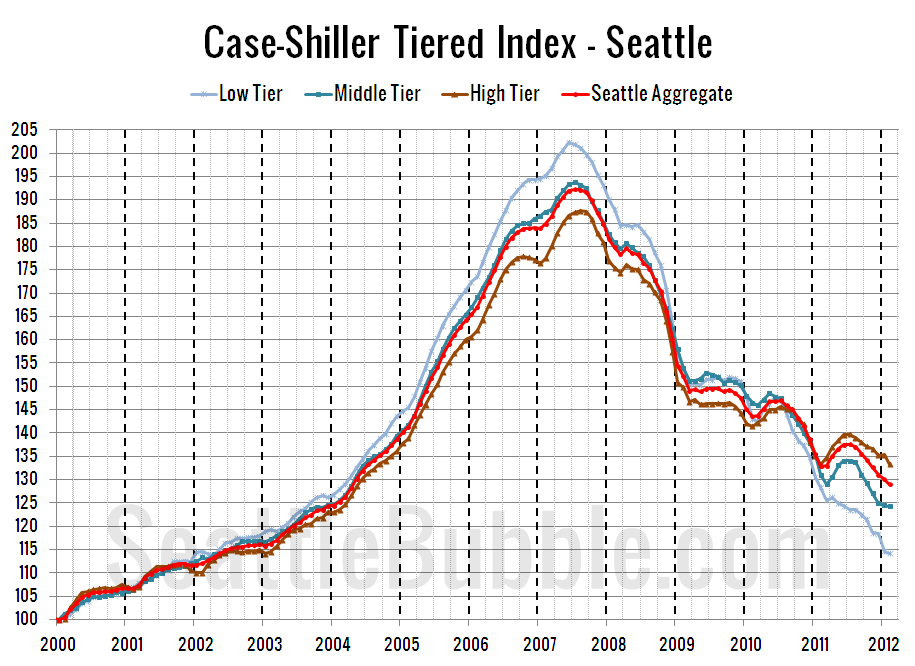
Let’s check out the three price tiers for the Seattle area, as measured by Case-Shiller. Remember, Case-Shiller’s “Seattle” data is based on single-family home repeat sales in King, Pierce, and Snohomish counties.
Note that the tiers are determined by sale volume. In other words, 1/3 of all sales fall into each tier. For more details on the tier methodologies, hit the full methodology pdf. Here are the current tier breakpoints:
- Low Tier: < $228,037 (down 0.8%)
- Mid Tier: $228,037 – $364,832
- Hi Tier: > $364,832 (down 1.2%)
First up is the straight graph of the index from January 2000 through February 2012.
Here’s a zoom-in, showing just the last year:
All three tiers took a predictable seasonal dip between January and February. While the low and middle tiers both only barely declined, the high tier dragged down the combined index. The low tier fell 0.3% MOM, the middle tier dropped 0.2%, and the high tier lost 1.5%.
Here’s a chart of the year-over-year change in the index from January 2003 through February 2012.
Flat for the high tier, but a strong improvement on both the other tiers. Here’s where the tiers sit YOY as of February – Low: -11.0%, Med: -5.1%, Hi: +0.1%.
Lastly, here’s a decline-from-peak graph like the one posted yesterday, but looking only at the Seattle tiers.
Current standing is 43.6% off peak for the low tier, 35.9% off peak for the middle tier, and 28.9% off peak for the high tier. The middle and low tiers each set new post-peak low points, while the high tier remains just barely above its February 2011 low.
(Home Price Indices, Standard & Poor’s, 04.24.2012)


Sounds Like the Normal Spring Bounce is Over Early
For the high tiers.
Rate this comment:
0
0
By softwarengineer @ 1:
Case Shiller numbers will start including data from Spring some time in July. This data is an average of sales from December, January, and February. Most of us call those months “winter”.
More timely data suggests just the opposite of your conclusion.
Rate this comment:
0
0
Interesting. Seems like the Sammamish winter stampede was not able to lift the high-tier by it’s own instead high tier pricing accelerated downwards. Must just be the delay between the start of the stampede until closing. Next month should show an upswing I’m sure.
Rate this comment:
0
0
The bounce usually lasts until early July.
This year should be a good show. The election year promises could bring in the greater fool buyers who still fall for political promises. There could also be another fight over raising the budget ceiling. Last time, the republicans only allowed it to be raised just enough to make it to this summer — hoping to spoil Obama’s chances.
Rate this comment:
0
0
By patient @ 3:
I share your optimism. Those bidding wars we’ve been hearing about surely mean it’s all green shoots and pink ponies from here on out.
Rate this comment:
0
0
By deejayoh @ 2:
Correct, and typically the offers on those closings were 30-60 days before closing, so we could be dealing with market conditions all the way back to October.
Rate this comment:
0
0
weather AND market has exhausted me..I’m off to Vegas and some Wynn Buffet baby!
http://www.youtube.com/watch?v=56BPWE2TStU&feature=related
Rate this comment:
0
0
You really have to hand it to S&P Case Schiller. I mean, take an intuitively easy base concept of pairing sales on the same property. Then consider that these properties only sell, on average, every 5 to 7 years. Then find a methodology for eliminating properties which have had significant changes over that period of 5 to 7 years. Now take a market like Seattle where you sometimes have less than 2,000 sales in a month, and extrapolate from your remaining data points, a monthly change for that market. It’s no wonder they use moving averages. This kind of analytics requires a higher level of assumptive sophistication than rating stocks, bonds, or credit default swaps. Thank goodness S&P has experience in all of these.
Rate this comment:
0
0
RE: whatsmyname @ 8 –
woo woo, woo woo
- Sounds like a lot of work doesn’t it. So I assume when CS/Fiserv determines which transactions to include each month, they substitute a few easily available transaction statistics for information you would normally have to verify with thousands of man hours of grunt work, after long ago having done the grunt work on a sample batch and having proclaimed the methodology to be valid to a certain degree of statistical certainty. And as they say, the rest is zero’s, one’s and semi-conductors. It’s a friging digital age miracle. It’s mathmagical.
Either that or Shiller is Satan and has a big box of lost souls on his desk doing grunt work so boring only soulless silicon slaves will do it, in which case the mathmagic might more aptly be termed garbage in, garbage out.
But as I believe Kerry has often said noting a touch of irony, the CS Index seems to track the MLS median pretty closely. So if the MLS lies, CS seems to swear to it on a two month delay.
Rate this comment:
0
0
By whatsmyname @ 8:
I track a 3 month moving average for the NWMLS median.
As to C-S though, I really wonder whether there is bias in selecting the pairs. If their data shows that the market has dropped overall, then they’re more likely to not include a pair that shows a lesser fall. It could be that relatively good performance was due to improvements, but it could also be that the property was just relatively superior. The same thing could happen on the way up as the way down.
The point I’m trying to make is they are not just randomly selecting their pairs. That adds the chance of selection affecting the results.
Rate this comment:
0
0
RE: Kary L. Krismer @ 10
However you cut it – over the past decade (where i have been following the C-S index), it has been more accurate than any other realtor, builder or govt index. It is really a point of credibility – if someone in the housing complex (builder, salesperson, financier or lawyer) comes off as discounting C-S, my confidence in them drops.
Rate this comment:
0
0
By Bob @ 11:
How can one be more accurate if they’re highly correlated? The results of the C-S index and the NWMLS are very similar. The differences are in part due to C-S being three counties and a three month moving average.
Also, but for the fact that the NWMLS includes some late reported sales, I don’t think there’s been any claim that the numbers are not accurate. And that really isn’t so much a matter of accuracy as understanding the process.
Rate this comment:
0
0
RE: deejayoh @ 2 –
Point Taken and Agreed on the Untimeliness of Tim’s Data
Albeit your comment is akin to reading tea leaves with no tea or leaves.
Rate this comment:
0
0
RE: Kary L. Krismer @ 12 –
Since they are highly correlated, and a house purchase is a long-term investment, the real-estate industry should just use C-S with their customers and don’t try to cherry-pick trends to snooker the buying public.
From NAR to John Scott down to each agent, mention that we are at 8-10 year lows, no-one know whether we are at a bottom price-wise, so be careful around your purchase. Don’t do harm by trying to create a sense of urgency
Rate this comment:
0
0
RE: Bob @ 14 -
I point out each month how useless this data is. The NWMLS also has bad data that can be targeted to specific neighborhoods.
The idea was to have an index of home prices to be somewhat predictive of housing trends. All of that changed with that big spike in pricing, then the fall, along with the crash of the global economy. If you followed the index on the ride up the spike you made a mistake, the same as you would be making a mistake to trust the data we produce today.
The Case Schiller index became useless with the big spike, but we have decades of development in it so there it is.
My point has been, repeatedly, that a good Real Estate agent should be able to be more intuitive in making a good home purchase.
Rate this comment:
0
0
By Bob @ 14:
First, if you’re going to pick one, why would you pick the one that is out much later and which cannot in any way be verified (is a black box)? And why would you pick one which covers too large of an area. If one should be ignored, it’s C-S.
Second, and Losh made this same mistake, this data does not predict a bottom or the future in any way. it’s about the past. Both the median and C-S are historical records of what happened, not what is going to happen. To the extent that the press and agents are using it for something more than that, perhaps I would agree with you.
Rate this comment:
0
0
RE: David Losh @ 15 –
David, only if said Realtors and Mortgage Brokers were explicitly giving advise during the bubble, that housing prices were too high and unsustainable. Otherwise, provide the index and be conservative.
Rate this comment:
0
0
RE: Kary L. Krismer @ 16 –
Exactly Kary. Agents should not be hyping how “special” an area of town. Provide the historic index (and frankly C-S is from an independent org vs a realtor or homebuilder index), and help buyers be conservative (no more than 3x household income).
And be on record chastising and clarifying poor insight like the following – increasing foot traffic – really?
——-
According to the Campbell survey, home prices for non-distressed properties fell 5.7 percent from March 2011 to March 2012. Prices for damaged REOs fell 5.7 percent and for move-in ready REOs, prices fell 2.5 percent during the same one-year period. And for short sales, prices fell 14.3 percent, year-over-year. The total share of distressed properties in the housing market in March, as represented by the HousingPulse Distressed Property Index (DPI), was 47.7 percent, using a three-month moving average. This was the 25th month in a row that the DPI has been above 40 percent. .
Both NAR and the Campbell survey report that the buyers are pounding the pavement and looking at houses. NAR’s monthly survey of Realtors found foot traffic up from 38 to 58 percent since the first of the year and the Campbell survey’s traffic indicies for current homeowners and investors last month were even higher than those recorded when the federal homebuyer’s tax credit was offered in 2009 and 2010.
Yet they’re not buying. NAR’s Lawrence Yun blames the low inventory. “We were expecting a seasonal increase in home listings, but a lack of inventory has suddenly become an issue in several markets with not enough homes for sale in relation to buyer interest,†Yun said. “Home sales could be held back because of supply factors and not by demand – we’re already seeing this in the Western states and in South Florida.â€
Rate this comment:
0
0
RE: Bob @ 18 –
Realtors should indeed confine themselves to providing statistical information and chastisement of poor insight. Although I am not a licensed realtormarm, I can spot poor insight, for example, arbitrary ratios such as a maximum price of 3X income. This utterly fails to capture how people in differing circumstances use substantially different combinations of worth and income to finance their purchase, (sorry grampa, put your million $ back in the bank; my chart says you top out at $150,000), or how even for the purely income driven buyer, interest rates can dramatically impact ones monthly housing costs at any given principal amount.
Rate this comment:
0
0
RE: whatsmyname @ 19 – RE: Bob @ 18 – I would say it’s more the loan originator’s job to advise the client what they can or cannot afford. They typically have much more information about the buyer’s financial circumstances. And whatsmyname is probably right that doing so is more complicated than some simplistic formula printed in newspapers.
The problem has been that many put their interests well ahead of their clients. A real estate agent might earn 10% more having the client buy a $275,000 house rather than a $250,000 house . Back in the day a loan originator could probably double their income by putting their client into the wrong loan. Maybe they still can.
Rate this comment:
0
0
RE: Bob @ 18 – RE: whatsmyname @ 19 –
I was actually very accurate during the 1990s, 2003, 2006, 2007, and 2008. The tax credit screwed the market, and there was no clear direction, so I went on to do other things.
It looks like the smoke may clear so we are looking again.
There are good deals in any neighborhood, at any time, you just need to know the difference. The problem with timeing the market place is asking yourself if that is the best deal you can do.
I was in a condo yesterday that was very reasonably priced. The owner is retired in Florida with his nephew who is the only surviving relative. They just want to sell the unit, money is a secondary consideration, ease of the transaction is more important.
I was in a hoarders house last month that the family just wanted to sell after they had been through all the crap. The woman up the street from me only wants to sell to a family that will love the house.
You can’t put individual motivation into a chart of graph. Real Estate is a transaction between two individuals. There is no way to predict what can happen.
In 2007 I sold a client a house 4000 sq ft, with a shop that had an apartment, and a seperate building lot. The sellers were asking $650K, we offered $500K. After some back and forth the sellers took the $500K.The house rented for the mortgage payment, and the shop with the apartment is used for storage of my clients construction equipment, and he has a care taker in that apartment for $400 per month. He still has a positive investment with a profit potential in the building lot. The sellers are a family of plumbers who have more money than you can imagine. The house has more plumbing than you can imagine. The shop was a 1960s style plumbing shop complete with parts, and some equipment. My buyer is a contractor who knows how to maintain the boiler system, and has used the shop.
How about that in a chart?
Rate this comment:
0
0
RE: David Losh @ 21 – I think what you’re saying is that there are deals to be had in any market. Worrying that the market might drop 10% is no reason to not buy a property at 15% below market.
I see that mistake a lot here. Assuming that because someone bought X years ago, that their investment has declined 25% because the median or C-S has gone down 25% since then. Even ignoring the fact that the type of house in that particular area might have only gone down 15%, that does not mean that the buyer lost even 15%.
A similar mistake is basing your offer on what the seller is asking. It’s fine to think you got a great deal because you negotiated the seller down 5%, but that’s hardly a deal if the property was 10% overpriced. Conversely, not making an offer over list is foolish if the property is 15% underpriced.
Rate this comment:
0
0
RE: Kary L. Krismer @ 22 –
There are always buyers who do better than others in selecting property and negotiate price. Someone who can get 15% off market value now will likely be able to get 15% off when the general market has fallen another 20%. So did he loose 20% or 5%?
Rate this comment:
0
0
RE: patient @ 23 – It’s not all about negotiating ability. It’s about opportunity.
I will give you the fact that finding the right opportunity is a bit harder now with the reduced inventory. I certainly wouldn’t go jumping into this market for no reason whatsoever. It’s a tough and frustrating market for buyers, but not an impossible market.
Rate this comment:
0
0
RE: Kary L. Krismer @ 24 -
I didn’t say it’s all about negotiation, selecting property is even more important. You call it opportunity but it’s mainly the same thing, being able to be patient and knowledgeable enough to find a bargain.
Rate this comment:
0
0
RE: patient @ 25 – I would agree.
I had a buyer client once who was familiar with a house that wasn’t on the market. They really liked it. Then it went to a short sale listing. They ignored it. Then it became an REO. They pounced. They weren’t even in the market to buy a house. That’s why I’ve been referring to it as opportunity.
Rate this comment:
0
0
RE: Kary L. Krismer @ 26 –
Fair enough but opportunities arises in all markets so it doesn’t really change the equation much if anything. For price that is. If you are just looking for one specific property the opportunity might not come back in your lifetime but that’s a totally different context than where we started. I.e if a buyer who pays below market value is loosing less as market prices decline. I say that he is not, since the opportunity to pay below market value is always there, especially in a falling market.
Rate this comment:
0
0
RE: patient @ 27 – And I would agree with that point about being able to find bargains in a future down market, if it is down. But I’m using the broader concept of opportunity because a similar opportunity might not show up in the future. I don’t think you need to narrow it to just one property to make that point.
Part of this might depend on whether you’re going to be owner-occupied or an investor. Opportunity is much easier for an investor type.
Rate this comment:
0
0
RE: Kary L. Krismer @ 28 –
Agree with the note that if it’s not a down market losses becomes a mute point.
Rate this comment:
0
0