It’s time for another look at the King County single-family sale price percentiles.
Here’s how I break down the price percentiles for these posts. Each bucket is a cutoff where some percentage of homes sold below that price, while the remaining percentage sold above that price.
- Bottom: 10% below, 90% above.
- Low: 25% below, 75% above.
- Median: 50% below, 50% above.
- High: 75% below, 25% above.
- Top: 90% below, 10% above.
First up, a long-term view of the five percentiles, going all the way back to January 2007, shortly before King County’s peak pricing.
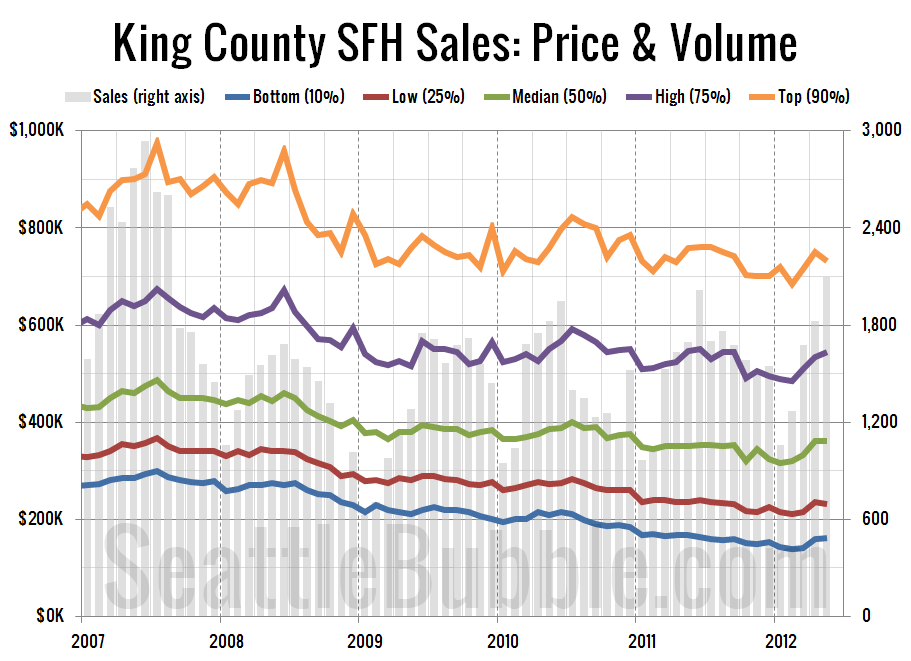
In May, 39% of homes sold for under $300,000 (the 10th percentile level at the peak). Meanwhile, 68% of homes sold in May went for less than the $481,000 median price at the peak.
Here’s a closeup look at just 2010, 2011, and 2012 so far:
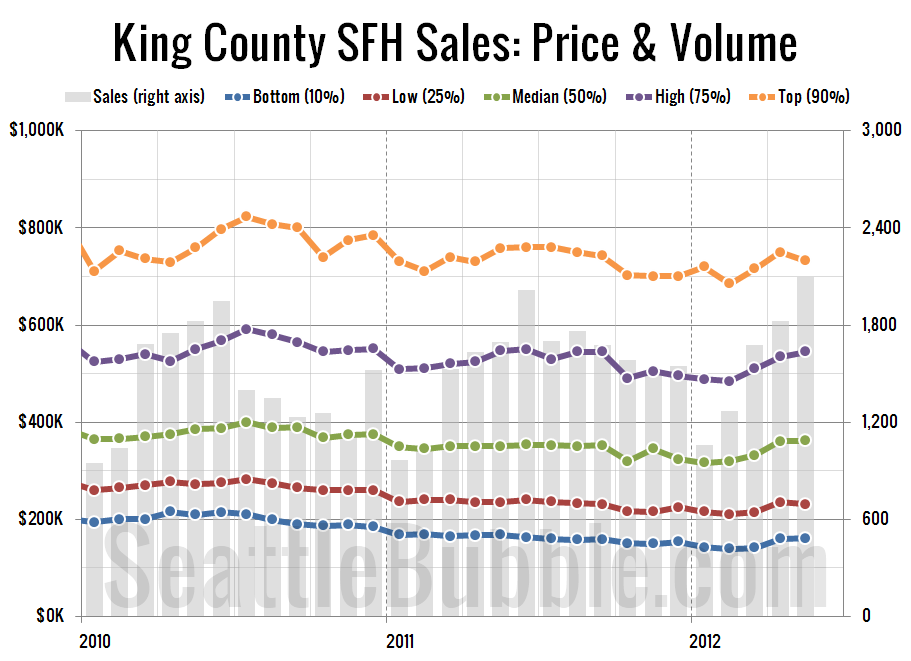
All five tiers moved up between March and April, but the low and top tiers both dipped a bit between April and May. Here’s where all five percentiles fall compared to their respective peaks as of May:
- Bottom: 46% off peak
- Low: 37% off peak
- Median: 26% off peak
- High: 19% off peak
- Top: 25% off peak
Lastly, here’s a look at the year-over-year price changes in each of the five percentiles.
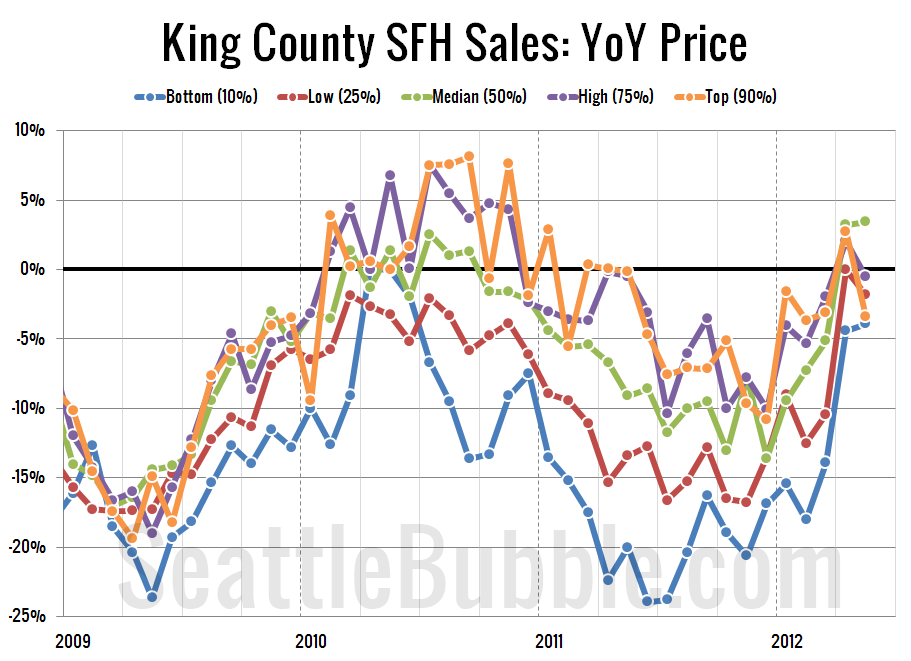
Every tier but the bottom was in the black in April, but as of May only the median is still above zero. Here’s where the tiers stand as of May:
- Bottom: down 4%
- Low: down 2%
- Median: up 3%
- High: down 1%
- Top: down 3%
Pretty amazing that such a short time we went from all five tiers in double-digit negative territory in December to flirting with break-even in May, all without a giant wasteful giveaway of taxpayer money to homebuyers.


There is a massive giveaway in progress. It’s called subsidized lower interest rates far below what the real market would be. There is a massive cost to all. Someday those costs have to be repaid. The Fed has increased their balance sheet to 2.3 TRILLION doing this. Also try earning a decent rate on your savings without having to take substantially more risk then buying a treasury or a CD. Can’t be done. Remember as of last count there are 13,000 mortgages in Washington state(mostly Western Washington) that have been in default for 12 months or more. Will those become dematerialized with some magic potion or will we finally see them hit the market?
Rate this comment:
0
0
On the first two graphs, once you get over about a year back there’s likely huge change in mix. Those graphs probably understate the drop for areas south of I-90 (except Mercer Island). ;-)
Rate this comment:
0
0
RE: Pegasus @ 1 –
Good Point Pegasus
Even Europe is flirting with more bailouts to keep the implosion delayed, but one has to seriously ask themselves….are we just delaying the inevitable with federal interest rate intervention; and in the end, its worse than just letting the economy settle out where its going to go soon anyway.
Useless zero interest 401Ks for moot point retirement planning comes to mind and the impacts this lack of money into the private sector has on bracing the economy and providing much needed income for federal/local taxes.
Rate this comment:
0
0
RE: Pegasus @ 1 –
There’s some truth to that, to a degree. In a large part interest rates in the US are so low because people are looking for safety after repeated massive losses in the stock market. If it was not so, no effort by the Fed would produce such low rates. Look at the Spanish yields, no amount of intervention or ECB support matters – there are no buyers and rates keep going up.
Rate this comment:
0
0
RE: 2kt @ 4 –
True 2KT
The stock market has now become a repeditive short term get in and get out vehicle; rather than a long term retirement asset. When they get out they put it in like safe 0.2% federal treasuries.
Is there a science to this? Let’s put it this way, even the billionaires with their company finacial advisors are losing money at it. But their losses can be sustained when ya got billions.
Rate this comment:
0
0
RE: 2kt @ 4 – The FED is still in control of our interest rates. When rates don’t go as they wish they buy debt to hold down yields. They have not lost all control as parts of Europe have. The good news is all of that foreign money that keeps buying our debt at ridiculous yields because it is still a lesser evil(safer haven) in a time of fear has cut our borrowing costs. (10 year @ 1.6%). It is not Mom and Pop that are the big buyers. Its the big boys foreign and domestic. Someday that all ends. The piper will be paid.
Rate this comment:
0
0
By 2kt @ 4:
Not to mention people from other countries dumping money here as a safe haven. Not to mention companies being afraid to spend the money they have, and instead sitting on huges piles of cash, because the President of the United States is openly and repeatedly hostile to their interests.
All those things result in low rates too.
Rate this comment:
0
0
By Pegasus @ 6:
Are there any stats indicating they’ve had to do any of that in the last six months? With the flight to safety recently, I would not be surprised if they have not had to intervene.
Rate this comment:
0
0
RE: Kary L. Krismer @ 8 – They are still out there almost daily. They bot 4.8 billion of the 10 years just before they sold 25 billion two hours later last week. The next day the Fed has bought $2 billion in 30 year bonds just two hours before the Treasury sells $13 billion in 30 year paper.
http://www.zerohedge.com/news/absurdity-continues-fed-buys-30-year-bonds-two-hours-treasury-sells-30-year-bonds
Rate this comment:
0
0
OK, let’s talk about Real Estate.
From everything I read it seems inflation is a distant chance of saving the price of housing.
What I think is that rather than us seeing a bottom of the housing market we are seeing a ceiling, where no matter what gets thrown at the housing market at this point it stays relatively the same.
What could possibly be done at this point to spark an increase in pricing? Builders are going to start adding units to the inventory, apartments are already on the way, interest rates are historically low, and we already had the tax credit. What more could possibly be done?
Rate this comment:
0
0
RE: David Losh @ 10 – Get those mortgage rates at 3 or below and see what happens for a while while the bad debt gets transferred to new fish? Four percent is definitely having an impact as predicted.
Rate this comment:
0
0
RE: Pegasus @ 11 –
So what if rates go to 3%? People are paying premium prices for property today.
Rate this comment:
0
0
RE: David Losh @ 12 – That’s the game isn’t it? Based on a monthly payment and not on anything else?
Rate this comment:
0
0
RE: softwarengineer @ 3 – Tanks in the street. Nyet, comrade.
Rate this comment:
0
0
RE: David Losh @ 10 – The human population continues to grow. Can’t hedge that.
Rate this comment:
0
0
RE: Blurtman @ 15 – RE: Pegasus @ 13 –
Whoa there, payments don’t mean squat in the end game.
How many millions of people were counting home equity in a retirement portfolio?
Property appreciated since WWII based on this same human population formula.
Today we have density, work until all hours, two incomes, to make ends meet, and an economic crash that wiped out the small investor, including home equity in the billions, if not trillions of dollars.
Now if you want to pretend you are a big time player in the game of finance, great, but the wage earner isn’t that lucky.
I see a lot of room for downward pressure on pricing in residential housing units. I don’t see a huge population spike from the end of the Iraq, and Afganistan wars.
We’ve hit a historic ceiling, went way past it in the bubble, and are now stuck with the same prices for longer periods with lower payments.
Do you really see a seven year hold for property before selling or refinancing? Do you see prices doubling in ten years? What I see is the end of traditional Real Estate reasoning.
Rate this comment:
0
0
RE: David Losh @ 16 – It isn’t about whether “payments don’t mean squat in the end game” or not. It is about the here and now. Pouring gasoline will lite the fire even if it goes out quickly. We are kicking the can down the road by any means available or the people in power will lose control. It isn’t about doing the right thing or doing anything that will benefit mankind in the long run. It is all about maintaining the status quo and those in power.
Rate this comment:
0
0
RE: Pegasus @ 9 – I guess the answer is don’t buy bonds.
Rate this comment:
0
0
RE: David Losh @ 16 – Flat nominal prices for ten years out is your prediction, then?
Rate this comment:
0
0
RE: David Losh @ 16 –
Most people buy high-ticket things based on monthly payment. When monthly payment is about the same as rent, it makes sense to buy. There are few alternatives, if any, and at this point real estate is a sensible investment.
Rate this comment:
0
0
I think it’s worth splitting the should I buy or not discussion into two camps: buying to live in, buying to invest in because the answer can be very different.
If you are buying to live in then monthly payment is a huge factor – if you like the payment amount for what you get in return, and are content to live there for a long time, then it makes sense to buy even if there’s risk of prices dropping. I don’t see a problem with buying today if you find something you like at a price you can handle at minimum semi-comfortably. The days of “buy as much as you can” are definitely gone. But you do want to live somewhere you like right.
If you’re buying to invest then monthly payment should not be the factor, purchase price should be. Low rates help if you are carrying a loan of course, but it’s more gambling at that point. If I had 200k in cash right now I don’t think buying an investment property is where I put it.
Seeing lots of downward pressure on prices now on the eastside, even though alan pope’s charts show percentage of inventory being sold per month is still through the roof. Seems that trend is diving fast and pulling prices with it, but could be poor analytics on my part.
We close on our new home on Monday, but since we’re buying to live in, I’m not gonna sweat the price trends. We love the house.
Rate this comment:
0
0
By David Losh @ 10:
I don’t know where you drive, but builders already are starting to add units. That decreases the value of houses. It does not increase the value.
Rate this comment:
0
0
RE: Blurtman @ 15 –
And Wages are Going Down Simultaneously With Population Density Increases and Housing Prices Following Wages Down
How do ya fix that? With your hogwash world trade magic wand? We’re out of fish, trees and water guys.
Rate this comment:
0
0
By softwarengineer @ 23:
Increasing trade worldwide has a negative impact on this country over the short term. The theory was though that it would benefit us long term (a bigger pie). I think what might not have been factored in was energy costs. Emerging markets use more energy, which drives up the cost of energy, which slows our economy. So that’s an additional drag on our economy, in addition to the temporary loss of jobs which was expected.
Rate this comment:
0
0
Through the 1950s, and 1960s a person could buy a house to live in, but in the 1970s, and 1980s residential housing became a big part of an over all investment strategy. I’ll use the Case Schiller chart to demonstrate: http://www.ritholtz.com/blog/2011/04/case-shiller-100-year-chart-2011-update/
The volitility of the 1980s, 1990s, and into 2000s shows where we get the idea that there is a see saw top, or bottom to the housing market.
The problem, the big problem, that we have today is the price we pay for houses. There is no way to compare a mortgage to rent, because you have the cost of buying in, and the cost of selling a house. Second is you have the payments that may be the same today, but you are stuck with those payments if you don’t have the ability to sell.
The idea you could sell after three years of housing price appreciation seems far fetched today. I don’t see prices going up, or any economic reason why they should.
I do see many reasons why the price of housing can continue to decline from here, such as new units coming on the market, a complete change in living situations, and a mobility in job centers. We have an influx of people coming here for jobs right now, but we are very robust in responding to that demand so when we build what we have on the books what about what we already have for sale?
The only thing you can count on is paying the house off. That is the only sure way to create equity, because I don’t see housing units appreciating. If you love the house great, but your strategy should be to pay it off, and resign yourself to a loss if you while you do that.
After all, it is only money.
Rate this comment:
0
0
The FOMC expects to maintain a highly accommodative stance for monetary policy. In particular, the Committee decided today to keep the target range for the federal funds rate at 0 to 1/4 percent and currently anticipates that economic conditions–including low rates of resource utilization and a subdued outlook for inflation over the medium run–are likely to warrant exceptionally low levels for the federal funds rate at least through late 2014.
Also Operation Twist to continue: The Committee also decided to continue through the end of the year its program to extend the average maturity of its holdings of securities. This continuation of the maturity extension program should put downward pressure on longer-term interest rates and help to make broader financial conditions more accommodative. The Committee is maintaining its existing policy of reinvesting principal payments from its holdings of agency debt and agency mortgage-backed securities in agency mortgage-backed securities. The Committee is prepared to take further action as appropriate to promote a stronger economic recovery and sustained improvement in labor market conditions in a context of price stability.
http://www.federalreserve.gov/newsevents/press/monetary/20120620a.htm
Rate this comment:
0
0
Okay maybe I am wrong but with all the divisiveness in the US today I would guess one thing people can agree on is the best choice would be to buy a house pay it off and not use it as an atm or think it is a retirement account.
I mean really if you can just pay the darn thing off aren’t you doing okay.
I know reach for the brass ring — but hey you know what brass really is weak how about reach for that light weight aluminum ring maybe not so typical but it more practical.
Rate this comment:
0
0
RE: softwarengineer @ 23 – See Frank Herbert, The White Plague.
Rate this comment:
0
0
RE: Kary L. Krismer @ 22 –
I believe you are trolling, intentionally, to engage any one who will listen.
Yes, my point was that builders will add housing units and that will further lower prices by adding more “supply.” We are already over supplied.
Rate this comment:
0
0
By David Losh @ 29:
I’m sorry Dave, but that’s not what you said. What you said was:
By David Losh @ 10:
“Builders are going to start” indicates you don’t know that they are already building. That was my first point. Building more units will act to reduce prices, not raise them as you stated. That was my second point.
Rate this comment:
0
0
RE: David Losh @ 25 –
Adding to yours:
“Through the 1950s, and 1960s a person could buy a house to live in…”
for most of their lives and even all of their lives.
“but in the 1970s, and 1980s residential housing became…”
I would interject here that during the last 2 to 3 decades the average working person has changed jobs and living locations more frequently than people tended to do in the 50s and 60s.
Much of the change in buying a house to live in has come from the anticipated time frame a family would actually live there. Some areas continue to be stagnant in that regard. But areas like ours with a heavy concentration of IT people are less likely to have families who will stay in their home for 20+ Years. That churning will create volatility.
I agree that the volatility exacerbates the focus on market tops and bottoms and everything in between. But the shorter term churning of residential housing is creating that volatility, rather than vice versa.
Rate this comment:
0
0
RE: interested @ 27 –
Yes, that is the best thing to do in my opinion as well. Why put money in a 401K to make little interest, why put money in a savings account or a CD to earn no interest. Buy a house you can easily afford on your own, or afford on one of your incomes as a couple, build an emergency fund, and then pay down the house as fast as possible.
Granted I live in Olympia so this can easily be accomplished without too much sacrifice, as my 1950′s rambler @225K is a lot easier to pay off than a 1920′s craftsman at $550K in Ravenna. No matter where you live though, Wealth is Income minus Expenses. When your in a period of little to no income growth, then the obvious strategy for wealth building appears to me to be reduce expenses. Eliminating housing expenses beyond Taxes+Insurance seems like a good place to start.
Rate this comment:
0
0
RE: Kary L. Krismer @ 30 –
Like I said you are trolling, and attempting to create controversy where none exists.
My entire point was, and is, that the price of housing units will continue to go lower.
Rate this comment:
0
0
RE: ARDELL @ 31 –
Also that churning was possible by an ever increasing price of the housing unit. Now people are stuck with what they buy, and are paying for.
Of course anyone can always take a loss on a sale, but I don’t think that’s going to be a good thing.
The churning is a good interjection, as well as the mobility. I’m not sure how that will all play out in the future.
Rate this comment:
0
0
RE: Sean @ 32 –
Great comment, and exactly the point I would want to make if I were more articulate.
Thanks
Rate this comment:
0
0
By David Losh @ 33:
David, misunderstanding you is not trolling. But in any case, your point was not that the market would continue lower. From the same post I responded to:
By David Losh @ 10:
Rate this comment:
0
0
RE: David Losh @ 35 –
Maybe putting words into David’s mouth but I think the point he’s making in the posts above is that there are a lot of people out there buying up houses because the monthly payment looks cheap and those folks are effectively saying to hell with whatever the purchase price is, price effectively doesn’t matter as long a it is cheaper than rent. Given recent trends and our transient IT based economy here in particular though, those people are all risking getting royaly hosed when they need to take a new job in 3-5 years, at which point interest rates may have jumped, more apartments will have finally hit the market and their house may be worth 5-10% less than they paid (or at minimum they loose that much in transaction costs with no appreciation to offset). Yes, they’ll have locked in a good monthly payment, but be stuck and better hope they can find a position they like that they can reasonably commute to from where they are.
Given that nobody on here seems to arguing a good reason for prices to go up in the mid-term, unless you really love your job and have a great degree of confidence that you will stay in it, it seems that owning needs to be cheaper than renting by an amount that allows you to recoup at least your transaction costs over whatever you estimate to be a reasonable period to stay in the house. Basically, if you can’t recoup at least the 10% in transaction costs over the 5-7 years you’re actually likely to be in the house based on your principal and applying any rent savings, then rent is still cheaper, notwithstanding your monthly payment going down.
Rate this comment:
0
0
RE: Mike @ 37 –
They can always just walk away, probably with increasingly little real consequence. The majority of people have a very short-term perspective. All that matters will happen between now and the end of the month. Buying now is a gamble, but one with very little real downside risk. If the market completely tanks, you lose your job, etc. then you just stop making the payments and likely live in the house for free, perhaps for years. If the market goes up then it’s back to the 1990′s and early 2000′s and you’ve got a leveraged return on an expense (“rent”) you had to incur anyway. Win, win from most people’s point of view.
Rate this comment:
0
0