Let’s have a look at the latest data from the Case-Shiller Home Price Index. According to August data, Seattle-area home prices were:
Down 0.1% July to August.
Up 3.4% YOY.
Down 26.3% from the July 2007 peak
Last year prices fell 0.3% from July to August and year-over-year prices were down 6.1%.
Almost every city showed month-over-month gains again… Seattle was the first to dip a bit heading into the slow season. Both composite indices moved further into the black year-over-year.
Here’s an interactive graph of the year-over-year change for all twenty Case-Shiller-tracked cities, courtesy of Tableau Software (check and un-check the boxes on the right):
Seattle went from the middle of the pack in July for month-over-month changes to all the way at the bottom in August.
Hit the jump for the rest of our monthly Case-Shiller charts, including the interactive chart of raw index data for all 20 cities.
In August, ten of the twenty Case-Shiller-tracked cities gained more year-over-year than Seattle (the same number as July):
- Phoenix at +18.8%
- Detroit at +7.6%
- Minneapolis at +7.4%
- Miami at +6.7%
- Denver at +5.5%
- San Francisco at +5.3%
- Washington, DC at +4.3%
- Tampa, FL at +4.2%
- Portland at +3.6%
- Dallas at +3.6%
Nine cities gained less than Seattle (or were falling) as of August: Charlotte, Los Angeles, San Diego, Boston, Cleveland, Las Vegas, Chicago, New York, and Atlanta. Interestingly, Las Vegas actually inched into the black for the first time since January 2007.
Here’s the interactive chart of the raw HPI for all twenty cities through August.
Here’s an update to the peak-decline graph, inspired by a graph created by reader CrystalBall. This chart takes the twelve cities whose peak index was greater than 175, and tracks how far they have fallen so far from their peak. The horizontal axis shows the total number of months since each individual city peaked.
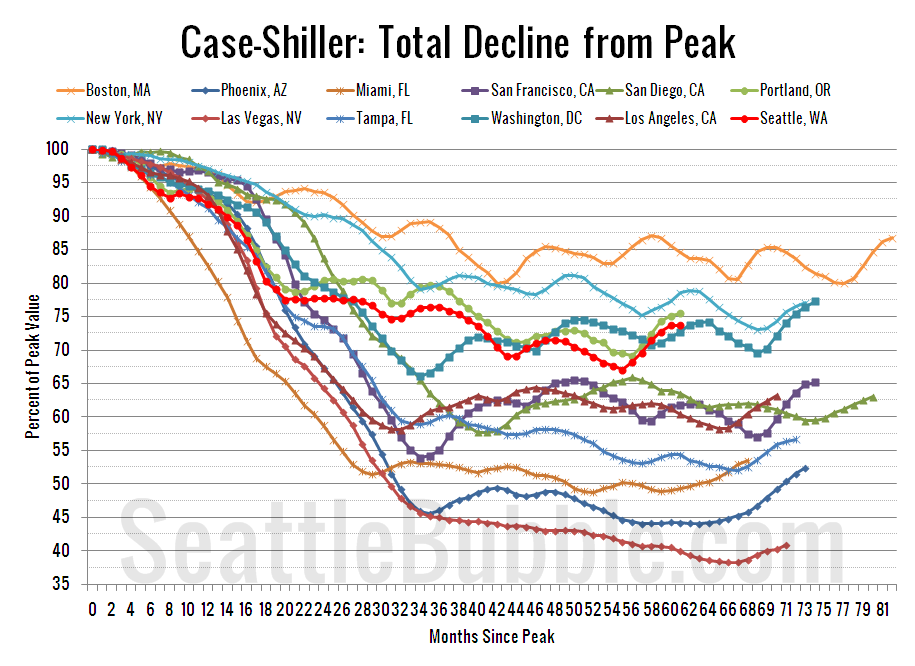
In the sixty-one months since the price peak in Seattle prices have declined 26.3%.
Lastly, let’s see just how far back Seattle’s home prices have “rewound.” As of August: February 2005.
Check back tomorrow for a post on the Case-Shiller data for Seattle’s price tiers.
(Home Price Indices, Standard & Poor’s, 10.30.2012)


The second and last two graphs are not showing on my system.
Rate this comment:
0
0
RE: Kary L. Krismer @ 1 – Sorry about that, uploaded the wrong images. Fixed now.
Rate this comment:
0
0
Meh…..with the current macro environment, it’ll bounce back down. Both MoM and YoY.
I’ll think about calling stabilization during the high summer selling season when there is back to back years of YoY flat to positive, and when it does so AFTER the Fed and FHA quits manipulating the mortgage market. Until then….yawn.
Rate this comment:
0
0
Move along people . . . . nothing interesting to see here. Bounce, bounce, bouncing along in a slooooowwwwwwww manner.
Rate this comment:
0
0
why is august 2005 shown in blue?
Rate this comment:
0
0
RE: Erik Muller @ 5 – That’s the month I started Seattle Bubble.
Rate this comment:
0
0
Sweet! That’s approximately my interest rate. *Crosses fingers, holds breath*.
Rate this comment:
0
0
Could you explain the initial number that states the Seattle HPI change MOM is negative? It looks like the graph shows Change in HPI continuing to be positive.
Rate this comment:
0
0
Do you think Las Vegas, Phoenix and Los Angelas have more potential to make money as an investment than Seattle because they have been higher in the past? Is previous price a good indicator of future price if we are comparing one city to another? For that matter, is previous price of a home a good indicator of future price?
Rate this comment:
0
0
By Erik Muller @ 9:
No.
No.
No.
Rate this comment:
0
0
When you say things like “We are back to 2004 prices,” doesn’t that imply that the sale price of a home in 2004 is approximately the same as it is today? To me this indicates the past sale price is a good indicator of the future sale price.
Rate this comment:
0
0
RE: Erik Muller @ 11 –
Um, are you trying to say the *2004* sale price is a good indicator of the *PRESENT* sale price? Are you asking if today’s market is going to follow the ensuing trend of 2005-2007 in the next few years?
I’m having a difficult time understanding that question. Past sale prices run the gamut from enormously inflated to very reasonable back in the late 90′s.
Rate this comment:
0
0
Relatively speaking, Seattle MOM looks absolutely horrific. In fact, it’s downright scary (especially when considering the macro data). My fingers are crossed that this isn’t a sign of things to come.
Rate this comment:
0
0
By No Name Guy @ 3:
I’m curious how much appreciation in the HPI you expect by that time. The way I see it, there is little pressure on the Fed to raise interest rates until inflation starts to rear its ugly head (at least officially — to me it already feels like there’s more inflation than the official numbers seem to imply). So if I understand that your argument is that the current trend of increasing home values is due to interest rate manipulation, as long as it continues to be successful market manipulation we’ll continue to see YoY HPI increases (in general).
Once inflation kicks in, even flat home valuation should see YoY HPI increases merely due to currency devaluation. What’s the risk, to those looking for a bottom before making a move, of missing the bottom by several years waiting for proof that we’ve arrived at an actual bottom?
Just curious,
–Mark
Rate this comment:
0
0
RE: The Tim @ 10 –
No, no. no. Kill-joy. Practicing your child rearing skills? Throw the dog a bone. Can I have a “maybe?” ;-)
Rate this comment:
0
0
RE: The Tim @ 10 –
In previous posts, The Tim has compared Seattle proper housing prices to the housing prices in 2004. His point was that at that time we were at the same price as we were in 2004.
What I am saying is making this comparison is implying present value has a relationship with past value. This would be a great tool to determine if you were getting a good deal or not. If I find a property in Seattle proper that is priced significantly less than what it sold for in 2004,I could realize that i’m getting a good deal.
Rate this comment:
0
0
RE: Erik @ 16 –
…more like a dog of a place with severe problems. Too cheap is not usually good unless you can find the negatives and they are correctable.
Rate this comment:
0
0
RE: Erik @ 16 – The index may be at the same level as some other point in time but that doesn’t necessarily translate to each individual house.
Rate this comment:
0
0
RE: Doug @ 12 –
I have a lot of respect for Tim’s opinion and i’m trying to get him to tell me if I can reasonably determine the value of a home based on what it sold for at a previous date. He has made this comparison before. I would like to use this comparison as a tool to determine value.
He said “no, no, no” above, so at this point I would not use that metric to determine value… though i’d like to.
Rate this comment:
0
0
By Question Mark @ 14:
The bulls need to ask themselves, why is the economy growing at less than 2% at a time when interest rates are the lowest they’ve ever been in all of history? The answer is, we are in the midst of a depression that is being masked by unprecedented borrowing and printing by the Fed and government. When the Fed pulls another magic trick with it’s magic money printed from thin air, a new round of buyers jump off the fence, and prices temporarily increase slightly. But soon, the newest “good deal” starts to seem, “same ol’.” So the Fed has to engineer a newer even better magic trick. The problem is, when rates hit a certain point of being low, they can’t get any lower, and we are very near that lower bound.
That only occurs when wages go up as inflation increases, and this requires good high paying jobs (or finding a way to get all the printed money to actually hit mainstreet). If workers who were once making good salaries are laid off and rehired to flip burgers, or if they just can’t get a job period, or they simply must compete with Chinese manufacturing wages, then wage increases do not track inflation. In this case, as food, energy, and the price of many imported goods rise, house prices go down.
The government and Fed are master manipulators whose main goal is to increase the amount of debt the taxpaying consumer is willing to take on. The hope is, this will stimulate the economy to grow again. But since the game has never been quite set up this way before, nobody is sure what the outcome will be. The problem is, the consumer is already highly in debt, so attempting to fix the problem by tricking the consumer into taking on more debt is a dangerous proposition. Yes, we could end up with runaway asset inflation, but we could also end up with runaway asset deflation.
IMO, there is very little risk in “missing the bottom” as long as you are an experienced investor and know what signs to look for.
Inexperienced investors believe they need to pick the absolute tops and bottoms of markets in order to profit. The problem with this strategy is, very few people can do it consistently. Instead of rushing into a highly volatile market in fear that you might miss the absolute bottom, it’s better to buy into a trend that has shown past strength and has great upside potential. So what if you miss the first 5% if you end up getting 5% every year for 20 years after that? Either that, or you could try to catch a falling knife and lose $100K.
We’ve seen a plethora of inexperienced bottom pickers lose there rear ends over the last 8 years. Meanwhile, the smart money has sat on the sidelines, lived frugally, and continued to save up a monster down payment.
Prices are currently back to late 2004 to early 2005 levels in many local areas. But that only tells a fraction of the story. When you add in 7 or 8 extra years of down payment savings on top of massive interest rate drops on top of massive house price drops, it adds up to, those who bought early, having missed an unprecedented time in the history of our country to patiently wait on the sidelines until the right time to buy a house occurs.
Rate this comment:
0
0
By Erik Muller @ 9:
RE: Erik Muller @ 9 – YES. Better weather, better proximity to better coastline and better inland areas.
Rate this comment:
0
0
RE: Erik @ 16 –
In terms of selling you have to, have to, use sales data to determine a price, but price, as we just saw in the last run up in pricing, has very little to do with value.
You could use rental income with a formula that suits you, and rental income tied back to the Consumer Price Index, may be predictive, but sales data isn’t.
Rate this comment:
0
0
By Erik Muller @ 9:
I would look at it differently than Tim, but unfortunately the graph I want to use is no longer available. Instead go to the second Tableu graph above and only select Las Vegas and Seattle.
The rapid run up in LV between 03 and 07 would cause you to think that even without economic turmoil their prices would fall. At the time, Trump was investing in developing condos there, and I was asking why? What was driving the growth there? Seemingly the answer was nothing but hype.
You could have the opposite situation, where a market falls so much that it would be viewed as an over-correction, with prices set to rise. I don’t think you could say that about Las Vegas without knowing how much inventory they added during their boom (probably a lot), how much population they added (probably not very much), and how their economy has been doing overall. Of those three, inventory is probably the biggest concern, and I’m using “inventory” in the manner Losh does–all housing units, not just those for sale. With too much inventory it’s possible prices today are too high, even if they’re about where they were before the run up.
Rate this comment:
0
0
By Erik Muller @ 11:
Unless you’re at a record price, today’s price will always be some other period’s or periods’ price. That wouldn’t help you predict anything though, because there are many periods tomorrow’s price could match.
Rate this comment:
0
0
By Jonness @ 13:
Did you forget a “/sarc” tag there? How is down 0.1% horrific? I would describe it as flat, and I think I’ve probably described prior larger increases as flat.
Rate this comment:
0
0
By Erik @ 16:
Why wouldn’t you just determine what the property is worth today to determine whether you’re getting a good deal on it? Comparing it to an arbitrary point in time seems—arbitrary. It also creates unnecessary work, because you have to determine the value in 2004.
Rate this comment:
0
0
By Jonness @ 20:
The answer is President Obama is an anchor on the economy. Why would business want to invest in the future with his policies in place? The only way he knows to create jobs is spending government money to hire people (directly or indirectly). That scares business, like it scares you and others here.
Rate this comment:
0
0
RE: Question Mark @ 14 –
What Jonnes at 20 said (more or less).
I’ll add that “so what” if I miss the exact bottom. With dry powder in hand if it turns out things have bounced a few percent off the bottom, so what – I’d still be able to buy property that pencils out. Until then, I’m being extremely patient. After all, the saying is to wait until there’s the financial “blood in the street” to buy – I think the macro data indicates that point is off in the future, not here and now.
Rate this comment:
0
0
RE: Kary L. Krismer @ 27 –
Hence why private sector employment is up, and total government employment is down in this country, right?
Kary, your assumptions and impressions just don’t jibe with the facts at all: http://www.businessinsider.com/the-private-sector-and-the-public-sector-under-obama-2012-6?op=1
Rate this comment:
0
0
RE: Doug @ 29 – Wow, do you work for the Obama campaign? I’ve never seen so much spin.
Yes, private employment is way up under President Obama. /sarc
http://static3.businessinsider.com/image/4fd298b4ecad042f67000026-590/however-the-private-sector-has-been-adding-jobs-steadily-since-the-end-of-obamas-first-year-and-today-there-are-more-private-sector-jobs-than-there-were-before-obama-took-office.jpg
What is that? 111,000k compared to 111,100k in three plus years. Yes using your data the private sector economy is clearly just taking off. /sarc
But that’s totally ignoring my argument that private sector employment should be much higher today, and that President Obama is part of the reason for that. Showing pathetic growth under President Obama doesn’t prove that the growth would not have been higher without him.
To be fair the Republicans are also at fault. For example, taking the government close to default earlier probably didn’t instill a lot of confidence in employers.
Rate this comment:
0
0
RE: Kary L. Krismer @ 26 –
I was considering the case that it sold in 2004. This is a simple lookup to determine what it was worth in 2004. The price of a home is subjective. Comparing it to its previously sold price is another clue to what its current value really is.
Rate this comment:
0
0
RE: Kary L. Krismer @ 30 –
if you’re going to blame Obama for the economic collapse that was underway when he got into office, built on a huge asset bubble that created trillions of dollars of illusory wealth, then we clearly can’t have a real conversation here, Kary. I know you not to be a stupid man, so I think you’re just really twisting facts to fit your preconceived notions.
If you want to compare all economic indicators to the past highs of illusory wealth, go right ahead. It sure is easy! My house is worth $280,000, not $450,000 like the last person bought it for. “That darn Obama! When is my house going to be worth $450,000 again?”
you claimed:
“The only way he knows to create jobs is spending government money to hire people (directly or indirectly).”
I showed that this was factually incorrect. Private employment is up under Obama, and public employment is down. This doesn’t require a lot of spin, Kary.
Rate this comment:
0
0
By Erik @ 19:
As another commenter mentioned, the index as a whole is roughly where it was in February 2005, but that doesn’t really tell you much about any one home. Sure, a home might be a good deal if it’s selling at a price comparable to years earlier than that and it might be overpriced if it’s selling at a price comparable to years later. But it totally depends on the condition of the home and the neighborhood it is located in. Some neighborhoods have “rewound” much further than February 2005, and some have rewound less.
You might be able to use the Case-Shiller index and past sale prices as one very rough piece of information in valuing an individual home, but I wouldn’t use it as the primary indicator.
Rate this comment:
0
0
RE: The Tim @ 33 –
In addition to the variation between neighborhoods, quality didn’t seem to factor much into bubble house prices. People were simply snapping up houses as fast as they can, motivated either by fear or greed.
Now, low-quality houses constructed as recently as 2008 are already aging extremely poorly, sagging, and leaking. Prospective home-buyers know they have the luxury of time to pick out their home, and I believe they are buying with a more discerning eye.
When I was looking for a home, I found three well-constructed new homes, one of which I bought. We also toured dozens of drafty, depressing McMansions built as closely as possible. I don’t think people are going to go for that anymore, unless it’s at a significantly reduced $/sq ft
Rate this comment:
0
0
RE: The Tim @ 33 –
Thank you very much Tim
Rate this comment:
0
0
RE: Erik Muller @ 35 – Also, I forgot to mention, I have made a few posts on this subject in the past:
Strategies for Finding the Best Value in Today’s Market
How To: Analyze a “Below-Market†Deal (5-part series)
Rate this comment:
0
0
By Erik Muller @ 31:
Okay, but then you’d have to look into the terms of the sale. 2004 might not be too difficult, assuming it wasn’t a FSBO, but once you get past 2007 it can be problematic because of REOs and short sales.
As to the FSBO, I came across a property bought FSBO in 2007 or early 2008 where it had been listed for a significant period of time at a price well below what it sold for FSBO. So the buyer paid way too much for it. Using that type of a sale for a comparison would lead to bad results.
Rate this comment:
0
0
By Doug @ 32:
I’m not saying the economy should have turned around on a dime when President Obama took office. I’m saying that for the past year or 18 months we should have had a lot stronger growth than what we’ve had.
Private employment is barely up under President Obama. After you factor in the jobs needed for population growth (and the decline in government employment you mention), that low level of increase is a very bad thing, not a good thing at all.
Rate this comment:
0
0
RE: Doug @ 32 –
I see you’ve wasted a couple of days in the world of Kary Krismer; better you than me.
Rate this comment:
0
0
RE: David Losh @ 39 – Yes, better Doug than you. Doug is seemingly intelligent, educated and not living in some total fantasy world. He’s just a little misguided, IMHO, but he’d probably say the same thing about me.
Rate this comment:
0
0
RE: Kary L. Krismer @ 38 –
“I’m not saying the economy should have turned around on a dime when President Obama took office.”
From a macro-perspective, Kary, it certainly seems to have done that in relatively short order.
Prior to President Obama taking office, the economy was losing ~800,000 jobs a *month*. Read that sentence again please, so I don’t have to re-type it. Since Mr. Obama took office, we have had several *years* of slow growth. Not nearly enough growth, not even enough to absorb new workers entering the workforce…but growth…again, compared to massive monthly losses immediately prior.
I say this as someone who did not vote for Obama in 2008. I work in a finance-related field. My own company had four rounds of layoffs between October 2008 and March 2009. Now deal flow is up, we are aggressively hiring, and my salary has almost doubled since late 2008.
I do agree with you that showing pathetic growth under Obama does not mean that growth “would not be higher without him.” However, similarly, it doesn’t mean that growth *would* be higher without him either.
Rate this comment:
0
0
RE: Erin @ 41 – At what cost? Flooding the market place with debt that can never be repaid and subsidizing manipulated interest rates comes with a penalty that must be repaid. Try the same thing yourself. Buy a house with nothing down, borrow the money with no ability to ever pay it back, lie about everything and wait for the reaper to arrive while proclaiming everything is wonderful and that nothing is wrong. The reaper is coming sooner or later.
Rate this comment:
0
0
RE: Pegasus @ 42 –
What debt that can never be repaid? Do you mean China? or the Federal government?
The second question would be what reaper?
I don’t foresee a world that will allow the United States to go bankrupt, do you?
If Greece can reorganize debt, we can reorgainize, but I don’t see that either.
What I see is a massive amount of spending that can be cut, and plenty of ways to raise revenue. I didn’t say raise taxes, but I think that’s coming, no matter who gets elected.
Rate this comment:
0
0
By Kary L. Krismer @ 25:
Seattle is not “flat” compared to the other cities (relatively speaking). It’s in last place and the only city in negative territory.
What does it mean when a city turns down first and begins to correct out ahead of all other cities? This is especially concerning given we had record sunshine in August, mortgage rates were hitting record lows, and the unemployment rate was decreasing.
Rate this comment:
0
0
By Pegasus @ 42:
The difference between your position and mine is I’m not certain we’re past the tipping point. I think with four more years of President Obama we probably would be. And of course, if Romney is elected and pulls a Bush (W), and doesn’t cut spending, it won’t matter either way. Remember, in many ways President Obama didn’t change Bush policies that those who voted for him wanted changed.
Rate this comment:
0
0
By Jonness @ 44:
We don’t really know what’s going on in other cities. In Seattle we know the YOY number is almost certainly where it is due to reduced numbers of short sales and REOs, rather than actual improvements in value. Some cities may be going up because they over-corrected. Each city is different in some way.
But again, you were addressing the month over month figure as horrific. No month over month change could be horrific in my mind, because it might just be a blip. But a 0.1% change clearly is not horrific.
Rate this comment:
0
0
RE: Pegasus @ 42 –
Again, total U.S. debt (hosuehold, business, all government) is growing more slowly than it did under Bush, barely over inflation.
Compare this to Greece, where govt debt, consumer debt and housing debt were all decreasing while the economy contracted. Nothing was going in the right direction.
Here, the government is alleviating some of the burden of debt from businesses, consumers, and local governments. The GDP is increasing, bond rates are low.
You can’t compare the U.S. economy to a household budget. There’s a reason business budgeting and macroeconomics are entirely different fields :-)
Rate this comment:
0
0
RE: Doug @ 47 – Is growing too slow to meet population growth really moving in the right direction? We’ve probably had maybe three months where the employment growth was adequate. A positive number is not necessarily a good number.
Rate this comment:
0
0
RE: Kary L. Krismer @ 48 –
It’s enough to be increasing consumer confidence and slowly bringing down unemployment. So it’s adequate…. barely.
Overall, wage stagnation and household debt are still big, big problems, in my mind the root problems in this economy. We’re probably going to have to create some inflation to deal with that, or we’re going to continue on a kind of lost-decade path.
But a lost decade is a hell of a lot better than austerity and dismantling the government.
Rate this comment:
0
0
Looks like Pfft is now posing as “Doug”.
Rate this comment:
0
0
RE: No Name Guy @ 50 –
Doug is doing good.
I was reading about Greece this morning, and I don’t see us going down the same road, but there will be reprecussions from European defaults.
Rate this comment:
0
0
RE: No Name Guy @ 50 –
Wow, only room for one liberal on Seattle Bubble? My apologies.
I think it’s obvious that pffft and I make our arguments very differently.
Back on-topic: It would be interesting to plot the Case-Shiller against inventory levels. We bought in March 2011, and it seemed like around that time was just about the perfect time to buy.
Rate this comment:
0
0
By Doug @ 52:
I would agree. pffft is exclusively democratic party talking points.
Rate this comment:
0
0
By Kary L. Krismer @ 46:
We’ll have to agree to disagree on this one. IMO, the fact that it turned down at a time of record sunshine, low mortgage rates, and decreasing unemployment speaks volumes about whether we are seeing legitimate housing market strength or just more temporary stimulus shenanigans. I shudder at the thought of what will occur if we hit the fiscal cliff this winter.
Rate this comment:
0
0
By Doug @ 47:
http://www.amazon.com/This-Time-Different-Centuries-Financial/dp/0691152640
Rate this comment:
0
0