Entries Tagged as 'median'
Posted by deejayoh on August 19th, 2007 at 6:01 PM · 27 Comments
Last week Tim had a great post on median prices, where he looked at sales by area of the county, and showed that sales had remained strong in the high end locations while they had dropped away in the lower-priced areas. It was great analysis, and it got the wheels turning in my head - with average price data at the right level, I knew that we could really show how the distribution of sales prices was changing. Of course, the MLS likes to make this data as difficult as possible to come by, so I wasn’t able to dig any deeper.
Then while reading a blog this morning I found this link for MelissaDATA - which is the company that sells your name to all kinds of people when you buy a new house. One of the other things they do to tempt buyers of that data is show the number of sales and average price per sale by zip code. They had data back to 2001.
After a whole lot of point, click, cut and paste activity - I now have a distribution that shows the average price of a home sale and the number of sales by zip code for all of King County by month for the last 6 years. With about 75 different zip codes to report, I was able to put together a histogram that I think should approximate the sales price distribution in the overall market.
This chart pretty clearly shows that the sales volume has dropped year over year in the lower priced zip-codes while the high-end “tail” of the distribution has remained fairly consistent. In comparing 2007 to 2005 and 2006, the shape of the distribution appears flatter and more skewed to the right.
More support for Tim’s contention that the median price doesn’t tell the whole story.
Update:
Here’s another look at the data based on JP’s excellent suggestion in the comments. In order to normalize away the shift in the median and just focus on the shift in the volume by neighborhood, I assigned each zip code to a decile based on their 2005 average price and sales volume - such that each decile contained about 10% of the sales volume for that period (not exactly as you can see, because the sales are grouped by zip code so they are kind of “lumpy”). I then compared the distribution of sales in 2005 to the distribution in 2007 for these decile assignments. I also reduced the data set to just the last two months, as I wanted to focus on what the impact of the subprime fallout has been. As you can see in the chart below, the shift isn’t huge - but the percent of total sales in the top five deciles has increased as a percent of the total market. In 2005 the top five deciles was 52.4% of total sales. In 2007, this has increased to 55.6% of total sales. Put in context of total sales, the volume in the top five deciles has dropped 55% (from ~6,400 to ~2,900 homes) while the volume in the bottom five has dropped 60% (from ~5,900 to ~2,300 homes).
As JP points out, this does assume that the “mix” of homes by zip code remains constant over time (e.g. Medina remains relatively high while White Center remains relatively low) but given there is only a two year span between the data sets, I think this should be a safe assumption.
Thanks for the comments and suggestions. Keep them coming!
Categories: Uncategorized
Tags: median, NWMLS, Statistics
Posted by The Tim on August 14th, 2007 at 5:31 PM · 45 Comments
When July’s housing stats came out last week, the most confusing piece of data was that despite skyrocketing local inventory and tightening lending across the nation, the median price still jumped up 2.3% from June, bouncing back into double-digit YOY territory at a 10.6% increase since July 2006.
While the local press has their own theories—apparently based on whimsical fantasies and proud pink ponies—I’ve been doing some actual investigating into the more detailed reports from the NWMLS and have come up with a theory of my own.
The shortcomings of the median price as an indicator of actual price changes have been discussed here before, but typically in a hypothetical sense. For instance, we know that if low-end home buyers stop buying homes, while middle and high-end buyers keep buying, the median will increase. However, in the past we have not been able to observe this happening in King County via the data we have available to us. As you are about to see, I believe that is no longer the case.
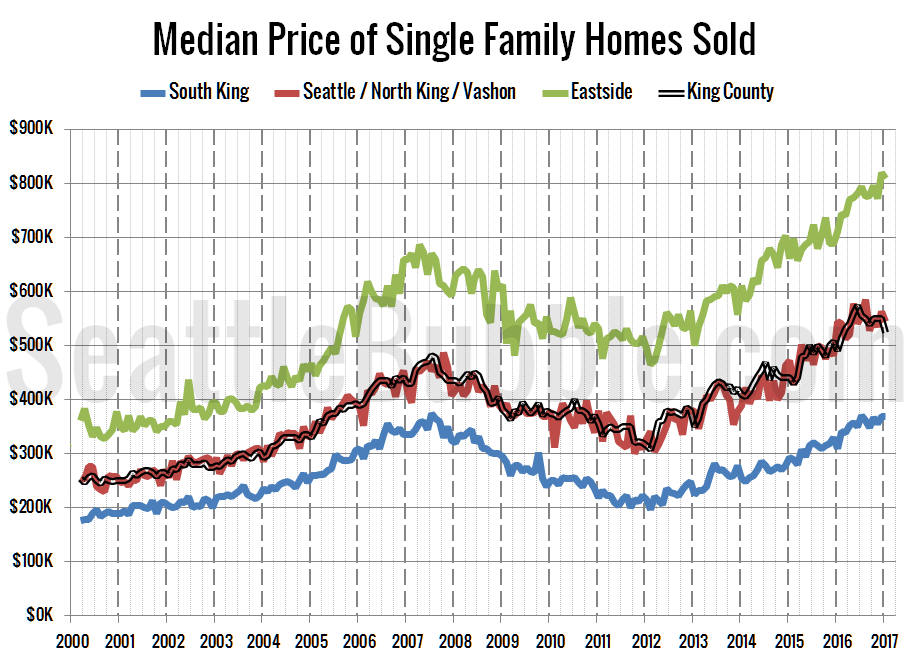
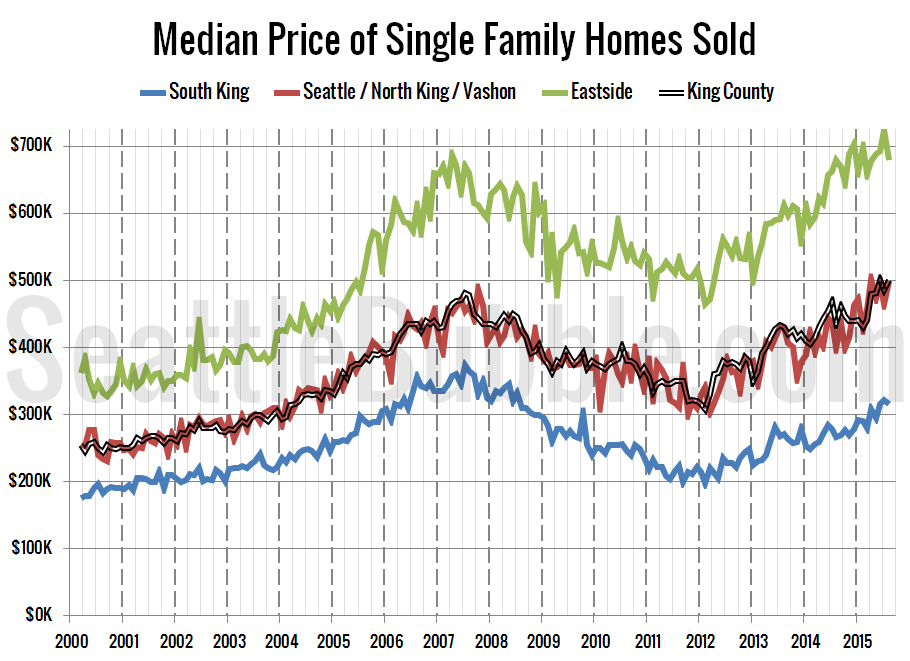
The last time we investigated this topic we looked at actual price breakdowns. This data is not generally available to the public though, so I came up with a reasonable alternative: regional breakdowns within King County. This data is publicly available in the KCBreakout pdf files that are released by the NWMLS every month. Furthermore, it serves more or less the same purpose as price breakdowns, since the county can be split into three general regions:
- low end: South County (areas 100-130 & 300-360)
- mid range: Seattle / North County (areas 140, 380-390, & 700-800)
- high end: Eastside (areas 500-600)
The areas’ approximate June 2006 median price was:
- South County: $360,000
- Seattle / North County: $480,000
- Eastside: $640,000
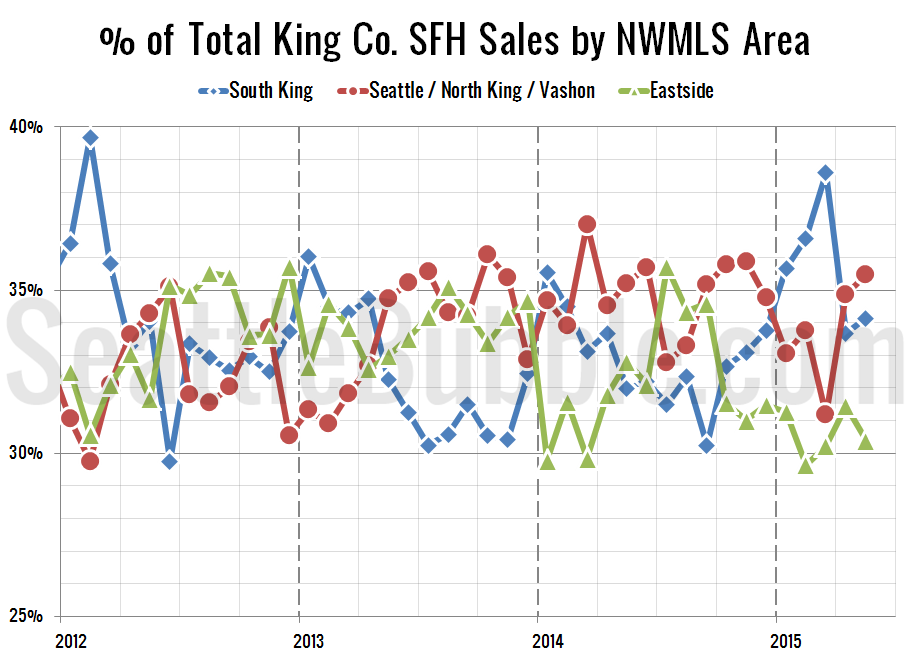
So, if we were to see (for example) a drop in sales in South King County coupled with an increase in sales on the Eastside while the median value of homes sold in each of those areas remained unchanged, the net effect on the county-wide median would be an increase. Let’s see what has actually happened in the King County single-family house market since January of last year:
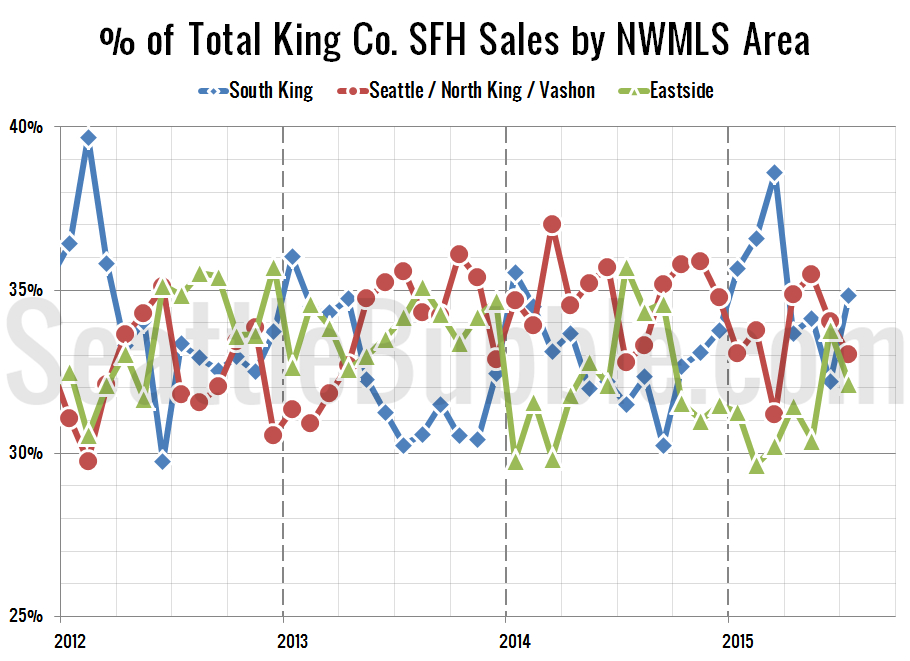
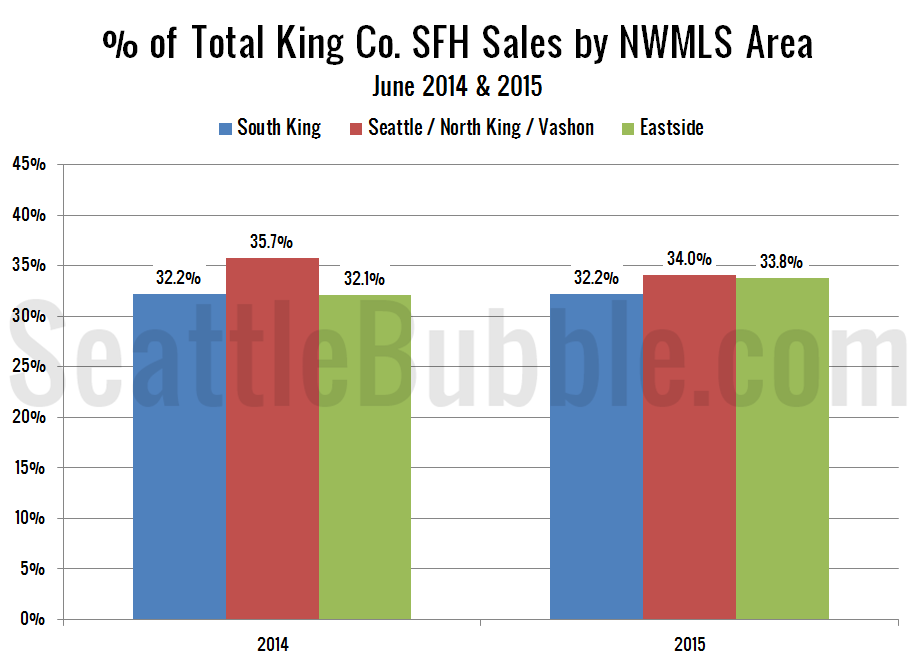
From January of last year through about January of this year, the Eastside region averaged around 30% of the total closed sales, Seattle / North County averaged roughly 33%, and South County come in at about 37%. However, look what started to happen in February. The Eastside held pretty steady, but the percentage of sales in Seattle vs. South County began to converge, and essentially swap. This was followed up last month with a relatively large jump in sales on the Eastside, from 29.8% of the county-wide total in June to 33.5% in July.
In fact, I believe that almost all of last month’s increase in the county-wide median can be attributed to this spike in sales on the Eastside. To get a better idea of the magnitude of this change, take a look at this graph, which shows the monthly deviation from the six-month rolling average for each area:
In July, the Eastside had a 15% larger portion of the total closed sales in the county than it had averaged over the January-June period, while the South County came in 11% lower. Seattle held mostly steady in July (just 1% lower), having had its large spike in April (up 11%), also primarily at the expense of sales in the South County.
What happens when the sales breakdown goes from 30-35-35 to 33-32-35 in one month, shifting sales from the least expensive area to the most expensive? Ta-da, you get a higher county-wide median.
So how much of the increase in King County’s SFH median can be explained by shifting sales patterns, rather than actual rising home prices? Before February of this year, I would have said “none.” But with Seattle’s share of the total homes sold in the county showing a steady increase, South County sales experiencing a steady decrease, and Eastside sales taking a sudden spike in July, I am now much more inclined to say “quite a bit.”
I don’t think this explains away all of the median price increase over the last few months, but I do think it accounts for a good portion of it, especially last month. In theory, if sales distributions are indeed skewing the median, we should see the YOY change in the Case-Shiller Index begin to diverge from the YOY change in the median, since the Case-Shiller method avoids this particular shortcoming. I’ll keep you posted when July Case-Shiller data is released.
Update: Guess what? My prediction about the July Case-Shiller data was dead-on. MoM change was just 0.2%, YoY was 6.86%. That’s quite a bit different from the median’s 10.6% YoY increase.
Categories: Uncategorized
Tags: median, NWMLS, Statistics