Seattle Bubble

News & discussion about real estate & the housing bubble in the Seattle area.

Seattle Bubble - News & discussion about real estate & the housing bubble in the Seattle area.

Entries Tagged as 'rent'

Rent vs. Buy Comparisons: Have the excesses been removed?

By The Tim on October 14th, 2009 at 6:00 AM · 102 Comments

Let’s try another rent vs. buy exercise to see if “all the excesses have already been removed” as some have claimed. Rather than delve into depth on a specific randomly-selected Seattle-area neighborhood, let’s instead look at what a specific type of house might cost you in multiple Seattle-area neighborhoods to rent vs. how much it would cost to buy.

Methodology
The prices quoted below are for a 3-bed, 2-bath single-family homes with 1,750 to 2,000 square feet. For the rentals, these are based on actual houses I found currently on the rental market. For the sales, I used sale records of actual prices that people have paid in the last three months. Where possible, I have located multiple samples that match the description above and taken the average price.

To calculate the monthly payment (principal + interest only), I’ll be using a 5.15% interest rate (roughly the average over the last three months), (generously) assuming 20% down on a 30-year mortgage. Keep in mind that the true cost of buying also includes insurance, taxes, maintenance, and a host of other costs generally not paid by a renter. For a more detailed breakdown of the total costs (and tax benefits) of buying, hit up this 2007 post.

I have also indicated the price to rent ratio, which is simply the home price divided by the total rent paid in a year.

Area For Rent P + I Home Price Ratio
Ballard $1,595 $2,070 $473,661 24.7
Queen Anne $2,000 $2,686 $615,000 25.6
Shoreline $1,415 $1,609 $368,379 21.7
Kirkland* $1,511 $2,040 $466,916 25.8
Redmond $1,450 $1,877 $429,625 24.7
Renton $1,250 $1,428 $326,938 21.8
West Seattle $1,650 $2,271 $520,000 26.3

According to a table of data from Fortune Magazine, Seattle’s price-to-rent ratio just before the local peak in prices was at 38.0, compared to a 15-year average of 23.3. In our table above, the average price-to-rent ratio for a 3-bed, 2-bath home in a handful of Seattle-area neighborhoods comes out to 24.3. Unfortunately, the two are not directly comparable since Forbes’ calculation included houses, condos, and apartments all among the rentals (which would drive the rental prices lower and the long-term average price-to-rent ratio higher), while my data was drawn only from single-family homes.

While home prices have come down some since I first researched the rent vs. buy discussion in detail back in 2007, a growing oversupply of repartmenting condos and accidental landlords is also pushing down rents recently, so the price-to-rent ratio hasn’t actually changed as much as one might expect.

Overall, price-to-rent ratios in the low-to-mid 20s still seems a bit high. Not crazy out of control bubble high, but it still looks like there is room for a bit more correction. Especially when you consider that the current prices are being artificially propped up by unnaturally low interest rates and the $8,000 tax credit in the midst of nearly 10% unemployment and a local economic scene that has yet to show any clear signs of turning the corner.

* [Updated, see comment #71 below.]

→ 102 CommentsCategories: Features
Tags: , , ,

Housing Stats: Seattle vs. Other Big Cities

By The Tim on September 24th, 2009 at 10:16 AM · 22 Comments

Building on the data that was presented yesterday, here’s a sortable table of some more detailed housing stats for the 25 largest US cities by population. Included below are population, density, median sale price, median price per square foot, median rent, median household income, median list price, and some ratios of sale prices to rents and incomes. Unfortunately sale prices are not available in Texas or Indiana (which is why I went with list price in yesterday’s post).

Click on any column header to sort by that column. Enjoy!

City State Pop. Density Med. Sale Med. $/sqft Med. Rent Med. HH Inc. Sale/Rent $/Sqft/Rent Sale/Inc. Med. List
New York NY 8,363,710 27,440 $471,200 $339 $985 $48,631 39.9 0.34 9.7 $449,900
Los Angeles CA 3,833,995 8,205 $442,800 $293 $986 $47,781 37.4 0.30 9.3 $447,000
Chicago IL 2,853,114 12,649 $255,500 $199 $832 $45,505 25.6 0.24 5.6 $276,000
Houston TX 2,242,193 3,828 $749 $40,856 $187,000
Phoenix AZ 1,567,924 2,938 $158,600 $96 $797 $48,061 16.6 0.12 3.3 $160,000
Philadelphia PA 1,447,395 10,721 $150,600 $122 $770 $35,365 16.3 0.16 4.3 $169,000
San Antonio TX 1,351,305 2,809 $698 $41,593 $159,900
Dallas TX 1,279,910 1,427 $737 $40,986 $215,000
San Diego CA 1,279,329 1,612 $394,800 $284 $1,209 $61,863 27.2 0.23 6.4 $427,000
San Jose CA 948,279 2,223 $486,800 $322 $1,249 $76,963 32.5 0.26 6.3 $499,000
Detroit MI 912,062 6,378 $51,600 $37 $704 $28,097 6.1 0.05 1.8 $16,500
San Francisco CA 808,976 17,323 $728,200 $579 $1,192 $68,023 50.9 0.49 10.7 $800,000
Jacksonville FL 807,815 1,062 $155,600 $95 $831 $48,699 15.6 0.11 3.2 $160,000
Indianapolis IN 798,382 2,152 $668 $44,325 $112,500
Austin TX 757,688 2,396 $829 $48,966 $253,000
Columbus OH 754,885 3,556 $137,300 $93 $703 $42,253 16.3 0.13 3.2 $129,900
Fort Worth TX 703,073 1,828 $753 $47,104 $155,000
Charlotte NC 687,456 2,516 $174,800 $101 $786 $52,690 18.5 0.13 3.3 $189,900
Memphis TN 669,651 2,327 $124,200 $72 $719 $35,143 14.4 0.10 3.5 $103,500
Baltimore MD 636,919 7,889 $169,300 $137 $778 $36,949 18.1 0.18 4.6 $149,900
El Paso TX 613,190 2,447 $564 $35,646 $149,900
Boston MA 609,023 12,561 $356,100 $365 $1,107 $50,476 26.8 0.33 7.1 $389,000
Milwaukee WI 604,477 6,296 $138,100 $118 $689 $35,281 16.7 0.17 3.9 $129,900
Denver CO 598,707 3,905 $229,500 $169 $726 $44,444 26.3 0.23 5.2 $275,000
Seattle WA 598,541 7,179 $386,500 $283 $881 $57,849 36.6 0.32 6.7 $450,000

→ 22 CommentsCategories: Statistics
Tags: , , , , , ,

Checking Up on the “Forced Savings Plan” Myth

By The Tim on August 31st, 2009 at 6:00 AM · 101 Comments

Please consider the following excerpt from a post I wrote that was originally published on the personal finance blog Get Rich Slowly (and later here):

…if home buying is like a savings plan, it’s probably the worst savings plan on Earth. Would you voluntarily sign up for a savings plan where well over half of the money you deposit in the first 20 years simply vanishes, and from which you can only withdraw money by relocating and paying a 6-9% fee (not on the amount you have “saved” mind you, but on the total sale price of the home)? Of course not. That doesn’t sound anything like a savings plan.

If your goal is to build wealth, you will be much better off investing your money in the stock market than buying a home.

In the post, I described a pair of examples using real-world homes that I had located on both the rental and for sale markets at the time: comparable 3-bed, 2.5-bath, 1,800 sqft houses in nearby neighborhoods in the Kirkland / Juanita area. The rental was $1,495 a month, and the home for sale had an asking price of $425,000.

It just so happens that I wrote this post in July 2007, the peak month for Seattle home prices according to both the Case-Shiller home price index and the NWMLS King County SFH median. As such, I thought it might be instructive to run a little comparison of how things would have turned out for the hypothetical buyer and renter / stock investor described in the original post. With home prices off over 20% from their peak, and stocks down 34%, who would currently have more equity?

Following is a chart that shows the monthly equity in each scenario. Note that the buyer adds to their equity by paying $322-$367 in principal each month (it increases slightly each month), while the renter / stock investor increases their equity is assumed to be adding the $1,161-$964 (it decreases slightly due to rent increases) they are saving each month to their investment. The value of the home is based on Seattle’s Case-Shiller index, with a slight increase in value assumed for July and August. The value of the stock investment is based on the S&P 500 index, and rent increases are based on the “rent of primary residence” portion of the CPI for the Seattle area.

Peak Buyer Equity Comparison: $85,000 Down on a $425,000 House

As of the end of August, just over two years into their respective “investments,” our hypothetical homebuyer is left with $537, while the renter / stock investor currently has $84,690 in equity. Here’s a visual of the total amount of money each would have put into their respective investments, and the total amount they have lost in the crash:

Peak Buyer Equity Comparison: $85,000 Down on a $425,000 House

At 25%, the stock investor’s loss is nothing to sneeze at for sure, but it pales in comparison to the 99% loss suffered by the peak homebuyer. Ouch.

But what if we tweak the scenario slightly, in order to stack the deck as much as we can against the renter / stock buyer? Let’s say we set the start date to October 2007, the peak of the stock market, and only run the numbers through February 2009, the low point when stocks were over 50% off their peak. The stock buyer’s losses double to 50%, but as it turns out, the home buyer is still far worse off with a 93% loss.

Of course, the $85,000 down scenario isn’t really very realistic compared to what most people were really doing in 2007. Let’s modify the situation a bit into something more reflective of reality.

Instead of comparing 20% down on a $425,000 house, let’s say the hypothetical potential buyer and renter had just $8,750, which would be a 3.5% down payment on a $250,000 house. Again, to stack the deck against the renter / stock buyer in this scenario, we’ll assume they’re still paying $1,495 a month in rent, even though that would rent a far nicer house in 2007 than $250k would buy.

Here’s the equity matchup for our more realistic scenario:

Peak Buyer Equity Comparison: $8,750 Down on a $250,000 House

Wow. The homebuyer in this scenario presently has negative $39,847 in equity, while the stock buyer has $12,820. Take a look at the invested / lost chart:

Peak Buyer Equity Comparison: $8,750 Down on a $250,000 House

The homebuyer has lost 364% of what they have put in, vs. 22% for the stock buyer.

I think this is an appropriate time to repeat the point I quoted at the beginning of this post. If home buying is like a savings plan, it’s probably the worst savings plan on Earth.

When you actually look at the present equity situation for the people who jumped into the housing market near the peak, stretching their budgets to buy a house that they didn’t even intend to live in long-term, the current record foreclosures start to make some sense.

If you bought a house near the peak thinking that it would be a great “forced savings plan,” you would probably be pretty tempted to hand over the keys, walk away, get yourself into a nice affordable rental, and get yourself started on an actual savings plan—like actually saving money every month. And who could blame you, really.

P.S. – I should add that at this particular moment, I don’t think the stock market is a very good place to put your money. With a P/E ratio on the S&P 500 somewhere in the ballpark of 150, I think stocks are primed to drop back down in the not-too-distant future, possibly by a considerable amount. That’s not investment advice, just my personal opinion.

→ 101 CommentsCategories: Features
Tags: , , , , , ,

Improvement in Seattle Home Prices vs. Economic Fundamentals

By The Tim on August 14th, 2009 at 7:21 AM · 57 Comments

Here’s an update to the area-wide price-to-income and price-to-rent ratio charts we first posted back in April.

These charts are based on per capita income, “Median Contract Rent” (from 2005 adjusted using the “rent of primary residence” component of the CPI), and Case-Shiller home prices indexed to the county-wide median. They are not intended to be used as a valuation tool for any specific home or neighborhood, but rather as a broad measure of the local housing market as a whole.

First up, the home price to income ratio:

Seattle-Area Home Price to Income Ratio

There has been a little bit of improvement since our last update, with the ratio falling another 0.19 points (3%). As of May (the latest Case-Shiller data presently available) the price to income ratio sits roughly 5% above the 1990-2001 average (an improvement from 8% in January).

Here’s the home price to rent ratio:

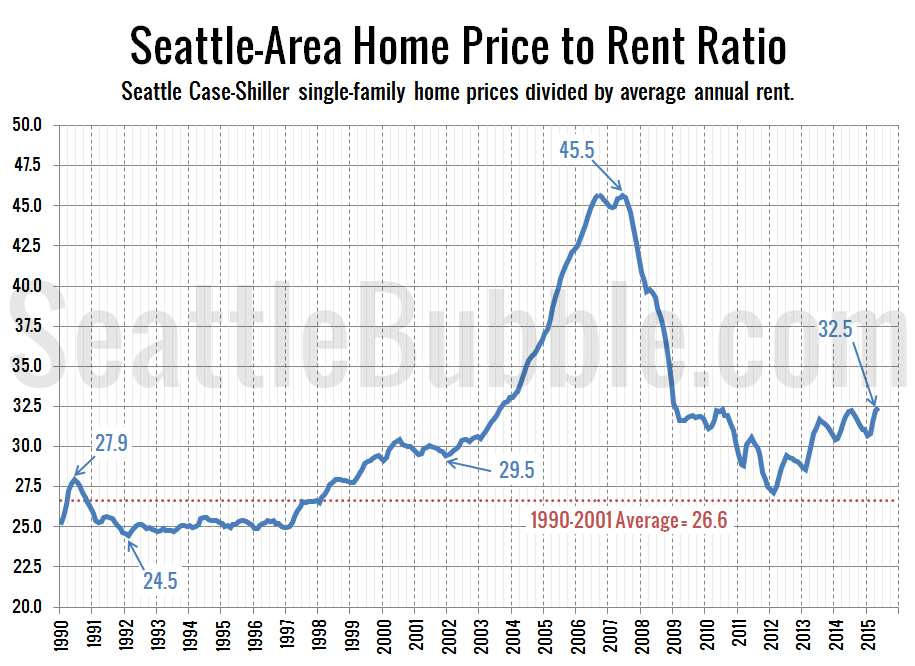
Seattle-Area Home Price to Rent Ratio

Improvement on that front as well, with the ratio dropping 12.7 points (3%) since the April update. The price to rent ratio is still 19% above its 1990-2001 average (an improvement from 23% in January).

Since incomes and rents are currently falling along with prices, neither ratio has improved as much as we might expect. In the five months between January and May this year, Seattle-area home prices fell 3.5%, but since income also fell 0.6% and rents dropped slightly as well (0.3%), neither ratio has fallen quite as much as the raw drop in home prices.

The mini-plateaus over the last few months in both of the above charts closely resemble the same spring “bounce” that was seen last year. Following last year’s spring plateau from May to December, the price to rent ratio fell 14%, while the the price to income ratio fell 11%. It will be interesting to see where each ratio sits at the end of this year.

→ 57 CommentsCategories: Statistics
Tags: , , , , ,

“Throwing Away Money”

By The Tim on June 9th, 2009 at 10:47 AM · 127 Comments

One of the reasons we would often hear people use to justify overspending on a home during the bubble was that they wanted to stop “throwing away money” on rent.

I would hope that by now most people have realized how ridiculous that concept is, but I thought it might help dispel the notion if we consider a pair of hypothetical (but completely plausible) scenarios.

Couple A is renting a 2-bedroom, 1.5-bath townhouse for $1,000 a month in Ballard. Their $1,000 pays for not only the roof over their heads, but the water/sewer/trash, any necessary maintenance, and access to shared facilities such as a pool, hot tub, and workout room.

Over the past three years Couple A have spent around $35,000 on shelter. If they decide they want to move, it’s as easy as waiting until the lease is up and collecting their security deposit.

Couple B decided in 2006 that they were tired of “throwing away money on rent.” They didn’t have a down payment, but that of course didn’t stop them from qualifying for a $400,000 loan on an adorable 2-bedroom, 1.5-bath Ballard craftsman. With an interest rate of 5.7%, their (PITI) payments are around $3,000. Of course, this doesn’t include any services or maintenance.

Over the past three years Couple B have spent around $67,000 on mortgage interest alone, and their home is now valued at around $340,000—15% less than they paid. If they decide they want to move they have three options: Come up with about $40,000 in cash to cover the difference between their mortgage and the house’s value, convince the bank to accept a short sale, or walk away.

Now, which of these hypothetical couples seems more like they have been “throwing away money” to you?

→ 127 CommentsCategories: Features
Tags: , , ,

News Roundup: Time to Rent, Tax Credits, Indices…

By The Tim on May 28th, 2009 at 8:07 AM · 27 Comments

Here are a few relevant news stories that have popped into my inbox in the last few days:

The plan referred to in the second story above would be the irresponsible, counter-productive one we discussed here last month. Frankly, I hope the IRS figures out a way to prevent people from pre-acquiring the tax credit, but realistically I suspect the plan will move forward.

Nobody can accuse real estate professionals (or, more accurately, their lobbying groups) of letting the bubble deflate without a fight, I suppose.

→ 27 CommentsCategories: News
Tags: , , , , , , , ,