Seattle Bubble

News & discussion about real estate & the housing bubble in the Seattle area.

Seattle Bubble - News & discussion about real estate & the housing bubble in the Seattle area.

Case-Shiller: Seattle Following the Crowd Down

Posted by The Tim on August 30th, 2007 at 12:36 PM · 46 Comments

As many of you have already noticed, the latest Case-Shiller data (June) has been released. Here’s an update of the graph I’ve been keeping of the west coast cities:
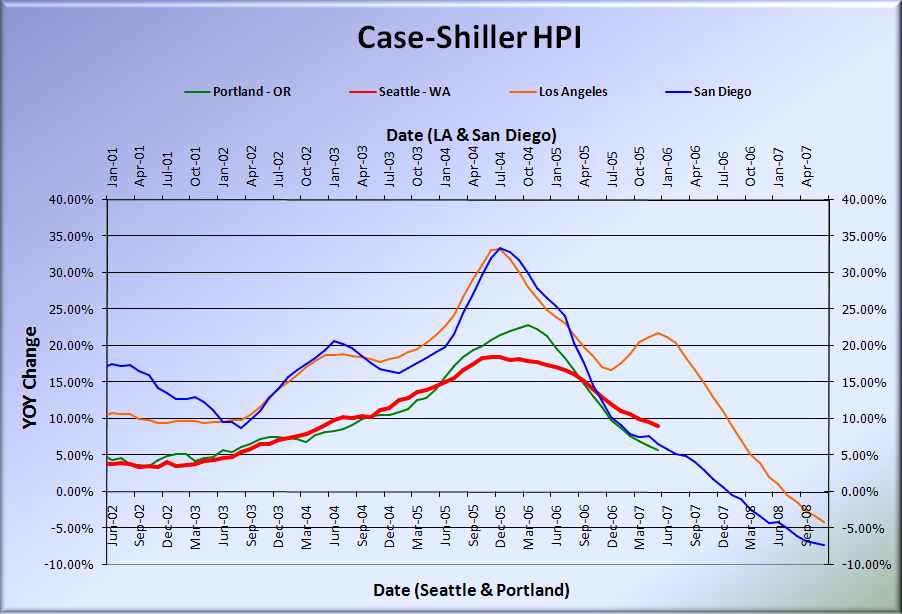
Case-Shiller HPI June 2007
Click to enlarge

For those that are into this sort of thing, here’s what Aubrey Cohen over at the Seattle P-I had to say about the latest data:

Seattle-area home appreciation continued its long slide back to reality in June, according to data released Tuesday.

The typical home in King, Pierce and Snohomish counties was worth 7.9 percent more in June than a year earlier, but June had the lowest increase since February 2004 and was the 16th consecutive month of slowing growth, according to the S&P/Case-Shiller Home Price Indices.

Still, while market observers say that the national housing credit crunch is affecting the area’s market, Seattle had the largest yearly increase of the 20 metropolitan areas the indices track and was one of just five with increasing values.

A 7.9 percent annual growth rate still is extremely good, Matthew Gardner, a local land-use economist, said Tuesday. “No markets can continue to see real estate values spiraling and double-digit annual appreciation rates. It doesn’t work.”

Annual appreciation is expected to continue to slow until the end of this year and possibly into early next year, Gardner said. “I think we’ll probably end up somewhere between 3 and 5 percent.”

From the looks of the above graph, Seattle appears to be right on schedule… If the local real estate bulls such as Matthew Gardner are correct, we’ll see the red line drop another 2-3 points, then completely level off. Is it possible? Sure. It’s also possible that the legions of crows that fly by my house every day at dawn and dusk are really robotic spies, deployed by clandestine Soviet Union operatives poised to carry the motherland out of the shadows and onward to glorious new heights.

Just to give you an idea of how ridiculously unlikely it is that Seattle will escape unscathed, as the sole beacon of housing appreciation light in the dark valley of the bursting national bubble, behold the following graph, which shows thirteen of the twenty Case-Shiller-tracked cities (with Seattle and Portland still time-shifted back 15 months):
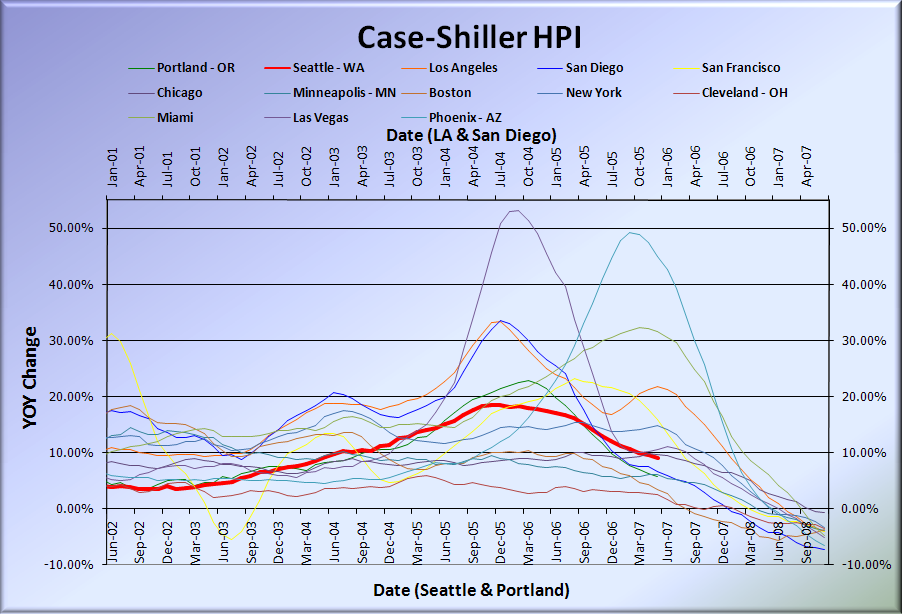
Case-Shiller HPI June 2007
Click to enlarge

You should note that while there are examples of cities that saw home prices rise much higher and faster than Seattle and are already falling much harder (Las Vegas, Phoenix), there are also examples of cities that never saw much more than 10% YOY appreciation, and yet have already hit negative YOY (Chicago, Minneapolis, Boston). The “we didn’t rise as much” excuse really holds no water at all.

In fact, looking at that graph, the existence of robotic USSR spy crows seems more likely than a near-future return to steady 5% appreciation for Seattle. I suppose that by this time next year, either Matthew Gardner or The Tim will look like a fool. We shall see.

(Aubrey Cohen, Seattle P-I, 08.29.2007)

Categories: Uncategorized
Tags: , , , ,

Related Posts:

46 responses so far ↓

  • 1 explorer's avatar explorer // Aug 30, 2007 at 2:10 pm

    I am still in awe of the jump in Las Vegas from July 03 to Oct 04. Can you say jackpot! Don’t bet against the house now, literally. Looks like Portland did the same thing a year later.

  • 2 Affluent Bitter Renter's avatar Affluent Bitter Renter // Aug 30, 2007 at 2:28 pm

    “It’s also possible that the legions of crows that fly by my house every day at dawn and dusk are really robotic spies, deployed by clandestine Soviet Union operatives poised to carry the motherland out of the shadows and onward to glorious new heights.”

    You laugh, Tovarish.

  • 3 Joel's avatar Joel // Aug 30, 2007 at 2:33 pm

    Looks like Portland did the same thing a year later.

    I think that’s Phoenix.

  • 4 Angie's avatar Angie // Aug 30, 2007 at 3:05 pm

    I’ve been an occasional reader of Seattle Bubble for several months. I see you all are now serving your Sour Grapes Special with a side of freshly-ground Schadenfreude. ;)

    Looking at those graphs reminds me of the great failing of economics, which tries to be a science–it’s always descriptive, never prescriptive. Tim, your timeshift of 15 months certainly makes the curves line up better, but the fact is that whatever’s been going on in Seattle has actually been occurring in a different time frame. (I’m also curious about the other 1/3 of the data that isn’t on that second graph–what about the other 7 cities?)

    Yes, things are slowing down; and yes, problems in the financial markets are going to shake out in Seattle as they have elsewhere in the US. But let’s take a wider view of those numbers. Remember that those percents are multiplying by large numbers…

    The other day you had a piece citing the median home value in Seattle as $480K. Say that appreciates at a rate of +2% for 3 years; that’s still +~10K a year; that house would be worth $509K in 8/2010. Say it stays flat at 0%; still $480K in 8/2010. If your concern is that housing is unaffordable now, in these scenarios it sure doesn’t become any more affordable to the average Jane and Joe first time buyer in Seattle.

    Say the median in Seattle starts to really tank. Say it declines by 5% each of those three years. That median house will be $433 in 8/2010. What the heck, how about a 10% decline for each of those 3–assume the economy’s totally in the chocolateter–it’ll be $349K. Those numbers aren’t so scary, but in those scenarios, it’ll still be extremely hard for a first-time buyer to afford them…not least because he or she will probably be totally out of a job.

    Remember also that prices have been running up for years. People who have been in their houses for >5 years are still going to be ahead of where they started even in the worst case scenario above. If your house has tripled in value since you first bought it, 27% off the current value isn’t gonna kill ya…

    As for the flippers…well, sucks to be them!

  • 5 patient's avatar patient // Aug 30, 2007 at 3:08 pm

    It’s interresting to see how the spread between the markets seems to almost disappear at the last 5-10% of appreciation pace. It’s like independent of the different sizes of the bubbles they all enter a similar pace of deceleration when closing up on zero. Does this mean anything I wonder or is it just a visual error from my side when looking at the graph?

  • 6 Alan's avatar Alan // Aug 30, 2007 at 3:08 pm

    It’s also possible that the legions of crows that fly by my house every day at dawn and dusk are really robotic spies, deployed by clandestine Soviet Union operatives poised to carry the motherland out of the shadows and onward to glorious new heights.

    He’s figured us out, Comrade. Time to implement plan B.

  • 7 Angie's avatar Angie // Aug 30, 2007 at 3:24 pm

    Patient, are you talking about how the slopes of the lines seem to converge from the dates labeled Sept 07 to Sept 08 on the graph, the last year of reported data?

    I notice that Seattle’s curve has essentially the same slope for the last year of reported data, too If they were plotted contemporaneously, Seattle’s slope would be totally in keeping–just shifted up 10% in the Y axis.

  • 8 biliruben's avatar biliruben // Aug 30, 2007 at 3:43 pm

    5-10% a year for the next 3 to 8 years is completely plausible, whether the economy stays decent or not. My guess is that, if anything, the housing collapse will hurt economy through loss of RE-related jobs as well as decline in Mortgage withdrawal drying up consumer spending. Not the other way around.

    So realtors, brokers and construction workers won’t be able to buy houses, but the rest of us will. A reversal of fortunes well overdue.

  • 9 patient's avatar patient // Aug 30, 2007 at 3:52 pm

    Angie, yes that is the range I’m curious about. But more the fact that it is the last percentages of appreciation pace that seems similar for all markets than the actual timeframe. Seattle seems to be right on track to follow the same pace. I’m curious to why the pace of deceleration seems so similar close to zero percent appreciation when the spread was very large earlier in the graph? If anyone have a theory it would be interresting to hear it.

  • 10 rose-colored-coolaid's avatar rose-colored-coolaid // Aug 30, 2007 at 4:11 pm

    Angie,

    Nobody with their head on straight is predicting 0% growth for two years followed by continued 4%+ growth. A bubble is a misallocation of resources, and it is very clear what happens in all capitalist economies when there are misallocations.

    Your only choices are the following
    a) Price declines to an appropriate level.
    b) Stagnant prices until inflation makes up the difference.
    c) A little of ‘a’ and a little of ‘b’.

    For any commodity, this is true. The government cannot alter these choices. The main influence is how willing owners are to sell for a loss (real or perceived).

  • 11 Mike's avatar Mike // Aug 30, 2007 at 5:00 pm

    Perhaps I missed it in an earlier post, but are there any theories as to *why* Seattle is 15 months behind the rest of the country?

  • 12 Matthew's avatar Matthew // Aug 30, 2007 at 5:08 pm

    Keep in mind that the data on the graphs was prior to the majority of the credit crunch tightening that mostly started in late July early August. You are already starting to see markets turning negative without the full impact of tightening lending standards. My guess is that when the data is released for August, you are going to see a totally different story.

    Angie, who says the worst case is scenario is going to be 5 percent a year?? Once the market psychology has turned, we are going to see prices fall as fast if not faster than they went up. We could easily see prices drop 20 percent or more a year. No one is going to want to catch a falling knife…

    Keep in mind the majority of ARMs do not reset until spring of 2008. More ARMs reset in March 08 than have rest so far this year. It’s going to be a very scary ride from here on out. Buckle up.

  • 13 Marc's avatar Marc // Aug 30, 2007 at 5:34 pm

    Angie’s got a great point about the 15 month “time shift.” I’d like to see these lines on a larger chart showing the actual timeline so we could see a literal, rather than a hypothetical, comparison of price changes in these cities. This apples to oranges comparison might be very misleading.

  • 14 Marc's avatar Marc // Aug 30, 2007 at 5:42 pm

    I didn’t live here then, but wasn’t the Seattle economy in the crapper in 2002. If that’s the case and the area still managed 4 to 5% appreciation (per the chart), it would seem to suggest Seattle in late ‘07 and early ‘08 with a good economy should avoid tanking.

  • 15 Justin Case's avatar Justin Case // Aug 30, 2007 at 5:42 pm

    Extremely high liquidity in the markets, via extreme inflation of the US dollar will keep the housing market
    afloat.” The Fed has been injecting free dollars into the system like madmen, to fund the war in Iraq, to bail out the mortgage lenders and hedge funds, and also to pay for war with Iran.

    The housing price sticker crash will be averted. However, what will eat you alive is the resulting inflation of the US dollar. At 13+% inflation, the same foreign investors and government that have been carrying American debt for so long will want to get entirely out of US dollars. Hence, a coming USD crash. It’s already started, in fact.

    What does any hosuing appreciation mean when the currency it’s held in is bound to be worthless at some point?

  • 16 Grivetti's avatar Grivetti // Aug 30, 2007 at 5:49 pm

    Wow, Seattle really is 15 months delayed… we’re now in the coined “soft landing” phase of the downturn… remember about 15 months ago the Seattle press was denying a bubble at all?

  • 17 Joel's avatar Joel // Aug 30, 2007 at 6:13 pm

    …wasn’t the Seattle economy in the crapper in 2002. If that’s the case and the area still managed 4 to 5% appreciation…

    I would argue that that is more evidence we were experiencing a bubble. When prices go up unsupported by fundamentals, you might be in a bubble.

  • 18 Blake's avatar Blake // Aug 30, 2007 at 6:39 pm

    biliruben said: “5-10% a year for the next 3 to 8 years is completely plausible, whether the economy stays decent or not.”

    Robert Shiller was interviewed on Bloomberg the other night and said that he expected the US real estate market to follow the trend the Japanese market followed after their real estate bubble burst in the early 90s: Declining values for 5+ years…

    Bill Gross is expecting 10% declines, and many others are forecasting 20% plus…. 5-10% appreciation will not happen for decades int he US… and by that time it’ll probably be calculated in “New Dollars!”

    (With almost $500 billion in mortgage resets in the first 6 months of 2008, it’ll be rough ride for the mighty US consumer…)

  • 19 Pegasus's avatar Pegasus // Aug 30, 2007 at 8:04 pm

    “biliruben said,

    on August 30th, 2007 at 3:43 pm

    5-10% a year for the next 3 to 8 years is completely plausible, whether the economy stays decent or not.”

    Will you share your stash with the rest of us so we can see as clearly as thou? Get a brain. 5 to 10 percent a year? Run the numbers. The game is over and you are still riding the pink pony on the merry-go-round that stopped last year. Wake up McFly.

    Hey has anyone tracked the value of the houses on Zillow in the past few months? They are exploding! To da moon! Only problem is the sales they quote in the area are stale or one year old. Why is that?

  • 20 Joel's avatar Joel // Aug 30, 2007 at 8:47 pm

    Get a brain. 5 to 10 percent a year? Run the numbers. The game is over and you are still riding the pink pony on the merry-go-round that stopped last year.

    I think he meant negative 5-10% a year.

  • 21 Matthew's avatar Matthew // Aug 30, 2007 at 8:57 pm

    It’s going to get REAL nasty once August numbers are released….

  • 22 Jeff's avatar Jeff // Aug 30, 2007 at 9:18 pm

    In the year 1152, there was a rich man. He had become rich by employing a family secret as his father

    did and his fathers fathers before him. The secret of their success was an investment strategy that

    increased their gold holdings by exactly seven percent per year. Not a fabulous return but extremely

    steady. In 1152, the mans ancestors had worked the system long enough that an entire pound of gold was

    accumulated. Now, a pound of gold was a large amount of wealth in 1152 - but there certainly were

    others that were wealthier. The man appreciated the significance of the seven percent system they had

    enjoyed and made sure that it was passed on to his descendants.

    Fast forward to 2007. The man’s descendants have faithfully employed the family secret - increasing the

    amount of gold the family owned by seven percent every year. How much gold does the family own today?

    The answer: the mass of their gold is equal to the entire MASS OF THE EARTH!

    Now what was that you were saying about sustainability?

  • 23 biliruben's avatar biliruben // Aug 30, 2007 at 9:34 pm

    Easy there, winged pink pony. Declines.

  • 24 Angie's avatar Angie // Aug 30, 2007 at 10:12 pm

    Matthew says: Angie, who says the worst case is scenario is going to be 5 percent a year?? Once the market psychology has turned, we are going to see prices fall as fast if not faster than they went up. We could easily see prices drop 20 percent or more a year. No one is going to want to catch a falling knife…

    You know, I might believe this if we were talking about the stock market, and the value of a given share of something was solely dependent on the esteem in which it were held by other investors, with no intrinsic value.

    However, it’s not like people will suddenly cease needing shelter in which to live, solely because all the f’d up sh*t with the subprime market is finally catching up with the mortgage-industry greedheads and the poor sods who believed them.

    Prices will drop and poor people will get screwed. The numbers will get to the point that rental investments make sense again and rich people will step in and become landlords. Poor people will still have places to live. A new equilibrium will be established. It’ll look a lot like the old equilibrium.

    Billie Holiday said it best: “Them that’s got shall have, them that don’t will lose; so the Bible says and it still is news.”

  • 25 Matthew's avatar Matthew // Aug 30, 2007 at 10:53 pm

    Angie,

    You are pretty much making my point for me. Housing will return to the old equilibrium. The return back toward equilibrium will be at the same rate as the rate in which it ran away from equilibrium (double digits).

  • 26 rose-colored-coolaid's avatar rose-colored-coolaid // Aug 30, 2007 at 11:10 pm

    Angie,

    I think you don’t understand the stock market very well to make such a comparison. A stock gives you partial ownership of a company. If that company pays dividends, which is the only kind of stock investment worthy of the name ‘investment’ (instead of speculation), then you get a regular check in the mail. Try doing the same with a house.

    This is the type of argument that people who don’t believe housing is a bubble make. It goes like this. “I don’t think housing is a bubble. Seven years ago we had a stock bubble. Ergo, stocks are speculative and housing is an investment.”

    Sorry, but that just aint so.

  • 27 finance's avatar finance // Aug 31, 2007 at 6:32 am

    Coolaid - Just to play devils advocate, a dividend from a stock doesnt pay more than the purchase price, as in often rent doesnt cover your nut and neither does dividends of a stock.

    Any investment by definition can be an investment, speculation, or gambling (thats the worst of them all with extremely low or high returns).

    Valuation is king! Right now RE is overvalued and the stock market is at its historical avg based on PE, PEG, FCFF, ROE, thus the stock market isnt extremely overvalued like in 2000 an any downturn in stocks will be temoorary (like a 10% correction we nearly had).

  • 28 Buceri's avatar Buceri // Aug 31, 2007 at 6:32 am

    Meanwhile inventory climbed to 10600. And I insist; not only people with questionable credit got into unacceptable debt levels; a lot of people with stellar credit that did not wanted to get “priced out” got also “approved” for high monthly payments that require 2 high incomes and for the planets to line up. Divorce? Illness? Economic slow down?
    By next summer we’ll be able to look back and see how the PI headlines have changed.

  • 29 johnnybigspenda's avatar johnnybigspenda // Aug 31, 2007 at 6:51 am

    You bubble kids are funny. I agree that there needs to be a correction. Its called a cycle. Its been going on for a long time. (fear and greed are still the two big drivers of everything that costs money). I have to say that at a certain point, the selling will stop and its probably sooner than what most people here believe. Lets say my property goes under by $150K (on a $300K condo) and I am forced to choose between paying off the difference that I owe on my mortgage in cash or letting the bank take over and effectively destroying my perfect credit record… lets just say, I don’t HAVE to move… why would I sell and kill myself? At a certain point, no matter what the investment properties and foreclosed homes are doing, people have a choice to say: “it just doesn’t make sense to sell my place”. At that point, the supply on the market dries up and we reach a new equilibrium of supply and demand.

    My guess is that a lot of this excess inventory right now are a bunch of people saying “we better get out while we still can make a little profit”…either because they won’t be able to afford their home if they can’t refi or because they think their home is still worth somewhere between 0% to that 45% gain that they though they have and they want to get out before those gains are lost. (in which case by the way, they also need to buy another house or rent… thus depleting suppy)

    Actually, now that I think about it: since the supply is going up so much, wouldn’t it be true that most of the homes forsale right now must be investment properties, since the people who were supposed to be living there would need to find an alternative place to live? If so, everyone just hang on, let those guys bleed out and the selloff will be limited to the investors. I’m sure I am missing something?

  • 30 david losh's avatar david losh // Aug 31, 2007 at 8:14 am

    People sell for a variety of reasons and one of the most common I hear today are that people are trading properties now by betting on the cycle. If they sell a house today and wait a year, in theory, the prices will be less and the cash they have in the bank will get them a better house for less. The speculation is that they will be able to winter in Arizona and come back to a lower priced housing market.
    Supply and demand only works if the supply can be more than any market will absorb, like brass door knobs. The brain washing of the American Dream of Home Ownership will always keep the demand high.
    Sorry but the supply factor can continue to grow for years to come. Our foriegn policies bring in more and more people every year. You guys are always talking about being renters like that’s a good thing. Again you are all a part of the demand by the simple virtue you are blogging about home prices. Why else would you care if you were not taught that Home Ownership was a goal in life? This blog adds to the demand for affordable housing.
    Now we are in the area of pricing. Your contention is that pricing is decreasing which in turn will make housing more affordable. Why? There are comparisons to the stock market which is a total scam from beginning to end. Government policies are driving the stock market more than sound company business models.
    Our government is playing with us right now over interest rates. The Real Estate industry and stock market are trying to force the Fed to lower rates at the September meeting. Then what? What will happen in the housing sector if the Fed does begin cutting rates?
    The answer is demand will return, those speculations about the cycle will go away and life goes on.

  • 31 johnnybigspenda's avatar johnnybigspenda // Aug 31, 2007 at 8:25 am

    I would like to david’s comments… the whole “rate cut thing” is not a bail out… its only a bail out for the market makers who will sell on the ‘good news’ that there is a rate cut. By creating this widespread fear, I believe this is how the fed hopes to create a ’soft landing’… hopefully by now people will have stopped refinancing their house in order to buy a car (and thus go further into debt for something that isn’t really a necessity). If people adjust their spending / debt attitude because of this fear that the sky is falling, then the fed’s job is done and the world will continue to spin as it always has… then again, there are those who ‘need’ their BMW and will continue to rack up their credit cards… i say let those dumb dumb’s go bankrupt and rent my apartments for a while (since a lot of them actually have pretty good cashflow… just no concept of money)

  • 32 Matthew's avatar Matthew // Aug 31, 2007 at 8:28 am

    johnnybigspenda,

    In the scenario you outlined we would see a slow leak out of the bubble much like Japan, and prices would probably slowly depreciate for 10-15 years.

    I’m predicting a much more sudden collapse based on a US economic collapse.

  • 33 Angie's avatar Angie // Aug 31, 2007 at 8:35 am

    Coolaid, I don’t think you have a very good understanding of how the vast majority of Americans are involved in the stock markets. The value of the mutual funds in their 401Ks largely reflect stock prices, not dividends. I agree; that feels a whole lot like speculation to me. While I’m glad to take my employer’s money for my 401K account, I’d rather hedge my bets about my and my family’s financial security with things we can see, touch, directly influence, and heck, maybe even live in. Try that with a stock certificate!

    It’s interesting to me how many people on this board seem to view housing strictly “by the numbers”. People here seem to forget that there are a whole constellation of other factors at work for most folks around their living arrangements. It’s a huge deal to uproot children from their schools and communities, for instance. I’m sure I’m not the only one who’d be willing to hang on in a situation that was less than ideal “on paper”—but short of catastrophe—in order to keep things stable for the kids.

  • 34 Matthew's avatar Matthew // Aug 31, 2007 at 9:11 am

    People are forced to move, that’s a fact of life. When they have to move, they have to sell their house. They are going to have to sell that house to someone who can no longer qualify for the financing to buy the house at the houses current price.

    Buyers are also going to be more hesitant to buy when they see prices falling in their areas. Couple that with the fact that speculators are going to be unloading their properties as fast as possible to maximize any chance they have at profits.

    We already see this happening around the nation WITHOUT the current lending restrictions factored into the data. It is going to get much worse.

    I don’t think people realize just how vast speculating has been in these markets. I work with two 20+ year olds in my office that own 4 houses each! Even in this market, they both believe that “Seattle is special”. A rude awakening is coming to everyone.

  • 35 johnnybigspenda's avatar johnnybigspenda // Aug 31, 2007 at 9:28 am

    yes people are forced to move, but based on the past few years, its likely that most people that moved didn’t do so because they had to. now we can take our parents advice and buy a house only if you can forsee yourself living there for 5 years or more… there will be many that will wait out the storm.

  • 36 Matthew's avatar Matthew // Aug 31, 2007 at 4:58 pm

    Johnny,

    Most people weren’t forced to move? Do you have stats to support this? The more people that “wait out” the storm, only prolongs the storm so that you see a long slow and painful hissing of air out of the bubble. I’d much rather see the bubble pop and then rebuild.

  • 37 rose-colored-coolaid's avatar rose-colored-coolaid // Aug 31, 2007 at 9:35 pm

    Angie, Microsoft, Boeing, GE, Coca Cola, etc are physical are things that you can see, touch, and directly influence. Yegads!

    Here’s how it works. You own part of a real life company. The company sells a product to people for profit. You recoup some of that profit. Some of the profit goes towards increasing profitability, which as finance pointed out may causes speculation on future profit. As an aside, a P/E of 14 is ‘normal’ and I thought the S&P was around 18-19 P/E. This fits your 10% view, because another 10% chop would put the market pretty close to average.

    Back to housing.

    Housing you can also touch, see, taste (yuck). Here’s the difference. Unless you are renting out real estate, you are realizing no profit. We can argue all day long about emotional benefits. But that is NOT economics. Economics is based on rational decision making, and the driving force of ALL bubbles is irrationality. That’s why bubble economies don’t work long term.

    Mortgage a house. Borrow it from the bank. Maybe even become an actually owner of said home (in 30+ years). Great! I’ve got no problem with that, neither should I. Just be realistic that the house you are paying on has reach it’s peak value. It will go up in price, but it will never hold value as high as it does today. The only questions are how it will lose value and how low it’s value will go before rebounding to normal levels.

  • 38 Angie's avatar Angie // Sep 1, 2007 at 9:50 pm

    My friend, unless you are buying stock directly from the company, a company does not directly benefit from your investment in ownership. Most stock sales are from one investor to the other. In those transactions, it’s the agreed price between buyer and seller that matters, i.e., the only value that the share has is the value that the parties involved have agreed upon.

    Dividends are all well and good, but as I said earlier, most average Americans aren’t big enough players to purchase individual stocks. Most people own shares of mutual funds, and the shares thereof are mostly determined by this investor-to-investor share price market.

    If everyone says shares of stock Y are worthless, guess what? It’s worthless. Ask those nice folks at Enron.

    As it happens, I am renting out real estate. Lord willin’ and the creek don’t rise, we’ll expand our rental holdings in the future. There are “emotional” reasons why I’d rather spend my money in this way than in investing in the stock market, but there are also good hard economic reasons as well. Oftentimes they are deeply intertwined.

    Like: the mortgage on our rental house is scheduled to be paid in full the year before our oldest kid is expected to start college. Rental income could put her through school–or that house could be where she could live while in school.

    Or: since I think housing in Seattle really is entering the realm of “permanently unaffordable” to average earners, I think it’ll be a huge economic benefit to my adult children and their progeny if they can live in one of our houses at below-market, and inherit a place to live, free and clear. Note that this has the added advantage of making it possible for my kids and their kids to live near my husband and me, as I hope they would like to do. Lots of families these days don’t have that choice.

    I’m not just making this stuff up out of whole cloth. My financial role models are my best friend’s parents, who worked hard and acquired a modest portfolio of rental houses. This has provided a great retirement for them and has helped support (not spoil, not smother!) their 3 grown kids in lots of ways.

    My husband and I also have known both emotional and financial rewards from improving some horrendous fixer-uppers and really contributing to the improvement of the community (not to mention the bottom line). We’re the buy and hold type, taking it slow, making sure the numbers make sense, and enjoying the projects along the way.

    Works for us!

  • 39 Matthew's avatar Matthew // Sep 1, 2007 at 10:39 pm

    The phrase “permanently unaffordable” is flawed on so many levels it is borderline retarded! Nothing in our society without a serious limited supply will ever become “permanently unaffordable”. Last time I checked, they are building houses in droves. Supply is actually increasing, not decreasing, and inventory is skyrocketing through the roof. See supply and demand (ECON 101).

    Plenty of people choose to invest in real estate vs. the stock market over the years. The market has proven to be the better bet over the last 100 years, though both RE and the market are going to see major corrections in the near future. Both are overbought and inflated.

  • 40 johnnybigspenda's avatar johnnybigspenda // Sep 2, 2007 at 7:41 am

    how much do you think the builder’s cost of building a house has changed since 2001? Most of the costs have been inflated due to supply and demand (concrete, wood and labor) but at the same time, this will all come down quickly once the demand decreases and all these companies that ramped up capacity are sitting there with no business. Its a pendulum… eventually we will hit the middle, go past it a bit too far and then come back towards the middle.

    PS. houses are only worth what a comparable replacement is worth. ie. if I can buy a house down the street for $100K less, your house is now worth that much less (even if you bought it for more)… so, if ‘comparable’ is the word, then you’re back to looking at location, location, location since they can’t build more location.

  • 41 Angie's avatar Angie // Sep 2, 2007 at 8:54 am

    Nothing in our society without a serious limited supply will ever become “permanently unaffordable”.

    “Serious limited supply” is exactly what I’m talking about. Unless we get housing density like New York City, there is no way the city of Seattle is going to be able to house all the people who are projected to come here in the next 10 years. Supply is always going to be less than demand.

    Housing density *is* increasing, but Seattle isn’t going to get as dense as NYC. And the new units being built aren’t anything like affordable housing. I live in a neighborhood that’s sprouting townhouses on former single family lots like mushrooms spring up after a rain. We’ve got a massive retail-and-condo project coming down the pike—lots of new residences where a run-down old supermarket is now. But these new units are going to be really expensive.

    And by and large people—especially people with kids—are still going to strongly prefer living in single family homes with yards. THAT has hit its limit in Seattle. There are just no places to put new ones, and in fact supply is diminishing (see above re: townhouses). Seriously limited supply, my friend.

    I think you’re right that things are going to go boom out on the edges of the metro area. ($300K for a house in Sedro Woolley??) But in the city limits, nope.

  • 42 Matthew's avatar Matthew // Sep 2, 2007 at 9:39 am

    Johnny/Angie

    Read these posts and then get back to me.

    http://seattlebubble.com/blog/2006/10/25/big-picture-supply-vs-demand/

    http://seattlebubble.com/blog/2006/10/11/lets-talk-inventory/

    http://seattlebubble.com/blog/2006/11/03/a-question-of-affordability/

    If you are going to dispute the bubble, at least make some points that haven’t been discussed ad nauseum on this forum.

    The fact that Seattle isn’t as densely populated as other major urban cities means that it can still build in its urban core to increase density. We have a lot of area to build as compared to many other cities. Sure we aren’t going to be as dense as NYC, but that just means the ability to build more. BTW, I don’t expect that many people to move here in the next 10 years. That’s propaganda by the mayor’s office.

    As to cost of building materials? They have actually come crashing down the last year, but yet prices are still going up. As the demand for housing is decreasing, the demand for housing related materials is also dropping, driving the prices of materials down. Anything related to this bubble is about to get a lot cheaper, as are houses.

  • 43 Matthew's avatar Matthew // Sep 2, 2007 at 9:42 am

    BTW, as for location location location, prices in certain locations have already been factored into their prices. There is always going to be a premium to live on the water on Mercer Island. However, that doesn’t mean that the house on Mercer Island hasn’t become inflated along with all the houses around us. The high end has some of the most inflated prices in this market. It will not go unscathed.

  • 44 Angie's avatar Angie // Sep 2, 2007 at 2:52 pm

    Not a lot in those links to dissuade me, actually. I guess we’l just have to wait and see if the mayor’s office (and, for that matter, the demographics wonks in Olympia, where I think those projections actually come from) are right!

    I just don’t think you can get around the fact that Seattle is the biggest city in the quadrant of the USA, so it’s a magnet for growth and development of all kinds.

  • 45 Matthew's avatar Matthew // Sep 2, 2007 at 9:12 pm

    I agree that Seattle is growing, but the builders have more than kept up with the influx of people, as seen with the recent record high inventory levels.

  • 46 Seattle Bubble » Blog Archive » Has Seattle Reached a new Plateau?'s avatar Seattle Bubble » Blog Archive » Has Seattle Reached a new Plateau? // Sep 4, 2007 at 11:55 am

    [...] Case-Shiller: Seattle Following the Crowd Down [...]

Leave a Comment

Do you want a nifty avatar picture next to your name, instead of a photograph of Tim's dog? Just sign up with Gravatar, and make sure to use the same email address in the form below. It's that easy!

XHTML: You can use these tags in your comment: <a href="" title=""> <abbr title=""> <acronym title=""> <b> <blockquote cite=""> <cite> <code> <del datetime=""> <em> <i> <q cite=""> <strike> <strong>

Read the comment policy before submitting comments.