Seattle Bubble

News & discussion about real estate & the housing bubble in the Seattle area.

Seattle Bubble - News & discussion about real estate & the housing bubble in the Seattle area.

Explore Seattle’s Sub-Prime Status

Posted by The Tim on October 11th, 2007 at 9:06 AM · 63 Comments

A couple people pointed me to a great article in today’s Wall Street Journal on the prevalence of sub-prime lending across the country over the last few years. The article discusses the surge in such risky loans, and the fallout that is already underway and likely to continue.

The data suggest that financial suffering is likely to persist in many parts of the U.S. where subprime lending had surged. Many loans at risk of going bad have not yet done so. As much as $600 billion of adjustable-rate subprime loans, for example, are due to adjust to higher rates by the end of 2008, which means that more and more borrowers are likely to fall behind.

Attached to the article is a nifty interactive graphic that shows just how widespread subprime lending has become since 2004. Here’s a bit about the methodology they used:

High-rate loans are defined as those having an annual percentage rate of at least three percentage points above a Treasury security of comparable maturity for first-lien loans and five percentage points for second-lien loans. Lenders have been required to report pricing details on high-rate loans since 2004. High-rate loans are considered to include many, but not all, subprime loans.

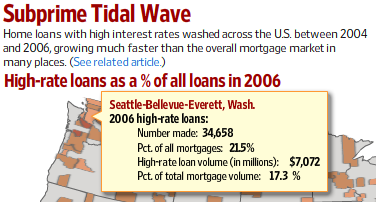
So how does the Seattle area stack up? Obviously we didn’t have nearly the amount of sub-prime lending as other parts of the country, such as Miami, Orlando, Las Vegas, or Los Angeles, where sub-prime made up over 30% of all mortgages in 2006. But we still experienced plenty of a “surge” of our own:

2004
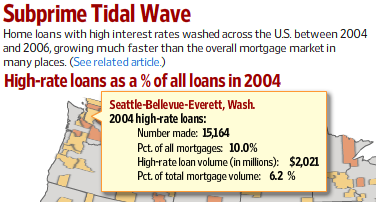
Subprime Lending Around Seattle: 2004

2005
Subprime Lending Around Seattle: 2005

2006
Subprime Lending Around Seattle: 2006

Yup, sub-prime lending more than doubled as a percentage of the total mortgage market in the Seattle area. Tacoma was even worse, clocking in with 31% of all loans being sub-prime in 2006, earning them special mention in the WSJ article.

Lest you think that 20% is a low enough number to keep us out of trouble when the appreciation music stops, consider San Diego’s sub-prime stats for the same period (2004-2006): 8.1%, 19.1%, 22.7%. So no, sub-prime lending itself does not precipitate the decline of home prices. But once home prices do start to decline, even having 10-20% of recent mortgages being sub-prime can result in skyrocketing foreclosures.

Am I saying that things in Seattle will shake down exactly like they have in other places (such as San Diego) with similar statistics? Of course not. All I’m saying is that if they do, no one should be surprised. The real estate “professionals” that are frequently quoted in the media keep saying that the market is different enough in Seattle to protect home prices from falling, but every time we see the real data, such statements appear to be nothing more than wishful thinking.

(Rick Brooks & Constance Mitchell Ford, Wall Street Journal, 10.11.2007)
(Interactive Graphic, Wall Street Journal, 10.11.2007)

Categories: Uncategorized
Tags: , , , , ,

Related Posts:

63 responses so far ↓

  • 1 NotaBull's avatar NotaBull // Oct 11, 2007 at 9:48 am

    NO!!!!

    BOEING!!!!!!!!!!!!!!!

  • 2 deejayoh's avatar deejayoh // Oct 11, 2007 at 9:52 am

    Tim -
    Great post. I have always felt that San Diego was a good market to look at as a comparison to Seattle. This data reinforces that. The percentages of Sub-Prime, and the volumes - are very similar. The only difference has been that their market has declined while ours has continued to go up. A very important difference, I realize - but if indeed we are “behind the curve” then I think you are spot on with your inference.

  • 3 Matthew's avatar Matthew // Oct 11, 2007 at 10:31 am

    There is one thing that Seattle has in its favor vs. San Diego………………..

    An unlimited supply of pink ponies!

  • 4 Sniglet's avatar Sniglet // Oct 11, 2007 at 10:39 am

    As bad as the sub-prime problems are, we shouldn’t lose sight of the broader issue: there has been an unprecedented EXPLOSION in the use of exotic financing in the last 7 years. In fact, the use of 100% interest, negative amortization, and no-doc loans is by far in a way greater than the sub-prime space.

    It’s not the proliferation of sub-prime mortgage holders we should be worried about, it’s all those Alt-A and Prime borrowers who have used exotic financing to acquire homes they can’t really afford. Without appreciation to bail these people out (i.e. through re-financing or sale) things will get very ugly indeed…

  • 5 Garth's avatar Garth // Oct 11, 2007 at 10:44 am

    This study recently released about race and subprime loans is also kind of interesting:

    http://www.mercurynews.com/realestatenews/ci_7085446

    This part is really bad:

    “Some of those consumers could have been in prime loans with lower interest rates if they had been given the proper education about their options,” said Lori Jones Gibbs, vice president for affordable housing industry affairs at Genworth.

    I recently talked to a friend who is a mortgage broker at a large firm, and he said a lot of young agressive brokers had not built up any prime business at all because of the higher commissions on subprime, and now many are about to lose their jobs.

  • 6 Mike2's avatar Mike2 // Oct 11, 2007 at 10:56 am

    This is exactly what I figured had happened. Seattle didn’t have the “demographics” for widspread subprime lending prior to this boom, so the historical levels were predictably low. My how quickly that changed.

  • 7 Joel's avatar Joel // Oct 11, 2007 at 11:36 am

    So has anybody considered that hiring by Boeing might exacerbate the housing decline? I’ve heard that the people Boeing hires here aren’t exactly the highest paid employees and when they move here and want to buy a nice home maybe they had to use subprime, alt-a, neg-am, 100% financing to do so. So more hiring -> more crazy loans -> more mortgage problem -> more severe decline. I don’t know, just speculating.

  • 8 biliruben's avatar biliruben // Oct 11, 2007 at 12:15 pm

    That’s a pretty horrible definition of subprime.

    Do they not even realize there is such a thing as Alt-A?

  • 9 Mike2's avatar Mike2 // Oct 11, 2007 at 1:24 pm

    That’s a pretty horrible definition of subprime.

    Yeah, it’s mind blowing to think that just a few months ago there was little if any difference between prime conforming rates and those on stated loans. If anything, defining subprime as 3%+ above conforming rates is missing a huge portion of the total loans to risky and poor credit borrowers.

  • 10 Nude's avatar Nude // Oct 11, 2007 at 1:45 pm

    Am I saying that things in Seattle will shake down exactly like they have in other places (such as San Diego) with similar statistics? Of course not.

    Okay, fine then, I’ll say it: Seattle and the surrounding areas will shake down exactly like they have in other places with similar statistics.

    Got stagnant sales? Check
    Got inventory overhang on new contruction? Check
    Got high-priced condos flooding onto the market? Check
    Got a high percentage of mortgages with a reset deadline looming? Check
    Forced refi’s and sales to avoid the reset were the starting gun of the crash in housing prices. As the date grew closer, passed, and reality of the new monthly payment hit home, people began to reduce asking price or just quit paying. As prices began dropping, fewer buyers were willing to pay asking price in a falling market. Yay, never-ending downward spiral!

    The only thing holding up the GSA right now is the amount of people who can qualify within the tightening credit requirements. When we run out of people who a) can cough up 20% down and b) get approved for a conforming or jumbo and c) are willing to accept the possibility of declining value over the next few years, this bubble will pop like all the rest as the wave of resets hits our area.

  • 11 softwarengineer's avatar softwarengineer // Oct 11, 2007 at 3:02 pm

    THE SEATTLE PINK PONY IS ACTUALLY AN UGLY DONKEY (A_S) PAINTED PINK TO LOOK APPEALING

    Great statistics Tim, you wouldn’t find that stuff on KOMO, KIRO, KING….

    I’d add a caveat, the great American ATM machine (home equity) has run out of cash the last couple years and we’re still buying on 6 cylinders instead of 8; but we’re using good old American plastic credit cards in hoards. Do you bloggers get a plethora of those credit card checks in the mail, non-stop, tempting you to just sign them and you’l have $10s of thousands in debt at like 18% interest [they offer you low kicker rates to addict you, then in a few months jack them up to loan shark rates]? Have you bloggers notices these loan shark cash advance places are popping up all over the place like cancer spreading lately [they out number Starbucks easily]?

    We’re running on gas fumes and the party’s coming to an end. Dr. Roubini states in part:

    “….This slowdown in consumption is not surprising as the saving-less and debt burdened US consumers is now on the ropes and at a tipping point. Headwinds against consumption include sharply falling home prices and home values (now falling at a 9% annual rate based on the Case-Shiller/S&P index), sharply falling home equity withdrawal (now down to about $140 billion at annual rate from its $700 billion peak in 2005), a credit crunch in the mortgage markets that is now slowly spreading to other types of consumer credit, a falling consumer confidence, high oil and gasoline prices (with oil hovering around $80), concerns about the financial turmoil and volatility and a slowing and slackening labor market where – in spite of still positive job creation – the rate of job growth is slowing down and many other indicators of the job market signal a slackening of this market….”

    The rest of the URL:

    http://www.rgemonitor.com/blog/roubini/219538/

  • 12 Seattle Man's avatar Seattle Man // Oct 11, 2007 at 3:40 pm

    Has anyone - reporter, banker, whatever — gone out and talked to people who owe on sub-prime mortgages to ask them what they plan to do? I know it’s anecdotal but I have read nothing about the perceptions of people who are most impacted and they plan to deal with this impending crisis in their lives.

  • 13 on topic's avatar on topic // Oct 11, 2007 at 3:52 pm

    assuming they can’t possibly cover the cost and they are underwater:

    if they’re smart, they’ll give it back to the lender

    if they’re not, they’ll pay the mortgage w/ credit cards for as long as they can, then file for bankruptcy when their credit card minimum payment becomes unmanageable.

  • 14 Ubersalad's avatar Ubersalad // Oct 11, 2007 at 3:59 pm

    Start forwarding your liquid asset to offshore account instead of continue to pay for the godforsaken mortgage on the depreciating house.

  • 15 FormerNYorker's avatar FormerNYorker // Oct 11, 2007 at 4:10 pm

    How hard to you think it will be for the folks who have to give their houses back to the lender and eventually file bankruptcy to buy another house again?

  • 16 The Tim's avatar The Tim // Oct 11, 2007 at 4:26 pm

    Aubrey Cohen covered the question of how some people are dealing with it in a blog post today: Foreclosure house.

  • 17 Seattle Man's avatar Seattle Man // Oct 11, 2007 at 5:03 pm

    No, I am curious to hear from people who have a subprime mortgage about what they plan to do…not suggestions from people who seem to me to have a huge psychological investment in having a real estate crash.

  • 18 Ubersalad's avatar Ubersalad // Oct 11, 2007 at 5:14 pm

    What can they do when the 2/28 resets? Especially if it’s a 2/28 I/O that’s 80/20 with 12.99% on the 2nd mortgage.

    Your neighbors are bailing, neighborhood price is dumping…what options do you really have?

  • 19 Seattle Man's avatar Seattle Man // Oct 11, 2007 at 5:18 pm

    I am not asking the question in the abstract as “What can they do?”

    I want to know what people who are in that situation actually plan to do. Yes, I know it’s just anecdotal and not conclusive of anything…but it might offers some insights.

  • 20 Ubersalad's avatar Ubersalad // Oct 11, 2007 at 5:23 pm

    It’s a rhetorical question…I don’t see how it would offer any insights.

  • 21 Sniglet's avatar Sniglet // Oct 11, 2007 at 5:37 pm

    Seattle Man,

    I think the choice for sub-prime borrowers is pretty simple: if you home is worth substantially less than your mortgage you should just walk away and turn the keys back to the bank. Actually, this is likely the same choice any borrower who finds their home substantially under-water (i.e. worth less than the mortgage) will make. Of course, people would have to investigate their particular mortgage contract and state law to ensure that the lender can’t pursue other assets (like wages), but other than that, it’s a simple choice.

    Frankly, I think this is EXACTLY the choice most sub-prime borrowers will be facing by the time their mortgages reset. Home prices are declining nation-wide, and just beginning to slide in the Puget Sound. For those sub-prime borrowers who still have some equity left, they can try and re-finance with a more palatable loan or sell before they are forced to default. But the choices are straight-forward, it all just depends on how much equity you have.

  • 22 jon's avatar jon // Oct 11, 2007 at 6:17 pm

    “I have always felt that San Diego was a good market to look at as a comparison to Seattle. This data reinforces that. The percentages of Sub-Prime, and the volumes - are very similar. The only difference has been that their market has declined while ours has continued to go up.”

    There is one other small difference. San Diego has grown 2% since 2000 and the growth was already slowing down. King county grew by 5.2% from 2000 to 2006. Washington state grew by 8.5%. That will make a huge difference in how the price responds to an increase in inventory. San Diego had a population boom in the 90’s and the financing kept construction going after the boom ended. Since Seattle has had steadier growth, there might have been less pressure to push unaffordable loans.

  • 23 chris's avatar chris // Oct 11, 2007 at 6:18 pm

    Isn’t most of this likely to be concentrated in Everett, and less in Seattle? (And even less on the Eastside?)

  • 24 deejayoh's avatar deejayoh // Oct 11, 2007 at 6:53 pm

    Jon - Are you talking about population? Then please compare apples to apples

    County Comparison 2000-06.
    - San Diego County, + 4.5%
    - King county, + 5.1%.
    City comparison 2000-06
    - Seattle = -0.3% (that’s right, it shrunk… remember 2001-02, Boeing cut something like 30,000 jobs)
    - San Diego = +3%.

    If you need a fact checker, go here
    And the loan numbers are the same, pressure or not.

  • 25 Seattle Man's avatar Seattle Man // Oct 11, 2007 at 7:16 pm

    Sniglet, Jon. Your comments are good but don’t answer or even attempt to deal with my question.

  • 26 Ubersalad's avatar Ubersalad // Oct 11, 2007 at 7:20 pm

    I’ll put it this way, your question is pointless.

  • 27 Jillayne Schlicke's avatar Jillayne Schlicke // Oct 11, 2007 at 10:01 pm

    Hi Seattle Man,

    From what I’m hearing, people with (future) resetting subprime ARMs are trying to figure out what to do. They’re not likely to “out” themselves around the coffee pot in the break room and ask for suggestions from co-workers due to the scarlett letter subprime has become.

    I am also hearing that the phones at local mortgage broker shops are not ringing; these homeowners are not calling the broker who put them into that loan product. Instead, they’re trying to quietly do research into all their options, without the help of those who called themselves “professionals.”

    Sniglet offers one suggestion: they could just decide to walk. There are many other options. For example, they could find an FHA-approved mortgage company and see about becoming approved for the new, (just in time for the 2008 election) FHASecure loan program, designed just for these people…..BUT they have to have been current on their mortgage up until the ARM reset.

    All I’m hearing out there from my vantage point is that these folks are trying to figure out their options besides just a deed-in-lieu of foreclosure (also known as handing over the keys and walking away.)

  • 28 Carl Cucumber's avatar Carl Cucumber // Oct 11, 2007 at 10:14 pm

    CYCLE #1:
    Home equity drops, therefore…
    consumer spending drops, therefore…
    the economy slows down, therefore…
    jobs and higher salaries are harder to come by, therefore…
    few can afford to buy a home, therefore…
    home equity drops…
    REPEAT CYCLE #1.

    CYCLE #2:
    War spending increases, therefore…
    US dollar dilution continues, therefore…
    US businesses spend more on goods bought from overseas, therefore…
    US business cut back on salaries and hiring, therefore…
    few can afford to buy a home, therefore…
    home equity drops…
    REPEAT CYCLE #1.

    Normally, the Federal Reserve could stop these endless death spirals by cutting the borrowing rate on the US dollar. However, since the rate is already very low, reducing it more will do very little to ignite the economy.

    Since foreign investors have been buying Yen and Swiss Francs and investing that money into US dollars at a higher rate of return, now that the Fed is cutting rates, these investors are getting out of the US dollar in full force.

    This weakens demand for the US dollar and the dollar drops in value even more. That’s cycle #3, but I won’t scare the hell out of you by adding another death spiral to the pile of death spirals.

  • 29 econ101's avatar econ101 // Oct 11, 2007 at 10:48 pm

    “Demand for US dollar” - now how stupid does that sound?

    What are you going to do with a dollar?

    If the dollar is low compared to other currencies, it is _good_ for the country’s exports. Canadians and Europeans can actually go on vacation to the United States now for much less.

    The US is killing the EU…

  • 30 Ubersalad's avatar Ubersalad // Oct 11, 2007 at 10:55 pm

    Very good Jillayne Schlicke, but your comment doesn’t answer or even attempt to deal with his question.

  • 31 b's avatar b // Oct 12, 2007 at 12:01 am

    econ101,

    Yes, then Americans can use their dollars to buy all of those American made products sold in stores in the cars they drive on American oil. I am sure consumer spending, 70% of our GDP, will not be harmed in the slightest by a weak dollar since we import practically nothing at all. I am sure increased tourism will make up for the shortfall.

  • 32 Eleua's avatar Eleua // Oct 12, 2007 at 12:05 am

    Carl and Econ,

    Your views on the Yankee Lira need some modification, IMHO.

    If the FED cuts, the dollar problems continue to tighten. They need to HIKE rates to save the dollar. It puts us instantly in a recession (which is good in the longer term), but it saves the US Peso.

    Cutting is what got us to the present situation. Inflation is running double digits and the dollar is selling off against just about everything.

    Falling US dollar is good for exports but crappy for imports. Since most of what we do is consume, that instantly puts us in an inflationary environment. I don’t want my currency debased so a bunch of Hosers can come to the US and buy trinkets; I want to go to their country and buy trinkets.

    A weak dollar is nothing more than a paycut for American workers. It is graft to the corporate chieftans like a traditional paycut would be.

    When oil, steel, rubber, food, and various finished goods gets real expensive in terms of the Yankee Lira, you may not think a weak currency is so sexy.

  • 33 Jay's avatar Jay // Oct 12, 2007 at 12:42 am

    The housing problems run far deeper than the subprime exposure (which is bad enough).

    Misconceptions:

    1) There aren’t that many subprime borrowers out there - this WSJ article shows that’s just not true.

    2) Only people who bought in the last two years will be underwater and in trouble - also not true - you have to include all those people who bought earlier than that, even with substantial equity built up, who subsequently MEW’d to support their lifestyle. These folks will be underwater as their house price declines AND they will face increasing HELOC payments as interest rates rise going forward (falling dollar is inflationary - rates already up despite recent fed rate cuts).

    3) The government will bail out borrowers and support prices - wishfull thinking. Only 1% of loan volume recently has been worked out. This is largely because people who commited fraud on their loan apps will not be eligable for workouts - they will eat the losses. How prevalent is loan app fraud? How about up to 70%:

    Up to 70 Percent of Defaults Linked to Misrepresentation in Mortgage Applications

    http://efinancedirectory.com/articles/Up_to_70_Percent_of_Defaults_Linked_to_Misrepresentation_in_Mortgage_Applications.html

  • 34 Old Ballard's avatar Old Ballard // Oct 12, 2007 at 5:22 am

    Here’s a must read story from the Washington Post.

    Subsription is free.

    http://www.washingtonpost.com/wp-dyn/content/article/2007/09/28/AR2007092801331.html?sub=AR

    It’s more than just numbers.

  • 35 softwarengineer's avatar softwarengineer // Oct 12, 2007 at 7:53 am

    BAIL OUT?

    Washington Post and Washington Times are on opposite ends of the political spectrum on the subprime issue.

    I read Old Ballard’s article above and yes, oh yes, Washington Post referenced bail ‘em out.

    Who picks up the tabs? We all do, remember the savings and loan fiasco?

    Now we’ll need an additional war tax for Iraq and an additional subprime fraud tax going to the rich investors too? Pathetic!!!

    If this happens, welcome to the New Great Depression.

  • 36 softwarengineer's avatar softwarengineer // Oct 12, 2007 at 8:07 am

    HERE’S A MUCH BETTER ARTICLE SUGGESTING NO SUBPRIME BAIL OUT FROM WASHINGTON TIMES

    Why throw any money to rich bankrupt mortgage companies and fraudulant home buyers who caused this mess? The Democrats want a Mortgage Czar expense, its like re-arranging the chairs on the Titanic.

    See the Washington Times business news:

    http://www.washingtontimes.com/article/20071004/BUSINESS/110040019

  • 37 deejayoh's avatar deejayoh // Oct 12, 2007 at 8:23 am

    The Washington Times is owned by Sung Yung Moon. You know, the “moonies”?

  • 38 softwarengineer's avatar softwarengineer // Oct 12, 2007 at 8:33 am

    INTERESTING DEEJAYOH

    I’ve never been much for mixing religion and politics, in my opinion the religious right are the religious wrong too.

    Issues are a poor way to pick a Presidential candidate in my opinion too; its one bad issue can ruin our whole future and country [i.e., wage degradation, overpopulation, ignored environmental degradation and phony unions], rather than wedge issues that go away in a couple years or don’t matter, like gay marriage or abortion rights.

    This subprime bankruptcy issue can turn into the biggest economy sinker since the Great Depression, it scares me and bailing it out with debt is a hopeless solution [we're broke, GWB and Congress already saddled us with a $10 Trillion federal debt].

  • 39 nitsuj's avatar nitsuj // Oct 12, 2007 at 8:45 am

    Can we get a “I lived within my means” tax and disburse it to myself and others like me?

  • 40 Joel's avatar Joel // Oct 12, 2007 at 8:53 am

    Can we get a “I lived within my means” tax and disburse it to myself and others like me?

    But you’re not a victim. Get victimized first and then we’ll talk.

  • 41 on topic's avatar on topic // Oct 12, 2007 at 9:08 am

    in other countries, when people think the currency is about to crash, people go out and buy anything they can afford before their money get devalued.

    maybe that is the Fed’s strategy: boost consumer spending based on fear rather than confidence.

    of course, it depends on people having actual money actually saved and liquid. something we don’t see much in this country.

  • 42 Lake Hills Renter's avatar Lake Hills Renter // Oct 12, 2007 at 9:13 am

    Isn’t taking on huge debt (mortgage, CCs, etc) and walking away the same thing without the savings?

  • 43 NotaBull's avatar NotaBull // Oct 12, 2007 at 9:15 am

    Jay said “AND they will face increasing HELOC payments as interest rates rise going forward (falling dollar is inflationary - rates already up despite recent fed rate cuts).”

    Jay, I think you’re confusing HELOC rates with ARM rates (and Fixed rate, for that matter). HELOC rates are almost always tied to the prime rate, just like a credit card. If the fed drops the funds rate, the prime rate drops, and the HELOC rate drops.

    ARM rates POST reset are usually tied to the LIBOR or some other rate like a 10 year T-Bill, or something like that - not sure on all the possibilities. These are likely, as you say, to go up over time.

    I don’t disagree with the majority of your points, just thought you might want to be 100% accurate while debunking misconceptions. :)

  • 44 Matthew's avatar Matthew // Oct 12, 2007 at 9:31 am

    CNBC is filming from the Space Needle today. They just had two people on, one from the PI and the other from the Times. They were both talking about why Seattle is immune from a housing downturn “Look around, there is water all around, mountains to the east, Microsoft is expanding and hiring, job growth is good so people want to move here, it’s a nice place to live, etc etc.” I heard basically every Seattle housing bull argument for unaffordable houses : Water, Mountains, Boeing, Microsoft, Tech, jobs, “nice area to live”, etc.

  • 45 on topic's avatar on topic // Oct 12, 2007 at 9:41 am

    sarcasm/

    yeah, i heard Las Vegas became a much nastier place to live right before their RE market started declining. same goes for Florida, and SoCal. the market fundamentals all went to crap first, then the market started to fall. the jobs disappeared, the mountains crumbled and the oceans dried up.

    /sarcasm

    oh, no, that’s right. none of that actually happened. the cities didn’t change. only the psychology did.

  • 46 RottedOak's avatar RottedOak // Oct 12, 2007 at 9:51 am

    I would be very careful about using the WSJ data to say that X% of loans in any area were “subprime.” The WSJ analyized high-rate loans. As they say, most subprime loans are high-rate. However, many people are using the numbers as if the converse were also true: that all high-rate loans are subprime. This is not the case.

  • 47 nitsuj's avatar nitsuj // Oct 12, 2007 at 10:27 am

    “But you’re not a victim. Get victimized first and then we’ll talk.”

    ROFLMAO

  • 48 Jay's avatar Jay // Oct 12, 2007 at 12:04 pm

    NotaBull,

    No, I wasn’t confusing HELOC with ARMs , but I admit my wording could have been a bit clearer. What I said is that HELOC payments would be rising. I was trying to infer this would be because the Fed is likely to raise rates going forward to control inflation and support the dollar. It will take a while for the market consensus come to this conclusion. However, Fed fund futures have recently priced out addtional rate cuts for the rest of this year so we’re already moving in that direction. Sorry for the confusion.

  • 49 Old Ballard's avatar Old Ballard // Oct 12, 2007 at 12:36 pm

    Softwarengineer ya need to go back and re-read the articial. You missed the point all together.

  • 50 Mike2's avatar Mike2 // Oct 12, 2007 at 12:47 pm

    As they say, most subprime loans are high-rate. However, many people are using the numbers as if the converse were also true: that all high-rate loans are subprime. This is not the case.

    The implication is that if you didn’t have bad credit, were underwater or had a ridiculous DTI why would you take a high rate loan?

    For most borrowers, it’s because the high rate loan is either all they can get or better than what they have (IE: tons of CC debt piling up at 20%)

  • 51 NotaBull's avatar NotaBull // Oct 12, 2007 at 1:01 pm

    Jay,

    “I was trying to infer this would be because the Fed is likely to raise rates going forward to control inflation and support the dollar. It will take a while for the market consensus come to this conclusion. However, Fed fund futures have recently priced out additional rate cuts for the rest of this year so we’re already moving in that direction.”

    I see what you’re saying - sorry for the correction. :)

    Not sure I agree though. Partially because fed funds futures turn on a dime. Helicopter Ben just has to sneeze slightly differently and the market can change from 100% chance of a cut, to 0% chance. It’s happened so many times over the past few months.

    Also, if you take the housing market popping to mean slower growth, whether you believe in outright recession or not, this does not seem to indicate an environment in which the fed could raise rates. They’d be way too scared of pushing the country into a recession.

    IMO, I think they’ll take a bit of high inflation for a few years over a recession. Prices AND the labor markets are the two major things they’re supposed to be taking care of (although some include Wall Street in that equation). So in a slowing economy, which one do you take? A declining dollar (with associated good exports and trade deficit assistance) and some inflation, or a recession and job losses?

    I don’t think the fed knows what it’s doing next, let alone the fed futures. They’ve stated recently that more “timely” measures will be used instead of older stats, due to the credit crunch. I think they’ve got an awesome poker face, and when they meet to make the decision, they just make it up as they go along. IMO, there is no “master plan”.

  • 52 Ubersalad's avatar Ubersalad // Oct 12, 2007 at 1:08 pm

    I don’t believe in refinancing and I never refinanced since I got my house back in late 90’s.

    I guess I have subprime, too.

  • 53 Zzyzx's avatar Zzyzx // Oct 14, 2007 at 7:16 am

    Seattle is just like San Diego, except that San Diego’s boom was longer and steeper. Seattle had about a year of increases over 15% and that was the peak. SD had 3 years of that and peaked around 35%

  • 54 Zzyzx's avatar Zzyzx // Oct 14, 2007 at 8:05 am

    Oh and don’t forget that SD started out being much less affordable even before its rise. You don’t have to believe that Seattle is super duper special to see that there are differences between the situations, making it more likely that Seattle’s drop will be smaller than SD’s.

  • 55 Jay's avatar Jay // Oct 14, 2007 at 2:01 pm

    NotaBull,

    I agree the Fed fund futures can and do turn on a dime - still, the trend is your friend (until it’s not). I also agree the Fed is data dependent and doesn’t yet know for sure what it will do, but the minutes showed it is reluctant to lower rates again unless forced to do so. I suspect they will stand pat for the rest of the year. I still think the odds of increases next year are greater than most people think. Yes, recessionary forces could prevent that. But the reversal of global disinflationary pressures is likely to overwhelm other factors. I think the most likely scenario is stagflation (recession in housing, retail sales, some manufacturing, but not all industries due to growing exports and healthcare etc) combined with inflation due to currency and global factors. Given that scenario, I think the Fed will at some point be forced to raise rates, as a falling dollar will create a vicious cycle. It will be highly unpopular. When faced with stagflation previously, indeed the fed has been forced to raise and Volker is considered a hero for having done so. There are times the Fed comes to the conclusion that a recession is the “least bad” way out of a bad situation. Who ever said we would never have a recession again? Who ever said the Fed could prevent every recession? It will be intereting to see how this turns out. Regardless, housing is screwed.

  • 56 whit's avatar whit // Oct 14, 2007 at 6:08 pm

    some of these points are SPOT ON.

    the thing that makes housing different from most other markets is the fact that housing is far less liquid and there is far greater transaction time. a bubble is a bubble is a bubble. ALL bubbles are basically the same, and sell-side analysts (like these idiot brokers) that say it can’t happen here are drinking the same kool-aid as mayor schell was before the WTO when he claimed riots (that had happened other places where the WTO met) couldn’t happen here - “seattle is different”. no, it’s not.

    ALL markets are collections of people. people trade, and invest based on herd mentality, and the concepts of greed, fear, panic, euphoria, apply to all bubbles.

    the sentiment is already shifting. heavily. sellers are extremely uneasy but they are sitll in denial mode where if they just put their offer out there, somebody will lift it (sorry for my trader terminology). it doesn’t work that way.

    by any metric, we are in a bubble. it WILL pop. it has to. they always do - tulips, stocks, real estate, etc.

    the cascading effect is in some ways greater in real estate than in stocks or futures, because of the delay (it takes me 10 milliseconds to sell a futures contract, but days to weeks to months to sell a house).

    the fed should have kept its powder dry. the fed cannot prevent the pop. it can only (at best) delay it.

    people overleveraged and the carnage will be ugly (for them). it will be great for buyers. give it time.

  • 57 Jay's avatar Jay // Oct 14, 2007 at 8:43 pm

    Whit,

    I agree with you but the sad part is we are possibly underestimating how bad things will get for real estate because ultimately this is not just a real estate problem, it probably even much worse off the

  • 58 Jay's avatar Jay // Oct 14, 2007 at 8:53 pm

    Sorry, comment got mangled during posting.

    I was saying it will probably much worse than it looks because besides stupid high house prices and stupid high leverage and debt and stupid low savings, we have even more stupid debt, leverage, skirting capital requirements, fraudulent ratings, conflict of interest, etc going on in our banks, investment banks, and ratings agencies which has great potential to create a confidence crisis. This is not a good thing at a time when we are so dependent on foreigners to buy our debt, when our currency is on the brink, and when global disinflationary forces are reversing. Talk about the perfect storm for real estate. And did I mention political forces about to massively increase taxes in general including severly curtailing the tax exemption on real estate appreciation? Yikes.

  • 59 uptown's avatar uptown // Oct 15, 2007 at 7:38 am

    A few points:

    a lower dollar means more jobs here.

    more jobs here equals higher salaries - which the current Fed hates (that’s what they mean when they say “inflation” - wage inflation), so probably higher interest rates.

    a Democratic Pres. and Congress will mean more investment in infrastructure, paid for with higher taxes on the upper classes. That will help long term growth and employment.

    people who get out from under heavy home-borrrowing debt loads (via foreclosure or just selling) will have more disposable income to spend.

  • 60 Economic Crisis's avatar Economic Crisis // Oct 15, 2007 at 11:15 am

    When I see comments that focus on any short-term factors, I know that I’m seeing the rantings of day-traders. The real estate crisis isn’t about Fed funds futures or the near-term movements in the dollar.

    Those things are symptoms, not causes. When it comes to residential real estate, the first thing people must realize is that turnover is slow. The average dwelling turns over every 7 years. The second thing to know is that the market is inefficient. You’re not trading identical units, and friction is high due to sales commissions and the multi-step mechanics of trading dwellings (i.e., inspections, offers, financing, legal documents).

    As a result, directions don’t change fast. It’s clear that the residential market is in a downturn and has been (depending on the city) for one to two years. That’s not going to change soon, no matter what.

    Seattle has always been an economic laggard, owing to its heavier than average reliance on manufacturing. The real estate crash started later here, and it’s going to end later than it does in San Diego, which is typically a trend leader. As for how low it goes, I think all of the home price appreciation since about 1996 or 1997 is going to be erased. Not just here, but everywhere else.

    The real issue with that is whether completely erasing the bubble (and then some) will trigger a depression. To me, that is the question of the hour. There are no quick fixes. Check my blog for more commentary.

  • 61 Seattle Bubble » Blog Archive » P-I: Seattle Bubble » Blog Archive » P-I: "Seattle is not immune" // Oct 15, 2007 at 1:36 pm

    [...] Explore Seattle’s Sub-Prime Status [...]

  • 62 Puget Sound Business Journal on San Diego vs. King | Seattle Bubble — News & discussion about real estate & the housing bubble in the Seattle area.'s avatar Puget Sound Business Journal on San Diego vs. King | Seattle Bubble — News & discussion about real estate & the housing bubble in the Seattle area. // Jun 13, 2008 at 1:56 pm

    [...] Ok, those are some interesting assertions, but where’s the data? What were the per capita rates of new construction and subprime lending in the two counties? The article doesn’t say. In fact, the only data I’ve been able to find that compares lending in San Diego to the Seattle area shows suprisingly similar amounts in both areas. [...]

  • 63 Foreclosures Up 41% YOY Around Seattle | Seattle Bubble — News & discussion about real estate & the housing bubble in the Seattle area.'s avatar Foreclosures Up 41% YOY Around Seattle | Seattle Bubble — News & discussion about real estate & the housing bubble in the Seattle area. // Aug 14, 2008 at 3:46 pm

    [...] that this trend will continue for a while.  As home prices continue to drop, many of the dangerous loans made in 2006 and 2007 will become [...]

Leave a Comment

Do you want a nifty avatar picture next to your name, instead of a photograph of Tim's dog? Just sign up with Gravatar, and make sure to use the same email address in the form below. It's that easy!

XHTML: You can use these tags in your comment: <a href="" title=""> <abbr title=""> <acronym title=""> <b> <blockquote cite=""> <cite> <code> <del datetime=""> <em> <i> <q cite=""> <strike> <strong>

Read the comment policy before submitting comments.