Seattle Bubble

News & discussion about real estate & the housing bubble in the Seattle area.

Seattle Bubble - News & discussion about real estate & the housing bubble in the Seattle area.

Case-Shiller: Prices Still Falling (Even in Seattle)

Posted by The Tim on May 27th, 2008 at 9:07 AM · 56 Comments

The March Case-Shiller Home Price Index came in fairly close to, but slightly worse than the NWMLS statistics for the same month.

Down 0.9% February to March.
Down 4.4% YOY.

According to Case-Shiller, home prices in Seattle have now declined a total of 7.3% from their July 2007 peak, and have retreated to just above where they were in June 2006.

In related news, if you are looking for a laugh, check out this recent column over at Inman News: Put a gag on Chicken Little. In it, the author actually tries to argue with a straight face that Case-Shiller is the least accurate gauge of home prices. Her “logic” is centered on the fact that data from Case-Shiller shows larger price drops than indices from OFHEO (which includes refinancing and only conforming loans), the NAR (you know how trustworthy they have proven themselves to be), and Realogy (parent company of Century 21, ERA, Coldwell Banker, and Sotheby’s International Realty—definitely no bias there, either), so obviously Case-Shiller must be incorrect. Heh.

Here’s the usual graph, with L.A. & San Diego offset from Seattle & Portland by 17 months. Portland’s YOY drops nearly caught up with Seattle in March, coming in just over 4% to Seattle’s 4.4%. The vertical axis on most of these graphs had to be expanded, due to the continued declines in cities such as San Diego and Miami, now topping 20% YOY, and 25% total decline from the peak (with still no sign of slowing).

Case-Shiller HPI: West Coast
Click to enlarge

And here’s the graph of all twenty Case-Shiller-tracked cities:
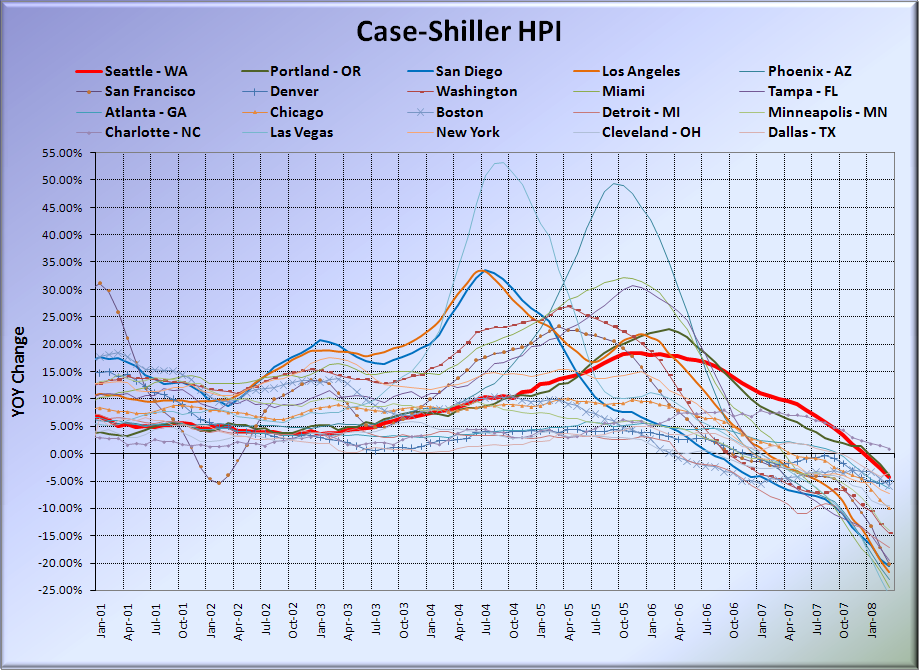
Case-Shiller HPI: All Cities
Click to enlarge

Here’s an update to the peak-decline graph, inspired by a graph created by reader CrystalBall. This chart takes the twelve cities whose peak index was greater than 175, and tracks how far they have fallen so far from their peak. The horizontal axis shows the total number of months since each individual city peaked.

Case-Shiller HPI: Decline From Peak
Click to enlarge

8 months into home price declines, Seattle has shed 7.3% off the peak. At this point in San Diego’s decline, prices were down a whopping 0.5%, San Francisco was down about 3%. They have now seen a total decline of 26% and 23%, respectively.

Here’s the “rewind” chart I introduced last month. The horizontal range is selected to go back just far enough to find the last time that Seattle’s HPI was as low as it is now. This gives us a clean visual of just how far back prices have retreated in terms of months.

Case-Shiller HPI: Seattle Price Reversion
Click to enlarge

Prices have been rewound approximately 21 months to June 2006. In the 8 months since Seattle’s peak prices, 13 months of price gains have been wiped out.

One thing I hear a lot is that price drops will never get as “bad” here as they will in Florida or California. I agree with that assertion. However, even if we take that as a given, we won’t really know anything about where Seattle’s bottom will be until we finally see a bottom in Florida and California. San Diego and Miami are down 26% so far, but who is to say they won’t continue dropping until they reach 50% off? They’re certainly not showing any sign of leveling off any time soon. If that were to happen, prices in Seattle could drop “only” 35-40% (which would put us at 2003 prices) and still not be as “bad” as Florida or California. A scenario like that seems entirely plausible to me.

Check back tomorrow for a post on the Case-Shiller data for Seattle’s price tiers.

(Home Price Indices, Standard & Poor’s, 05.27.2008)

Update: Here’s the Aubrey Cohen’s P-I story on the data. Apparently Elizabeth Rhodes at the Times is too busy today to do anything more than add a single sentence to the AP story.

Categories: Statistics
Tags: , , ,

Related Posts:

56 responses so far ↓

  • 1 Tejas's avatar Tejas // May 27, 2008 at 9:52 am

    “with a straight face that Case-Shiller is the least accurate gauge of home prices. ”

    ….and in a way she is right, but not in the way she thinks…

    Reading the news this morning I learned that Case Shiller not only uses the two month lag in reporting, it uses a three month rolling average. I am sure most of you knew this already, but it was news to me. Averaging, along with the delay, certainly ’softens’ the curve; as ugly as it may be.

    I think there is a whole lot more decline out there than even Case Shiller is indicating. ……”with no sign of leveling off”….good thing there was never a bubble, and that the market has stabilized! (as he stirs his cool-aid)

  • 2 Garth's avatar Garth // May 27, 2008 at 10:11 am

    Somebody sell me on the value of the 17 month offset, I just don’t see it.

  • 3 jon's avatar jon // May 27, 2008 at 10:15 am

    Case-Schiller is measuring something different than the other indexes. CS is looking at the price changes to specific homes over time, which will tend to depreciate as they grow older. That’s great for understanding the returns that you will actually see. The real estate indexes look at the market overall, which will be higher growth/less loss because new houses tend to be more larger and more expensive than older houses.

    One of the commenters on Inman news points out the CS also weight shorter sales intervals more heavily. The paper on the CS methodology says

    “For large metro area markets, the interval weights for sale pairs with ten-year intervals will be 20% to 45% smaller than for sale pairs with a six-month interval.”

    This will place disproportionate weight on houses that were bought at the peak and the seller is in now financial distress, often in foreclosure.

    So the measurements are different, and which one is better depends on what you are doing with the data.

  • 4 vboring's avatar vboring // May 27, 2008 at 10:17 am

    the rewind graphic would be better if adjusted for inflation.

    it doesn’t seem likely that any market will fall below a certain P/E ratio. not by much, anyway. so that may be a good way to identify a bottom.

  • 5 The Tim's avatar The Tim // May 27, 2008 at 10:23 am

    Garth, I’m not going to try to “sell you” on any alleged value of the offset comparison, but I will explain why I post it. I came up with the 17 months by simply lining up the peak YOY appreciation points of San Diego (33.5% in July 2004) and Seattle (18.5% in December 2005).

    Since Seattle and San Diego are both west coast cities of similar size and economic makeup (note: similar, not identical), many people find it interesting to compare the two. I provide the graph with the offset as a means of comparing the rise and fall of the CS index values for the two cities.

    I will point out though that in the year since I first posted the comparison, Seattle’s decline has followed San Diego’s pattern fairly closely. I’m sure they will diverge again at some point, but I personally think that it’s worth watching.

    The bottom line is that it’s meant to be a curiosity, not some sort of predictor.

  • 6 The Tim's avatar The Tim // May 27, 2008 at 10:24 am

    it doesn’t seem likely that any market will fall below a certain P/E ratio. not by much, anyway. so that may be a good way to identify a bottom.

    Indeed. I was in Boston last week, and I noticed that although home prices seem somewhat similar to Seattle, rents are through the roof. I’ll be doing a post later this week that looks into that a little more.

  • 7 Steve Tytler's avatar Steve Tytler // May 27, 2008 at 10:36 am

    Tim,

    Your graphs are fun to look at it, but as you and I have discussed over the years, I don’t believe you can use “technical analysis” like this to predict future home prices.

    Comparing Seattle to San Diego is comparing Apples to Oranges (Literally!)

    When San Diego home prices fell 50% in the early 1990’s the home price correction is Seattle was nowhere close to that. We have a correction of about about 20%, most of which occurred in a single year (1990).

    As I have repeatedly said over the past couple of years, we will not fall as much as San Diego this time either.

    So far, the local real estate market is pretty closely following the pricing trend I predicted last year in my weekly real estate column in the Everett Herald: I said home prices would fall by an average of 10-20% this year (depending on the neighborhood) and we are about half-way there in many neighborhoods already this year.

    I expect the pace of home price depreciation to increase as we enter the Summer doldrums, when home sales drop off as people go on vacation and enjoy the sunshime rather than spend their time shopping for a new home.

    Home sales tend to pick up again in the fall and then drop off dramatically in the holiday season of November and December.

    So by the end of the year, you will see home prices down significantly from where they are today.

    It might be interesting to post the predictions made last year by various “experts” about what home prices would do this year.

    As I recall, I was by far the most bearish (and so far the most accurate).

    But even though I am the most bearish of the published “real estate experts” I am still much less bearish than many of the posters on this blog.

    I think there is virtually no chance that Seattle area home prices will fall 40-50% as the boom-bust markets of Las Vegas, Phoenix and San Diego are likely to do.

    That’s not a guess or hope, that’s based on my study and observation of the LOCAL housing market over the past 40 years.

    “What happens in San Diego, stays in San Diego.” It has virtually NO impact on the Seattle area housing market, other than possibly reducing the number of people migrating North to cash in our “cheaper”housing.

  • 8 b's avatar b // May 27, 2008 at 10:50 am

    Steve Tytler -

    Would you agree that the credit bubble is what drove insane housing appreciation in every area of the country (and some other countries)? If so, then what happens in SD or other markets will certainly effect Seattle. When all of those AAA rated securities that were backed with homes in Vegas or SD or other superbubble areas continue to deteriorate, so will the available credit for every other market in the country. This will become especially pronounced when Seattle is still posting declines (and thus higher risk to lenders) when those other areas that are rocketing downward have hit their floor.

  • 9 Ray Pepper's avatar Ray Pepper // May 27, 2008 at 10:57 am

    Steve , Nice Post! Since you are the BEST predictor here what do you forsee with 500 Realty, Red Fin, etc. We already know the home prices will rebound in time. Thats a given. What do you forsee with the impending change in Real Estate Brokerage?

    Do you forsee what I do…..? The major Brokerages will advertise Buy from US and receive 5000-10,000 toward closing costs? Do you see the door swinging to the Left in the major Brokerages offering a discount service and to the right a full service ? Do you forsee all the tiny satellite offices merging into the major hubs? Do you see a veritable collapse of the MLS system as I do? Do you forsee Google/Yahoo/Msft/Zillow being the future of real estate as I do? Many of these changes are happening today! I hope you see it!

    As a Mtg Rep I hope you are educating your clients in the ONLY way to Buy real estate not on when to buy real estate. You owe it to your customers don’t you? You will not be like many MTG Reps will you? You will be an advocate 1st for your client . Right? When a buyer needed another 4000 to close you will not sit there and think. Hmmmm, too bad they didn’t use a different “type” of Brokerage to find their home.

    There is so much to predict. Most are blatantly obvious! Buy GEMS! Lets watch this all unfold together. It will be a GREAT RIDE! Home prices WILL come around in time but the Greatest change in real Estate for the Consumer is happening everyday.

    Ray Pepper
    http://www.500Realty.net

  • 10 Michael's avatar Michael // May 27, 2008 at 11:08 am

    The Fed’s new accounting rules are going to have a drastic change in housing prices. Most mortgage losses will no longer be counted as losses and in fact many will actually be calculated as gains by investment banks. I’m telling you these new “historical” off balance sheet accounting rules must be rejected by Berneke or this thing is going to get really wierd. I’m really ringing the alarm on this one because it is the biggest unreported story in the mortgage mess and no one seems to realize what they are doing.

  • 11 deejayoh's avatar deejayoh // May 27, 2008 at 11:11 am

    other than possibly reducing the number of people migrating North to cash in our “cheaper”housing.

    Thanks for stopping by Steve. While I don’t disagree with your assessment, it looks like SD is not so much cheaper any more…

    http://seattlebubble.com/blog/2008/05/20/san-diego-county-now-cheaper-than-king/

    I think the predictions thread was here

  • 12 John's avatar John // May 27, 2008 at 11:14 am

    Bubble tends to overshoot to the upside and downside. Gas and food price are adding to the credit problems. Regional banks that are knee deep in constrcution loans haven’t fallen apart yet. When I read about how the numbers are the worse in the last 20 years, 30 years, we are in uncharted water. This is a clusterf*** if there ever is one.

  • 13 Nick's avatar Nick // May 27, 2008 at 11:18 am

    Gotta agree with Steve; the price increases in the strong bubble areas where much greater than Seattle, and the corresponding correction is likely to be much greater as well.

    The time delay factor is interesting; there are several metropolitan areas which seem to be experiencing a time-delayed proportional correction to the “market-leading” bubble areas (eg: Seattle, Portland, Austin). I’m guessing speculators migrated money from the leading bubble areas to those areas looking for opportunities.

    I also agree with the P/E being the practical bottom, but I expect rents to go down as well, as people consolidate living spaces to reduce costs and lenders unload REO inventory. Hopefully this will be encouraged with new laws to make lenders more financially responsible for upkeep of vacant units (making it more profitable to sell than ASAP at market). As inventory increases faster than demand, rental prices should come down a bit, which will allow a lower P/E floor (and better affordability for non-investors).

    Just my opinions. :)

  • 14 Olaf's avatar Olaf // May 27, 2008 at 11:19 am

    Hey Tim, thanks for the link to the Put A Gag In Chicken Little article. Hilarious.

    Did you happen to see the note in the comments section, posted by the Classifieds Director at the Washington Post? He’s rushing to the defense of his paper, saying “WE don’t report negative news, honest!”

    It’s a revealing glimpse on the pressure those Classifieds departments must be putting on the reporters to keep the real estate news positive.

    Here’s his post:

    Submitted by Tim Condon on May 23, 2008 - 7:22am.

    Nobody likes to be the subject of generalizations - not even media. The Washington Post reported on housing prices today, and specifically referenced in the first part of the article that the OFHEO index is ‘considered the most comprehensive measure of value in the U.S…’. The article also pointed out that the data is skewed by areas such as California, Florida and Nevada. Later in the article, the S&P/ Case-Shiller index is referenced, but the article AGAIN mentions that the government index is more comprehensive.

    Not all media is out to report sensationalist stories, and making broad statements to that fact is a bit of sensationalism in iteself, now isn’t it?

    Tim Condon
    Director, Classified Advertising
    The Washington Post

  • 15 Groundhogday's avatar Groundhogday // May 27, 2008 at 11:29 am

    “’What happens in San Diego, stays in San Diego.’ It has virtually NO impact on the Seattle area housing market, other than possibly reducing the number of people migrating North to cash in our ‘cheaper’ housing.”

    That is a BIG “other”! Equity locusts have played a huge roll in the run up and the absence of such locusts will play a huge roll in the downturn. Out here in Pullman, our market has been heavily influenced by Seattle area parents pulling equity out of their homes and buying houses for undergrads to live in. This is just one big pond with housing bubble waves rippling out from the epicenters in California, the southwest, Florida, and the northeast.

    I agree that Seattle isn’t as bubbly as San Diego or Las Vegas. But as Tim points out, that is rather like winning a tallest midget contest. If the bubbly markets fall 50%+, Seattle could easily fall 30%.

    The key, above all, is to look at rents. Rent value will put a floor under housing price drops, though when the GSEs become officially insolvent (I suspect that with honest accounting they would already be insolvent) we could see prices drop below equivalent rent value due to unavailability of home loans.

  • 16 softwarengineer's avatar softwarengineer // May 27, 2008 at 11:29 am

    I AGREE WITH JOHN

    How far this will go before we level off, keep plummetting or eventually make a come-back is anyone’s wild guess.

    My guess:

    Without a surge in our local domestic industrial base, the inadequate industrial base replacement (glueboard housing with massive deficit spending) is just pushing America into a Banana Republic economy (to quote Ross Perot); this means continued degradation in Seattle’s average household wages.

    With banks holding on to the ropes in the recent boxing ring losses; don’t expect them to loosen up lending to allow even lower Seattle houehold incomes to buy 1st time bigger homes. Those days are long gone.

    The Seattle housing market is as strong as its houses of cards, propped up by the 1st time home buyer dodo birds or everything else collapses in price too.

    When will it level off or ever go back up? Lord only knows.

  • 17 biliruben's avatar biliruben // May 27, 2008 at 11:29 am

    First thing I saw on yahoo today was:

    ” Home sales post unexpected April increase”!
    http://news.yahoo.com/s/ap/20080527/ap_on_bi_go_ec_fi/home_sales;_ylt=AhpSFK3b4wYJO0.eKbKr0lOs0NUE

    Negative indeed.

  • 18 Scotsman's avatar Scotsman // May 27, 2008 at 11:49 am

    My favorite spin on the news, from Bloomberg: “we’re now closer to the bottom”. I think we can all agree on that. But i have to say the bottom is still a lot further down than many want to believe possible. Seatttle verses San Diego isn’t the issue. The issue is the context of the U.S. macro economy verses the rest of the world, and that isn’t even on the radar screen of most so called experts.

  • 19 Jimmythev's avatar Jimmythev // May 27, 2008 at 11:53 am

    Looks like Seattle has made the big times (ie NY TImes)… take a look at this story that just showed up… “Multiple offers” in Bellevue??? Really?

    http://www.nytimes.com/2008/05/28/business/28home.html?hp

  • 20 Ben's avatar Ben // May 27, 2008 at 12:00 pm

    Here is a genuine question - what will the floor in pricing be for the housing segment that has very low inventory for renting?

    If you want a 2br apartment / townhome, then pretty soon the rent / own ratio will adjust prices for you. But what about a 3000 sq ft 4 br house less than 5 years old? I don’t see many (or any) of those for rent on the Eastside, so what will set their price?

  • 21 jon's avatar jon // May 27, 2008 at 12:01 pm

    Interesting post over at calculated risk. They plotted months of supply vs. change in price and found that the buyer vs. seller market is between 6 and 7 months.

    http://calculatedrisk.blogspot.com/2008/05/case-shiller-real-prices-off-21-from.html

    Based on that, one could expect nationwide prices to continue to decline, but Seattle looks to be in good shape going forward.

  • 22 b's avatar b // May 27, 2008 at 12:01 pm

    Seattle featured specifically in the NY Times today: In Housing Market, Even the Strong Are Weakening. Probably won’t help drive any more out of state investors to propping up the local market.

  • 23 b's avatar b // May 27, 2008 at 12:05 pm

    Ben -

    The price of other homes will set the price of those. Once the low end comes down to rental equivalent “fair value” prices, it will set the comps for every other home just like now. Since the majority of the housing market is based on first time buyers enabling other people to move up, the price they can sell at will set limits for the prices the next tier can charge and so on.

  • 24 Angie's avatar Angie // May 27, 2008 at 12:44 pm

    Looks like even the NYT is feeling the economic pinch–it’s cheaper to use spellcheck than to pay an actual human copy editor. From the article b linked to in # 22:

    “As the home-buying season — that annual rite of spring and early summer — enters what is traditionally its busiest period, there are simply too many homes in many parts of the country, and two few people with the means to buy them.”

    Hmmm…

    N = number of homes for sale
    N-2 = number of people with means to buy them?

  • 25 johnnybigspenda's avatar johnnybigspenda // May 27, 2008 at 12:45 pm

    Tim,

    I think it would be good if you considered removing the ‘17 month lag’ from the Case Shiller. Its misleading to many who are new to the board.. a nuance that could be taken as reality by someone who glazes over your graphs and takes them as fact.

    I like the data you post. I worry when you post ‘theories or opinions’ that appear to be facts… its misleading and it will devalue your brand very quickly.

    By visually juxtapositioning those items, it is dangerously close to mis-leading people.

    Post the data, let us all discuss what it may mean. Don’t tell us what you think it may mean and then let us talk about it.

    In my opinion, this blog is successful because of the limited amount of bias (as compared to the mainstream realestate information). Do not let the articles on this blog become an equal and opposite amount of bias… your point is strong enough without exaggerating.

  • 26 deejayoh's avatar deejayoh // May 27, 2008 at 1:15 pm

    Taking a look at C/S history, this is now officially the longest and deepest downturn in the time they’ve been tracking Seattle (since 1990)

    Here are the numbers

    09/90 - 03/91: -6.0% in 7 months
    09/91 - 02/92: -2.2% in 6 months
    11/91 - 02/95: -1.1% in 4 months
    11/95 - 01/96: -1.0% in 3 months
    08/07 - 03/08: -7.3% in 8 months (current streak)

    In the 218 months that C/S has tracked Seattle, 170 months have seen appreciation M2M and 48 of months have seen depreciation (22% of the time).

    This is only the second March in the series that has been negative.

    As

  • 27 [troll]'s avatar [troll] // May 27, 2008 at 1:26 pm

    sttlbbbl.cm = th nxt f*kdcmpny.cm

  • 28 The Tim's avatar The Tim // May 27, 2008 at 1:35 pm

    NDU, I think you have us confused with the Mortgage Lender Implode-O-Meter.

  • 29 [troll]'s avatar [troll] // May 27, 2008 at 1:57 pm

    Tm - yh, rd th Crtr frm Jkyll slnd lng tm g… t xsts n r hds mstly.

  • 30 [troll]'s avatar [troll] // May 27, 2008 at 2:04 pm

    Sn Dg hs flttnd t, rthr thn “brst” - hm w sld thr md bt 40k vr th lst 3.4-4 yrs, vrss nrly 200k btwn nd f 2001 nd md-2004…

    gn, wht md dffrnc whn w bght s th lctn, nghbrhd, dstnc frm mjr SD mplyrs (.g. Qlcmm), qlty f hm/”mtnl ppl”, tc.

    Frnds wh bght ftr s, hvn’t md mny n thrs, hwvr thy hvn’t lst thr (nd thy wrn’t vn n th Scrpps Rnch r -whch s rlly nc/ttrctv).

    SD ddn’t bbbl p. nd SD rl stt cn’t rlly ls vl. T nyn wh hs bn t SD, thy knw wht th rl vl f th plc s - nd t n’t th rl stt s mch….

  • 31 Silver9's avatar Silver9 // May 27, 2008 at 2:25 pm

    Two people referred to “p/e”? How are you applying this stock market metric to housing?

    If you are referring to the income of rental properties, then there is still a LONG way for things to drop. Since rents cannot be financed, rent is always kept in check by actual incomes (which we see is definately not the case for home purchases.)

    We have been shopping for a house recently around Bellevue. We can rent a $2000 house that would cost us $3000+ to purchase. A 33% home-ownership premium is pretty steep. A 33% drop in housing prices to bring them in line with rent… ouch.

  • 32 WestSideBilly's avatar WestSideBilly // May 27, 2008 at 2:45 pm

    P/E is just another way of saying rent-equivalent value. If current carrying costs are double the rent you can generate, your P/E is basically 2, and you’d prefer it to be 0.75 to 0.9.

  • 33 Joel's avatar Joel // May 27, 2008 at 2:46 pm

    We have been shopping for a house recently around Bellevue. We can rent a $2000 house that would cost us $3000+ to purchase

    Only a 33% premium (actually I think that that is a 50% premium to rent, a 33% discount to buying)? What area of Bellevue are you looking at beacuse I’m seeing more like a 100% premium. Maybe you’re assuming a large downpayment, but then you have to factor in the opportunity cost of using that downpayment on a house vs. investing it.

  • 34 softwarengineer's avatar softwarengineer // May 27, 2008 at 3:26 pm

    PAYING OFF YOUR HOME(S) PRINCIPLES MAKES EXCELLENT SENSE RIGHT NOW

    If you are a home owner and can pay off the 5-7% interest principle [or any amount of it] with investment cash, do so ASAP in my book.

    Its like making 7-9% interest on your investment cash before taxes. The 2.6% money markets at BECU are a joke right now. The avearge short-term stock market returns are worse [negative 5% the last year].

    Make money in investments, pay off any home principle you can right now and I don’t see banks offerring higher investment interest rates for years to come either. The tax advantages of paying high (5-6%) interest are a joke, compared to the money you make not paying their interest (when investment interest is so darn pitiful in comparison) or risking more losses in the stock markets.

    I bet the Suzy Orman show on CNBC would totally agree with me.

  • 35 Ubersalad's avatar Ubersalad // May 27, 2008 at 4:04 pm

    I can’t figure out where the hell Bernice Ross graduated from…how many worthwhile Ph.D’s you know that do not list their academic credentials?

  • 36 Ubersalad, Ph.D's avatar Ubersalad, Ph.D // May 27, 2008 at 4:07 pm

    I am going to start calling myself Ph.D as well, perhaps I can garner additional respect from my already highly respected comments.

  • 37 Ubersalad Ph.D's avatar Ubersalad Ph.D // May 27, 2008 at 4:09 pm

    Sun rises from the west.

  • 38 Jim's avatar Jim // May 27, 2008 at 4:24 pm

    I guess it’s all in how you look at things. While S&P/Case-Shiller is known to be flawed, I think it shows how remarkably well Seattle has weathered this storm so far. I think the more interesting thing is how major metropolitan areas that had dramatic increases in value in short periods of time have been hit the hardest. Look at the last chart that I have in my blog "Even Case-Shiller Shows Seattle as Relatively Strong" showing appreciation rates in Phoenix, Las Vegas, and Seattle (in orange, red, and green) and then the depreciation compared to other cities.

  • 39 alex's avatar alex // May 27, 2008 at 4:24 pm

    [Nostra"golly"Us] . To anyone who has been to SD, they know what the real value of the place is - and it ain’t the real estate so much….
    ==================

    I don’t get the drift … would the author (or anyone else who “gets” it) care to clarify?

    Thanks!

  • 40 Gill's avatar Gill // May 27, 2008 at 4:27 pm

    Weather: Sand, Sun and Surf.

  • 41 [troll]'s avatar [troll] // May 27, 2008 at 4:34 pm

    Tm,

    Yr 17 mnth lg grph s BS.

    Sttl s th scnd mst dctd cty n th cntry nxt t DC. W hv dffrnt dmgrphc, wrkfrc, prsnl ncm nd nmplymnt rt cmprd t Prtlnd, Sn Dg r Ls ngls, nd tht shws n th fct tht th Sttl rl stt mrkt s hldng bttr.

    Pst th FCTL GRPH, nt yr prsnl crv fttd pp drm.

  • 42 economist's avatar economist // May 27, 2008 at 7:01 pm

    P/E is just another way of saying rent-equivalent value. If current carrying costs are double the rent you can generate, your P/E is basically 2, and you’d prefer it to be 0.75 to 0.9.

    Gack.

    P/E = price/earnings = price / (rent - taxes - insurance - maintenance - condo fees)

  • 43 Matthew's avatar Matthew // May 27, 2008 at 7:33 pm

    RAL,

    Explain why DC metro has returned to Oct 2004 price levels. Thank you. I spend a good deal of time in DC metro for work, and everyone there told me that DC was a “special market” before it went south. People said the same line of BS you are spewing “DC is different, we have new people coming here all the time, the federal government is still hiring like crazy, we are running out of land out here, we are more educated than the rest of the U.S., blah blah blah”.

    Now they are at 2004 price levels. Seattle is at 2006 price levels and tanking. Our price run up merely started later, end of story.

  • 44 Scotsman's avatar Scotsman // May 27, 2008 at 8:28 pm

    Man, the bitterowners and ownersarelosers are getting a bit testy. Who cares how well educated the average Seattleite may be. The issue is median income and median price, and when those are out of sync prices adjust. In this case they’re adjusting down…… big time.

    Lagging a graph to show a similar pattern isn’t messing with the data, or injecting one’s personal opinion, it’s facilitating an understanding that indeed, Seattle follows the same reality as the rest of the country, and is no more special than any other place.

    It’s a great time to get out of debt- if you can. Too many, I’m afraid, are stuck in a trap that will restrict them for years to come. It’s great to be a renter!

  • 45 [troll]'s avatar [troll] // May 27, 2008 at 8:44 pm

    Pst th FCTL GRPH, nt yr prsnl crv fttd pp drm
    ………………….

    nt tht TM ddn’t hv th blls t rspnd.

    Rntrs r Lsrs

  • 46 singliac's avatar singliac // May 27, 2008 at 8:50 pm

    Dr. Ubersalad, you are cracking me up.

  • 47 Michael's avatar Michael // May 27, 2008 at 8:51 pm

    Rentersarelosers,

    You can scream all day about workforce but the only data that matters is the price of a home to the average income in the city. The Bush era has brought in the golden age off book accounting, opaque financial insturments, and general ignorance about finance. Here are three things that will make this crisis so much worse.

    1. 45 Trillion Dollar Derivatives Market! Since when was the derivatives market larger than the stock market? Since most derivatives are off the books you can bet that the banks were buying mortgage backed securities with leveraged capital for the last three years.

    2. All those investment banks are holding mortgages in SIVs. Banks sold toxic debt to their own off book entities. The SIVs and other off book entities are holding the mortgages not the banks! The banks only had to report a minimum of the mortgage debt and they are frantically fighting to change accounting rules before they bring any more of it onto their books. (ask Citigroup)

    3. Ben B. is stuck in a really bad spot. When the toxic mortgage debt moves from off book entities to on book the banks are going to need more than fake loans to bail them out. No one knows for sure but we are looking at Trillions not billions in loses. So now the banks want to price bad mortgage backed securities at “historic” prices. The bank gets to pretend (for accounting purposes) that no one lost a home.

    Either the dollar or the banks crash - end of story.

  • 48 TJ's avatar TJ // May 27, 2008 at 10:13 pm

    From a pure model point of view, isn’t it more likely when everyone was hit by the same shock, the healthiest market would show weakness last, suffer the least, while recover first? It’s not like Seattle people/banks/companies have some kind of natural lag behind other places. There is no secret interest rate only applied to Seattle. The national economy factors hit everybody at the same time. The fact that Seattle market went down later than everyone else is the proof of strength.

    By that logic, the Seattle market will not fall as much as others, and will recover before everyone else.

  • 49 Alan's avatar Alan // May 27, 2008 at 10:46 pm

    TJ, that theory would predict that Seattle prices would have risen before other markets, which didn’t happen.

    I think it is random when the bubble starts and mass human psychology creates a nearly constant cycle time.

  • 50 RG's avatar RG // May 28, 2008 at 6:44 am

    Post the FACTUAL GRAPH, not your personal curve fitted pipe dream

    I may be wrong, but Tim does have that graph posted.

    Isn’t it the second one down from the top showing all 20 cities?

  • 51 TJ's avatar TJ // May 28, 2008 at 9:35 am

    Alan, I think the idea is that every market has its own trends for real estate movements with some shared national factors.

    Looking at the charts you can see a lot of cities falling at about the same rate in 2007, but some of those peaked in 2004, while some of those peaked a year later. There is no fixed delay from the peak, but a fixed timing for the fall. That’s easily explained by the national crisis, which hit everybody at the same time.

    That explains why it took Miami 11 months to hit 85% of the peak value, but San Diego 24 months. It’s simply because San Diego peaked 13 months early.

  • 52 WestSideBilly's avatar WestSideBilly // May 28, 2008 at 9:39 am

    Gack.

    P/E = price/earnings = price / (rent - taxes - insurance - maintenance - condo fees)

    If you want to expand on my gross oversimplification, you should also include vacancy as a factor.

    And looking at it from the buyer/renter’s perspective, what really matters is cost to buy (PITI + maint + assoc fees) vs cost to rent.

  • 53 b's avatar b // May 28, 2008 at 10:02 am

    TJ -

    You have to think about it differently. The same factors inflated the bubble everywhere, but it took longer for it to start in some areas than others. The only reason SD fell before Seattle is that SD started earlier, it hit its maximum price inflection point sooner than Seattle did. Had the credit spigot continued in the Seattle area, we likely would have had another little while to go before hitting that point. You can think of the bubble apex as the maximum price a region can afford even with bull"chocolate" loans and no money down. For every area this is different due to demographics, bubble start time, etc. I think another influencing factor for Seattle in particular is the California equity locusts like to move into the PNW when their bubble has heated up. It happened this time and it happened back in the early 90’s as well, they cash out at bubble prices down in Cali and move up with cash and buy investments in the PNW, creating a new bubble up there.

  • 54 Bryce's avatar Bryce // May 28, 2008 at 12:55 pm

    A minor brainwave: I wonder if the pre-peak curves would tell us much about the post-peak dropoffs? Could you extend the peak-aligned graph to include pre-peak indexes?

  • 55 Mikal's avatar Mikal // May 28, 2008 at 6:22 pm

    The lag in the chart is a load as everyone lost access to easy credit at the same time. I understand that our run up happened a bit late, but we were already expensive before the latest run up. It doesn’t make sense to me as much as it must to you guys.

  • 56 WestSideBilly's avatar WestSideBilly // May 29, 2008 at 8:36 am

    For those that think we’re at the bottom, the only graph that really means anything there is the Total Decline from Peak graph. Seattle is not special.

    The lag chart is an interesting perspective. We can argue the relevancy of it ’til we’re blue in the face, but I get the impression that those arguing it are mostly hoping we don’t follow the trendline of LA and SD. Fear, Uncertainty, Doubt - the Seattle way. (old /.ers will know what I mean)

Leave a Comment

Do you want a nifty avatar picture next to your name, instead of a photograph of Tim's dog? Just sign up with Gravatar, and make sure to use the same email address in the form below. It's that easy!

XHTML: You can use these tags in your comment: <a href="" title=""> <abbr title=""> <acronym title=""> <b> <blockquote cite=""> <cite> <code> <del datetime=""> <em> <i> <q cite=""> <strike> <strong>

Read the comment policy before submitting comments.