Seattle Bubble

News & discussion about real estate & the housing bubble in the Seattle area.

Seattle Bubble - News & discussion about real estate & the housing bubble in the Seattle area.

May Neighborhoods Months of Supply Update

Posted by The Tim on June 16th, 2008 at 9:30 AM · 18 Comments

Here’s the latest update on months of supply, or “absorption rates” for the 30 NWMLS areas in King County. For an explanation of what months of supply means, please refer to the original neighborhood MOS breakdown post.

Remember: Over 6 MOS is a buyer’s market, which gives buyers more negotiating power, but doesn’t mean homes are priced attractively for buyers or that it’s a good time to buy. Before this year, the longest that King County as a whole has sustained a MOS above 6 was 4-5 months in the winter of 1994-1995. May MOS for King County came in at 6.97 (up 0.76 points from April), bringing the current run to nine months.

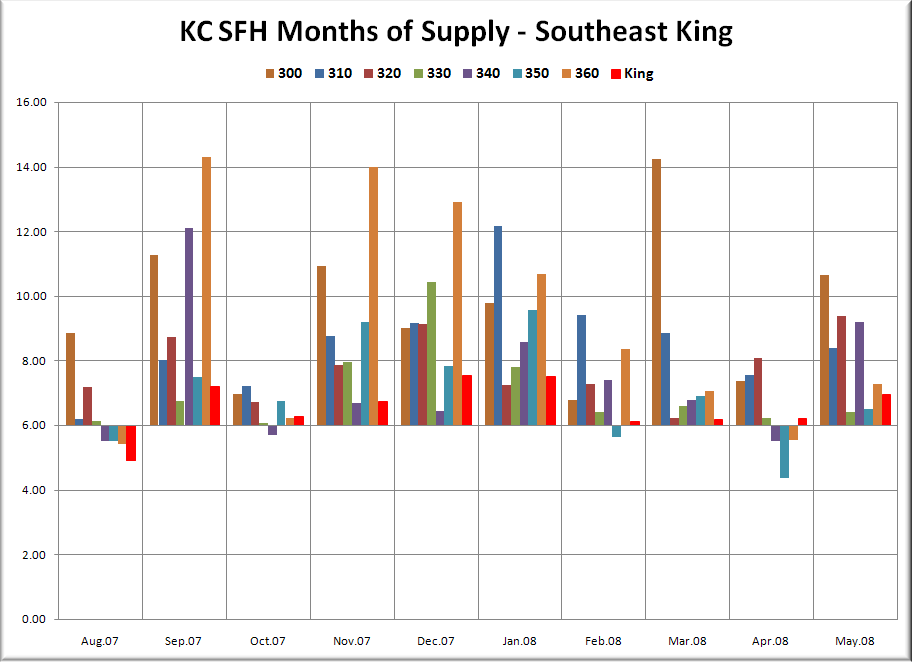
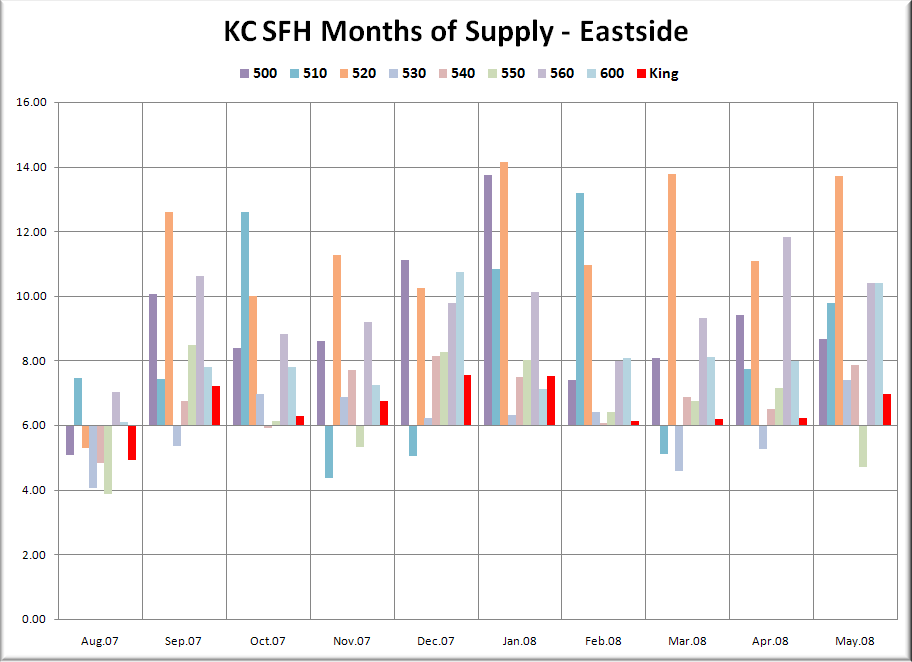
In the graphs below, you’re looking at the MOS for the “Res Only” data from the NWMLS King County Breakout pdfs for the ten-month period of July 2007 through May 2008. The bar graph is centered vertically on 6.0 MOS, so that it is easier to visually tell the difference between a seller’s and buyer’s market (i.e. - shorter bars mean a more balanced market). Each graph again has the same scale on the vertical axis and has the King County aggregate figure plotted in red, so they can be easily compared.

Unfortunately I haven’t yet gotten the fancy color-coded maps ready, but I did make some improvements to the enhanced area map, which can now be found on this page. My goal is to have interactive color-coded maps for next month’s neighborhood update post.

Note: Area 100 MOS was over 21 in January, and has been clipped.

KC SFH MOS: SW King
Click to enlarge

KC SFH MOS: SE King
Click to enlarge

Note: For Area 701 (Downtown Seattle) we’re using condo data.

KC SFH MOS: Seattle
Click to enlarge

KC SFH MOS: N King
Click to enlarge

KC SFH MOS: Eastside
Click to enlarge

Nothing too surprising in this month’s data. The North Seattle neighborhoods that make up 705 and 710 (Ballard, Greenlake, Greenwood, Lake City, Northgate, Wedgewood, etc.) continue to show unusual resilience, coming in at 3.81 and 4.00 MOS. Last month eleven neighborhoods were below 6.0 MOS. This month only six hold that title.

Seattle proper’s collective MOS continues to come in below 6.0, but not by much. Last month it crept up to 5.18, still more than twice what it was a year prior at 2.35.

Last month there were six neighborhoods with excessive MOS over 10.0, with three of those coming on the Eastside. As a whole, the Eastside is still a tough place to be selling a home, with a collective MOS of 8.33, and only one area below 6.0 MOS (550: Redmond, Carnation), and all other areas coming in higher than the county-wide average.

Here’s the bonus graph, which lets you directly compare each area’s MOS to its value one year ago. May 2007 is in red, and 2008 is in blue.

KC SFH MOS: Eastside
Click to enlarge

Every area was more of a buyer’s market in April than it was at this time last year, with MOS doubling in many regions.

The three toughest markets for sellers were Medina / Clyde Hill / W. Bellevue (520) at 13.70, Jovita/West Hill Auburn (100) at 11.05, and Vashon Island (800) at 10.82. 520 continues to make records, now in its ninth straight month of 10+ MOS.

The three best markets for sellers as of last month were Ballard/Greenlake/Greenwood (705) at 3.81, North Seattle (710) at 4.00, and Redmond / Carnation (550) at 4.71. Ballard: the pink pony’s last stand.

Categories: Neighborhoods · Statistics
Tags: , , , ,

Related Posts:

18 responses so far ↓

  • 1 Gill's avatar Gill // Jun 16, 2008 at 10:15 am

    Great graphs, Tim — I find these to be very useful and love seeing a breakdown neighborhood by neighborhood, so thanks again.

    Gill

  • 2 budbrad's avatar budbrad // Jun 16, 2008 at 10:22 am

    I think buyers are substituting condos for SFH when they can, and that’s keeping the condo-heavy neighborhoods strong.

    Not that people are selling their SFH to buy a condo, but if they are a new entrant (divorced, new to area, first-time buyer) they are opting for condos in general.

    This would explain the strength in the condo numbers too.

  • 3 softwarengineer's avatar softwarengineer // Jun 16, 2008 at 11:21 am

    EMPTY LOCAL BUILDING LOTS STAY UNBUILT FOR MONTHS

    There’s a 10 acre building area in east King county that was cleared, subdivided into home lots, fenced off and development all of the suden stopped about 6 months ago.

    Is surging inventory and tighter bank loans putting new homes on hold?

    If I was an used home owner I’d cringe everytime a new home was built [adding to the glutted inventory], especially since the new homes seem better priced [in my estimate] than most of the older homes and they generally aren’t “money pits”, like older homes generally turn out to be.

  • 4 Gill's avatar Gill // Jun 16, 2008 at 11:31 am

    Budbrad –

    I think you are right about that. I live in Ballard/Whittier Heights and there are still quite a few townhomes being built in the area and it seems like they are still selling well.

    A lot of them in this area are a bit more modern or less ‘cookie cutter’ than the ones further north in Greenwood and Northgate. There also don’t seem to be huge numbers of homes for sale compared to other parts of town, which may drive sales a bit as people want to move to these neighborhoods.

  • 5 jon's avatar jon // Jun 16, 2008 at 12:19 pm

    It’s hard to judge looking at just one year of data, because both sales and inventory are so strongly seasonal.

  • 6 deejayoh's avatar deejayoh // Jun 16, 2008 at 12:59 pm

    It’s hard to judge looking at just one year of data, because both sales and inventory are so strongly seasonal

    Isn’t that why you look at a whole year? Because it contains all of the seasons?

  • 7 Alan's avatar Alan // Jun 16, 2008 at 1:43 pm

    DJO,

    Jon was talking about the “seasonal” with respect to solar cycles.

    http://en.wikipedia.org/wiki/Solar_cycle

    You really need around 11 years of data to find anything meaningful.

  • 8 deejayoh's avatar deejayoh // Jun 16, 2008 at 2:02 pm

    Jon was talking about the “seasonal” with respect to solar cycles.

    oooh. I think I read about these! also responsible for our recent spate of warm weather, IIRC.

  • 9 Alan's avatar Alan // Jun 16, 2008 at 2:22 pm

    What mankind is doing is moving hydrocarbons from below ground and turning them into living things. We are living in an increasingly lush environment of plants and animals as a result of the carbon dioxide increase. Our children will enjoy an Earth with twice as much plant and animal life as that with which we now are blessed. This is a wonderful and unexpected gift from the industrial revolution.

    That increase in animal life is obviously increasing the demand for real estate in general and can explain ever rising prices.

  • 10 deejayoh's avatar deejayoh // Jun 16, 2008 at 2:50 pm

    and we do need increased demand for real estate, because we need to have a use for the 30% increase in standing timber!

    I believe they call it a “virtuous cycle” on the Fox News channel

  • 11 shawn's avatar shawn // Jun 16, 2008 at 4:25 pm

    “That increase in animal life is obviously increasing the demand for real estate in general and can explain ever rising prices.”

    In Seattle that increase in animal life is mainly seen in the species equus caballus; oddly they seem to mostly be less than 58 inches tall and colored pink.

  • 12 Scotsman's avatar Scotsman // Jun 16, 2008 at 5:38 pm

    The moss and mildew on just about everything I own is certainly lush. And I haven’t noticed any real seasonality to it. ;-)

    I wish they would split 500 into two sections, since the reality of the Eastern half is a world away from the Western half. Fall city has nothing in common with Factoria and Newport Hills. let alone Issaquah.

  • 13 Greg Perry's avatar Greg Perry // Jun 16, 2008 at 6:37 pm

    Me too. 550 and 600 should be split as well.

  • 14 Garth's avatar Garth // Jun 16, 2008 at 6:56 pm

    I don’t think condos are strong, I do think there are probably more properties at the high end selling and a limited new buyer pool cutting lower end purchases and messing up the median. Discounts on the high end can raise the median while lowering comps.

  • 15 TJ_98370's avatar TJ_98370 // Jun 16, 2008 at 10:14 pm

    Sorry, off topic :

    Whoa - verbatum from a Microsoftie. A bubblehead in the making? (see thread started in forums) -

    Cons (working at Microsoft):

    Three words: Real estate prices. In 2007, the median price in Redmond Washington for homes was over 650 thousand. Granted some of those are really nice and have a good bit of space. But I moved from a place where the same sized place cost half of that. Anywhere within a 30 minute commute to Microsoft will cost 450K+. The costs are such that the low income people are being driven out of the area and the medium income people are becoming the low income people because they can barely afford a 300 thousand dollar condo 45 minutes away from where they work.”

    glassdoor

  • 16 Joel's avatar Joel // Jun 17, 2008 at 12:39 am

    Rates on jumbos are high and higher end homes are getting slaughtered. I just witnessed this happening the other day. Some friends of mine have their house on the market. From browsing around redfin I estimated it was about 75k to 100k overpriced so I was curious about what it would eventually sell for. Well the other day they told my wife that they weren’t going to move because rates rocketed up and they won’t be able to afford the kind of property they want to buy. So much for move-up buyers rescuing the housing market.

  • 17 what goes up comes down's avatar what goes up comes down // Jun 17, 2008 at 6:45 am

    Looks like 13000 is just around the corner.

  • 18 softwarengineer's avatar softwarengineer // Jun 17, 2008 at 9:37 am

    MAY HOUSING STARTS PLUMMET TO 1990 BUBBLE LEVELS

    See the proof:

    http://www.usatoday.com/money/economy/housing/2008-06-17-housing-starts_N.htm

    But its far worse than the 1990 Bubble; i.e., Seattle population is approximately 32% greater, so housing starts numbers comparable at those past levels are horrifyingly depressionary in my book today.

Leave a Comment

Do you want a nifty avatar picture next to your name, instead of a photograph of Tim's dog? Just sign up with Gravatar, and make sure to use the same email address in the form below. It's that easy!

XHTML: You can use these tags in your comment: <a href="" title=""> <abbr title=""> <acronym title=""> <b> <blockquote cite=""> <cite> <code> <del datetime=""> <em> <i> <q cite=""> <strike> <strong>

Read the comment policy before submitting comments.