Seattle Bubble

News & discussion about real estate & the housing bubble in the Seattle area.

Seattle Bubble - News & discussion about real estate & the housing bubble in the Seattle area.
Findwell - Get full service at 1/2 the commission.

Puget Sound Counties July NWMLS Update

Posted by The Tim on August 20th, 2008 at 11:33 AM · 99 Comments

Let’s check in on the NWMLS statistics from around the sound.

Here’s where the YOY stats stand for each of the six counties as of July 2008:

King - Price: -7.5% | Listings: +22.9% | Sales: -24.4% | MOS: 6.6
Snohomish - Price: -5.5% | Listings: +10.5% | Sales: -32.8% | MOS: 8.4
Pierce - Price: -10.0% | Listings: -5.8% | Sales: -13.2% | MOS: 7.6
Kitsap - Price: -10.9% | Listings: +4.2% | Sales: -15.9% | MOS: 8.9
Thurston - Price: -5.8% | Listings: -6.1% | Sales: -24.8% | MOS: 6.4
Island - Price: -18.8% | Listings: +8.9% | Sales: -13.5% | MOS: 10.7
Skagit - Price: -3.9% | Listings: +8.5% | Sales: -19.2% | MOS: 9.0

Following below are the graphs you’ve come to expect. Click below to continue reading.

These graphs only represent the market action since January 2006. If you want to see the long-term trends, feel free to download the spreadsheet (or in Excel 2003 format) that all of these graphs come from, and adjust the x-axis to your liking. Also included in the spreadsheet is data for Whatcom County, for anyone up north that might be interested.

First up, it’s raw median prices.

Puget Sound Median SFH Prices
Click to enlarge

Median prices declined from June to July in King, Pierce, Kitsap, and Island counties, and increased in Snohomish, Thurston, and Skagit. The largest drop was in Island, where the median price dropped over $20,000.

Here’s how each of the counties look compared to their peak:

King - Peak: July 2007 | Down 7.5%
Snohomish - Peak: March 2007 | Down 8.5%
Pierce - Peak: August 2007 | Down 10.8%
Kitsap - Peak: September 2007 | Down 12.3%
Thurston - Peak: July 2007 | Down 5.8%
Island - Peak: August 2007 | Down 26.9%
Skagit - Peak: June 2007 | Down 13.7%

Thurston County still holds the prize for smallest total decline, with Island County way out in front for largest decline, rapidly approaching 30% off peak.

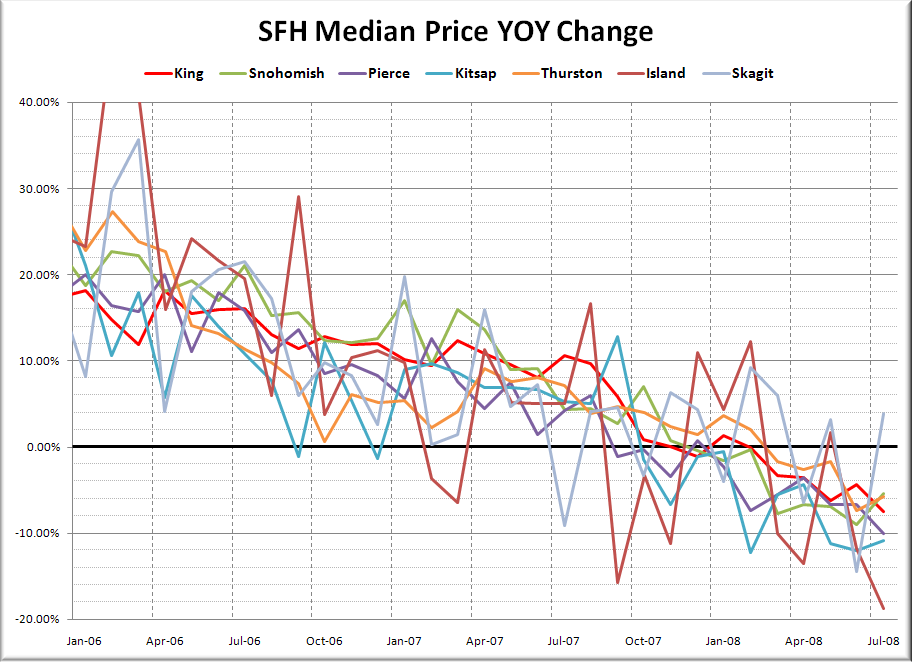
Here’s another take on Median Prices, looking at the year-to-year changes over the last two years.
Puget Sound Median SFH YOY Price Changes
Click to enlarge

The ever-noisy data for Skagit County bumped back into positive YOY territory last month, with year-over-year price declines elsewhere in the sound ranging from a 5.5% drop in Snohomish to a huge 18.8% drop in Island County.

Here’s the graph of listings for each county, indexed to January 2006.

Puget Sound SFH Listings
Click to enlarge

Listings resumed their increase in every single Puget Sound county in July, with Island County seeing the largest jump and setting a new high point for listings in that county.

Here’s a look at the YOY change in listings.

Puget Sound SFH Listings YOY
Click to enlarge

Thurston and Pierce continued in negative YOY range for listings.

Lastly, let’s check out pending sales, also indexed to January 2006.

Puget Sound SFH Pending Sales
Click to enlarge

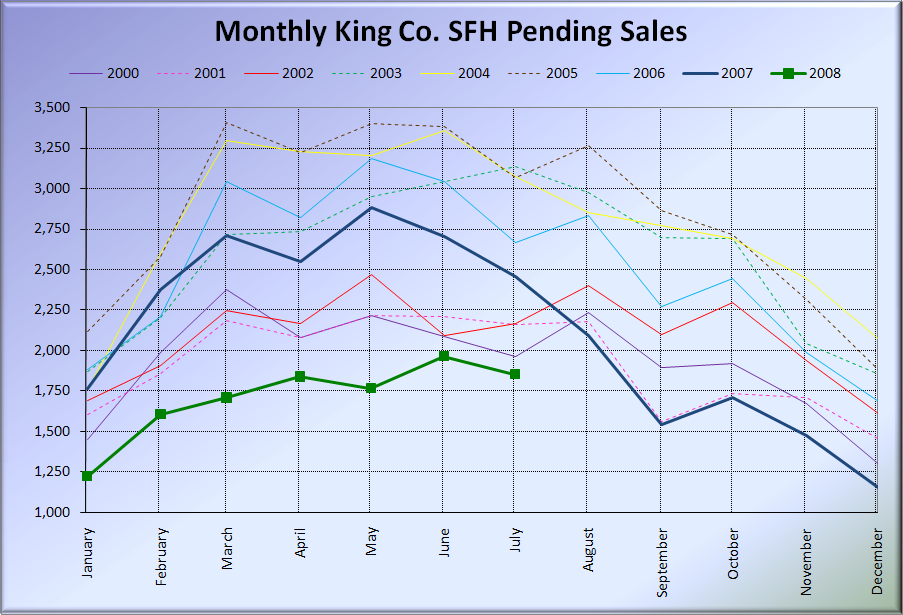
Kitsap, Island, and Skagit all broke above the January 2006 sales mark, while King slipped back below. Note that in King County May or June is typically the high point for pending sales (see graph). It seems unlikely that we will break back over the January 2006 sales volume. If I were to describe sales in a word, that word would be anemic.

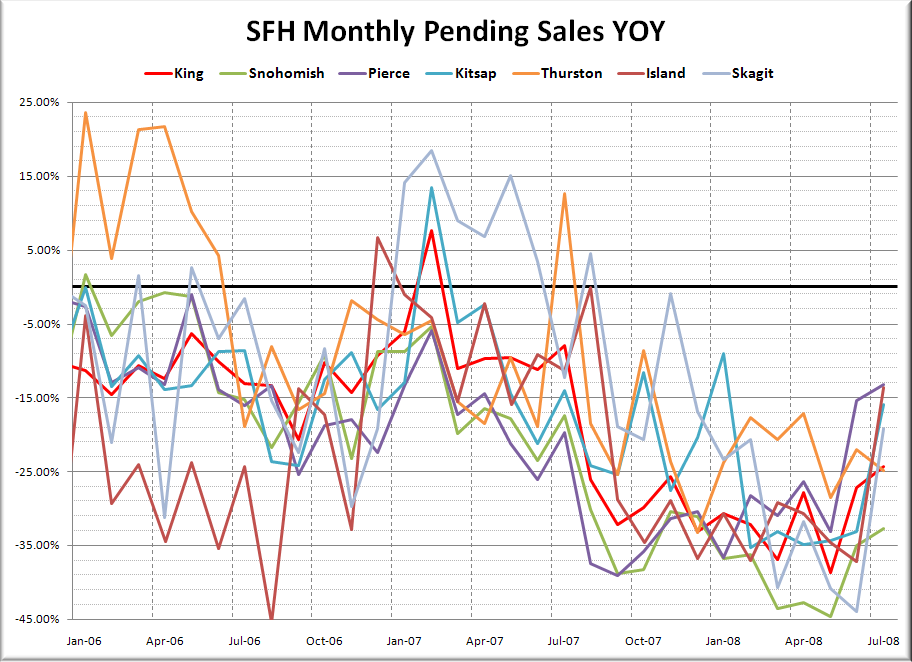
Lastly, here’s the YOY graph of sales:
Puget Sound SFH Pending Sales YOY
Click to enlarge

Even the best-performing counties are still seeing sales volumes 13% lower than July last year, while Snohomish continues to pull up the rear with 30% fewer sales. Ouch.

Island County continues to be the big loser as far as prices and “months of supply” are concerned. With record inventory that continues to rapidly build, I suspect prices there will continue to drop for some time.

Categories: Statistics
Tags: , , , , , , , , , ,

Related Posts:

99 responses so far ↓

  • 1 softwarengineer's avatar softwarengineer // Aug 20, 2008 at 1:28 pm

    TIM’S TRENDING ESTIMATES ALL LOOK ON TRACK; PRICE COLLAPSING

    And to think Tim, a year of two ago the RE folks (not Ira) were calling you Dr. Doom….lol

  • 2 Hinten's avatar Hinten // Aug 20, 2008 at 2:15 pm

    It will be nice to see when the tone of some of the posters here will change from “Yeah, we won!” to “Okay, we all have a problem here, let’s start figuring out how we can help people.”
    Better information is always helpful and this blog community and Tim perform very well. But data is only have the story, actionable insight would be even more helpful. For example, can we start looking at reasonable predictions of when the downturn will slow down? How long will things stay flat post downturn? Etc.

    Just saying that cheering on the downturn and possible depression seems almost ironic.

  • 3 Tim's avatar Tim // Aug 20, 2008 at 2:55 pm

    “Just saying that cheering on the downturn and possible depression seems almost ironic.”

    Cheering on the downturn is cheering for a return to a safe economic environment. 15% annual appreciation was absurd and dangerous. Freddie and Fannie are failing for Christ sake. That pretty much sums up the real estate boom.

  • 4 TheHulk's avatar TheHulk // Aug 20, 2008 at 3:19 pm

    It will be nice to see when the tone of some of the posters here will change from “Yeah, we won!” to “Okay, we all have a problem here, let’s start figuring out how we can help people.”

    Help exactly whom? Not that I have a choice, but I don’t want any of my hard earned tax money to be used for bailing out anybody (homeowners / lenders etc.) Some people genuinely had it coming for them and I don’t feel a shred of pity for the “poor” 50K annual income homeowner (before taxes) who purchased a 500K house regardless of who took advantage of the said homeowner OR who lied.

    While all this madness was going on I have silently waited for the party to end (and saved money in the meantime). And now that markets are returning to reality (we still have a couple of years to go I think) I sure as hell (Tim is swearing allowed?) am/will be cheering from the sidelines.
    Personally for me its not just “I win”, its also “By how much I win” because it directly impacts how much debt I am willing to assume in the next 3 years or so, when I buy a house.

  • 5 rose-colored-coolaid's avatar rose-colored-coolaid // Aug 20, 2008 at 3:28 pm

    Hinten, the reason you aren’t seeing any data on when the downturn will end is because it is too early to predict that. That would be like predicting when the bubble would pop in 2004 nationwide or 2005 in Seattle. It was early enough to see things were out of control, but until appreciation began evaporating there was nothing to trend.

    Right now, declines are accelerating, so how do you expect anyone to produce reasonable predictions. At some time in the future, we’ll notice that declines are slowing. Tim will probably then produce a chart about how the declines are moving towards 0%, and that will be the sign that reasonable predictions can start being made. Until then cheering for more lower prices is all we can do.

  • 6 peter's avatar peter // Aug 20, 2008 at 3:32 pm

    “actionable insight would be even more helpful. For example, can we start looking at reasonable predictions of when the downturn will slow down? How long will things stay flat post downturn?”

    I’m pretty sure it is impossible at this point to predict the bottom let alone the timeframe for recovery. There are a lot of things the need to shake out (Option ARM resets, area economy, shadow inventory, etc..) and the dog isn’t even back inside from the rainstorm.

  • 7 Niuska's avatar Niuska // Aug 20, 2008 at 3:41 pm

    Hinten wrote:
    It will be nice to see when the tone of some of the posters here will change from “Yeah, we won!” to “Okay, we all have a problem here, let’s start figuring out how we can help people.”

    It is not our responsbility to help anyone here. In fact, “helping” will only prolong the downturn in real estate. Taking artificial steps to prop up bad mortgages (via government) is going to extend this mess.

    There are many positives to lower values. Affordability is the main one.

  • 8 johnnybigspenda's avatar johnnybigspenda // Aug 20, 2008 at 3:44 pm

    This was a post by someone on SeekingAlpha re:

    Long but some good (debatable) ideas….

    from SeekingAlpha

    Solving the Housing “crisis”.

    A. In order to solve the crisis a quick look at the underlying issues of the crisis are important.

    1. The rate of increase in housing prices was artificially accelerated by the availability of high risk loans. The loans were high risk in that people could not afford to pay the principle and interest while maintaining a quality of lifestyle commensurate with the property they were purchasing. Risk increased as the available cash flow of home owners was not enough to create capital reserves to offset future risk. The loan types were generally variable rate mortgages that even financially savvy borrowers could not adequately assess risk.

    2. Supply over the last few years was increased in response to the artificially accelerated rate of home price increases. While the rate of home prices increases was high and capital was easy to come by a large portion of the pool of potential buyers entered the pool of buyers. Those “potential buyers” who transitioned into the “buyers” pool were forced to purchase homes that would normally have stayed out off the market or been eliminated from the market due to development, nature, or disaster for inflated prices. So while these homes in “normal” markets would not have been marketable or tradable in a period of “abnormal” markets they became commodities that were prized by two classes of buyers. The first were marginal buyers who generally would have stayed in the “potential pool” of buyers and “investors” who desired to purchase and “flip” with marginal and minimal “upgrades” to the properties. Further, the accelerating pool of “new” homes added to available supply making the calculus for home buyers more complicated. i.e. Pay slightly more for a new home or slightly less for an existing home. More and more buyers were choosing the former over the latter. This increased risk and resulted in builders having competitive advantages over existing homes. The competitive advantage resulted in more new home construction. At the same time the dynamic of the marginal buyer and investor and now exacerbated by those seeking to “trade up” increased the supply of existing homes. A general but not unreasonable increase in basic commodities created situations in which marginal buyers (i.e. those that recently transitioned into the buyer pool because of the previous dynamics) became unable to service their mortgage debt. As these properties entered the market as sell before foreclosure the supply increased even more. This portion of the supply was marked at very close to cost causing a DECELERATION in the median price of homes in at risk markets.

    3. The availability of rental properties became reduced as they became converted to finance and buy properties. This began to drive up the cost of renting. As the cost of renting increased, the calculus of buy versus rent increased the number of those transitioning from “potential buyers” to “buyers”.

    4. Eventually the pool of available buyers became maximized to the market conditions and there were no new entries into the demand market. At this point demand began to decelerate. All those who could trade up had done so. All those who could buy a house to live in had done so. The available leverage and capital of “flippers” was maximized.

    5. As demand decelerated, the time it took to sell properties increased. Loan brokers and financial institutions as well as construction firms and sellers attempted to reduce this time to sell through special “fast track” loan programs and incentives. Eventually the only way to reduce the time to sell was to reduce prices. This reversed home price increases and began the process of accelerating decreases in home values in the system. As comparable homes were sold for less and less month over month investors began to question the actual value of the collateral behind financial instruments.

    6. As interest rates reset on homes and the true cost of ownership began to affect marginal buyers a new class of supply entered the market; the foreclosure. While this class of supply had generally been available to the market they had generally been in demand by the investor and developer. The market could not absorb this extra supply and as housing prices had entered the phase of declining values already, these new entries resulted in drastic rates of declines in “key” markets.

    7. Declining values of collateral and leveraging strategies by financial institutions resulted in decelerating returns on loan portfolios and even losses. These losses were identified rightly as due to the decrease in value of properties, which erased the value of collateral, the increasing costs of foreclosure, the decreasing revenue for loan generation, the decreasing interest payments from the pool of home owners, and the increasing cost of refinancing debt as the capital markets began to doubt the value of financial instruments in a new wave of analysis.

    8. Risk insurance and cost of capital increased as the traditional backstop of losses, the insurers exited the market place. The scope and depth of losses in the insurance sector locked up the entire market place and made the cost of refinancing and capitalization such that losses mounted. The result was two-fold: 1) increased capitalization that reduced the amount of liquidity in the market and 2) increased cost of gaining capital at the retail level. The result was pushing a large portion of those in the “buyer pool” back to the “pool of potential buyers” and drying up demand.

    9. With even less demand and an over abundance of supply prices fell at an even accelerated rate.

    10. Psychology of the market place now dictated that the entire pool of buyers analyze the risk of entering a falling market. At this point the cost of moving first may be the further erosion of the value of one’s home and missed opportunity to purchase higher quality at equal or less cost. The buyer market then became limited to those who “HAD” to purchase as a result of market conditions.

    11. Interest rates for those financing and the information requirements (i.e. total cost) increased dramatically further eroding demand for properties.

    12. The end result is a stagnant market of buyers and sellers and financial institutions with an increasing portfolio of under or non performing loans making all the financial instruments that are supported by the market of an uncertain value. This has further eroded both availability of capital to fund purchases and the ability of financial institutions to finance its debt increasing threats of insolvency. As certainty and confidence is eroded the problems become worse and a feed-back-loop results.

    Now that the underlying process leading to the current “crisis” is understood some solutions can be formulated.

    B. Reduce supply.

    Stabilizing the values of homes is essential to create certainty as to the value of securities and collateral. It will also change the calculus of buyers who are staying out the market because of hopes that they will be able to buy more for less. Reducing supply would also decrease the time that homes are on the market creating conditions that will decelerate the rate of foreclosure. This too will create conditions of certainty and solve the under-and non-performing loan problem.

    There are several possibilities for reducing supply and they include:

    1. Offering grants to localities to purchase properties to turn into green-space or to place in land/property trusts for later development.
    2. Offer terms that would allow the refinance of properties to reduce the foreclosure of homes. Terms such as 40 year or 50 year mortgages at increased interest rates with provisions that state that the property cannot be sold or transferred for 2, 3, or 5 years. The lender can force refinance instead of foreclosure.
    3. Market clearing houses can be established where people in foreclosure can have the option of “trading down”. Financial institutions can offer homeowners the ability to refinance into a lower cost home removing it from supply, keeping a marginal home-owner in the home owner pool and maintaining the very highest valued properties in the supply system. These properties would be the most likely ones to benefit from the “trust” green-space programs mentioned above. They are also the most likely to be successfully managed in foreclosure.
    4. Financial institutions should enter into property management agreements utilizing programs such as the Defense National Relocation Program that offers property management services for relocating home owners. Properties are rented. By transiting homes from the sale/finance pool to the rental pool two things are accomplished. 1) Those entering the rental pool may be able to remain in their homes as renters paying less cost such as insurance and local property taxes. These costs are transferred to the lender. However, with rental rates as they are, it is possible that even with decreased rates due to increased supply that the lender will be able to cover the costs with rents. 2) Financial institutions are able to maintain the book value of their collateral (real property does not suffer from mark-to-market issues) and still maintain a revenue stream. A provision for refinance and repurchase may be included in the lease/rental agreement offering the potential for future revenue and a ready market of borrowers when future conditions improve.
    5. Increase the costs associated with selling a home. For those home owners who cannot show cause for sale( i.e. not in threat of foreclosure as certified by their financial institutions) will pay a tax penalty on the sale of their home regardless of whether they make a profit or not. Something like a .005 tax on the total proceeds of the sale payable into a “Green Space and Trust” account for giving block grants to localities for purchase and clearing homes. This could be in effect for 2 or three years while the market cleans itself up.
    6. Decrease the costs of home purchase if one is not also selling a home. Offer a tax rebate equal to the total costs of closing (minus down payments and points) payable in 5 years if the home is owned as a primary or secondary residence for 3, 4, or 5 years. The payment can be prorated based on the length of ownership. The payment can also be divided into two segments, one payable to the lender as a principle payment and one payable to the owner. The rebate could be recouped by the federal government at a rate equal to 10% or 20% a year from the mortgage tax deduction in the years following the payout.
    7. Increase the regulatory requirements to offer adjustable rate mortgages. For instance, increased equity in the home through higher down-payments, or increased monthly payments into an “Interest rate adjustment account” to offset the affects of interest rate increases.
    8. Allow new home construction companies to purchase their own inventory at reduced prices to claim the loss on their taxes and to not pay sales tax on the properties if held for 2 or 3 years.
    9. Allow construction companies and owners of residentially zoned lots to “charge off” or deduct an “opportunity cost” equal to some percentage of the assessed value of the land if the land is undeveloped for 2 years after the deduction. If developed then the individual or company has to pay back the savings resulted from the deduction + 20%.

    C. Close the gap between cost of capital for the financial institution and the return on loans given.

    1. Embrace the fractured pricing of the housing market by creating new loan segments. Break the housing price market into segments of 100K each in which each higher segment has higher real interest requirements. For instance on a 30 year fixed, the “base” bracket may be between 0 and 100K and equate to the 5 and 6 % range. From 100 – 200K the interest may be between 6 and 6.5% range. Between 200K and 300K the rate may be between 6.5 and 7%. Over 300K the rate may come back to between 6 and 6.5%.
    2. Restructure equity requirements based on tiers or categories of loans. For under 100K the equity requirement may be 0%. From 100K to 200K the equity requirement may be between 5% and 10%. Between 200K and 300K the requirement may be between 10% and 15%. From 300K to 400K the requirement may be 20%. Over 400K the requirement may be 10-15% again.
    3. Extend the period of repayment to reduce monthly payments on existing loans without refinancing, sort of an automatic renegotiating of terms. By extending the period of the loans and reducing principle payments it decreases the likelihood of default but increases the total expected interest payments to the loan. A 200K loan at 7% moved from 30 to 40 years would reduce the interest and principle payment from $1330 to $1242 a month.
    4. Use savings from Dividend Cuts and equity offerings to reduce debt through retirement and repurchase. Repurchase of low quality debt at prices lower than issued with higher quality debt issues and cash would reduce borrowing costs for institutions.
    5. Reduce leverage from the current 3:1 (for FRE) to 2.5:1 or less through the process of retiring debt and building cash reserves.
    6. Increase cash flow to reduce borrowing requirements. Renegotiate mortgage terms to allow interest reductions, special incentives, and benefits for increasing principal payments.
    7. Increase and capital cash flow to reduce borrowing requirements. Encourage voluntary increases to ESCROW and manage ESCROW accounts like Debit Card accounts. Pay interest on excess escrow balances and charge fees for the use of the account. Fence ESCROW DEBIT Accounts as capital reserves not to count in leverage decisions so that a “cushion” or “emergency reserve” of capital exists.

    D. Increase Demand

    1. Allowing the cashing out of 401K and IRAs for the purchase of homes if the family is “trading down”, the refinance of a home if lived in for more than 1 year and will live in for the next 5 without penalty, or the making of mortgage payments if in foreclosure and have lived in the property for more than a year and will live in it for more than 3 without penalty. If a family uses these funds then the financial institution has to forgive all interest and fees related to the foreclosure proceedings.
    2. Stabilize the value of homes through the previously mentioned actions in order to eliminate the tendency of current buyers to wait for a better or lower price.
    3. Provide grants and tax incentives for investors to purchase “distressed” properties and to transform them into green spaces.
    4. Provide tax incentives for investors to purchase properties in foreclosure, to hold them for 2 or 3 years and then to redevelop or sell them. The incentive could be NO tax on the profit, a tax loss on the purchase that is then offset by a gain when and if sold, or any other program.
    5. Allow the purchase of lots zoned for residential single home construction to be held for 3 years. At the end of three years the lots may be developed and no federal taxes paid on the assessed value of the land when sold, only on the property built on it.
    6. Allow companies and individuals to purchase residential lots from themselves and to not pay federal taxes on the profits from the assessed value of the land if held for 3 years, only on the value of the property built on it.

    E. Accept Losses to reduce Losses

    1. Allow the “forgiving” of a % of an outstanding mortgage coupled with rate and term adjustments in order to reduce monthly payments and bring mortgage rates in line with actual values. The owner will pay taxes on the forgiven amount as income, the financial institution accepts a “loss” less than foreclosure, and the terms of the financing are transformed to create a new lower risk asset. For instance: 200K at 8% on a property worth 170K (for whatever the reason for drop in value) with 27 years left, turns into a Mortgage for 180K at 8.5% for 40 years saves over $200 a month when reduced payments and re-assessment of the property and the corresponding tax savings are taken into account. The government collects income taxes on the $20,000.00, the financial institution takes a tax loss on the $20,000.00, and instead of losing 1/3 or more by Foreclosing the financial institution only losses 10% on the revaluation and increases by .5%.
    2. “Donate” distressed properties to localities for them to turn into green spaces or rental properties for low income persons. These properties can be “written off” at a value equal to the foreclosure costs and balance of the mortgage.
    3. Offer programs by which local communities can purchase/finance distressed properties for destruction/rental/gre… space initiative/business development. For instance, a distressed property in a community could be refinanced under a special community works program at a low interest rate to be paid for by a locality such as a city or even a neighborhood corporation. A group of 25 home owners take partial (4%) ownership of a property that is foreclosed in their neighborhood that is then rented to own to a child care provider at a cost per month equal to the mortgage. While the child care provider may not have the capital to purchase the property the community does. The child care provider then provides care for the community and locality at market rates. This could be the same for any type of community home based business, a medical clinic, or even a library or dentist.
    4. The property could be financed by a community and be torn down at cost to the lender in exchange for the community taking a refinanced stake to turn the lot into a neighborhood playground, green space, or held in common for later sale. On a 200K home each resident of the community (if 25 were included) would finance $8,000.00 over 30 years at 5%, or less than $50.00 a month. This may be added to a community association dues and the federal government may grant tax deduction status to the interest and any profit from the use or sale of the lot/property. The amount may be managed on an individual basis by the loan provider. 25 low risk loans at the price of 1 HIGH RISK loan. $50.00 is a small price to pay to maintain the value of homes in a community. And the cost is borne by the community that benefit from a maintenance of value. This also reduces supply and increases demand.

  • 9 being patient's avatar being patient // Aug 20, 2008 at 3:52 pm

    Hinten,

    You won’t find too much information like that on this site.

    I have wondered that myself and have not found every much of it here.

  • 10 singliac's avatar singliac // Aug 20, 2008 at 3:53 pm

    Hinten, how exactly would you suggest helping these people? Should I take one for the team and buy an overpriced house to help out one of these unfortunate home-sellers?

  • 11 pfft's avatar pfft // Aug 20, 2008 at 4:04 pm

    ” For example, can we start looking at reasonable predictions of when the downturn will slow down?”

    in other words when is the time to buy? are you a realtor?

  • 12 Cheapseats's avatar Cheapseats // Aug 20, 2008 at 4:17 pm

    I would also argue that this site has and is helping people, when I moved here a bit over a year ago, this site helped me make a more informed on whether to purchase at that time.

    I am not cheering at this “win”, I am thankful that I have at least established some barometers on what type of purchase situtation will be right for me.

    You could also argue that this site may help a seller determine whether to sell now or in a year, if they know that they will need to sell.

  • 13 Civil Servant's avatar Civil Servant // Aug 20, 2008 at 4:19 pm

    Objections to the “tone” of the site (as if we are all like-calibrated machines — but that’s another issue) used to coalesce around accusing Tim and us readers of being greedy, callous bums who were only interested in timing the bottom of the market. If we have turned a corner and the new trend in criticism is that the site is being insufficiently helpful in terms of that timing, what does that mean?

    I do notice over the last few months less objection to the premise of a market downturn. That’s cool.

  • 14 johnnybigspenda's avatar johnnybigspenda // Aug 20, 2008 at 4:28 pm

    most with objections have been chased away with pitchforks and torches

  • 15 Civil Servant's avatar Civil Servant // Aug 20, 2008 at 4:33 pm

    JBS — You don’t mean the new pro-civility comments policy, do you? If so, I don’t think that’s a fair or apt metaphor. If people can’t make their points without foaming at the mouth, something is wrong with either the points or the people.

  • 16 Cheapseats's avatar Cheapseats // Aug 20, 2008 at 4:37 pm

    I will agree with what someone else said, that until a majority of subprime/Alt A’s reset there is no way to even begin to predict anything. Equally I am watching other markets to see where their apparent bottoms are…

  • 17 olaf's avatar olaf // Aug 20, 2008 at 4:40 pm

    Hell (H-E-double-hockeysticks, I mean), yes, I’m cheering the downturn. I’m not ashamed to admit it. The bubble was turning Seattle into the exclusive province of trust-fund babies and over-indebted fools. Once prices come down another fifteen percent and stagnate for a bit, maybe the rest of us can move back in and restore the natural balance to the ecosystem.

    As to the broader national economy: It’s already doomed to recession. Seattle’s belated return to normal pricing won’t make a difference to that. Just hunker down with your savings, people, and wait for the smoke to clear.

  • 18 aldreth's avatar aldreth // Aug 20, 2008 at 4:40 pm

    as expected.

  • 19 mikal's avatar mikal // Aug 20, 2008 at 5:07 pm

    Hinten, I agree it is stupid. There are some here that have been smart about waiting to buy and from their comments they seem to feel immune to the possible downfall of the economy. The others are jelous and will more than likely find themselves unemployed and still unable to buy a house as everything is still all related. If you couldn’t afford it before, you still won’t be able to when prices fall as you will no longer be able to get a loan as they have changed as well. Mathew, I find your comment to me in yesterdays post to be in violation of the new conduct policy. Please don’t try to goad me. Thank You. Any questions?

  • 20 Hinten's avatar Hinten // Aug 20, 2008 at 5:07 pm

    Just want to clarify my post: help=more actionable information and insight NOT help=government bail-out.

    I don’t rely on this site or any site to make life changing decisions for me but I am interested in what smart people have to say.
    Take myself as an example. For various reasons (not this site) I have been thinking about selling my home and standing on the sidelines for a while. I am in a region withing King County that is experiencing >12% drops quarterly YOY. I have come to the conclusion (again, not based on this site) that we will not experience a recovery in 2009.
    Any additional information to rationalize/support/educate me on selling/purchasing decision or stop me from doing it I find helpful.

    I will also say that those who respond with variations of ‘you are trying to time the bottom, you must be a realtor’ must completely be missing the point of what I thought Tim is trying to do here. To me, this attitude is worse than name calling.

  • 21 Pen's avatar Pen // Aug 20, 2008 at 5:08 pm

    Sure I hate seeing my hard earned money go to bail out those who remind me of the old fable of the Grasshopper and Ant, but really aren’t we helping ourselves when we bail out the two biggies, Fannie and Freddie? What I wonder would happen to the economy if they were allowed to go under? Or am I buying into all the talk that we need to save them to save ourselves?

  • 22 mikal's avatar mikal // Aug 20, 2008 at 5:10 pm

    Hinten, that is what many of them do. And they don’t see it. Harley is right in that I am not sure Tim does.

  • 23 TheHulk's avatar TheHulk // Aug 20, 2008 at 5:55 pm

    Hinten:
    A suggestion, why don’t you try listing your house by taking the base price as the price at year 2000 (before all this madness began) and raising the price by 4% (simple interest) for each year. So, assuming a house worth 300K in 2000, that should be worth around 400K today. That in my view would be a reasonable price today.

    And just curious, why would you be trying to sell in this market? If you bought a while ago, you are relatively safe (especially if you purchased before 2002).

  • 24 Hinten's avatar Hinten // Aug 20, 2008 at 6:11 pm

    TheHulk:
    Interesting thinking on your pricing strategy. BTW, I would guess that a sizable chunk of the market has not been in a house since 2000 or the house didn’t even exist in 2000.

    The reasons for selling in this market are out of my control to a certain degree. Like many other serious sellers I do not consider myself as trying to skim the market just to see if I can find someone still willing to pay a ridiculous price.

  • 25 Ira Sacharoff's avatar Ira Sacharoff // Aug 20, 2008 at 6:43 pm

    Hinten,
    People are still buying houses. Yes, less than they were a year ago and for less than they were a year ago, but if your house has some appeal, you enhance that appeal, you price it for lower than comparable properties, and it is marketed well, it should sell.
    You didn’t say where the house is, and certainly in some areas more needs to be done to distinguish individual properties ( Puyallup, for example. There are a ton of homes for sale there), but if it’s priced well and you can draw attention to it, I’d try selling it now rather than gambling on what the market might be like a year or two from now.

  • 26 david losh's avatar david losh // Aug 20, 2008 at 6:51 pm

    We hit bottom a couple of weeks ago. There is no coming back to business as usual. If you want to buy, pick a price that works for you and shop the price. Make offers. Look at current market, expireds, cancelleds, rentals, or any property you even think might come up for sale, then make an offer.
    It should be a fair offer, I don’t mean you need to take advantage of anyone, but people who want to sell can see the hand writing on the wall. Those that want to wait and see will do just that.
    The only way for a correction to become real is if there is real data to support a correction. To get that data there has to be sales.
    It’s ridiculous to watch inventory grow out of all proportion to the market place then hope for prices to fall. What’s the motivation for a seller to take less when the house two streets over waited then sold for $10K below asking price? We are still seeing Real Estate professionals selling over priced properties so why ask less or sell for less?
    If you’re a buyer you need to tell your agent you want to pay less. You want to make offers. You want your agent to earn a commission. If they don’t want to carry the offer or if they can’t negotiate an offer then get another agent.
    Seriously, also, for heaven sake get a Real Estate agent that can negotiate a deal. Get some one who is invested in getting the deal done. Paying some one a few hundred bucks to do some paper work usually gets an offer rejected. Hire the best agent you can for real dollars and grind out a deal that works for you.
    Until the consumer stands up and demands service there will be a staus quo.

  • 27 david losh's avatar david losh // Aug 20, 2008 at 7:02 pm

    I saw Ira’s comment after submitting. By all means sell now.
    We run a company that prepares properties for sale and in this last season there were four properties with complete cosmetic work that did sell for more than I would have thought. They were priced slightly lower than market, two reduced within two weeks, all four sold within thirty days.
    If nothing else “any property will sell if it’s clean enough.” The cheapest, most cost effective thing you can do to get a property sold is to clean it inside and out. Tidy, make orderly, get rid of cob webs, open up dark areas, replace light bulbs, fix wobbly steps, make everything accessable, never hide anything, if it’s wrong at least let people see it.

  • 28 Scotsman's avatar Scotsman // Aug 20, 2008 at 7:18 pm

    David, what bottom would that be that we hit a couple of weeks ago? It certainly wasn’t the bottom for home prices, or for the world and national economies. My education and focus on macro economics leads me to believe that we really haven’t even gotten started yet, let alone hit any bottom.

    I don’t see any entity within the government or major financial markets taking the kind of action needed to stop the current decay, let alone turn it around. I truly believe that one band-aid after another will be applied until they whole system collapses under the weight of the debt such “fixes” inevitably generate. Some commentators are beginning to realize that correcting the current mess will take generations. If that is indeed the case, then the bottom is still years away.

    I repeat that I doubt we will ever see home prices as high as they are now, adjusted for inflation, during our lifetimes.

  • 29 Niuska's avatar Niuska // Aug 20, 2008 at 7:32 pm

    david losh wrote:

    We hit bottom a couple of weeks ago.

    That is hilarious !!!

    The sad part is when you remember that quote a year from now and see how wrong you were.

  • 30 Scotsman's avatar Scotsman // Aug 20, 2008 at 7:45 pm

    I really don’t want to sound like your mother, but…. it’s important for all to think about expanding your understanding of housing and credit markets beyond the scope of just Seattle. It’s about more than just local jobs, weather, and which neighborhood is best. Real estate is local, but it also exists within the context of national and world economies. Here are some interesting places to start:

    http://www.youtube.com/watch?v=HBo2xQIWHiM

    http://www.iouusa.com/

  • 31 david losh's avatar david losh // Aug 20, 2008 at 8:03 pm

    It’s over, done, finished, prices will continue to decline. If you are waiting for some one to tell you that the price you pay will be less than what the seller is asking for today, you will, indeed, be waiting a long time.
    You, as a buyer, are calling the shots. If you have any doubt then look at inventory, rentals, foreclosures, price reductions, expireds, and cancelleds. What we don’t have is sales data, and we won’t get that until the consumer says what they will pay.
    It’s not up to the government, banks, real estate professionals, economists, or orcles to tell you what a property’s value is. After all, “a property is only worth what some one is willing to pay for it.”
    By making the offer, you are creating the reality that pricing has outstripped value.

  • 32 b's avatar b // Aug 20, 2008 at 8:08 pm

    Scotsman -

    I would recommend http://calculatedrisk.blogspot.com to get an up-to-the-minute take at the scope of trouble $800k "chocolate"boxes sprinkled over the country have and will cause.

  • 33 Cheapseats's avatar Cheapseats // Aug 20, 2008 at 8:17 pm

    David Losh,

    Your comments “We hit bottom a couple of weeks ago” and “It’s over, done, finished, prices will continue to decline.” confuse me, what happened a couple weeks ago that differs from the past year?

  • 34 david losh's avatar david losh // Aug 20, 2008 at 9:04 pm

    I think that it’s common knowledge that this last spring was the last hope for the old pricing structures. The Fannie and Freddie problems, with Congress stepping in, took the real estate is local, or regional, argument off the table.
    I can see there are arguments for propping up pricing, but by now the consumer must know that they should be paying less. I think lenders, in light of it being harder to sell loans, will be looking more closely at true property value rather than what the market will bear.

  • 35 Jillayne Schlicke's avatar Jillayne Schlicke // Aug 20, 2008 at 9:07 pm

    Over the past two years, this site has done more to help educate me on the Seattle market and on understanding trends than any other site out there. I put the seattlebubble.com on the board at every class I teach.

    The bottom is a long, long ways away. Many years. I am estimating 8 years from start to finish and that was last year.

    And let’s hope the FHA insurance program doesn’t fail.

    Think about all the loan modifications being written left and right these days. Many are only temporary rate reductions. In 3 to 5 years, we’ll see a whole new wave of homeowners with their hand out again…..a good percentage of those homeowners will simply re-default.

    Thanks for the long list of ideas, johnnybigspenda.

  • 36 TJ_98370's avatar TJ_98370 // Aug 20, 2008 at 9:08 pm

    For as long as I have been reading the Seattle Bubble, The Tim’s posts have been a consistently unbiased portrayal of available real estate market data. That is why I continue to visit and support his blog. Two years ago he was challenging the Goliath MSM real estate propaganda machine that was pushing the myth that real estate always appreciates. Who else was doing that locally in ANY media format? From what I see, The Seattle Bubble is not a cheerleader for declining real estate prices or the likely future downturn of the economy, but rather a source of accurate info about the local real estate market that is not bought and paid for by the real estate industry. That is the power of the internet!

  • 37 Jillayne Schlicke's avatar Jillayne Schlicke // Aug 20, 2008 at 10:03 pm

    “Who else was doing that locally in ANY media format?”

    I was questioning the “real estate always goes up” myth in the classroom many years ago. Starting in 2002. Nobody listens when there’s lots of money being made on the way up.

    Believe it or not, there were some rational people in the mortgage industry who were speaking out against the insane underwriting decisions and the unethical sales practices that were rewarded and celebrated.

  • 38 disbelief's avatar disbelief // Aug 20, 2008 at 10:54 pm

    I still remember back in 2006, the 20 something floosie who went from Hooters to a position as “senior loan officer” at Merit Financial in Kirkland-one of the first local mortgage companies to go under).
    Someone had linked to her myspace page in their comment and she was selling bongs and other paraphernalia as a side business.

  • 39 jonness's avatar jonness // Aug 20, 2008 at 11:06 pm

    OK, now that we have the “Seattle prices will never decline” myth out of the way, how about putting to rest the “Seattle is special because it has jobs and is surrounded by water, and that’s why its prices are higher than California, Nevada, and Florida” myth?

    I showed in a previous post that all NW cities appreciated at a similar percentage rate despite whether they had jobs and were surrounded by water. Now Tim’s data shows that Thurston county home prices are declining slower than King county. What the heck is so special about Thurston county? Seattle has Microsoft and Boeing. Thurston county has micro penile implants and boring.

    The bottom line is there is a sect I like to refer to as REligious propagandasts. Their REligion is good for them because it helps them sell houses, but it is dangerous for new house buyers to be indoctrinated into the REligious cult.

    Despite the pleasant feelings the REligious teachings provide you while you and your SO are daydreaming about a new house, you should seriously consider breaking away from the cult. As we all know, following cults often leads to the need to be deprogrammed. Once you are deprogrammed, you have to go out and find a job because the cult swallowed your life’s savings.

    So please be careful about believing a pREacher who downplays the current dangers of jumping into the housing game. It is always great for the pREacher, but in today’s climate, purchasing a home could lead to to eternal "golly"ation instead of living in a gated community with streets paved with gold.

    Ha ha, sorry for the lame parodies. I couldn’t resist. :)

  • 40 TJ_98370's avatar TJ_98370 // Aug 20, 2008 at 11:16 pm

    Hello Jillayne –
    .
    It’s encouraging to learn that some Realtors and others in the industry saw the reality back then. Unfortunately, I was unaware. All I saw was the constant hyping of the MSM to buy, buy, buy in the local newspapers, magazines, and radio ads.

  • 41 TJ_98370's avatar TJ_98370 // Aug 20, 2008 at 11:32 pm

    I’ll never forget the first time I heard a radio commercial pushing a fifty year mortgage. It was then that I decided that the real estate market was totally and completely insane.

  • 42 EconE's avatar EconE // Aug 21, 2008 at 12:10 am

    Hinten….

    Thanks for clarifying your initial statement. I’ll try to take a fair stab at it using a hypothetical plain vanilla example. Everybody has a unique situation however, so my example certainly doesn’t apply across the board and I’m not trying to apply it to your particular situation.

    For my example, I will assume 0% down, $6 per 1000 borrowed (30 years fixed), and a 1% property tax rate to keep things as simple as possible. I’ll touch on the sales commission, however, let’s assume that it is a “cost of doing business”.

    For the sellers, I will assume that they bought in 2003, have a combined income of 100k and purchased a 300K house. For arguments sake, lets say that the house has doubled in value since purchase to 600k and their incomes have gone up to 150k combined. I’m also assuming that their jobs are stable and not at threat of loss.

    Say this couple wants/needs (for whatever reasons) to upgrade to a house that is 50% larger at a 50% premium to their current house. So…the difference would be 300k to upgrade. Lets also say that the upgrade is in the same neighborhood so it can be more of an apples to apples comparison. The house that they are looking at would be 900k. (1.5*$600k).

    Upon Sale at 600k lets assume that the sellers now have 300k to put down the 900k house. However, They would need more than their 150k income to finance the 600k using a 3x income assumption as the upgrade would take them from a 3X income mortgage to a 4x income mortgage and their annual property taxes are 9k.

    For this *hypothetical* example (I’m not making any predictions here) Lets assume that housing ultimately falls back to the levels of their original purchase price. If they sell their house for 300k and upgrade to a 1.5x value house (450k) their new mortgage would still be the original 3x income and their property taxes would be $4500 a year.

    So, by waiting, it seems that even though the “value” of their current residence has fallen, the upgrade ultimately costs less in both payment and taxes and could be more comfortably handled.

    I feel that the days of lucrative “bubble sitting” (selling to rent) and then jumping back in are harder to do as their aren’t as many places that you can safely and surely park your money with decent returns. Unless of course you are able to live for free during the interim.

    I know people in L.A. that are watching their home values plummet yet aren’t worried because this is how they see the situation working out for themselves in the end.

    Just my 2c FWIW

  • 43 Harley Lever's avatar Harley Lever // Aug 21, 2008 at 12:20 am

    The funny thing is that you do not hear much about how much more expensive it is from the bubbleheads for everyone to get a loan now then it was in the past.

    The interest rate you are quoted for a 30-year fixed rate assumes that you have a 740+ credit score and 25% down. Those of you who do not have these scores and cash can expect to pay .25% premium at every FICO score level below the 740 threshold and for every 5% deficit in down payment.

    http://www.raincityguide.com/2008/08/15/mortgage-rates-on-a-summer-day-adverse-market-pricing/

    Having to bring $90k to the table, pay 14% more in closing costs, with a 740+ FICO score to get an interest rate 1% higher than what would have been available last year with 0% - 3% down just doesn’t seem that this “buyers market” is much of a better deal than last year.

  • 44 b's avatar b // Aug 21, 2008 at 1:10 am

    Harley -

    Its been touched on quite a bit, the higher cost and lower availability of credit is going to seriously impact prices further than just correcting to historical norms. Not only will people who get loans be able to afford less in price, but less people getting loans means less demand. But I am sure you already knew all of that. Anyways, it is generally always better to buy a home at a lower price and higher interest rate than vice-versa.

  • 45 Scotsman's avatar Scotsman // Aug 21, 2008 at 1:27 am

    NEW YORK (AP) –” Mortgage application volume fell last week to its lowest levels in more than six years, the Mortgage Bankers Association said Wednesday.
    The fall in application volume is the latest sign of a struggling housing market. On Tuesday, a Commerce Department report showed construction of homes and apartments fell in July to the lowest level in more than 17 years…….. Application volume is down 61 percent from its 2008 peak in February.”

    Down 61%? That pretty much sums things up, eh? Wait until it’s really gets hard to qualify. The traditional 20% down, 28% front ratio requirement will kill housing prices.

  • 46 Harley Lever's avatar Harley Lever // Aug 21, 2008 at 1:57 am

    Scottsman,

    The 61% from February is off from a spike in refinancing and not necessarily home purchasing. Whomever could refinance did.

  • 47 Harley Lever's avatar Harley Lever // Aug 21, 2008 at 2:38 am

    B,

    I don’t think the Tim or anyone here ever predicted a 20% - 40% down payment on houses or as severe of an increase in interest rates based on both credit score and loan value from the prime rate. For some, they are looking at interest rates of 9%+ right now. While the best case scenario gives you 6.5% with 100k down.

    It is not inconceivable that interest rates for some will easily exceed all time highs for interest rates (18.1%). Would it not make sense that a super bubble in home prices might be followed by a super bubble in interest rates?

    The question is will you have the money to put down on the house during a time of inflation, joblessness, high interest rates, increasing rents, and higher closing costs?

    In the end those who bought previously leveraged little, at historically low interest rates, with less of a cost, and are hedged well against inflation. Even if the properties go down, losses are never realized until time of sale… whenever that will be. Remember 99.99% of the houses in King County are not in foreclosure.

    As rents increase due to both the currently deflated rental prices and a tighter rental market, this will increase the cash reserves of landlords and make some unprofitable properties, cash flow. Homeowners who are in a fixed rate mortgage and can currently afford their homes are in a much better position than renters assuming equal risk of unemployment and other facts of life.

  • 48 mikal's avatar mikal // Aug 21, 2008 at 5:20 am

    Harley is right. I put down next to nothing on my properties and it would take an 80% drop for me to not be able to sell even if I wanted to. I don’t intend to. The only risk for me is if they drop that much over the next 25 years. Inflation makes the stock market and savings in a bank to be poor places for money. Maybe if interest rates hit 12% or higher inflation will be brought in check. The inflation is the payment for the tax cuts of the last 8 years. No politics, but didn’t politicians help cause the bubble with deregulation. I have to go now. I have a job.

  • 49 Ella's avatar Ella // Aug 21, 2008 at 6:24 am

    Tim,

    Thanks for the June update. Where is the July data?

  • 50 david losh's avatar david losh // Aug 21, 2008 at 6:49 am

    I just pulled some numbers for another comment to find 1772 cancelled and expired listings in the past six months. This was for residential listings from around down town Seattle up to 145th. That’s a lot.
    There are 1782 Active Listings.
    I think it’s the numbers we aren’t looking at that tell the story. Days on the market, price reductions, cancelled, and expireds. The number of short sale listings compared to foreclosures, plus those properties that are ending up Real Estate owned should also be looked at.
    The shadow Real Estate market is more than a rise in rental units.

  • 51 Ubersalad, Ph.D's avatar Ubersalad, Ph.D // Aug 21, 2008 at 8:33 am

    Most of us did predict the wackiness of mortgage lending and how it was going down. We simply could not have predicted the interest rate hike (artificial bullcrap like the gasoline price).

  • 52 Ubersalad, Ph.D's avatar Ubersalad, Ph.D // Aug 21, 2008 at 8:35 am

    Spring/Summer is coming to an end, all of us here saw this coming from a mile away.

  • 53 b's avatar b // Aug 21, 2008 at 8:47 am

    Harley -

    The problem with your outlook is that there is a huge amount of home supply, and even more is coming on line. If interest rates skyrocket, credit availability plummets and a deep recession takes hold, do you think somehow there are going to be even less homes on the market? Or more demand for them? The scenario you describe is not bad for the people who can still buy, which will be those who luckily kept their job (even in a bad recession this will be 80-90% of people) and did not extend themselves with ruinous credit during the bubble.

  • 54 b's avatar b // Aug 21, 2008 at 8:50 am

    Harley - To touch on one other point, those who bought high and at low interest are well hedged if they don’t move. Unfortunately, most people move within 7 years of their home purchase, and if we get slammed with a bad recession that will force many more people to sell. They are "lick"ed. Those who buy during the high interest/low price category will be much better off, its highly likely that when it comes time for _them_ to sell, interest rates will have come down and prices at least stabilized.

  • 55 Demersus's avatar Demersus // Aug 21, 2008 at 8:56 am

    Hinten,

    What the heck do you think The Tim has been trying to do for the past few years? He’s been giving people solid information and real analysis. This is much more than what the REIC had been doing; they were helping to get people into the mess. The Tim, via this site, was trying to tell people it’s not a great idea to buy something you can’t afford and which will likely lose value in the near-term

    THAT WAS/IS AN EARNEST AND ONGOING ATTEMPT TO HELP!

  • 56 Demersus's avatar Demersus // Aug 21, 2008 at 9:01 am

    Rents will start coming down here within a year. Look at the cranes in the sky and then compare that number with the number of likely half million dollar condo buyers. The ratio isn’t in condo-appreciation favor.

  • 57 Demersus's avatar Demersus // Aug 21, 2008 at 9:05 am

    Harley,

    Don’t worry, the buyers market is coming. It will will begin when the 2008-2010 recession ends.

    We’ve just started so see the roll-off from the top. Prices will come down, hard. Loans will be hard to get, expect for people like me with almost zero dept and CASH down.

  • 58 Cheapseats's avatar Cheapseats // Aug 21, 2008 at 9:09 am

    I would agree with Harley and Mikal, that in their situations it might be crazy to sell. Harley/Mikal what is your advise to Hinten in his situation.

  • 59 Sniglet's avatar Sniglet // Aug 21, 2008 at 9:12 am

    I don’t think the Tim or anyone here ever predicted a 20% - 40% down payment on houses

    Ummm, I have. Before this real-estate downturn is through I expect it to be darn near impossible to buy a home without a 20% down payment, and HELOCs will be virtually non-existant.

    On the other hand, I don’t expect mortgage interest rates to rise all that much. During deflation, interest rates fall, credit tightens (i.e. it becomes increasingly harder to borrow money), and asset values fall. Energy and commodity prices should also fall due to demand destruction as the entire world slips into a recession sometime towards the end of 2009.

  • 60 Sniglet's avatar Sniglet // Aug 21, 2008 at 9:22 am

    can we start looking at reasonable predictions of when the downturn will slow down? How long will things stay flat post downturn?

    This has already been discussed on seattlebubble at some length. I feel confident in saying that we have a LONG way to go before hitting bottom. The downturn has barely even started in the Seattle area, and will likely last for 4 or 5 years before hitting bottom. The real-estate decline in Japan lasted for over a decade, with prices continuing to decline throughout the whole period. I don’t see why a similar thing can’t happen here.

    I predict we will see a minimum of 50% price drops from peak prices (in nominal terms), and possibly up to 80%. When we do finally hit bottom, we will drag along for well over a year without seeing either any substantial declines or increases in prices.

  • 61 softwarengineer's avatar softwarengineer // Aug 21, 2008 at 9:31 am

    I AGREE WITH SCOTTSMAN AND JILLAYNE

    This chronic out-of-control conundrum of force feeding real estate into buyers that cannot afford it, with the bottom 90% of household incomes tanking since 1999, seemed like a great pyramid scheme if you bought early.

    Its a horrifying debt crisis for America and makes even saving money in a bank an anomalous risk today, let alone trying to retire on an interest income with food on the table and a half a million in the bank earning 2% interest.

    As far as rent, cars, planes, etc going up in price; I can only point at the Great Depression’s rent, cars, houses historical price collapse….the banks failed then too. I know FDIC will save us, did you bloggers know that IndyMac sucked 25% of the $60B FDIC has for bailouts and there’s 100s of banks in far more dire straits than Indy [Indymac wasn't even identified as a bank in trouble, it failed "out of the blue"].

    Cash cans and mattresses are looking better and better lately.

  • 62 EconE's avatar EconE // Aug 21, 2008 at 9:38 am

    As usual, right on schedule…Harley said…

    The question is will you have the money to put down on the house during a time of inflation, joblessness, high interest rates, increasing rents, and higher closing costs?

    There you go with your “you won’t have a job argument.

    You make it sound like the only people out there that will have jobs are homeowners. Doesn’t make sense.

    Will you have a job? Will your tenant down in AZ have a job?

    You make it sound like you are the only one who will survive a downturn yet renters wont…

    Unless of course they run out and buy a house and lock in on those low interest rates.

    Whatever.

  • 63 John's avatar John // Aug 21, 2008 at 9:39 am

    When a former Fed governor said she doesn’t know what is going to break loose next and a former IMF chief economist said a big US bank will collapse in the next few months, it would be crazy to make a big financial commitment like buying a home. Can Fannie Mae and Freddie Mac even make it through this month? Can Lehman Brothers?

  • 64 John's avatar John // Aug 21, 2008 at 9:55 am

    EconE, it is always a good time to buy. When housing skyrockets, you are going to get rich. When housing crashes, rents are supposedly going up, don’t ask how. If things get too dicey, well, the government will bail you out or you are going to lose your job anway. So it makes sense to jump right in and enjoy that overpriced townhouse and its radioactive granite countertop in the meantime.

  • 65 patient's avatar patient // Aug 21, 2008 at 10:12 am

    I love it. The comments in line with “Don’t think you won just beacuse you were right and the bubble was real and is now bursting and prices will come down, since you will loose anyway!”. Someone over in the forum expressed it much better and humorous a while ago with something like aliens will come down and eat your mother, the plague will make a come back etc,etc or something like that. I can’t wait for credit to tighten further and 20%-50% down is required. It will force prices to the absolute bottom, hey they might even get close to what could be considered as affordable and sane.

  • 66 Sniglet's avatar Sniglet // Aug 21, 2008 at 10:25 am

    Don’t think you won just beacuse you were right and the bubble was real and is now bursting and prices will come down

    No, I don’t feel as if I have won by being “right”. However, I am pleased that my family has managed to keep out of all debt (including a mortgage), in attempt to minimize the pain we might feel from falling asset prices and job uncertainty. Hey, I am sure my friend who had to wait 10 years before he could sell his home in San Jose (he bought in the late ’80s) before it was above water again wished he had rented for a while longer too. Avoiding that purchase that became an albatross around his neck (which he complained about ALL the time) wouldn’t have made him a “winner” but it would have given him a lot more piece of mind.

    It’s not about hoping for the appocalypse. You can have massive property price depreciations WITHOUT a general end of the universe, and civilization as we know it. I fully expect that life will go on quite nicely for most people during the coming global recession. However, we will all wind up re-adjusting our priorities to things that truly are important. I am DEFINITELY looking forward to this!

  • 67 Hinten's avatar Hinten // Aug 21, 2008 at 10:55 am

    Leaving macro economic factors for a second…
    Any predictions of price drops below actual replacement cost (building material + labor + land) would require massive inventory build-up beyond what we have seen so far. And we are not just talking about inventory of homes for sale with people in them but homes for sales without people living in them. This can only happen if builders don’t slow down at all or if we see a massive exodus of people.
    How likely is either? I remember builders telling me during the height of the craze that, yes, they were making money but some of the elements of the price increase were related to increasing commodity cost (lumber, metal, etc.) and rising cost for land. What ever happened to those causes of increased prices?

  • 68 Eleua's avatar Eleua // Aug 21, 2008 at 10:59 am

    Harley Lever said:

    I don’t think the Tim or anyone here ever predicted a 20% - 40% down payment on houses or as severe of an increase in interest rates based on both credit score and loan value from the prime rate. For some, they are looking at interest rates of 9%+ right now. While the best case scenario gives you 6.5% with 100k down.

    I know for a FACT this was being said in the early days of SB. It was dismissed as a paraniod, delusional rant - just like the eventual bursting of the Housing Bubble.

    It is not inconceivable that interest rates for some will easily exceed all time highs for interest rates (18.1%). Would it not make sense that a super bubble in home prices might be followed by a super bubble in interest rates?

    Yes, although I would not refer to that as a bubble. It is the result of a bursting bubble (bond market bubble).

    The question is will you have the money to put down on the house during a time of inflation, joblessness, high interest rates, increasing rents, and higher closing costs?

    Delusional. How do you get higher rents with high joblessness? How does inflation rage when people are in a recession/depression and scrambling for money to meet the basics? To drive inflation, you need money in peoples’ pockets to drive it from the demand side. How does the money get there if we have joblessness?

    In the end those who bought previously leveraged little, at historically low interest rates, with less of a cost, and are hedged well against inflation. Even if the properties go down, losses are never realized until time of sale… whenever that will be. Remember 99.99% of the houses in King County are not in foreclosure.

    You might be hedged against inflation, but how are you hedged against deflation? I’m not sure I’m going to be happy if my home has a market value that is 40% of what I owe on it, even if I don’t have to take the loss until I sell. If we have a 20 year deflationary spiral in real estate, your low interest rates won’t help much.

    As rents increase due to both the currently deflated rental prices and a tighter rental market, this will increase the cash reserves of landlords and make some unprofitable properties, cash flow.

    Nonsense. How do you drive rents north with falling incomes and increasing inventory (both owner-occ and rentals)? How much of the Seattle economy is in the REIC and absolutely linked to ever-rising home prices? A lot. Too much. Properties purchased within the past few years are not going to cash flow until they drop by 50%, or more. You will have a change of ownership by that time.

    Homeowners who are in a fixed rate mortgage and can currently afford their homes are in a much better position than renters assuming equal risk of unemployment and other facts of life.

    Delusional. How is this so? In the past 12 months, my landlord has lost almost $40K in cash-flow, plus another $95K in capital destruction. I have lost nothing. I can’t imagine that I am unique in this regard. Owning a leveraged asset on the back side of a historic bub