I’d like to draw your attention to a post I made earlier this week on the Redfin Sweet Digs blog: Where are buyers getting the biggest discounts?
The specific portion that I believe may be of interest to Seattle Bubble readers is the following chart, which is a scatterplot of Seattle-area zip codes, with the average list price of homes sold in each zip code in the last 3 months on the x-axis and the average percent discount from the final list price that they closed at on the y-axis.
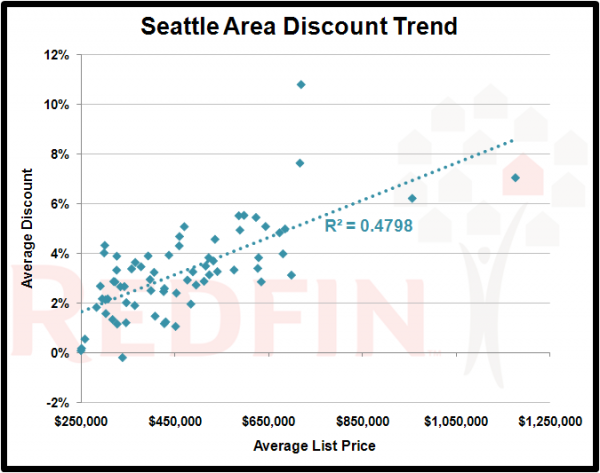
I thought it was quite interesting to see a relatively strong correlation between the average price of a neighborhood and the percent below asking price that homes are closing at.
For anyone that is out there right now making offers (not that I think it’s a great time to buy yet), be aware that the more inexpensive the neighborhood, the less likely a seller is to accept an offer significantly below asking price.
If you’re interested you may download the full data summary here.


The pricier the area the bigger the denial when setting the listing price. We’re special you know.
for the mathematically inclined, an R-squared of .48 is a weak correlation.
but I agree, there appears to be something there. it might be more interesting grouped by neighborhood plotted against average price, or just plotted against neighborhood.
For lower priced areas, the fraction of value that is in the land is smaller. The value of the house itself can be compared to replacement cost and depreciation. The land value is harder to get a handle on, so sellers will likely start out high and work their way down until they find a buyer. That reverse auction process takes time, so houses will be on the market for a long time as they wait for a buyer at each price step down.
Is it the average price of the neighbourhood, or the price of the house itself that really matters here? Are sellers of million dollar homes in poor neighbourhoods just as reluctant to lower their prices as all the other nearby sellers of lower-priced properties?
Investors can probably cash-flow cheaper properties more easily, putting a bottom on the bottom-end, so to speak.
There are many factors about lower priced properties in terms of location and condition. There’s a reason why cheap properties are cheap.
Real Estate is the land plus amenities. View, proximity to shopping or job centers, the size of the lot, what you can build on the lot are some of the factors a property can have. Real Estate is the land value and the value of the land can mean different things to different people. That’s why some schools such as Bryant/Assumption or Saint Joe’s on Capital Hill have a higher imact on home prices. Some people have to live near Green Lake.
One of the main factors about cheap houses is that you can get them paid off to own free and clear. In that way the demand for cheap is greater.
There’s a term in Real Estate of scotch tape and paper clip properties. They are cheap and differently configured from what people normally want. They are held together with scotch tape and paper clips. You can buy them cheap, rent them, pay them off and you own a land based porfolio when you’re done.
Yes the terms can be slum lords, but most people with this strategy end up being very good land lords. They become wealthy rather quickly. These are the people who appreciate good tenants because of the hassle free income once the property is in good shape and “on line.”
“po folks tend to dick around less get right down to it so the asking is "golly" close to what the place is worth.”
:-)
“golly” is what was substituded. “Shucks, I’ll be more careful next time.”
Interesting, Tim now has access to broker level MLS data.