A recent report on the housing market across the country from Global Insight and National City contains some interesting bits that are worth noting:
Extreme overvaluation is now essentially nonexistent. … For the country as a whole, the housing market is slightly undervalued.
…
Only the Pacific Northwest remains overvalued across a wide region.
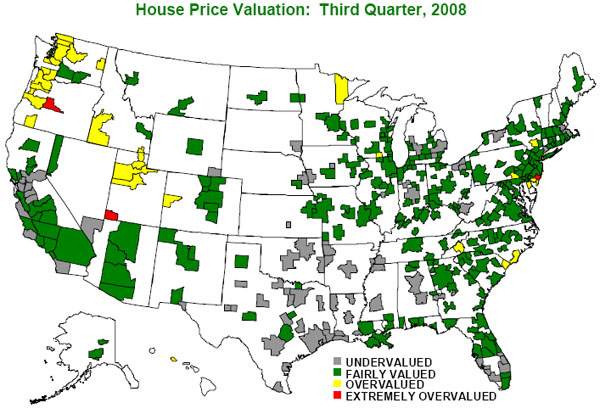
Their analysis is based on population density, mortgage rates, incomes, and a “constant” for each city, that is roughly equivalent to the concept of desirability that we have discussed on these pages numerous times in the past.
Since they are claiming that most of California is already “fairly valued,” I think their analysis tends to lean somewhat in favor of more expensive housing. So while I can’t say I agree with their analysis 100%, I do find it interesting / amusing that the Pacific Northwest now sticks out like a sore thumb in their nationwide analysis.
You can play around with their nifty interactive map, read the full report, or check out the methodology pdf.
Update: Changed the map image above to the one directly from the pdf report, since the National City website is serving up different versions of the interactive map in a seemingly random fashion.


vboring » Dec 4, 2008 at 10:59 am
bad luck for Portland.
TheHulk » Dec 4, 2008 at 11:07 am
If all you bubbleheads were a little concerned about the stupid 4.5% proposal by the Treasury, read
http://calculatedrisk.blogspot.com/2008/12/house-prices-and-interest-rates.html
Its a short, concise and effective shredding of *that* particular argument to buy houses.
vboring » Dec 4, 2008 at 11:14 am
according to the graphic, Seattle has been overpriced since 2002 and should expect prices to fall to about $350k.
at present, our prices are about 2% below those of LA, and about 15% above San Diego. in my industry, those areas pay 10-15% more than here.
patient » Dec 4, 2008 at 11:21 am
Thanks TheHuk, that’s all the proof I needed to confirm that the current treasury is run by lobbyists. This proposal has the NAR and the NAHB stamped all over it.
jon » Dec 4, 2008 at 11:23 am
As CR says, the 4.5% would not work if the intent was to somehow lift prices. But that is not what they need to do. What they need is to stop the deflationary cycle. That cycle will end of its own accord when inventory runs low, but it would be nice if they could stop it sooner. I don’t think they can, especially not if they start subsidizing more new construction. Maybe they can prevent the deflation from overshooting, but I don’t think that is worth another bailout because it just creates a bigger problem later on when we try to pay for it.
Interloper » Dec 4, 2008 at 11:27 am
Well, I think their color chart is useful for showing regional trends, but “fairly valued” is too wide of a band. For example, Phoenix fits in the green “fairly valued” group even though it’s 14.8% over estimated value, and falling fast.
A lot of bubble cities on their map have still not corrected to their “estimated” price.
True, there are a lot of undervalued cities in the US now. Too bad I can’t find a good reason to live in Detroit, Dallas, Cleveland or Houston.
Interloper » Dec 4, 2008 at 11:37 am
This isn’t the only recent report where Seattle sticks out like a sore thumb.
The new Radar Logic report shows Seattle is the leading metro area in the US for 5-year annualized change in price per square foot. (7.1% per year; Philadelphia is 2nd at 5.1%).
http://www.radarlogic.com/research/RPXMonthlyHousingMarketReportforSeptember2008.pdf
It sure doesn’t look like Seattle’s current prices are sustainable.
patient » Dec 4, 2008 at 11:40 am
“True, there are a lot of undervalued cities in the US now.” I agree that there are good values in many places and I think that the government will soon realize that it’s there they should focus the efforts. It’s cheaper to put a bottom on a $100k market than a $500k market. It’s also more likely to succeed which will score political points. Many markets should be close to a bottom anyway so it’s a good time to implement plans for those markets now to be able to show results even if they would have turned by themselves. The bubble cities as Seattle should be left alone since they are still very overinflated and no sustainable and reasonable backstop can really be implemented. Also how do you explain to the people in the midwest on more or less food stamps that you bailout million dollar homes on the coasts? You can’t, it’s political suicide.
EconE » Dec 4, 2008 at 11:52 am
Tim…If you think that Los Angeles is “fairly” priced…I’ll buy you a plane ticket and chauffeur you around down there.
Then you can tell us what you really think.
But if you’re ok with “shopping by stats” then be my guest.
TheHulk » Dec 4, 2008 at 11:54 am
Patient @ 8
The “true value” of an asset (any asset) is what someone payed at the time it exchanged hands. It doesn’t make any sense to bail out anybody (regardless of whether they put down 100K vs. 500K).
The real issue is that housing is returning back to historical norms. Its faster in some places (detroit) than others (seattle) because of differences in the local economies. The main point however is that the regression to mean is inevitable.
Considering the big picture, no (sensible) person is going to buy houses in Seattle (just look at what people payed for the same house around 2001). Thats what people should be paying when all the bleeding stops. Some people might be suckered by their RE agent into buying a *great* deal at 4.5% in the next quarter or so. Let me know how that works out 1 year from now when that person is about 10% underwater.
The Tim » Dec 4, 2008 at 11:54 am
EconE, perhaps I was unclear in the post, so allow me to clarify. I am highly skeptical of their valuation of SoCal as “fairly valued.”
noegruts » Dec 4, 2008 at 11:58 am
Umm Tim, the colors/valuations assigned to many of the Pacfic NW areas in your copy of the map appear to me to be significantly different from the copy on the National City web site you linked to. I hope there is a simple explanation and somebody hasn’t been busy with Photoshop…
Here is a screenshot that I just took of the map from web site you linked to:
http://img165.imageshack.us/my.php?image=ncescreenshotvg2.jpg
The Tim » Dec 4, 2008 at 12:01 pm
“noegruts” @ 12,
Yup, there is a simple explanation. Your screenshot is outdated. I bet your browser is pulling a cached copy of the page or something. Try doing a force-refresh.
Edit: Okay weird. I refreshed a few times myself, and half the time I get the image above while the other half the times I get the one linked @ 12.
patient » Dec 4, 2008 at 12:02 pm
“It doesn’t make any sense to bail out anybody” I fully agree but the pressure to do something is to big so my point was that when you do something you shouldn’t you do it to score political points and I think the $100k market is where it’s possible to succeed and that the politiicans will soon figure this out.
MacAttack » Dec 4, 2008 at 12:04 pm
Yeah, I agree it’s bath time for Portland – the foo-foo districts, anyway. I tried to convince a co-worker not to buy in one of those districts, citing the bubble, but they bought anyway. I’m polite enough not to point it out, but my guess is that they’re under water for the next 6-8 years.
noegruts » Dec 4, 2008 at 12:09 pm
The Tim @ 13
Something isn’t right for sure. I tried it in two browsers and got the same image multiple times. And if I open the PDF report you linked to, I get this graphic, which again is significantly different from the one you are basing this article on:
http://img142.imageshack.us/my.php?image=ncereportscreenshotlo9.jpg
vboring » Dec 4, 2008 at 12:10 pm
re: 4.5% suggestion
it’d work just fine to stabilize prices – if it is offered for both refi and new loans.
otherwise, we still have the ARM wave to deal with.
softwarengineer » Dec 4, 2008 at 12:14 pm
VALUE IS SUBJECTIVE TOO
If I told you three months ago that gas was going down 70% in price in 2009, I’d be laughed off the stage. If I told you that today, you’d nod your head yes.
Same with plasma TVs, laptops, homes, etc…..massive deflation during a bailout economy is uncharted water economically and its size may be much bigger than you first estimated.
January 2009’s Kiplinger’s Personal Finance had a great chart on the history of stock collapses and the rebound size a year later (pg 30). The Worst Years of Our Lives [2008 is rated #2 Worst Down Market Year Historically, Believe It or Not]:
Year Down market Following Year
1931 -43.3% -8.2%
2008 -36.6 N/A
1937 -35.0 -31.1
1974 -26.5 +37.2
1930 -24.9 -43.4
2002 -22.1 +28.7
1973 -14.7 -26.5
2001 -11.9 -22.1
1941 -11.6 +20.3
1957 -10.8 +43.4
Note, The Great Depression’s 1929’s 90% collapse isn’t mentioned, since 6 months later the market mostly recovered, then sank back into the 1930s hole [see chart above].
The Tim » Dec 4, 2008 at 12:15 pm
“noegruts” @ 16,
Okay something is really screwy. I love how neither of the two versions I’m seeing on the website flash tool match the one in the pdf. Because of that, I’ve changed the graphic on the post to reflect the one in the pdf.
SeattleMoose » Dec 4, 2008 at 12:26 pm
This is a whistling past the graveyard report (at least with respect to CA). I keep weekly tabs on the 865 Ft2 condo I owned in CA (Huntington Beach) and sold in 1992 for $172K. It is currently listed at $420K. Only when it gets to about $250K would I consider it a “fair value”.
As for Seattle…we are behind the rest of the country and this chart confirms that our correction is lagging. However the downward trend in prices is now firmly underway and will continue “down” until the 2012 timeframe (+/- year).
deejayoh » Dec 4, 2008 at 1:26 pm
NWMLS numbers are out
King County home prices fall 9.2% in November
The median price of a single-family house in King County fell 9.2 percent in November from the year earlier to $395,000, the Northwest Multiple Listing Service reported today
Scotsman » Dec 4, 2008 at 6:53 pm
Seattle, Portland, and Hood River- the nerdy kids at the back of the bus, always the last to get the joke. Too full of themselves to see the reality around them…
Following the logic of Global Insight/National City, this must be the bottom for most of the country, and a great time yo buy! Pay no atterntion to the fact that National City is a huge mortgage lender and clearly unbiased.
jonness » Dec 4, 2008 at 8:38 pm
I’m glad to see the National City data is out. I was worried they gave up on this project when they went bust. I can update my tools this weekend. :)
I find a lot of value in the Global Insight median price data, because their adjustment to the OFHEO data makes it more accurate. As far as their valuations are concerned, the same parameters are used throughout the country, so the chart has great value when taken as a relative comparison tool.
As for the upcoming low-interest loans, It’s important to keep in mind it was easy-to-get loans that really caused the market to explode. Cheap rates helped, but after building the comparison tool on my website, I was a surprised to learn that rates don’t affect home prices nearly as much as I had supposed.
http://www.housingcorrection.com/medianpricevsmortgagerate/medianpricevsmortgagerate.aspx
IMO, 4.5% rates will create a stimulatory effect but will not fix the problem in Seattle. I predict, for the most part, the low rate will bring out buyers in areas identified on National City’s valuation chart as being undervalued. Places like Seattle will actually see larger drops than in previous quarters.
Why do I believe this about Seattle? It comes down to the historical homeownership ratio. Mortgage rates can go to 0%, but it won’t change the fact that way too many people got loans during the bubble years. Now that banks will only loan to qualified buyers, house prices have to go down to meet the law of supply and demand. House prices cannot stabilize until the homeownership ratio gets back in line with historical levels. Most likely, this means the areas identified on GI’s chart as undervalued will continue their downward trend for some time to come.
jonness » Dec 4, 2008 at 9:02 pm
I think this image might help explain the problem a lot of people have with Global Insight’s valuation method (look at the 0 line):
Valuations
Sniglet » Dec 4, 2008 at 9:10 pm
Whatever stimulus 4.5% rates might cause will be exceedingly short-lived. As I’ve been repeating (again and again), low rates are a sure-fire signal of deflation. Who wants to buy an asset that is depreciating at 5% a year, even for 0% interest?
I have a podcast on the problem with low rates at http://msurkan.podbean.com.
economist » Dec 10, 2008 at 1:32 am
That map is ridiculous. Housing is not fairly valued, never mind undervalued, if buying is more expensive than renting and in most US markets that is still the case. Price/income is also still above historical norms. See recent post on Calculated Risk on this subject.