Posted by: The Tim

Tim Ellis is the founder of Seattle Bubble. His background in engineering and computer / internet technology, a fondness of data-based analysis of problems, and an addiction to spreadsheets all influence his perspective on the Seattle-area real estate market.

63 responses

  1. C’mon Middle Tier… Baby needs a new pair of shoes!

  2. Nice explication of the breakpoint shift, Tim. I suspect that what’s also coming into play to some degree is buyers’ decreasing tendency to opt for the most expensive house they can afford — the people who last year would have splashed down for the high tier are deciding that prudence and restraint are back in fashion, so if they’re buying now they’re buying in the middle tier.

    If I’m right about this, recent buyers of prestigey ~$500K+ condos and townhouses are not in for a happy new year. And speaking of which, best wishes for 2009 to all who post here — grateful thank-yous for the parts you have played in my incremental real-estate enlightenment.

  3. Microsoft layoffs have been cancelled. Their stock finished up again for the second straight day!!

    This is wonderful and welcome news to those looking to buy a new house. This GUARANTEE’S that housing prices will now most likely go up in our area.

    Please contact our local Windermere Office for details.

  4. If #3 *is* a parody, then the extraneous apostrophe is a brilliant touch.

  5. “This GUARANTEE’S that housing prices will now most likely go up in our area.”

    ….and how are you going to honor that guarantee, Eastside Real Estate Agent?
    What happens if you sell a buyer a home and prices are lower a year from now? Are you personally going to buy it back from them at the price they paid?…
    And how can you guarantee something to ” most likely” do something? If prices will “most likely” go up, that’s fine but you can’t guarantee a “most likely”…it’s just an opinion by someone whose business is selling real estate, not exactly a reliable source for unbiased opinions.
    Me, I think it’s “most likely” that home prices will continue downward in the Seattle area over the next year. I won’t “guarantee” that, but I’d be willing to bet lunch on it.

  6. @ 3: “second straight day!!”

    If it was a parody, I believe that would read “second straight day!!1!”, or even “second straight day!!one!” What I find extremely amusing is that someone thinks posting an uber-bullish substanceless advertisement on a bubble site is going to draw in customers. It does serve as a great example of the exuberance that got us into this, though.

  7. Once again, Ira shows wy he’s part of my real estate dream team (e.g. who I’d like to use when I decide to buy). So far it’s Ira for agent and S-Crow for escrow.

  8. Interesting there is not much price compression any more.

  9. “Oh if we’re going to go off-topic and talk about Microsoft, let’s talk about the “mass suicide” of every friggin’ 30GB Zune on the planet.”

    Too many problems with Microsoft products! I’ve switched over to Apple and I’m very pleased with their products!

  10. I don’t need a player bloated with “features” to play my music, or even worse — tell me whether I am allowed to play my music or not — no matter who puts it out. A 32Gb USB drive works just fine.

  11. So you all want layoffs at Microsoft (which isnt going to happen). Bill Gates doesnt fire people for no reason, he has enough money that he can keep as many people as he needs to.

    It is pretty obvious that this website and most people who post here are in favor of the housing market to collapse in Seattle. You all want a 2000 sqft home to cost 180k instead of 350k like it does now. Keeping in mind that more money helps our local economy and keeps big companies and like Microsoft, Costco, Amazon and Boeing stay afloat.

    Do you know what would happen to housing in King and Snohomish counties if Microsoft laid-off 10% of its local workforce. Housing prices would lose a third of their value by the end of 2009 from where they are today.

    Housing prices and Microsoft employment being at the levels they are currently at (and higher) helps the local economy, that generates more tax revenue, which equals more roads, better schools, more people moving here to generate even more tax dollars. Our economy is based on growth, something that you all must have missed at Real Estate College…..especially you Ira.

    As Mayor Nickels implied: We need to buy more housing to stimulate growth in our area, so construction can continue, jobs can be created and more people can emmigrate to our area and continue to buy and spend to create tax revenue and job growth exponentially.

  12. Dear ESREA,

    For the sake of the argument get your facts straight. Steve Ballmer is the CEO of MS not Bill Gates.

  13. “We need to buy more housing to stimulate growth in our area, so construction can continue, jobs can be created and more people can emmigrate to our area and continue to buy and spend to create tax revenue and job growth exponentially.”

    Reminds me of the old anti-drug commercials:

    I need to work harder…so I can buy more drugs…so I can work harder…..

  14. EastsideRealEstateAgent:

    Whether you like it or not, housing prices will continue their decline until they are supported by local wages. Your shilling will do nothing to stop that. Microsoft DOES NOT have that much influence on overall prices, and while the canceling of layoffs will be a good thing for the economy and those workers, it’s not going to stem the decline. The lack of QUALIFIED buyers at today’s prices has everything to do with what’s happening. For someone representing Windermere, your lack of insight is staggering.

  15. Eastside Real Estate Agent,
    I’m not anti growth. But I’m well acquainted with reality. Things don’t go up forever, no matter how much I’d like them to, or no matter how I preach to the contrary.
    I don’t want Microsoft to lay people off.
    But I also don’t see lower house prices as being a bad thing. If house prices were lower, more people could afford houses, and if more people are buying houses, shouldn’t that be good for real estate agents?

  16. What is “Real Estate College”?

  17. Well Ira,

    First, I too am “well acquainted with reality”. However, I am in real-life reality. You and most people on here are in the “I want a big house for next-to-nothing reality.”

    You people here dont care that layoffs at MS would destroy our housing market. I think that is one thing we agree would happen if that MS 10% rumor became true(which it wont).

    Ira, your logic is also flawed. If we have lower housing prices, that means that people havent been buying because the local economy/job market has faltered and therefore nobody can qualify or afford one.

    And as for you LUC, Bill Gates is the founder of Microsoft, and is currently the CHAIRMAN OF MICROSOFT, thats right the “CHAIRMAN OF MICROSOFT”. Ballmer is nothing more than a figurehead. So please get your facts straight before posting(you’ll look smarter in the long-run).

    Finally, I wish you all here and the webmaster of this site could stop inciting a boycott of housing in Puget Sound just because you cant afford one.

  18. That Eastside Realestate Agent is most likely a troll. I rarely post and mostly read here, but I had to respond after seeing this.

    I believe that many Agents to a certain degree think about 70% along these lines however. They wake up in the morning and look themselves in the mirror and delude themselves into thinking its all ‘just temporary’ before they go to work every morning. Just like it was ‘temporary’ in San Diego and Miami.

    Just wondering, has anybody heard anything new about the layoffs at microsoft that our new friend says wont happen. Not any new links to articles. Most of those just rehash mini-microsoft. Perhaps a poster here works there or knows somebody who does.

    My roommate is an A-dash and I thought they would/will be the first ones on the chopping block.

  19. The Tim,

    I agree, after reading his comment about Ballmer only being a figurehead. He’s a troll trying to get a rise out of people.

  20. If he’s for real, this is the best thing since Meshugy. I’m almost rolling in the floor!

  21. I work at Microsoft and haven’t heard anything, but to be honest most people at the company have been on vacation for the last few weeks. From what I’ve seen so far it’s all just rumor, but I have no idea if it will happen or not. I’m also pretty low on the totem pole as an SDET, so I on’t know that I would have heard anything, but I haven’t even heard rumors inside. Everything I’ve seen or heard about the layoffs have all referred back to the Mini-Microsoft posting.

  22. I looked up my old house I purchased in 1996 and sold in 2001 in NC. I purchased it for $60/sqft. Zillow estimates it at $80/sqft now.

    I’m setting my target price for this area around $120-140/sqft. I can scrape the bottom of the barrel for that now in Renton, but I’ll buy when that is a typical price.

  23. A Happy New Year To All!

    Here’s your 2009 survival guide:

    http://www.moneyandmarkets.com/gala-issue-biggest-sea-change-of-our-lifetime-3-28912

  24. The Real Estate College tells you that the price of Real Estate is a constant. The Real Estate you buy today will seem like a bargain twenty years from now.

    Read the Scotsman’s Money and Markets. It outlines clearly that Real Estate is the only thing you can count on in good or bad times.

    People make good purchases of Real Estate every day, if you know what you are doing. People make mistakes, or get swindled, on occasion also, but it depends on the advice you get.

    An investor buddy of mine asked the other day about a property on the market in his neighborhood. He has a great eye and he’s considering a $180K offer. The sellers paid $36K for it in 1987. At even two times the price every seven years the asking price is $270K. Uh Oh, it’s a fixer, Uh Oh.

    So, DJO, I took your advice and made a blog called http://www.FixerFixer.com

    It has all you ever heard or read about the “Investment Grade Real Estate Business.” Real Estate Wholesaling is a fact of the Business. The problem is no one wants to do it.

    Most of the guys I work with pay cash for everything. We are all conspiracy theory, never trust whitey kinds of guys. The advice I give is to be smart, work hard, and buy a deal.

    If you wait for the perfect house that you will grow old in, become a doctor or lawyer. If you work for a living, work towards your dream home, trade up, and follow a plan of action.

    Happy New Year!

    Replyhttp://www.FixerFixer.com \r\n\r\nIt has all you ever heard or read about the \"Investment Grade Real Estate Business.\" Real Estate Wholesaling is a fact of the Business. The problem is no one wants to do it. \r\n\r\nMost of the guys I work with pay cash for everything. We are all conspiracy theory, never trust whitey kinds of guys. The advice I give is to be smart, work hard, and buy a deal. \r\n\r\nIf you wait for the perfect house that you will grow old in, become a doctor or lawyer. If you work for a living, work towards your dream home, trade up, and follow a plan of action.\r\n\r\nHappy New Year!’,'28′); return false;”>Quote
  25. As Mayor Nickels implied…

    Another reason to believe that Eastside Real Estate Agent might be either fictional or simply an inciter…who else would refer to Greg Nickels as if he were a great wise man?

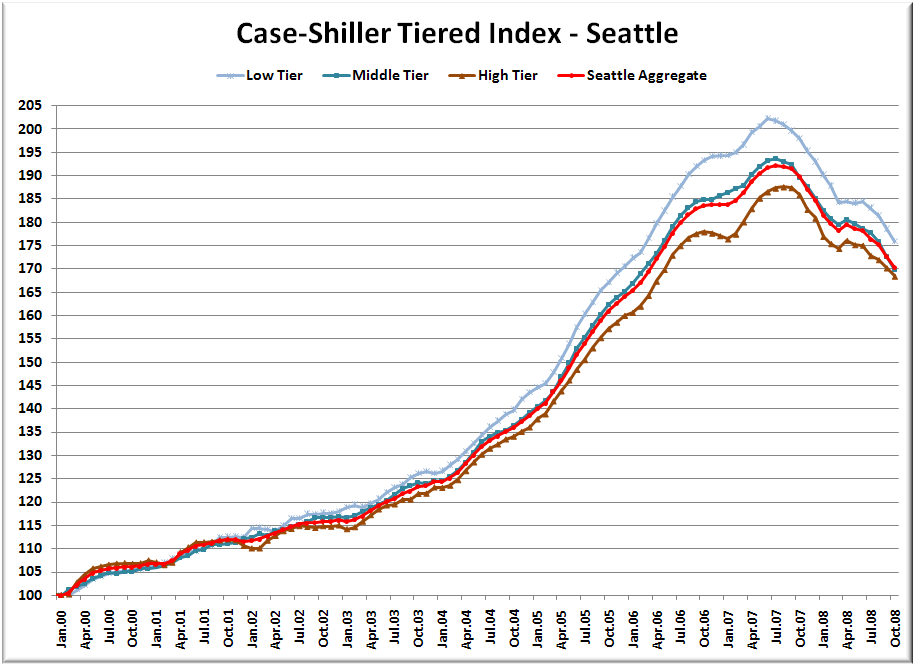
  26. Looking at the first chart, Seattle house price deflation is occuring relatively symetrically from the peak. This pattern is very familiar to anyone who has looked at markets further into the correction than ours. Thus, many expect the symmetry of the upside to be fairly predictive of the downside. If nothing else, the chart demonstrates that house prices are still wildly over valued and have a lot of correcting to do before homes are historically affordable again.

    Right now, we are experiencing deflation, but many predict the massive Govt. spending of the next few years will eventually hit the money supply and create inflation. I’m not saying that will happen, but I wonder what will happen to house prices if it does?

    My main concern is that our upcoming economy is nothing but a bag of hot air. Let’s say Obama spends enough money to create 3 million jobs as he claims. This is not the same as a company with a bright new self-sustaining business model (i.e. profitable). It’s simply borrowing a bunch of money to temporarily employ people to do work that really doesn’t need to be done. IOW, it’s not a real manufacturing base that drives markets. I just can’t for the life of me imagine this to be self-sustaining. Let’s say it actually works and causes people to borrow money again. Aren’t we just getting back into the same game we were playing before the bubble burst, only worse? I can’t shake the image of this bailout being nothing but a temporary bag of fluff. People saying spending a lot of money to create jobs brought us out of the Great Depression, but nobody seems to be accounting for the decade+ years of massive deflation that occured prior to the spending. Thus, prices were historically undervalued before all that spending started. I think people are comparing apples to oranges.

    I appreciate any comments on what you guys think about the long-term self-sustaining nature of the upcoming stimulus plan. Or for that matter comments of why it won’t work.

    Thanks :)

  27. “If house prices were lower, more people could afford houses, and if more people are buying houses, shouldn’t that be good for real estate agents?”

    Lowering the price on existing houses doesn’t create more housing. The only way more people can afford houses is if they build more less expensive houses. House building has slowed to a crawl at the current price level, and lower prices will only make it even slower. Builders would build less expensive, smaller houses if that is what people would buy. But people are now only bottom fishing now for instances where someone, or someone’s estate, needs to sell in a hurry. Right now it is a game of chicken between buyers and sellers watching the price fall while they wait for the inevitable turnaround. Net migration into Washington was still strong up through November, and inventory is about the same as a year ago. There will be some former WaMu employees selling, but that is less than one month of in-migration.

  28. “Lowering the price on existing houses doesn’t create more housing. The only way more people can afford houses is if they build more less expensive houses.”

    It would be nice if things always worked that logically. For quite a while in Seattle, sales were slowing, inventory was growing, and prices were rising. It didn’t make sense and ultimately wasn’t sustainable, but that lasted far longer than i thought it would. It’s kind of a vicious cycle. Builders won’t build until sales increase, and sales won’t increase until prices get lowered…

  29. Deflation has a downward effect on prices, but the low interest rates that accompany deflation have an upward effect on prices.

    Inflation has an upward effect on prices, but the high interest rates the accompany inflation have a downward effect on prices.

    The house I referenced above can be finianced today for 30 years at about the same monthly payment I had in 1996, even though the sales price is about 30% higher.

  30. From http://www.moneyandmarkets.com/gala-issue-biggest-sea-change-of-our-lifetime-3-28912

    From peaks reached just a few months ago to the latest bottoms, the price of oil has plunged 73% … copper has fallen 66% … lead and nickel are down 73% … platinum is down 66% … and wheat is off 64%.

    Housing isn’t as liquid as all of those assets. It doesn’t correct as quickly, but maybe housing is going to be 60-70% off too.

  31. The source of the Zune failure is described here:

    http://www.zuneboards.com/forums/zune-news/38143-cause-zune-30-leapyear-problem-isolated.html

    Basically, some of the code MS licensed from Freescale (a Motorola spinoff) had a bug which will cause the 30 gb Zunes to freeze on January 1st every 4 years. From what I’ve read, they should be fine the next day. People with warrantees are taking the Zunes back to Best Buy and such to use the hang as an excuse for an upgrade)

    This isn’t a MS defending post – just a public service announcement for anyone else with Zunes. ;)

  32. If I draw a “straight line” during the first couple years of the first graph until now, you’d get down to the 140 mark or so. Of course things that over-shoot on the way up, tend to on the way down too (see stock market, oil). But everywhere else is already back to 2004 prices (if I read my national pricing correctly), so we’ll be there too, right?

    I think 60-70% off is a tad unrealistic, unless we are unsuccessful at stemming the worst damage from the recession and get the “next Depression”. Another 10-20% drop? Or further – back to 2003 prices before things turn around?

    I’m sure synthetik or softwareengineer will chime in to say we’ve reached peak of success for humanity and it will be a long ugly slide into irrelevance, war, famine and madness from here on out. But they’re the same doom-sayers that have been wrong after every recession, war and the Depression, so you’ll excuse me if I ignore them.

  33. The wild card in the home price decline is what the government may do to try to stabilize home prices.

    Personally I don’t believe they should do anything. It was low interest rates and lax lending standards that built the bubble in the first place. Now the government is trying to get interest rates to 4.5% or less and there’s talk of possibly offering tax incentives to entice people to buy in 2009.

    Money is being printed like never before to try to keep the country from going into a depression but if that’s avoided there’s the risk of hyper inflation. Imagine the bubble that would be built in this environment if lending standards were still lax!

    If not for the government action, I think it would be easy to say that prices would return to pre-bubble levels, 2002 – 2003.

  34. Money is being printed like never before to try to keep the country from going into a depression

    Actually, very little money is being “printed”. Most of the stimulus is being created by increased government borrowing, which actually just sucks money out of the broader economy.

    If massive stimulus spending by the Japanese government over the last 20 years (they are spending something like 180% of GDP each year right now) hasn’t prevented deflation I don’t see how such spending will lead to different results in the US. Unfortunately, there is NOTHING the governments can do to prevent the severe deflation up ahead (and corresponding depression).

    Check out my blog (http://www.surkan.com) for more details on the case for deflation.

  35. Jon posted:

    “The only way more people can afford houses is if they build more less expensive houses. House building has slowed to a crawl at the current price level, and lower prices will only make it even slower. Builders would build less expensive, smaller houses if that is what people would buy.”

    You’re missing an important point, Jon. The main reason builders were building more and more expensive homes was because they overpaid for raw land. They had to recoup that money, so they built more expensive homes on smaller parcels. Townhomes and such were marketed as if they were what people were looking for, but in reality they were built due to high land prices since builders could really cram them together, garnering more $ per acre. What people really want is a smaller house with a decent sized piece of earth, something builders could not afford to provide given the land bubble.

  36. Sniglet:

    Sustained deflation is rare, but once it gets started, it is very difficult to get rid of. If we do experience it, we should not see levels creep above 1.5 percent per year. Such, low-level deflation has been a drag on the Japanese economy, but it has not been apocolyptic. Thus, it’s totally possible that the U.S. gets stuck in sustained deflation but continues to operate quasi-normally (reduced standard of living via the welfare effect).

    Doing nothing to fight deflation leads to a liquidity trap where even strong businesses go under. The Japan model shows that deflation cannot be stopped until the banks become recapitalized. Thus, the U.S. government’s emphasis on recapitalizing greedy evil bankers and paying incompetent CEO’s massive bonuses via tax dollars.

    Reaching zero interest rates disarms the central bank’s most powerful weapon. Thus, quantitative easing gets used in order to maintain faux-negative interest rates. Many people believe the U.S. goverment’s use of quantitative easing will cause runaway inflation. However, the massive quantitative easing used by Japan’s government had no disernable effect on deflation. Thus, once interest rates hit zero, the central bank’s remaining tools can be thought of as largely ineffective except where recapitalization of banks is concerned.

    IOW, the way to turn around the situation is to force banks to write off the bad loans, recapitalize the banks, and institute responsible lending standards. Until then, monetary policy will continue to have a minimal effect on deflation.

    Are you in agreement with this?

    If so, what do you feel the effects of the U.S. massively outspending Japan would be as far as recapitalization of banks, quantitative easing, etc. are concerned?

    Thanks :)

  37. I think 60-70% off is a tad unrealistic, unless we are unsuccessful at stemming the worst damage from the recession and get the “next Depression”. Another 10-20% drop? Or further – back to 2003 prices before things turn around?

    I agree that it seems unrealistic, but I might have said the same thing about oil, , copper, lead, nickel, platinum and wheat a year ago. Why is housing more special than those assets? Is there any reason housing cannot follow the same pattern?

  38. “Is there any reason housing cannot follow the same pattern?”

    Commodities are less labor intensive than housing, and salaries have not fallen that much, and will be more sticky because of multi-year contracts and the demotivation that occurs when someone’s salary is cut. If there is a widespread pressure for wage cuts, I think the government would flat out print money. So far the stimulus has largely been sterilized by other borrowing, which as sniglet says takes away from other investment. The proposal by California to start paying people in IOUs would be an example of what might happen.

    So to the extent that salaries stay stable, the value of land that is close to job centers will remain stable once the effect of bubble pricing has passed. The fraction of the price of a house that is in raw material costs is pretty small in comparison to both land and labor. Short term some people will have to dump their house on the market, but that hasn’t been too severe in Seattle yet.

    Tim, here is an idea for a new graph: Like the chart that plots the drop in price from peak for different cities, but have the y axis be the year/month that the price has rolled back to in that city. It would be interesting to see how the fall in price compares to the increases leading up to the peak.

  39. So what does it take to flunk-out of “Real Estate College”, given the caliber of graduates?

  40. “I think 60-70% off is a tad unrealistic, unless we are unsuccessful at stemming the worst damage from the recession and get the “next Depression”.”

    Alan posted:

    “I agree that it seems unrealistic, but I might have said the same thing about oil, , copper, lead, nickel, platinum and wheat a year ago. Why is housing more special than those assets? Is there any reason housing cannot follow the same pattern?”

    Alan makes a great point in comparing housing to commodities. In fact, I’m more stunned by how quickly the oil bubble burst than I would be by a 70% drop in house prices. Why can’t housing prices fall 70%? I happen to believe certain houses will.

  41. a little off topic but….

    Trustee Deeds issued in King County

    for 2007: 821
    for 2008: 2098

    With the slowing level of sales, such an increase in foreclosed properties doesn’t speak well for housing in 2009

  42. Hi Dr. Short,

    Is the 2098 figure for the entire year?

    Thanks.

  43. That’s what I got from looking at the King County website for 1/1/08 – 12/31/08.

  44. “I’m more stunned by how quickly the oil bubble burst than I would be by a 70% drop in house prices. Why can’t housing prices fall 70%? I happen to believe certain houses will.”

    Oil is a product where there is continuous consumption and a wide range of costs of production. When demand falls, the first thing that happens is expensive sources, such as oil shale, just shut down because their margin is too small. As the prices falls, sources that need revenue for preserving their place in government will increase their supply, further driving down prices.

    In housing on the other hand, consumption in new housing can stop because people just double up with parents or roommates. That means that only desperate sellers on the market. So the price will swing down temporarily until population growth increases crowding until people won’t put up with it any more and will buy into a falling market, figuring the bottom is close enough and they don’t want to miss out on a great deal.

    The areas with the 50% off peaks are the retirement areas. But with the drop in the stock and housing markets, there will be a big delay in boomer retirements, so those sunny locations will stay down for a while. Job centers like Seattle will recover sooner than the sand belt. The longer that Washington construction levels stay below in-migration levels, the faster will be the recovery prices to the level of cost of production.

  45. From the article referenced above:

    Jack: Martin, all this raises some urgent questions in my mind and probably in the minds of our readers as well. First, can the government offset this massive destruction of wealth with more bailouts, more Fed actions and gigantic economic stimulus packages?

    Martin:
    They can buy some time or they can slow down the process temporarily, as they did in the second quarter of 2008, for example. But still, my answer is a flat NO! Not even Washington can print enough money fast enough to halt this deflationary spiral; it’s just too huge. And all the printing press money in the world won’t do much if it’s not lent or spent.

    Bottom line: No matter which companies Washington bails out, this is a house of cards. It’s coming down. And you must get out if its way.

    Jack: Still, a lot of people have big expectations for President-elect Obama’s stimulus package starting next year.

    Martin:
    The highest estimates for the Obama stimulus package are $1 trillion. But even if it’s that big, it’s still small in contrast to the wealth destruction we’re already seeing. And it’s going to take a couple of years before all of that money reaches Americans. By that time, trillions more in wealth could be lost.

    Jack: Every economist I read likes to leave some wiggle room for future butt-covering, just in case they turn out to be wrong. But you’re not pulling any punches, are you? Why is that?

    Martin:
    It’s not needed in this situation — because of the sheer enormity and speed of the wealth destruction: $7.7 trillion just through over the past year. In contrast, the Trouble Asset Relief Program (TARP) is $700 billion. So these losses are already 11 times more than the entire bailout program.

  46. The goal of the bailout is not to restore all the “lost” wealth, it is just to stop the deflationary cycle. Unlike Europe and Japan, this country is growing, and so even with no bailout, population pressure will eventually restore prices to the level of new construction and then construction industry will restart. Taking advantage of low raw material costs and available skilled labor does make sense for doing infrastructure work now as Obama proposes. Keeping that spending from getting out of hand will be the hard part.

  47. Jon, I think the point is that by the end of 2009 we will have witnessed the destruction of perhaps $20 trillion in wealth, a very significant percentage of the total U.S. net worth. That money is gone, never to be spent or invested, out of circulation for ever. The effect on investment and consumer spending will be devastating. And while you’re right that population increases can drive economic growth over time, the reality is that people have fewer children during hard times, and immigration also drops off.

    People are understandably having a hard time getting their minds around the idea that this coming depression will be much deeper and longer than they can imagine. I find this to be especially true of those under 35 who have known nothing but inflation and boom times their entire lives. My suggestion is to ignore historic trends and recent past cycles, and focus instead on the structural limitations of the economy. We’re headed down a new road, never seen before. Start any analysis with a clean sheet of paper and the discipline to stay focused on reality, not wishful thinking.

  48. The $20 trillion figure is funny money. It took me a long time to come to the realization that all the statistics are based on a ten year trend. From 1998 to 2008 we had the grandest escalation of world wide wealth in any history. If we wipe out ten years of exorbitant global growth we will still be dollars ahead.

    My point for years has been muddied by the hysteria of a financial crash that was sure to come. The point is that global economics is a fact of life. Communist China, and Russia are a part of the international financial markets. How bizarre is that? They’re Communists talking about stock prices.

    Globally we are a united world today in economic crisis. The landscape has changed, but the principles are the same. We eat, sleep, breath, and poop. We have a problem, we fix it.

    To be real clear, let’s just take financing out of this equation. Do we really need to finance anything? The banking system was set up so we could carry less. We had paper instead of gold. Should we let the trading of paper take a front seat to feeding people?

    The Obama plan is to put people to work in a time of deflation. If he sticks to the plan it works. If we give money to bankers, and global investment trusts, it falls apart. Giving financial engineers more money to play with is wrong. Making profit by creating debt is wrong. The cost of goods should be tied to a tangiblble ability to pay.

    That’s economics that has been in place since the beginning of time and in the short one hundred years of globalization got lost.

  49. “Do we really need to finance anything? ”

    Unless you plan on having people living in cardboard boxes, yes. Even renting is a form of financing, one in which the financial risk and reward accrue to the lender, but you get to live in the place even though you did not buy it outright. Traditional borrowing to own worked up until it was taken advantage of by fraudsters at WaMu, FM’s and elsewhere. It will continue as before at the banks that were prudent during the bubble.

    For all the crying about lost trillions, unemployment is still way below what it was in the early 80s. It could get worse, or the recovery could start tomorrow, now that mutual funds can send out statements showing they were safely in Treasuries at the end of the year. Nobody really knows.

  50. In 1995 the stock market was at 4500. It makes sense that the stock market today could be as high as 6000. 14000? Please.

    Many of the companies that drove the stock market were tech stocks, some other are companies that most benefitted by technology. I would compare it to the great deppression in terms of the end of the Industrial Revolution, we are at the tail end of the tech revolution.

    It’s hard to see paper profit for what it is; paper.

    So let’s burst the Stock Market Bubble first, then address housing. Housing is where we sleep. Panic if you must, but there are places in the global economy where people are starving to death. Those people are going to want some action that requires tangible goods.

    The financially engineered market place did it’s job and let’s let it die with dignity.

  51. Jon posted:

    “In housing on the other hand, consumption in new housing can stop because people just double up with parents or roommates. That means that only desperate sellers on the market. So the price will swing down temporarily until population growth increases crowding until people won’t put up with it any more and will buy into a falling market, figuring the bottom is close enough and they don’t want to miss out on a great deal.”

    No, Jon. Price will go down until “INCOMES” support prices, nothing else. The reason for the lack of transactions has nothing to do with people choosing not to buy. It’s a lack of QUALIFIED buyers. Once the phony baloney loans went away, so did the market.

    Further:

    “The areas with the 50% off peaks are the retirement areas.”

    BS. Modesto, Stockton, Merced- those aren’t retirement areas.

    “Job centers like Seattle will recover sooner than the sand belt. The longer that Washington construction levels stay below in-migration levels, the faster will be the recovery prices to the level of cost of production.”

    You need to take off the rose-colored glasses and realize there is absolutely no difference between the bust in the SF bay area, LA, and Seattle other than timing. Many of the markets in CA are major “job centers”. Your “Seattle is special” arguments are nothing more than wishful thinking. Furthermore, I’d like to know how you are coming up with your “Washington construction levels stay below in-migration levels”. Methinks you have no basis for that statement. There is an OVERSUPPLY of homes on the market. Nuff said.

  52. “No, Jon. Price will go down until “INCOMES” support prices, nothing else.”

    What’s more, in a deflationary cycle, incomes go down. So the case we currently have is house prices must go down to match incomes, but incomes are simultaneously headed down (the State 2-year salary freeze for example). Thus, even when houses come down to levels we now think will be realistic, they could continue to track wages down. It’s a feeding cycle that’s very difficult to stop.

    IMO, the only way to stop it is to make the banks healthy again. I believe the deflationists will argue that all good, except for the fact that nobody currently possesses the tools to make the banks healthy again. Thus, it is impossible to stop the deflationary cycle until it runs its course.

    Personally, I’m uncertain what will happen. I find it all very interesting, and I’m reluctant to part with cold hard cash until I see evidence of a broken deflationary cycle.

  53. Comment 38
    Actually, very little money is being “printed”. Most of the stimulus is being created by increased government borrowing, which actually just sucks money out of the broader economy.

    Comment 56
    IMO, the only way to stop it is to make the banks healthy again.

    Both are relying on borrowing today to pay the debt with “future” dollars.

    Here’s the real question: do things cost so much because we finance everything or do we finance everything because things cost so much?

    Does a house cost $500K because we finance it or do we we finance it because it costs $500K? IMHO we pay $500K to prop up a unsustainable financial market that pushed the price of eveything to the point it had to be financed in order to get it.

    This is much different than inflation. Inflation has cause. Scarcity is a cause for inflation. Oil could have been scarce until we saw that was a lie. Housing could have been scarce, but that was a lie. How do we have so much price reduction in commodiites, housing, and the stock market all at the same time?

    The lie of our need to Finance.

  54. Meanwhile, at least one source claims that the Microsoft layoffs are real, and will reach 17% of their workforce.

  55. “How do we have so much price reduction in commodiites, housing, and the stock market all at the same time?

    The lie of our need to Finance.”

    Little has changed since the market was going up. It’s still a game of paper where investors are attempting to maximize their profits. The direction of the market is meaningless. It’s price movement that matters. With illiquid banks, there is not as much money to bet, thus profits are reduced. But credit/leverage is still alive in the market place.

    To professional investors, this is simply a board game where you bet right and you win; you bet wrong and the government bails you out.

    As for mom and pop Jones, they are acting as any sensible person does in a deflationary environment–waiting to buy assets until the prices hit the bottom. Unfortunately, amidst long term low level deflation, people understand that prices will always be cheaper in the future, so they never buy. Thus, the cost that mom and pop pay along the way is much steeper than the final dollar amount they pay when the asset reaches bottom, especially if they bet the farm on the wrong direction at the outset of the downward trend.

    Certainly a society can survive and even flourish in a cashless system based upon the exchange of goods and services, but a credit-driven society cannot transform intto a cashless barter-based society without taking massive casualties in its wake. Thus, seeking justice through “correction” is a dream that destroys many good people in its wake and can only be embraced by turning a blind eye to the damage.

  56. Inventory is shrinking. If you look at the SFHs for sale at this time last year it was 8,600 v 8200 this year. That’s only 5%, but it’s worth noting, and could possibly be due to:

    1. The fact that many people are waiting until after the snow to re-list

    2. Fannie said they would hold off on foreclosures in Dec. until Jan (thus these listings will be delayed another month)

    3. People took advantage of a 4% refi even if they had to take on PMI and decided they didn’t have to sell. (PMI is now tax deductible. I had some friends do this.)

    4. What’s left out there is crap- not a lot of new listings-just the old stuff with issues. Nice stuff is getting snapped up quick. i.e. we may be leveling off???

    Curious to hear your thoughts.

  57. Inventory is shrinking. If you look at the SFHs for sale at this time last year it was 8,600 v 8200 this year. That’s only 5%, but it’s worth noting, and could possibly be due to:

    Curious to hear your thoughts.

    I think you are guilty of bad math, or wishful thinking as inventory does not appear to be shrinking on an apples to apples basis. Compariing the lowest points on 1/1 of sources 2 & 3 on Tim’s reader (only ones that have 2008 and 2009 data), we have

    Source 2 = +3.8%
    2008: 8921
    2009: 9265

    Source 3 = +6.8
    2008: 8058
    2009: 8613

    So the growth is flattening but I think you are comparing apples and oranges. Sales are not driving this, they are still extremely low (if not at all time lows). People are perhaps giving up. I agree most of what is out there is crap.

  58. This is a graph of 2007 and 2008 KC SFH from Tim’s log.

    http://img155.imageshack.us/my.php?image=kcsfhyoyip8.jpg

    2007 turned bad in July and instead of the normal downward trend for the rest of the year, inventory peaked in late September. In 2008, things didn’t get substantially worse. For the first half of the year we saw 40% plus increases in inventory, then when we hit the period where things when bad those YOY increases virtually vanished. We still have more inventory in 2008

    According to the graph, inventory in 2009 is currently lower than it was in 2008 (we don’t have 2007 data for January), but this is due to a new data feed that seems to be reporting lower numbers in general than the old data feed (that disappeared).

    I predict 2009 KC SFH inventory is not going to be much different from 2008.

  59. Never said 07 v 08, just said prior year.

Leave a Reply

Do you want a nifty avatar picture next to your name, instead of a photograph of Tim's dog? Just sign up with Gravatar, and make sure to use the same email address in the form below. It's that easy!

Sponsors


Seattle Real Estate :: Brent Fosso

Sponsors

  • Home Improvement Forums
  • East Bellevue Real Estate
  • For Sale By Owner
  • Home Builders

Tip Jar

Archives

Performance Optimization WordPress Plugins by W3 EDGE