Posted by: The Tim

Tim Ellis is the founder of Seattle Bubble. His background in engineering and computer / internet technology, a fondness of data-based analysis of problems, and an addiction to spreadsheets all influence his perspective on the Seattle-area real estate market.

128 responses

  1. 0.8021721 0.7952183 0.7609252

    The first number is the percentage of C-S’s January figure to the peak of July, 2007. The second is the percentage of NWMLS’s January median to the peak of July, 2007. And the final number is the percentage of NWMLS’s January mean to the July, 2007 peak.

    Since the peak in July, 2007, the C-S numbers have only shown larger drops than the NWMLS mean 3 times.

    Finally, I’ll note that part of the difference is due to C-S covering a larger area.

  2. Tim,

    I wonder if the B-school & Dr. Downing (Ph.D from Yale) had any pull in getting Shiller to SPU. I’m going to try to attend.

  3. RE: Kary L. Krismer @ 2 – That should have read greater drops than the NWMLS median only 3 times.

  4. The National Association of Realtors would like to remind you that every market is different!

  5. The National Association of Realtors would like to remind you that now is a great time to buy!

  6. Interesting DB study cited here: http://zerohedge.blogspot.com/2009/03/47-more-price-declines-for-ny-real.html – says Seattle has 23% more to drop from 4Q 2008 prices.

  7. Question for the SB crew,

    Wife and I are looking in Gig Harbor (as I have indicated many times)
    We are looking for a 3500-4500 sq foot home with a water view
    Recent water view sales here have been $529K (4500sq ft, circa 2007, 4BR); $600k (4744sq ft 2005, 4BR)
    But yet, people are still listing newly built (2005-2009) comps as $899K – 1.3MM. They think this is still the peak!
    Considering that the latter is “THE MARKET”, why are these people + banks that own a great deal of the properties, not marking the inventory down in droves (that we would expect from the figures Tim has indicated)
    Also, can someone explain how much it would cost to build a home?
    I’m getting rather tired of waiting, and figure that I can hire labor cheap ($80-120 sq foot)
    Why would I screw myself by buying; I might as well buy a nice acre for $50K (or less) and build the "golly" thing
    Would love some feedback, I’m finally getting more frustrated with this market (primarily because I’d like to buy, but want a fair price). I would hate to lose $150K in equity, my entire cash downpayment, as the market settles
    Gig Harbor is very overpriced…

  8. http://seattletimes.nwsource.com/html/businesstechnology/2008954441_webcaseshiller31.html

    More creative wording by the Times. Home prices SLIP here, but PLUNGE elsewhere. See, we’re not as bad as everyone else!

    ……..yet.

  9. RE: Dave @ 6

    Hahahahahaha; I especially love the fact they have that Laura Bush (on the TV commercial) look alike acting like a Realtor.

    Remember, only Realtooors are members of the National Association of Realtoooors…lol!

  10. I am beginning to think Seattle is following a trend similar to the national trend? Strange!? Further observation, since we seem to be following, rather than leading the trend, it also seems that we could have predicted where we are right now! Someone dropped the ball.

    My landlord is offering a discount if I agree to stay another year. I am climbing up on the fence for another year.

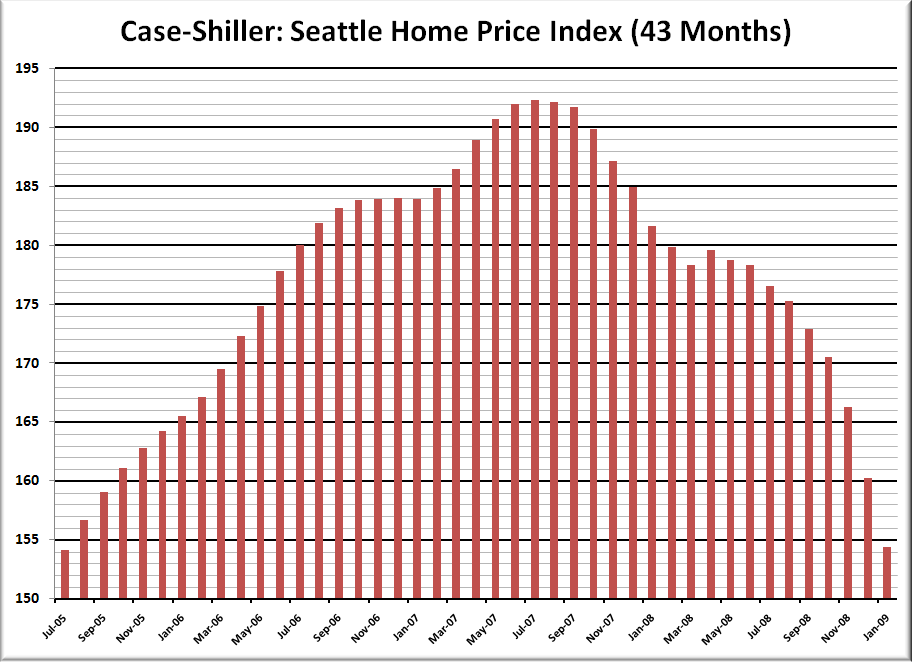
  11. Did you guys notice how the mountain in the “rewind chart” is getting off-center, bent to the right? That means prices are coming down faster than they went up.

  12. RE: David McManus @ 9
    I’m glad they repeated that about 20 times just to make sure we got the message. I know I shouldn’t be, but I’m a little surprised what passes for journalism these days.

    In other news, my rent is going down from $1270 to $950 if I renew my lease.

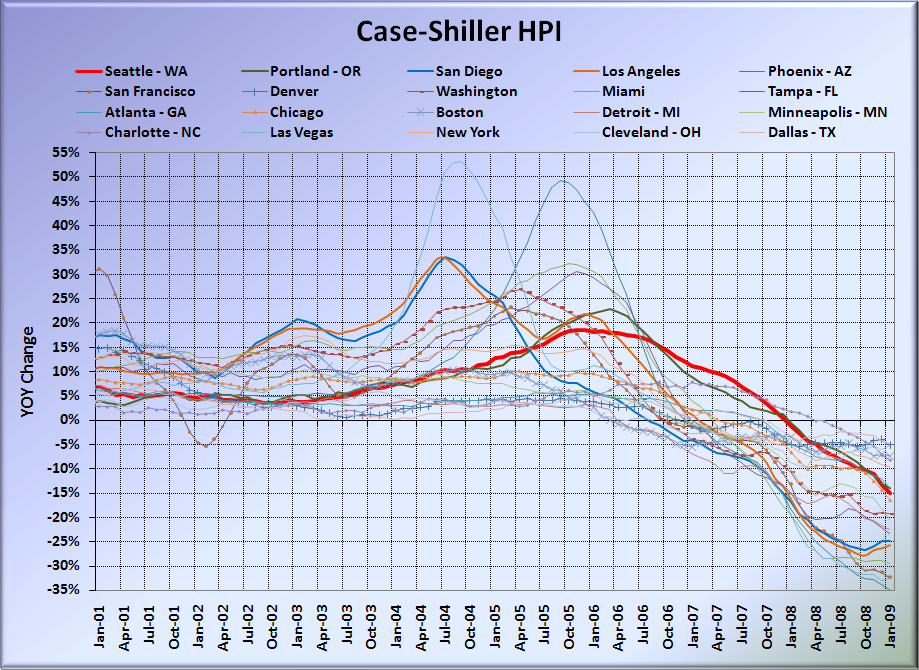
  13. It’s amazing how all those cities are still in a free fall even after 40% declines. And Seattle is just following along their paths. There aren’t even any false bottoms to tease us. Just down, down, down.

    There is a major, structural correction (or collapse) going on in the housing market. It amazes me how some can select 5 zip codes and look at 2 weeks worth of pending data and say “we’ve hit bottom.” The forces in play impacting housing prices are bigger than that.

  14. Phew… good thing I live in Pullman. I’ve been told that our market is special, so we won’t see the home price declines experienced on the West Side. What is that you said? Our dominant employer, Washington State University is facing massive budget cuts, layoffs and reduced enrollment? That won’t impact the housing market, will it?

  15. Who want to buy a home when Seattle is falling at a 15% yoy rate! at that rate you’ll lost your down payment in no time!

    but hey, now is ALWAYS a great time to buy! real estate only goes up except when it doesn’t! at the very top it’s a buy and at 5% off the peak real estate is the greatest buy every. same thing withe 10%, 15% and 20%.

  16. By drshort @ 16:

    It’s amazing how all those cities are still in a free fall even after 40% declines. And Seattle is just following along their paths. There aren’t even any false bottoms to tease us. Just down, down, down.

    What is truly amazing to me is how many sellers still refuse to drop their asking prices, or decide to “rent it out for a year, until things turn around.” At this point, how could you NOT see where things are going? …Particularly since we have already seen how this movie ends by watching other markets tank.

  17. why are these people + banks that own a great deal of the properties, not marking the inventory down in droves (that we would expect from the figures Tim has indicated)

    I suspect the primary reason many sellers aren’t lowering their prices to current market prices is because they can’t afford to. For example, many individual home-owners have mortgages that are greater than the current value of the home. These sellers either need to get a “high” price that allows them to pay off the mortgage, or they will wind up going into foreclosure.

    Banks are in the same boat. A great many lenders are in such shaky financial shape that if they sold the foreclosed home they own at market price they would have to recognize such massive losses on their books that they would be technically insolvent. Thus, it is preferable for many lenders to just sit on a foreclosed property and keep an artificially high value for the place rather than take a loss by selling, and falling under capital reserve ratio laws, leading to insolvency.

    In short: when your only choice is to sell for the current market price and go bust, or hang on hoping for unrealistic prices and delay the inevitable, many people (be they banks or individual home-owners) will opt to just wait.

  18. RE: David McManus @ 9

    Yeah, this headline is a joke. The Seattle price index has fallen 7% in just two months vs. just 5% for the 10-and-20 city indexes, yet the Times is telling us Seattle’s not “plunging.” It is.

    They should save booster-ism for the Sports page.

  19. By Groundhogday @ 19:

    By drshort @ 16:
    It’s amazing how all those cities are still in a free fall even after 40% declines. And Seattle is just following along their paths. There aren’t even any false bottoms to tease us. Just down, down, down.

    What is truly amazing to me is how many sellers still refuse to drop their asking prices, or decide to “rent it out for a year, until things turn around.” At this point, how could you NOT see where things are going? …Particularly since we have already seen how this movie ends by watching other markets tank.

    And this is exactly why our sales volume is just a trickly of what can be considered normal. With listing prices still at 2007 levels noone will enter the market. People know times are tough in general and especially in the housing market. Until you see the average listing prices keeping up with the decline. i.e getting to 20% off peak or 25% off next month and 30% off peak this summer and so on volume will remain anemic which will drive prices down even faster. It’s the greatest time in history to wait with buying.

  20. Tim,

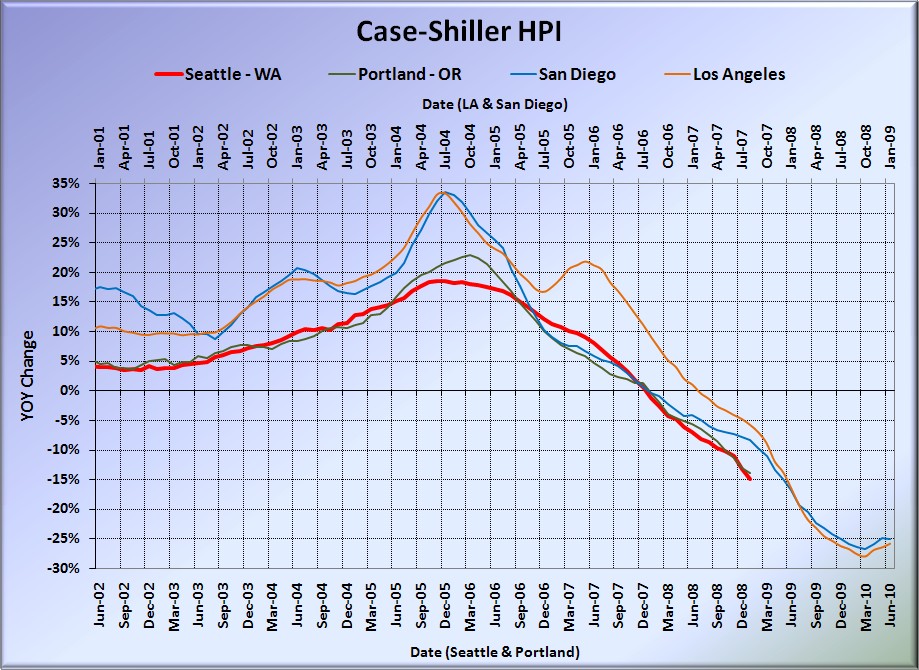
    Looks like someone hit fast-forward on the rewind chart! I think we can safely remove bottom calling method that you based on the beautiful symmetry that the chart used to have.

    Does the CS data include the actual data points used? If so, it would be interesting to see how the time between sales of the same property have fluctuated over time, and also info on $/sqft over time.

  21. Tim: Try to get in interview with Shiller!

    It would certainly be newsworthy to have him interpret what his own index says for Seattle!

  22. Money magazine predicts that Seattle prices will fall 4.8% in 2009.
    So with 3.6% down in January we only have another 1.2% to go. Yeah that seems likely, not. Where do these guys get their info from, the NAR? Either that or they are throwing darts blind folded.

    http://money.cnn.com/magazines/moneymag/moneymag_realestate/2009/index.html

  23. good that i just renewed my lease for another 12 months last week… it seems I still won’t miss the train…

  24. Tim, it’s interesting that you highlighted Boston as special. There was a report I heard last week about a couple looking to buy a home in Boston. Basically, the report said that the couple was not able to get a nice house in a good area because the only people selling homes in Boston were those that had to sell. So, the couple was left with choosing poor quality houses in bad neighborhoods (mostly foreclosures and short sales) or buying a nice house in a good neighborhood for more than they thought they should be paying. This effect was described as a ’sticky’ market, not a declining market.

    Interestingly enough, Case, from Case-Shiller was interviewed and said that in places like Boston, Seattle, and Portland this was the case. From that interview, I gathered that Mr. Case believes that Seattle is special (probably because of the fact that our decline started about a year late).

    Now, I am certainly no RE cheerleader, I am a humble renter like many on this blog pondering the opportunity of finally buying a home at a reasonable price. However, my biggest questions is, when do the prices in Seattle ‘unstick?’ When do you think that we will be able to buy a nice home in a nice neighborhood, not a foreclosure, or a rare ‘gem’ as Ray would say, in Seattle for market value?

    I’m not really looking for a timing of the market here, just what you think is likely in the years to come. For example, will it take a bottoming out of the market, and house price stabilization before this happens, or will it happen sooner?

  25. RE: The Tim @ 1 – That’s (2) 3.6% month over month declines in a row. It doesn’t look like we’re going to have too much trouble in logging another 20% down total from where we are now. It also doesn’t seem to me that the gov’t programs are going to do enough in a short enough time frame to slow this train down. Too many credit difficulties on all fronts for the banks to remain profitable, let alone solvent.

    I know there are many finance/statistic genius types out there. You can skip over this next part as it’s pretty simple. But these numbers were run to get a sense of relationship between declining prices and potentially increasing loan rates. A loan amount is shown with a monthy payment and interest rate based on 30 year fixed and no points.

    $500k: 5%: $2684 6%: $2997 7%: $3326 8%: $3668
    $450k: 5%: $2415 6%: $2697 7%: $2993 8%: $3301
    $400k: 5%: $2147 6%: $2398 7%: $2661 8%: $2935
    $350k: 5%: $1878 6%: $2098 7%: $2328 8%: $2568
    $300k: 5%: $1610 6%: $1798 7%: $1995 8%: $2201

    So for me, this says wait on the side for a while longer. If prices drop another +/- 20% — say from $500k down to $400k loan amount — then the monthy payment would still be less than if in the same time period the interest rates went up to 7%.

    There is a relationship that is not quite exact, but it amounts to:
    For every 1% increase in interest rates, the loan principle value must come decrease 10% to keep the monthly payment the same. Of course as Tim pointed out in his interview, it’s easier (though not a given) to renegotiate a lower interest rate in the future than to bring down the principle basis of the loan.

  26. By David McManus @ 9:

    http://seattletimes.nwsource.com/html/businesstechnology/2008954441_webcaseshiller31.html

    More creative wording by the Times. Home prices SLIP here, but PLUNGE elsewhere. See, we’re not as bad as everyone else!

    ……..yet.

    15% is a slip, 19% is a plunge. After all, Seattle was only the 12th worst in a list of 20 cities!

  27. I love the new Realtor(tm) interest rate spin. Bernanke is now buying the long bond to push rates down even further, who the hell thinks they are going to skyrocket by next year? That would take our foreign creditors refusing to buy any more funny money from us, which may happen. If it does, I am pretty sure the last thing on anyones mind is going to be buying a "chocolate"box in Ballard as all those houses will be torched in the unemployment riots by then.

    Anyways, this January data is very interesting but I heard that we bottomed out in February, so I am very interested in those numbers. There was a great post of confused logic and miniscule data sets over on RCG explaining exactly how the bottom is finally in and the gravy days are here again. Nevermind those silly unemployment numbers, or all that crazy data showing salaries decreasing, that is just crazy talk by weirdos.

  28. The Tim, make sure to extend a huge thanks to Mr Shiller from the readers of SeattleBubble. Having a seemingly unbiased metric in the swamp of propaganda, lies and deception that makes up the real estate industry and the news outlets they corrupt has been a life saver and is by far the most interresting, reliable and valuable data available for us who watched the bubble inflate and now deflate. It’s greatly appreciated.

  29. Tim, thanks for the announcement on Dr. Shiller’s visit to SPU. I missed Krugman when he visited the UW a few months ago and I’ll miss this talk too. Looking forward to reading your notes.

  30. This marks the point where the average buyer who bought at peak with a traditional 20% down 30y fixed is now under water. Ouch. Going forward it’s no longer a subprime/exotic loan issue in Seattle which should mean that many more and “upmarket” areas with lower percentage of subprime will be impacted by foreclosures going forward. No gloating, just saying.

  31. [...] BTW, the latest Case Shiller reports are out and the analysis on the Seattle market can be found here which shows the Seattle area off 20% from our [...]

  32. RE: patient @ 33
    It’s true. My wife and I have a $1 mil pre-approved physician home loan from BoA (5% down, no PMI). But they are doing away with the program at the end of April. It’s going to be 20% down required for any loan above $417.

    I have a feeling that these type of loans are going to be hard to come by going forward. That will put more pressure on the higher end houses.

    We’re probably not going to buy until at l see at least two straight quarter of price stability.

  33. -3.6% monthly annualized is a -35.6% yearly. But January is usually the weakest month for prices so this year’s drop may be much less than that.

    Note that if you bought a $400k property a January’s drop in value would’ve wiped out your $8,000 Obama stimulus tax credit in less than 3 weeks.

  34. By patient @ 33:

    This marks the point where the average buyer who bought at peak with a traditional 20% down 30y fixed is now under water. Ouch. Going forward it’s no longer a subprime/exotic loan issue in Seattle which should mean that many more and “upmarket” areas with lower percentage of subprime will be impacted by foreclosures going forward. No gloating, just saying.

    I wouldn’t think they’d be underwater quite yet, as they’d have made payments since buying that would have brought the principle down somewhat. They would have lost almost all the equity from their down payment and selling a house also costs money.

    The general point is well taken though, as they’d certainly be close to underwater and it’s not looking like it’s going to get better quickly.

    This also speaks to the point made several times above where people selling have to list at a certain price in order to close on the house without a huge loss. When one adds in the 6% to realtors and any other concessions a seller might have to make, the 20% drop most likely puts them in a negative position.

  35. Masaba @ 27, here is a link to the story in question.

    http://www.npr.org/templates/story/story.php?storyId=102371104

    I heard this too when it aired and found it irritating on two counts — first of all the (annoying) subjects’ narrow focus in terms of what they would accept in what neighborhoods, but more broadly the story’s willingness to generalize based on the experience of those subjects. Journalistically it was sloppy work. “More than they thought they should be paying”: yes, right. Is part of the story the subjects’ unreasonable expectations? Unreasonable expectations and a declining market are not mutually exclusive. This is more of a human-interest story than news or analysis.

    But yeah, markets tend to be sticky on the way down. Until they’re not. I didn’t get that Case was calling Seattle “special” as much that he was observing that it is still in the sticky phase.

  36. RE: Joel @ 36 – I should’ve said “one of the weaker months for prices”.

  37. Kary I am somewhat surprised you usually post quite often but for some reason you seem to be quite today.

    I think soon the reality will start to set in and people will start bailing — the band is underwater.

  38. RE: masaba @ 27
    Interesting question. Seems to me that nice houses in nice neighborhoods near downtown Seattle are in the sticky phase, but I’ve seen some decent price drops in Ballard and even more so in the Admiral District/Alaska Junction areas of west Seattle, so maybe the getting unstuck happens neighborhood by neighborhood. Still, even in West Seattle and Ballard, most nice houses for sale are still fairly significantly overpriced.

  39. I’m not so sure that that things are that “sticky”. The Seattle market peaked in July 2007, which shows a 20% decline in 18 months. However, the C-S numbers for Nov/Dec/Jan show a decline of 2.4%/3.6%/3.6%, for a total of 9.6%. So half of the decline from the peak 18 months ago has occured in the last three months.

    The decline is accelerating, with a bottom nowhere in sight.

  40. By Dave @ 42:

    I’m not so sure that that things are that “sticky”. The Seattle market peaked in July 2007, which shows a 20% decline in 18 months. However, the C-S numbers for Nov/Dec/Jan show a decline of 2.4%/3.6%/3.6%, for a total of 9.6%. So half of the decline from the peak 18 months ago has occured in the last three months.

    The decline is accelerating, with a bottom nowhere in sight.

    If the Dec, Jan pace has remained the same for Feb and March we are close to 30% off peak already, that’s how fast it’s falling now. It’s seems that it’s just list prices that are sticky not so much the price of homes that actually sell.

  41. I think prices are quite sticky. At least for the areas for which I have been watching inventory. There are very few new listings coming on to the market, even as the spring season has started. Prices are being set by the “must sell” inventory (which is, judging by volumes – very few units sold) and everyone else is trying to wait it out.

    We’ll see what happens to inventory as we get into June/July. I suspect there will be significantly fewer listings on the market vs. last year.

  42. Thanks Tim for the announcement. We will all be there…………..(passing out hats)……………

    Andy, you need to be patient. You should be putting offers together and getting them submitted. Don’t look at the price. Contact the owners/agents and start pounding the pavement. Are you tracking the foreclosures yet???

    Gems are everywhere and they will continue to be abundant for many years. There are 1000’s in the Harbor that will be coming back.

  43. 25. patient

    There is a possibility price would drop and than jump up so an average do be 4.8% :) Probably they believe we almost bottom out :)

  44. Yeah, it was definitely a human interest piece. However, I think it rings true for the Seattle area. Many people have replied to this blog post highlighting that the majority of Seattle area sellers continue with unrealistic expectations. And with Case making the statement that certain areas are sticky, I am assuming that there are also areas that are ‘unstuck.’

    So, it seems that there are three important questions:
    1) What does unstuck really mean? Can I go to San Diego today and choose from a plethora of good homes in nice neighborhoods marked at or below market value (which is something you certainly cannot do in Seattle)?
    2) What caused these cities to go from the ’sticky’ phase to the ‘unstuck’ phase? Or, were they ever even in a ’sticky’ phase?
    3) Can we expect Seattle to go from ’sticky’ to unstuck in the near future?

    I think that this is a really important question for anyone looking to buy a house right now in Seattle. In my opinion, it really isn’t even worth wasting your time looking for a house right now unless you want a foreclosure or short sale. Otherwise, you are going to come up to brick wall after brick wall of sellers asking 10-20% more than market value for their home. Yes, some homes are selling, but as others have pointed out it is the ‘must sell’ inventory, and definitely not the norm for what you see when you look at the market right now.

  45. You’re all pessimists. If you tilt your head hard to the right while looking at the graphs you’ll see that we’re actually past the bottom and headed back up.

    Man, I should be a Realtor.

  46. RE: masaba @ 27 – yeah, same situation here…cash, renting in an area I like, but don’t see the price reductions in homes my wife and I like; as indicated by the CS graph. Re your question to The Tim, man, that’s one he gets everyday. I like what Ray has to say a lot of times … and can think of one neighborhood around my digs where folks who bought at the peak simply don’t have money in their houses to negotiate if they were to sell now (a smaller house in that neighborhood now goes for 100k less … talk about parting shots). Back to Ray’s musings…that neighborhood will un-stick further when life’s little annoyances such as divorce, job loss, or a new found crack addiction, forces the owners to say ‘flock it’ and turn in the keys. En masse, I suspect this will happen in this town around the time all fancy HELOC German sedans require new Michelins.

    Another point along these lines is what people are telling themselves or rather, what prices they are anchored to (I’m thinking this is what Prof Shiller is talking about in his new book, as reviewed by the Economist p88, and refers to this as animal spirits, part 5 – stories…
    “…the fifth they call stories. Economists are loth to suppose that people are irrational enough to latch onto plausible tales and forecasts – for example, that house prices will never go down. So their models won’t spot the consequences of misplaced belief until it it too late.”

    Keys….crack….no more heloc money for the incidentals and oh shnikes, the neighbor sold his house for what???!!! These are certain to have an impact on stories… and maybe then we’ll see further un-sticking.

  47. By Groundhogday @ 19:

    By drshort @ 16:
    I

    What is truly amazing to me is how many sellers still refuse to drop their asking prices, or decide to “rent it out for a year, until things turn around.” At this point, how could you NOT see where things are going? …Particularly since we have already seen how this movie ends by watching other markets tank.

    real estate is a disease. there are investors and then there are people who have the real estate disease. they are people who constantly have to “do deals.” I’ve seen Dave Ramsey tell callers not to sell because he thinks real estate will come back. He probably never told anyone to sell. how did dave ramsey become a financial guru? he learned his lessons when he went broke doing deals in real estate.

    many people have the stock market disease too.

  48. the tim looks like a young dave matthews. am I the only one that noticed that?

  49. By pfft @ 18:

    Who want to buy a home when Seattle is falling at a 15% yoy rate! at that rate you’ll lost your down payment in no time!.

    That is why, even though I have seen some houses I like, can afford and could live in for 10+ years, I havent pulled the trigger.

    Why in the world would I risk vaporising my 20-25% downpayment and going underwater in less than a year?

    No way…

  50. RE: masaba @ 27
    Masaba, where are you looking? I am keeping an eye on some of the stickiest of markets in Seattle Markets.

    From what I can see, prices are well “unstuck”.

    I see lots of houses listed at their 2006-7 prices and sittting for over a year. Houses priced closer to 2005 and 2006 will move, but not even that quickly.

    It is only a matter of time before we are 30 even 40% down….

  51. RE: deejayoh @ 45
    Why less inventory this year? Wont growing uneployment and the increase # of people underwater increase inventory?

    Also, I can imagine people who have been considering selling trying to get out while they can. Who wants to wait 10+ years for prices to recover?

  52. RE: Cris @ 26

    Listing prices are sticky in the desirable areas, but the selling prices aren’t so sticky. I’ve been following Queen Anne, Wallingford, Madrona, North Capitol Hill and there’s lots of overpriced inventory, but the closed sales are going for 15% – 20% off peak. Some more. Some less.

    When the influx of houses came on the market in Jan/Feb, prices were all over the map. Some were priced well and those houses sold, but most came on priced too high and are just sitting there. Lots of people are at the open houses, walking through, and waiting for it to be 20% less in the future.

  53. Coming from someone who bought 6 months after the July 2007 peak and has been following the NWMLS in Seattle since then on a monthly basis, the quality of homes on the market for similarly sized homes (3 bd, 3 ba) is VERY VERY poor in comparison.

    I think those people who still have a good quality home to sell in Ballard for example (1920s/1930s updated craftsman) are keeping their prices high because the competition (ticky tack post WWII ramblers) are filled with homeowners who are desperate to sell because they bought homes (that are really meant to be rentals) with ARMs that readjusted.

    Anyone with any sense is holding on to what they have for as long as they can. And with so many baby boomers in homes that already paid off, the quality will continue to be poor because they have no incentive to sell in a declining market.

  54. RE: Hugh Dominic @ 55 – I suspect that Seattle will follow the same pattern as every other market – Inventory grows and grows until prices start to free fall, and then the combined impact of a) slight increases in sales volume and b) people realizing they can’t get their “wishing prices” leads to fewer listings.

    My bet is we have seen the top in terms of inventory, and Tim’s post on Friday offers support:

    King | Listings: -3.5% |
    Snohomish | Listings: -13.2% |
    Pierce | Listings: -18.6% |
    Kitsap | Listings: -19.1% |
    Thurston | Listings: -18.9% |
    Island | Listings: -10.4% |
    Skagit | Listings: -6.8% |

    Notice a pattern?

  55. By PhinneyDawg @ 57:

    Coming from someone who bought 6 months after the July 2007 peak and has been following the NWMLS in Seattle since then on a monthly basis, the quality of homes on the market for similarly sized homes (3 bd, 3 ba) is VERY VERY poor in comparison.

    I think those people who still have a good quality home to sell in Ballard for example (1920s/1930s updated craftsman) are keeping their prices high because the competition (ticky tack post WWII ramblers) are filled with homeowners who are desperate to sell because they bought homes (that are really meant to be rentals) with ARMs that readjusted.

    Anyone with any sense is holding on to what they have for as long as they can. And with so many baby boomers in homes that already paid off, the quality will continue to be poor because they have no incentive to sell in a declining market.

    I dunno, baby boomers are close to retirement and might not be so happy about seeing their main asset continue to decline and not recover in a timeframe when they are fit enough to enjoy retirement. I think when the light comes on that prices are not going back to past heights these people might start flooding the market with SFHs to instead pickup a penny on the dollar condo in Florida.

  56. By deejayoh @ 58:

    RE: Hugh Dominic @ 55 – I suspect that Seattle will follow the same pattern as every other market – Inventory grows and grows until prices start to free fall, and then the combined impact of a) slight increases in sales volume and b) people realizing they can’t get their “wishing prices” leads to fewer listings.

    My bet is we have seen the top in terms of inventory, and Tim’s post on Friday offers support:

    King | Listings: -3.5% |
    Snohomish | Listings: -13.2% |
    Pierce | Listings: -18.6% |
    Kitsap | Listings: -19.1% |
    Thurston | Listings: -18.9% |
    Island | Listings: -10.4% |
    Skagit | Listings: -6.8% |

    Notice a pattern?

    This could just as well be a result of sellers hoping for better prices and others not being able to sell at loan value and hanging on until foreclosure. If so it’s just temporary until an even bigger inventory is released.

  57. The sky is falling the sky is falling. Just stopped by, have grown pretty tired of my financial news readings but outside of the numbers life chugging along as usual. Knock off another 10 to 25 % not going anywhere anytime soon. Anyway had a few more projects to handle and more money dumped into the house. I get the feeling most are oblivious to the monthly numbers and its only those who need to sell that need to be concerned.

    In other news business still down, a turn around better come soon in the economy or we all will be screwed, I mean just us homeowners. No one here seems to be affected by the overall economy, renters have it different I guess.

    Cheers!!!

  58. “Why in the world would I risk vaporising my 20-25% downpayment and going underwater in less than a year?”

    home prices tend to trend. they don’t go up and down like stocks. people can just wait for home prices to go up. they can wait for 3 consecutive months of YOY increases. they can wait 4 months or 6 months and etc.

    that eliminates the need to buy now because you can’t time the bottom as the real estate industrial complex like to tell us.

  59. Two families in my circle of friends have purchased homes this year. Both bank owned foreclosures on the eastside. Both purchased at about 40% off appraised value. If you got the time and are impatient to own there are possibilities to get next years prices now, the problem I see is that you will be limited to a very small selection. Better to wait until you can get more or less any property on the market at a similar reduction.

  60. For an old hippie turned statistics geek like myself, the chance to see Robert Schiller is like going to see the Grateful Dead. I’ll be there for sure. Not sure I want to see Robert Schiller doing that stoner trance twirly dancing though.

  61. RE: Magnolia44 @ 61 – Now you are finally catching on! Many of us predicted and prepared for the worst case scenario that is starting to materialize before our eyes. One of those preparations was not going into debt to buy a depreciating asset.

  62. I really have a hard time seeing why a lot of you think you can see the future by looking at the past with a telescope. I really don’t think that prior to July 2007 many of you were here saying that the charts indicated prices were going to continue upward because of their past action. And they didn’t. And looking at the past won’t tell you when the prices will turn around, when they finally do turn around.

    I continue to believe prices will drop the next month or two, but that’s due to looking at pendings. Those tell you something about the future.

    BTW, here’s a good example of why the past doesn’t tell the future. Currently there are about 6 SFR properties in King county that closed over $1,500,000.. There are also about 35 properties over $1,500,000 that are in a state of pending (STI, pending, pending BU or feasibility) that have gone to that state since 2/1/09. Now some of those might close at a price below $1,500,000 and some might not close at all. But if you’re just looking at what closed in March, that would give you a distorted sense of the future.

  63. RE: patient @ 60

    This could just as well be a result of sellers hoping for better prices and others not being able to sell at loan value and hanging on until foreclosure. If so it’s just temporary until an even bigger inventory is released

    and your “could be” is based on what? a hunch?

    Inventory levels have fallen on a YoY basis in San Diego, San Francisco, Los Angeles, Sacramento, Miami, Riverside, Orange County…

    I grow tired of typing. Once prices start free falling, the pattern is pretty predicable.

  64. By Ira Sacharoff @ 64:

    For an old hippie turned statistics geek like myself, the chance to see Robert Schiller is like going to see the Grateful Dead. I’ll be there for sure. Not sure I want to see Robert Schiller doing that stoner trance twirly dancing though.

    I saw Shiller a few months ago when he was at the Town Hall. He wasn’t all that exciting and not very doom and gloom despite his own statistics that show otherwise. His tone may have changed since then.

  65. I notice a common trend here. People that want to buy a nice house and can’t find any at good prices. If we all have the same tastes we’re going to get in a bidding war once we think we’ve bottomed. I think there is a lot of pent up demand for nice craftsmans with good locations at good prices. It sounds like none of us have seen them yet.

  66. By deejayoh @ 67:

    RE: patient @ 60

    This could just as well be a result of sellers hoping for better prices and others not being able to sell at loan value and hanging on until foreclosure. If so itâ??s just temporary until an even bigger inventory is released

    and your “could be” is based on what? a hunch?

    Inventory levels have fallen on a YoY basis in San Diego, San Francisco, Los Angeles, Sacramento, Miami, Riverside, Orange County…

    I grow tired of typing. Once prices start free falling, the pattern is pretty predicable.

    Not really a hunch just logical thinking. I know you are an inventory geek so I’m not saying you are for sure wrong just that there is a possible logical counter argument to your prediction. A bit touchy since your prediction model about inventory vs. prices was more or less discredited in the bottom calling series? Be careful not to endup trying to bend reality to suit your models.

  67. By Kary L. Krismer @ 66:

    I really don’t think that prior to July 2007 many of you were here saying that the charts indicated prices were going to continue upward because of their past action. And they didn’t. And looking at the past won’t tell you when the prices will turn around, when they finally do turn around.

    I think a lot of us were more focused on the fundamental factors that drive market prices. We saw home price to income and home price to rent ratios that were completely out of whack from a historical perspective. Those who were really insightful saw how shoddy lending standards would lead to massive foreclosures. And they were right.

    But, your absolutely right. Looking at the declining graphs now and concluding we can only keep going down is just as false as the cheerleaders “buy now or be priced out forever” mantra in 2006. It’s still appropriate to look at the fundamental drivers of housing prices — supply and demand.

    So what do I look at that makes me think we’re not done dropping?

    1. Further increases (doubling or more in Seattle) of distressed properties.
    2. Rapidly rising unemployment rates.
    3. A fundamental and significant tightening of credit standards.
    4. A sharp reduction in housing speculation.
    5. The mentality of bursted bubbles which often cases prices to overshoot on the downside.

    Pretty much the only bright spot you can find is low interest rates, but rates have been fairly low for some time. What will be the catalyst to turn prices around?

    The run up in housing prices are generally attributed to a strong economy, speculators, and very easy credit. Those things have all been reversed. It isn’t illogical to conclude that housing prices should reverse also. The question is obviously how much? There are still several key things applying downward pressure on prices, so I think we continue lower.

  68. Ray I disagree on Gems,
    Out of single family that I track with 1200 listings active in my tracker I would call 5-8 actual deals, that I would pay cash for and know that I am getting a "golly" good deal, everything else is either average or subpar. The agents are also close to letting me get the price that I want. They know that if they don’t sell it I will buy it from the bank at the steps or one day later.

  69. By patient @ 63:

    If you got the time and are impatient to own there are possibilities to get next years prices now, the problem I see is that you will be limited to a very small selection. Better to wait until you can get more or less any property on the market at a similar reduction.

    Seeing the same thing on the east side of the state. There are a few distressed properties selling, but the selection is very limited.

  70. By D. @ 69:

    I notice a common trend here. People that want to buy a nice house and can’t find any at good prices. If we all have the same tastes we’re going to get in a bidding war once we think we’ve bottomed. I think there is a lot of pent up demand for nice craftsmans with good locations at good prices. It sounds like none of us have seen them yet.

    RE: D. @ 69

    The thing is, there just aren’t that many of us: people who have no debt, great credit, a big downpayment and didn’t buy during the bubble.

  71. Well put at #71 DrShort.
    I don’t think we can have a housing recovery without an economic recovery. The time when housing can power the economy is over, that was just a credit bubble that ended with a bang. Employeers just don’t go from massive lay-offs to massive hiring in the blink of an eye. It takes time and as long as employment remains depressed, consumption will remain depressed and housing will be weak. It doesn’t take a genius to see the connection. So even if you don’t look at any charts from the past you get to the same conclusion, there is no quick housing recovery or an iminent bottom on the horizon. The charts and historic data just makes it more visual and lends support in technical terms to the obvious fundamental issues.

  72. RE: DrShort @ 71 – I’d agree with pretty much all that. I’m just having a problem with those that try to draw a line on a graph and extend it out using the current trend. Also, just the volume of this thread bothers me somewhat, because the same conversation could have been had about 55 days ago when the NWMLS released almost identical figures for the same period.

  73. @ Andy

    I believe that the minute banks list their houses for the true current market value vs. the price they were worth (a.ka. the price on their books) they lose a ton of money. Yeah, it’s phantom money, but they are clinging to it for dear life!

  74. By Kary L. Krismer @ 76:

    RE: DrShort @ 71 – I’d agree with pretty much all that. I’m just having a problem with those that try to draw a line on a graph and extend it out using the current trend. Also, just the volume of this thread bothers me somewhat, because the same conversation could have been had about 55 days ago when the NWMLS released almost identical figures for the same period.

    It’s a good thing and understandable. The Case-Shiller crew is as far as I know not dependent on the volume of homes listed or sold or the price direction for their income. The nwmls owners are. The press releases alone together with the nwmls data is enough to make you question the integrity, right or wrong. The nwmls data is interresting as well due to the volume numbers but the median is inferior to CS in many areas. Don’t let it bother you, use both they have value in their own way however CS is more reliable where most interest lies, the value fluctuation of homes, that’s probably the reason to the more intense discussion around that subject with the CS data.

  75. By DrShort @ 71:

    Pretty much the only bright spot you can find is low interest rates, but rates have been fairly low for some time. What will be the catalyst to turn prices around?.

    BTW, to that list I’d add slightly improving consumer confidence (which could change with any press conference) and the $8,000 tax credit, which is probably better known and clearly better than the $7,500 tax credit. But most the factors are clearly negative, especially unemployment.

    I’d also add that I think we’re currently about another 4% down off peak from the January numbers we’re discussing, and that that will almost certainly increase, so I agree we’ll “continue lower.” But using my system there’s no way of knowing whether we’ll continue lower than what you could negotiate today, because I’m using the pendings that already have been negotiated. Those too can change, and those are incomplete information.

  76. RE: Kary L. Krismer @ 78 – Go look at my post #2 above. Case-Shiller and the NWMLS median are almost exactly the same amount off the peak, and they peaked in the same month.

    I sort of view the C-S numbers as being something to test whether there is any inaccuracy in the NWMLS numbers. Since the peak there’s been nothing to indicate that because the NWMLS numbers have been more negative than C-S.

    But again note for NWMLS I’m using King County and C-S is King, Pierce and Snohomish.

  77. Why would independent verification “bother” you? More independent sources of data is good, not bad.

  78. RE: Kary L. Krismer @ 66

    Kary, I’m probably one of the most adamant doom-and-gloomers here, and outside of my own self interest and plans to eventually purchase, I really don’t pay any attention to real estate prices. I see them strictly as a consequence at this time. While they were a focal point in the past they really don’t have much impact beyond their contribution to an ongoing downward spiral. The situation our country finds itself in is largely the result of defaulting loans, not falling prices. One could even argue that home prices could remain at their peak levels and we would still be faced with the current economic crisis since it is the lack of cash flow to support the loans, not the value of the collateral that has triggered the current series of events. If we look at the converse, stable or even slightly rising home prices won’t do much, if anything, to restore or even more accurately create the cash flow needed to stave of the coming collapse.

    Home prices won’t continue to fall because of inventory levels, or interest rates, or even the ham-handedness of the NAR, but because the employment and income levels needed to support them are going to rapidly disappear. In the big picture, home prices are the flea on the tail of the dog.

  79. RE: patient @ 70
    Not the least bit touchy about that. If you read my post, I never said anything about predicting a bottom. but thanks for the lame attempt to flame.

    I’m not bending anything, inventory is down year over year here like it is in almost every market. Seems like a pretty rational conclusion

  80. By Scotsman @ 83:

    RE:
    Home prices won’t continue to fall because of inventory levels, or interest rates, or even the ham-handedness of the NAR, but because the employment and income levels needed to support them are going to rapidly disappear. In the big picture, home prices are the flea on the tail of the dog.

    The bigger driver of lower prices will be the re-evaluation of riskiness of housing as an asset. In practice this means:

    - Home buyers and speculators will no longer view a home purchase as a “can’t miss” investment.
    - Investors will be less willing to buy mortgage backed securities. Loans will be less available.

  81. By patient @ 63:

    Two families in my circle of friends have purchased homes this year. Both bank owned foreclosures on the eastside. Both purchased at about 40% off appraised value. If you got the time and are impatient to own there are possibilities to get next years prices now, the problem I see is that you will be limited to a very small selection. Better to wait until you can get more or less any property on the market at a similar reduction.

    http://www.redfin.com/WA/Newcastle/8616-137th-Ave-SE-98059/home/12443425

    I visited this property last weekend. Wanted to make an offer. But was told by my realtor that it will sell for around 550k, don’t waste time unless I want to offer at least around 500k.

    Do people really get good deals with foreclosures?

  82. By julie @ 86:

    I visited this property last weekend. Wanted to make an offer. But was told by my realtor that it will sell for around 550k, don’t waste time unless I want to offer at least around 500k.

    Why is it listed at $399,900 then? Is your realtor serving your best interests do you think?

  83. RE: julie @ 86 -

    Correct link? Only asking $399K. Doesn’t make sense.

  84. RE: DaveyDave @ 87
    Leagl but sleazy as hell. That house was on the market a couple of years ago for close to 800,000 dollars, and it didn’t sell, and before this most recent listing, the last asking price was 579,000 in May of 2008.
    Now, they priced it very low with specific agent remarks that they are expecting many offers and there is a deadline in which to submit them.
    This listing agent behavior is just BS. Price the house right and sell it. Don’t get into this bidding war frenzy by pricing it way lower than you are really willing to accept. I hope nobody bids on that house and that the listing agent never earns another dime in commission. Reprehensible behavior, especially in this economy, misleading people into thinking they can get that house for 399. I expect the house will ultimately sell for 500-525, but I hope nobody buys it, except Julie at 399,000.

  85. RE: DaveyDave @ 87
    I guess the bank wants to get a bidding war going?

  86. RE: Ira Sacharoff @ 90RE: Ira Sacharoff @ 90
    Thanks for the listing history. I think you are right. probably won’t sell for 550k if it was 579k last year. There is also minor fire damage in the garage.

  87. By Lake Hills Renter @ 81:

    Why would independent verification “bother” you? More independent sources of data is good, not bad.

    If that was directed to me, it doesn’t bother me. I consider that the main purpose of C-S. BTW, I also look at some numbers First American provides, that includes some sales outside the NWMLS, and also some timing differences (I don’t think the NWMLS necessarily checks the actual closing date on all the sales). Their numbers were within 2-3k of the NWMLS for King County for January and February.

  88. By The Tim @ 82:

    By Kary L. Krismer @ 76:
    Also, just the volume of this thread bothers me somewhat, because the same conversation could have been had about 55 days ago when the NWMLS released almost identical figures for the same period.

    Kary, you keep acting as though we don’t post the NWMLS data here. .

    I’m not directing that at you or this site. It’s the same thing everywhere, including over in PI Land. Case-Shiller might even get prominent placement (front page???) and a ton of comments, when typically the price change information has been around for about 2 months. They’ll even report a couple of other more minor index numbers too, although not as prominently as C-S. but those too will get the same reaction.

    It just bugs me because it’s stuff we knew already.

  89. By DaveyDave @ 87:

    By julie @ 86:
    I visited this property last weekend. Wanted to make an offer. But was told by my realtor that it will sell for around 550k, don’t waste time unless I want to offer at least around 500k.

    Why is it listed at $399,900 then? Is your realtor serving your best interests do you think?

    It’s a requesting offers listing–4/1/09 deadline. They’re trying to create a bidding war. I don’t know that I would be so certain that the listing would get the type of action the agent expects, but that’s just because I haven’t followed one of these for some time–I’m not questioning the price opinion of Julie’s agent because I haven’t researched that. I’m just saying sometimes those types of listings don’t generate interest and sometimes they do.

    I would say on something like that you really should have an attorney review the special forms that the seller is requiring. And no, I haven’t reviewed those either, it’s just that whenever you’re dealing with non-standard forms an attorney review would be appropriate.

  90. RE: Ira Sacharoff @ 90 – I would think that with this type of listing they might have a harder time getting the property to appraise in this environment.

  91. RE: julie @ 86

    Julie…………Just a question…………Why didn’t you call the listing Agent? Ask them directly. Tell them what your Agent said. Always verify. ALWAYS!………

    When people tell you someone will not accept something (that you want) do you usually accept it and move on?

    Do people get really good deals with foreclosures? ************YES***********************
    Do people get really good deals with short sales? **************YES***********************
    Do people get really good deals with conventional sales *******YES**********************
    Did people find really good deals in 2005-2007******************YES**********************

    It only matters what you buy, how you buy it, and what you pay for it. I don’t care what status the house is. Take your time and FIND YOUR GEM.

  92. RE: Kary L. Krismer @ 95

    That’s a Wachovia (now AKA Wells Fargo) foreclosure. Have you seen Wells or Wachovia run this kind of silent auction on any other properties? I wonder if this format is just a one time deal or if it’s going to be WF’s marketing strategy for most foreclosures to get REO’s off the books quickly?

  93. RE: julie @ 86
    A little more info on that listing:

    Sold as a brand new home in April, 2006 for 695,950.
    Sold at the foreclosure auction to the lender in December, 2008 for 552,259.

    I have seen homes that were not bank owned sold in this fashion. I had a client interested in a home in the North end, and I warned her that the home was priced low simply in order to attract attention and that I predicted multiple offers. Still, we made an offer just slightly above the asking price, and the home sold for more than I estimated fair market value to be. This was in the spring of 2008.
    I’d previously heard that Wachovia was one of the easier banks to deal with regarding short sales and bank owned homes. Maybe this was the guidance of the listing agent rather than the bank?

  94. RE: Ray Pepper @ 46 – Ray

    Will do; this is getting frustrating, considering the sales (in Gig Harbor) that are taking place are 30-50% below ask….it would be great if the fantasy just ends! I wonder what it will take for panic to set in, perhaps this what we need…pure panic!

    1. Realtooors and their clients are living in a fantasy
    2. Realtooors need to be honest for a change…
    3. Real Estate is not an investment in your future. Its a place you can sleep, poop, and shower….
    4. Then you head to work to pay for your piece of the dream….that is depreciating by the second…

    Realtooors; freaking Obama should regulate them to death…liars and thieves…
    What they dont realize is that boosting prices, they are not selling anything, – effectively shooting themselves in the foot….

  95. “It just bugs me because it’s stuff we knew already.”

    When will we know for certain the outcome of the Feb and March data? It’s painful to wait for the CS.

  96. By Andy @ 100:

    What they dont realize is that boosting prices, they are not selling anything, – effectively shooting themselves in the foot….

    Sooth. Realtors should be aggressively driving down prices in order to find the floor and re-ignite deal flow. That’s where they make money.

  97. By Ira Sacharoff @ 90:

    Now, they priced it very low with specific agent remarks that they are expecting many offers and there is a deadline in which to submit them.

    I’m supportive of this tactic in this environment. Sellers/agents do not seem to be doing a good job at pricing their listings low enough to sell. I’ll bet it’s hard to guess the right price right now and the errors are on the high side.

    This approach would at least elicit some offers and provide some insight as to the fair market value. Provided, of course, that they do intend to sell it at the fair value. Otherwise they’re just wasting everybody’s time.

  98. RE: Scotsman @ 83

    There are many people in the Real Estate business who are doing business as usual. You’re making a very good point. The entire economy is shrinking.

    Real Estate however never changes. It is based on what people can afford. In terms of rent or mortgage it’s what people can afford to pay. That is the value of Real Estate.

    So I follow your conversation of a larger economic picture because in my opinion 20% or going back to 2004 prices will be a start.

    The bigger issue will be if Obama can pull together world leaders to follow what I have come to appreciate as a grander vision he has for America. Cars as an example have bothered me for decades. It’s old stupid technology.

    If we can redirect the economy there is money to be made. Going back or looking at the way things were will cost us.

  99. RE: Kary L. Krismer @ 66

    If I look at what sold in the 1.5M+ range over the last 3 months (approximately 30 per Redfin) and compare it to the number offered for sale on the MLS (over 800…not including inventory not listed on the MLS) it doesn’t look so good now does it?

  100. RE: Andy @ 8

    Hey Andy, you need to chill and wait for the Darwinian Flush to occur. I love the Harbor and wouldn’t live anywhere else. GH is on sale, and there is a lot of subprime, alt a, neg equity, upside down, over financing out here. It’s not going to recover for 10 years. The market is your ally and time is not your enemy. Appropriately discount what commission only sales people profess. I can’t for the life of me understand why some real estate agents are against the concept of prices going down. Nor can I rationalize some of their reactions to the obvious. I’m not in the camp that dropping values are a negative. I think that for your benefit, prices in Gig Harbor will drop more than average. Fortify your cash position, improve your borrowing profile, and be very picky. Go to open houses 25% above your budget. Tell the pushy hostess your not ready to buy. If they are rude enough to ask why, tell them your rich mother in law has brain cancer from talking on the celly too much. Track your favorites as prices bottom out over the next 3 years or so. If you find the ONE, look up the sales/refi activity on the county website and make a reasonable guess what they owe, etc. If the spirit moves you, have Ray Pepper sling them a lowball offer.

    Disclaimer: Ignore my advise at your own peril. Tomorrow’s depreciation is today’s down payment. The pent up demand to save this market is still in grade school. Cash is King, not Rodney King or Don King. The last thing bank executives want to do is loan money, it will jeopardize their bonus pools. Massive Government layoffs are on the way. Wait for the flush if you are fortunate enough to not own a house now. Whatever Ardell says, assume the opposite.

  101. The high prices are just due to easy lending from banks.

    When banks start asking for 20% downpayment & start increasing interest rates, Prices will have another free fall.

    I am a contrarian and will buy a home when interest rates are high.

  102. RE: harbord @ 106

    I like your style, dude!

  103. By One Eyed Man @ 98:

    RE: Kary L. Krismer @ 95

    That’s a Wachovia (now AKA Wells Fargo) foreclosure. Have you seen Wells or Wachovia run this kind of silent auction on any other properties? I wonder if this format is just a one time deal or if it’s going to be WF’s marketing strategy for most foreclosures to get REO’s off the books quickly?

    I haven’t noticed anyone doing this, but you have to have enough interest in the property to look at the agent remarks, so it’s possible I’ve seen properties done this way but just not noticed it.

  104. By Jonness @ 101:

    “It just bugs me because it�s stuff we knew already.”

    When will we know for certain the outcome of the Feb and March data? It’s painful to wait for the CS.

    We already know that February’s median was down about another 1.5%. There is a schedule for the NWMLS, but I don’t know it. I suspect it will be early next week we’ll know March. That will most likely be down again, but I’m more interested in the pendings median.

  105. By EconE @ 105:

    RE: Kary L. Krismer @ 66

    If I look at what sold in the 1.5M+ range over the last 3 months (approximately 30 per Redfin) and compare it to the number offered for sale on the MLS (over 800…not including inventory not listed on the MLS) it doesn’t look so good now does it?

    I didn’t claim it was good, only that the past didn’t reflect the future.

  106. I read this today. (regarding a comparison of CS vs. OFHEO. It states a couple of weaknesses of CS: This was intended to explain why the OFHEO showed an increase in home prices in Jan while the CS showed a continued decline. Thoughts?

    OFHEO and Case Shiller are not looking at the same data set. OFHEO contains only conforming mortgages and in some versions includes refinancings. Case Shiller includes sub-prime, ALt-A data, so gives more emphasis to the wretched excess reflected in those transactions toward the end of the housing bubble. Case Shiller gives extra weight to higher value transactions.

    Case Shiller also gives more weight to recent transactions, so a house that was bought on speculation at the top of the bubble and quickly foreclosed and sold at a distressed price would have more influence than a house that was bought 10 years ago and then sold in a normal sale where the seller was under no compusion.

    Case Shiller gives an accurate description of the worst of the wretched excess in California, but is not accurately descriptive of what is happening in the country as a whole. Carl Case has gone public with the shortcomings of the index, but the more visible and influential Shiller has not done so.

    To the extent that Case Shiller influences public and governmental perceptions of how the real estate market is functioning, it adds to the crisis by exaggerating it.

  107. RE: johnnybigspenda @ 112 – I’m not entirely comfortable with how C-S just throws out some data, but from memory I think OFHEO only deal with houses that would be only just over half our market, due to their price limitations. I think Tim will be posting the breakout of C-S in the tiers today, so it will be interesting to see how the low end of that compares.

  108. By The Tim @ 88:

    By The Tim @ 13:
    The biggest one-month rewind I have seen to date was in San Francisco’s October data, where a full year of price gains from ‘02-’03 were wiped out in a single month.

    Oops. I spoke too soon. Today’s update for San Francisco saw seventeen months of price gains from 2001-2002 wiped out between December and January.

    San Francisco’s Case-Shiller home price index is now back to October 2000 levels. Whoa.

    Holly special city!!! And it does not get more special or desirable than SF.

    Disclaimer: Please don’t reply to this post telling me how much you hate SF, traffic, taxes, and all that crap. If you feel that way, you and the other 2 people you know that feel that way, are a very, very small minority.

  109. RE: johnnybigspenda @ 112 – One other thing on this topic. To the extent that OFHEO relies at all on refinance appraisals, the results would be questionable. Those tend to be notoriously high (although that was true a year ago too, so it’s unclear how that would affect the comparisons).

  110. RE: johnnybigspenda @ 112

    It is hard to try to get everyone to really understand what the CS numbers actually show. When the media uses their numbers and the public see’s their graphs they just take it for word. I have many issues with the CS numbers and the way they track them.

    I prefer just the old add up the sales and divide it by the total theory.

    Plus, the worse part is the public doesn’t realize how old their data is. So when the shoe dropped yesterday as they reported their numbers it wasn’t even February and March numbers.

    I was watching CNBC yesterday and they were reporting about how disappointed they were with the numbers as they were hoping for a spring bounce. Say what? The spring numbers aren’t even out yet.

    This is what the consumer hears.

  111. By JJL @ 116:

    RE: johnnybigspenda @ 112 – I was watching CNBC yesterday and they were reporting about how disappointed they were with the numbers as they were hoping for a spring bounce. Say what? The spring numbers aren’t even out yet.

    I’ve seen other media do exactly that–not realize the date range for the data they’re reporting on. The C-S numbers that were just released are mainly for sales that were written in November and December.

  112. RE: The Tim @ 117 – Ken Harney has apparently written on this a couple of times, because the link I just found wasn’t the one I was looking for, but it will do:

    http://www.washingtonpost.com/wp-dyn/content/article/2007/09/07/AR2007090701163.html

    That 2007 article indicates OFHEO doesn’t include FHA, which would make it virtually irrelevant if that’s still true today.

  113. RE: Groundhogday @ 74
    Amen – and remember, the downpayment keeps growing….and the houses keep getting better…

  114. By deejayoh @ 84:

    RE: patient @ 70
    Not the least bit touchy about that. If you read my post, I never said anything about predicting a bottom. but thanks for the lame attempt to flame.

    I’m not bending anything, inventory is down year over year here like it is in almost every market. Seems like a pretty rational conclusion

    What can be seen as irrational is the prediction that lower inventory will trigger a price recovery. This would be true if the lower inventory was based on larger than normal sales volume but when volumes are about half of normal you have an abnormal contraction of supply to get to a simultaneously lower inventory. This contraction could be due to temporary factors as sellers thinking that prices will recover and owners not able to sell due to being in some phase of foreclosure. It would be rational to assume that many of these homes will come on to the market in one form or another in a not so distant future. I view this as specualtion based on rational arguments just as yours are.

  115. RE: patient @ 121

    What can be seen as irrational is the prediction that lower inventory will trigger a price recovery.

    Did I say that? I think I said the opposite – which was that inventory drops as prices start to free fall. You are putting words in my mouth.

    This contraction could be due to temporary factors as sellers thinking that prices will recover and owners not able to sell due to being in some phase of foreclosure. It would be rational to assume that many of these homes will come on to the market in one form or another in a not so distant future

    Look, inventory is dropping in Riverside County where 50% of the sales are foreclosures. So are you saying that foreclosures and desperate sellers are going to increase inventory here where desperate sellers are a fraction of that?

  116. By SimpleGuy @ 107:

    I am a contrarian and will buy a home when interest rates are high.

    Not a bad strategy. You can always refinance. You are stuck with the purchase price forever.

  117. By julie @ 86:

    By patient @ 63:
    Two families in my circle of friends have purchased homes this year. Both bank owned foreclosures on the eastside. Both purchased at about 40% off appraised value. If you got the time and are impatient to own there are possibilities to get next years prices now, the problem I see is that you will be limited to a very small selection. Better to wait until you can get more or less any property on the market at a similar reduction.

    http://www.redfin.com/WA/Newcastle/8616-137th-Ave-SE-98059/home/12443425

    I visited this property last weekend. Wanted to make an offer. But was told by my realtor that it will sell for around 550k, don’t waste time unless I want to offer at least around 500k.

    Do people really get good deals with foreclosures?

    It depends off course what a good deal really is. if you as Eleua predict a 80% decline from peak than no I don’t think you can get a good deal. What you can get is a significant lower price than appraised value. The two properties I mentioned was a $850k (appraised value) lake view SFH that my friends got for just above $500k. The other was an older 2-story 2300sqft SFH that was appraised to $600k where the bank accepted a $350k bid.
    So it seemigly a good discount today but it might seem like overpaying in two years time. I myself is not tempted to go this route since i want a bigger selection and a better grip on where this is going to bottom out. If your agent tells you not to submit an offer since it’s to low, get another agent. No offers are to low today.

  118. By deejayoh @ 122:

    RE: patient @ 121
    What can be seen as irrational is the prediction that lower inventory will trigger a price recovery.

    Did I say that? I think I said the opposite – which was that inventory drops as prices start to free fall. You are putting words in my mouth.

    This contraction could be due to temporary factors as sellers thinking that prices will recover and owners not able to sell due to being in some phase of foreclosure. It would be rational to assume that many of these homes will come on to the market in one form or another in a not so distant future

    Look, inventory is dropping in Riverside County where 50% of the sales are foreclosures. So are you saying that foreclosures and desperate sellers are going to increase inventory here where desperate sellers are a fraction of that?

    I’m saying that it could.

  119. Also, in Riverside prices has falling so low that I suspect noone is trying to get out while there still is a chance to get a pre-bubble price. Here that is still not true so there is a chance that pre bubble buyers can get out with a profit and a price that is higher than their loan value. There is a chance that this realization can get traction. So there are imo arguments that supports a possibility of the shrinking inventory to reverse. I wouldn’t bet on one or the other and I do respect your analysis but I’m not convinced that it’s a given and for sure not that the shriking inventory will lead to increasing prices as long as volume remians below normal. I think Riverside et all can show that as well.

  120. When do you think that we will be able to buy a nice home in a nice neighborhood, not a foreclosure, or a rare ‘gem’ as Ray would say, in Seattle for market value?

    You can always buy a property for market value, just like you can always buy a share of GM or Microsoft for market value. Whether the market value is good value is another question.

  121. RE: economist @ 127

    Real Estate is different from stocks. You can always buy for core value depending on the transaction you make with the seller. Some properties are owned free and clear so they can sell for $10.

    Here are some examples. A person could inherit a house they want to sell now, an investor who has gotten all the money they want out of a house, a seller who wants to sell to a nice young couple and get them started out in life can be purchased for core value.

    What is happening today is that banks have loans on properties far in excess of the value. Through the process of short sale and foreclosure in will be years before the price of properties matches value. In addition as prices are going down value is going down due to unemployment.

    The second part of that is banks are wanting to generate more loans. The banks want to match the prices of loans that are surrently outstanding. In addition to the high prices banks want to be sure the borrower will jump through the hoops to pay the loan no matter how much value the property loses.

    You can buy, but you need a strategy. First you want to buy way below the amount you can afford so you can pay the loan off as quickly as possible. You need to circumvent the mortgage interest trap. By using amortization you can get better value from the property. Over the course of five years, maybe ten you can sell and take more cash to make your next purchase of a home.

    Waiting for the banks to adjust or unwind loans in place will take time, ar least three to five years.

Leave a Reply

Do you want a nifty avatar picture next to your name, instead of a photograph of Tim's dog? Just sign up with Gravatar, and make sure to use the same email address in the form below. It's that easy!

Sponsors


Seattle Real Estate :: Brent Fosso

Sponsors

  • Home Improvement Forums
  • East Bellevue Real Estate
  • For Sale By Owner

Tip Jar

Archives