Let’s check out the three price tiers for the Seattle area, as measured by Case-Shiller. Remember, Case-Shiller’s “Seattle” data is based on single-family home repeat sales in King, Pierce, and Snohomish counties.
First up is the straight graph of the index from January 2000 through January 2009.
All three tiers continued their steep declines in January, but this time the high tier took the largest month-to-month hit: 4.2%. The low tier has rewound to May 2005, the middle tier to August 2005, and the high tier to July 2005.
Here’s a chart of the year-over-year change in the index from January 2003 through January 2009.
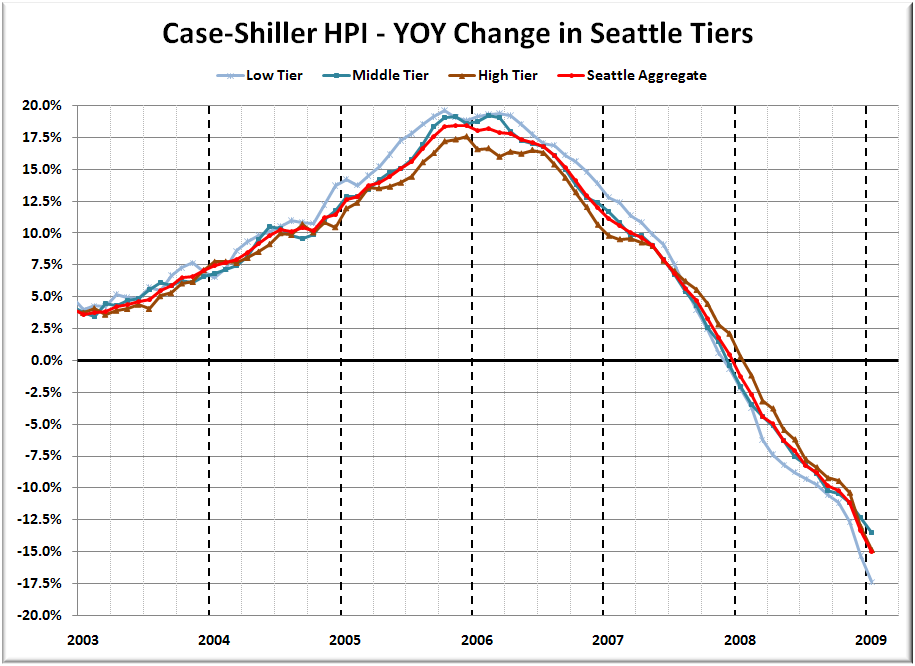
The highest YOY performance turned in by any of the tiers during the bubble was October 2005 for the low tier, coming in at +19.6%. The way things are trending right now, it looks as though all three tiers could turn in negative YOY performance in greater quantities as early as March. The low tier also kept its title for largest YOY decline. The high tier held its position in second place. Here’s where the tiers sit YOY as of January – Low: -17.4%, Med: -13.5%, Hi: -14.8%.
Lastly, here’s a decline-from-peak graph like the one posted yesterday, but looking only at the Seattle tiers.
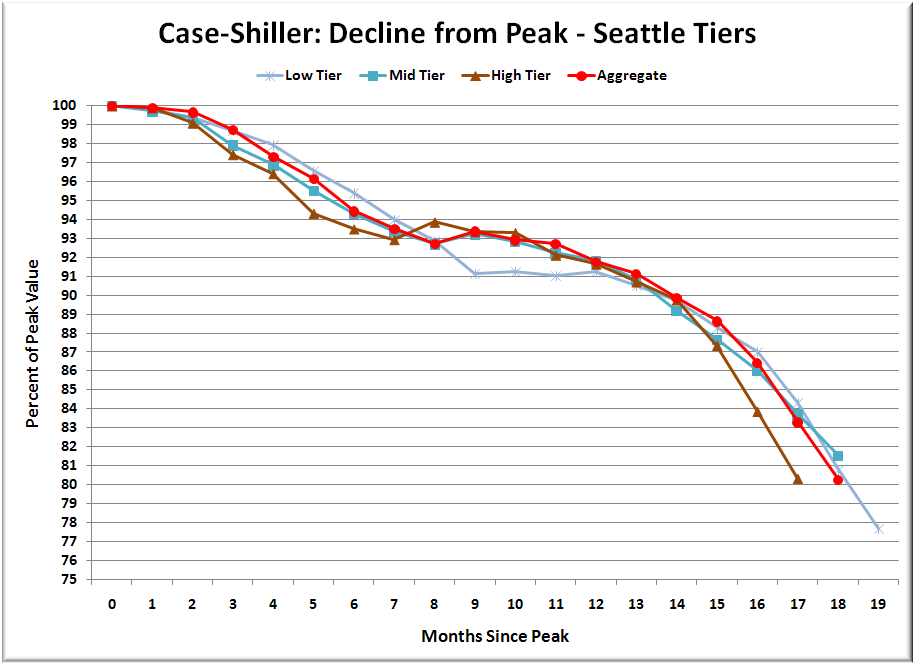
The high tier continued the trend that began last month, falling slightly faster than either of the other tiers that far from their respective peaks.
Seattle’s respective performance of the high tier vs. the low tier stands out as unusual when compared to other cities such as San Francisco, where the low tier has fallen quite a bit further than the high or middle tiers.
(Home Price Indices, Standard & Poor’s, 03.31.2009)


Hey, I wanted to call “BOTTOM OF THE MARKET TODAY”….
oh shoot, it’s just April fools.
Tim, I really think you should insert a snowboarder on that downhill graphic!
RE: Slumlord @ 2 – Here you go.
Am I reading their data right? I’m seeing that low tier is anything under $271k, high tier anything over $395k. That seems like a pretty low high tier.
The only reason I looked was I was trying to see how many sales their high tier would be, since there were only 20 sales in all of King, Pierce and Snohomish during January over $1,000,000. I was thinking they might not have a good sample size, but going all the way down to $395k they would.
I think if they used a higher upper limit the upper tier would be showing much more poorly.
By The Tim @ 3:
I’d like it better if it was someone riding a pink pony on the way down. Now that would be kick a**!
RE: Kary L. Krismer @ 4 – Kary, to determine the tiers they just break all the sales down into even thirds. So if there were a total of 90 sales, the low, mid, and high tiers are determined by simply taking the bottom 30, middle 30, and top 30. So the sample size is the same for all three tiers.
ADP announces another 3/4 million unemployed in March, up from February’s 700K. Until that at least levels out I don’t think we’ll be seeing a change in the CS slope or direction. Indeed, given the lag in CS data, we can probably expect things to worsen for several more months.
Kary – The tier definitions are dynamic and reflect simple tertiles of sales, I believe. Doing that, sample size will never be an issue.
My guess is that the reason we are seeing a different pattern between high and low is we haven’t seen the spike in foreclosure that they have, yet. So the low-end still doesn’t cash flow for investor/slumlords.
The “high-end” decline could be being driven by the East-side bloodbath, but who knows. Why anyone would pay a million for anything in Kirkland or Edmonds is beyond me, and my guess is other buyers are starting to ask the same question.
I saw this little gem that seems to be affecting our region due to the economic downturn. Looks like people are bringing their boats (bought with HELOC’s) into the sound, putting a few bullet holes in them, and then trying to claim insurance…
http://www.cnbc.com/id/29991233/
weeeeeeeeeee!!!! put your hands up, it’s more exciting!!
“So if there were a total of 90 sales, the low, mid, and high tiers are determined by simply taking the bottom 30, middle 30, and top 30. So the sample size is the same for all three tiers. ”
The drop in the high tier is being complicated by the shift in mix. With so few high end houses selling, the reported number for the high tier consists of houses that would have been middle tier at a time when sales were more balanced.
RE: The Tim @ 3 –
You are my hero!
RE: brettro @ 10 -
I looked, but I couldn’t see the bottom!
Is that second derivative steady or increasing? AAckk!
By jimmythev @ 9:
So that’s where all the boats are!
A couple of years ago, finding a boat slip in the Seattle area was a real chore and often involved long waiting lists. The other day, I checked Salmon Bay Marina web site and they look 30% empty.
http://salmonbaymarina.com/slipmap.html
By Scotsman @ 14:
At first I thought this was an amusing geeky extreme exaggeration. But Scotsman is right if you consider the % of value lost month-to-month. It seems to have accelerated from December to January.
In other words, Seattle housing lost X dollars of value in December, then lost X dollars more in January. But because the value at the start of Jan was lower than in Dec, that X dollars is a greater percentage drop in Jan.
I know there are all kinds of seasonal affects that mean one should not read to much in to month-to-month comparisons, but it would be quite the discontinuity to see that graph flatten out and show a bottom for the next month, eh?
By jon @ 11:
Yeah right! So, when people were forking out a million bucks for houses on the east-side at more than 300$/sq ft, that was the time when sales were more “balanced”.
Actually, I think the Case Schiller tiering system is fantastic. If pink-pony-priced houses are not selling at pink-pony-prices it immediately shows up in the respective tiers. If no one was complaining when all the tiers were moving higher, no one should complain when they are (rightfully) moving lower.
I have said it before and I will say it again… Owners, Sell now or be priced in forever.
RE: The Tim @ 6 –
Tim – This probably goes in the who gives an RA file, and I’m not sure that it’s truly responsive to Kary’s question, but I think that you’re answer probably oversimplifies the CS methodology and may be missleading. If you go to the “Overview” page on the CS link, and scroll down to the bottom, there is the pdf link to “S&P. . . Methodology.” On page 18 (I know you probably read it too) at the beginning of the second paragraph under the heading entitled “The Divison of Repeat Sales Pairs into Price Tiers” it says:
“Note that the allocation into tiers is made according to first sale price. Individual properties may shift between price tiers from one sale date to the next. We use only the first sale, ignoring the tier of the second sale. This allocation was chosen so that each of the tier indices closely represents a portfolio of homes that could be constructed on each date using information actually available on that date.”
As you know, the CS report uses paired sales for the same piece of property. A current sale is matched with a prior sale for the same property. If I understand the division into tiers correctly, it means that the assignment to a tier is based on the oldest sale of the pair in question, based upon which tier (third) that sale fell into at the time it was made. If that is the case, then the pool of sales in each tier when the 2nd sale is made (the current sale of the property) can be more or less than a third of the current sales. If so, it still leaves us with the question, ” where do the tier division numbers of 271K and 395K come from, because if my interpretation is correct, they don’t necessarily represent the break points for thirds of the total sales for the current reporting period.
Sadly, even if I am correct, I doubt that the above information is of any real value to anyone. Just thought I’d let you know you might be wrong about something completely immaterial.
RE: One Eyed Man @ 18 – Thank you. I just have a problem with $395k being the high tier. Perhaps they should use a smaller percentage of sales for the high end, maybe 20% or something. The way high tier is defined it would be like calling a Honda Accord a luxury car.
RE: Kary L. Krismer @ 19 –
I agree, 395K seemed low to me too. I guess I don’t spend enough time in Tacoma and Everett. Speaking of Honda Accords, did you hear on CNBC the other day that Geithner drives an Accord and Larry Summers drives the Mazda model that replaced the 323. They brought it up in a discussion of trade protectionism. I guess they’re not in the “buy american” camp, at least as to their own purchases.
Yeah, the gazillion cement-block ramblers for sale in Mountlake Terrace completely wash out all variation, if you are interested in Seattle-proper. With C-S, you can distinguish the performance of Seattle starter shacks (middle tier) and everything else (high tier) but that’s about it.