It’s that fun time of the month once again. That’s right, time for the latest data from the Case-Shiller Home Price Index. According to August data,
Up 0.1% July to August.
Down 0.2% July to August (seasonally adjusted)
Down 14.7% YOY.
Down 22.2% from the July 2007 peak
Last year prices fell 0.7% from July to August (not seasonally adjusted) and year-over-year prices were down 8.8%.
Once again, here’s a little dose of sanity to contrast with what is no doubt set to be a day full of crowing and hoopla over the month-to-month increases seen in most of the 20 cities tracked by the Case-Shiller index.
It still looks as though Seattle is being somewhat left out of this party.
Here’s our offset graph, with L.A. & San Diego time-shifted from Seattle & Portland by 17 months. Look at SoCal’s year-over-year skyrocketing back up to zero. Portland came in at -12.5%, and now both Los Angeles at -12.0%, and San Diego at -8.9% came in better than Seattle.
Note: This graph is not intended to be predictive. It is for entertainment purposes only.
Here’s the graph of all twenty Case-Shiller-tracked cities:
In July, fourteen of the twenty Case-Shiller-tracked cities experienced smaller year-over-year drops than Seattle (vs. twelve last month). Dallas at -1.2%, Denver at -1.9%, Cleveland at -2.8%, Boston at -4.2%, Washington, DC at -7.9%, Charlotte at -8.6%, San Diego at -8.9%, New York at -9.6%, Atlanta at -10.6%, Los Angeles at -12.0%, Portland at -12.5%, San Francisco at -12.5, Chicago at -12.7%, and Minneapolis at -13.7%. Vegas took the #1 spot again for the largest year-over-year drop, with prices still falling over 30% in a single year down there—stimulus? What stimulus?
Here’s an update to the peak-decline graph, inspired by a graph created by reader CrystalBall. This chart takes the twelve cities whose peak index was greater than 175, and tracks how far they have fallen so far from their peak. The horizontal axis shows the total number of months since each individual city peaked.
In the two years and a month since the price peak in Seattle prices have declined 22.2%. Definitely seems to be stuck moving sideways.
Here’s a complimentary chart to that last one. This one shows the total change in the index since March for the same twelve markets as the peak decline chart.
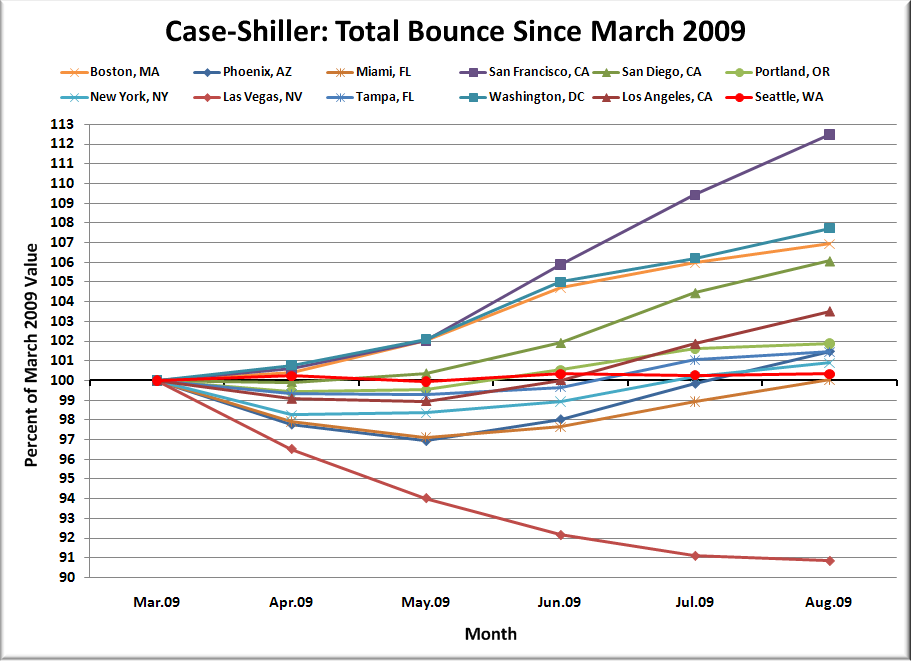
With just a 0.3% increase since March, the summer of stimulus seems to be having little effect on Seattle home prices. But hey, at least we’re not as immune to stimulus as Vegas apparently is. Down 9% in just the last five months. Ouch!
The following chart takes the post-bubble years of 2007, 2008, and 2009 and indexes each January’s Case-Shiller HPI to 100 so we can get a picture of how this year’s declines compare to last year:
Thanks to the tax credits, abnormally / artificially low interest rates, and lots of hype about a so-called recovery, it would seem that we have pulled 2009 into slightly better territory than 2008.
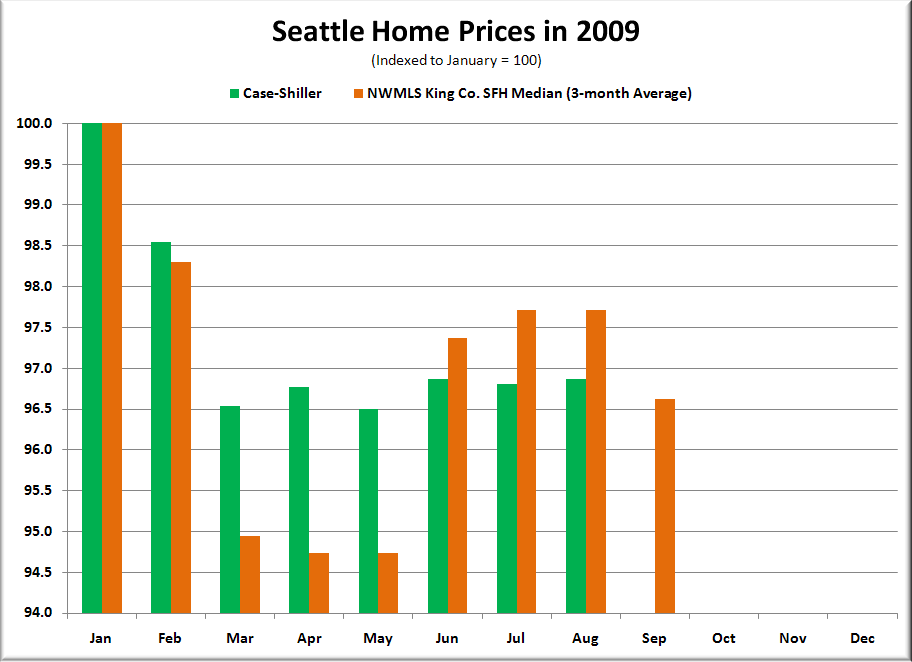
Lastly, here’s an update to the Case-Shiller vs. NWMLS median chart. The following chart shows Seattle-area 2009 home prices, indexed to January = 100, as reported by the NWMLS (using a 3-month rolling average) and by Case-Shiller.
Check back tomorrow for a post on the Case-Shiller data for Seattle’s price tiers.
(Home Price Indices, Standard & Poor’s, 10.27.2009)


Case-Schiller, if I’m understanding this correctly, is attempting to put together an index of housing prices based on metro areas around the country. Didn’t Doctor Schiller also say that there is a group think about housing prices that has people over paying for housing? Wouldn’t having an index of house prices add to that group think?
How important or relevant is this Case-Schiller Index? What can it possibly do or what information does it provide?
To Tim Ellis this graph is showing the impact of the $8K tax credit, which I agree is a bad thing. To Tim Kane, the owner of an escrow company, this is a positive sign of solid building blocks of home sales that will stabalize the housing market. What I remember is that Ardell used this group think to call a bottom to Real Estate prices and she got four transactions in escrow shortly there after.
The Index is relative to whoever is using it. Inside the index is a host of regional economic conditions. Right now the Index is tracking, in my opinion, lower priced first time home buyer sales. How relevant is that to the broader Real Estate market?
Tim, the second to last graph is not seasonally adjusted right? If I’m reading it right (and the raw data right), Seattle has gone down every August since 2006 using non-seasonally adjusted numbers. Prior to that I think it went up at least three years in a row.
Oh, and thanks for the last graph.
RE: David Losh @ 1 – David, these numbers (as well as the county-wide and even smaller area-wide NMWLS numbers) are irrelevant to any particular property. They’re just a gauge of over-all market strength, not an indication of what any property is worth.
Home owners in places like Bothel, Issaquah, Kent and Auburn are hosed if they are going to have to sell…… or refi!
RE: Acerun @ 4 – Kent isn’t so bad. I wouldn’t want to be on Camano Island though. That’s where people are hosed.
[...] out these great charts by The Tim on Seattlebubble.com — they show a strong California recovery with San Francisco prices up 2.5 percent, and Los [...]
RE: Kary L. Krismer @ 5 – I don’t want to debate whether or not Kent is good or bad. It will be interesting to see what six feet of water will do to home values.
RE: Acerun @ 7 –
Acerun, you should know by now that waterfront homes always increase in value.
And everyone knows that Kent is bad. I’m not talking about home prices though.. Kent is just bad :)
And Tim,
Can we have it broken down by tier? I love when you break it down by tier!
Tim, you ought to fix the text on the x and y axes on the Bounce since March graph. They are the same as for the Decline from Peak chart and don’t apply.
RE: jon @ 10 – Whoops, thanks for catching that. I’ve updated it, but your browser’s cache may still be storing and displaying the old image until you do a forced full refresh.
RE: Acerun @ 7 – When I think of Kent I for some reason think more of the east hill area.
It’s looking more and more like Tim’s 17-month offset assumption was off the mark. In other words, Seattle & Portland really are fundamentally different than LA & San Diego in important ways.
RE: The Danza @ 8 – I agree that when the water is in front of the home, it increases the value. However, when the water is on TOP of the home, I don’t think that helps much.
RE: mydquin @ 13 – I’m not sure that was The Tim’s assumption, but that was the most absurd theory out there. You can’t have major national economic events and expect such a theory to hold, unless you assume such major national economic events don’t affect housing prices.
[...] no better than they were in March despite seasonal benefits. Seattle Bubble has all the details here. Now part of this is because Pacific Northwest real estate looks like it rolled over about a year [...]
RE: Acerun @ 4 –
Subtract 10% From Your 2009 Average Selling Price If You want to Sell
If the chart says -15%, ask -25%….then you’ll have a good chance of selling in today’s market.
You’ll give me a big hug in a year or two for the advice, when [IMO] prices plummet another -25% from today’s -15% plummet.
Its that simple.
If you want to flip/sell a recent upside down loan puchase; my advice: ask Ira or Dave for some RE classes on becoming a landlord…LOL
If you can’t get enough rent to stay afloat, remember, it was your decision to get into this bankrupt RE mess, not “We the People’s”….
RE: Anon. @ 9 –
Ahhh. Kent..We attended the Cornucopia Days last year and had our 500 Realty Tent set up in all its Glory only to have to shut it down because of the murder at Arby’s about 800 feet away. The police swarmed the area, I grabbed our precious 500 Realty T Shirts, a few of our candies in the bowl, and left for the rest of the day. I did get an elephant ear though on the way out.
Needless to say no more 500 Realty exhibits on display at Cornucopia.
Kent? Oh please….
Get serious! Analysis of the tax credit and CS:
http://www.washingtonpost.com/wp-dyn/content/article/2009/10/27/AR2009102703791.html?wprss=rss_business
RE: Ray Pepper @ 18 – You missed your chance Ray. You should have claimed that it was the NAR trying to get you, and then you could have had 20 minutes of free advertising on CBS. ;-)
I have noticed in the Ballard, Crown Hill area that most houses are selling quickly. The ones that sell are priced to sell. I also see a lot of sellers still trying to get bubble prices. What is really crazy is I still see houses being bought and renovated and resold ….in other words flipped. Did they not get the memo that flipping is so yesterday? Or am I missing something?
@15 – I am not sure that I understand your point. Seattle was not immune to the national downturn, but it also was not affected by it in the same way that San Diego & LA were.
@21 – It appears to me that the overall drop in N. Seattle has been about 50% to 67% of the rest of the citiy. I expect the recoveries in those areas to be about 50% to 33% stronger… at least in the single family home segment. Not sure about condos.
By mydquin @ 22:
I’m not sure how you can say Seattle wasn’t affected by the national downturn like San Diego and LA were. The changes to financing were national events. The economic scare at the end of last year sent our monthly sales volumes down into the middle triple digits. The downturns in San Diego and L.A. occurred prior to either of those events. To the extent those cities behaved differently, it was merely due to the fact they were already heading down.
RE: Urban Artist @ 21 – Even in the worst of markets (so far), about 30% of listings go pending within 30 days of being listed.
RE: Kary L. Krismer @ 20 –
Now thats funny! There were lots of news crews there (arriving)..I was just too focused on self preservation, gathering up the prized T Shirts, and of course the elephant ear.
RE: Scotsman @ 19 –
I come to praise Kent, not to bury it..Kent certainly has an old reputation of being a dangerous place full of white trashers. And it does have some scuzzy parts. But if you look at it’s crime rate, it’s actually better than most Seattle neighborhoods, and shootings happen in Ballard and Bellevue too. Kent has one of the best bakeries in the Seattle area, Kent has one of the best Greek restaurants in the Seattle area. Kent has a gay bar. Kent has an ethnic diversity not seen in most of Seattle. Seattle has a lot of rich white liberals who believe in celebrating diversity by going out for Phad Thai. Kent has whites, blacks, Russians, Ukrainians, Indians ( Indian truck drivers, not code writers), Vietnamese, Mexicans, etc, and has a certain refreshing vitality that some of Seattle lacks. Kent doesn’t sign onto the Kyoto protocol or call itself world class. Kent doesn’t impose fines if you throw recycleables in with the garbage.
RE: Ira Sacharoff @ 26 -
“Kent has a gay bar.”
Well, then I have to admit the error of my ways- Kent has changed since the 1970’s when it was where those who couldn’t afford Renton went to live. Can world class status be far behind?
I have friends on the east hill, where the developments sprawl as far as the eye can see. I guess it’s pretty much like anywhere else these days.
“Seattle has a lot of rich white liberals who believe in celebrating diversity by going out for Phad Thai.”
Ouch!… but it’s true. And not having the garbage police is a big plus! What is the world coming to?
I have a question for Tim and Kary:
Seems that the Shiller index tracks the average home price being sold. Given the first time home buyer bonus, I would expect the percentage of low and mid-tier homes being sold for the past few months to be higher than the historical average?
Hence we may see the index declince while the average price per square foot stays the same or higher (smaller houses being bought)? Do we have a chart somewhere about the average sq foot price, or the final sale price is a better indicator?
Thanks!
God this funny….
“Seattle has a lot of rich white liberals who believe in celebrating diversity by going out for Phad Thai.”
Interesting to see that the Case-Shiller index has been much stronger over the past six months than either the baseline or the “more adverse” scenarios that the Treasury used for their “stress tests” last year. I think at the time, many people here thought the “more adverse” scenario wasn’t adverse enough
http://2.bp.blogspot.com/_pMscxxELHEg/SucArqYyGwI/AAAAAAAAGpY/v9UTmjnooBM/s1600-h/CaseShillerStressTestAug.jpg
RE: Kevin @ 28 – The counter example is the so-called move-up buyer.
What if some one were to use the Case-Schiller index to prove that not only had prices bottomed out, but they were rising again?
RE: David Losh @ 32 – More crystal ball theory?
If you can prove a future event, then it’s already priced into the market.
RE: Kevin @ 28 – My answer is simply that Case Shiller is an indication of market strength. Expecting more out of it is unrealistic. So any change is mix is practically irrelevant.
You’re not going to determine how much any property is worth by looking at Case Shiller, unless it’s by pure chance. The same could be said for the NWMLS mean and median.
The question does raise an interesting question. The NWMLS median in King County would be over $400,000 if not for short sales and bank owned. At the current level of short sales and bank owned, you do not really need to compete with them. I wonder how Case Shiller deals with that issue in the various markets? At a high enough percentage, they do affect the market.
RE: Kary L. Krismer @ 34 – Now I will go back and give some support back to Kevin.
Clearly the move-up buyer is the counter example to his claims. (Simply put, increase in first-time home buyers => increase in move-up buyers).
That said, if the move-up buyers were not present, then areas where the low end is near the $80k price range get a an extra 10% support from the government. The paired data could easily be boosted with an extra 10% on the lower end.
With the government manipulation, I am going to suggest that Cash-Shiller has lost much of its status as a good indicator. C-S would need to separate out the government sponsored transactions to maintain consistency.
I am sure there are some other good tests, indicators, but the cost of gathering the necessary data will prohibit the development of such, in all likelihood.
RE: AMS @ 35 – Well, it’s an indicator of the strength of the market with the $8,000 credit. That doesn’t mean that the market would be as strong without the credit. Conversely, the market would have been stronger in this last winter if the economy hadn’t been on the verge of collapse. Prior to that it would have been weaker if sub-prime financing had not been available.
The market is strong or weak based on all the factors that affect it at any given point in time.
RE: Kary L. Krismer @ 36 – Let’s get this out of the way:
Significant government intervention is not a normal factor that can be lumped into “all the factors.”
Let’s take cash for clunkers as a good example of how free cash cannot be ignored. Dealer inventory was cleared out in what, about 10 days? I know it went on longer, but I had my choice of exactly ONE vehicle at the dealer I purchased my CFC deal, and I was very lucky to get that one. Yes, the one vehicle was exactly what I wanted, but there were no more after I purchased mine, and they are not making any more Vibes. I am not sure if Toyota will continue making the Matrix.
Back to the topic at hand, to suggest that the car market was strong during the CFC program is ignoring the guerrilla in the room. It was only strong because of CFC.
A 10% governmental intervention, bound by $8k, should not be ignored.
RE: AMS @ 37 – Is the 8k rebate bigger than the subsidized interest rates? I sort of doubt it, at least locally.
RE: Kary L. Krismer @ 38 – Interest rate changes are generally slow to change, and the NPV is not obvious. The $8k credit is nearly immediate, and it is very easy to measure the value.
(By the way, 0% interest did not sell cars, it was the $3,500/$4,500 Obama bucks that sold the cars!)
This was the center piece of today’s finance article concerning Real Estate:
The Standard & Poor’s/Case-Shiller home price index of 20 major cities climbed 1 percent from July to a seasonally adjusted reading of 144.5.
Real Estate Index? Standard $ Poors/Case Sciller home price index?
This is all sales data, the same as the National Association of Realtors uses, to hype the investment aspects of Real Estate. Next you’ll be able to buy into the Index or more to the the point the Index will include Home Dopey, Centex Homes, Wells Fargo Mortgage, and American Title.
Now we can have the housing market manipulated by institutional investors.
RE: Kary L. Krismer @ 38 –
You’re falling into a trap here the same as many people do. You are commenting on comments that are personal assertion that have very little thought to them.
Of course interest rates have sold more homes than all the gimmicks in this country.
By AMS @ 35:
Realistically, almost all housing transaction are government sponsored and have been long before the $8k credit…
– mortgage interest and real estate tax deductions
– gains on home transactions non-taxable
– FHA. Fannie, Freddie rates kept artificially low by gov’t guarantees
RE: deejayoh @ 42 – Case Shiller is largely a black box. Unknown data goes in, and a result comes out. Then they run it through another black box to get to seasonally adjusted numbers. I guess there’s nothing stopping them from creating another black box and adjusting for the $8,000 credit. ;-)
RE: Kary L. Krismer @ 43 –
I hope you’re not implying that the mathematics and data used to compute the shiller index is misleading?
I’ve heard about how it’s computed and it seems like a much better metric than median value because it uses repeat sales.
RE: Anon. @ 44 – News flash–all the metrics use repeat sales except for new construction.
What do you really know about Case Shiller? Just about anyone can tell you how a mean or median is calculated. Strike that. A lot of people can tell you that. But Case Shiller admittedly throws out sales if they think the price is too high or too low or otherwise doesn’t fit within their view of the world. What do you really know about that?
If you think you understand it, answer my question above about how they deal with increasing levels of short sales in a given market? How do they transition from our market, where short sales are likely thrown out, to one with a lot of short sales? With the NWMLS mean and median I can include, exclude or only include such sales. With Case Shiller we don’t know what they’re doing.
RE: Kary L. Krismer @ 45 – I don’t think you understand the CS methodology!
Let’s start with this: “But Case Shiller admittedly throws out sales if they think the price is too high or too low or otherwise doesn’t fit within their view of the world. What do you really know about that?”
Without getting to the mechanics, the basic idea is to toss out sales that are too far out of bounds. Sales of $1-removed. Sales where the value went from $80,000 last year to $600,000 this year-removed.
The reason behind the elimination on the ends is to eliminate the transactions where something other than simple market change. The first example might be the result of a gift, or various other reasons. The second was probably construction.
As far as the short sales go, they would generally be included. Remember that CS does not consider if the sale is short. The take the starting price with date and compare that to the selling price and date. If the short sale resulted in a very low price, like $1, then it would be eliminated.
As far as which transactions are eliminated, which might be your next question, this gets to what is statistically significant.
I hope we can agree on this: If all the very low value transactions were included, or the construction related transactions, then the data would be skewed by such.
RE: deejayoh @ 42 – Note that these are all long-term. The $8k is nearly immediate.
For example, when the government has sponsored low interest rates for years, what difference does that make today?
RE: AMS @ 46 – I think you’re making assumptions as to which transactions get thrown out–what the threshold is. I don’t think Case Shiller publishes that information, so you don’t know whether the discrepancy is 10% or 50%. If it’s 10% then short sales are thrown out in our market. If it’s 50%, they’re not.
If it’s only 10%, then a lot of transactions could be thrown out that shouldn’t be. Maybe the market in their particular locality changed more than the surrounding areas.
Think of it like Zillow. Zillow tries to value properties without seeing them. Case Shiller tries to determine whether outside events (e.g. a remodel or deferred maintenance) affected the value without seeing the property. Neither is going to be terribly accurate.
RE: Kary L. Krismer @ 48 – CS does publish their methodology, and it’s not “short-sales” that are targeted. It’s the transactions that are too far out of statistical bounds in terms of gains and losses.
Oh, and to the Zillow versus CS:
Zillow attempts to give a market value of specific properties today, CS gives a picture of what has happened in the past–much different.
RE: Kary L. Krismer @ 48 – I would also add, with Case Shiller what do you know about location mix? Seattle doesn’t behave the same as King County, which doesn’t behave the same as Snohomish County. With the NWMLS numbers you can at least get some breakdown on that. With Case Shiller it’s all a black box.
By AMS @ 49:
Yes, that’s what I’m saying. But what do you know about that? Specifically, are short sales thrown out here because they are only a tiny part of the market and thus outside the statistical bounds set by Case Shiller? Given how low short sale prices are, I would think they would be. But in other markets where short sales are practically the only sales, I doubt they would be. The point is, we don’t know any of that. If you think we do, please explain.
RE: Kary L. Krismer @ 48 – One more comment, this is your claim: “If it’s 10% then short sales are thrown out in our market. If it’s 50%, they’re not.”
My comment: Once again you are not thinking about this in a statistical way at all. We must consider standard deviation. While there are not normally many outliers, there is also randomness. CS does not target a specific number, or percent, of transactions to eliminate, but rather CS considers statistical significance. If a given transaction is too far out of bounds, then it’s eliminated.
Construction-eliminated.
Fire damage, or other disaster damage-eliminated.
Gifts and other unusual deals-eliminated.
However, there are almost surely some transactions that are statistically eliminated, both high and low, that maybe should be included, and there are some transactions that are included that should have been eliminated. These are not statistically significant.
RE: Kary L. Krismer @ 51 – No, just no. You don’t have this right at all.
“Short sale” is not an input into the equation.
RE: AMS @ 53 – I’m not saying short sale is input into the question. And I should have said “typically thrown out.”
What I’m asking you is do you know whether short sales are within or without the criteria that Case Shiller would use in this market (whether it’s percentage, standard deviation, or whatever). Short sales are priced much lower. Do you know whether that difference in price means they are typically included or excluded here or elsewhere? If the answer to that question is no, then Case Shiller is a black box.
RE: Kary L. Krismer @ 54 – If the short sale is for $1, it’s eliminated. If the short sale is not out of bounds, then it’s included.
Now the question is: How short is short?
By AMS @ 52:
How do you know that? I know they give some information on the pairs they do use, but do they give any information at all on the ones they throw out? If not–black box.
By AMS @ 55:
Well first, no short sale is likely to go through for $1.00. If it did there were likely be environmental contamination.
Let’s say the short sale is 20% less than what an identical non-short sale would sell at. Would that be thrown out?
RE: Kary L. Krismer @ 57 – Is that 20% reduction statistically significant?
RE: AMS @ 58 – That’s the question. In our market, where there are very few closed short sales, I would guess that it is significant. In another market where the majority of closed sales are short sales, I would guess that it isn’t significant–it’s the norm. And my question is how does it transition from one type of market to another?
By Kary L. Krismer @ 48:
Many of your criticisms of C-S in this thread can also be applied to the median, a metric that you’ve expressed support for. Median in no way accounts for repairs, remodels, intentionally-below market transactions (e.g. parents sell to kids), or even the volatility of sales mix from month-to-month.
So, you can go through public records and find all the contributors to the median for a month. However, even if you did that, unless you go to each property and interview the home owners to find out the particulars of the transaction, median is functionally a black box, too (to play on the words of a post long ago: someone using the median is learning nothing special about the market, he’s just learning nothing special faster than everyone else).
And if you are doing all that, you should release the Krismer Index, since it would put all the others to shame.
None of the metrics that get bandied about here are flawless, but I’ll take C-S’s flaws over the others’ flaws any day.
RE: Kary L. Krismer @ 59 – You don’t understand this at all.
For you, CS is a “black box.” For some, it’s much more.
(To answer your question more directly, I don’t have the data set, so I don’t know if the given sale is statistically significant, but I am going to guess that it would be included.
Let’s take a property that sold for $100k last year. A $1 sale today would be eliminated. A $1M sale today would be eliminated. There is a range in the middle where the sale would be included. The exact points will depend on the data set.)
RE: Fran Tarkenton @ 60 – I’ve said much the same thing myself:
http://blog.seattlepi.com/realestate/archives/182732.asp
But the point I’m making now is we really don’t know much about Case-Shiller. If you had the time you could actually go through the NWMLS data and determine some things about mix and location. Other things would be an issue, such as repairs, unless there was a listing within about the past three years with pictures. But it isn’t perfect either. That’s not the claim I’m trying to make.
RE: AMS @ 61 – I don’t think you can avoid this by dealing with extremes. Let’s use 20%.
If 20% is a threshold for whatever reason (the SD is 15% and they use one SD), then in our market they could be excluded, while in other markets normal sales would be excluded. If so, then in those other markets, CS would be understating the market.
BTW, I suspect 20% would be excluded if they’re trying to exclude family transactions. You cannot always determine a transaction is a family transaction by name.
RE: Kary L. Krismer @ 63 – Clearly a market that is heading up would have a higher lower bound for the elimination point, and a higher upper bound for the upper elimination point, in annualized percent return terms.
Also you are taking the 20% and working backwards, which is not how it’s done.
Let’s get a group of paired transactions together. We see that, in general, prices have increased, but there are a few where the prices have gone down by 20% or more. These few are statistically too far out of bounds on the lower end, so they are eliminated.
By AMS @ 47:
My point is that government intervention in the housing market is nothing new. and value wise, every one of those other giveaways is on average worth a whole lot more than $8k. So why would the credit be treated as an exogenous factor? The prices paid are the prices paid. you might as well try to adjust for the weather.
RE: Kary L. Krismer @ 63 – By the way, here is another case where statistics are used to try and determine what has happened:
Ask someone to flip a coin 100 times and write the results down in order, but allow them the decision to either flip the coin or just write down a bunch of data:
HTHHHTTTTHT…
Then it’s your job to determine if the data was fabricated or generated by the coin.
Benford’s Law comes to mind with this stuff. Benford’s Law is a fraud detection technique, but it cannot be used to prove any specific fraud.
“A phenomenological law also called the first digit law, first digit phenomenon, or leading digit phenomenon. Benford’s law states that in listings, tables of statistics, etc., the digit 1 tends to occur with probability ∼30%, much greater than the expected 11.1% (i.e., one digit out of 9). Benford’s law can be observed, for instance, by examining tables of logarithms and noting that the first pages are much more worn and smudged than later pages (Newcomb 1881). While Benford’s law unquestionably applies to many situations in the real world, a satisfactory explanation has been given only recently through the work of Hill (1998).”
http://mathworld.wolfram.com/BenfordsLaw.html
Another way to look at this is the first digit holds its distribution under scalar multiplication.
When people make numbers up, they invariably do not follow Benford’s law. That said, there is always randomness, which reminds me of a Dilbert comic:
[Tour of Accounting]
Accounting Troll: “Over here we have our random number generator”
Number Generator Troll: “Nine Nine Nine Nine Nine Nine”
Dilbert: “Are you sure that’s random?”
Accounting Troll: “That’s the problem with randomness: you can never be sure”
RE: deejayoh @ 65 – The difference is that the low interest rates have been included in the data for years, thus consistency has been maintained.
If the $8k credit had been around for years, then we probably would not be having this conversation.
RE: AMS @ 64 – I’m only using 20% because that’s a typical discount locally for short sales. That might not work the same way where short sales are the majority of the market–the non-short sales may get a premium over 20%. But 20% is not an extreme example, like the ones you’re using.
But again, my point is without knowing how Case Shiller deals with this specifically, how do you know what Case Shiller means? With the NWMLS data, at least some effort can be made to include, exclude or only include short sales. It might not be perfect, but you know what you’re likely getting.
BTW, by referring to seasonal adjustments as a black box, I didn’t mean to imply that the downward movement this month wasn’t warranted. Even the NWMLS mean went down for August. But I am a bit skeptical of seasonal adjustments in general even though I accept seasonality. The same months in different years behave differently, so I don’t see how you can easily just apply a seasonal adjustment to any given month.
RE: Kary L. Krismer @ 68 – If the 20% is out of bounds far enough, then it’s going to be eliminated. If not, then these sales will be included. It depends on the total mix of the data.
RE: deejayoh @ 65 – RE: Kary L. Krismer @ 68 –
You are trapped in a debate about nothing. Of course you’re making good points, but they are lost here in the tangle of comments.
RE: AMS @ 69 – Okay, if you accept that (and it’s true) that would mean Case Shiller would be accurate for our location, but perhaps not for Phoenix.
Or stated differently, Case Shiller wouldn’t mean much to a short seller here, or a normal seller in Phoenix. And my mean much I mean help them determine the strength of the market, not determine their value.
RE: Kary L. Krismer @ 71 – The data is region specific. What you are trying to do is suggest that the data is aggregated for the entire country, which it is not. The Seattle market is computed independent of the other markets, and so on.
RE: AMS @ 66 –
Benford’s Law? comes to mind with this stuff?
I know you’re not kidding because i have been here with you before.
WTF?
RE: David Losh @ 73 – Once one starts to generalize, many things are essentially the same. What’s the difference between detecting fraud from the distribution of first digits to detecting transactions that are too high or low in price? The methodology is essentially the same. There are plenty of other examples that come to mind, but I do have my favorites, which do not follow a pattern of randomness.
You have detected a pattern in my psychology… This is exactly what happens when people fabricate numbers. They have their favorites, which are distributed more often in the data.
RE: AMS @ 72 – Well actually they have 10 and 20 city aggregates. But what I’m suggesting is that in a changing market it means different things at different states of the market.
Even absent a changing market, I don’t think I would give any of these data sources (CS, NWMLS) much credit beyond YOY. The further you go out the more changes to the market there could be that are affecting the market. To some extent that’s agreeing with you on the 8k issue, even though I agree largely with deejayoh’s position on that.
RE: Kary L. Krismer @ 75 – “Well actually they have 10 and 20 city aggregates.”
If I remember right, the 10 are computed independently, and then the independent computations are aggregated together. It’s been some time since I went through the CS aggregate methodology.
“I don’t think I would give any of these data sources (CS, NWMLS) much credit beyond YOY.”
If I handed you a list of 50 sales in King county where the sales were in the month of August 2009 and the initial sale was during the summer of 2000, could we make some conclusions about the gains between 2000 and 2009?
RE: Kary L. Krismer @ 75 – As far as the $8k credit goes, I don’t think it can be ignored, but at the same time it does not apply to every sale. It’s a sudden and significant government program.
The lower end is where the credit is going to impact the most, but even there not all buyers qualify. Thus the total impact is not the full $8k. Finally in the Seattle area the $8k does not represent a high percentage of the total sale, unlike the areas where it represents close to 10%.
It is my opinion that we are just pulling the sales forward from the future. If a person was already to buy in January, why not buy in November and grab the $8k? In part the assumption being made is that prices are stable, which according to the recent poll on this board, the readers here think that Seattle is still over-priced.
It’s not easy to handle that $8k, but it’s too big to ignore.
I didn’t think Cash For Clunkers would have the impact it had, but I must admit, prior to CFC I didn’t think I would buy a new car any time soon, which I immediately did under the CFC program.
By AMS @ 76:
Yes, but that isn’t the way I would attempt to value a 51st house in August 2009.
Maybe we can all agree to this:
There is no way to know how much the prices are being propped up by the $8k credit.
For starters there is no way to know the buyer’s income tax situation, such as income itself. A transaction that looks like it might have a buyer that would qualify, yet it is impossible to know what’s going on with the buyer. Even if we know that the credit was claimed, the IRS could do an audit and later determine the credit should not have been claimed.
RE: Kary L. Krismer @ 78 – “Yes, but that isn’t the way I would attempt to value a 51st house in August 2009.”
Given an initial value in 2000, I would estimate a selling value of a 51st house.
RE: AMS @ 80 – And you would be likely wrong, unless all 50 houses were in the same neighborhood and all of the same type of house. And if that’s the case, it’s unlikely you’d have 50 sales in 2000 and 50 in 8/2009.
RE: Kary L. Krismer @ 81 – Also, I’d add that you could determine value much easier by only looking at 3-5 of those sales in 2009.
RE: Kary L. Krismer @ 82 – Price Kary, it’s price you can determine by looking at sales not value. Price and value are not the same thing as many now experiences who bought into the hype at Dow 10k. They paid market price but are now realizing that they did not get good value.
RE: Kary L. Krismer @ 82 – One of the assumptions I make when analyzing value is that every buyer values the item independently and does not use the same methodology of valuation as any other buyer. That said, many values come in near the same amount, at least within some level of statistical significance.
Bill Gates might want to buy a given house, but the chances are near zero that it’ll be your house…
I have a friend who was bought out by General Motors, back when they actually had cash. He thought he was going to have to discuss price with them. No discussion was necessary. He went in looking for $400k on the high side (he didn’t think he would get this much), but the offer, which had many terms and conditions, was for $750k. (One of the terms was that all property must be removed, no matter how small, by a specific date–the structure stays.) Let’s just say, he was quick to sign, and all the terms and conditions were met.
RE: patient @ 83 –
Very good point, thank you.
RE: AMS @ 84 –
This thread is an unfortunate deterioration of a topic that should be explored more fully. Maybe next time we can have some informative discussion about the Case-Schiller Index.
By patient @ 83:
I think you need to look at the definition of market value. You’re confusing value with your own personal demand.
RE: Kary L. Krismer @ 87 –
You’re confusing market value with value.
RE: Kary L. Krismer @ 87 – It’s quite a soup your cooking their Kary, mixing price, value and demand into one. Market price is one thing, value another and demand a third. It’s a common mistake though to mix them up I see it all the time.
Hardly a soup at all.
Market value is what a willing buyer and seller are willing to pay. It’s not some lower amount an unsuccessful bidding buyer is willing to pay. Price equals market value.
What any one buyer is willing to pay is dependent on their own individual demand. I’m not talking about market demand. Using soymilk as an example, at $5.00 a half gallon my individual demand is zero , at $4.00 it’s one half gallon and at $3.75 I’ll buy two. If the stuff is selling at $4.25, that doesn’t mean it’s worth only $4.00 because that’s all I think it’s worth. Other people are buying at $4.25, and to some of them it’s worth even more.
By David Losh @ 88:
You’re right. But unless you’re dealing with an asset denominated in currency (e.g. a note), you can’t calculate value. Value is different for each person.
RE: Kary L. Krismer @ 90 –
$5 per half gallon = $0 in sales
$4 per half gallon = $4 in sales
$3.75 per half gallon = $7.50 in sales.
As the priced was reduced, the gross sales went up.
In housing right now we generally have lower prices with lower gross sales.
RE: Kary L. Krismer @ 90 –
Soymilk??? It’s worth a trip to Trader Joe’s to by the 2.99 a half gallon stuff, but I just can’t see the soymilk industry producing commercials about how you need to buy a few gallons or you might never be able to afford soymilk again.
Kary sales must be slow if not I don’t understand how you get so much time to post.
RE: Kary L. Krismer @ 91 –
What amazes me about Real Estate blogs is how little information gets through in this age of transparency.
Real Estate is a market place. People buy, sell, and trade Real Estate every day.
Value is determined by the market place. It has nothing, absolutely nothing to do with what some idiot will pay for a property. Any brain dead moron can be talked into anything if they have enough logical data to back up the decision. That’s exactly what happened and is continuing to happen.
Sales data based on what any idiot will do is what we are in the process of correcting. As long as people continue to over pay the correction gets more drawn out.
Value is based on the housing unit. The housing unit is a commodity. A Real Estate is the holding of properties as assets. That means those assets have an equity, a value, a marketable value.
When we say marketable value it’s what we can sell the property for today. As prices went up most people were holding assets. As the market value goes down many people are now holding liabilities. The balance sheet gets reversed.
Housing units have the value of housing, shelter, a place to put carp. That can be determined by rentability at market rates. That is where the job centers come in, or proximity to amenities.
Value can always be established for Real Estate and it is separate from sales data.
RE: what goes up must come down @ 94 –
there are 3 kary’s..there must be. hes everywhere.
By what goes up must come down @ 94:
Well my guess is there are probably a lot of things you don’t understand. The world must be very confusing to you.