Since this month’s NWMLS press release focused on pending sales again, and there has been some discussion in the comments about what the relationship between pending and closed sales looks like in recent months, I thought it would be interesting to look at a few charts of the two data sets in a few different perspectives.
First up, here’s an update to one I posted last month, with the monthly pending and closed numbers as well as a forecast of closed sales based on a linear relationship with the pending sales from two months prior:
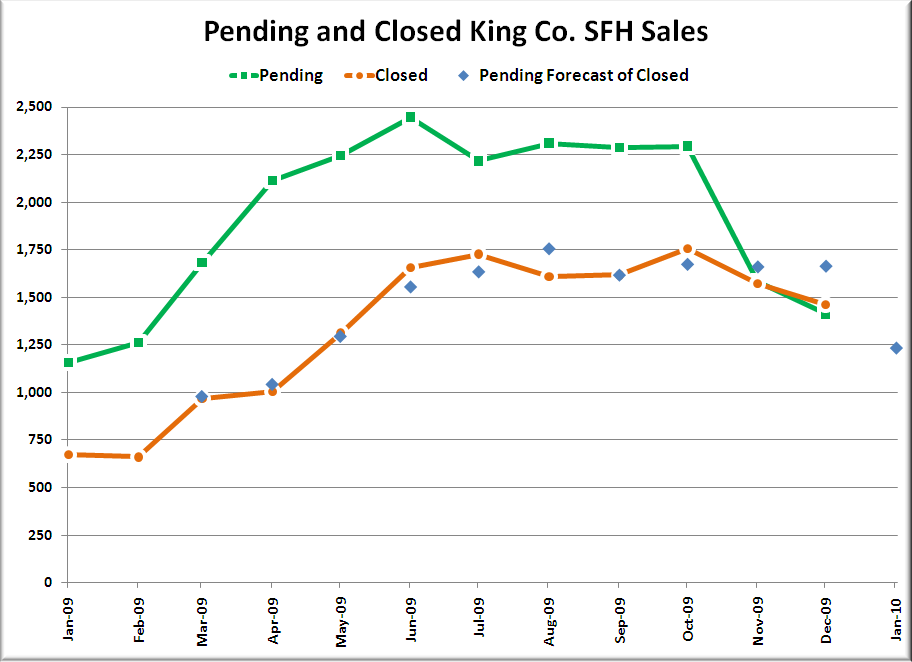
Not much change there. The closed sales for December came in a little lower than our linear forecast predicted, but not by a lot. I still expect January’s closed sales to drop below 1,250 based on this relationship.
Next, here’s a chart of the difference between each month’s closed sales and that same month’s pending sales for 2009 as well as the average of 2000-2008:
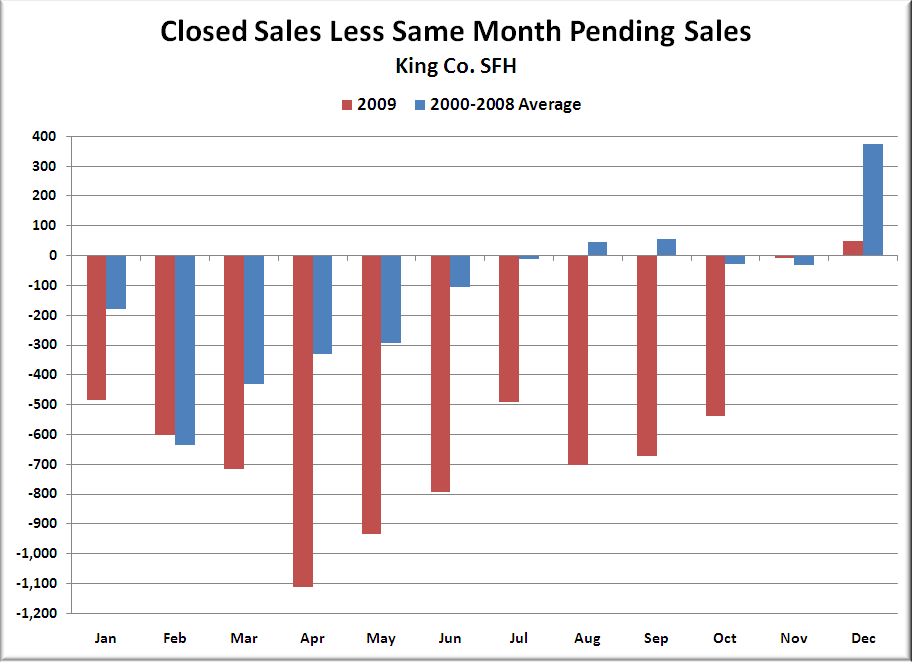
Every month in 2009 but February and November came in with a significantly lower difference between the two than the nine-year average. This means a lower than usual number of closed sales compared to the number of pending sales, and December was no different.
Lastly, here is a look at the total difference between calendar-year pending sales and closed sales for every year since 2000 (which is as far back as I have access to reliable data):
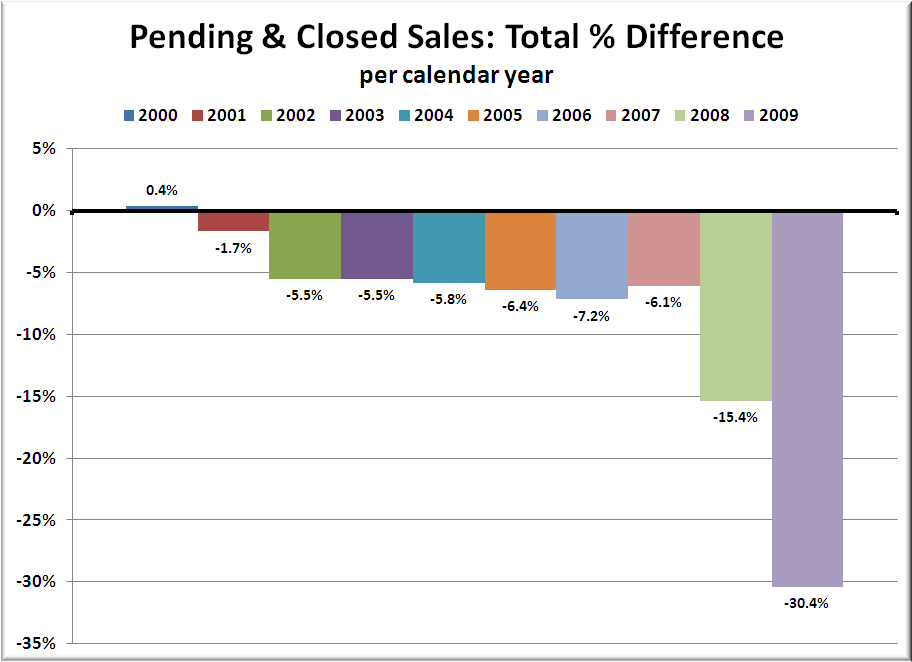
2008 had twice as high a difference than any year prior, and 2009 came in with over four times the discrepancy of any year 2000-2007.
So if you’re wondering why I continue to insist that pending sales have become a useless measure, wonder no more.


“So if you’re wondering why I continue to insist that pending sales have become a useless measure, wonder no more.”
I still don’t know why you think that. Pending sales still appears to be a very useful measure. It’s just that the Y-intercept of the predictive model decreased when banks became more conservative while borrowers’ expectations didn’t change as much. So it’s not that the measure is useless. It is that your predictive model became more misspecified because you did not change your thinking when bankers changed theirs.
The Tim-
Could you remind us what transactions are included in “pending” and which transactions are included in “closed.” If I remember right, a “pending” is only pending once, unless it goes back to active, and then it could be counted twice? Or was it that it’d be counted twice if it went pending in a different month? But if it’s pending at the end of two months it’s only counted once, but in the first month it went pending?
RE: mydquin @ 1 – I think The Tim is more concerned with how useless the YOY pendings comparison has become. Earlier years were on different fundamentals.
Pending sales are a much more accurate snapshot of activity today, and current pricing today, because timeframes to close deals are all over the map due to foreclosures and short sales being a much higher percentage of the market in 2009 than in all years past…..by far. Repos can be all cash quick closes, short sales can take a year, conventional deal can take 30-45 days (which used to be fairly constant with all deals) and FHA/ VA deals can take longer depending on backlog….all wildly different closing dates on all pending transactions from the same day.
If a short sale transaction with Countrywide written in March of 2009 closed on Dec 27, 2009 , should a person looking at the market in January of 2010 compare values today to a transactions written in March of 2009 or a pending sale written yesterday? Pending transactions show more accurately where sellers are pricing today in order to get an offer today.
You keep looking at the sold closed…I’ll take pendings anyday.
Pending always meant that a house would likely be sold in several weeks. Obviously it has lost that meaning. It’s not “useless” information, just not what average people think it means. Many of these pendings will fail, sometimes more than once.
I’m in the midst of an office move and just glancing at a box or two dedicated to cancelled transactions (heavily refi) made me think of pulling some stats if (big if) I can find the time for 2009.
Around the end of May of 2009, NWMLS issued a rule revision/clarification, stating that in short sales, as soon you had mutual agreement, you would list the property as pending. Maybe some agents were already doing this, but most were not. Most short sales don’t end up closing, and most lenders want to see more offers before they approve a deal. So prior to the end of last May, a short sale where the buyer and seller agreed would continue to be listed as active.
There are a ton of short sales out there. I don’t know exactly how much of an impact this rule change had, but I think it was pretty significant, and makes Year over Year pending sale comparisons look pretty suspect.
“Many of these pending will fail, sometimes more than once”
Maybe….I just think it’s way overstated and personally wouldn’t disregard the value of pending sales based on that assumption. Is there data that shows how many pending sales from December will fail? more than once?
I would say a “few” or “some”….but not “many”.
RE: Bilo @ 8 – Oh, I am not suggesting that there is no value, but rather I am trying to understand what the data represents. To suggest there is no value is much more difficult to prove than it has little value for a narrow specific purpose. I suspect if I had a better understanding of the data, I could do much more with it. Ira points out that short sales might have an impact on the situation. Maybe the data is a reflection of failed short sales? I have no idea at this point. We need a good definition of the underlying information and how the data is generated.
By Hugh Dominic @ 3:
Exactly my point. Problem is not that pendings are no longer predictive. The problem is that no adjustment has been made in Tim’s (and many others’) mind for the new “fundamentals.”
On another note, I find it a bit odd that 2007 and 2008 are lumped in with 2000-2006. Didn’t banks really tighten up lending standards in March/April of 2007?
My brother Bilo, he a retard!
Who said that?
And no offense intended.
RE: Ira Sacharoff @ 7
Sales are marked as pending only after mutual acceptance and the seller and buyer agree not to accept more offers. YOY pending are not the issue, it’s month to month.
What most people are unaware of is nwmls no longer marks all mutual accepted deals as Pending like they have in the past. There’s a Pending Feasability status, Pending Inspection status, Pending with Back Up request status and Pending status. A mutually accepted deal is marked as Pending only after it has removed it’s inspection contingency and feasability contingency making the Pending status today different than in the past. When you see a deal that had mutual acceptane in Nov it was more thanlikely marked as Pending Inspection. Only when the inspection contingency is removed does it show up as Pending in Dec. That is different than in years past when all mutual accepted deals were marked as pending..
A mutual accepted short sale where the buyer and seller have agreed to keep the house on the market and accept other offers is marked as Pending with Back Up requested. A mutual accepted deal where the buyer and seller have agreed not to accept further offers is marked as Pending. A Pending with Back Up on a short sale can move to Pending status only after the short sale as been approved approved.
I would bet most agents are unaware of that too.
RE: Bilo @ 13 –
So you are suggesting that there are less listings being counted as pending than there were due to changes?
This contradicts everything I’ve heard or read. Cite me some sources, please. My understanding is that all pending statuses ( inspection, feasability, backup accepted, etc) are all counted as pending, not simply the “pending ” status alone.
Also, a few years ago there was only STI and pending, and STI ( subject to inspection) was an active listing, viewable on public sites.
Right now, none of the pending statuses are viewable on public sites, even if they are accepting backup offers.
I may be wrong, but I don’t simply want you to tell me I’m wrong. I don’t have a clue who you are, Bilo, or how you happen to have this knowledge, so please enlighten me with verifiable sources.
RE: Ira Sacharoff @ 14 –
My source is nwmls! Why do you think nwmls made Pending a seperate and different status?
Also, as an agent I can check any Pending status I want, and not check any other Pending status I don’t want! Public sites are not where I do research. Just make sure you input your mutually accepted transactions as the right Pending status so we can all get better stats in the future!
RE: Ira Sacharoff @ 14 –
What I Really Liked About Ira’s Response
He admitted, “I may be wrong”.
That’s the trouble with a lion’s share of all professionals, i.e., business planners, doctors, politicians, engineers, etc,etc, ….they’ll never admit they may be wrong.
How many of you bloggers had one professional’s opinion contradicted by another like professional? I bet 100% of you have.
To quote Proverbs:
“A haughty man goeth before the fall”.
RE: Bilo @ 15 –
No, Bilo, wrong answer. Find me something issued by the NWMLS stating that for statistical purposes, they only count “pending” in their pending sales stats, and do not count all the other pending statuses.
We all know that you’re brilliant and have that secret arcane knowledge limited to the agent elite, access to the NWMLS.
But the fact is is that most people are not agents, and use public sites to find listings.
I don’t know anybody who simply relies on their agent to find listings. I consider myself very good at finding properties, but if a client only relied on me to find them possible homes and didn’t also search for themselves, they’d be limiting themselves.
pendings are utterly and totally useless to the public. We want to know how many homes actually sell not how many might sell. They way it’s used towards the public is a big scam and media who wants to be ethical needs to understand that. It used to be meaningful infomration but with a margin of error of 30% or more it’s plainly useless.
RE: Ira Sacharoff @ 7 – Agents can still specify in the listing that the offer won’t be submitted to the client until the bank accepts. For such listings it will stay “active” until the bank accepts and the client signs off. I have no idea why any buyer’s agent would advise their client to make on offer on any such property.
By Bilo @ 13:
Other than Pending Inspection those other status states have been present for several years. Pending Inspection used to be Subject to Inspection.
I’m not 100% sure how those other pending states are included in the pending stats, but I suspect Pending Backup is included and was always included. Prior to short sales becoming so prevalent, I used to take most my listings Pending Backup. Why wouldn’t a seller want a backup offer? Now, however, I don’t do that because I don’t want some agent to think my listing is a short sale because it was “Pending Backup” at some point in the past. (Actually, it’s the client’s decision, but that’s what I recommend.)
RE: Bilo @ 13 – “What most people are unaware of is nwmls no longer marks all mutual accepted deals as Pending like they have in the past.”
Does NWMLS really update the listings? Did they in the past?
I thought it was the members who updated the listings, not the staff.
RE: AMS @ 21 – Older agents will fax in the listing status change to the NWMLS, and they will make the change. Most agents do it themselves or through an assistant.
By Ira Sacharoff @ 17:
I would agree with that statement. To just say find it on the NWMLS is not a proper response.
RE: Kary L. Krismer @ 22 – Even when an agent uses the fax service, the data is from the agent. NWMLS staff does little other than data entry. Essentially the data is subject to each agent making some error, human or otherwise.
RE: Kary L. Krismer @ 19 – That box should say, “Client will accept any offer that the current lender approves.” What difference does it make to the client when the property is underwater?
RE: AMS @ 25 – The thing is, the buyer client with such listings has no idea whether there is already an acceptable offer on the property, and once they make an offer other buyers will have no idea whether theirs is an acceptable offer. So in the first instance they could be wasting their time entirely, and not even know if for months. In the second case they would be more likely to be outbid. Also, it’s rather uncommon that an agent writes an offer that a seller can just sign off on. It’s not all just about price. Basically, until the seller signs off they’re just wasting the bank’s time too.
There’s no upside in it for the buyer, so no reason to bid on the property or even look at it. From the seller’s side it makes it less likely that a buyer will make an offer, so again there is no reason for a seller to do it. I suspect the practice is the result of some short sale class. Agents learn all sorts of things at short sale classes that are wrong, stupid, illegal, or some combination thereof.
RE: Kary L. Krismer @ 26 – “The thing is, the buyer client with such listings has no idea whether there is already an acceptable offer on the property, and once they make an offer other buyers will have no idea whether theirs is an acceptable offer. So in the first instance they could be wasting their time entirely, and not even know if for months.”
1. Offer to ‘owner’ to lender.
2. Offer to lender to ‘owner.’
To go pending don’t both the lender and the ‘owner’ need to approve? Thus in both cases we need the approval of both. There is no way to speed up the lender by suggesting that the ‘owner’ has already approved, right?
And when the ‘owner’ is quick to approve any offer, even very low ones, the lender isn’t going to think it’s a good deal… Unless it’s very close to the principal balance.
RE: AMS @ 27 – As soon as the seller and buyer reach an agreement, it should go pending–typically Pending Backup. That’s what’s caused the main issue with the pendings being unreliable. Most short sales never close, but they are part of the pending data.
Agents do imput there pending transactions wrong all the time and always have. nwmls new search has made it obvious where to imput and narrow searches in order to seperate out certain contingencies. Even if that didn’t exist and we assume a 30% fall out ratio, the fact that pending sales doubled in one month over another is still doubled. If the average pending price goes up or down 10% it’s still 10%. That may be useless information to some, that’s up to them. Agents do have the ability to narrow their searches any way they want, and with experience they’ll know what to look for and how to interpret it. I don’t share my research with the public because I’m happy with letting public believe what they want to believe. My research is for me to use in my business in order to position my business and my clients business. I use pending sales all the time and have a pretty good Idea of what I’m looking at. I have been wrong in the past, and I’ll be wrong in the future, I try to keep my degree of error to a minimum. I’m also much more selective and careful today. Pending sale numbers probibly should not be used by the public, but I find the very useful and track them daily.
“I don’t share my research with the public because I’m happy with letting public believe what they want to believe.”
Don’t mean to pick on you, Bilo, but really? You feel that the public should be kept in the dark and not be provided with information so they can make an informed decision? Why is that? So you can tell them anything you want? What are you trying to hide?
Most of the people who read Seattle Bubble are the public, and they come here for information.
There are also a handful of agents who post here regularly. Agents are generally not trusted here, and sort of have to prove themselves by being willing to consider that real estate industry generated press releases aren’t always the whole truth. We don’t always agree with each other, but I see the agents here as particularly good at either providing real information or having opinions that are contrary to the standard industry views.
Point is, I’ve learned a lot in the 3+ years I’ve been posting here from ” the public”. Sure, I’ve learned things from having experience in the industry and from classes, but there are a lot of people here on Seattle Bubble who know a whole lot and I’ve learned from them.
Then there are kamikaze real estate agents who come here insisting how right they are, refuse to really engage in dialogue, and disappear quickly, usually after getting tarred and feathered.
RE: Bilo @ 29 – “Agents do imput there pending transactions wrong all the time and always have.”
aka agents are human.
We could divide the ‘error’ into different categories:
1. Human error (the agent was trying to enter the correct information, but made a mistake)
2. Misunderstanding (the agent thought he was trying to enter the correct information, but he was wrong)
3. Other wrong information or error, including intentional deception.
I am sure we could refine category #3, but there will always be human error. It’s really tough to eliminate that, and in this case the cost of elimination probably far exceeds the value. Category #2 might be reduced by better education. Category #3 is the most difficult to address, as it’s hard to know if an error was intentional.
As far as the pending number and the claim that such “should not be used by the public,” I’d suggest that before using any tool, one should know how to use it. Part of the problem with the pending numbers is that it’s quite questionable as to exactly what it represents, and another problem is that even if one knows exactly what it represents, one must also know how to use it. If a member of the general public understands what the pending numbers represents and knows how to use it, then why not?
RE: Kary L. Krismer @ 28 –
If the buyer and seller (not the bank) have agreed and checked the box on the SS addendum that states the seller “may not” accept offers on the property, the listing should be imputed as Pending because the seller has agreed to not solicit other offers on the property. If they check the box that states the Seller “may” solicit additional offers (which banks prefer) then it should be imputed as Pending Back Up. If you see a pending short sale with back up request you can probibly guess which box was checked (if the agent inputed it properly, which needs to be verified). Generally speaking, only investors play with those listings, they don’t care if they don’t get the house and for them it wasn’t a complete waste of time if they don’t get it. If you’re homebuyer trying to by the house as your primary residence…don’t get your hopes up putting in a back up on a short sale, you really have to know what you’re doing and go at it pretty hard.
RE: Bilo @ 32 – That’s all well and true, but if the agent indicates that the offers will not be presented until bank approval, then the listing will stay active during the month(s) it takes to get bank approval. IMHO, the NWMLS needs to outlaw this procedure, but so far they have not.
RE: AMS @ 31 –
Sometime it’s not error. Kary gave an example of imputing a Pending sale with back up requested because “why not get a back up”? (because you’re wasting peoples time?)
There’s always a need for future refinements once flaws are exposed in the last refinement.
RE: Bilo @ 34 – Getting a backup offer wouldn’t show up on the system. The listing would stay pending. In fact it would reduce possibly reduce the number of pendings if going from Pending BU to Pending-Inspection wouldn’t show in the stats. I’m not sure of that.
RE: Bilo @ 34 – As discussed, the owner has no incentive to seek a high offer if the sale is going to be short. Wasting the lenders time based on accepting low offers and pulling the property off the market has its consequences too. In fact, there has been some fraud where the seller works with buyers to submit only low offers for lender approval.
Am I supposed to listen to a “professional” who doesn’t know “imput” isn’t a word?
RE: Lake Hills Renter @ 37 – Imputed is an English word, but clearly one doesn’t impute a home. One might impute an interest rate or an income.
RE: AMS @ 36 –
Yeah. My heart just bleeds for these poor lenders. I know! Let’s bail them out!
RE: Ira Sacharoff @ 39 – I have no love lost when a lender takes a hit on a risky loan, but the hit should be a fair one. I wish I had the links ready to the stories I read about a conspiracy to defraud the lender. One involved the seller, buyer, appraisers, real estate agents, and mortgage brokers. We’ve also heard the other side, where a property sells for considerably less than an earlier offer, such as ARDELL’s situation. Ultimately the lender pays the price, as we know there is no way to collect the cash in most situations.
Everyone seems to have an idea of what a property is worth, and some ideas are clearly lower than others.
What the best action to minimizing losses?
RE: AMS @ 40 –
I took Richard Hagar’s Real Estate fraud class, and there were plenty of examples of lenders being defrauded. Still, I don’t think things fell apart simply because of some poor lenders being defrauded. As you stated, there were a lot of folks involved in fraud, including loan originators, real estate agents, appraisers, etc.
Way too many people who were in a position to take advantage of the system did just that.
RE: AMS @ 40 – Wouldn’t that apply for all sales not only reos? If a buyer offers money to an agent and mortgage broker to bury better offers? I don’t see that as a reo problem and I clearly remember the flyers from lenders in the hey days. I have no sympathy is they endup with “unfair” offers, none.
RE: patient @ 42 – Yes, every seller should have an idea of what the property is worth. In general one must assume the market is fair, unless there is some reason to suggest otherwise. Short sales are disadvantaged, and have been the target of fraud.
A seller who lives in the neighborhood who also stands personal gain is in a much better position to know the fair value of the property than a lender who is 2,000 miles away. But, yes, if an agent is only presenting the lower offers from his friends, then I agree that it’s a problem.
RE: Ira Sacharoff @ 41 – We need to separate specific fraud from the general market. There have been indictments regarding specific fraud. General market risk, on the macro level, isn’t easy to avoid. Part of the problem is that low offers are made because the seller has no incentive to seek high offers on short sales.
In ARDELL’s case, the lender turned down a “low offer” to accept an even lower one later. Why did they turn down the first offer?
By AMS @ 44:
Who knows why banks do what banks do but my guess would be that they thought they would get a better offer and when they didn’t they accepted what was on the table without making the effort to contact the buyer they had turned down earlier. Perhaps they have stats that shows a slim chance of that buyer still being interrested or demanding a large discount from the first offer since the lender is now acting more “desperate”. Only guesses for who knows? Perhaps they burnt the better offer or it was another handler that didn’t have the history etc, etc.
RE: patient @ 45 –
Or the Lender Looked at the Buyer’s Loan Qualification
And smelled a skunk.
RE: patient @ 45 – It’s my opinion that the only reason they turned the offer down is because the lender thought the offer was too low. Had they known that the offer was better and sooner than the future accepted offer, clearly they should have accepted. Part of the problem, however, is that I am using finance to make the decision. It was a WaMu loan, so on an accounting basis the loss would have been realized sooner, even if the loss was minimized. Often corporations delay accepting the fact that there is some loss, even if it costs them far more in the future.
If those at WaMu actually thought the market would return, then waiting for a better offer was the correct play. However, I do find it interesting that ARDELL claims that the offer should have been accepted to mitigate the total loss. Of course this is looking backward. Had the home sold for more than the initial offer, enough so there is a highly positive return, I doubt this claim would have been made, yet a seller without any resources has no skin in the game.
I know some retirees that personally underwrote mortgages. They are struggling with selling prices these days. As a group, they know they are going to take a loss, but the question is how much. When you put your life savings into mortgages, and you watch values crumble, what do you do? How patient can you be when your expiration date is getting a little too close for comfort? What if you owned property in the Vegas market which has gone down by 60%+ in the last three years–for all practical purposes, hyper deflation of housing prices.
” It’s my opinion that the only reason they turned the offer down is because the lender thought the offer was too low” Agree, but I also speculated in why a lower offer was accepted later since the first rejection alone would not be anything to discuss. It’s the acceptance of the lower offer that makes it a bit peculiar.
RE: patient @ 48 – The market clearly turned south by the time the second offer was made, maybe? The higher offer was before September 2008, if I remember right. Also JPM/Chase might have had a different view on the value of the place. That was another big change.
By Ira Sacharoff @ 7:
I can also confirm that agents are not all doing this. I know of 2 short sale offers on the same property that the agent did not change the status from active to pending. The first of the sales fell through. The second short sale waiting for bank agreement now, but the house listing is active.
Perhaps these two offers fit Kary’s description – maybe the agent is taking the position that the offers will not be presented until bank approval. I do not see why it matters much whether NWMLS allows this or not. So long as the number of short sales going through are so small it would seem less accurate to list the house as pending than leave the listing as active.
Other agents seem to de-list a property while the short sale is being bank processed, and that seems the most accurate. If they are not accepting backup offers, but the bank has not accepted the original offer yet, then the property is not really being offered for sale, is it?
RE: AMS @ 49 – Yep, that’s most likely it.
RE: kfhoz @ 50 – The number of closed short sales is small, but the number of listings is much larger. So it matters. Also, if you’re in the market for a short sale, you’re in for a wait, and it would be nice to know you’re not just waiting for no reason.
IMHO what the NWMSL should do is create a separate Pending Short Sale status, and not include those sales in the pending data.
RE: Kary L. Krismer @ 52 –
Why would NWMSL do this? From a propaganda standpoint, would be disastrous. Look, general public, “real” pendings are way down, and “short” sale pendings are way up.
RE: Kary L. Krismer @ 52 –
I agree…and agents should not be allowed to do their own status updates.
The Tim,
Please generate the first plot showing last november and december data