Posted by: deejayoh

39 responses

  1. Factor in additional credit tightening, as well as mortgage rates continuing to rise therefore making ARM resets this year even more painful and harder to refi which = more foreclosures which = even more inventory and we will be seeing YOY decreases in price in the not so distant future.

    Great work Deejayoh.

  2. I HATED econometrics. Hard as hell.

  3. Whatever. I’m sure the shugster is only going to be convinced by a 1:1 relationship with no time lag!

  4. Excellent analysis. Sellers do react much slower hoping they can get what was fair pricing back in the boom. Here in Tampa; we’ve been seeing price corrections for about one year (about 14 months after the peak).

  5. It seems to me that builders will keep on building until they can’t make a profit. Does anyone have an idea of how much profit they make on a house & thus, how much the price has to fall until they hit their break even point?

    In my neighborhood, they are putting up stacked duplex townhouses (that is, two duplex townhouses on a lot, with one behind the other). Anyone have an idea how much it costs to build one of these?

  6. Bear in mind, the median price typically rises in a slowing market, as the lower end gets clobbered and what few sales there are skew towards the upper end (i.e. non first-time buyer).

    Here in the Bay Area, our local MSM is finally including that little inconvenient fact in their RE coverage, perhaps in the hope that sellers will let go of their 2005 wishing prices. Just because the median is going up doesn’t mean that an individual house is going up as well.

  7. “Anyone have an idea how much it costs to build one of these?”

    No… but I had a house built in Tampa in Y2K. It was a well-built three bedroom, two bath, one car garage home — 1350 square feet, cement block construction [stucco finish]. Price, excluding land, was $76,000.

  8. Here’s an amusing related comment from our favorite spamming realtor Tim Dunn over at his blog full of “actual facts”:

    I have been seeing comments about the increasing inventory for many months now, and it hasn’t led to the decline in prices that one might reasonably expcect based on Econ 101 assumptions.

  9. Good job DJO!

    Your analysis provides an explanation for the seemingly accepted conventional wisdom of housing prices being “sticky”.

  10. OK, I was just looking at Mr Dunn’s latest post about how special Seattle is because we have the bestest, mostest specialest mortgages in the country. He links to a Cohen article in the PI. I skimmed the article, but I noticed something weird in the graphic.

    http://seattlepi.nwsource.com/business/319870_mortgage15.html

    It says percent in foreclosure has increased from 0.46% to 0.47% in from Q1 2006 to Q1 2007. I don’t know where Cohen is getting those data, but when I look at the foreclosure page on Yahoo, which gets its data from RealtyTrac, it looks like foreclosures have increased 33% over the last six months for the state of Washington. I don’t know where I can find the data for Mar 06, but I can’t imagine it was very high then. What gives?

  11. I would think the actual ratio of sales to inventory would be a more important parameter in determining the direction of pricing.

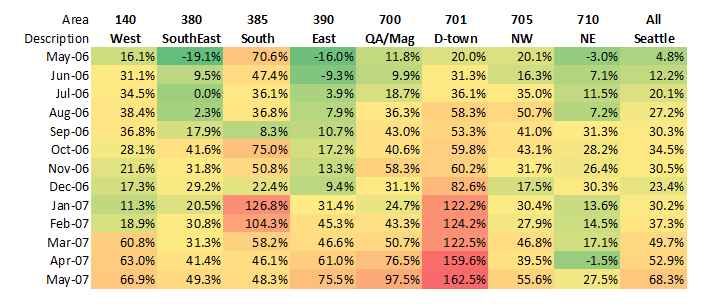
  12. Nice analysis, thanks. For the “map of doom” you break down inventory changes by MLS area (e.g. areas 140, 380, 385). Where may I find a map depicting the boundaries of those MLS areas? Thanks.

  13. This is off topic, but could someone please formulate an articulate response to the post from the soft-focused, “usual suspect” on RCG:
    “It looks as if you will be happy if people get hurt by all this. I’m sure that is not the case, but we’d like a response to your ! ”

    I’m just so ticked by the crocodile tears “people get hurt by all this”. People gambled when they took on ARM or I/O loans. Do we say that people who lost their money on gambling at casino “get hurt”?

    If anything, the ARM or I/O people get hurt by their LO or real estate agents.

  14. Where may I find a map depicting the boundaries of those MLS areas?

    You may find it here.

  15. tlw,

    That sounds like a good question to ask on the forums.

  16. Brilliant bit of work deejayoh …thanks!

    I had some follow-on questions if you don’t mind:

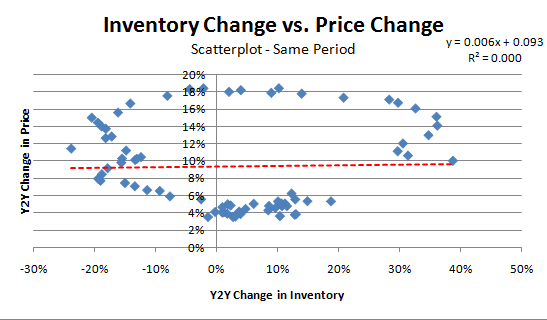
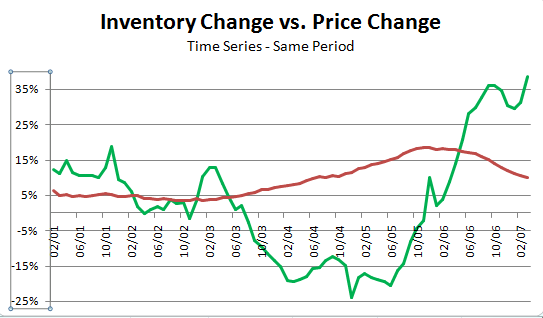
    1) Did the analysis indicate a linear relationship or is there possibly a non-linear curve that is a better fit (R^2)?

    2) Are there any cyclical impacts you considered? I know looking at inventory it tends to be cyclical, which is why I ask.

    3) Are you at all concerned that your data starts during an up-cycle and doesn’t contain any down-cycle data (i.e. previous crashes)? I am concerned that it may slope different in down years.

    And one for anyone:
    4) Do you know if we have a longer lag time than other markets or if their inventories just went up and down before Seattle’s did?

    Seems to me that the beauty of this model is that it should be able to predict a bottom (and a 14 month rise prediction after we reach that bottom). A powerful tool for anyone wanting to buy after the inevitable fall.

  17. CKT –
    FYI: Just wanted to let you know that RealtyTrac came out with a statment last week that their recent inventory data is overstated and should be fixed sometime this week…that might explain the huge jump (even more so than what it would have been).

  18. EconE – Yes, You are right about Economics, as I have found that people love it or hate it, not a lot of middle ground (one one of the Econ lovers).

    Why does your name have the works Econ in it if you hate economics (which means you probably dont know as much about economic indicators). The guys on this blog busted my chops when I was using FinanceGuru (thus amended my name).

  19. tlw – what I would say is that people who made sound decisions (took fixed rate mortgages, expected to live in their home for years) will not be hurt by this. They will ride out any price drops, happy in a house they like and can afford. Good for them! People who made speculative, greed-driven decisions will suffer the consequences. When the market punishes speculation, everyone but the speculators ultimately benefits with increased affordability.

  20. Finance.

    I never said I hated economics.

    I said I hated “econometrics” as it was extremely hard…it was hard for most of the class.

    Economics isn’t only about math…and my name never said EconGuru nor have I purported to be an expert.

    Did you take econometrics?

    Why don’t you amend your name on the CL HousingForums as you are FinanceGuru there also?

    And no…I don’t post there but have read it from time to time.

  21. Heres a local antedote from the weekend…
    So I went to some yardsales with my wife and we come across this young couple with two kids…The guy looked like a construction worker and had a work truck in the driveway – he wasn’t very friendly either. So we bought some of their kids stuff and then took off. As I was leaving, I began to think, was that a F@D borrower? and how could I find out.

    So I just looked at the house at Zillow and yep, just as I had suspected…The house sold in June 2006 for 360K.

    So now I am thinking this family might have taken out a 1 year arm and the yardsale is a sign of distress…

    Such a perfect looking life on the outside, but once you dig deeper its not as great as it looks…

    Now i know why the guy had that sour look on his face.

  22. I running into a lot of folks who recently bought, and don’t appear on the outset to be making jack hand over fist. Good, down-to-earth working-class families.

    I find myself hoping these good folks didn’t stretch to get into the house, and will have to struggle to figure out how stay in it in the next few years.

    Makes me sad and angry, and a bit conflicted as I hope for a return for sane fundementals.

  23. GOOD ANALYSES

    A lot of folks compare the current Seattle Bubble to the 1986-1993 anomaly.

    See the proof:

    Current Housing Slump Mirrors 1991 Housing Slump

    I remember when prices went through the roof (like now) in the late 1980s and nothing was affordable, as the new homes saw the best price declines then and the used houses [mostly fixed rates?] just stayed on the market longer, unless the seller got desparate.

    That may likely account for that 14 month lag in the chart presented in this article. I think Seattle home sellers are “pig-headed” and don’t like price declines [who does]; so don’t sell the first year or so if they can’t get their original higher price.

    I was looking for data on subprime %s in Seattle and remember seeing they were quite high compared to the national market. The average American (see 6/17 Roubini blog) home recently is about 55% equity, which makes things look rosey….bear in mind, there are a lot of 100% equity homes averaged in with 30%-50% of the homeowners with little or no equity; so a 55% average is skewed, especially for the Seattle area or other high priced regions requiring more subprime [and hence far less equity].

  24. Wish I had the time to do a more in depth analysis, but I stopped at Lowe’s over the weekend to pick up some stuff and on the way back home drove through a development.

    I was amazed at how many homes were on the market (resales that were new construction via 2004-05) in this development. In one stretch of a block there were 4 out of 9 homes on that one street for sale. Did some research: All were financed with sub-prime lenders, all increased their base loan amounts from either a re-finance or added straight second mortgage/HELOC’s to their first mortgages. All primary loans were ARM’s. One with a wicked pre-payment penalty. All increased their emcumbrances on the homes on average over 100K over the original purchase price.

    The old school refinancers: get a better rate and drop my monthly payments.

    Today’s refinancers: add tens of thousands to the bottom line, pay off some credit cards, take a chunk of change for a downpayment on a $40K car/truck, and keep my payments the same via a 10 yr. I/O loan.

    Side note: I was at Church yesterday and the Pastor indicated to the congregation how much he learns from other people’s mistakes. I couldn’t help but think to myself, ‘yeah, I agree from being in the escrow business.’ It’s an eye opener.

  25. Finance said “Just wanted to let you know that RealtyTrac came out with a statment last week that their recent inventory data is overstated and should be fixed sometime this week…that might explain the huge jump”

    Yeah, I guess that could be the problem, but I am pretty sure that the percentage of foreclosures in the state of WA has increased more than 0.01% over the last year. I would bet dollars to donuts that Cohen is flat out wrong, but I can’t find the data. Anyone else know where to look, especially using a nonRealtyTrac service, given that they have the problems Finance cited?

  26. Good, down-to-earth working-class families.

    Apparently they didn’t get the memo. Seattle is supposed to be a playground for the rich. We have no more room for “working class families” Pshaw.

  27. Apparently they didn’t get the memo. Seattle is supposed to be a playground for the rich. We have no more room for “working class families” Pshaw.

    Apparently you didn’t get the memo that anyone who can borrow several hundred thousand dollars is now considered “rich”. Debt is wealth.

  28. “I have been seeing comments about the increasing inventory for many months now, and it hasn’t led to the decline in prices that one might reasonably expcect based on Econ 101 assumptions
    I guess that’s the problem with stopping your education at your freshman year.”

    LOLOLOLOLOLOL

  29. EconE – Yes, I did take econometrics in college and liked it much more than a regular stats class, as the examples actually meant something. It was not intuitive info though and took a while to understand some terms though.

    P.S. I dont post on the Craigs List HousingForums so it was probably someone else.

  30. Interesting analysis but it is a simplistic analysis at best. As you know, the clearing price is the point at which the supply and demand curves intercept. The fact that there is a correlation between aggregate inventory and aggregate price is obvious. What your model ignores is the impact of demand. Clearly, an increase in inventory is less relevant if demand increases. Another factor you ignore is the duality of the Seattle housing market. By duality, I mean the quality of housing stock in Seattle. You have the quality houses that sell immediately and set price expectations and the average "chocolate"hole whose owners price based on the assumption that their cardboard box is equivalent to the 1920 craftmand with character. Everything sells eventually..it just requires a price that matches the expectation of a buyer. I think a more interesting and relevant analysis would be to create a supply curve based on housing inventory at specific price point buckets and overlay a demand curve based on equivalent sales at these price buckets. Track the intercept as the clearing price. This still ignores the duality issue but at least you are factoring in the effect of demand.

    I commend you for your analysis. There are far to many people yelling about the housing market – for and against. We need more data to support a fact based discussion.

  31. POSITIVE SOUNDING HEADLINE NEWS FROM LOCAL MEDIA (Radio, TV, Newsprint)

    Please note it is most important to consider the effect of news media headlines on the rising median price in King, Snohomish, and Pierce Counties. (I’ve heard comments on KCTS specific programs stating that an increase in the number of listings is a sign of a healthy local housing market – there are too many very similar examples from our local newspapers, radio and television stations to quote here…it’s bewildering how many ridiculous assertions about our local real estate market get past editorial desks). In other words, the principal reason median house prices are continuing to follow a positive trajectory, is the psychology factor. Almost all of the houses we’ve been looking at, have been on the market 75-125+ days, furthermore, the recent nearby sales of these houses (transactions in months April and May, often no sales in June or July) support only 75% – 85% of asking price. People still think King County market is as hot as ever despite rapidly declining sales and even more rapidly increasing inventories.

  32. [...] of you may have read my previous post that tied the performance of the Case-Shiller index to the growth in inventory. Since then, I’ve done a bit more tweaking of that model – which has proven to be reasonably [...]

  33. [...] two factors that affect the price of homes: supply and demand. We’ve looked extensively at the relationship between supply (inventory) and price in the past. Let’s take a look at the relationship between demand and [...]

  34. [...] readers may recall Deejayoh’s inaugural Seattle Bubble article from June 2007: Why Inventory Matters. In it, he postulated that the Seattle-area Case-Shiller Home Price Index could be relatively [...]

Leave a Reply

Do you want a nifty avatar picture next to your name, instead of a photograph of Tim's dog? Just sign up with Gravatar, and make sure to use the same email address in the form below. It's that easy!

Sponsors


Seattle Real Estate :: Brent Fosso

Sponsors

  • Home Improvement Forums
  • East Bellevue Real Estate
  • For Sale By Owner
  • Home Builders

Tip Jar

Archives

Performance Optimization WordPress Plugins by W3 EDGE