Many of you are aware of the “Residential Property Index” published for the top 25 MSAs by Radarlogic. Radarlogic has a similar business model to MacroMarkets with the Case-Shiller Index (e.g., creating housing-based contracts to be traded on a futures market) but there are some key differences in the way that they calculate their index. Here is a quick overview:
- Radarlogic’s index is based on ALL sales in a market. They do not ignore any sales that appear to be outliers. As such, Radarlogic does not use a “paired sales” methodology
- As a means to make transactions comparable, Radarlogic tracks markets based on the price of a house per square foot, rather than the overall price of the house
- Radarlogic reports their index daily - not monthly. The data is published on their site 60 days in arrears (so as of the date of this analysis, prices were available through February 5)
- In order to smooth the daily impact of low sales volumes, etc, they offer rolling 7 and 28 day averages. The 28-day average is the one most comparable to other indices.
- Like Case-Shiller, the reporting unit for Seattle is the MSA - which includes King, Snohomish and Pierce counties.
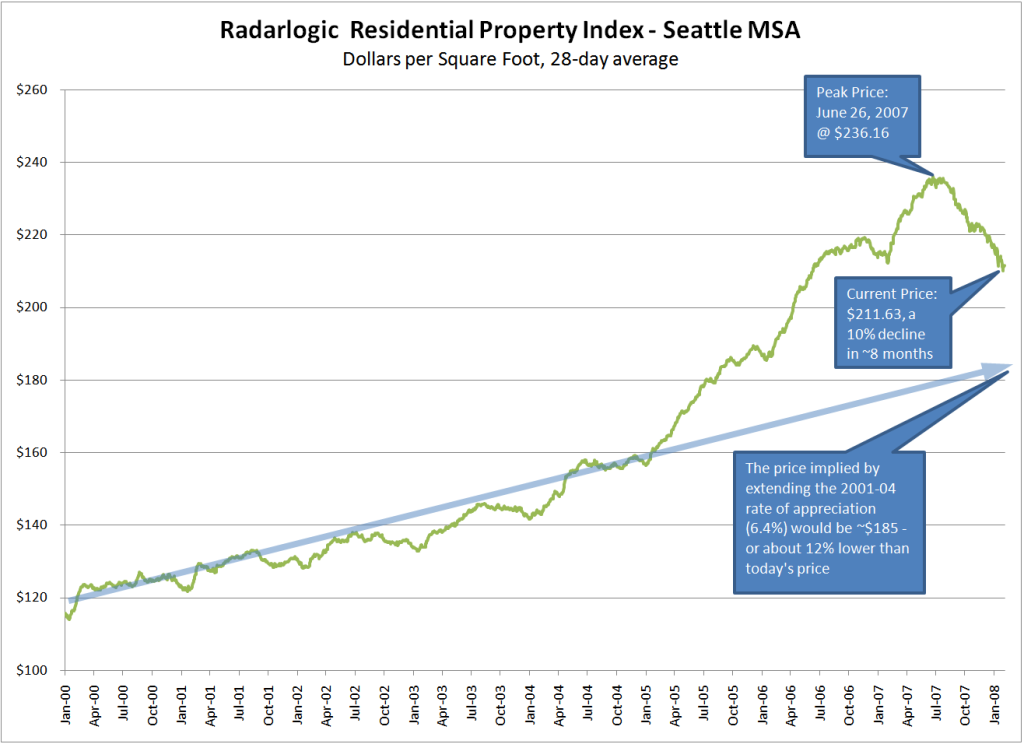
The index for Seattle shows a fairly familiar picture. A market that peaked in June of last year, that has fallen steadily since then, and has just recently turned negative on a year over year basis. I was interested in how fast things were off from the peak. When one looks at the rate of decline since the peak in June, things look a little different.
click image to expand
According to Radarlogic - prices in Seattle peaked on June 26, 2007 at $236.16 per square foot. Since then, prices have dropped fairly steadily to their current level of $211.63. That’s a drop of 10.4% in just over 7 months. On an annualized basis, this means prices per square foot in the Seattle MSA are dropping at a rate of 17%. What I also found kind of interesting in looking at this chart is how consistent the rate of appreciation appeared to be between 2000 and 2004. As you can see by the line I’ve added, it was almost linear at ~6.4% per year. If you extend this rate of appreciation through today, you’d have seen prices at about $185 per square foot - or 12% under current levels.
The fact that we’re only 8 months past the peak is very important. The papers are still reporting the year over year changes, and interpreting the lack of a significant drop as evidence that Seattle has dodged the bullet. However, as this index (and Case-Shiller, and the median) shows, even if the market is able to trade sideways for the next 4 months - we are still looking at double digit price drops in July.
Since Radarlogic also offers indices for 25 other MSAs, here is a comparison to some other West Coast markets:
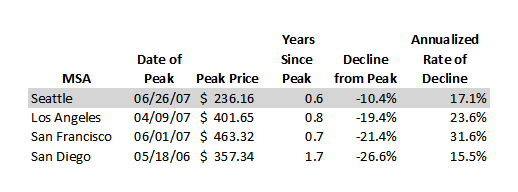
As you can see, Seattle again looks most similar to San Diego in the scale of our downturn - and in this index we lag that market by 13 months. Interestingly, San Francisco and Los Angeles seemed to have peaked much closer to Seattle according to this measure. Like Seattle, all of these markets have already booked double digit declines on a square foot basis inside of a year. The Bay Area (San Francisco) seems particularly hard hit on this metric - tracking to nearly a third off in the space of a year.
At the end of the day, this is just one data point - but when I get enough of them all pointing in the same direction, I start to think I’m on to something!


Jump to the bottom to add your comment. ↓
29 responses so far ↓
1
Marc
// Apr 10, 2008 at 9:45 am
I’ve long felt that price per square foot analysis would be a more useful tool so this is great. However, as someone who reviews county residential real estate records on a daily basis I suggest a bit of caution before jumping to strong conclusions. I can assure you that the county records have a significant amount of inaccuracy when it comes to square footage reporting. Particularly amongst older homes that may have been remodeled or expanded over the years.
That said, I’m especially surprised in the significant disparity in price per square foot between Seattle and all of the California towns mentioned. Perhaps I’ve underappreciated the differences in the median prices as well. Without thinking deeply on the issue, I’ve been under the impression that the difference between our median price and those in California were not that massive. But the prices per square foot you show demonstrate a very clear disparity. For instance, an equivalent 2500 square foot home in each local would theoretically cost:
$590,400 in Seattle
$893,350 in San Diego
$1,004,125 in L.A. and
$1,158,300 in San Francisco
2
Civil Servant
// Apr 10, 2008 at 10:03 am
How to account for the disparity between rate of price drop per unit and rate of price drop per square foot? What this suggests to me — though I’m interested to hear other explanations — is that buyers are starting to realize that they can get more house for the same money; house budget X goes further now, in terms of square feet, than it did a few months ago. But the idea that one should max out budget X — rather than, for instance, looking for a totally reasonable house that now costs .85X (or whatever, insert factor of your choice) — still seems symptomatic of the bubble mentality. This isn’t really bargain-hunting behavior on the part of buyers. Or am I off base?
3
softwarengineer
// Apr 10, 2008 at 10:04 am
HI BLOGGERS, I JUST STUMPLED ON TO A GREAT WEBSITE ARTICLE FROM ONE OF DR. ROUBINI’S BLOGGERS: CASH IN YOUR REAL ESTATE CHIPS NOW
The big guys do it all the time with their investments [how do you think they got to be rich]; so Seattle homeowners, don’t be chicken to make big money now too. Yeah, your credit goes down a bit short-term, so what….your bank account can sky-rocket without that over-priced house mortgage strapped to you like a cement block before you’re thrown into Puget Sound by the organised crime that got you in this house price downturn mess in the first place.
There’s many solid financial people now that can afford their present house payments, that are just handing the keys back to the bank anyway and the money they make doing it is massive.
See the proof:
http://www.financialsense.com/fsu/editorials/2008/0408.html
4
deejayoh
// Apr 10, 2008 at 10:21 am
Marc -
thanks for the comment. I was interested in the snippet above. If county records are not reflecting increases in square footage, wouldn’t this cause exactly the opposite effect we are seeing? In other words, if I expand the square footage of a house - which is reflected in it’s sales value, but not the tax records - it should drive cost per square foot higher, right? So unless the county has suddenly gotten religion about getting square footage right - I’m not sure it should be too much of a factor on this index.
5
WestSideBilly
// Apr 10, 2008 at 10:21 am
I’m still not sure I like this metric. My reasons:
1) It seems to disregard the differences in value of the lot. A 2000 sq ft home on 10,000 sq ft is immensely more valuable and appealing than a 2000 sq ft home on a 4000 sq ft lot, but if one of each sold (at, say $600k and $400k, respectively), the cost/sq ft averages out to $250. By that measure, the former got a great deal and the latter got ripped off, but in reality they both probably got a fair deal.
2) A 1200 sq ft condo does not have the same value as a 1200 sq ft SFH. I don’t think Radarlogic discriminates the two.
3) It seems that it would be strongly affected by the mix of sales, whereas C-S isn’t. So if a bunch of million dollar 2000 sq ft condos and multi million dollar 5000 sq ft mansions sold, CPSF would be highly skewed… even if every one of them was sold at a substantial YOY loss.
6
alex
// Apr 10, 2008 at 10:21 am
Civil Servant, you are RIGHT ON!
People have gotten used to having a huge chunk of their paycheck reserved for mortgage payments. This is one of the obstacles to “median prices” returning to sane levels - but it matters not - asking prices are dropping all around us, and it is very very evident.
In one neighborhood I’ve been preying upon, there’s been no sales over the last 6 months, there’s 5 houses for salre right now, and the asking price that used to be ~560k now is more like ~535k.
7
deejayoh
// Apr 10, 2008 at 10:26 am
Oh - and also, your price comparisons are based on the peak pricing. Using today’s pricing, these look like this:
Seattle = $529.1k
San Diego = 655.9k
LA = $809.6k
SF = $910k
Those seem a bit more in line with my sense of comparative market values
8
b
// Apr 10, 2008 at 10:30 am
Civil Servant -
No, you are totally right, it is the buying mentality of todays knife catchers. The people who are buying right now in spite of an avalanche of information available pointing to declines are still in “bubble mode”. The belief that the market is going to turn on a dime right back to 20% appreciation a year immediately after they buy is very strong in some people. I know a few of my friends down here in silicon valley have this belief, despite prices here already showing serious declines compared to Seattle.
9
Ben
// Apr 10, 2008 at 10:31 am
WestSideBilly,
I did some analysis of Redmond SFH houses for sale on redfin to try and find a pattern in terms of what factors make up a house price.
The first pattern that was very clear was that prices are proportional to the square of the square footage. In other words, a house that is twice as big commands more than twice the price. Sounds odd but there was a 95% R^2 confidence in that statistic.
The other thing that I found strange was that if you try to find a similar pattern with regard to lot size it is very hard to do. The correlation between either the residual or full price of a house and the lot size is almost non existant.
This tells me that the size of the house drives the pricing by the seller far more than the size of the lot. There are probably some factors driving this, but my guess is that old houses are on large lots and new houses are on small lots, and the age and lot size cancel each other out in terms of desirability.
10
jon
// Apr 10, 2008 at 10:43 am
There are a lot of neighborhood factors that will attract more affluent buyers, and those buyers will build/buy a larger house. So the larger square footage is a proxy for other factors.
This may also explain why the price per square foot seems to show a faster drop than the median statistics. The collapse of jumbo loans last year would shift the center of market activity to less pricy areas, where $/ft2 is lower. The recent relaxing of rules on conforming loans may help shift that back.
11
Marc
// Apr 10, 2008 at 10:44 am
Deejayoh,
You’re absolutely right. I figured it on peak price and, assuming your math is correct, your figures are the relevant ones. And they do show less of a disparity than the peak figures. I’d like to see the respective income levels for these areas as an additional basis of comparison. Does anyone have that info at their fingertips?
12
Marc
// Apr 10, 2008 at 10:51 am
Lot size in Seattle proper is, in my opinion, less important to the typical buyer than the appearance of interior space. I think many in-city buyers will sacrifice lot size much quicker than a spacious kitchen, big master bath, third bedroom, etc. After moving in they may realize that was a mistake, but the initial wow factor of interior square footage (and the amenities already in that space) are the principal drivers of the often emotional decision to buy a given house.
13
Scotsman
// Apr 10, 2008 at 11:41 am
I was most surprised by the 6+% annual increase from 2000-2004. I’m sure wages weren’t going up at that rate, maybe it’s the result of a combination of population growth and wage increases. I’d be surprised if we saw that as a baseline trend going forward though, so it seems reasonable to expect more than just 12% in additional reductions.
14
Ira Sacharoff
// Apr 10, 2008 at 11:55 am
Marc’s right. Many homebuyers in Seattle proper actually prefer smaller lots- they want to be close in and though they want to own a home, they don’t want to do yardwork .
15
Buceri
// Apr 10, 2008 at 12:14 pm
Target —–> $150/sq.ft.
16
Joel
// Apr 10, 2008 at 12:54 pm
Maybe because of the weather?
17
Buceri
// Apr 10, 2008 at 1:13 pm
Joel - correct.
Figure you’ll be indoors for over 9 months of the year.
18
afferent input
// Apr 10, 2008 at 3:36 pm
I think your line might be too steep. 6.4% per year appreciation seems like a lot. I think the bubble started to turn north at the end of 2003, which make the slope of your line smaller.
19
deejayoh
// Apr 10, 2008 at 4:17 pm
Probably true. As I said, it’s “kind of interesting” - I eyeballed the fit on the line, and certainly didn’t mean it to be predictive.
I was hoping to bring home the point that even though we’re down 10% already, there seems to be clearly more room to go down +20% as the California markets have done.
Any predictions?
20
Chris
// Apr 10, 2008 at 7:03 pm
I’m calling bottom. With the M’s performance in Tampa today I can feel the Mojo is back! :0
21
Alan
// Apr 10, 2008 at 9:01 pm
My first residence in NC cost around $60/sqft.
My second residence in TX cost around $100/sqft.
I don’t know what this area will settle at, but I don’t think $150/sqft is unreasonable.
22
Lamont
// Apr 11, 2008 at 7:35 am
I would draw a support line under the Jan 01/02/03 lows, which results in an extrapolated price of around $160-165/sqft.
I would also expect the market to dive under that anyway with all the oversupply that needs to get flushed.
23
Garth
// Apr 11, 2008 at 7:41 am
I bought in December of 2006, we looked at a lot of houses in the spring of 2006 and it was an absolute nuthouse in the spring and through the summer. Prices seemed to have no correlation to the lot size, and square footage numbers are all screwed up by marketing and wishful thinking. One house I looked at had a boulder in the corner of the basement with a ten foot circumference four feet tall that clearly was counted on the sq footage in the listing.
The spring after we bought (2007) I continually saw properties with lots 1/2 the size of ours selling nearby for similar prices, since august the comparable houses on 3000 sq foot lots are selling at substantially lower prices than those on 6500+ sq ft lots.
From being at open houses that spring I concluded that if the house was listed under $400,000 (often 320-350) and had the key home depot touches (granite, stainless steel, tile and a pedestal sink) it would sell for 420-450 even if the lot was 3000 sq ft. I was kind of shocked to see how much value people put in granite and stainless steel, since appliances cost a couple of thousand and you can buy most of the countertops I saw in these houses in west seattle for $225 at http://www.valuestone.com/ .
24
Angie
// Apr 11, 2008 at 8:44 am
Ira says, Many homebuyers in Seattle proper actually prefer smaller lots- they want to be close in and though they want to own a home, they don’t want to do yardwork .
Hence all those townhouses. Not my cup of tea, but people do buy ‘em.
Or used to, anyway. The new townhouses that went in near my house went up for sale in February or thereabouts and so far as I can tell none of them have sold yet. The initial asking price was lower than the figure on the sign out front as they were being built, and I can’t imagine that they’ll ultimately sell for what they’re currently asking.
The builder seems like a nice guy. Too bad he’s going to lose his shirt on this one.
I’m still grateful to him for putting up something else in place of the the decrepit, abandoned house on the weedy, trash-strewn lot that was there before.
25
Buceri
// Apr 11, 2008 at 9:32 am
Angie - most people do NOT prefer townhouses; most people CAN NOT afford a SFH.
Based on this, builders offer more of what will sell at current market conditions. And obviously, the profit margins are much higher when instead of building 6 SFHs on 3 acres, you put a building with 40 units.
26
biliruben
// Apr 11, 2008 at 9:40 am
Townhouses, particularly new townhouses, are seductive. A bigger sq/ft that you could afford in a SFH, and all these shiny, apparently maintenance -free appliances and finishes. And no hassle in the yard!
That said, everyone I know who bought one, regrets it. All of them are looking to get into a SFH.
27
Ira Sacharoff
// Apr 11, 2008 at 9:51 am
Angie,
would it have been better( or even possible) for that builder to have bought the abandoned home and rehabbed it , or was it too far gone?
28
Dave
// Apr 11, 2008 at 10:37 am
Yeah - I can’t think of anyone whose first choice is to buy a townhome. When we bought in July ‘07 we thanked our lucky stars that we were fortuante enough to fidn a desparate seller. We got a SFH in Maple Leaf on a decent lot size for 25,000 less than they were asking for new townhomes 2 blocks away on Roosevelt.
Townhomes are generally just big condos. We didn’t want one but we looked because it was all we could afford. To share walls with people and have a 25 ft square yard? No thanks.
Dave
29
Angie
// Apr 11, 2008 at 4:13 pm
Personally, I think townhouses are disasters waiting to happen, unless there are rules and covenants for dealing with the conjoined units that I don’t know about. All those “No HOA dues!!!” signs seem like big fat red flags to me. I’m guessing that insurance companies must have something figured out about them–or else this is going to be an interesting evolution in the next few years…
Ira, that particular house was in seriously bad shape, from the foundation on up. It was also close enough to the Columbia City business district that it was classified as “historic”. I gather that it took some time and effort to convince the city folks who safeguard that stuff that it was too far gone, though I can’t believe it was very hard to build a solid case for that argument. It was also on a 10K square foot lot–that’s awfully hard to come by for a single family home in the middle of a built-up neighborhood, and next to the business district beside.
I’m a sucker for a good rehab, but even I think that place was ‘dozer bait. Wish the buildings that replaced it had a little more graceful profile, but hey, at least the lot isn’t attracting squatters anymore.
Jump to the top of the comments. ↑
Leave a Comment