Posted by: The Tim

Tim Ellis is the founder of Seattle Bubble. His background in engineering and computer / internet technology, a fondness of data-based analysis of problems, and an addiction to spreadsheets all influence his perspective on the Seattle-area real estate market.

99 responses

  1. Come on back down to 4%… looks like about 20% more drop to go.

  2. nice pictures!

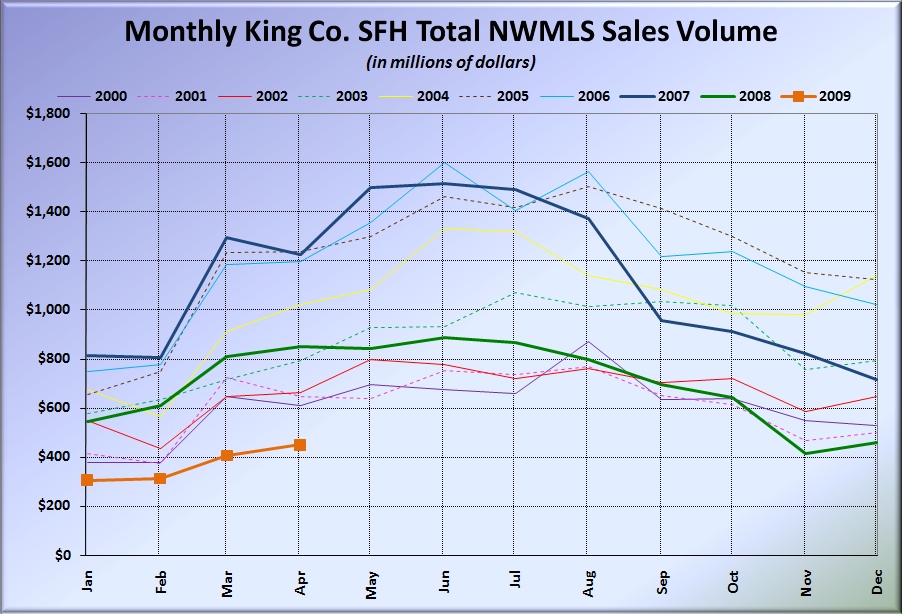
    the first one shows that real estate pro’s are on average making 30% of what they were at the peak (likely less since there are many who are discounting to 2% commission)

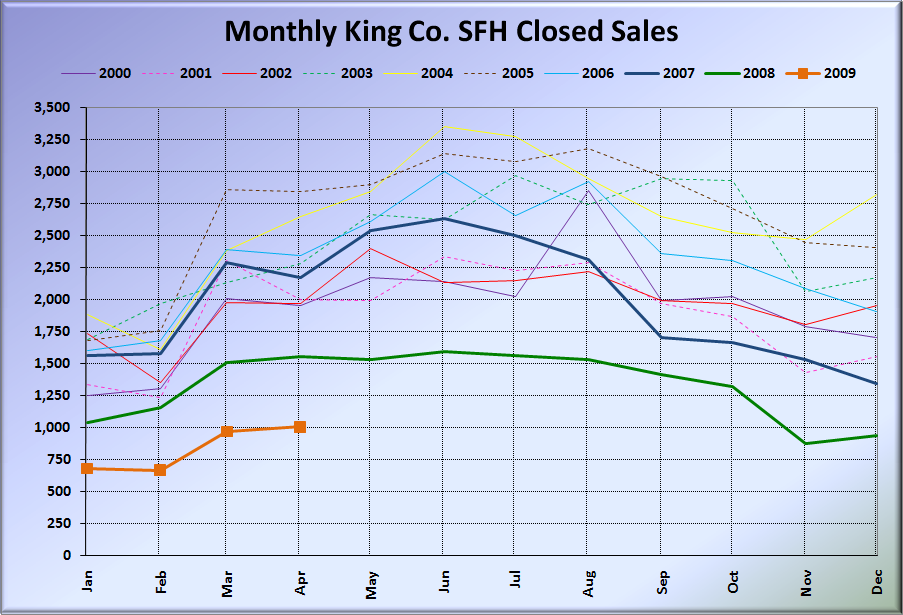
    a logarithmic scale might be a nicer way to show the 2nd graph… I still like looking at it as is though.

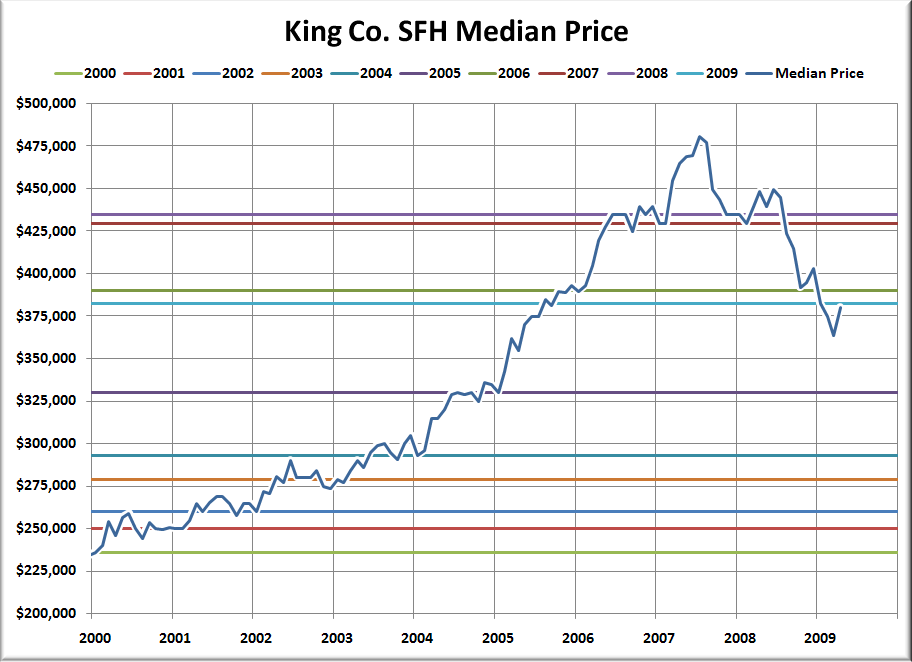
    the third graph is the one I need to show my friends who are convinced that now is *the* time to buy a house. If I were a weather forecaster I would say 80% chance of a 20% drop from here, with some cloudy periods and a possibility of a 30% drop. Nice picture really puts it all in perspective.

  3. RE: johnnybigspenda @ 2 – The on average doesn’t really mean much. Some agents are making more, some are making less, and some are no longer in the business. It probably means more on the office level–the broker’s share. I doubt there are many offices that are making more than the peak.

    What it does tell you for sure is that the state is making a ton less money on real estate excise tax.

  4. TIM.
    PLEASE show the close up of recent months on the Case Shiller. Are you trying to mask slightly increasing prices or something? Not trying to have an accusing tone, but I’m just curious.

  5. Just wondering why you don’t show a close up on the recent months HPI here? Did you already do this elsewhere or something and I just missed it?

    Have home values (Case Schiller HPI) increased in the last month?
    I can’t really tell from the graph.

  6. asdlfkj — what is your point? Why not just say it if you have something to say?

  7. RE: asdlfkj @ 6 – The graphs posted monthly (latest one is http://seattlebubble.com/blog/2009/04/28/case-shiller-seattle-price-declines-still-accelerating/) show a pretty close up view of the case shiller index, enough to show that it hasn’t increased month-to-month recently If you want a closer look you can click the link from that post to the actual case shiller website with a spreadsheet of all the data.

  8. RE: what goes up must come down @ 7RE: what goes up must come down @ 7

    I am absolutely not trying to offend anyone. I am entirely grateful for this site. I just am curious, why the home values of more recent months (April, May (if you can extrapolate)) are not shown. Yes I know YOY is what matters, but not really.
    The CHANGE in YOY from month to month is the indication of the state of the home values.

  9. Thanks Dave0

  10. And February was still a down month on the NWMLS.

  11. asdlfkj,if you look at the total decline from peak graph in Dave0s link you can also see that no market have had a month-month price increase once they reached the level of decline as Seattle currently are at. Though most of them have a couple of months flattening right around where we are before they resume a higher depreciation pace. The temporary flattening is probably a psycological effect that wears off pretty quickly as fundamentals inevitable drags prices lower.

  12. Tim, is there a substantial difference in the HPI graph if you use a different year as a baseline (say, 1995 instead of 1990)?

  13. Tim- can you add a 2% trend line to allow a more realistic interpretation of where the bottom may lie? Average inflation for the last 11 years has been 2.7%, and is currently negative for this year, suggesting a 1% trend line may be necessary in the near future. (Don’t worry, houses always go up…)

    http://www.inflationdata.com/inflation/inflation_rate/historicalinflation.aspx

  14. Wow I know that no tree grows to the sky, but housing quite often beats inflation unless you live in some super rural undesirable area.

    You would have to remove all the growth from an area to simply expect an increase from inflation alone.

  15. RE: Racket @ 17

    You must be younger- housing has only “beat” inflation for the last decade or so. That, in part, is why we’re having a correction now. The following chart has inflation adjusted housing prices, building costs, population growth, and interest rates. That should just about cover all of the “explanations” except… Seattle is special. I’m not sure how you graph that.

    http://www.econ.yale.edu/~shiller/data/Fig2-1.xls

  16. GREEN SHOOTS IN THE ECONOMY OR YELLOW WEEDS?

    Someone this morning asked me if “now was the time to buy a house”.

    My comment back was, “giving financial advice today is like using seers and astrologists”.

    Yes, The Tim’s regression analyses charts show clear/definite price degradation and in the future too.

    Something I think that will have a massive impact on home prices will be bank interest rates in the near future, like a few months from now [have you noticed everything gets worse in like September?], is commercial loan failures; this full impact hasn’t been felt to date, but assuming the tea leaves play out like I predict, the banks are going to be left holding another massive subprime-like bag, as strip mall projects and such find out there’s no monthly payments coming in with chronically distressed consumers not buying much anymore and they’ve hopelessly overbuilt.

    Let’s wait until September and see if Softwarengineer has egg on his face….LOL

  17. “You must be younger- housing has only “beat” inflation for the last decade or so”

    I am only concerned with how Seattle’s real estate market performs, not broad national figures.

  18. RE: Scotsman @ 18

    No doubt…when I think about the house I grew up in…it was built in 1924.

    By 1972 it had doubled in price.

    Only took 48 years…Imagine that!

  19. Scotsman I was under the understanding that nationally he 100 year return of real estate after inflation .4%, which isn’t much, but still more than inflation.

  20. RE: Racket @ 20

    Ah, that would fall under the “Seattle is special” disclaimer, a calm island unto itself in a tumultuous sea of global dysfunction. Carry on.

    I’m not being mean, or picking on you. But please remember context is important, and shouldn’t be ignored. To do so renders any analysis invalid.

  21. RE: k2000k @ 23

    Technically you are correct. But there is some discussion as to whether or not the slight increase in home size over the same period has been corrected for in the data. Looking at the data in the above graph I referenced there does appear to be a very slight upward trend, perhaps the .4% or .6% I have seen in other places. I personally think it relates more to the growth in average size, but we just don’t know. Or at least I don’t.

    I am sure, however, that Seattle is considerably higher… and permanent. So relax folks, everything is going to be fine. Have another beer- the sun will be back tomorrow. /sarc

  22. RE: Scotsman @ 26

    How many buildable lots are available within 20 minutes of the urban cores now versus 20-30 years ago? I mean lots that aren’t adjacent to major artials or have topography issues.

    You aren’t actually making an argument that housing prices MUST follow inflation simply because they did so for a period of time, are you?

    20-30 years ago you could have acquired a very ordinary property in the Evergreen Point area on the Eastside for $40K, now it is $500K even if values drop another 30%. Why is that?

    Seems like you are excluding a few factors in your analysis.

  23. RE: waitingforseattletocool @ 27

    It seems to me you are attempting to justify a position as opposed to letting the facts lead you to a conclusion. What are you selling? Show me one of the original homes in the Evergreen Point area, and I bet its value isn’t that far off the trend line. Teardowns, rebuilt, don’t count.

    If Boeing leaves and MS outsources, how many buyers are there for any urban core housing? If San Diego, with sun, surf, and good jobs becomes less expensive than Seattle, how many will stay here? It would be easy to argue that Detroit is fully built out in its urban core. Tell me about the demand for housing there.

    There are currently 18 million empty homes here in the US. At 4 people per household/home, that’s enough vacant inventory to house almost a quarter of the total population. How long will someone stay in Seattle when there is cheaper housing in areas with better job growth? These, and myriad other reasons are why I remind all that context is everything. Economics is not static, but dynamic- people, industries, other resources, all change and adapt to external as well as internal considerations. Just because Seattle did well over the last couple of decades with MS, Boeing, Amazon, etc. doesn’t mean anything… starting right now. Tell me about the job growth prospects for a state that has one of the least business friendly tax environments in the country. Hmm?

    In the longer term, yes, housing prices follow inflation. That’s what 120 years of data suggests. In an economic system everything constantly strives for equilibrium. In simple terms, if Johnny pees in the shallow end of the pool it’s eventually going to pollute the deep end. There’s no way around it. You may not be the first to adjust, but others will, and their actions will affect everything around you, whether you choose to participate or not.

  24. So where do you think Seattle prices will end up and when?
    I just saw a Greenlake house slash its price from 439K to 375K in a single day. That’s crazy.
    I want to buy but can’t get myself to do it seeing these crazy price drops.

  25. RE: Scotsman @ 28

    Your argument is built on too many hypotheticals to make any reasonable predictions about the future of home prices, but I will at least agree with you that we another “will the last person to leave Seattle turn out the lights” is possible, although not probable.

    It would also be easy to argue that Detroit’s urban core is built out, but in a totally delapitated state and has been for 20 years. I have yet to see many signs of urban core deterioration in Seattle area.

    There is probably not a single public school district in San Diego to which I would send my children. I would factor in at least $16K of private school tuition (at the very least) for two children.

  26. RE: waitingforseattletocool @ 30

    http://www.redfin.com/search#lat=47.620187499983324&long=-122.2124475&market=seattle&region_id=2903&region_type=1&sf=&sold_within_months=1200&status=1&uipt=1&v=4&zoomLevel=16

    Good choice- Vuecrest has a number of original homes, but also many more that have been remodeled extensively to say the least. But you shot yourself in the foot. Look at the graphic in the top right corner where is shows the price per square foot for sold homes. That puppy is falling off a cliff. Dare I say, “meandering” back to the mean? Where will it be in two years without a major break in the trend? One year?

    Forty years ago Detroit was booming, home to the largest corp[oration in the world, full of bright prospects, secure, desirable. Look at it now. Today the government announced it’s taking ownership of GM, nationalizing a failed giant. Imagine Seattle in 20 years without Boeing, without Amazon or Microsoft. It is not outside the realm of possibility. Change can and will happen. While you may discount these specific examples, one would be wise to at least leave the possibility on the table. Should these regional giants go, what happens to prices in Vuecrest? Don’t think it can’t happen here. That’s what they thought in Detroit too.

  27. RE: Scotsman @ 28

    Scotsman,

    My rough calculation using all the sold data available on Redfin for that Evergreen Point neighborhood was:

    Around 1984, average sales price was approximately $100K

    Around 1992, average sales price was approximately $200K

    Around 2000, average sales price was approximately $340K

    Around 2008, average sales price was approximately $800K

    That is double every 8 years, or roughly 9% per year appreciation going back 25 years. When you said bet, what did you actually want to wager?

    http://www.redfin.com/search#lat=47.620187499983324&long=-122.2124475&market=seattle&region_id=2903&region_type=1&sf=&sold_within_months=1200&status=1&uipt=1&v=4&zoomLevel=16

  28. RE: Scotsman @ 31

    If the average price goes down to $400K, 50% drop tomorrow, that would mean it doubled twice in 25 years, or approximately 6% average annual appreciation.

  29. waitingforseattletocool,

    What does the list of closed sales prove? What Scotsman is saying that if subtract all the major improvements made over the years, the price increase is probably in line with inflation.

    I don’t think what Scotsman is saying is all that complicated. All he is saying is that price of things tend to increase in-line with everything else. Why is that so hard to believe? For anyone to BUY something, they have to MAKE money. If GDP, inflation, income increase are all consistent with each other, there is no way housing prices can buck that trend. There is no place where that addtional money can come from.

    While you may be able to find specific neighborhoods where the trend deviates from general Seattle area, in a larger area like “Seattle” it is going to toe the trend.

    I will say that though, the price of houses more close track income rather than inflation. And because of Boeing and MS, Seattle had a slightly higher increase in income than rest of the country and that is probably reflected in the housing prices.

  30. waitingforseattletocool,

    If the price goes down to $400k and sits there for a decade, that would pretty much bring it back inline.

  31. I almost hate to add fuel to this one – but if you look at ofheo data, the CAGR for the Seattle Index going back to 1975 has been 11.2% per year. ofheo is the longest running time series for this market, and some would say the most conservative because they only include conforming mortgages, FWIW

    and the paired sales approach of this data set should eliminate the impact of major upgrades/remodels to a large extent.

    I think it is safe to say that Seattle RE gains have far outstripped inflation since the 70’s. Past is no predictor of future performance.

  32. RE: The Tim @ 25

    Nice chart Tim. Can you update it through 2008 or into early 2009?…

  33. RE: gameboy @ 34

    I understand Scotsman’s argument, I think it is too simplistic.

    BTW, He specifically asked me to “Show me ONE of the original homes in the Evergreen Point area, and I bet its value isn’t that far off the trend line”.

    I showed him an entire neighborhood that is way off the trendline. This is going back over 4 real estate cycles and probably 5 recessions, 1 near depression.

    I agree with deejoyoh, past is no predictor of future performance, but I’ll put some of my net worth to work betting on performance based on multiple past cycles.

  34. RE: waitingforseattletocool @ 32RE: waitingforseattletocool @ 33RE: Scotsman @ 31

    Real Estate appreciation rate has been 4%. The 2.7% is the appreciation of the return, rents.

    Real Estate has had peaks and valleys so looking at 8 year increments is misleading. Also the last thirteen years now has been greatly exaggerated,

    There are too many economic factors to list, but the tech revolution, expanded credit markets, and the housing bubble, as a recognizable term, have driven prices for housing up.

  35. RE: Scotsman @ 31

    Detroit has fallen victim to a dead industry.

    Are you arguing that embedded software, airplane manufacturing, and e-commerce are going to follow in the place of the auto industry?

  36. RE: deejayoh @ 36

    “I think it is safe to say that Seattle RE gains have far outstripped inflation since the 70’s. Past is no predictor of future performance. ”

    You pretty much capture the crux of the problem, much more succinctly than I. Clearly Seattle has seen enormous appreciation for almost 2 generations now, the result of being blessed with some of the strongest industries in the country. If we go back in time and remove Boeing’s domination and eventual elimination of McConnell/Douglas, remove the MS and Amazon Billions, what do we have left? Would we have seen anything approaching 11% average annual gains? Absolutely not. Are these gains sustainable going forward? Absolutely not. But people who know no different refuse to disconnect the future from the past and look at the new reality. Past performance is no guarantee of future returns. And as the economic sun decides to shine on some other city’s butt for a while, Seattle returns to the mean. And it’s going to be a long ride down.

  37. RE: waitingforseattletocool @ 40

    Personal transportation, or however you want to define automobile manufacturing is far from a dead industry- it just isn’t happening like it used to in Detroit.

    Are you trying to tell me that software, mail-order sales, and airplane manufacturing can only happen in Seattle?
    Are you trying to tell me that WA is the best, indeed only, place to locate any of these businesses for the long haul? Here’s something to think about- is the USA even the best place in our global economy to locate any of these businesses? Aside from the momentum of their current existence, the logic of keeping them here is stacked against us. I wouldn’t bet on it.

  38. By k2000k @ 23:

    Scotsman I was under the understanding that nationally he 100 year return of real estate after inflation .4%, which isn’t much, but still more than inflation.

    RE: k2000k @ 23

    Isn’t that just annual appreciation? Your actual “return” would be less than inflation due to taxes, insurance, maintenance, etc…

  39. By gameboy @ 34:

    waitingforseattletocool,

    I will say that though, the price of houses more close track income rather than inflation. And because of Boeing and MS, Seattle had a slightly higher increase in income than rest of the country and that is probably reflected in the housing prices.

    Agree with this completely. Areas fail to track inflation when there are major economic adjustments either up or down. Major employer leaves town, prices crash. Local firm makes it big, incomes go up, prices go up (e.g. Microsoft). If Boeing left WA entirely, Seattle home prices would collapse.

  40. RE: Scotsman @ 41

    You make your arguments regarding the demise of these industries in Seattle so matter of factly, you might as well state “forgone conclusion” ahead of every premise.

    The last time I checked, Microsoft is investing over $9B in R&D, a decent portion of that in the Seattle area. Yes, if the R&D investment went to $1B, with zero allocated to Seattle area, it would have a major impact on MSFT and local real estate.

  41. By Groundhogday @ 44:

    By gameboy @ 34:
    waitingforseattletocool,

    I will say that though, the price of houses more close track income rather than inflation. And because of Boeing and MS, Seattle had a slightly higher increase in income than rest of the country and that is probably reflected in the housing prices.

    Agree with this completely. Areas fail to track inflation when there are major economic adjustments either up or down. Major employer leaves town, prices crash. Local firm makes it big, incomes go up, prices go up (e.g. Microsoft). If Boeing left WA entirely, Seattle home prices would collapse.

    +1, incomes and RE appreciation have been 99.9% correlated up intil about 2001. Income growth in this area has far outpaced the rest of the nation since the early 90’s so by that metric much of the run up in home prices is understandable. Post 2001 the divergence between the two series explained by the change in credit standards. Increased willingness to lend against income. Plain and simple.

    Given that, I personally would not expect home prices to fall much below early 2000’s levels unless incomes fall dramatically as well (they have grown since 2001), or lending standards tighten more than they have in ~30 years

  42. Let’s separate housing inflation from land inflation. Land generally appreciates by more than the rate of inflation. However, a house is a depreciating asset that requires constant upkeep just to maintain it’s value.

    Last year, I rented a large house in Capitol Hill. Redfin estimates it’s value to be about $900k. However, $600k is in the land and only $300k in the structure.

    A $900k home in the Phoenix exurbs would probably have less than $50k worth of land underneath it.

    So, in the long-term, areas with higher land values will appreciate at a higher rate. Of course, if you live in a condo you are in the worst position, since you only “own” a small fraction of the land under your building.

  43. Also, regarding land inflation, one quick anecdote.

    I had some friends who owned a house on Boston street in Queen Anne. They bought the house in 1998 for about 300k. Later, the land was rezoned for higher density, and they were able to sell for 1.3 million to a townhouse developer.

    If you buy a condo, you are pretty much shutting yourself out of any potential land appreciation.

  44. RE: waitingforseattletocool @ 45

    I don’t see how Washington state, or King County, or the city of Seattle are working to create a pro-business environment. Boeing has already figured this out, and moved it headquarters and much of its manufacturing to other areas. Ms invests mostly in people, and uses a lot of real estate to contain them. But they can easily pick up and move should they desire. Truth be told, Amazon would be better located closer to centralized shipping hubs.

    I don’t think anything is a certainty, but I look at these organizations as a businessman, not a real estate booster. And from my perspective the incentives to keep them here reduce to no more than momentum and the status quo. Cheaper labor, more political consideration, lower taxes, all exist elsewhere. Additionally, as I look at the way they are positioned in their respective industries I don’t see where the big growth opportunities, similar to those that underpinned last decade’s housing boom, exist. Add in the context of a national or world-wide recession/depression, and I’m not a housing booster. But I appreciate your taking the other side- divergent opinions make a market.

  45. RE: Scotsman @ 49 – California has higher taxes, more traffic, and higher housing costs than Washington, and yet it far outpaces Washington for high tech work. Having a concentration of people and companies allows cross-fertilization and gives people a place nearby to switch to if they don’t like their first job. Amazon, Adobe, Google, etc. are a small fraction of Microsoft, but their presence makes the area more attractive for engineers to move here. Other companies see the growing pool of talent and it makes the area a more attractive place to have a development center here. That in turn drives up housing costs, but as has been shown in Silicon valley, the value of concentration of industry exceeds the higher salary costs needed to pay for housing.

  46. RE: waitingforseattletocool @ 45

    Apologize to all who have heard this before

    I’m bullish on MSFT but the facts are that Seattle isthe #4 destination on the West Coast (LA, SF, SD) and is currently 20% more expensive than SD and close to par with LA. That financial relationship will not stay that way – Seattle will fall back to 4th because its geography and climate are not as attractive to as much of the population in the US and worldwide than LA, SD or SF.

    Seattle counts on migration, primarily from CA, to drive population growth.

    You didn’t think that prices went up the last 5 years because everyone who was already here decide to pay more for homes, do you?

    So today’s reality – aside from the fact that no one in Seattle is moving up right now (no equity gains with which to do so), no one from Cali is escaping the sunshine with bags full of money to buy a bigger house here. In fact, I know more than a few who are wondering why they should stay (including tech people returning to SF). Little population growth means very little reason for prices to go up.

    And that’s not even considering – layoffs, tightening credit (how many people have the 20% down payment for last year’s median price in King County AND are willing to do so right now), the building glut of condos.

    If you think big metro area real estate is local, you must be a realtor (no offense intended Kary) trying to push the “bottom already happened” BS.

    There is nothing screaming bottom. But there sure are alot of indicators pointing the other way.

  47. Here’s another take on the graph, let’s be generous to the bulls and choose the 5% line. The x-axis is time the y-axis monetary value. Integrate it and the area c overed by the graph is volume of buyer funds, if salary inflation is 5% you would expect the volume over time that is enclosed by the plotted graph to equal the area enclosed by the inflation line. Now we have a massive over area covered by the graph is much larger then the one coverd by the 5% line. What does that mean? Probably that if salary inflation did not cover that extra volume of buyer funds we will have borrowed funds from the future and the graph will spend considerable time below the 5% graph as well. I.e we will undershoot the 5% line. Wha we do know i that the extra funds were not from extreme salary growth but from insane lending, draw your own conclusions.

  48. RE: Scotsman @ 49

    The only comment to add is that companies with ‘knowledge workers’, such as MSFT, AMZN, need to be attractive to smart people (try putting MSFT in Houston or Memphis or Oklahoma City and see how well you recruit those MIT kids). The tax structure is part of it but the metro area is what retains talent. It’s why NYC attracts so many despite wages that while high are ridiculously low compared to cost of living. WA state and King Cty in particular, while hostile to mfg, know that SEA is attractive to a certain profile because of its culture. It’s absurdly elitist, but it still works.

  49. RE: patient @ 52

    Interesting and original take on things- kudos. While the definition of exactly what is under the curves is somewhat open, the idea that we have borrowed from the future is spot on. And that has to have an effect going forward, most likely as you say some sort of over correction.

  50. RE: Eastside Westside Its All Good @ 51

    I am neither a realtor nor a bottom caller, but I am a home owner, so I guess I have a bias.

    The premise of this particular thread was meant as a long term question of RE appreciation vs. inflation. Someone wanted to add a 2% appreciation per year line to one of the charts The Tim posted and I took issue with that.

    The leading posts of the thread seemed to indicate real estate MUST track inflation.

  51. RE: Scotsman @ 54

    I agree that it’s up for debate and far from exact science.

  52. RE: Eastside Westside It’s All Good @ 53

    The smart people, educatd people, are in India and Asia. Those families send the children here to get a Degree from a United States University and have Visa documents for the US. There is no illusion that the children actually get an education here, they come to have credentials from the United States.

    We also pay huge amounts of money here that go a long way in the country of origin.

    Eventually Microsoft will need to move Reasearch and Development probably to India because of the English language. Many extremely talented people will be barred from the United States on a bunch of technicalities. It will just makes sense for Microsoft to move. I think they already are a Deleware Corporation.

  53. RE: patient @ 52

    Given.

    Credit covered the wage deficiencies. Low interest made it all seem affordable. I have said for years low interest rates have nothing to do with property value.

  54. Tim – Please add the graph of the total monthly dollar volume of all NWMLS-reported closed sales to your regular month end roundup. I think this is a good metric to track.

    Thanks for your work in presenting this info!

  55. I miss the good old days when all we had to deal with was “shug” incessantly gloating about the “pot-o-gold” that he had bought out in Ballard, and “FinanceGuru” telling us how strong WAMU was.

    Oh…and the REIC shlubs that berated every renter telling them to get better paying and 2nd jobs in order to “afford” a house.

    Perhaps we should take that stance when dealing with homeowners having trouble with their mortgages.

    I’d be willing to bet that over the next year, we will see a plethora of supposedly well-to-do homeowners…or should I say…loanowners that borrowed heavily against their homes, storming in here to tell us how special Medina, Madison Park, Laurelhurst, Kirkland (98033), Mercer Island blah blah blah. We will have long since forgotten about places like…ehem….Ballard. It’s gonna be the million$+ asking price crowd…the ones that “need to sell”.

    I’ll bet there were just as many “fat cats” up in Seattle borrowing against their homes in Seattle as Los Angeles. Call it human nature. It’s too bad that you can’t look up mortgages as easily up there as we can down here.

    You guys have Boeing, MS and Amazon. BFD. We’ve got celebrities.

    Just as I’m seeing down here, the banks will methodically pick these “rich folk” out and squeeze them for every penny they have. I’ll bet that the banks will pursue judicial foreclosures also so they can then squeeze them for the rest of their lives. They know which turnips “bleed”.

    This party’s just getting started.

  56. “You guys have Boeing, MS and Amazon. BFD. We’ve got celebrities.”

    Why does everyone keep talking about Amazon. Amazon is not that big of a player in our economy They have roughly 4,000 employees in Seattle. I don’t think they even ship anything from this state ( I have never received a package from washington from amazon).

    Costco has more employees than that.

    The founders of both Amazon and Costco, are tied closely to the Seattle area. Until these companies get taken over their operations will stay here.

    Amazon could be operated from the burbs, but they are having a office building built down in the south lake union area. They could have bought land in a million different areas for less, but they are committed to this area so they choose to be there.

    As far as Microsoft going to India, is absolutely crazy. India has a small handfull of very well educated people. If you walk the MS campus you will probably see about 20% or less of their employees being asian, or indian. And I know very well the Microsoft gets about everybody they want into this country.,

  57. RE: David Losh @ 57 – David you are slightly delusional. Kids from Asia do not come here for school unless they are extremely talented, which means they usually end up staying here with high paying jobs, or are extremely rich. Visas are not given out to students readily especially to India.

    The quality of indian labor is not better it is just cheaper.

  58. RE: Racket @ 60

    Thanks Racket – the answer was going to take longer than I wanted to write. Also wanted to add that we shoul look at all the American corps with Indian CEOs who are NOT moving key roles to India.

  59. RE: Racket @ 60

    The reason Amazon makes the cut is because they had lower level workers walking off with half a million in stock options. I remember reading in the Seattle Times about a warehouse clerk who’s options were more than my net worth at the time. That kind of money helped push home prices up. You’re right- they don’t haver that kind of impact now, but back in the day they were major players.

  60. Seattle is special really say it 100 times and that makes it so /sarc.

  61. Seattle isn’t special, but different.

    You cannot look at national price hikes and say city X will see the same rate of growth or drop as city Y.

    Seattle isn’t immune to price drops, but it grew tremendously over the past 20 years which a lot of the price increases were caused by the growth. Those increases will not go away until we shrink.

  62. RE: EconE @ 61

    According to http://www.usa-foreclusure.com:

    Mercer Island has 6 properties in some state of foreclosure.
    Medina has 5 properties (4 active, 1 cancelled) in some state of foreclosure.
    Laurelhurst has 1 property in some state of foreclosure.

    I am not saying there is no downward price pressure in those areas, but the level of foreclosure activity hardly indicates any level of stress presently.

  63. We do a lot of projects in those areas. Typically they have very little to no bank involvement.

    Those foreclosure numbers seem to be very standard for those areas.

    That being said, not much is selling in those neighborhoods, but quite a bit is still being built.

  64. RE: Racket @ 69

    I see the same, not much is selling in those areas.

    From my thousand foot view of those areas, a 6 month supply of homes would indicate some price appreciation, where the broader market would be neutral.

  65. Racket – Seattle growth explains prices from 1980-1998. From then on, its been our own credit bubble and Californians fleeing their credit bubble.

  66. b why mention the facts they only get in the way.

  67. RE: waitingforseattletocool @ 68

    Give it time.

    All the NOD’s that are popping up down here (Los Angeles) recently in the high-end markets defaulted on the loans about 3 years ago. Funny how the banks are just now getting around to issuing the NOD’s.

    Keep smoking the hopium.

  68. RE: Racket @ 62

    Exactly the point. The market for technology is broader based than what you see walking around on the Microsoft campus. There are a billion consumers in China alone.

    Technology is a garage based business. It’s people working together in groups to come up with solutions. The great thing about technology is that any one can have the ability. It’s very much a math thing.

    In order for technology to advance it will need to move off shore. More people will need to be involved and engaged. Limiting technology to the people who can jump through the United States hoops will stiffle innovation.

    No, not every one can get a Visa. Only the game players get Visas, that’s the game.

  69. RE: mukoh @ 63

    Sorry, but you know for a fact that the only people who would condescend to come to the United States are the expendable. No one from Asia will lower themselves to come here unless it’s for the money. Microsoft has a much better chance of recruitment to off shore locations.

  70. “. No one from Asia will lower themselves to come here unless it’s for the money. ”

    Pahahah

    Ask 10 asian people at microsoft where they would rather live. Once they answer here, ask them if they still would with a 50% pay cut.

    People from other countries seem to want to live here more than people from our own country.’

    Broke in India is way different than being broke in the USA.

    “There are a billion consumers in China alone. ”

    No, there is a billion people in China, there are probably 100 million “consumers” most of china is still very dirt poor.

  71. RE: David Losh @ 75 – David there are plenty of asian kids in Edmonds community college, UW, SPU, and you should see the houses that their parents buy them while they go to school here. Trust me none of them are financially challenged, and they are hoping to get high paying jobs here.

    Your point earlier was that there is more educated people in india and asia? Thats why I asked you to elaborate with some stats just for curiosity sakes.

  72. RE: EconE @ 73

    yes, it will be a difficult few years for some.

    Were do you find information regarding NOD’s issued now were defaulted on the loans about 3 years ago? Seems like a claim that is worth some justification.

  73. No really the bubble only burst in those other — shall we say BAD places — here in Seattle unemployment doesn’t occur — whoops I guess it does.

  74. By waitingforseattletocool @ 78:

    RE: EconE @ 73

    Were do you find information regarding NOD�s issued now were defaulted on the loans about 3 years ago? Seems like a claim that is worth some justification.

    Foreclosure.com

    _________________________________________________

    301 s Windsor L.A. CA 90020

    Lot Size: 18,000 Total Sqft.: 7,565 Taxable Value: $3,453,699 Year Built: 1983 Last Sale Date: 10/05/2004 Last Sale Price: $2,100,000

    Foreclosure Information
    Recording Date: 04-22-2009 Transfer Value: $2,100,000 Default Amount: $2,160,000 Default Date: 03-29-2006 Transfer Date: 10-05-2004

    __________________________________________________

    400 S. Rossmore L.A. CA 90020

    Lot Size: 15,399 Total Sqft.: 6,146 Taxable Value: $3,448,925 Year Built: 1920 Last Sale Date: 02/25/1997 Last Sale Price: $705,000

    Foreclosure Information
    Recording Date: 03-24-2009 Default Amount: $2,730,000 Default Date: 09-01-2006 Transfer Date: 12-22-2005

    __________________________________________________

    304 S Plymouth L.A. CA 90020

    Lot Size: 18,000 Total Sqft.: 4,116 Taxable Value: $3,017,160 Year Built: 1949 Last Sale Date: 02/01/2005 Last Sale Price: $1,700,000

    Foreclosure Information
    Recording Date: 03-17-2009 Default Amount: $1,360,000 Default Date: 02-01-2005 Transfer Date: 05-30-2006

    TONS MORE!

    You should start reading the Irvine Housing Blog.

    Cheers!

  75. spam bucket tim

  76. RE: waitingforseattletocool @ 78

    I have 3 examples waiting for Tim to retrieve them from the spam bucket.

    Be patient….it’s his B-Day.

    Happy B-Day Tim.

  77. So what do you think Waitingforseattletocool?

    Pretty interesting that they wait 3 years to issue an official NOD. I’m not surprised however.

  78. RE: EconE @ 80 – They defaulted on the very same day they bought the house?

    Lot Size: 18,000 Total Sqft.: 4,116 Taxable Value: $3,017,160 Year Built: 1949 Last Sale Date: 02/01/2005 Last Sale Price: $1,700,000

    Foreclosure Information
    Recording Date: 03-17-2009 Default Amount: $1,360,000 Default Date: 02-01-2005 Transfer Date: 05-30-2006

    There is something wrong with this data. In the other two, the default amount is greater than the last sale price. I suspect the default date is actually the date those were last refinanced.

  79. RE: jon @ 84

    No Jon, there is nothing wrong with the data. I’ve already researched it.

    I’m just showing you the tip of the iceberg also.

    Enjoy.

    Oh…and I LOOOOOOVE how the waitingforseattletocool is sooooo quiet.

  80. RE: EconE @ 85

    I am SOOOOOOOOOOOOOOOO happy that I please you with my silence.

    I guess I’ll wait 3 years and see what happens to MI, Medina, Laurelhurst. Right now, the foreclosures in those areas are less than 0.1% of the housing stock.

  81. RE: EconE @ 80

    You think 90020 is a high end neighborhood?

    The median price in that zip code was $475K at the peak per Zillow. LA as a whole was $600K at the peak.

    No wonder those people are in trouble, buying homes 5x or 6x the median price of the zip code.

  82. RE: waitingforseattletocool @ 87

    Glad you don’t think the neighborhood is high end.

    Here’s a short list of the people that think differently than you.

    David Schwimmer
    Marta Kaufman
    John Mills
    Sean Hayes
    Anne Heche
    Beck Hansen

    There are many, many more.

  83. RE: EconE @ 88 -

    I am quite impressed with that list of names. I am just asking for comparisons to comparable valued zip codes. We are talking MI, Medina, Laurelhurst to what in LA?

    Ken Griffey Jr. lived in Issaquah Highlands when we had stars in this provincial neck of the woods. His $2M home was a bad investment.

    Ichiro is taking a bath on his home in Issaquah too.

  84. RE: EconE @ 88

    T he zip codes for MI, Medina, and Laurelhurst if you care 98040 (~$1M median at peak), 98039 (~$1.5M median at peak), and 98105 (Laurelhurst is just part of this zip, but probably 2X other parts of 98105) .

    I have witnessed first hand people, mostly foreign investors, making bad decisions at the peak in these zip codes too. So they are not immune.

    If I can generalize, the vast majority of the people in those zip codes, are long time residents with family ties to those locations. Not alot of relocation compared to say zip code 98006.

  85. RE: waitingforseattletocool @ 89

    Using zip codes here doesn’t work as well as it does in Seattle. Hancock Park is comprised of 3 zipcodes. I’d compare it to the better parts of Laurelhurst. Homes are generally 4-6,000 sf on 1/2 acre lots. There are a few outliers however…both larger and smaller.

    It’s harder to compare it to the Eastside/MI as the homes are much older in Hancock Park. It has always been full of Hollywood A-listers due to it’s proximity to Paramount. Go a mile any direction and it’s a different world.

    Honestly…I was pretty surprised to see the amount of HELOCing going on down here.

  86. RE: waitingforseattletocool @ 90

    Not many foreign investors in the hood unless you want to include consulates from Japan, Korea, Canada and Turkey….but they’ve all been here for a long time and probably aren’t selling.

  87. RE: EconE @ 92RE: EconE @ 91

    sounds like we shouldn’t draw comparisons to our provincial high end neighborhoods to LA then.

    anyway, there wasn’t a single area in this bubble fiasco that could compare to say Compton, where the median went from $150K to $500K in heartbeat.

    Compton for Christ’s sake!

  88. RE: waitingforseattletocool @ 93

    If you tab back up…you’ll notice that it was you that asked me to provide proof to my statement regarding banks sitting on high dollar defaults and not recording them for years.

    I did.

    You then claimed it wasn’t a high end neighborhood.

    LOL

    All I’m saying is that it’s mighty interesting seeing multi-million dollar defaults that went unreported for 3 years.

    I’m just now realizing that neg-AM loans were issued as high as 2.7 million from what I’ve seen.

    Compton is irrelevant.

  89. RE: EconE @ 94

    The foreclosure process is not very difficult to understand.

    After about three to six months of missed payments, the lender orders a trustee to record a Notice of Default (NOD).

    These NOD should show up on foreclosure.com or usa-foreclosure.com or other public locations after 1 year (I’m giving it 6 month margin).

    Are you disagreeing with this assertion?

  90. “David Schwimmer
    Marta Kaufman
    John Mills
    Sean Hayes
    Anne Heche
    Beck Hansen”

    Wow all billionaires.

    I had to IMDB 1/2 of them.

  91. RE: waitingforseattletocool @ 95

    You are a "licking" troll just like others say.

    I mentioned 3 years you "licking" imbecile

    [comment by editor: filter avoidance may result in deleted comments]

  92. RE: EconE @ 97

    i’ve been called worse

  93. RE: mukoh @ 77

    I have seen the houses. They are here to make money. That’s their function.

Leave a Reply

Do you want a nifty avatar picture next to your name, instead of a photograph of Tim's dog? Just sign up with Gravatar, and make sure to use the same email address in the form below. It's that easy!

Sponsors


Seattle Real Estate :: Brent Fosso

Sponsors

  • Home Improvement Forums
  • East Bellevue Real Estate
  • For Sale By Owner
  • Home Builders

Tip Jar

Archives

Performance Optimization WordPress Plugins by W3 EDGE