Posted by: The Tim

Tim Ellis is the founder of Seattle Bubble. His background in engineering and computer / internet technology, a fondness of data-based analysis of problems, and an addiction to spreadsheets all influence his perspective on the Seattle-area real estate market.

33 responses

  1. If you look at the pendings, the “low end” looks *very* active, but I’d bet a lot of that activity is short sales. Those short sales aren’t closing skewing the mix.

    So short sales, in a round about way, are increasing the median….

  2. As a practical matter any of these broader area indexes, including C-S aren’t going to mean much to anyone. You need to look at houses of your type in your particular area, preferably no further than a mile away, unless waterfront issues or the like affect that.

  3. The median is the mid point and that’s it. It isn’t representative for home values. There is no skewing of the median. It’s the mid point of homes sold in the area covered. To try to make it a value metric is not easy and pointless, especially since there is a good metric for that already, case shiller. There will be times when median correlates to the value metrics and there will be times when it doesn’t. If you want to know the mid point and get the idea of the sales mix use the median if you want to see what is going on with home values use case shiller.

  4. RE: patient @ 3 – Too much deja vu for me with this thread.

  5. Another great post, Tim. You always mention how the median doesn’t tell the whole story, but this was a clear and concise way to convey the message.

    @Patient

    Tim may be preaching to the choir here, but the reason he has to keep bringing this up is to counter the media reports. When the median price rises, it is reported “seattle home values rise.” This is a great primer for people who are just learning about real estate statistics.

  6. RE: singliac @ 5 – The NWMLS actually does report the numbers for just Seattle, although in the past I’ve questioned the accuracy because it’s hard to determine if a sale is within the city limits. Lots of Seattle addresses are unincorporated King County, and the NWMLS areas don’t follow the city boundaries.

  7. RE: Kary L. Krismer @ 4 – Yep, for you and me but as you can see there are readers who appreciate the clarity from The Tim’s skills in explaining both in text and visually compared to when you and me have a go at it with our opposite views.

  8. RE: Kary L. Krismer @ 6
    True. My point is just that most people don’t really know anything about real estate trends beyond the headlines they read. And they often give the impression that all home values have risen or fallen based on the median.

    This post may be deja vu to you, but I still found it interesting. Tim comes up with some creative ways to represent data. Mostly, I appreciate the fact that I can steer people to this site when they ask me about whether or not they should buy in this market.

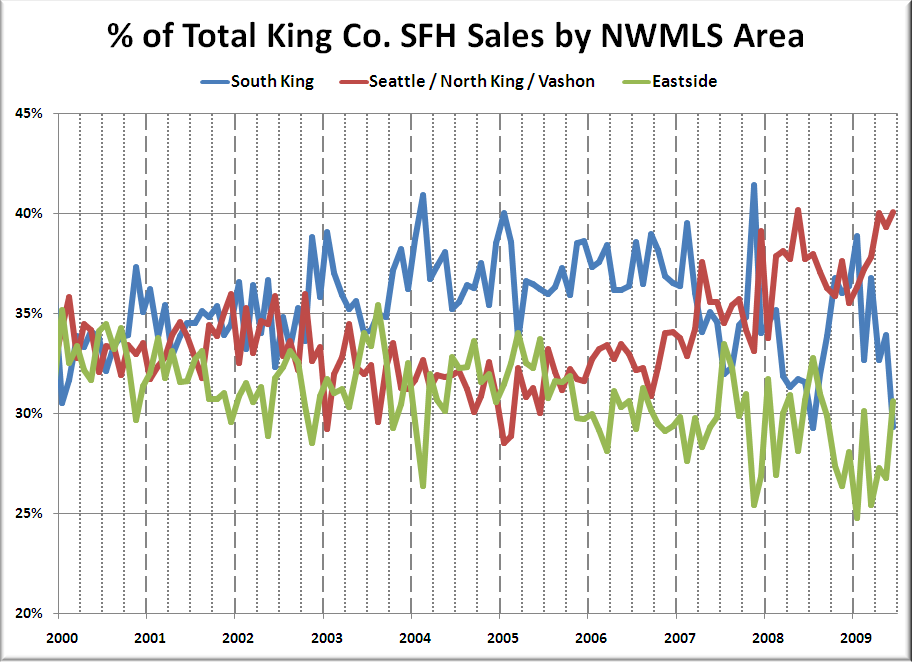
  9. I find the last graph especially interesting. It seems to suggest that during the bubble years the low end’s share of total sales rose rather dramatically. Prior to 2003 the three tiers seems to be much closer to one another. I’m curios to see this data go further back so we can see if this holds true or not.

    If it does hold true, then the current trend of the low end representing a lower percentage than that of 2003-2007 would seem to be a correction to the mean.

    And if that’s the case then the recent increase in the median is not so misleading as some on Seattle Bubble might hope.

    That said, the median and its trendline is only one tool prudent buyers and sellers should look at when making their own decisions.

  10. “It goes a long way toward explaining why the median price jumped 4.4% from March to April, but the Case-Shiller index (which uses same-house sale pairs) rose just 0.2%.”

    The larger factor in the difference is that the CSI is a three month average. The March NWMLS median is an outlier and so the rise sharp rise from March to April was offset by the sharp drop from February to March. The difference between the 3 month average NWMLS average and the CSI was only .5%.

    I suspect that the shift in the mix is not so much geographic as it is the price range that buyers are interested it. The available inventory then determines the shift in prices in individual houses as measured by sales pairs.

  11. Hi Tim, I’m new around here. Thanks for breaking down the data like you do. It’s nice to see data presented instead of interpreted and spun for a headline. I think most people don’t understand the differences when the newspaper reports figures as an average, mean, or median (extra points if you also know mode). I think the bottom line is that the recent data isn’t anything to get excited about even if the real estate agents are crying bottom.

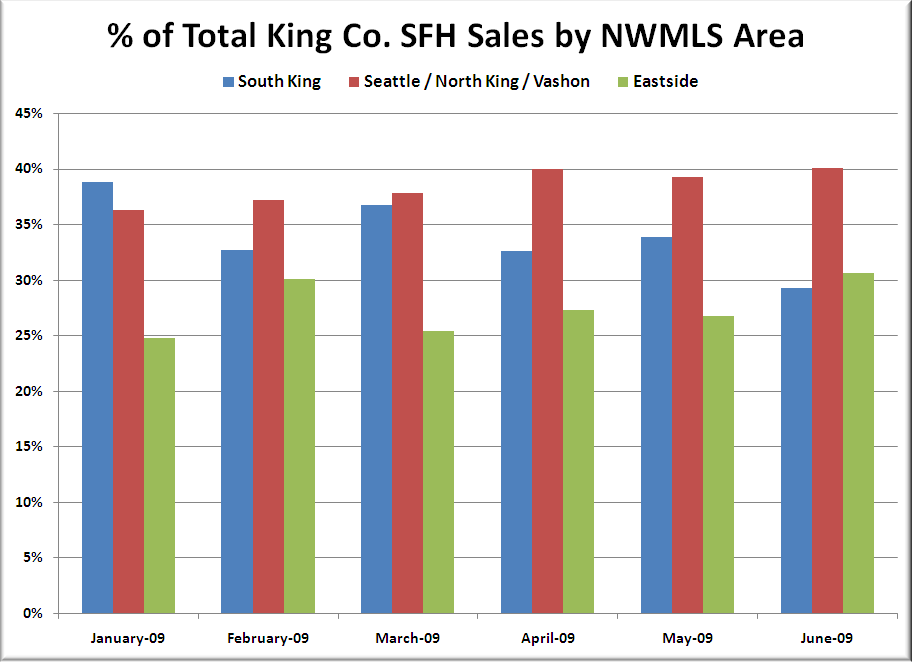
  12. So… the low median from Jan/2009 was distorted towards the bottom – as the low-priced areas had an unusually high percentage of all sales!

    “Those eggs were a lie, Steven… a LIE!”

  13. RE: Kary L. Krismer @ 6

    Absolutely. The NWMLS counts Seattle as everything with a Seattle mailing address. That includes everything in the West Hill and North Highline unincorporated areas. That’s a big swath of land, and a combined population of 50,000 plus. The West Hill goes from the southest border of Seattle down to the Renton city limits, and includes Skyway, Lakeridge, Bryn Mawr, parts of Earlington.
    North Highline includes White Center, some of South Park, and extends south to the Burien city limits.
    Most of the unincorporated areas with a Seattle address would have a larger concentration of lower tiered housing prices.

  14. RE: jon @ 10 – Also, C-S is three counties, and I don’t believe the NWMLS releases numbers for the three counties combined. Even so, the numbers of C-S and the NWMLS median are highly correlated.

    For March the NWMLS was about .018 less than the C-S numbers, as a percentage of being off the peak (e.g. C-S was 0.7744232 of the peak and the NWMLS median was 0.7564449 of the peak). The next month it .014 the other direction. The NWMLS numbers are more volatile, in part because of the 3 month average C-S uses.

  15. I’m seeing houses in South Seattle, some quite nice sit for months even at $219k. I’m seeing a few houses in non-wealthy magnolia sit around 400k. To me, that says that things are not recovering. There are tons of homes on the market, and values in prime places like Montlake are down 200-300k. Never happened before. This market is hurting and coming down. Worsening economic circumstances will push out any remaining doubt this fall…as far as places out of town, you gotta be nuts to buy now. Bellingham does have a college, is near water and ski activities, so its got some amenities.

    i do wonder how many people will still come here to get away from the rest of the country’s nightmare. We have got one of the better climactic futures.

  16. Speaking of geographic shifts, an update on Washington population and migration by county and city was released last week.

    http://www.ofm.wa.gov/news/release/2009/090629.asp

    They have housing unit data as well. King county picked up 10K new housing units in each of the past few years, while population went up 25K last year.

    Since 2000, King County population when up by 170K, while the housing increased about 10K each year. It looks like that while housing did grow faster than population from 2003 to 2005, it has since reversed.

    http://www.ofm.wa.gov/pop/april1/cocmpch2009.pdf
    http://www.ofm.wa.gov/pop/april1/huchange.xls

  17. RE: The Tim @ 17

    According to their description of their methodology (http://www.ofm.wa.gov/pop/annex/process/overview.pdf), the reason they collect the housing unit data is that it is one of several methods for estimating the population. So while it is not the greatest way to estimate population, one would expect their data to be computed with units in mind rather than structures. They do break it down by type of structure so that they can apply different ratios of people per unit, but the numbers themselves appear to me to be units. The title of the graph is “April 1 Housing by Structure Type by County, 2000-2009″, which to me implies it is housing units, not structures that are counted.

  18. Seems to me that the relevant comparison is the growth rate over the time period in question

    Housing Units (OFM) = 12.1%
    Population (OFM) = 9.9%

    Housing stock has grown quite a bit faster than population.

  19. RE: deejayoh @ 20

    IT COULD BE THE 70% LEARNING CURVE ON NEW HOME CONSTRUCTION

    Everytime the builder makes a cookie cutter house, and the quantity doubles [2, 4, 8, ect, etc. units]; the labor costs go down 30%. That’s why custom homes cost an arm and a leg, they’re all unit #1.

    I saw this phenomena during the mid 80s bubble, sales collapsed, but new cookie cutter houses kept getting built in developments already with 100+ units….it gets real cheap to slap them together after a while, even with prices collapsing they can make a killing.

    Add in glueboard and 2×6s selling for fire sale prices with the depression we’re in, you get the gist…

  20. By deejayoh @ 20:

    Seems to me that the relevant comparison is the growth rate over the time period in question

    Housing Units (OFM) = 12.1%
    Population (OFM) = 9.9%

    Housing stock has grown quite a bit faster than population.

    There is a big difference between the average size of a household between a single family and a multi-unit structure:

    http://www.ofm.wa.gov/researchbriefs/2007/brief047.pdf

    In 2000, it was 2.77 for a single family and 1.92 for a multi-unit. The shift has been towards more multi-unit: 37% in 2000 in King County in 2000, 39% in 2009. That will bring down the average household size, and thus require more housing units per person. The result will be an apparent excess of housing units, if you hold household size constant.

    That doesn’t account for the full 2.2% difference in relative growth of population to housing units, but it does take a chunk out of it.

    I’m not claiming there is not an excess of units now, I’m just looking to quantify how big that excess really is relative to the annual increase in population we can expect.

  21. RE: jon @ 22

    THE POPULATION INCREASE WE CAN EXPECT?

    Assuming the jobs outlook stays chronically unsolvable without an immediate industrial base surge and we’re tapped out borrowing for “Growthfriend”….maybe this hypothetical “population growth” in Seattle you’re refferring to won’t need homes, how about cardboard shacks and tent cities?

    Perhaps I’m being too pragmatic; assuming the new “population growth” get’s here and subsequently displaces higher income workers for lower wages, then the subsequent growth of pre-existing domestic Seattle families shacking together to survive, leaving even more empty foreclosed units, won’t matter at all?

    Let’s drink this weekend to “Growthfriend”?

  22. By Softwarengineer @ 23:

    RE: jon @ 22
    Assuming the jobs outlook stays chronically unsolvable without an immediate industrial base surge and we’re tapped out borrowing for “Growthfriend”

    Jobs will come back once inventories have dropped. The more population there is, the faster inventory will drop.

    Besides just a resumption of ordinary commerce, there are immense new markets opening up. We will be completely converting over our automobile base to electric, huge chunks of our electrical system, a whole new airframe, paper thin computer monitors connected to wireless controllers, huge changes in health care at all levels, it just goes on and on. So there is going to be tremendous opportunities for lots of people.

  23. John I am convinced that Softy wants to drag everyone down to his level. I would imagine that he has experienced very little success in his life because anyone who has been successful doesn’t think about everything being in the toilet all the time. I get a feeling that he want’s the world to go in the toilet, and have all the people in food lines etc.

    I feel if I bust my butt I will always have money, and every year including this one I have continued to make more money. But I am relentless in how hard I work to build my client base, and do not let up.

    “pre-existing domestic Seattle families shacking together to survive, leaving even more empty foreclosed units, won’t matter at all?”

    You may be right, buy how many people do you know that are in this situation. Everybody I know that has been foreclosed on had multiple properties, so I can’t comment about “shacking up” but I have not heard about people I personally know that are in this position, I know they are out there, but how many do you know personally?

  24. RE: Sniggy @ 25

    I’M NOT IN DEBT ARE YOU?

    Where’s the jobs for all your growth…..you two have optimistic attitudes, BUT NO JOBS and you want more population growth. And I’m negative, because I’m for real global warming protection and debt reduction?

    I’m a nuclear engineer and not an economist, but it doesn’t take a rocket scientist to figure you can’t create jobs out of no where. Even if your new technologies started hiring 5-10 years from now, how much is going to be insourced/outsourced? Little good that does “We the People” right now. But tax payers really don’t matter?

    When your “pie in the sky” unemployment rate agrees with your optimism, then I’ll listen to you.

    Enjoy your debt, you two sound like you signed mortgage papers a couple years ago and are bitter.

  25. [...] prices can be a poor indication of actual short-term home price [...]

  26. [...] Median Price* [...]

  27. [...] Let’s check in on an update of how the sales volume is breaking down among the different price tier regions around the county. For a more in-depth explanation of the process and reasoning behind this data, hit this post. [...]

  28. [...] Let’s check in on an update of how the sales volume is breaking down among the different price tier regions around the county. For a more in-depth explanation of the process and reasoning behind this data, hit this post. [...]

  29. [...] Median Price* [...]

  30. [...] strongest showing for buyers last month, which should come as no surprise given what we saw when we broke down the sales patterns on a geographic basis earlier in the [...]

  31. [...] (?)2.33+17.1%-30.9%Pending Sales1,765+24.9%+52.3%Months of Supply4.3-12.9%-45.1%Median Price*$375,000-1.3%-2.0%Closed sales usually tumble from December to January, but last month’s [...]

Leave a Reply

Do you want a nifty avatar picture next to your name, instead of a photograph of Tim's dog? Just sign up with Gravatar, and make sure to use the same email address in the form below. It's that easy!

Sponsors


Seattle Real Estate :: Brent Fosso

Sponsors

  • Home Improvement Forums
  • East Bellevue Real Estate
  • For Sale By Owner
  • Home Builders

Tip Jar

Archives

Performance Optimization WordPress Plugins by W3 EDGE