Posted by: The Tim

Tim Ellis is the founder of Seattle Bubble. His background in engineering and computer / internet technology, a fondness of data-based analysis of problems, and an addiction to spreadsheets all influence his perspective on the Seattle-area real estate market.

22 responses to “Homebuying Tips and Traps from 1996”

  1. Acerun

    That is good for a Monday morning laugh, thanks for posting.

    Rate this comment: Thumb up 0 Thumb down 0

  2. David Losh

    In 1996 properties were cheap. There were very few over priced listings. Windows 95 looked to be the next generation of personal computers and every one needed to buy a computer in those days. Properties were an investment you had to work at as opposed to buying some stocks and getting rich over night.

    The world has changed a lot since then.

    Rate this comment: Thumb up 0 Thumb down 0

  3. Ray Pepper

    How about digging a bit more and tell us what Robert Irwin is doing now?

    Rate this comment: Thumb up 0 Thumb down 0

  4. Kary L. Krismer

    With hindsight, the advice to buy in a sellers’ market in 1996 wasn’t too bad of advice. ;-)

    The median for July, 1996 was $170,700. Even ignoring the effects of leverage on the calculation, you could have easily doubled your money in less than 10 years.

    The book though does seem to treat buying a home more as an investment than of one made for personal reasons. That’s part of what got us into the situation we got into.

    Rate this comment: Thumb up 0 Thumb down 0

  5. Kary L. Krismer

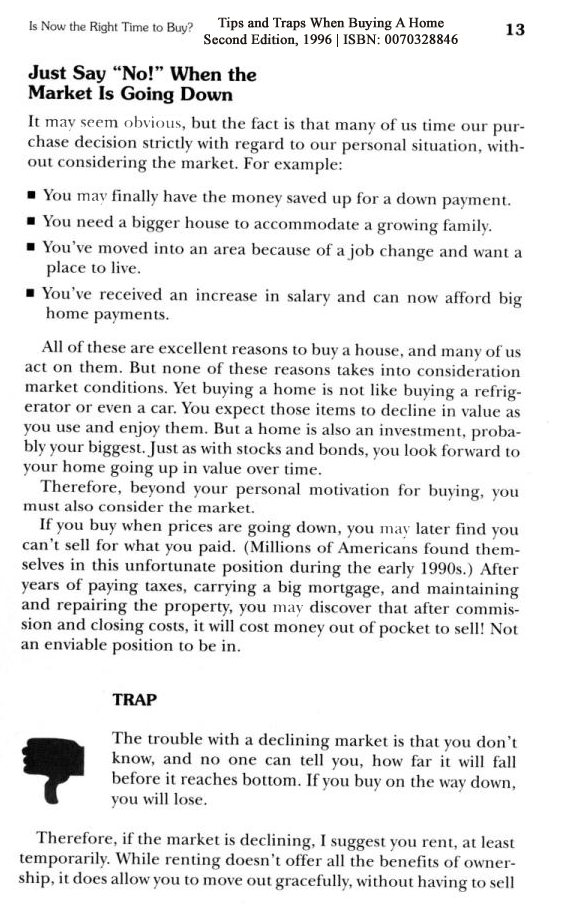
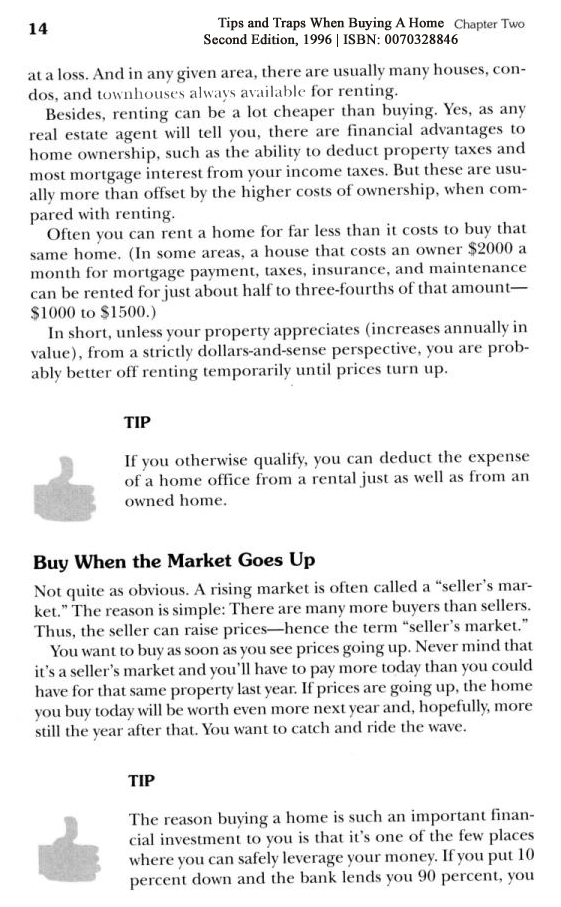
    “Never mind that it’s a seller’s market and you’ll have to pay more today than you could have for that same property last year. If prices are going up, the home you buy today will be worth even more next year and, hopefully, more still the year after that.”

    Didn’t Cramer say something almost identical to that? Year might have been week or month, but I seem to recall him saying almost the same thing.

    It makes more sense with stocks than houses because of liquidity and transaction costs.

    Rate this comment: Thumb up 0 Thumb down 0

  6. Ray Pepper

    Never mind. I found Robert Irwins new book.

    http://www.violent loveskillsforchristianhusbands.com/bio.html

    Rate this comment: Thumb up 0 Thumb down 0

  7. Kary L. Krismer

    RE: Ray Pepper @ 6 – Now that book probably is funny!

    Rate this comment: Thumb up 0 Thumb down 0

  8. Ray Pepper

    RE: Kary L. Krismer @ 7

    I just ordered 2 books…See, Kary…We always learn something from Seattle Bubble. Tim just keeps giving and giving..

    Rate this comment: Thumb up 0 Thumb down 0

  9. Kary L. Krismer

    One of his books is how to sell FSBO–in 2008! :-D

    Rate this comment: Thumb up 0 Thumb down 0

  10. Groundhogday

    RE: Ray Pepper @ 6

    Does it also have tips and traps? They might have more literal meaning in this context.

    Rate this comment: Thumb up 0 Thumb down 0

  11. Groundhogday

    By Kary L. Krismer @ 4:

    The book though does seem to treat buying a home more as an investment than of one made for personal reasons. That’s part of what got us into the situation we got into.

    Yep. Interesting from an historical perspective to see that thinking published in 1996. It suggests that the psychology necessary to create a massive real estate asset bubble was in place long before the bubble actually occurred.

    Rate this comment: Thumb up 0 Thumb down 0

  12. BillE

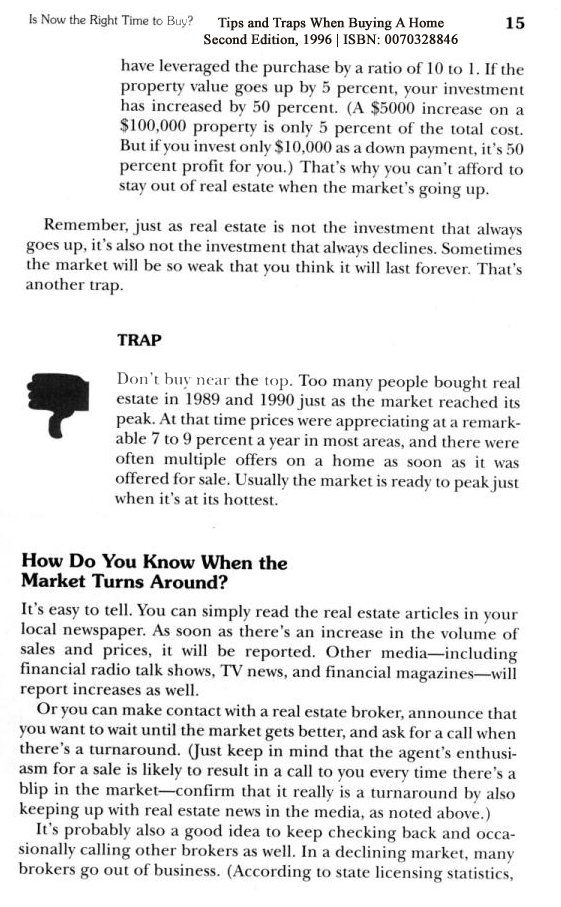
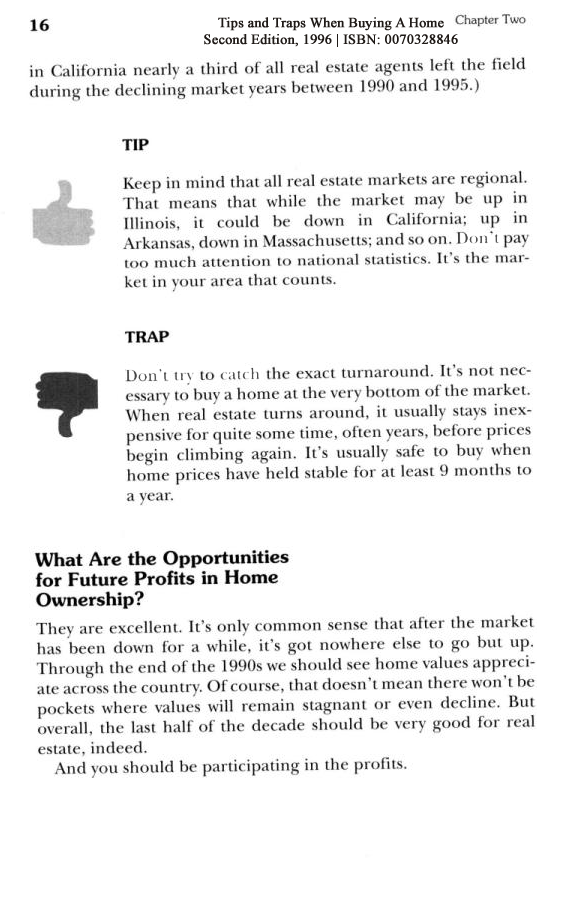
    How Do You Know When the Market Turns Around?

    It’s easy to tell. You can simply read the real estate articles in your local newspaper.
    …
    Or you can make contact with a real estate broker, announce that you want to wait until the market gets better, and ask for a call when there’s a turnaround.

    Priceless comedy right there.

    Rate this comment: Thumb up 0 Thumb down 0

  13. Racket

    By BillE @ 13:

    How Do You Know When the Market Turns Around?

    It’s easy to tell. You can simply read the real estate articles in your local newspaper.

    Or you can make contact with a real estate broker, announce that you want to wait until the market gets better, and ask for a call when there’s a turnaround.

    Priceless comedy right there.

    At the time this may have been good information for people who were not Real Estate Savvy.

    Rate this comment: Thumb up 0 Thumb down 0

  14. George

    The buyer has much better information to formulate their own opinions and there will be better and more information available in the future. When the public information made the transition to the web the industry completely changed. Now the purchaser has the same information as the agent and can formulate their own opnion. The industry is working to figure out how to deal with this fact. There are a whole lot of implications and it fundamentally changes how business will be done.

    Never ask an agent if now a good time to buy. If the market is going up the answer will be buy now because the price will go up. If the market is going down the answer will be prices are down now is a great time to buy. You know the rest.

    Rate this comment: Thumb up 0 Thumb down 0

  15. David Losh

    RE: George @ 15

    Seriously,

    Every body knows so much about Real estate that even today, with all of the information on the web, people would buy a house on Queen Anne for $199K and think they were making a good purchase.

    This book was written by the same person who writes blogs. The information was good in the day, today is different, and tomorrow will be different again.

    Real Estate is a snap shot in time. You need some one who can develop the picture clearly.

    Rate this comment: Thumb up 0 Thumb down 0

  16. tomtom

    By David Lush @ 16:

    Real Estate is a snap shot in time. You need some one who can develop the picture clearly.

    Most folks take digital photos these days which don’t need to be ‘developed’.

    Rate this comment: Thumb up 0 Thumb down 0

  17. meme

    By Kary L. Krismer @ 4:

    With hindsight, the advice to buy in a sellers’ market in 1996 wasn’t too bad of advice. ;-)

    The median for July, 1996 was $170,700. Even ignoring the effects of leverage on the calculation, you could have easily doubled your money in less than 10 years.

    Nationwide, the median single family home price was $121,900 in May of 1996. By May of 2009, it was $172,900.

    That’s an increase of 40%, pretty much about the amount of inflation in that time.

    Rate this comment: Thumb up 0 Thumb down 0

  18. Kary L. Krismer

    RE: meme @ 18 – Well first, the forum here is Seattle Bubble, so what’s it matter what the nationwide price change was?

    Second, how would someone buy a nationwide house? They have to pick a market. I’m sure there are a few markets that hardly changed at all.

    Rate this comment: Thumb up 0 Thumb down 0

  19. meme

    By Kary L. Krismer @ 19:

    RE: meme @ 18 – Well first, the forum here is Seattle Bubble, so what’s it matter what the nationwide price change was?

    Second, how would someone buy a nationwide house? They have to pick a market. I’m sure there are a few markets that hardly changed at all.

    So have Seattle prices really gone up 100% in the last 13 years, while nationwide, prices have only gone up 40%?

    If that is so, that is strong evidence that seattle property values are going to go way, way down from here.

    Rate this comment: Thumb up 0 Thumb down 0

  20. David Losh

    RE: tomtom @ 17

    Brilliant!

    Best of lick!

    what I know is that with this digital photograph people are paying 2004 and 2005 prices today for properties. Even with the information on the web people are paying too much for property.

    We were talking in 1996 terms.

    Rate this comment: Thumb up 0 Thumb down 0

  21. Sniggy

    By meme @ 20:

    By Kary L. Krismer @ 19:
    RE: meme @ 18 – Well first, the forum here is Seattle Bubble, so what’s it matter what the nationwide price change was?

    Second, how would someone buy a nationwide house? They have to pick a market. I’m sure there are a few markets that hardly changed at all.

    So have Seattle prices really gone up 100% in the last 13 years, while nationwide, prices have only gone up 40%?

    If that is so, that is strong evidence that seattle property values are going to go way, way down from here.

    Some houses in Detroit are down 75% so does that mean we are going to fall to their level?

    Rate this comment: Thumb up 0 Thumb down 0

Leave a Reply

Do you want a nifty avatar picture next to your name, instead of a photograph of Tim's dog? Just sign up with Gravatar, and make sure to use the same email address in the form below. It's that easy!

Please read the rules before posting a comment.

Archives