Time to take a look at August market statistics from the NWMLS. Here’s the NWMLS press release: Northwest MLS brokers report brisk activity, multiple offers, "irrational delays" by lenders.
Here’s your King County SFH summary, with helpful arrows to show whether the year-over-year direction of each indicator is positive or negative news for buyers and sellers:
| July 2009 | Number | MOM | YOY | Buyers | Sellers |
| Active Listings | 9,491 | -3.7% | -20.6% | ![]() |
![]() |
| Closed Sales | 1,609 | -6.8% | +5.0% | ![]() |
![]() |
| SAAS (?) | 1.88 | -7.7% | -13.4% | ![]() |
![]() |
| Pending Sales | 2,311 | +4.2% | +31.5 | ![]() |
![]() |
| Months of Supply | 4.11 | -7.6% | -39.6% | ![]() |
![]() |
| Median Price* | $375,000 | -2.3% | -11.6% | ![]() |
![]() |
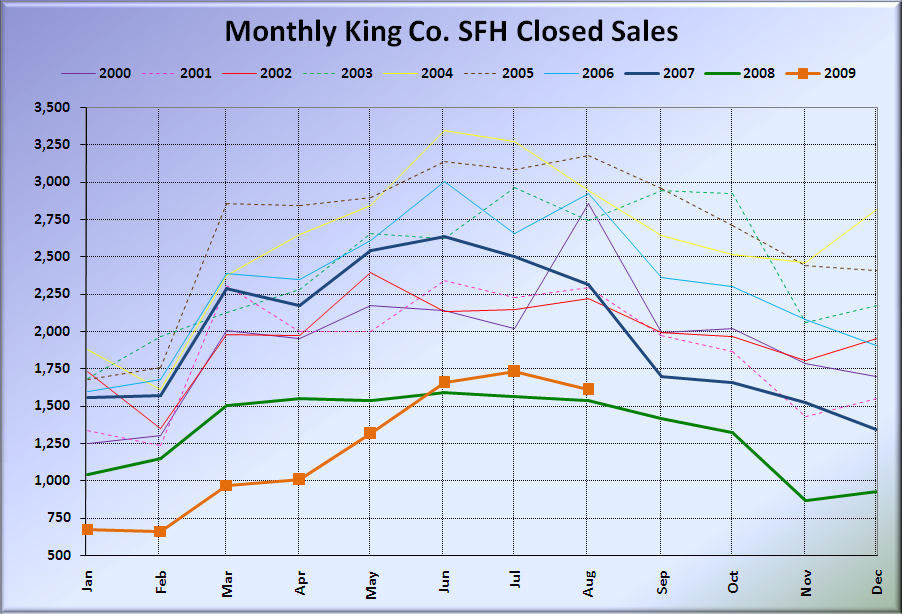
Breaking from the pattern we had seen in recent months, closed sales declined in August, falling even further below the pending sales levels from the previous months. Barring an unexpected and incredibly uncharacteristic surge in closed sales in September or October, it looks like July’s 1,727 will end up being the one-month maximum.
I’m having some trouble uploading the spreadsheet from here at PAX, but before I head to bed tonight I will post the updated Seattle Bubble Spreadsheet, and here’s a copy in Excel 2003 format. Click below for the graphs and the rest of the post.
Here’s the graph of inventory with each year overlaid on the same chart.
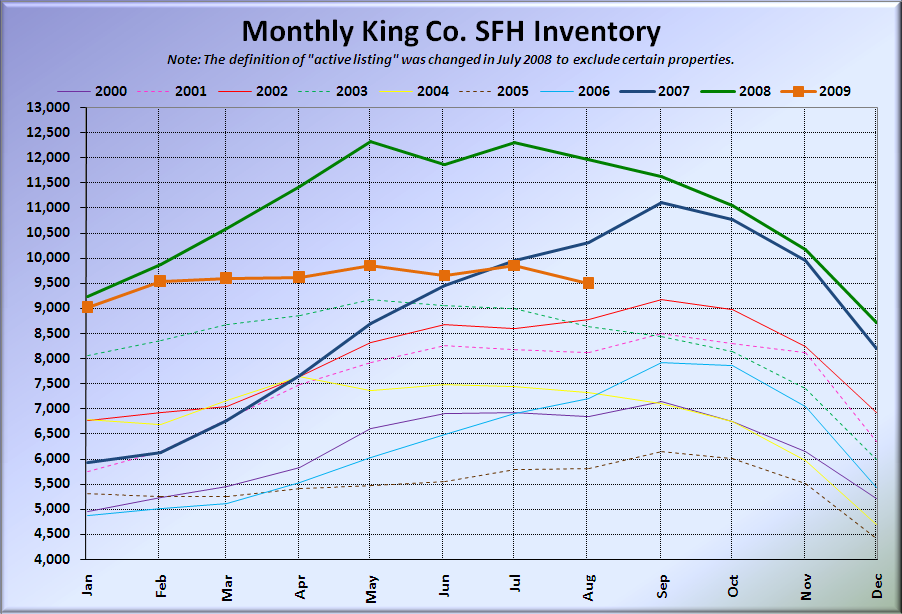
Inventory for most of this year has been remarkably flat.
Here’s the supply/demand YOY graph. In place of the now-unreliable measure of pending sales, the “demand” in the following two charts is now represented by closed sales, which have had a consistent definition throughout the decade.
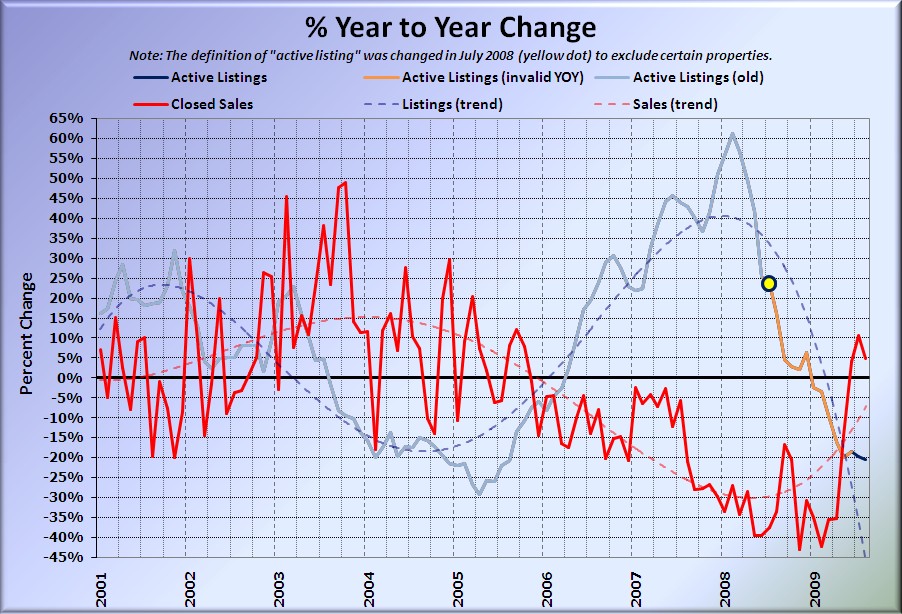
Diminishing YOY increases for sales in August. Will be interesting to see if we drop back into negative YOY territory before the year is up.
Here’s the chart of supply and demand raw numbers:
Here’s the median home price YOY change graph:
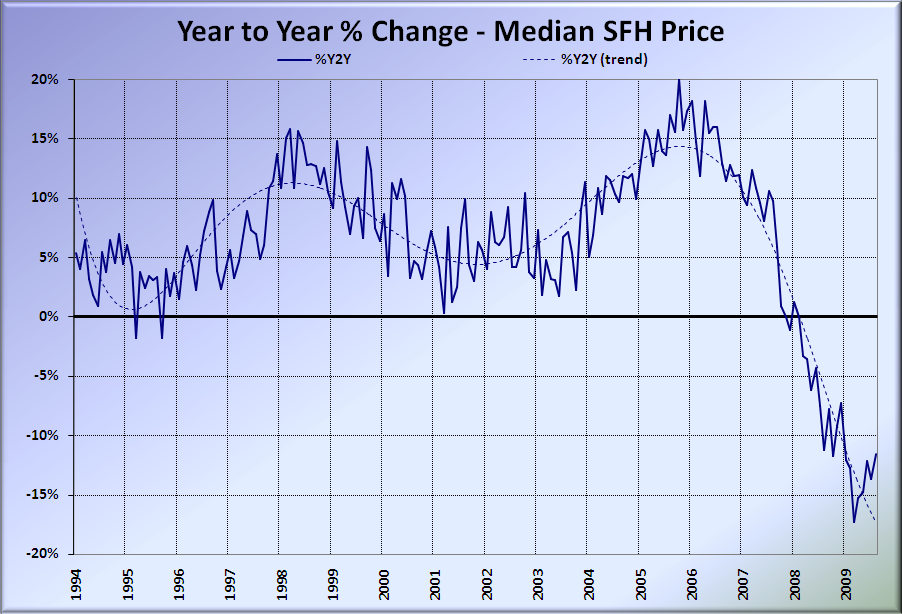
And lastly, here is the chart comparing King County SFH prices each month for every year back to 1994.
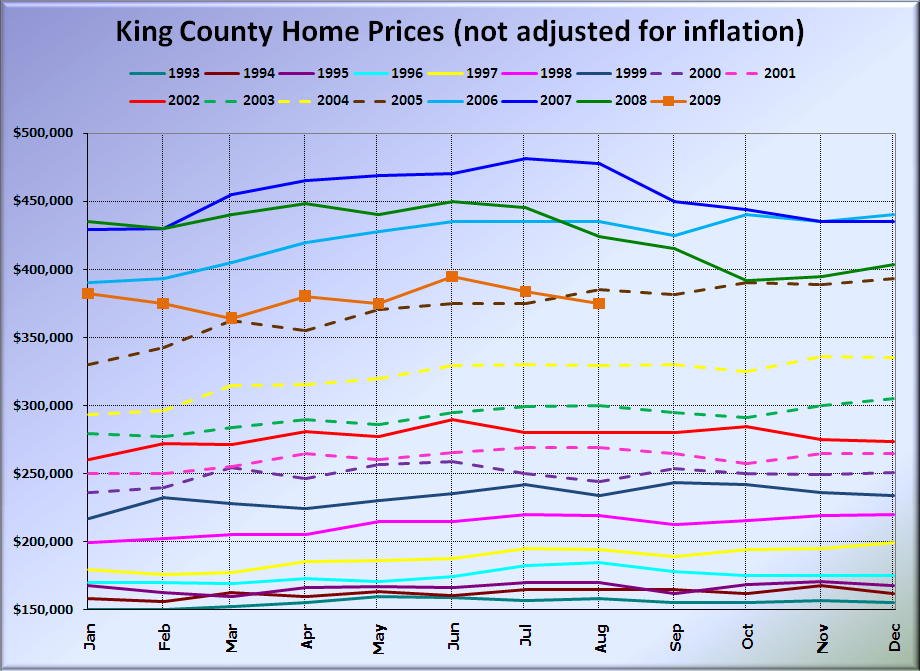
August 2009′s SFH median came in $10,000 below August 2005. I bet it would really suck to be somebody that was considering buying in August 2005, but started a bubble blog instead. Or not.
Here’s a few news blurbs to hold you over until tomorrow’s reporting roundup (which will probably be posted later in the day than usual due to it being a Saturday, and also PAX). [Update: I decided to hold off on the reporting roundup until Monday, since a lot fewer people read the site on the weekend anyway, plus with the holiday weekend I imagine traffic will be even lighter. Have a great weekend everybody, see you Tuesday.]
Seattle Times: August home sales strong in Puget Sound region but median prices continue to sag
Seattle P-I: Pending home sales spike, according to MLS report


“…is positive or negative news for buyers and sellers”
Better wording is “favorable (F) or unfavorable (U).”
Also I am not sure if a reduction/increase in closed sales is favorable or unfavorable for buyers. Why would an increase in sales be favorable for buyers? Why would an increase in sales be unfavorable for buyers?
Clearly increases (positive) in prices are favorable for sellers and unfavorable for buyers.
Rate this comment:
0
0
Tim,
Google: Vacation. ;-)
One thing occurred to me. Greg plays very close attention to pendings, and that probably played a big role in his prediction of 2000 sales in a month by now.
Rate this comment:
0
0
“it looks like July’s 1,727″ will be the max for a month.
I am going to go out on a limb here, and I will probably fall, but I am not going to discount the month of November. I am not sure how many of the “first time home buyers” will close in that month, but there could be some of the normal December activity pulled forward. November is going to be a “we must close now, or never…” Those who would actually get the $8k benefit will probably demand a $8k reduction to close on or after December 1, and that won’t go well with sellers, or lenders in the case of short sales. I also note that the big incentive is to close as close as possible to November 30, so the money will be on loan to the government for a shorter period of time.
Rate this comment:
0
0
I won’t be surprised if there’s an uptick in closed sales as people fall all over themselves to get in on the 8k government gift, because apparently, $8,000 is a big chunk to save when spending hundreds of thousands of dollars.
Rate this comment:
0
0
RE: BillE @ 4 – When you consider how leveraged many real estate transactions are, 8k is actually quite a bit. For someone doing FHA at the minimum down, it would replace their down payment on $242,000 of the transaction (after closing).
Rate this comment:
0
0
The Tim,
Shouldn’t the current month closed sales be compared to previous months pending sales to determine how much they have “diverged”?
The difference is 608 between August closings and July pendings.
The difference was 720 between July closings and June pendings.
The ratio went up to 72.6% from 70.6%
I don’t know how you can conclude this is diverging.
Rate this comment:
0
0
RE: waitingforseattletocool @ 6 – That sort of assumes that the pendings close in the next month. In reality, for those that do close, most would be in one of the next two months.
Also, Tim didn’t graph out historical pendings, but I’d suspect it’s unusual that they go up in August, because in most years (all but 2003) the sales in September and October were down from August, so you wouldn’t expect to see rising pendings in August.
The thing that might give this pending number a bit of validity is the first time buyer credit. A lot of people might be trying to miss the closing rush at the end of November.
Rate this comment:
0
0
RE: Kary L. Krismer @ 7 –
I am just saying you have to look at the pendings in the prior month or months vs. the present or recent closings to make a statement about divergence.
It is inaccurate headline.
Rate this comment:
0
0
By Kary L. Krismer @ 5:
Exactly! And that’s pretty much the point in this supposedly stabilized market–people don’t have the money to buy houses, so the government borrows money from China and gives it to them. This is ultra-high risk lending. These people can’t even manage to scrape together a measly 3% of the purchase price, how is it that they are fit to borrow $250K? A very similarly risk model (subprime) recently nuked the entire world economy. The solution to fixing the mess these insane lending practices created–more of the same.
“We can’t solve problems by using the same kind of thinking we used when we created them.” Albert Einstein
Rate this comment:
0
0
While I’d rather have $8000 than not, it’s a small percentage of a home’s purchase price. There are a lot of people thinking they have to buy NOW so they can get that $8k. In our recent environment, 8k can be 6 months of price declines, or negotiated off the asking price, or made up with the seller paying closing costs. It’s similar to the interest tax deduction. People want to send the bank $1000 in interest so they can save a couple hundred on their taxes, and now they want to take out a $300k mortgage so the government will give them $8k.
Rate this comment:
0
0
1600 more people decided to get off the fence. Interesting. MSM is really gaining.
Rate this comment:
0
0
I’m guessing they will extend the 8k credit right at the last minute for several month, and then wait til the last minute and extend again to keep people thinking it’s gonna disappear. The reality is that when it goes away, house values will promptly drop another 8k.
Rate this comment:
0
0
RE: buystocks @ 12 –
It doesn’t do much good to extend a “one-time-only” program like this at the last minute.
Consider the person who wants to become a homeowner soon (say, within the next 6 to 12 months) and for whom the 8K tax credit means the difference between buying and not-buying. This is the marginal class of individuals to which the “stimulus” is really directed since they would represent actual “additional” sales.
Now a person like this who is facing a time-hack and who believes that deadline is credible, has to make a decision of whether to buy or not in order to close on something before December. If they choose to buy, they’ll make the deadline. If they “miss” the deadline it is probably because they chose not to buy.
If the deadline is extended by, say, 3 months at the last minute, I highly doubt that their package of reasons for having chosen not to buy under the incentive of the credit and the threat of the deadline will change significantly in the new period. Maybe a few of them will have unexpected fortune, or inventory or pricing will improve somewhat, but I doubt you’ll capture many more folks after the first effort “expires”.
Rate this comment:
0
0
Indy,
Agree with some of your argument. Every time we extend it at the last minute there will be less of a boost during the next cycle, however it will still boost sales each time. Sort of like when your running out of toothpaste; you keep figuring out ways to keep squeezing some out, but getting less reward each time.
Rate this comment:
0
0
RE: buystocks @ 12 –
The prices won’t drop by 8k right after the expiration because not all buyers qualify.
Rate this comment:
0
0
RE: waitingforseattletocool @ 8 – I stand by the headline. I tried to explain my reasoning in the post…
…but I guess I wasn’t clear enough, so here it is in chart form:
Hit this post for the background on that chart.
Rate this comment:
0
0
By AMS @ 15:
The tax credit isn’t the only thing going away. There was also temporary high limit comforming loans created up to 567K that expire at the end of the year. Those became available in May and really helped the upper end homes start selling.
Rate this comment:
0
0
I think the 8K thing is a non starter for most of the well qualified buyers out there. Having it phase out between 75-95K MAGI may help sales in a lower income area, but in Seattle where our housing prices and incomes are generally higher, this doesn’t benefit those who are most capable of responsibly buying a house based on their income. My buddy just bought a house and was all excited about the 8K, but I informed him that he is too rich to qualify. Lucky him. I realized as well that being based on MAGI, I’m also out of luck even though I have quite a few deductions without being a homeowner. Fence sitting is pretty nice.
Rate this comment:
0
0
RE: DrShort @ 17 –
Oh, maybe I should be a little clearer in my thought process.
I do believe that prices are going down, but I am not willing to suggest that on December 1, 2009 all home prices will go down by $8,000.
Similarly with the loan limits. Once those are lowered, it will have downward pressure on home prices, but it certainly won’t adjust all the prices in the “gap” area down by the “gap” amount. (If a home is very close, then the reduction is very little. On the other end are the homes that were just above the conforming limits. These homes would need to be reduced by the entire gap, plus a little.)
These are two factors that have nothing but downward pressure on home prices. In my opinion there are plenty of more good factors that have a downward pressure on home prices. Very few things today have an upward pressure.
Rate this comment:
0
0
RE: The Tim @ 16 –
Latch on to whatever data makes your case.
Rate this comment:
0
0
RE:waitingforseattletocool
Isn’t that the point. Present data and attempt to derive a conclusion from it. This is one of the differences between an educated buyer and an uneducated buyer. Your not providing any counter-argument here.
Rate this comment:
0
0
RE: buystocks @ 20 –
well, an alternative argument might be that since March (stimulus enactment, stock market low, etc.), the ratio of closed sales to prior month pending has steadily improved, from 59% to nearly 73%.
will it reach historical average of 90% this year or any time soon? I doubt it.
Rate this comment:
0
0
By Jonness @ 9:
They don’t get the money until sometime after closing, so they had to have had the downpayment prior to closing.
That’s the one thing I liked about this particular first time buyer program, and the state tried to ruin it by making the money available at closing. Fortunately they didn’t succeed.
Rate this comment:
0
0
RE: BillE @ 10 – I agree 100%. But what is going to be the fate of these suckers?
The govt. is pumping money into the the stock market, the auto market, the housing market, etc. in order to fix prices above their true value and make the economic charts look better. The goal is to fool unaware people into jumping aboard the gravy train. Supposedly, this will permanently inflate the market. The problem is, unemployment is horrible, people are tapped out credit-wise, the housing correction has destroyed the perceived wealth of homeowners, mortgage delinquencies are setting new records, etc. So if the govt ends the cash for clunkers, $8K mortgage rebate, etc. all at once, the fluffy charts all the bulls are reading are going to look really bad. The only thing propping up this economy right now is govt. spending. Therefore, I don’t expect a reduction in free give-away programs. If anything, I expect an increase.
A third of loans are FHA. Most of the rest are guaranteed by the govt.. There is no real credit market out there. The only reason the banks are alive is because of govt. money and the suspension of the requirement to their mark assets to their real value. Thus, the banks can claim their worthless assets are worth billions. This makes good profits on paper, but it isn’t real. Investors made a fortune from Madoff up until his paper-scam collapsed. And that’s the final fate of suckers.
Rate this comment:
0
0
RE: Kary L. Krismer @ 22 – Yes, but buyers can keep their credit cards up in order to shoulder the $8K and then pay it back once the free money from China gets deposited into their checking accounts. As I understand it, the govt. does not raise it’s requirement to 10% down until the buyer’s credit score drops below 500.
People addicted to credit are experts at working the system. For many, the free money from China equates to a free downpayment. Unfortunately, many of these people will end up losing their homes because what looks good on paper is difficult to carry out in real life.
The smarter con would buy the house using free China money for the down, refuse to make a single payment, and live there rent free for 2 years. At $1K/mo rent, he’ll get $24K free instead of a measly $8K. And if he can arrange for enough paper stave-offs, he will more than triple the $8K gift. IOW, anybody can use the easily available infinite leverage available right now to make a very large profit if they are willing to ruin their credit score. If your score is between 500 to 600, you might as well go for it.
Rate this comment:
0
0
RE: Jonness @ 25 –
Processing time for amended returns right now is 12-16 weeks. If they’re hoping to put it on their credit cards and pay it off next month, they’re going to be in for a surprise.
Rate this comment:
0
0
Regarding price drops after the tax credit expires (if it does), I think sellers in the lower price ranges will be slapped in the face by reality if their home is still on the market after the credit goes bye bye. If I’m selling a house in a price range that should appeal to first time buyers, I’m going to start feeling sick when it’s still on the market in December.
Rate this comment:
0
0
RE: BillE @ 27 – The $80,000 and under homes are going to have much greater downward pricing pressure than million dollar places. Essentially the credit has no impact in the Seattle market when contrasted to the Detroit market. That said, the downward pressure is somewhere between $0 and $8,000, inclusive, on each individual property. The ‘average’ impact will be less than $8,000 and more than $0 in each market and the larger total market. If I remember right, the credit has an upper bound of 10%, but it includes mobile homes, motor homes, boats, and so on when used as a primary residence. Who knows, maybe I should start selling tents and tax services to the homeless–You can own your tent and Uncle Sam will pay 10% (max of $8,000), provided you have not owned a principle residence in the last three years. I bet the pricing on tents will remain unchanged after the expiration of the credit.
Rate this comment:
0
0
Expected Value:
First a definition, http://www.math.uah.edu/stat/expect/Properties.xhtml
For a single property take the credit amount, which is not a RV, and multiply by the probability that a qualified home buyer will buy, which is a RV.
The pmf is clearly finite, and thus discrete, with each price point (or category) being a potential qualified buyer’s selection. Based on supply and demand theory, we have a monotonic probability mass function (pmf) if we restrict our domain to get rid of some absurdities on the very bottom end. Of course human behavior doesn’t always follow the rational player assumption.
One thing should be clear: the expiration of the tax credit can only have a downward pressure, possibly zero, on selling prices, with an upper bound of $8,000.
NOTE: This is not a rigorous development, but rather a simple way to measure the potential impact of the expiration f the first-time home buyer tax credit.
Rate this comment:
0
0
RE: Jonness @ 25 – Well I’ve been very critical of using credit scores for mortgage lending because it does allow someone carrying $10,000 of credit card debt month to month to have a good credit score. That fact alone should devastate your credit score for purposes of mortgage lending. The credit scores work the way they do because owing $10,000 is a good thing if you’re going to give someone a credit card with a $5,000 limit. It’s a bad thing if you’re going to give them a $400,000 30 year mortgage. And credit scores were originally developed for the former purpose, not the latter.
BTW, I’m not so sure that for FHA you could borrow part of the down payment on your credit card. I’ll leave that for a mortgage person.
Rate this comment:
0
0
RE: Kary L. Krismer @ 30 -
I think your suspicion is correct. However, you can charge other things and use the money for them for the downpayment. Having known a certain culture of people a little too well, I highly suspect there is some real scamming of the system taking place in order to get at the $8K. Also, I suspect the free money has extra appeal to the impulsive gambler type personality, and a fair amount of people will end up hurting themselves playing the game.
I mean, one of Bush’s biggest legacies was presiding over a massive increase in the homeownership %. But his efforts eventually backfired, because you can’t loan money to people who don’t have the means to pay it back.
I predict the govt. will keep enticing the consumption addicts to spend in an effort to keep the magic numbers illusion going. In the end, I think it will do more harm than good though.
Rate this comment:
0
0