Time for the monthly reporting roundup, where I read all the local paper rehashes of the NWMLS press release so you don’t have to.
Here’s a link to this month’s NWMLS press release: Tax credit spurs big surge in Western Washington home sales
Before we get into the roundup, I’d like to take a moment to quote an excerpt from the monthly NWMLS data post from May, which was titled Huge Gap Opening Between Pending and Closed Sales (a subject that I first brought to your attention in August of last year).
The disconnect between pending sales and closed sales grows ever larger. … Something is becoming extremely fishy about the pending sales data.
…it is good to keep in mind when you start reading news reports in the coming weeks about the market supposedly picking back up. It’s an illusion.
Here’s a graphical representation of the 2009 sales illusion:
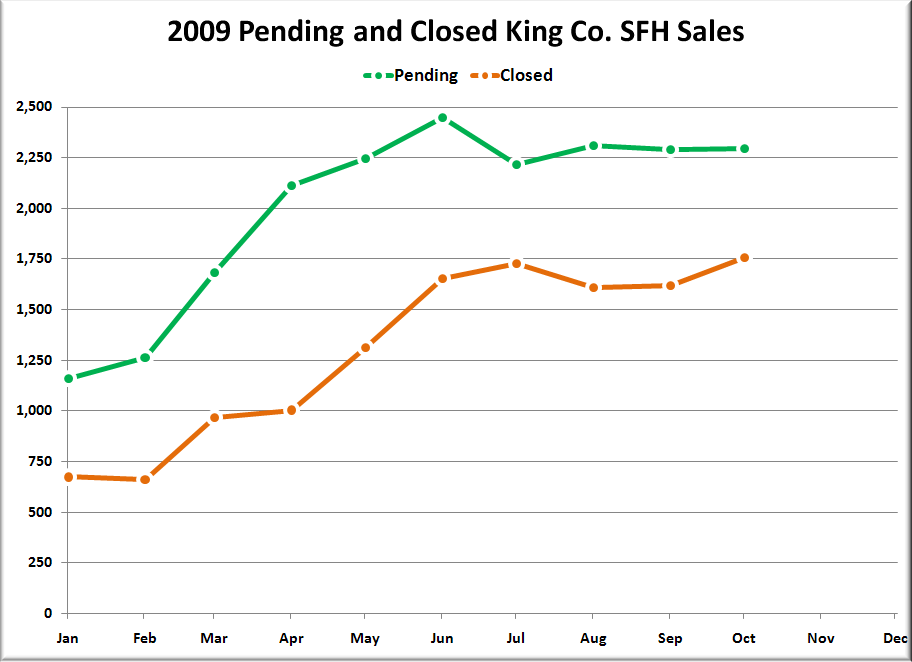
Pending sales peaked at 2,447 in June, while so far closed sales have not made it higher than 1,758—a nearly 30% discrepancy. So far this year there have been at total of 20,025 pending SFH sales in King County, but only 12,986 actual closed sales. In other words, more than a third (35%) of pending sales have yet to materialize into closed sales. That difference is typically well under 10%.
Find me a newspaper that reported this growing issue last August.
Click below for this month’s roundup of gawking at the tax credit.
Eric Pryne, Seattle Times: Tax credit brings house buyers out in October in King, Snohomish counties
Home sales in the Seattle area reached new highs for the year in October, a burst real-estate professionals attributed in large part to the $8,000 federal tax credit for first-time buyers.
…
On the Eastside, the tax credit has helped spur sales in neighborhoods south of Interstate 90, said Thadine Bak, broker in Windermere’s Bellevue South office.It also has created what she called “trickle-up” buyers: Homeowners looking for new, often more expensive homes once they sell their houses to first-timers. There has been a burst of interest recently in houses in South Bellevue in the $600,000-$700,000 price range, Bak said.
Eastside sales increased partly because sellers are getting more realistic in pricing their homes, said Mona Spencer, broker in John L. Scott’s Redmond office: “They’re finally getting it.”
But the impact of the federal tax credit can’t be understated, she added: “It gives [buyers] an incentive to go out and look.”
Once again, Eric’s reporting does a good job of sticking to the facts. Home sales are up thanks to the tax credit.
Gerry Spratt, Seattle P-I: Pending home sales spike, MLS report says
Pending homes sales were up more than 64 percent in Seattle and almost 71 percent in King County in October over the same period a year ago as first-time homebuyers rushed to beat the Nov. 30 expiration of an $8,000 federal tax credit, according to the latest numbers released by the Northwest Multiple Listing Service.
In the entire 19-county MLS coverage area, pending sales were up nearly 63 percent year-over-year and the median home price was down 7.2 percent to $269,995 — the smallest drop since June 2008. Inventory fell 17.39 percent from last year to 38,159 — the lowest level since December 2008.
Glenn Crellin, director of the Washington Center for Real Estate Research at Washington State University said the pending sales number is good indicator of market activity, but can be misleading.
“We need to understand that some, and perhaps many, of those pending will never close, and if they are pendings on short-sale properties they may close, but not for a long time,” Crellin said in an e-mail. “That said, the surge in pending sales in October was clearly driven by buyers claiming the tax credit who wanted to be able to close by the end of November. It’s probably even more spectacular than it looks, because I suspect that most of those contracts were written in the first half of the month, giving the buyers at least 45 days to close.”
Okay, first off, there was no “surge in pending sales in October.” Pending sales were virtually flat for the month. They “surged” year-over-year because typically pending sales tend to decline slightly from September to October, and last year they dropped off dramatically:
Secondly, as mentioned above, pending sales are about as useful a measure of actual market action these days as “open house traffic.”
Mike Benbow, Everett Herald: Snohomish County home sales shoot up 35%
Home sales in Snohomish County exploded last month as buyers rushed to beat a deadline that they thought might end an $8,000 tax credit.
Home sales in the county rose 35 percent from a year ago and pending sales ballooned 91 percent as first-time buyers hurried to close their deals by the end of this month, the Northwest Multiple Listing Service reported Thursday.
“I had my best month in 20 months,” said Meribeth Hutchings, a Windermere broker in Lake Stevens who is also on the board of the listing service.
She added that Thursday’s House vote to extend the first-time buyer credit and expand it to other people was great news.
It’s always “great news” when the federal government blows tens of billions of dollars that we don’t have to boost your special little industry. Maybe I can get Congress to pass a giant handout to bloggers, next.
Kelly Kearsley, Tacoma News Tribune: Closed sales of homes rise in Pierce County
Pending and closed home sales increased significantly in Pierce County last month as first-time homebuyers scrambled to take advantage of a tax credit that was set to expire this month, according to Northwest Multiple Listing Service figures released Thursday.
Pierce County’s pending home sales – where an offer has been accepted – spiked 55 percent from the same time last year to 1,174. It’s not the most pending sales in a month for this year, but it’s a significant uptick from last October.
…
The threat of an expiring tax credit did create some urgency for buyers who wanted to get a deal closed before the end of November, said Kevin Mullin, incoming president of the Tacoma-Pierce County Association of Realtors.“It’s first-time homebuyers, definitely. They are still making up the lion’s share of the market,” Mullin said.
…
The national real estate industry pushed to expand and extend the housing tax credit. Locally real estate professionals hoped it would help spur more sales.“It can’t hurt anything,” said Larry Bergstrom, president of Crescent Realty in Spanaway.
Well hell, if “it can’t hurt anything,” I still say we should bump it up to $1 million, and make it permanent. Start lobbying your senators and representatives now.
Rolf Boone, The Olympian: Home sales, median prices decline
Thurston County’s median home price fell more than 11 percent from October 2008 to October 2009, the second time this year that prices in the county have dropped by more than 10 percent, according to Northwest Multiple Listing Service data released Thursday.
…
Burger Professionals owner and broker Doug Burger said median prices fell because of the number of houses going through foreclosure or the short-sale process. A short-sale occurs when the lender agrees to accept less for the house than the value of the mortgage. It is that downward pressure on prices that has forced some sellers who are not in default to also lower their prices, Burger said.“The average Joe had to compete with these prices,” he said.
How sad for the average Joe seller. Funny how I don’t recall reading this kind of pity for the average Joe buyer back in the days of bidding wars and waived inspections.
(Eric Pryne, Seattle Times, 11.05.2009)
(Eric Pryne, Seattle Times, 11.06.2009)
(Gerry Spratt, Seattle P-I, 11.05.2009)
(Mike Benbow, Everett Herald, 11.06.2009)
(Kelly Kearsley, Tacoma News Tribune, 11.06.2009)
(Rolf Boone, Olympian, 11.06.2009)


I still have my other clunker. I wish Congress would hand me another $4,500. It was one per customer under the former program.
What I’d really like is a “move-up” credit where they hand me $6,500 to trade my new vehicle to move up into a less efficient vehicle. Maybe a Tahoe or Escalade.
A Food Tax Credit to the “Lagging Indicators” [Unemployed and Severely Underemployed] Makes Far More Sense if the Democrats Want Re-election
A Food Tax Credit could be like additional food stamps for only American made stuff [unlike autos]…..food. It would only go to the truly needy families in America, like $30K/yr on down.
It would stimulate the whole economy and help our failing grocery stores too. It would assist the homeless in America.
But no, the Democrats (Republicans too) want welfare to the banksters and upper middle class and like Tim mentioned, expect it to trickle down like conservatives rant (LOL).
If candidates with a (D) after their name don’t listen to the “lagging indicators” their re-election will be a lagging indicator too, like last Tuesday proved.
RE: softwarengineer @ 2 –
I basically don’t disagree with you. Playing devil’s advocate. Would it have been better to not rescue the banks and let giants like Fannie Mae and Freddie Mac collapse? Or, would that have generated more homeless people?
Everyone who had these visions of huge implosion and people lining up to hand over their homes for free to people who have saved up whopping 40,50k for hopes of buying homes for cash just failed. Renters will continue to rent which is a boost for people who like their mortgage paid by someone else.
Sucks the tax credit passed again….but it the system/market will adapt, take into account the false equity it provides, and life goes on.
I don’t think any of us have an answer to how the new federal debts that come from this will be paid for but….it’ll be accounted for eventually in some fashion. Likely in the form of higher income inequality, a shrinking middle class, and higher unemployment rate. Nothing new really. Capitalism is a b*tch and so is government interaction.
One hope perhaps….a Republican majority in the House/Senate and a Democratic President (ala 1994-2000) in 2010 might think about balancing the federal budget again….we can always dream.
RE: PhinneyDawg @ 5 –
“One hope perhaps….a Republican majority in the House/Senate and a Democratic President (ala 1994-2000) in 2010 might think about balancing the federal budget again….we can always dream. ”
No way we’ll see a balanced budget, but splitting control of the house/senate/ exec. would at least slow down the damage. We won’t see a balanced budget until the government goes broke and resets. Who in government has the incentive to balance the budget? Control must be imposed by either the bond market or a restructuring.
PD: “I don’t think any of us have an answer to how the new federal debts that come from this will be paid for but…”
Sure we do. It will be paid for by our kids and grandkids. Isn’t living off the backs of future generations what America is all about?
Every time I read about a new obama bail out or handout I wonder if I am the last moron left in the US that actually pays his mortgage, bills and taxes and works for a living.
Here’s a fun thought experiment…
Let’s say you were writing the Constitution back in the 1780s, but with the foreknowledge of the mess the USA would become in the 2000s. What additional protections would you have put in there to attempt to prevent this from happening?
“What additional protections would you have put in there to attempt to prevent this from happening?”
I would have proposed an amendment that states that any member of congress who votes for a tax credit for house purchases in 2009 must wear their underwear on the outside of their pants for the remainder of their term.
“Sure we do. It will be paid for by our kids and grandkids.” I just can’t take it any longer. This has become such a cliche that I need to comment. The only reason that the payback will end up with our kids/grandkids is that we will have failed to settle up the debt that we ourselves have created. If you don’t want to pass this off to future generations, then step up to the plate and start paying it off. Support politicians who have a viable plan to do so.
The solutions to our deficit/debt problems are political, not financial. And right now, the politics are preventing us from enacting any meaningful solutions. And before someone flames me about the current health care bill, let me point out that it is the first piece of major legislation that has been paid for (if it passes) in the previous 8 years. The Bush tax cuts of 2001 and 2003, and the Medicare drug benefit, were passed without any offset — to the tune of $2 trillion over 10 years. Apparently, they were so important, that we just HAD to borrow the money.
RE: WestSeattleDave @ 10 – Without getting into the cause, or placing any blame, do you believe that the problems today will take years go overcome?
RE: HappyRenter @ 3 –
I Believe His Name is Professor Black Summed it Up
If we’d of just thrown out the idea of “too big to fall”, RE: the banks, and just chopped them up and re-organized them like FDIC normally does to failed banks, it would not have cost the tax payer a cent and we’d be right where we are right now.
By softwarengineer @ 12:
Totally curious, does anyone know IF the FDIC would have taken over the nearly failed “too big to fail” banks, would there have been enough cash to cover all FDIC insured accounts? And if not, would it have been covered by what was spent on the stimulus? Also, what would have been the totally net loss amongst consumers who had more than $100,000 in their bank accounts at these banks?
RE: WestSeattleDave @ 10 –
I Agree With a Caveat
You and I [and our parents, etc] paid into medicare, about $120/mo all our lives to maybe get health coverage for a few years after we’re 65-70. New arrivals [older relatives of new immigrants] get into this country get the same Medicare benefit we might get, for only a five year wait.
Its simply not fair and pure hogwash Communism. I suggest give older new arrivals relatives catostrophic care only, available from private insurance at about $150-200/mo and they pay for it too.
They can only get full Medicare only after at least 20 years of paying into it. I’m sure 90% of “We the People” totally agree with me.
Otherwise, we bankrupt Medicare. Its that simple.
RE: mukoh @ 4 –
It’s kind of sad when mukoh is the only one making a comment on the point of the post.
The tax credit worked by dumping substandard inventory onto home buyers for premium prices. We have a whole new set of home owning cheer leaders. Investors who had bought the cheapest carp they could have had a field day unloading the carpy properties. Builders in South Everett got to sell carpy housing units for a profit rather than letting them go back to the bank. Builder banks got to generate more mortgages.
The tax credit worked!
RE: PhinneyDawg @ 13 –
Sounds better than giving the banksters a bunch of money they never lent out anyway….
RE: David Losh @ 15 –
David
Most of the loans are now “taxpayer loans”, like FHA and Fannie, private loans have all but dried up. It failed.
AMS — Yes — it’s taken decades to get this far into the hole, and we aren’t going to dig ourselves out overnight. A common thread on this blog (and many other places) is that we must begin to live within our means. The same goes for the government. But to paraphrase Pogo — “We have met the government — and they is us!” If government programs are important enough to pass, then pay for them with offsets: reduce spending somewhere else or raise taxes enough to pay for it (or a combination of both).
softwarengineer — the beauty of Medicare is that you are taken care of, no questions asked. Medicare (and Social Security) are paid for with current taxes. Quit thinking that you paid $120/mo. (or whatever) and you deserve coverage, and those that did not pay in deserve nothing. A woman who is born here and marries and never works would not deserve Medicare because she did not pay for it. That woman I just described could be anyone’s mother. Would you deny YOUR mother Medicare if she did not work and pay into it?
The problems in Medicare have nothing to do with immigrants.
For those of you who think the US does not manufacture any more.
Last year the US has exported as many weapons as never before:
http://www.reuters.com/article/ousiv/idUSTRE5A559G20091106
The US controls 70% of arms sales in the world worth 38 B$ last year. The largest buyers were United Arab Emirates, Afghanistan and Saudi Arabia.
Is that part of the peace keeping mission?
(sorry, it’s a bit off-topic)
By HappyRenter @ 3:
Or, would it have bankrupted small businesses that rely on banks for revolving lines of credit? Or increased crime? Or enabled 15-20% unemployment? Or created an even greater lost generation of children because their famies were bankrupted?
Of course none of these secondary economic effects matter if the budget isn’t immediately balanced or the housing market gets distorted, right?
Where were these budget whiners when the last administration decided to spend $2 trillion on tax cuts for the wealthy and $3 trillion on wasteful wars?
By WestSeattleDave @ 18:
Good point.
By mydquin @ 20:
I’m not going to excuse the reckless spending of the Bush admin + R-controlled Congress, but comparing it to today’s debt-fest is a bit disingenuous.
RE: The Tim @ 22 – The Tim…
Are you suggesting that Obama is running up debts in excess of Bush? Can you not put Obama’s (debt) spending into proper context, since we are still in the Great Recession? And as I said earlier, the health care plan will probably be paid for in whatever form it passes, not adding to the deficit. Sounds pretty responsible to me.
Many economists believe that in the absence of private spending, such as we have now (Great Recession), it is appropriate for government to step in and replace private spending with public spending. Do you think that is just a bunch of hooey?
RE: The Tim @ 22 –
I’m going to come way out of the bunker for this one, because it’s just shocking to me that this concern is anywhere in a discussion about our government.
George Bush I and II protected oil interests in the Middle East with military invasion. Saddam claimed Kuwait was slant drilling into Iraq and that Kuwait was a puppet government controlled by Western oil interests. Saddam was told to take a hike, thanks for fighting with Iran, and creating oil hysteria that pushed up oil futures. We are going to drill where we want, when we want, and you should be happy to be in power; we put you there, we can get you out of there.
Are you with me so far, because it had worked for Reagan and Russia.
We got attacked, the greatest military power on earth, by a handful of guys, and a few hundred million dollars.
George II invaded Iraq, killed Saddam’s sons, put the bodies on display in violation of Islamic Law, then hung Saddam. Afghanistan is a lost battle of no consequence.
Now we have a global economic melt down and all of Islam praises Allah for the down fall of the Great Satan. No more shots have been fired, no more attacks, no need for any attacks. We are powerless.
The projected budgets are for a complete over haul of our economic system that needs to take place. While Congress debates the world is closing in around us. All that military spending got us nowhere in today’s world.
We need to spend money to come up with solutions to energy, clean air, clean water, population control, a sustainable food source, and combating disease.
Best of Luck, but fear mongering about dollars is fruitless.
Obama stepped into a crudfest that wasn’t of his own making. I’m not sure its fair to compare stimulus spending to deal with a catastrophic economic meltdown happening just as he entered the office to the purely discretionary out of control deficit spending of the Reagan-Bush-Bush years. Particularly since the meltdown was largely caused by a huge housing and finance bubble created during the Bush years.
I’m sure you all have seen this chart
http://www.democraticunderground.com/discuss/duboard.php?az=view_all&address=389×2678226
RE: mukoh @ 4 – By my calculations, my rent is covering about 40% of my landlord’s monthly nut. Even at 40%, most of her mortgage goes to the bank in the form of interest. Am I paying her mortgage or is she subsidizing my quality of life? Meanwhile I continue to save in a diversified manner.
It’s not a bad setup. Try it, I assure you’ll like it!
The US under the Reagan-Bush-Bush terms was like a guy running around a shopping mall with a credit card buying everything that catches his eye. The US under Obama is like a guy getting hit by a bus and handing over his credit card to the ER doctor.
Yes, the second guy spent more dollars per minute, and you may disagree with the effectiveness and expense of the treatments, but it is a whole lot more understandable and less irresponsible than what the first guy did.
And Mukoh is correct in that the biggest losers from the tax credit being extended are potential homebuyers. The only people it will help are those trying to pull cash out from the housing market.
By anonymous @ 25:
If only he’d been in a position of power before becoming President! ;-)
What amazes me is that we aren’t likely to get 33 new Senators every two years, and that we didn’t get a new House in 2008. It’s not like any of them did a good job before hand, but voters recognize their names so they vote them in again.
RE: Kary L. Krismer @ 29 – Yea Kary…a common refrain is “I hate all those stupid congressmen, but I LOVE my senator!” The ability of 535 individuals, whom everyone holds in such low esteem, to get themselves reelected every time around, simply amazes me. It seems that voters have no memory.
RE: WestSeattleDave @ 30 – The memory of Americans is very short, I usually say 6 months.
RE: PhinneyDawg @ 13 –
At the beginnng of this mess FDIC didn’t have the money or the personel to take over any of the larger banks. In the past their approach has always been to fold the failed bank into a larger institution, a move that requires very little financial strength on FDIC’s part. At this point, having taken on several failures, some of them larger than normal, they (FDIC) are essentially insolvent. One of the main reasons several of the larger and generally acknowledged as insolvent banks remain is because the government doesn’t have the resources now to take them over, and there are very few if any banks that are large enough and healthy enough to absorb a similarly sized broken bank. So the government instead relaxes the accounting standards, thus allowing “failed” banks to remain standing. But all they’ve really done is push back the inevitable. Just one more thing to look forward to!
RE: anonymous @ 25 -
The national debt has gone up every year since 1956. That means real deficits were run every year since 1956. Over the past 55 years no one has pushed deficit spending like Obama has, and to less benefit. And no one has taken a stand against it.
If he is the guy that finally breaks the camel’s back, as they say, who will remember anyone else?
RE: Kary L. Krismer @ 31 –
A very generous assesment. But I think the memory of what is to come will stick around for generations.
By Kary L. Krismer @ 29:
As I recall, he was one of the only senators to vote against Bush’s biggest unnecessary expense, the Iraq war. Bush had enough republican seats in congress to steamroll over any objections from the other party, and he did so. Democrats in congress were hardly in a position of power.
By anonymous @ 35:
And that’s still true today! ;-) (Reference Will Rogers and his statement about not being a member of an organized party.)
RE: scotsman @ 32 – scotsman, you are essentially correct. However, the FDIC is not really insolvent, as they can borrow from the Treasury, and they can levee charges on the remaining member banks to raise funds to pay back any borrowing. They are on the verge of collecting a “prepaid” assessment, essentially requiring the banks to pay the funds normally collected over the next 3 years, upfront. They can also levee special assessments. There are any number of ways they can insure that they have adequate funds to close banks.
A year ago, I advocated that the FDIC should get it’s hands on lots of TARP money,and use that to close the TBTF banks. Although BofA and Citi are huge, with lots of worthless junk on their books, there is still a lot of value in them. Both banks have a HUGE depositor base and an extensive branch network that any bank would love to get their hands on. So — strip out the valuable assests and sell them off, take the remaining bad assets and place them in a separate entity and sell them off over time to maximize value (much as the FDIC did in the savings and loan fiasco), and kiss off the managers, bondholders, and shareholders that screwed the banks up in the first place. And make it all happen with TARP funds. I would argue that is a better use of those funds than propping up all those insolvent banks.
But that’s pretty strong medicine — no wonder it didn’t happen.
RE: WestSeattleDave @ 37 –
Agree 100%- they should be broken up and the consequences of their failure assigned to the management that put them at risk in the first place. But I doubt we’ll see that- too much political influence is held by the at-risk banks. If/when the bond market tightens up and the dollar is really suffering, then the ongoing bailouts of all institutions, including FDIC, Freddie/Fannie, etc. may have to come to a halt. But it won’t happen unless forced by a lack of funds. Despite current thinking, I really don’t think the .gov can print/QE for ever.
RE: anonymous @ 35 –
Revisionist history? Obama wasn’t able to participate in the original vote, as he was only a state rep at the time. He did however vote to fund the war once elected to the US senate. So I guess he was against it when he didn’t have the authority to do anything about it, but for it when it really mattered. And now he can’t make up his mind one way or the other about either Iraq or Afg.
RE: anonymous @ 25 –
I would be curious who was controlling congress during those times as an overlay. More importantly, I think that chart will quickly become obsolete to serve as a politcal statement. (Aside from pointing out that at no time did it actually go where it should have – negative)
By mukoh @ 4:
I believe there were very few people who believed that was the short-term outlook. OTOH, a lot more people believed a Japan-style long-term correction was in order. The jury is still out on that one, but the probability remains alarming high.
Now let’s look at the other side of the coin. The majority of the bulls believed house prices would not go down. After houses lost 1/3 of their value nationally, the government had to borrow from future growth in order to rescue the entities who held the loans on those houses–the same entities that caused the problem in the first place. The U.S. entered record deficit spending and played a fun game where the banks stole hundreds of billions of dollars from the taxpayers and then gave themselves enormous bonuses for a job well done.
I’d have to say the market bulls claiming house prices would not go down failed equally as well or worse than the bears claiming Great Depression II would appear within 6 months time. The difference is, the market bulls outnumbered the extreme doomsayers by at least 1000 to 1. The 1000 figure represents herd mentality by sheeple who lack the ability to think for themselves. IMO, it’s better to be wrong once in a while than be a mindless robot who never thinks a single original thought over the course of an entire lifetime.
As far as housing is concerned, I’m keeping in mind, it’s not over until it is over, and we’ve got a long ways to go before the final story is told. LOL, the national unemployment rate just hit 10.2% and climbing, Boeing is bleeding jobs from Seattle, the banks won’t lend and are instead using the mother of all carry trades to create a massive stock market bubble, and supposedly, the house prices are on the verge of v-ing straight back up to bubble territory.
I have bad news. Stimulus stimulates while it’s in play. But it does not create sustainable velocity. Thus, when the stimulus is pulled, PQ drops like a rock. And that explains why the government had to issue yet another tax credit on top of the last tax credit.
RE: scotsman @ 39 –
I’m going to harp on the war effort for a while this week end. Mc Cain claiming he could get us a victory in Iraq was an outrageous comment to make. Iraq has been at war as long as I can remember. We are on thier soil. There’s no objective there. It’s the same in Afganistan. It was the same in Viet Nam.
These wars are the most ridculous expenditures in our history. There is no objective other than to prop up our failing economy.
We have no industry outside of government contracts.
The United States government is the only viable business in the United States. Banks? Are you really talking about banks? The FDIC is the banking system. The FDIC is the only reason people have money in the bank. Banks are supposed to be the safe 1% interest return for having your money sit there.
Here’s the question: are banks actually lending money or doing a little institutional trading in stocks and commodities? Where’s the bigger bang for the buck?
We have no innovation, even in arms. Drone aircraft is the same as Germany used in World War II. The M4 is the compact model of the M16. The Hummer is the luxury model of the Willy. How many bouncing betties can the global war effort bury?
If we take war out of the equation that only leaves a lot of hard work to do.
By The Tim @ 8:
1) Any politician caught break any law, no matter how minor, is publicly hung with piano wire, resuscitated, and the act is repeated until dead.
2) Corporations who are caught gifting any money to political campaigns, even a dollar, have their top 10 executives sent the piano wire camp.
3) Laws are minimized to crime being defined as damaging another human being, and the punishment is to compensate the victim or take a trip to the piano wire camp.
4) Politicians who mess around with the gold standard take a trip to the piano wire camps.
5) Politicians caught lying, even a single small lie, are sent to the piano wire camps.
6) Politicians who break even a single campaign promise are sent to the piano wire camps.
7) Similar rules are imposed on judges and lawyers.
8) Any corporation that grows to a size large enough to adversely affect the health of the national economy if it fails has their top 10 sent to the camps.
9) In the year 2000, I get to be president and reign till the day I die.
10) I have immunity from all of the previously cited laws.
:)
Term limits.
Not allowing majorities to vote to limit the rights of minorities.
Something to enhance the availability of eduction.
You are reading this graph wrongly, if you shift the closing number 1-2 months to the left, that shows us the actualy percentage of pending sales actually closed. Otherwise you will always see a giant gap when pending sales increase drmataically for a month (i.e. April).
RE: RoommatesTennant @ 40 – RE: scotsman @ 39 – You have to really really want to believe everything republican-good, democrat-bad if you honestly think that Obama was responsible for the economic meltdown or that Reagan era republicans didn’t consistently push policy that caused soaring government deficits. That requires a person who can convince themselves of anything.
RE: Kary L. Krismer @ 44 – I like every one of those, and they are all somewhat realistic.
By Kevin @ 45:
That theory makes sense, but it doesn’t match the facts. Check out the same data plotted from the pre-bubble years 2000-2003. There’s a gap (sometimes), but it’s definitely not “giant.”
RE: Kary L. Krismer @ 44 –
Term limits would get us 90% of the way to perfect..
RE: anonymous @ 46 –
Just the facts, Jack. Sorry if they don’t fit your model.
RE: The Tim @ 48 –
Wow thanks Tim, that’s some impressively fast work! =)
I am not denying that a larger % of pending sales haven’t closed quickly (probably short sale? I heard some short sales approval can drag on for 6+ months). I am saying the gap is not as huge as the graph visually indicates, especially with the upward curve of this year – so closing increasingly lags pending.
But yeah, even if you move the closing curve back 2 months, there are still about 500 out of 2250 pendings that don’t close for the past few months.
RE: scotsman @ 50 – I guess it depends which facts you choose to ignore and which facts you choose to misinterpret.
By David Losh @ 42:
Even though the US is by far the biggest weapon trader in the world?
RE: anonymous @ 46 –
Which part of my comment accused Obama of causing an economic meltdown?
Unless you don’t agree with my inference that there will be a large increase in the national debt this year or that in an ideal world the national debt would decrease, there’s nothing for you to complain about in my post.
[...] If you’re interested, I have also plotted the pre-bubble years 2000-2003 individually: [...]
First off term limits, then put in an amendment that would require to have congress run a balanced budget, only being allowed to accrue debt for national emergencies such as a depression or war, which would then require that the debt that is accrued must be 60% or more purchased by Americans with no individual foreign nation being allowed to own more than 5% of the total debt. With a final cap on debt to GDP not to exceed a predetermined amount.
Also, I am tired of apologists for presidents, be it George Bush or Obama. Once the president assumes office, he assumes responsibility. Obama is culpable because a) he was a senator in the United States senate during Bushs’ drunken sailor spending days, and I highly doubt he voted against all poorly designed debt funded bills. and b) even if he shouldn’t be held accountable while he was a senator. Inheriting a bad financial and fiscal policy mess doesn’t excuse BAD POLICY!!!