Posted by: The Tim

Tim Ellis is the founder of Seattle Bubble. His background in engineering and computer / internet technology, a fondness of data-based analysis of problems, and an addiction to spreadsheets all influence his perspective on the Seattle-area real estate market.

71 responses

  1. After the bubble finally implodes beyond even the Goebbelsian spinning capabilities of our wise leaders, maybe the journalists can get jobs at the Trashury or one of the rating agencies. Skill in torturing numbers and making apples-to-bicycles comparisons to reach a pre-mandated conclusion is a talent in great demand these days.

  2. RE: The Tim @ 1

    I Hear National November’s Pending Sales Down 16%

    With or without the tax credit.

    http://finance.yahoo.com/news/Pending-home-sales-fall-16-apf-4260670970.html?x=0&sec=topStories&pos=5&asset=&ccode=

    I hear so much myopic “good news” on housing change during a pit economy; I almost didn’t read the above news article. Today’s bad news is tomorrow’s stock surge reason, using another twist/spin of myopic all bad data….

    LOL

  3. As I mentioned a couple of weeks ago, anyone who got “motivated” by the $8K credit probably bought before the original deadline. The extension is irrelevant, since it was not a case of people not finding available agents to assist them before the deadline (scenario that would merit an extension).

  4. Okay Bears ….Time to load up then…SRS

    http://finance.yahoo.com/q?d=t&s=SRS

    Now surely the FED cannot drag my beloved SRS to ZERO…………?

    Or can they?

    Don’t fight the FED!

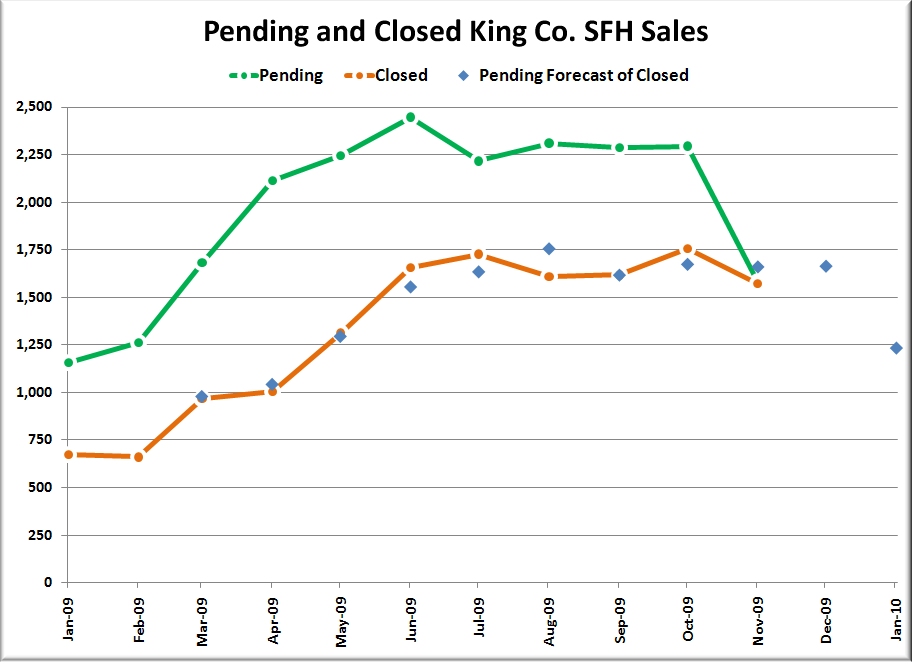
  5. How’s those 2000+ closings in a month looking Greg P.? I guess things weren’t that normal after all and pendings were/are in fact very misleading to the final sales volume.

  6. RE: Ray Pepper @ 6

    Ray,

    You do understand that that SRS resets everyday, and it does not function like a stock per se. It is my understanding that it was up primarily due to hedge funds that were naked shorting. Good luck with that one.
    Full disclosure – I no longer hold SRS, you could consider my last trade in SRS a short sale!

  7. RE: Willy Nilly @ 8

    . It is my understanding that it was up primarily due to hedge funds that were naked shorting.

    ????????

    You are mistaken its not up today nor has it been in an upward trend for the last 2 years. Down Down Down…But, very “ripe” for a tasty pop…back to double digits..

    People have lost their butts in SRS but its one heck of a great trade.

  8. Boosterism. How true is it that Seattle is a boom town and that local media do so called “boosterism”?

  9. RE: Ray Pepper @ 6

    Ray,

    Be careful. This is calculated on a daily basis. It will naturally trend to zero. Remember, an 8% decrease following by a 8% increase will be less than your original investment.

    That said, I think SRS is great if you plan to trade on a daily or weekly basis.

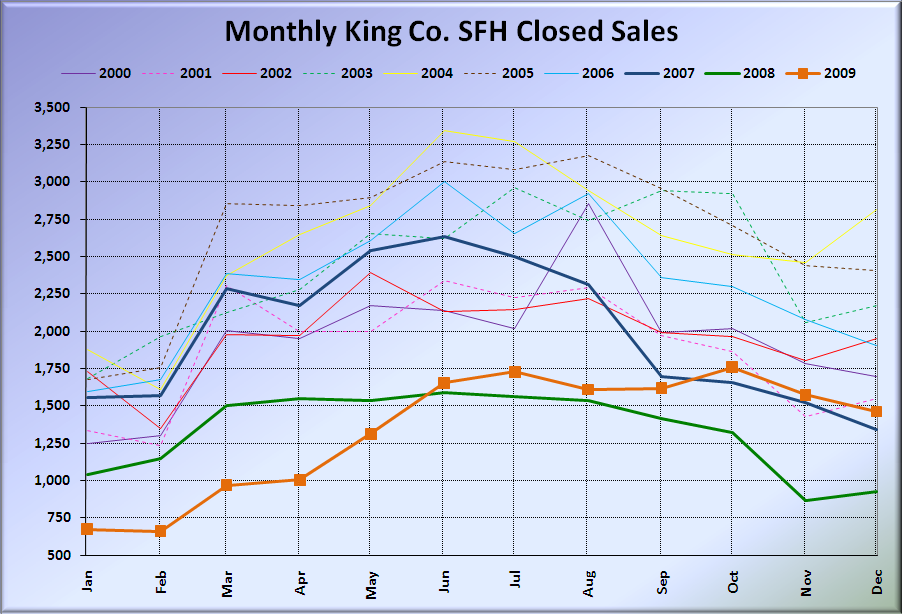
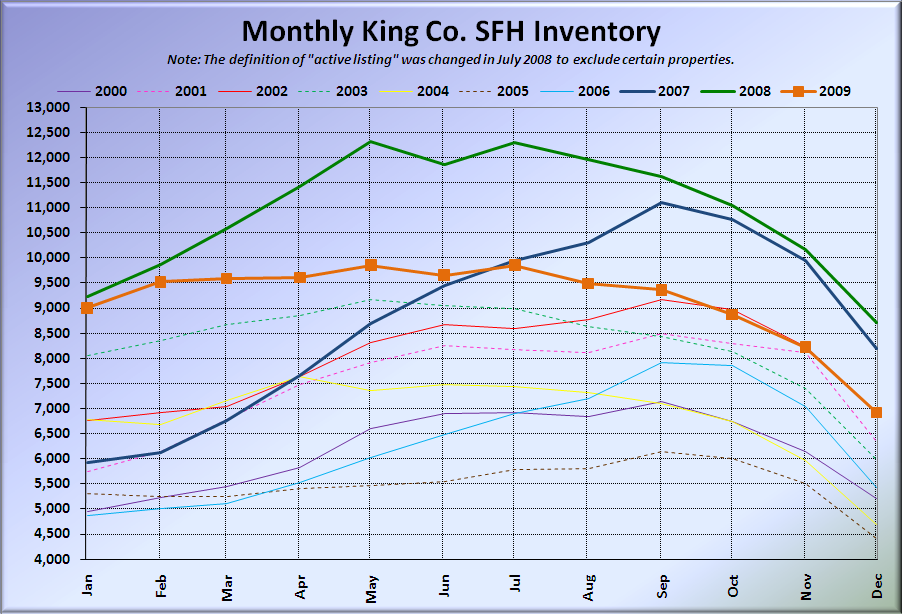
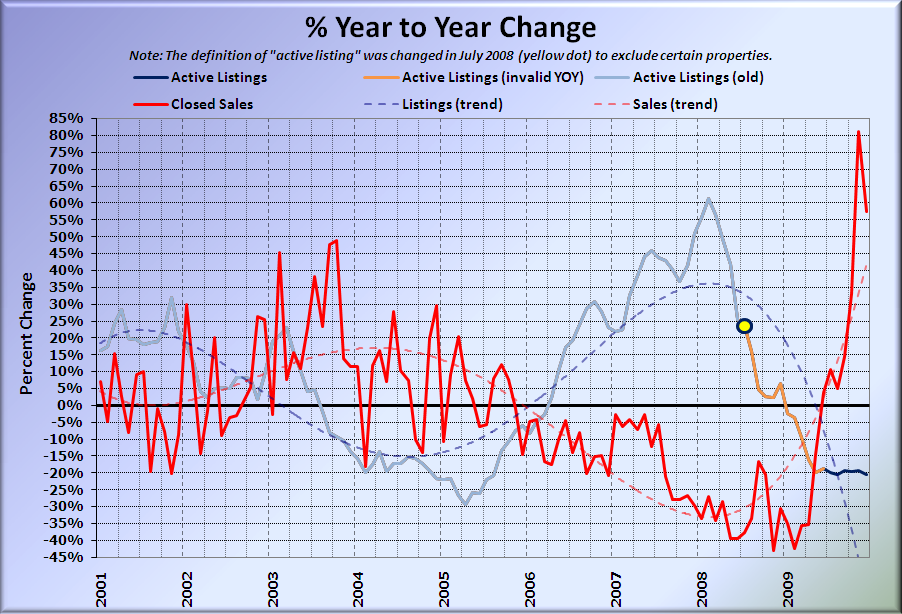
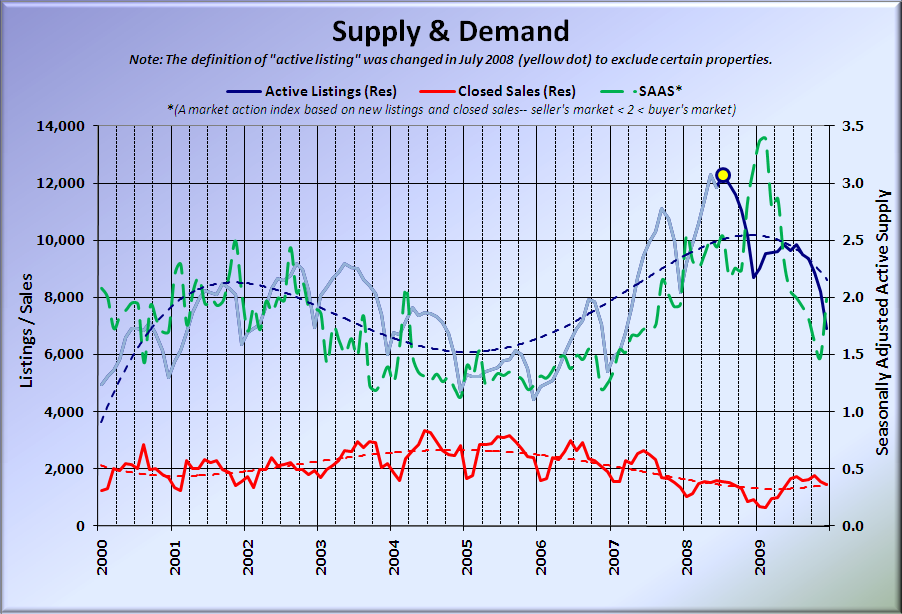
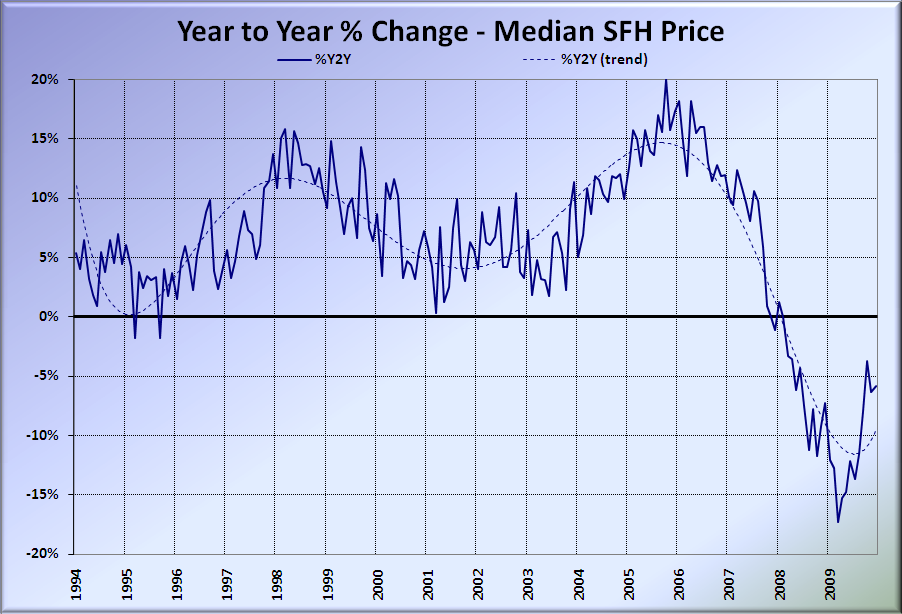
  10. I remember when the dialogue on this site was focused on making assertions that were supported by data. Well I’m looking at these numbers, and I see a Seattle market that has bottomed and is trending towards up in 2010. I still read posts that say we’re in for another drop. I would like to see graphs or charts that support those claims.

  11. RE: Ray Pepper @ 9
    I lost my butt in SRS. Fortunately I only had a very small amount invested, and got out before it got real bad. Still, it looked like it couldn’t go lower when it was 25.
    But yeah, it looks very inviting at it’s current price. Not goin’ there, though. Once bitten….

  12. RE: Hugh Dominic @ 12 – I note you did not include any charts, graphs, or numbers in your post to support your bottom call.

  13. RE: AMS @ 14 – did you miss them? They’re at the top of the page.

  14. Hugh, all you need to consider to draw a logical conclusion is median incomes vs. median housing prices for ANY AREA. That is your oracle.

  15. RE: Hugh Dominic @ 12 – The problem is that it is very difficult to chart or graph the whims of Congress, the Fed and the Treasury. That is what this market is all about now. Fundamentals, data analysis, charting, etc can be thrown out the window for the foreseeable future. For all we know tomorrow the Fed will extend its 1.3 trillion MBS purchase program to 2T, Congress will pass a $16k tax credit and the Treasury will announce that Freddie and Fannie are going to start buying houses on the market for any price and burning them to the ground.

  16. By softwarengineer @ 4:

    RE: The Tim @ 1

    I Hear National November’s Pending Sales Down 16%

    With or without the tax credit.

    As I mentioned elsewhere, I view that statistic as being like the Notice of Trustee’s Sale documents earlier in the year. This number was affected by the status of the extension of the credit, just as the NOTS documents were affected by the legislation that affected foreclosures. You can’t just view numbers in a vacuum and try to draw conclusions.

  17. RE: corncob @ 17 – ah yes, that makes sense. That was the rationale that the tim gave for this sites drift into political commentary and speculation. I am forced to agree.

  18. RE: Hugh Dominic @ 15

    You are correct, there is a lag in price declines, but do you really want all the charts and graphs again for why prices are declining? i’m doing some work right nor but I think I have a comment about this over on the rain city guide with the links to the data. Just give me a few more minutes.

  19. RE: Hugh Dominic @ 15 – The same ones that people are using suggesting the market is heading lower?

  20. RE: corncob @ 17

    “Congress will pass a $16k tax credit and the Treasury will announce that Freddie and Fannie are going to start buying houses on the market for any price and burning them to the ground. ”

    Why do i think they will even manage to screw that up?

  21. for all you declinests, how can you fool the credit markets?

    “The so-called distress ratio, or percentage of high-yield companies with spreads of 10 percentage points or higher, fell to 15 percent as of Dec. 31 from more than 70 percent at the end of March, when the credit-market rally began in the first quarter, and a record 88 percent a year ago, Merrill index data show.”

    http://www.bloomberg.com/apps/news?pid=20601087&sid=aG3Yna5adCvQ

    cash for clunkers was one of the declinests poster child but car sales are doing pretty good w/o government help

    U.S. Light Vehicle Sales 11.25 Million SAAR in December
    http://www.calculatedriskblog.com/2010/01/us-light-vehicle-sales-1125-million.html

  22. By CCG @ 2:

    After the bubble finally implodes beyond even the Goebbelsian spinning capabilities of our wise leaders, maybe the journalists can get jobs at the Trashury or one of the rating agencies. Skill in torturing numbers and making apples-to-bicycles comparisons to reach a pre-mandated conclusion is a talent in great demand these days.

    the great recession wasn’t good enough for you?

  23. By corncob @ 17:

    RE: Hugh Dominic @ 12 – The problem is that it is very difficult to chart or graph the whims of Congress, the Fed and the Treasury. That is what this market is all about now. Fundamentals, data analysis, charting, etc can be thrown out the window for the foreseeable future. For all we know tomorrow the Fed will extend its 1.3 trillion MBS purchase program to 2T, Congress will pass a $16k tax credit and the Treasury will announce that Freddie and Fannie are going to start buying houses on the market for any price and burning them to the ground.

    maybe you just don’t know as much about the stock market and the economy than you thought if things aren’t clear to you?

  24. RE: pfft @ 23 – “…but car sales are doing pretty good w/o government help”

    Who are you trying to fool, new car sales are terrible.

    CR comment, “The current level of sales are still very low, and are still below the lowest point for the ‘90/’91 recession (even with a larger population). On an annual basis, 2009 sales were probably just above the level of 1982 (10.357 million light vehicles).”

  25. RE: AMS @ 21 – there’s no basis to argue for further declines if all you’re looking at is those graphs. Those graphs show seattle is reaching a bottom. Prices have been flat for months, inventory is falling, and YOY price deltas are headed towards positive. Corncob is right to argue for the uncertainties that the government is inserting, but there’s no easy quantification of those influences.

    The income vs price graph, while not shown above, has been brought into line with pre-bubble trends. (extrapolate the line when the tim posts it again)

    That’s what the data shows. All you’re bringing to the table to counter that is fearmongering and permabear woofing. That is equal but opposite to the unsubstantiated ponyism of 2006.

  26. RE: Hugh Dominic @ 12

    http://www.marketoracle.co.uk/Article5212.html

    http://moremoney.blogs.money.cnn.com/2009/09/21/housing-tax-credit-cure-or-curse/

    http://www.zillow.com/blog/mortgage/2009/12/02/when-the-fed-stops-buying-mortgage-bonds-mortgage-rates-will-go-up-or-will-it/

    and my personal favorite

    http://quickfacts.census.gov/qfd/states/53/53033.html look at the number of housing units compared to house holds based in 2008.

    Census data will start pouring in the middle of summer, After the tax credit is expired and the fed stops buying up MBSecurities, the census data should show the huge disparity between the cost of housing and income.

    It really makes no difference. Banks and lenders have enough loans out to retire the practice of giving you more money than a property is worth.

  27. Why is my comment awaiting moderation? Is it the number of links, because I have a few more.

  28. RE: pfft @ 25 – Care to clear it up for me? I think it is pretty obvious that old metrics and rules do not apply when the game is changed for everyone with massive intervention in pretty much every large market in the world. The fact is we do not know what any of these numbers really mean anymore because they were developed to help model things and indicate directions under the old rules, which no longer really apply. It is like the earlier focus on Libor when it exploded, it was a good indicator of what was going on in the credit markets because it reflected things based on the “old rules”. So governments at the height of the crisis decided to backstop interbank loans and make them essentially risk free, which dropped Libor precipitously. Did this mean the underlying problems the Libor metric was previously indicating had been resolved? No, it meant that Libor was now a worthless metric because government intervention made it such. Now, we may disagree if, when all of this intervention is withdrawn, we will continue slow growing our way out or drop again. But I do not think it is even really an argument that most of these old rules market metrics no longer measure what they were developed for.

  29. RE: Hugh Dominic @ 27

    “Those graphs show Seattle is reaching a bottom”

    No. Those graphs show Seattle has stabilized. What makes you think it shows a bottom? Where is the information that precludes further declines? Where is the information that shows an upturn is imminent?

    Me thinks thou is’t as guilty as those you previously charged. ;-)

  30. RE: pfft @ 23

    “for all you declinests, how can you fool the credit markets?”

    Apparently with ease… and about $7 trillion of almost free money… all of it a fiction based on even more debt. What is funny/sad is that anyone is dumb enough to think that any of the original problems, let alone all of them, have been fixed. Nothing has been fixed. The banks have been allowed to change their accounting standards to hide debts that will never be collected while the Fed runs around purchasing garbage securities, taking them off corporate balance sheets and onto their own. But eventually they will have to go back- and then they will finally be recognized as the real losses they are.

    It’s like the child’s game of hiding the quarter under one of three cups on the table and trying to guess which one. The Fed is playing “hide the quarter (crap)”- and just because it isn’t under the cup (corp.) where you last looked doesn’t mean it’s ever off the table.

  31. RE: David Losh @ 28 – u r spammer.

  32. RE: Hugh Dominic @ 27 – “Those graphs show seattle is reaching a bottom.”

    Maybe you can elaborate on that particular claim. I hear these types of claims by one group of people, and the other group suggest something like, “Those graphs show seattle is going further down.”

    Same graphs. Diverging claims. Yes, it’s true, people view the same data and come to opposing conclusions.

    But, I’m really interested in how you know that Seattle cannot go lower.

    Let me remind you, I had many GM workers present to me seemingly hundreds of graphs that they claimed showed that GM stock could not go below $50. Then it was “proved” that it could not go below $40. At $18 it was a “sure thing.” At $9 it was really, really cheap. At $2 it was “less than a gallon of gas.” This is a small sample of all the things I heard. Even in the face of all the fancy charts and graphs, all the different views, my claim was that GM wasn’t looking good. Today the liquidation entity is not worth much.

  33. I do not pretend to know where the housing is going, but if the market is stable/flat after the amount of money that was injected by the Fed last year, I am willing to wait a bit longer to see.

  34. By Hugh Dominic @ 27:

    The income vs price graph, while not shown above, has been brought into line with pre-bubble trends. (extrapolate the line when the tim posts it again)

    That’s what the data shows. All you’re bringing to the table to counter that is fearmongering and permabear woofing. That is equal but opposite to the unsubstantiated ponyism of 2006.

    Unfortunately, the income data used in that graph was not the most accurate data available. Here is what the income data from WA State Office of Financial Management looks like. I’ll speak more about this data set after I interview the economist who created it.

    http://housingcorrection.com/misc/SeattleMedianPriceByIncomeO.jpg

    This is a metro area graph. Seattle city limits will vary. At any rate, it would really help if you would supply some evidence of your claims–especially when you are insulting another person using fictitious claims.

  35. By corncob @ 17:

    For all we know tomorrow the Fed will extend its 1.3 trillion MBS purchase program to 2T, Congress will pass a $16k tax credit and the Treasury will announce that Freddie and Fannie are going to start buying houses on the market for any price and burning them to the ground.

    Hey I think you’re onto something, corncob. Why are we giving free money to the banks (0% loans for their carry trade) without any social benefit? We should at least take some of their foreclosure inventory into the public trust, so that we can torch them in whatever quantity will bleed off our excess inventory. Not a bad idea…

  36. RE: Hugh Dominic @ 12 – Thank goodness for this much needed optimistic, yet fact based, chart reading, clear vision. I am going to go buy a home right now, thanks for clearing that up Hugh!!!

  37. RE: pfft @ 23

    This probably affected rates also-Pimco’s (World’s largest bond fund) Bill Gross said this while talking to Time about the Fed’s buying MBS:

    “… They’re buying a trillion dollars… and so we sold them a lot of ours. Now, what did we do with the money? We bought Treasuries, we bought corporate bonds, and so the bond markets in general have benefited, as have stocks because this available money effectively flows through the capital markets. … How that affects the markets, I just don’t know. I’m not eagerly anticipating the answer, but I think it holds some surprises in 2010, not just in mortgage securities but stocks as well. We could miss the money, put it that way.”

    Hmmmm. Essentially new money flowing into stocks (they go up), corporate bonds (rates go down) and treasuries (rates are depressed). How many other firms did the same? Multiply by 10? 100? 1,000? More?

    Wash, rinse,… repeat! It ain’t magic- it’s a farce!

  38. 2.7% MOM median price increase. Lovely. There will be some foreclosures in 2010, but with prices and unemployment stablizing, I don’t think I would bet against a recovery in 2011. 2010 seems like the year to buy.

  39. RE: Scotsman @ 40

    ahhh, my friend Bill Gross, who month after month the last year was recommending staying liquid in relatively high quality short term assets … only to watch the stock market move up 60% from the lows.

  40. RE: Jonness @ 37 – “I’ll speak more about this data set after I interview the economist who created it.”

    You know I appreciate all your efforts in this area.

    I was at Sears yesterday, specifically in the Lands’ End area. There were a few items that I picked to purchase. It was slow at the moment I was checking out. When I went to pay the cashier, an older gentleman, asked if I was returning the items or purchasing the items. I replied, “Oh, that’s right, I bet you have a lot of returns this time of year.” From there I commented on how Sears and Kmart, both bankrupt businesses at one time, have done fairly well together. He then mentioned that he wished he’d purchased Sears stock in the employee purchase program. Jokingly, I suggested that one doesn’t want to put all their eggs in one basket. Working and buying stock at a single place could be a disaster. He said he lost “several hundred thousand dollars” during the “dot com bubble,” but he sold his house about two years ago and started renting.

    He went further and commented on how he makes a fraction today of what he once did, but he is happy to be working.

    I then asked, given the average price of homes, how do your fellow, younger associates, some of which have children, afford housing? I elaborated a bit more by saying, “You know what you earn, and you probably know about what the other associates earn, and they don’t have your same history. How do they afford housing?”

    Fortunately, that question was posed at the end of the transaction. I ended the conversation by saying, “It’s a good thing you sold your home near the peak, but the new owners are the ones taking the loss, even if it’s been resold, someone is taking a loss.”

  41. RE: pfft @ 23

    Pfft, You Need a New Name

    Pfft, it sounds like hot air being released….just like your allegation(s) that recent car sales are rosy, Hades, 2009 car sales were the worst in 30 years this year [and we have a much bigger population today than 30 yrs ago], article in part:

    http://www.reuters.com/article/idUSTRE5043X020090106?feedType=RSS&feedName=businessNews

    You need to go an economist eye doctor and get your myopic rosy economy vision fixed to focus on “far sighted items” ….like comparing 2006 to now.

  42. RE: softwarengineer @ 44 – Let’s not forget that the 2009 new car sales included 750,000 CFC sales… I am not sure how many of those would have happened without CFC, but certainly there are some 2009 sales that would not have happened without the government incentive.

  43. RE: AMS @ 43 – a bore is a bore is a bore…but even at Sears?

  44. RE: truthtold @ 46 – You bet!

  45. By AMS @ 26:

    RE: pfft @ 23 – “…but car sales are doing pretty good w/o government help”

    Who are you trying to fool, new car sales are terrible.

    CR comment, “The current level of sales are still very low, and are still below the lowest point for the ‘90/’91 recession (even with a larger population). On an annual basis, 2009 sales were probably just above the level of 1982 (10.357 million light vehicles).”

    car sales in dec YOY will be up. car sales rebounded pretty good after so many people said the only reason why car sales were good was cash for clunkers. now the declinests don’t have the cash for clunkers excuse.

  46. RE: pfft @ 48 – Let me get this right. From 2006 – 2008 car sales were running about 16M SAAR, and now we are celebrating ~11M SAAR? New car sales are still very low. I’ll give you there is an YOY increase, but is it significant? When will we get back to > 15M SAAR?

  47. RE: AMS @ 49 – That may not happen again for years. The bubble extended to much in the economy besides houses.

  48. By Scotsman @ 40:

    RE: pfft @ 23

    This probably affected rates also-Pimco’s (World’s largest bond fund) Bill Gross said this while talking to Time about the Fed’s buying MBS:

    “… They’re buying a trillion dollars… and so we sold them a lot of ours. Now, what did we do with the money? We bought Treasuries, we bought corporate bonds, and so the bond markets in general have benefited, as have stocks because this available money effectively flows through the capital markets. … How that affects the markets, I just don’t know. I’m not eagerly anticipating the answer, but I think it holds some surprises in 2010, not just in mortgage securities but stocks as well. We could miss the money, put it that way.”

    Hmmmm. Essentially new money flowing into stocks (they go up), corporate bonds (rates go down) and treasuries (rates are depressed). How many other firms did the same? Multiply by 10? 100? 1,000? More?

    Wash, rinse,… repeat! It ain’t magic- it’s a farce!

    and the market doesn’t know all of this? it doesn’t has that information? is that what you’re saying? mr gross isn’t god. he said in the tech wreck that stocks would go to 6,000 and they didn’t. they went the opposite way and eventually to 14,000.

  49. RE: pfft @ 51 – Could you please remind me of when and what level did the NASDAQ peak? What level is it today?

  50. By softwarengineer @ 44:

    RE: pfft @ 23

    Pfft, You Need a New Name

    Pfft, it sounds like hot air being released….just like your allegation(s) that recent car sales are rosy, Hades, 2009 car sales were the worst in 30 years this year [and we have a much bigger population today than 30 yrs ago], article in part:

    http://www.reuters.com/article/idUSTRE5043X020090106?feedType=RSS&feedName=businessNews

    You need to go an economist eye doctor and get your myopic rosy economy vision fixed to focus on “far sighted items” ….like comparing 2006 to now.

    you guys are the one’s who don’t see less bad is good. you don’t see the stock market going up. you’re telling the market what to do as it rockets higher while I just tell you what IT tells me. I listen to the market. you guys fight the tape. not a good strategy.

    dec cars sales YOY are up btw.

  51. By AMS @ 49:

    RE: pfft @ 48 – Let me get this right. From 2006 – 2008 car sales were running about 16M SAAR, and now we are celebrating ~11M SAAR? New car sales are still very low. I’ll give you there is an YOY increase, but is it significant? When will we get back to > 15M SAAR?

    i don’t know when we’ll get back to 15M and I don’t care. the point is things are getting better.

  52. RE: pfft @ 54 – Getting better and good are two different things. Sure the concentration camp victims of Nazi Germany were tossed a scrap of food from time-to-time. That’s better, I suppose, but not good.

  53. By AMS @ 52:

    RE: pfft @ 51 – Could you please remind me of when and what level did the NASDAQ peak? What level is it today?

    I don’t care about where the nasdaq is and I knew it was a bubble back then anyway.

  54. By AMS @ 55:

    RE: pfft @ 54 – Getting better and good are two different things. Sure the concentration camp victims of Nazi Germany were tossed a scrap of food from time-to-time. That’s better, I suppose, but not good.

    godwin’s law! I win! I win!

  55. RE: pfft @ 57 – :-)

  56. RE: pfft @ 56 – How is that bubble different than the current one?

  57. Some things are definately getting better, Chris Dodd announced that he is out next year which is awesome. The recovery however is an illusion built with debt.

  58. By patient @ 60:

    Some things are definately getting better, Chris Dodd announced that he is out next year which is awesome. The recovery however is an illusion built with debt.

    consumers cut their debt. the gov’t didn’t but that didn’t matter because consumers had cut back so far it cancelled out.

    consumers saved like crazy during the recession which is why we had a recession.

  59. RE: pfft @ 61

    “consumers cut their debt. the gov’t didn’t but that didn’t matter because consumers had cut back so far it cancelled out.”

    Wouldn;t that imply that the problem is just as big today as before the recession? The debt is still there but some of it has been moved from the consumer to the government? And really who is the government? It’s the consumer, we will have to pay it back, now via taxes instead of credit card debt. The recover is an illusion. Until the goverment has left the financial instutitions and stopped stimulus no recovery can be taken seriously.

  60. RE: waitingforseattletocool @ 42

    I invest in Pimco CEFs and I remember Gross saying to clasp hands with the US Gov. during Oct ‘08 – Mar ‘09 and he also commented that many investment grades were selling for less than junk. His funds have done very well this year. In fact, the nav premium on PHK has been unreasonable the past 6 months.

  61. By patient @ 62:

    RE: pfft @ 61

    “consumers cut their debt. the gov�t didn�t but that didn�t matter because consumers had cut back so far it cancelled out.”

    Wouldn;t that imply that the problem is just as big today as before the recession? The debt is still there but some of it has been moved from the consumer to the government? And really who is the government? It’s the consumer, we will have to pay it back, now via taxes instead of credit card debt. The recover is an illusion. Until the goverment has left the financial instutitions and stopped stimulus no recovery can be taken seriously.

    private debt and the housing bubble was the cause of the problem. a nation has more leeway with it’s debt than a family does.

    you could say our whole mess was caused by a housing bubble and a non-existant savings rate. the public debt could, and I stress could, happen later. maybe, maybe not.

  62. “Until the goverment has left the financial instutitions and stopped stimulus no recovery can be taken seriously.:”

    I would argue that the government going into a crisis to help is probably a universal signal of things being so bad that the economy and markets are close to hitting bottom. governments won’t intervene until things are really really bad.

    jp morgan intervened in 1907 or 1908. FDR intervened massively in the 30s. it’s probably the same in every country no matter what decade or even century.

  63. RE: pfft @ 65 – “I would argue that the government going into a crisis to help is probably a universal signal of things being so bad that the economy and markets are close to hitting bottom. governments won’t intervene until things are really really bad.”

    What constitutes government intervention? Income tax credits, maybe?

  64. RE: pfft @ 65 – Do you think national debt is free money? Most americans do at this point since this is the spending period but when we go into the payback period a lot of things will change.

  65. RE: pfft @ 65

    Take a look at the graph I posted on the open thread and tell me how you think it’s resolved.

  66. By patient @ 67:

    RE: pfft @ 65 – Do you think national debt is free money? Most americans do at this point since this is the spending period but when we go into the payback period a lot of things will change.

    the problem is we have a national debt accumulated basically for the last 200 years. it doesn’t have to be paid off by a certain point. it’s not just people that pay taxes either, it’s corporations too. japan, italy and belgium have all accumulated higher national debts w/o incurring hyperinflation like a lot of people think.

  67. Yes the National Debt is alarming.

    For that kind of money we should have national health care. We should have low cost small business lending and mentorship. We should do away with the working man’s wage tax and put the full tax paying burden on the backs of the financiers. We should have a free education system.

    I can guarantee you things would be better if the people who work for a living were in charge. Make the corporate welfare bums pay their fair share. Let’s confiscate some of those trinkets we paid for from the bankers for a start.

  68. “Until the goverment has left the financial instutitions and stopped stimulus no recovery can be taken seriously.:”

    That is an amazingly uninformed statement in light of history. What do you think the Fed has been doing for the last 100 years? How do you think the Great Depression ended? In anything, the lack of Govt involvement made the Great Depression worse than it should have been.

Leave a Reply

Do you want a nifty avatar picture next to your name, instead of a photograph of Tim's dog? Just sign up with Gravatar, and make sure to use the same email address in the form below. It's that easy!

Sponsors


Seattle Real Estate :: Brent Fosso

Sponsors

  • Home Improvement Forums
  • East Bellevue Real Estate
  • For Sale By Owner
  • Home Builders

Tip Jar

Archives

Performance Optimization WordPress Plugins by W3 EDGE