Posted by: The Tim

Tim Ellis is the founder of Seattle Bubble. His background in engineering and computer / internet technology, a fondness of data-based analysis of problems, and an addiction to spreadsheets all influence his perspective on the Seattle-area real estate market.

57 responses

  1. Kary, Ardell, Ira, Ray or anyone, are you tracking the monthly percentages of closings that are distress properties to see if change in that percentage is correlating to the change in the CS Index and/or the median? If you are, do you have any comments or data you’d like to share?

  2. Bottom callers, you were wrong…again.

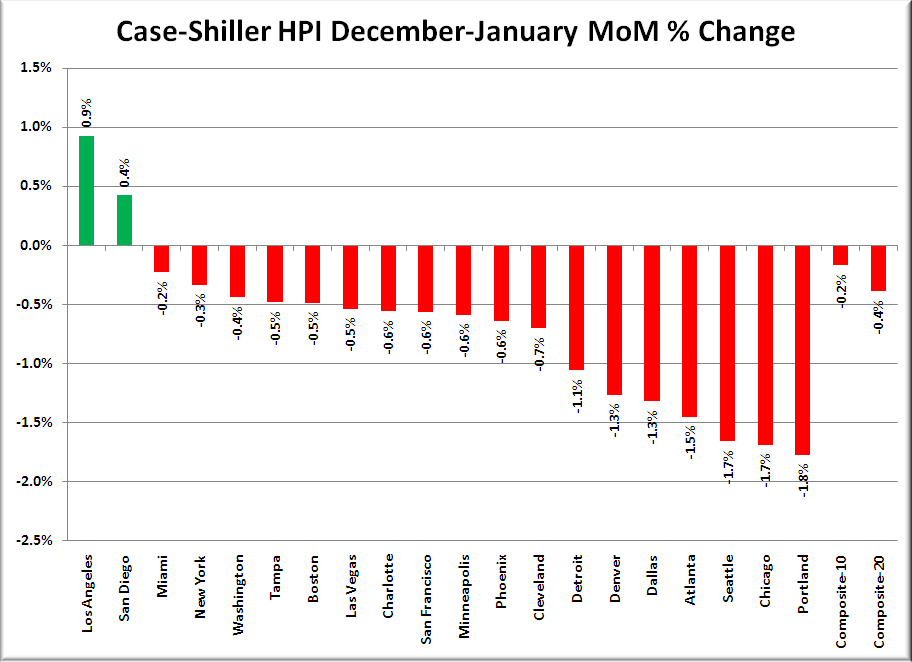
  3. Q: how do folks account for LA, SanDiego, Pheonix #s in the comments section? With so much inventory, i would think that it would flatline … or did they overshoot on the down side and this is the natural bounce back.

  4. RE: The Tim @ 7 – source?

  5. Lipstick On the Pig Market

    It’s been politically correct to talk about meaningless improvements during the repression 2009-2010 timeframe as positive…..LOL….wake up and smell the coffee, until we return the 2006/2007 peak years data spectrums, we’re just putting lipstick on the pig.

  6. I’ve often wondered about the blatant errors in Bloomberg’s reporting. Forbes is often just as bad. What is the logic behind an editorial policy that endorses spin over accuracy, especially when the reader will see the error? Are they playing to an advertising base? I know that Bloomberg makes it’s money off the wire services and hard data, but still, why not get it all correct?

    It does look like the steam has run out on this plateau, and we’re headed down again. That prices have turned heading into the spring selling season isn’t a good sign for those who thought some kind of bottom was near. It’s really no surprise though- nothing has really turned positive in the economy at large that would suggest or support rising home prices. The mirage is fading again.

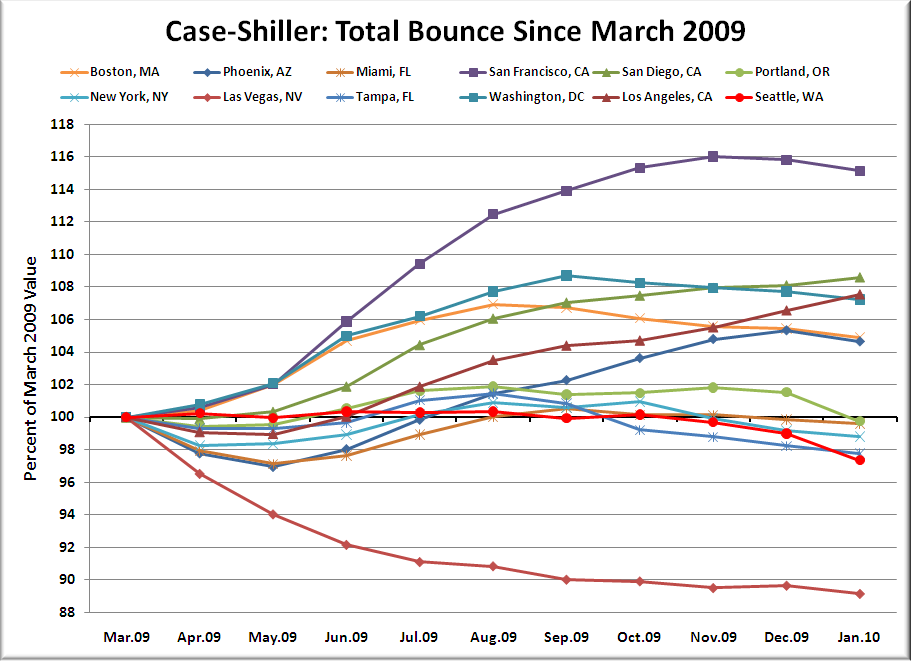
  7. But from looking at the graph it looks like SEA is recovering. The price declines are slower. And it looks SEA might take another 5-10% hit overall and might stabilize.

    So this is good news for everybody and sign that things are just okay!

  8. By Trigger @ 12:

    But from looking at the graph it looks like SEA is recovering. The price declines are slower. And it looks SEA might take another 5-10% hit overall and might stabilize.

    So this is good news for everybody and sign that things are just okay!

    Price declines are slower because we are further away from the peak. Look for example at Phoenix which had the highest price increase followed by the steepest price decline. It seems that in general, prices have been falling after the peak as fast as they have been increasing before the peak. What nobody can predict now is how long prices will keep declining, even if it is just a few % MOM.

  9. RE: Trigger @ 12

    “But from looking at the graph it looks like SEA is recovering”

    Nope. You are not in recovery when things are getting worse. A slower decline rate is still declining and this is no recovery. If you are sick and are getting sicker you are not in recovery even if you were getting sicker faster yesterday. Recovery, temporary or permanent starts when you stop getting sicker at least in the world prior to the financial meltdown, now everything is being spun to fool the common man to part from his money to help support a bankers new yacht.

  10. RE: The Tim @ 1 – Their website went down last month too right after the announcement. Very odd.

  11. I’ll look later, but the last time I looked I think REOs were a more significant percentage, but that short sales were holding steady as Tim indicted.

  12. By bob @ 6:

    Q: how do folks account for LA, SanDiego, Pheonix #s in the comments section? With so much inventory, i would think that it would flatline … or did they overshoot on the down side and this is the natural bounce back.

    LA has a huge renter population. You drop $8,000 in their pockets and some can afford a down payment. Supports my belief that all the $8,000 did was raise home prices by $8,000.

    It rained a lot in LA in February, so I’d expect those numbers to go back down.

  13. RE: softwarengineer @ 10
    Oh, please no. Growth from those years was only speculation fueled by greed and the well intentioned desperate to “not be priced out.” For me, I’d be happy to get to a very boring housing market with boring appreciation where boring people can make the house payment and raise the kids.

    Without jobs = no payment is small enough. There will be no sustainable real estate plateau or improvement until employment improves.

  14. It is anecdotal, but I hit a few open houses this weekend, there were piles of people out.

    I would not be surprised for sales and prices to go up a bit this spring, then taper back off when the incentives start falling off, at least here in Seattle.

  15. RE: The Tim @ 7

    Thanks!

  16. RE: Scotsman @ 11

    “- nothing has really turned positive in the economy at large that would suggest or support rising home prices”

    As you probably know, Friday’s jobs number is a huge wildcard on that score. There are estimates ranging from a low of plus 50K new jobs to a high of plus 500K with 100K being census jobs and 100K being weather related carry overs. I know which number you’re betting on, and you might be right, but it ain’t over til its over.

  17. I think someone made the point that we have to define what “the bottom” means before we can claim we are, or aren’t there.

    The definition that I read was C-S price oscillations within a 5% range would describe a bottom, as long as the price did not go below that for a period of 7 years. I think that is spot on.

    To apply that definition and confirm a bottom requires 7 years of hindsight, of course.

    But we can say that a “candidate” bottom period began in March 2009, and will remain a candidate until either the C-S index drops to ~74% percent off peak, or 6 more years elapse, whichever comes first.

  18. By patient @ 14:

    RE: Trigger @ 12

    “But from looking at the graph it looks like SEA is recovering”

    Nope. You are not in recovery when things are getting worse. A slower decline rate is still declining and this is no recovery. If you are sick and are getting sicker you are not in recovery even if you were getting sicker faster yesterday. Recovery, temporary or permanent starts when you stop getting sicker at least in the world prior to the financial meltdown, now everything is being spun to fool the common man to part from his money to help support a bankers new yacht.

    slowing the rate of decline in home prices is a good thing. there is no doubt about it. just like on the way up the slowing rate of increasing home prices was a bad sign.

    remember when house prices were going to settle to a more “normal” single-digit rate?

  19. Are these numbers adjusted for inflation? Or these are nominal numbers?

  20. RE: rationalguy @ 25

    They are a construct, an index. There is adjustment for a variety of factors, including inflation, but in the end it only measures relative values.

  21. RE: LA Relo @ 17 – “You drop $8,000 in their pockets and some can afford a down payment.” Oh please!!! $8K in LA does not even cover closing costs.

    How in the world could prices in that city be climbing again?

  22. Regarding traffic at open houses. As more and more people choose a less than full-service realtor the traffic in open houses will go up. We looked at a few open houses this weekend. I’ll be honest, the prices were fair. That’s why we went to see those particular houses and not the ones down the street. But these days, I’m not looking for a fair price. I’m looking for a bargain. Which means I’m going to be part of the open house traffic for likely another year. I’m going on two years right now.

  23. By patient @ 14:

    RE: Trigger @ 12

    “But from looking at the graph it looks like SEA is recovering”

    Nope. You are not in recovery when things are getting worse. A slower decline rate is still declining and this is no recovery. If you are sick and are getting sicker you are not in recovery even if you were getting sicker faster yesterday. Recovery, temporary or permanent starts when you stop getting sicker at least in the world prior to the financial meltdown, now everything is being spun to fool the common man to part from his money to help support a bankers new yacht.

    Don’t forget that you are looking at the year-over-year change. As a result, the YOY graph shows a delayed reaction of the market by up to a year. in your analogy, if you had cancer and were getting worse month by month for years, but you have finished chemo and are now getting better day by day, you are in the recovery stage, even if you aren’t as good as you were a year ago, you are still better than you were yesterday, or a month ago, so you are recovering. It may take a year before you can say you are better than you were a year ago. When the YOY change graph shows 0% change, we will be well past the bottom and into recovery.

    Whether we are in recovery now is still up for debate though. Personally, I would agree with Trigger, a slower rate of decline is an improvement and a sign of recovery.

  24. RE: D. in Ballard @ 28

    I agree!

  25. RE: Dave0 @ 29

    I think trigger is right.

    You need to apply what engineers call a “low pass filter” that filters out any small changes that occur over an (at least) four month period. A simple way to do this is just to chart the 4 month trailing average. But even this won’t tell you if we’re in a long term recovery.

    But you have to draw the line somewhere or else you could have said that our temporary recovery after the great depression was just an anomaly and we’re still in the great depression.

    That is why I said at least four months (preferably 7 months)

  26. Tim can you do the tiers?

  27. RE: Sorven @ 18

    I Agree With You

    Don’t misinterpert my blog….I’m just saying getting excited about tiny +/-’s month to month during 2009/2010 is a joke [lipstick on the economy pig]. 2006/2007 were the peak and those who bought in then [or years before then] need at least a flat value compared to those peak years to keep sellling losses contained.

    It’s that simple.

  28. RE: Dave0 @ 29 – What are you talking about Dave0? YoY, MoM are both down and we are at the lowest point since the declines started. How you can even speculate that you can call that a recovery is beyond me. But hey, you’r in “good” company, it’s seems to the new dogma to call a falling rate of decline a recovery, everyone is doing it from cnbc to the gov. Sorry but for me a recovery in prices can’t start while they are still declining. The same goes for then you are sick, you are NOT recovering until you start getting better. Hopefully you are not an MD…

  29. RE: patient @ 34 – The latest month-to-month dip is seasonal, this data is for the weakest time of the year in real estate.

    I’m not saying that the market has recovered as you appear to be hearing, I’m saying that the market has shown the first signs of a recovery. I’m looking at that 2nd graph: the Case Shiller YoY change for Seattle. When the line changed direction around June-09 from declining at an increasing rate to declining at a decreasing rate, that was the first sign of recovery in my opinion. The fact that the rate of decline has been decreasing at a pretty steady rate since then is a stronger sign of recovery. We have not recovered yet however; we will have recovered when the YoY change is consistently at or above 0% YoY. Looking at the graph above, it looks like that could happen this summer.

  30. By Dave0 @ 35:

    RE: patient @ 34When the line changed direction around June-09 from declining at an increasing rate to declining at a decreasing rate, that was the first sign of recovery in my opinion. The fact that the rate of decline has been decreasing at a pretty steady rate since then is a stronger sign of recovery. We have not recovered yet however; we will have recovered when the YoY change is consistently at or above 0% YoY. Looking at the graph above, it looks like that could happen this summer.

    My god, Dave is on to something. By simply projecting the line forward, the housing market will stop declining in May ‘10. By Nov ‘10 we’ll be having double digit YOY increases, and by May ‘15 TRIPLE DIGIT YOY Increases!

    Buy by May ‘10 or be priced out of the market, FOREVER!

  31. RE: Dave0 @ 35 – Where did I ever mentioned that the market has recovered? That would be poor madness. I’m telling you that recovery can’t start until prices stops falling. If the medical analogy was to hard to relate to, try the stock market (Dow Jones). We fell hard from about 12k to 8k. If we now where at the lowest level since the crash, say 6k would you say that the stock market where in a recovery? If you would, I give up.

  32. RE: patient @ 38RE: tomtom @ 37RE: The Tim @ 36 – Wow, its amazing how quick people here jump on someone who makes a bullish projection even if it is based on data and facts. The CS data is showing signs of a bottom approaching, just the same way it showed signs of a top months ahead of time back in 2007. Sorry if its not what you want to see.

    Last December when October data came out, I noticed that the year over year change was approaching zero. At that time I projected out what the CS index would be if it continued to aproach zero at the same rate. See here: http://seattlebubble.com/blog/2009/12/29/case-shiller-seattles-summer-of-stalled-prices-continues/#comment-90731

    All I’m saying now is that this has held true, and if it continues to do so, the CS index will bottom out in March 2010 and begin to recover after that. When I said that the latest dip was seasonal, I just meant that it was expected based on my estimation that the YoY change would continue towards zero. Maybe seasonal isn’t the right word for it, but this latest dip should be no surprise if you were following the data trends.

    Patient, calm down and stop trying to put words in my mouth. I never claimed that you said the market has recovered. I claimed that you are implying that I said the market has recovered, which is not true; another example of you twisting around what I am saying.

    Tomtom, I hope your being sarcastic. My linear projection only goes to 0% YoY change, I don’t know what will happen after that. It will probably hover around 0% YoY for a while, but its too early to tell at this point.

  33. By The Tim @ 40:

    By Dave0 @ 39:
    Not sure why you’re characterizing my comment as “jumping on you.” All I was interested in was pointing out that you made a factually incorrect statement. And I pulled up the data to demonstrate my point.

    Understood. Like I said, maybe “seasonal” was the wrong word to use.

  34. RE: Dave0 @ 39 – Dave0, Trigger said that Seattle was in recovery.

    ““But from looking at the graph it looks like SEA is recovering”

    and here’s your response:

    “Personally, I would agree with Trigger, a slower rate of decline is an improvement and a sign of recovery.”

    And I’m saying that you are both dead wrong and talk like that misleads people every day. That’s why I’m a bit harsh. You have now changed your statements to:

    “The CS data is showing signs of a bottom approaching”

    That is very,very different from being in a recovery. It can be stretched to signs of a future recovery but it can’t in anyway be related to as that we are in a recovery.

    Btw I agree that it can technically be interpreted as a trend towards a coming bottom. A pity for you bulls that imo fundamentals points in the other direction.

  35. RE: patient @ 42 – And if you think I’m splitting hairs consider this: If you are in a recovery it will be more expensive to buy a home tomorrow than today. If we are not, which the data clearly shows that we are not a home will be cheaper tomorrow than today. My guess is that it is something that is pretty important to just about everyone on this blog.

  36. OK, fine, it’s an index based on sales data. At this time every year, mom, dad, and the kids buy a house in the school district they choose so the kids can go to that specific school. Premium prices are paid for homes that fit the narrow parameters of a growing, school age, family.

    In 30 days the Real Estate market will have it’s first legs of standing alone. Credit will be tight, the tax credit gone, no more free money from the Fed to prop up the Mortgage Market, then after that we shed the Census jobs, and the economy will be on it’s own.

    There has never been a time in my history when so much has gone on in such a short amount of time.

    In my opinion, if the market remains even semi stable the Fed will raise rates.

    In terms of Los Angeles and San Diego, it’s been my contention for a long time that all markets there crashed across the board. Good properties were dragged down with the bad, foreclosed upon, and are now being resold for good, maybe even fair prices.

  37. RE: David Losh @ 44

    “In my opinion, if the market remains even semi stable the Fed will raise rates.”

    They should, Europe should be a wake-up call that’s loud enough even for Crocodiles like Turbo Timmy and Helicopter Ben.

  38. from a little over a year ago

    http://seattlebubble.com/blog/2009/02/10/one-in-four-pending-sales-failed-to-close-in-q4/

    By patient @ 31:

    One look at the volume chart is really all you need to know regarding the state of housing and where it’s headed. It looks like in an appreciation market King Co closes about 6000 units in a quarter, the last quarter we barely edge over 2000 units…a price bottom will for sure not occur until after the volume has recovered.

    Volume’s up ~50% over last year.

  39. RE: DrShort @ 46 – Uhmmm…yeah with a volume recovery I was more thinking of +2000 closings a month. 2 closings are 100% more than 1 it doesn’t mean volume has recovered. Nice try though…

  40. RE: patient @ 47 – Volume is in recovery though from it’s lowest point, but it has not recovered and I don’t think it will for a long time.

  41. RE: patient @ 47 – I would agree with Patient on this point. 2/10’s 997 looks good compared to 2/09’s 661, but not good at all compared to 2/08’s 1,148 or 2/07’s 1,572.

  42. I don’t think you should look to the bubble era volumes when judging “recovery.” At the risk of over analyzing the volume issue, this is my take on the relationship of volume to “recovery.”

    Looking for a return of bubble era volume as part of “recovery” from the bubble is like looking for a temperature of 102 degrees as a sign of recovery from the flu. Volume in a normalized market might be more than current volume, but I think it should also be significantly below bubble era volume.

    The appropriate normalized volume in a fundamentally recovered market might be something like the average mid 1990’s volume increased by the percentage of population growth. In a normalized market (a market in which prices are reasonably in line with economic fundamentals) you won’t have bubble volume because you won’t have as many new buyers jumping into the market for double digit appreciation, or move up buyers getting a bigger house just because they’ll have a bigger asset to appreciate at double digits. And there won’t be 5 cable shows devoted to house flipping because flipping won’t be as lucrative (sensational) in a fundamentally reasonable market.

    Just as the prices of the bubble era were evidence of a “sick” market (a market where pricing is driven by something other than economic fundamentals), the high volumes of the bubble era were probably abnormal and also a symptom of the “sick” market. A “recovered” market will return to the long term trends on price, volume and appreciation. It probably should have both pricing and volume levels below bubble era levels and a modest rate of appreciation just above historic inflation levels.

  43. RE: One Eyed Man @ 50 – I would agree with most of that, although I’m not sure you can ever determine what normal is. But picking what is probably the low point for maybe the past 10 or 20 years clearly isn’t the best comparison point.

  44. RE: Kary L. Krismer @ 51 – I’ll agree with that as well and that’s why I selected +2000 closings a month as an indicator. If you look at The Tim’s volume charts in the last nwmls post you will see that 2000 is a very modest level compared to the bubble years that had more like +3000 closings for most months. And we have probably had quite a growth in both housing units and population since then as well.

  45. RE: patient @ 52

    Just to be clear, since 2000, there’s never been a January of February with 2,000 closings. And in the last decade only 6 out of 120 (5%) of the months had over 3,000 closings.

  46. RE: DrShort @ 54 – Where did I say Jan or Feb in the segment you quoted? I said ~6000 closings per quarter.

  47. By DrShort @ 54:

    RE: patient @ 52

    Just to be clear, since 2000, there’s never been a January of February with 2,000 closings. And in the last decade only 6 out of 120 (5%) of the months had over 3,000 closings.

    29 out of 120 months had closings between 2500 and 3500 which to me is around 3000. Those where the dominant bubble months. Sorry.

  48. By Dave0 @ 39:

    My linear projection only goes to 0% YoY change, I don’t know what will happen after that.

    My linear projection only goes to 100% YoY change.

    By Dave0 @ 39:

    It will probably hover around 0% YoY for a while,

    Or it will go up.

    Or it will go down.

    It’s too early to tell at this point.

Leave a Reply

Do you want a nifty avatar picture next to your name, instead of a photograph of Tim's dog? Just sign up with Gravatar, and make sure to use the same email address in the form below. It's that easy!

Please read the rules before posting a comment.

Sponsors


Sponsors

  • Home Improvement Forums
  • East Bellevue Real Estate
  • For Sale By Owner
  • Home Builders

Tip Jar

Archives

Performance Optimization WordPress Plugins by W3 EDGE