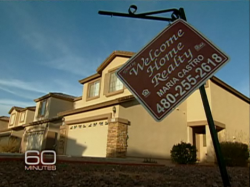
With the subject of “walking away” finally hitting the mainstream media in full force this weekend with a dedicated segment on Sunday’s 60 Minutes, it would appear that the idea of giving the keys back to the bank to get out of a financial death spiral continues to gain some serious traction.
Of course, even though walking away would massively improve their financial situation and should be a no-brainer for many people (several such people are profiled in the 60 Minutes segment), strategic default (choosing not to pay your mortgage even though you can afford to) still carries something of a social stigma in many people’s minds.
For example, “walking out on a mortgage” was recently listed among “8 money missteps” by USA Today, which was then repeated without question and escalated to a “financial deadly sin” by my favorite personal finance blog, Get Rich Slowly (P.S. – buy J.D.’s book). Here in my neck of the woods, Kenmore real estate agent James Lupori called the notion “disturbing” in a recent post.
However, while some individuals may still be fretting about their “moral obligation” to pay their mortgage, a growing number of recent high profile examples have demonstrated that strategic default is really nothing more than a smart business decision.
In January, the owners of the massive 11,227-unit Stuyvesant Town and Peter Cooper Village apartment complex in Manhattan announced they would be handing the property over to their creditors. Closer to home, Boston-based Beacon Capital Partners announced last month that they will be intentionally defaulting on the $2.7 billion loan that they used to buy the Columbia Center—Seattle’s tallest skyscraper—and 8 other towers in the Seattle area (as well as 11 in the DC area).
“We’re seeing a lot of these ‘strategic defaults,’” said Ben Thypin, senior market analyst with Real Capital Analytics, a commercial real-estate research firm in New York. “Beacon could probably pay the mortgage, but the properties are worth less now, and they don’t want to make payments based on outdated values.”
If you’re one of the people that is still not convinced that walking away is a strictly business decision in which ethics and morals should not even enter the conversation, allow me to point you toward an excellent pair of recent papers by Brent T. White, legal professor at the University of Arizona: “Underwater and Not Walking Away: Shame, Fear and the Social Management of the Housing Crisis” and “Beyond Guilt in the Housing Crisis: The Morality of Strategic Default.”
Here’s a particularly compelling passage from the second paper that specifically addresses the lack of any moral component in the decision to walk away:
Think of it this way: when you got your cell phone, you likely signed a contract with your carrier in which you “promised” to pay a set monthly payment for two years. Let’s say, though, that two months after you sign your contract, the price of cell phone service drops by half – meaning that the same cell phone service you pay $100 a month for could be had for half of that with another carrier. You decide that you would be financially better off paying the early termination fee of $300, rather $100 a month for another 22 months for the same service that you can now get for $50.
Would it be immoral for you to break your contractual “promise” to pay $100 for two years, and elect instead to pay the early termination fee? Of course not. The option to breach your “promise” to pay is part of the contract, as is the consequence of breach – a $300 early termination fee. There is absolutely nothing immoral about exercising your option to breach, and you’d be financially wise to do so.
Though a mortgage contract is more substantial, and involves a home, it is simply a contract, just like a cell phone contract. Like a cell phone contract, a mortgage contract explicitly sets out the consequences of breach.
In other words, the lender has contemplated in advance that the mortgagor might be unable or unwilling to continue making payments on his mortgage at some point and has decided in advance what fair compensation to the lender would be. The lender then wrote that compensation into the contract. Specifically, the lender probably included clauses in the contract providing that the lender may foreclose on the property, keep any payments that have been made, and may opt to pursue a deficiency judgment against the mortgagor, if state law so allows.
By writing this penalty into the contract, and then signing the contract, the lender has agreed to accept the property, and (in most states) the option to pursue a deficiency judgment, in lieu of payment. Of course, even in states where they can, lenders frequently don’t pursue borrowers for deficiency judgments because it’s often not economically worthwhile to do so.
Nevertheless, that’s the agreement. No one forced the lender to sign that contract. Indeed, they wrote it. And, to be sure, the lender wouldn’t hesitate to exercise their right to take a person’s house if it was in their financial interest to do so. Concerns of morality or social responsibility wouldn’t be part of the equation.
In short, as far as the law is concerned, choosing to exercise the default option in a mortgage contract is no more immoral than choosing to cancel a cell phone contract. The borrower just has to be willing to accept the consequences – which, in the case of a mortgage contract, typically include being subject to foreclosure and, in most states, the risk of a deficiency judgment.
Banks and corporations like Beacon Capital Partners understand what Mr. White is talking about here, that a mortgage is merely a legal contract, not some sort of sacred vow. They will continue to do what is in their best financial interests, and you should too.
If you find yourself in a situation where you have run the numbers every way you can and the best decision for your family’s financial future is to walk away from your mortgage, don’t let a misguided sense of ethics lead you to the wrong decision. Continuing to pay a mortgage that is hopelessly underwater is throwing good money after bad. If you already made the mistake of buying a massively overpriced house, that doesn’t mean you need to continue paying for that mistake for the next twenty years when there exists a way out.
Please note that this post is absolutely not intended to be legal advice. If you are considering walking away, it is imperative that you seek experienced legal council that can fully explain the legal ramifications of strategic default in your specific state or municipality.
It has been a couple of years since we last ran a poll on this subject, so here’s a new poll:
Should ethics/morals come into play when deciding whether to walk away from a mortgage?
- Yes. (24%, 187 Votes)
- No. (71%, 561 Votes)
- I don't know. (5%, 46 Votes)
Total Voters: 793
[Continue Reading - Part 2: Did Banks Act in Good Faith During the Bubble?]


By The Dude @ 191:
Yeah. Very enlightening. But also completely wrong.
Rate this comment:
0
0
By Scott Weitz @ 193:
And every contract is written with the understanding that the parties will make good faith efforts to not breach.
Rate this comment:
0
0
RE: ME @ 190 – Why should anyone on this website be taking ethics lessons from a banker is beyond me.
First, the original question was about STRATEGIC defaults, not defaults due to hardship.
Let me ask this question: when housing prices were rising around the country, how many times did bank decide to break the contract and foreclose. How many banks decided, “well, we could make more money by not accepting payments and kicking the borrowers out of the house, and sell it to someone else”? If you can break the contract because the house price goes down, why can the bank break the contract when the price goes up? It just a contract right.
People do not have ethics because the financial benefits, people have them in spite of them.
Rate this comment:
0
0
Many people are under the failed assumption that the borrower is responsible for the collateral’s value stability.
Completely untrue. The lender makes a loan commitment based only on a snapshot in time…at the time of the loan application.
All kinds of evens can unfold during the tenure of the loan contract. Death, illness, appreciation, depreciation, bank failure, you name it.
It is not the borrowers responsibility to maintain the properties value. It is the lenders responsibility to accuratly guage it. The lender takes the risk, not the borrower. Once a loan closes, the lender has zero options. They must take the payments, regardless of the value of the collateral, or of the current economic conditions.
The borrower on the other hand holds all the cards. They can pay the payment. They can pay more than the payment. They can skip a payment. Thay can move. They can sell. They can rent it out. They can walk and get foreclosed. The bank can only react to the borrower.
Why. Becasue of the contract. The contract matters. Is it unethical that the borrower has all the choices. Of course not. That is what the parties agreed to.
So if one of the parties agrees to excercise their contractual right how is it unethical. The contract actually staes the term is for a specified period. If you sell or refinance, you are not paying for the entire term, thereby shorting the lender their full term interest payments. Is that ethical?
Of course not.
Rate this comment:
0
0
By Sci Ry @ 203:
I have no doubt that if banks could legally do that, they would. Also, it seems you fail to acknowledge that there’s a difference between “breaking” a contract, i.e. completely disregarding its terms vs. ending it by following a certain procedure that’s outlined in the contract.
Rate this comment:
0
0
Dr. Short.
Not wrong, but nice try . And the good faith is applicable only at the time of inception (application) not commencement.
Sci Ry.
Cute on the banker ethics lesson comment. The fact I am a banker, yet I side with the borrower should give you some insight on how witty your thoughts really are.
Regardless, let me help you out. The reason for the default does not matter. Only that it happens. Strategic, Tragic, Voluntary. Doesn’t matter. Just like why you can pay or where the money came from doesn’t matter, why you can’t pay or where the money is no longer coming from doesn’t matter either. What matters is the situation, not the reason.
And as I said before, no one is breaking the contract. Banks cannot break the contract and not accept payments, because that option is not written into the agreement. And the agreement does not state that the lender shares in the profits. They are not an owner, only a leinholder.
As I said before (I thought fairly clearly) not paying is not breaking the contract. It only enforces the second provision of that exact contract. The default remedies. Which usually lead to foreclosure. Foreclosue is not breaking the contract. Quite the opposite, it is specifically due to the contract still being valid and enforceable that foreclosure can even commence. Of course the bank can file a defiency in certain states under many circumstances, but that is not the point.
The question was is walking away unethical. When two consenting parties make an agreement, even when part of that agreement dictates how the agreement will end, then excersing the ending of the agreement is not unethical. It was agreed to in writing at the onset of the agreement.
Rate this comment:
0
0
By DrShort @ 202:
You don’t breach a contract when you follow the terms outlined in it, e.g. the terms and procedures in the event of non-payment of a mortgage loan.
Take this analogy: You buy a laptop at a computer store. The receipt says you can return it within 90 days if you pay a 15% restocking. A week later the laptop’s price drops by 50%. Would it be unethical to return the laptop, get a refund of 85% of the original price and turn around and buy a new one? After all you’re “breaking” the implied-in-fact contract you made when you first bought it.
Rate this comment:
0
0
Sad that there are so many people who are apparently completely unfamiliar with the concept of “a man’s word is his bond.”
Rate this comment:
0
0
By Lars @ 205:
The difference is that you can return the laptop and still be in compliance with the terms of the sale. A foreclosure occurs when you have specifically broken the terms of the agreement. (ie, “I promise to pay…”)
The better analogy is that you get married with a prenup. And the prenup states that if the husband cheats, the wife gets the house. That doesn’t make it an open relationship. And it doesn’t make the husband’s cheating ethical if she gets the house.
Rate this comment:
0
0
No. A foreclosure is actually just the execution of the agreement. The loan agreement says that the borrower has the choice of making the payments or giving their house to the lender. If the borrower decides to let the bank take over the home then they are still in perfect compliance with the contract.
Like I said earlier, it’s no different than taking a ring to the pawn shop and then defaulting on the payments, thereby allowing the pawn shop to sell the ring.
Rate this comment:
0
0
By Sniglet @ 207:
You realize that foreclosure is a remedy for default, correct? And you also realize the definition of default is failing to live up to an obligation?
Rate this comment:
0
0
By Kary L. Krismer @ 174:
What is more risky:
1) Thinking logically about financial decisions and choosing the path that serves your best interest according to law?
2) Making financial decisions based on guilt, shame, obligation, and fear of what the neighbors think?
I choose to practice 1). IMO, practicing 2) is mentally unhealthy and often leads to weeping and gnashing of teeth.
Rate this comment:
0
0
By Jonness @ 212:
One can make logical decisions within a moral framework. This is my logical financial decision: My conscience and my word is worth a lot more than the money I owe.
Rate this comment:
0
0
Is it a crime to preserve your own wealth when the business model that you participated in was intentionally manipulated to lose your wealth?
I say — not only walk away, but be a bit more aggressive than that and go out of your way to remove from power those private individuals who own our central banking system worldwide.
Rate this comment:
0
0
For those of you who insist that the borrower promised to pay . . . you are incorrect. The borrower promises to pay – OR GIVE UP THE HOUSE – and it has always been thus. That’s what collateral is. Ethics and morality don’t enter into the discussion. Unless you define immoral or unethical as ‘executing a legal option that is not in the lender’s best interest’.
Rate this comment:
0
0
If I start working for an employer and sign a statement that I will “do X”, and that if I “don’t do X, there will be penalties, such as fines or prosecution”, that does not give me the ethical choice to do X or not. The company obviously wants we to do X (let’s say X is to protect other people’s identities), and has not given me a pass to do the opposite as long as I am willing to pay the price. That company probably will check my credit history to make sure that I am trustworthy, i.e. able to act in good faith, and have not decided to purposely default on loans.
Similarly, one the unwritten social contract, it is wrong to kill or steal, and just because there is a remedy for it, does not condone it or make it ethical.
And just because foreclosure is included as a remedy for not paying back the money someone borrowed you, it does not absolve it from being unethical. Obviously, each person’s tipping point of where this falls on the scale of ethics is different, but I would love to see people have to “wear” their ethics for everyone else to see.
Finally, ALL corporations, banks, oil companies, etc. are legal entities devoid of ethics and morals, and should not be considered “people”. I will not allow them to set my moral standards.
Rate this comment:
0
0
Was it ethical for the lenders to create and approve crap loans to people who never should have been approved in the first place? We sold one house in Chicago and bought another during the height. The move was necessary due to a change in employment, otherwise my commute would have been double what it is at the new house. We had about 15% down on the new house. Now, values have plummeted so much that our house is worth $100K less than it was when we bought 5 years ago, despite the $20K we put into it. We now find ourselves $80K in the hole. Is it unethical to sell the house for what we can? I have a lot of pride and have never gone back on anything, but I really don’t see the people who caused this doing anything but putting the problem on the backs of those who are creditworthy.
We tried to talk to our lenders about an adjustment, and basically we were told since we are not behind or getting a divorce, tough luck. Really? I am disgusted and saddened that everything we have worked for for 10 years has gone down the drain because of greed and stupidity on the part of others.
Rate this comment:
0
0
When you walk away, you were still paying the mortgage until the last month before you left your home. The bank is not going through a legal process which cost often exceeds the value of the house, but that the bank must follow (unless a short sale makes sense) in order to repossess and sale. In the end, following a “normal” foreclosure process is going to cost the bank a lot more than a homeowner walking away the first month he is going to default, forfeiting the house to the bank without any legal costs to the bank other than repossession.
Walking away is a lot more ethical than foreclosing. You stand up to your situation, accept your mistake of buying at the peak (or refinancing to no end), and take the only logical action of your situation. You are a responsible person that made a judgment mistake and decently deals with it.
Of course a society build on debt is going to teach you exactly the opposite. My thumbs up to Tim for, once more, showing a critical mind unobstructed by fake ethics.
Rate this comment:
0
0
DrShort has won this argument.
Rate this comment:
0
0
[...] in with your comments and questions. Although I’ve made my position on this issue pretty clear here in the past, my main role on the program today will be to address the overall issue from a [...]
Rate this comment:
0
0
[...] same argument about the ethics of walking away that I made in this pair of posts from a year ago:On Misguided Ethics and Walking Away from a MortgageDid Banks Act in Good Faith During the Bubble?I mostly agree with Howard’s comments on the [...]
Rate this comment:
0
0