Posted by: The Tim

Tim Ellis is the founder of Seattle Bubble. His background in engineering and computer / internet technology, a fondness of data-based analysis of problems, and an addiction to spreadsheets all influence his perspective on the Seattle-area real estate market.

56 responses to “Seattle Home Prices Back in Line with Per Capita Incomes”

  1. LA Relo

    Interesting conclusions. Surprising actually, though I think an overcorrection is likely based on the last cycle.

    From what I hear 10-20% down payments are on the way to becoming mandatory (rightly so IMO) which will put a damper on any recovery. Interest rates won’t stay this low forever too, but the elusive bottom is no doubt closer.

    Rate this comment: Thumb up 0 Thumb down 0

  2. Consultant Ninja

    Tim-

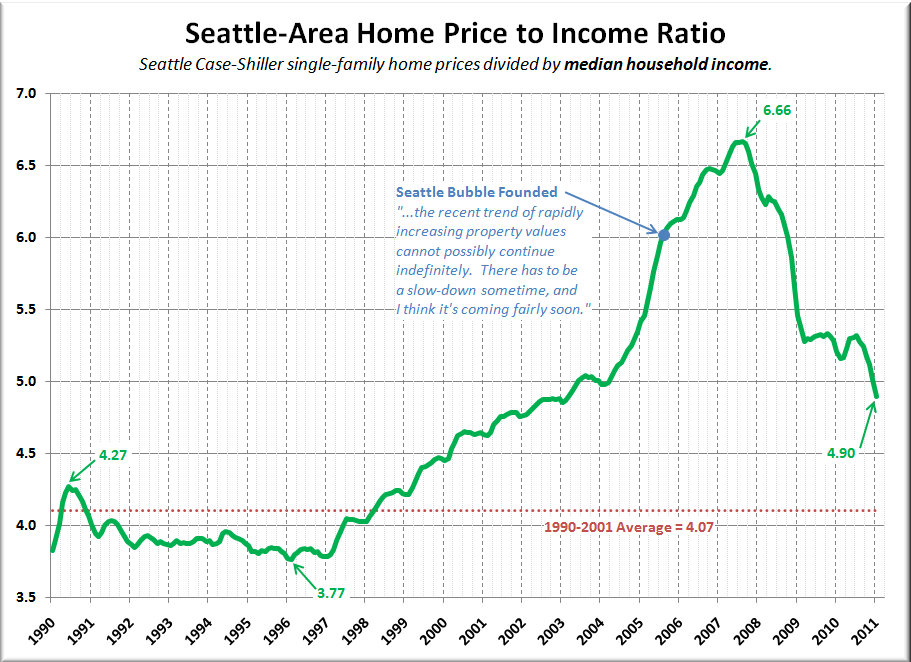
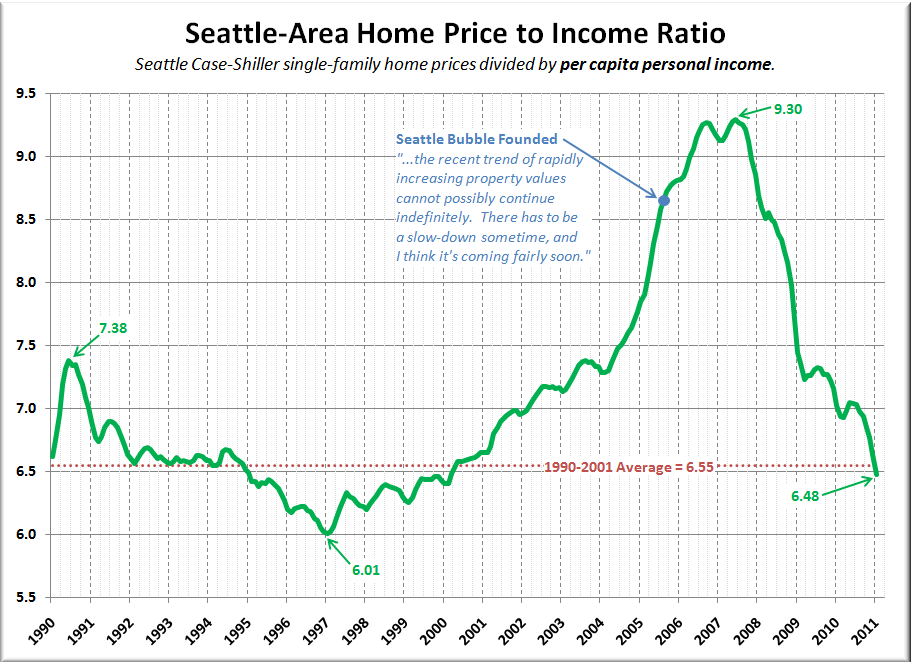
    Isn’t per-capita just the “average” income, vs. the “median” income? The upward skew of the average means that there are massive outliers above the median, which is not a surprise given the massive income-creation events – but I fail to see why that’s a better metric.

    Can you explain again why average per-capita income is a better index for a debt-coverage-ratio than median household? I’ve read your paragraph a couple of times but can’t decipher the rationale.

    Rate this comment: Thumb up 0 Thumb down 0

  3. Dave0

    I don’t understand why you throw out household incomes so quickly in favor of per capita incomes. I would think household incomes would be more accurate, since real estate is generally purchased by a household, not on a per capita basis. The per capita income doesn’t reflect the shift over time towards dual-income households combining their incomes to purchase a house, or people moving in with friends to afford more expensive houses.

    However, I’m not sure what to make of the fact that the price to per capita income ratio has crossed the 1990-2001 average, while the price to household income ratio has not. That would suggest that the current people per household is actually smaller than the 1990-2001 average, which doesn’t sound right.

    Rate this comment: Thumb up 0 Thumb down 0

  4. Dave0

    RE: Consultant Ninja @ 2 – I like the explanation that there are massive outliers above the median income per capita better than my less people per household theory. So, that would suggest that the reason the price to per capita income ratio crossed the 1990-2001 average is because the area’s income distribution is more unequal than from 1990-2001, skewing the average upward. Meanwhile, the more accurate measure, price to househole income ratio, is still way above the 1990-2001 average. Makes sense to me now.

    Rate this comment: Thumb up 0 Thumb down 0

  5. Dave0

    RE: The Tim @ 4 – However, the bottom 40% of households that will never own real estate was factored in when you derived the 4.07 figure from the 1990-2001 average, so that is not a good reason to throw out the price to household income ratio.

    Rate this comment: Thumb up 0 Thumb down 0

  6. hoary

    PI is an important variable, but my inkling is that the housing market will turn around with employment. We have a really big hole to dig out of on the jobs front.

    Rate this comment: Thumb up 0 Thumb down 0

  7. Basho

    Prices are set on the margin. The median household income is a lot more important than you think, especially considering roughly 60% of the housing units in King County are single family residences.

    Rate this comment: Thumb up 0 Thumb down 0

  8. random guy

    RE: The Tim @ 8 – 1) Households 1-4 are in the rental pool, which restricts income from investments. A smart investor would take that into account and demand lower prices.
    2) your income changes are about as favorable as possible for using per capita rather than median, but it could be that households 1-9 saw little to no increase, while household 10′s income more than doubled. Then the money would go to making a few high end properties into increasingly elaborate mansions, rather than increasing prices of median homes. In other words, the only thing that is going to affect household 6′s prospects is if there are a greater number of people as rich or richer than him in the area, which isn’t necessarily true if incomes are only increasing for the top few percentile.

    Rate this comment: Thumb up 0 Thumb down 0

  9. Hugh Dominic

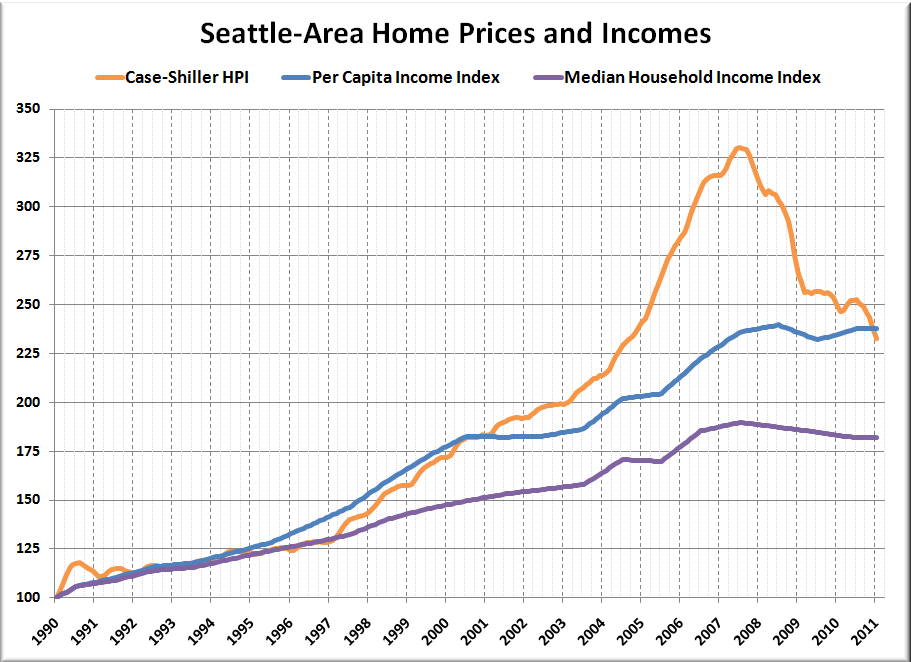
    RE: The Tim @ 8 – Yeah, but you’re indexing to median home prices, not per capita home prices. That strikes me as comparing apples to oranges.

    Rate this comment: Thumb up 0 Thumb down 0

  10. Hugh Dominic

    Other nagging topic – shouldn’t your price growth plot be done on a log scale? On your conventional scale, it makes a 5% increase or decrease look much wilder on the right side of the chart as compared with 5% on the left.

    Rate this comment: Thumb up 0 Thumb down 0

  11. Basho

    “Since households 1-4 are not in the homebuying pool, why would we pay attention to the median household income when the per capita income gives us a better idea of how incomes in the homebuying population have changed?”

    It is the marginal buyer that sets prices for the whole market. The person with the lowest willingness to pay who consummates a transaction sets prices for the entire market.

    In an extreme example. Say we have a market with 50 buyers and 50 identical homes, and assume the market clears (in the long-run markets clear). Forty-nine of the buyers are willing to pay up to $1,000,000 for a home. But the fiftieth buyer is only willing to pay $300,000. Guess what the value of a home is? $300,000.

    The price mechanism works no differently for housing than it does for food, water, or gasoline. The fact that I could afford to pay more for water and would willingly pay more if I had to does not increase the price of water.

    Obviously, the housing market is not a simple commodity market. There is substantial complexity in both the desires of the consumer, the products offered, and the specific workings of the market. But the basic lesson still holds. It’s the behavior of the people that won’t buy a home at current prices, but will at a lower prices, that will end up setting the prices for the entire market.

    Rate this comment: Thumb up 0 Thumb down 0

  12. deejayoh

    I always prefer to look at this sort of relationship as a scatterplot

    Using the same sources as Tim for HHI and home prices, here is what the relationship looks like

    Looks like we are basically back on the trend line for the relationship between 1990 and 2004

    Rate this comment: Thumb up 0 Thumb down 0

  13. deejayoh

    By Basho @ 16:

    “Since households 1-4 are not in the homebuying pool, why would we pay attention to the median household income when the per capita income gives us a better idea of how incomes in the homebuying population have changed?”

    I am not sure I agree with the assumption that the 4 in 10 HH’s who rent are necessarily the poorest. It may skew that way but it seems a major assumption. And since this seems to be the hang up that people are having – I think it may be blown out of proportion.

    Rate this comment: Thumb up 0 Thumb down 0

  14. Daniel

    By deejayoh @ 18:

    I am not sure I agree with the assumption that the 4 in 10 HH’s who rent are necessarily the poorest.

    Considering that rentals are much more common in cities than in rural areas I also doubt this.

    Rate this comment: Thumb up 0 Thumb down 0

  15. Daniel

    By The Tim @ 4:

    RE: Consultant Ninja @ 2 & Dave0 @ 3 – Investors.

    For the past I agree but considering your scenario for the future this makes absolutely no sense. An environment where rents are low and the appreciation of real estate is smaller than inflation is not well suited to convince investors that rental properties are the thing to pour your money into. But then again if I had anything to invest nothing of it would be invested in the US =).

    Rate this comment: Thumb up 0 Thumb down 0

  16. karl

    So is the afforability index a different set of charts? Seems that set of metics made for a more volitile graph. (and more realistic)… Interest-monthy costs- inflation-ect… pinned the actual monthly cost of owning a home.

    Rate this comment: Thumb up 0 Thumb down 0

  17. Real World Express

    You’re making the classic Liberal mistake.Prices don’t rise to meet ability to pay.Prices rise to what people are willing to pay based on alternatives.Otherwise we’d be spending 100 percent of our incomes on homes.However, Puget Sound is not the Wonderworld it once was.It’s actually a pretty bad place to live, just based on climate, than many other cities with high tech salaries, warmer, dryer weather, and bargain basement housing costs.

    Rate this comment: Thumb up 0 Thumb down 0

  18. Yaj

    Great data there. Is there a comparable price-to-rent data set out there? Prices still seem quite high relative to rents.

    Rate this comment: Thumb up 0 Thumb down 0

  19. Yaj

    Also worth pondering if the number of employed persons per household has been consistent over the course of the period used to compile the median household income series.

    Rate this comment: Thumb up 0 Thumb down 0

  20. Scotsman

    Ok, so now price/income ratios are more or less back to their traditional relationship. What predictive power does that hold? What happens if we shift the income trend? I wrote more on the price decline thread:

    http://seattlebubble.com/blog/2011/04/03/poll-how-much-further-are-real-seattle-area-home-prices-likely-to-fall-in-the-next-5-years/comment-page-1/#comment-128627

    Rate this comment: Thumb up 0 Thumb down 0

  21. karl

    RE: The Tim @ 22

    Ok good, looking forward to seeing that.

    Not sure how much longer they can keep the rates this low. At some point they will need to feather fuel/comodity costs into the inflation calculation.

    Rate this comment: Thumb up 0 Thumb down 0

  22. me

    Keep in mind that from the investors perspective, Seattle isn’t necessarily the hottest place in tech – the big cash cows (Boeing/MSFT) are showing serious signs of weakness, Seattle as a location is less attractive than, say, CA or east coast properties, and, worst of all, you have to factor in future price depreciation into your prospects.

    Rate this comment: Thumb up 0 Thumb down 0

  23. masaba

    Really good analysis, Tim. Thanks for posting this.

    It is interesting to see that housing prices in the area are now back in line with the 1990-2004 price trend based on a quantifiable metric. Of course, the future is still anyone’s guess, but this result at least let’s someone who is thinking of buying in today’s market know how current prices compare to historical trends when the market was much saner.

    Rate this comment: Thumb up 0 Thumb down 0

  24. masaba

    RE: Real World Express @ 23

    What is the ‘classic liberal mistake,’ and since when was Tim a liberal?

    Rate this comment: Thumb up 0 Thumb down 0

  25. Macro Investor

    This would be predictive if income was the only thing that determines prices. But there are other important factors. For example, debt capacity. From 1990 to 2010, median income rose 83%, while non-revolving debt rose 177%. Obviously the average household is loaded with debt compared to 20 years ago.

    And that doesn’t consider credit scores. I’m sure they’ve come down a lot. I’m too tired and lazy right now, but I’m sure I could find foreclosure rates, delinquency rates and bankruptcies over time — that would prove that the average household is far less credit worthy than they were 20 years ago.

    Savings rates should also be easy to find. I doubt the average household has anywhere near the savings for a down payment that they had 20 years ago. But that’s just a guess.

    I’ve had some experience with this. I worked with Fair Issac on some of the earliest credit scores. Multivariate is definitely the way to go.

    (Note, my data is from http://www.federalreserve.gov/releases/g19/hist/cc_hist_sa.html, so it’s a US average, not a Seattle average).

    Rate this comment: Thumb up 0 Thumb down 0

  26. Shoe Guy

    “Are we going to get back to the same relationship between median household incomes and home prices that we had 1990-1997?”

    I don’t see why not. What is the cost of a gallon of gas/income ratio today compared to 1997? The cost of a week of groceries/income ratio today compared to 1997? The cost to heat your home/income ratio today compared to 1997?

    Something has to give.

    Rate this comment: Thumb up 0 Thumb down 0

  27. David Losh

    RE: The Tim @ 13

    OK, let’s just take this, because I was also surprised by how many $100K jobs Seattle had to offer. There was some link that I posted months ago that showed Seattle was heavy on the upper end salaries.

    Let’s also take the per capita income that was listed at $48K for Seattle. Two incomes, is $96K.

    With interest rates as low as they are 30% of monthly income is $2600. So in that regard prices have stabilized a lot.

    Now, how many who read this blog actually believe that prices have stabilized?

    Rate this comment: Thumb up 0 Thumb down 0

  28. Pegasus

    RE: Macro Investor @ 32 – Exactly right. Income is only a small piece of the puzzle. We have a building foreclosure market that is going to be around for years unless the government pays off everyone’s mortgage with borrowed money. Not likely. That is the biggest factor facing almost all real estate markets today and it will be years of pressure on pricing. Don’t forget how we are now trying to make every loan a 20 percent downer. Oops there goes another whole lot of potential buyers. Even if employment were to increase rapidly(pfft’s dream) the currently unemployed won’t be able to buy a home for years as they rebuild and show employment stability. That will take years. Credt ratings have taken hits that will stick around for many years. Public opinion about home ownership is changing. Buyers are going to be much more cautious for years. Those people who bot on the first tax credit program are now seriously underwater and are trapped for years. Charts of the varying factors in home ownership are not reliable unless you are using 1930′s numbers for comparisons because that was the last time housing was anywhere near as bad as it is now and will be over the next few years.

    Rate this comment: Thumb up 0 Thumb down 0

  29. Jonness

    Tim:

    First of all, thanks for taking the time and effort to address this issue and explain the data and thoughts you have on the subject. You are using a more realistic data set than I previously realized. However, after some contemplation, I still do not agree average income is the better measure than median household income.

    Investors buy homes to rent out based on the incomes of the lower income people you are purposely trying to exclude from your analysis (despite still being present in your data, just weighted more lightly).

    You might argue, that a lot of lower income people rent apartments instead of homes, and these people should be excluded. However, this does not matter to our measure, because the prices of apartments in an area are directly correlated to the prices of homes in the same area. As long as the apartment:home price ratio stays relatively constant through time, using an income amount correlated to both will not cause an error in one’s analysis.

    But there is much more to the story. Not all rich people invest in homes. What does it matter to Seattle residential RE if a Seattle guy making $20 million/yr invests $19 million of it into an office building in New York? Why would you attempt to exclude an apartment renter and include this rich person in your analysis? This introduces a bias.

    More importantly, it’s not only rich people who can afford to buy homes. Households earning the median income can afford to buy houses and do so all the time. In fact, the majority of people who buy median priced homes are not rich. They’re the checker at your local grocery store or the electrician who lives down the street. The incomes of these working class citizens are far more important to home prices than Bill Gate’s income. While Bill might buy one mansion and 50 office towers, the working class citizens together buy far more homes.

    The median priced home in the Seattle Case-Shiller area is currently about $285K. Financing $275K for thirty years with a 31% housing expense ratio (including taxes and insurance) requires a household income of about $65K.

    Median household income over time represents a far better measure of housing affordability than average income, as it has a far better correlation to the incomes of those who buy median priced homes than the incomes of the super rich, whose wealth distribution has far outpaced that of the middle class over the course of the timeline we are analyzing.

    I believe claiming Washington State home prices are currently over correcting compared to historical incomes is a complete stretch of the imagination.

    Rate this comment: Thumb up 0 Thumb down 0

  30. Gus

    However, since we’re seeing high-tech job market action in Seattle like Google hiring software developers just out of college for nearly $100k, and 20-somethings with a few years experience making well into the six figures (personal anecdotes)

    Personal anecdotes from the Tim? Huh?

    I have no idea what causes it, but Seattle is exceedingly capable of rationalizing a sense of greatness and infallibility. Call it the “Starbucks Complex”. We are Seattle, therefore, we are great. We all make six figures at our tech jobs because, you know, we’re like, soooo smart. It just sounds so good how could it not be true? It’s this weird sense of civic pride that leads Seattleites and ONLY Seattleites to conclude that the collapse of Wamu was a well coordinated conspiracy between Jaime Dimon and Sheila Bair instead of just the final act of a bank that made a lot of really really dumb choices.

    To throw out the bottom 40% is just bad analysis. Let’s assume for the argument that the 40% of Seattle that rents is also the poorest 40% of Seattle (although it should be mentioned that using Census data on homeownership rates to assert that poor people don’t buy houses feels kind of flimsy). Do these people not rent? Does their capacity to pay rent not figure into investor expectations about cash flow? Absent a reliable cash flow isn’t an investment in housing essentially a speculative bet on asset appreciation? Without a reliable cash flow, how do you justify that asset appreciation?

    Also, it takes a really interesting distribution to shoehorn into these conditions:
    -The median is decreasing
    -However, the average is rising
    -Finally, “increases are happening for more than just the top 10% of Seattle-area households”.

    That doesn’t sound like the pattern we’ve been experiencing in income changes at the national level, but I guess it’s just more evidence of how Seattle is “special”.

    Tim, we know you’re capable of better. Let’s see some more data to back up your position, not a bunch of half-baked anecdotes and assumptions built around a pre-determined conclusion.

    Rate this comment: Thumb up 0 Thumb down 0

  31. Jonness

    By The Tim @ 13:

    RE: random guy @ 11 – As I said, it was a simplified example to demonstrate the concept I was trying to talk about. However, since we’re seeing high-tech job market action in Seattle like Google hiring software developers just out of college for nearly $100k, and 20-somethings with a few years experience making well into the six figures (personal anecdotes), I don’t think we’re just looking at a scenario like “households 1-9 saw little to no increase, while household 10′s income more than doubled.” I think the increases are happening for more than just the top 10% of Seattle-area households.

    Tim, I thought we put the “Seattle is special” theory to rest a long time ago. Run price to income charts for Spokane, Yakima, and Longview, and you will most likely find similar data patterns (in percentage terms) as in your Seattle charts. Seattle is not special, and rich people are not the only people who buy houses in Washington State.

    IMO, you are being influenced by Kary, who primarily serves high-end clientele and only sees one side of the coin. I believe you should talk to an agent who primarily serves military families in order to get a more rounded perspective on Washington State house prices.

    I believe you are introducing a very obvious bias toward high-end incomes in your analysis.

    Rate this comment: Thumb up 0 Thumb down 0

  32. Jonness

    By The Tim @ 24:

    I can’t really tell if you’re being sarcastic or not. If not, please provide me a list of some of these cities with plentiful high tech salaries and “bargain basement housing costs.”

    Let’s do the opposite. Ask yourself why house prices have fallen less percentage-wise in Thurston County than King County? Google doesn’t have a campus in Olympia, and very few people down there make $100K salaries. I strongly urge you to analyze more of the PacNW than just Seattle. Otherwise, I fear you will never see this for what it really is. House prices are extremely bubbled compared to incomes throughout the entire PacNW. I’m actually quite shocked you don’t realize this.

    Rate this comment: Thumb up 0 Thumb down 0

  33. Jonness

    By The Tim @ 39:

    Jonness, if you can find me some reliable sources of home price and income data for Spokane, Yakima, and Longview, I would love to run similar charts for those areas.

    You have already linked the income sources. You can use OFHEO same sales data for price, but you would have to use this for Seattle as well in order to make the comparison fair. I can create spreadsheets of the price data for whatever cities you choose if you would like. Otherwise, the data is available via the OFHEO website.

    Rate this comment: Thumb up 0 Thumb down 0

  34. Aaron

    I work in the tech industry and 20-somethings can and regularly do make $100K+ gross in certain companies.

    But so what? Even for those who make $100K/year, nearly every home in the city that isn’t totally run down is still more than 3x that salary, in the middle of nowhere or both. I can save for a while, but the whole situation seems absurd: buy myself into poverty, buy something that isn’t worth owning, or both.

    I’m feel fortunate to make as much money as I do, but the reality is that even at $100K/year, Seattle homes are expensive. Where do you find so many buyers for $500K+ homes?

    Rate this comment: Thumb up 0 Thumb down 0

  35. EconE

    What would the per capita income be if you knocked out the top 2% of income earners? (The Bill Gates, Craig Mccaws etc.)And while we’re at it…you can knock off the Medina, Hunts Point, Evergreen Point, Yarrow Point and Mercer Island waterfront homes.It’s not like I’m asking to exclude the top 40%.

    Rate this comment: Thumb up 0 Thumb down 0

  36. David Losh

    RE: Jonness @ 36

    OK, now let’s take the: ” The median priced home in the Seattle Case-Shiller area is currently about $285K.”

    Income around $100K, and home prices at around $300K, that sounds reasonable doesn’t it?

    What can you buy today for $300K?

    Rate this comment: Thumb up 0 Thumb down 0

  37. Consultant Ninja

    Tim-

    I applaud and appreciate the attempt at analysis from a different angle. But comparing median prices to average income just feels apples to orange. perhaps try comparing average prices to average income?

    Or, is there evidence that otherwise says median/average is a better long-term trend indicator than median/median, in this market or others?

    Rate this comment: Thumb up 0 Thumb down 0

  38. David Losh

    RE: EconE @ 43

    That’s not the issue. The upper income isn’t an issue.

    The biggest issue is how homogeneous the home prices are. You go from Everett, to Tacoma, OK Fife, to Issaquah, and find home prices at $300K. The volume of homes at that price point dilutes the in city pricing.

    Then you also have that this is all based on sales data. Lower priced properties sell more by volume.

    Next you have the people who are buying homes and that income level. One or two incomes at $100K and you get the average home buyer for the average home price. The upper wages already own homes, they rent those down town condos, sold at the peak, invest in the stock market, or work in general.

    In other words, there is no direct correlation between income, and the price of housing units. Housing units are a poor man’s investment.

    It’s a mom, dad, and the kids kind of tug at the heart strings kind of thing. Housing units are a white picket fence, towering trees, and babbling brook.

    When in city housing units begin averaging $300K then we are getting some place. What you get for $300K is a town house of questionable value. In my opinion we have a long way to go to get to a stable housing market.

    Rate this comment: Thumb up 0 Thumb down 0

  39. Jonness

    By Drshort @ 44:

    Ideally, the median income of those actively home shopping is what matters and i’d bet that number is well above the county total median income.

    This is absolutely not true. You are looking at a changing target. If the median priced home were $1 million, then a smaller subset would be shopping. If it were $100K, then a larger subset would be shopping. The exclusionary hypothesis sounds good in theory, but it will never work in the real world.

    Put another way, your claim assumes homes are fairly priced at all points in time. The housing bubble is proof to the contrary.

    The ability to borrow money has a heck of a lot to do with the prices of homes. If lending standards tighten back to where they were in the 80′s and early 90′s, then the median household income as an indicator will show it’s true colors. Until then, we simply need to compare Seattle to other PacNW cities in order to dispel the “Seattle is special” myth once and for all.

    I think some people are missing the fact that median household income is strongly correlated to the 25% of incomes above it. IOW, you guys would be correct if people with incomes 25% above the median had increased their wealth through the timeline we are analyzing at a rate matching the deviation from median in Tim’s Per Capita chart. But the truth is, their incomes have gone up lock step percentage-wise with the median.

    Rate this comment: Thumb up 0 Thumb down 0

  40. patient

    While interesting I think this analysis has very little value. The economy, lending standards and buyer sentiment overshadows everything else. Look at it from the other side, if this relationship was strong the bubble would never have happened, prices would have stopped rising soon after they left the average. The shock to corporate, public and private economies is far from healed and without a strong economy I doubt prices will stop falling independent of what historic comparisons like this shows. I think it’s premature to even speculate in a bottom or end of falling prices until closed sales are back to “normal” yearly rate unaided by crazy gov. band aids.

    Rate this comment: Thumb up 0 Thumb down 0

  41. David Losh

    RE: Jonness @ 48

    You just cotradicted yourself, but brought up what I think is the core point. Building wealth isn’t the same as income.

    Rate this comment: Thumb up 0 Thumb down 0

  42. Seattle Bubble • Seattle Got Richer Just Before the Housing Bubble

    [...] Housing BubbleBy The Tim on April 5, 2011 | 4 CommentsIn the comments on yesterday’s post, Jonness took me to task for my claim that the incomes of likely homebuyers saw a notable boost between 1996 and 2001.Ask [...]

    Rate this comment: Thumb up 0 Thumb down 0

  43. Tim McB

    RE: Drshort @ 44

    Actually the outright ownership in Seattle is 21% (not 10%) as of Dec. 2010 per this report done by Fannie Mae. (source:http://www.fanniemae.com/media/pdf/2010/Own-Rent-Analysis-Fact-Sheet-121610.pdf) . 44% of all residents in Seattle have a mortgage, 35% rent, and 21% own outright. I thought I’d look up the stats on it since I was curious.

    Other interesting tid bits in the survey (the whole fact sheet is pretty interesting):

    Economics of Owning vs. Renting
    The complexity of weighing both financial and lifestyle factors when deciding whether to own or to rent may result in some people favoring homeownership over renting, even if renting is the more beneficial housing decision.

    Sixty-six percent of respondents say they believe that housing is a safe investment – as safe as a savings or money market account.

    More than half say they believe that owning is a good idea, even if they plan to stay in the home less than three years.

    Eighty-six percent identify tax benefits as a reason to buy, even though tax benefits are small or non-existent for many homeowners.

    One-third of Americans (33 percent) would be more likely to rent their next home than buy, up from 30 percent in January 2010.

    From January 2010 to third quarter 2010, the percentage of renters who say they will probably continue to rent in their next move increased from 54 percent to 59 percent.

    Thirty-six percent of renters think it is a bad time to buy, relative to 21 percent of mortgage holders and 28 percent of outright owners.

    Rate this comment: Thumb up 0 Thumb down 0

  44. ARDELL

    Until volume sold is restored to at least historic levels pre- bubble, median price is likely skewed and not a true picture for comparison proposes. Volume sold in 2001 exceeded 2011 levels by at least 500 units a month year to date.

    Until we reach 2001 levels as to volume sold, consistently, we are far from being in ” over correcting” danger by anyone’s stretch of the imagination. I don’t buy the argument that they can’t do to tighter lending standards, as the tax credit brought out many and the standards have not gotten tighter since the credit expired.

    Rate this comment: Thumb up 0 Thumb down 0

  45. Ross

    RE: The Tim @ 4 – I agree with this observation, but I agree with other posters that per capita income is a highly suspect number, made weaker and not stronger by the observation that the wealthy are getting wealthier.

    What we need is an analysis of house prices compared to income ranges or a 3d chart that has some sort of semi-continuous comparison. I’m not an expert in data visualization but I have done a few charts in my day. Unfortunately, it seems like the type of analysis that’s highly subject to arbitrary correlation and the creation of any conclusion you wish.

    This requires a great deal more thought.

    However, I suspect that your first graph, showing that Seattle home prices are 20% above historical norms relative to household income is closer to representing the actual situation and likely trends for the short and medium term.

    Rate this comment: Thumb up 0 Thumb down 0

  46. Jonness

    By David Losh @ 50:

    RE: Jonness @ 48

    You just cotradicted yourself, but brought up what I think is the core point. Building wealth isn’t the same as income.

    David:

    Could you elaborate on that a bit more? I’m not seeing my contradiction through these shaded lenses.

    It seems to me, most of these seemingly contradictory arguments tie together to form a greater whole. For instance, Patience says incomes don’t matter. The bubble ran up due to lax lending standards and bullish sentiment. While that’s true, they ran back down because people’s incomes could not support the loans they took out. But that’s not the end, because after the loans started going bad, the lending standards began to progressively tighten.

    Most of these arguments we have are individual truths that, when put together, tell the full story. If I’m describing a lion by the characteristics of its head, and you are describing the lion based on the characteristics of its tail, we might never know, we are looking at and attempting to describe the exact same lion.

    At the end of the day, it’s often difficult to interpret exactly what it is the other person is saying, and is even more so when one is trying to prove a point and not fully listening to others. I admit I have this tendency, and I see it in others as well. I guess it’s a human condition.

    I could be dead wrong about everything I’m claiming. But I thoroughly enjoy the discussion and like to think about others’ perspectives. If I can at least work through and understand another’s model, even if I don’t ever fully agree with it, I’ll often find tidbits that I would have never considered had I not partook in the debate.

    At the end of the day, we’ll never all fully agree about this. But perhaps we can learn enough from each other to hopefully piece together a testable hypothesis that will teach us more about the questions we are asking. And that is really my end goal in this discussion. How can we ask questions that data will help to answer?

    Rate this comment: Thumb up 0 Thumb down 0

  47. Econe

    RE: Drshort @ 44

    Wouldn’t section8 and students already be included in the 40% that Tim already knocked off?

    Feel free to deal with retirees however you see fit, but to knock off 40% of the populace yet incude billionaires when coming up with an average income is disingenuous at best.

    Rate this comment: Thumb up 0 Thumb down 0

Leave a Reply

Do you want a nifty avatar picture next to your name, instead of a photograph of Tim's dog? Just sign up with Gravatar, and make sure to use the same email address in the form below. It's that easy!

Please read the rules before posting a comment.

You have 4 comments remaining on this post.

Archives