After spending a couple days looking at incomes and home prices, let’s throw interest rates into the mix as well with an updated look at affordability.
As a brief refresher, here’s the formula for calculating the affordability index:

While we discuss the broad county-wide affordability trends, don’t forget that you can also play around with the Simple Affordability Calculator I built to calculate your personal affordability scenario.
Here’s a look at King County’s affordability index over the last 18 years (as far back as the median price data from the NWMLS is available):
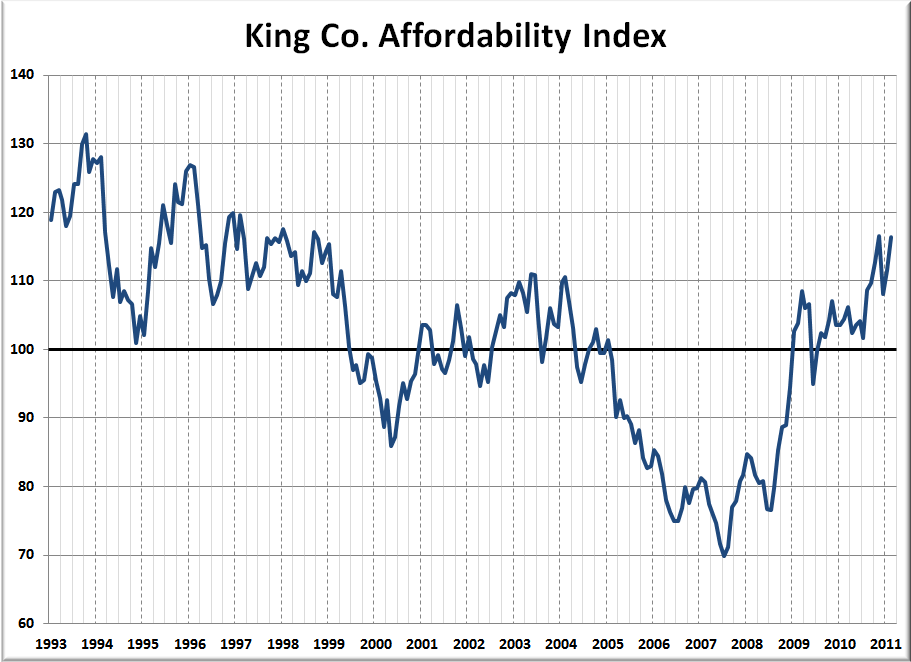
The average level of the affordability index from 1993 through 2004 was 108.3. The latest reading was 116.4. Whoa—that’s higher than any level we’ve seen since 1998!
Since the affordability index is fairly abstract, let’s have another look at my favorite affordability chart, where we compare how much home 30% of the median household income could buy with how much the median house is selling for each month:
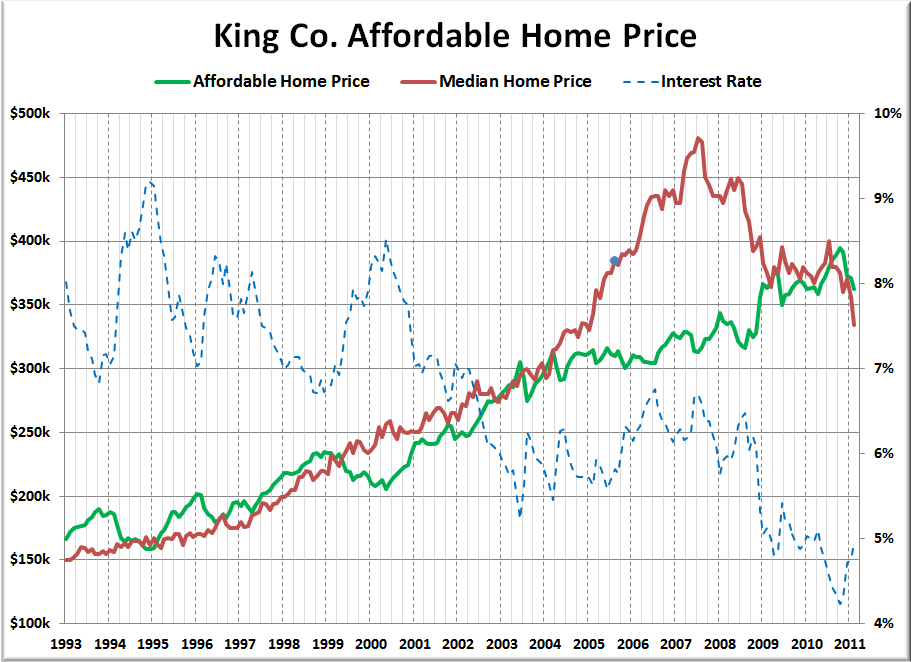
Wow, thanks to today’s still super-low interest rates, the affordable price for the median household income is actually $29,000 higher than the median home price.
The blue dot on the red line above represents the month this blog was started, August 2005. At that time, the median home price was 24% more expensive than what the median household income could afford. The difference between the two topped out at 54% in July 2007.
From 1993 through 2004, median prices came in an average of 0.4% lower than what the median household income could afford. The latest reading puts the affordable home price 7.9% lower than the median home price. That’s not the lowest point on record (that was 18.5% in October 1993), but it is the best affordability we’ve seen since September 1998.
As I mentioned, interest rates are still a huge factor keeping affordability high. February’s average rate for a 30-year mortgage came in at 4.95%. At an interest rate of 6.5% (0.7 points below the ’93-’04 average), the affordability index would currently sit at a much lower (but still not terrible) 98.3.
So what does this tell us? It would appear that although home prices got out of whack with median household incomes before the housing bubble started, the combination of post-bubble pricing and today’s abnormally low interest rates are actually making King County homes more affordable than they have been any time since before the dot-com boom.
Does this mean that home prices are at bottom? Probably not quite, since most busts tend to over-correct, and we’ve still got quite a few negative economic factors hanging over our heads in combination with a growing sentiment that homebuying is only for suckers. However, as I noted when I compared home prices to per capita incomes on Monday, it’s absolutely noteworthy, and could be a sign that we’re at least getting close to the bottom.


Just for laffs, what would the affordability be if the interest rate was 7%?
I want to see what it looks like once the government supports start getting taken out.
Rate this comment:
0
0
Tim… taking your “affordability” chart one step farther that just King Cty… how do the numbers look for Seattle when factoring in today’s low interest rates?
Rate this comment:
0
0
This data, combined with recent sales data, shows just how much of the market psychology simple two variable analysis can miss. Obviously, as shown here, . . . It’s A Great Time to Buy! But for some reason people aren’t. Hmmmm. We must have missed something.
Rate this comment:
0
0
Tim-
Can you tease out the impact of the interest rates on the affordability lines? There’s an inverse correlation for sure, but how much?
Once done you can hypothesize about what happens should rates go up in the future.
Rate this comment:
0
0
RE: Hugh Dominic @ 1 – If interest rates today were at 7%, the affordability index would be 93.4, roughly where it was through the year 2000.
RE: mike hearl @ 2 – I don’t have yearly median income for Seattle proper. If you can find me a source for that back through 1993, I’d be happy to tackle it.
RE: Consultant Ninja @ 4 – Are you looking for something like this post?
Rate this comment:
0
0
Seems like the data support the claim that monthly-payment affordability has increased, but I suspect that ability to qualify is lower than it has been for quite a while, now that quite a few people can no longer borrow zero down or transfer a huge chunk of equity into a new home.
Our household income is north of $200K and we live in a cheap rental and have no kids yet, and it’ll take a long, long time to accumulate a 20% down payment for anything that isn’t a complete POS that needs a major remodel since we are prioritizing accumulating retirement savings first, paying down student loan debts second (~$100K), and putting away money for a down payment as a super-distant third.
I have no idea how the median household can accumulate a downpayment well into the four-figure range *and* save for retirement (even without the $100K student loan debt) while paying for gas, groceries, cars expenses, utilities, etc, etc, etc….and either completely depleting their emergency savings or just rolling the dice and going without them entirely.
Even if owning becomes cheaper than renting it’ll be years before we’re in a financial position to make a $300-$500K mortgage anything less than a *massive* financial risk and a detriment to all of our other financial priorities. Life is full of tradeoffs, and being on the hook for a Seattle sized mortgage just isn’t worth making them – at least not to us.
Rate this comment:
0
0
So where do you all think we are?
Rate this comment:
0
0
By Yaj @ 6:
I’m not sure what you mean by “well into the four-figure range” but the median home price in February would require $67k to put 20% down. A household making the median income of $66k would take about 5 years to save that up if they saved 20% of their income. Doesn’t seem too terribly unreasonable to me, but I’ve always been a pretty heavy saver, so my perspective is no doubt skewed.
RE: deejayoh @ 7 – Hey no fair, I was saving the market emotions chart for another post later this week or next week (depending on when the NWMLS numbers come out).
Rate this comment:
0
0
RE: deejayoh @ 7 –
Fear.
On a side note, how many realtors do you think have already printed off Tim’s second chart above and thrown it in their notebooks to show to prospective buyers?
“This is the time to buy- with affordability at levels we haven’t seen since the late 1990s- well before the bubble- this market is poised to take off! Buy now, or miss the bottom!
Rate this comment:
0
0
Hey Tim
Slightly off topic ( rather, topic of a few posts ago ), is it possible to obtain the income of new mortgage holders rather than per capita or median household? Both per capita & median household incomes are estimates of the population that might be interested in buying a house.
If you plot actual borrower incomes you can look at the relative affordability for actual buyers, and also try to tease out the wealth effect. Is the distribution of home buyer’s incomes different from the population at large? A KL divergence test would be an interesting place to start. How have income distributions changed over time for both buyers and the population at large?
@ Scotsman, are you being sarcastic? Correct me if I’m wrong, but you seem to be reiterating the converse of pre-bubble collapse “logic”.
Rate this comment:
0
0
No matter how “affordable” you may think WA homes are — they’re still way, way out of line with what you can get almost anywhere else in the country…even in places with really desirable climate.
In fact, the still high Washington prices are probably what is keeping the unemployment rate here among the highest in the country:
http://www.bls.gov/news.release/laus.nr0.htm
Look, if you want to make Seattle an enclave for the haves…which it pretty much is, then don’t expect to participate in the broad based recovery that’s taking place…almost everywhere but here!
Rate this comment:
0
0
By Scotsman @ 9:
I think more likely some mainstream media outlet will pick up the thought and publish an article.
But I also believe the conversation this site has turned from being about a real estate bubble toward whether or not real estate is a good investment per se. If affordability has fallen back in line with historical metrics (which appears to be the case in spite of falling income, by the way!), then the arguments about bubble status are probably moot. People don’t need to believe that a new bubble is starting in order to justify buying a house. People just have their biases. Its like term vs. whole life insurance.
And the arguments about real estate as a good or bad investment are just less interesting to me. Plenty of bad investments to be had out there. Real estate isn’t any different in that sense.
Rate this comment:
0
0
RE: The Tim @ 8 –
Is median “income” pre- or post- estimated federal income tax?
Rate this comment:
0
0
RE: deejayoh @ 7 – Clearly we are past the panic stage. I’d guess we’re right around Despondency right now.
Rate this comment:
0
0
RE: deejayoh @ 12 –
You need to add a disclaimer- didn’t you buy a house recently?
Rate this comment:
0
0
“I’m not sure what you mean by “well into the four-figure range” but the median home price in February would require $67k to put 20% down. A household making the median income of $66k would take about 5 years to save that up if they saved 20% of their income. Doesn’t seem too terribly unreasonable to me, but I’ve always been a pretty heavy saver, so my perspective is no doubt skewed”
You’d have to be an *extremely* heavy saver to put away 20% of your gross at $66K per year after accounting for taxes, health care, rent, utilities, transportation, groceries, life insurance, etc, etc, etc, etc. Not going to happen if you’re coming anywhere close to maxing out your 401(K)/IRA contributions, let alone accumulating 3-6 months worth of savings.
Not arguing it’s impossible, but I’d put the the reality-indexed number at something closer to 10 years, and that’s only if the hypothetical household pretty much eschews retirement savings and emergency fund, etc, etc.
Not necessarily a right or wrong thing here – my main point is that it’s waaaay easier to borrow $50-100K than it is to accumulate that much in real savings by deferring consumption, and it’ll take the average household a minimum of 5 years to sock away that much money. It’ll take most quite a bit longer. End result – affordability is one thing, ability to qualify (in terms of fiscal sanity, if not bank lending requirements) is another.
Rate this comment:
0
0
RE: deejayoh @ 12 –
The discussion has been about Real Estate as an asset. Is Real Estate an asset that you want to own?
The problem with the affordability, compared to interest rates, is that when interest rates go back up, the price of Real Estate will go down. If you are using the payment as a gage of afforability then yes Real Estate would be an asset to avoid.
If the price were closer to something that cash could buy then maybe Real Estate would be a place to keep cash.
As it is today your return, on an investment of cash, is much higher in stocks, and even bonds. Bonds are holding value, Real Estate is going lower in price.
Rate this comment:
0
0
And…meant five figure range…my bad. Wish it was only four figures…
Rate this comment:
0
0
RE: Dave0 @ 14 –
Nah, too many think this is the bottom, or close to it. When prices continue down after the spring bump that’s when the panic/despondency will set in. I know people who are bummed or unhappy, but no one who is panicy, let alone despondent. Folks still think this will turn around by next year at the latest, and that gives them enough hope to keep the dream alive.
Ray says they’re all coming back. How- if people haven’t really even started to walk yet?
Rate this comment:
0
0
RE: Yaj @ 16 –
I have this discussion a lot with people tempted to put 20% down. A couple who worked with a Real Estate agent, and mortgage professional are putting nothing down on a bank owned property. It’s $135K of heaven in Mount Lake Terrace.
In my opinion, within 5 years, banks will be paying people to promise to pay on a property they can no longer get some sucker to buy.
Rate this comment:
0
0
RE: Alex @ 10 –
Yes, that “voice” is my alter ego- Betty Couger- sexy single and part time realtor. Grrrr!
Rate this comment:
0
0
RE: The Tim @ 5 –
Essentially two linked questions:
1) what is the sensitivity of the denominator, to the interest rate variable?, and thus
2) how does the green line change if you vary the interest rate?
The answer to #2 (on my analysis) is that each 1% increase in the interest rate decreases home affordability by about 10% or $30K, holding everything else constant.
But the topic du jour is not if home prices are affordable – it’s if home prices will stabilize at these levels. While the green line above the red line looks good today, if I buy it and interest rates rise, it will destroy the affordability of the people who are buying houses tomorrow (and thus, drive the red line further down in the future).
Conclusion – Red line will not stay flat, it will keep going down.
Rate this comment:
0
0
By Scotsman @ 15:
Why do I have to add a disclaimer? Does this somehow affect the math behind where we are vs. historical levels of affordabilty? That’s a comment about who I am vs. the validity of the facts.
Rate this comment:
0
0
RE: Yaj @ 6 – I have some remarks on your well-written post.
- you should prioritize the down payment above funding your IRA. You can’t live in an IRA! And the equity on your new home will rise and accumulate, tax deferred, just like a retirement account. After climbing the housing ladder, you can sell your house and downsize, thus turning your equity into retirement cash.
- at your household income level, you will not be satisfied in a “median” house. You will find that the houses befitting of your lifestyle are priced at $800k+. Be sure to factor that into your financial plans.
- you do not have 5 years to save for your down payment anyway. The prices will rise as fast as you save, you will never gain ground. You must stretch as much as possible to buy now, or you will forever be priced out.
Rate this comment:
0
0
RE: deejayoh @ 7 – I think we’re squarely in the fear and desperation part of the graph. Plenty of downward space from here.
Tim, remember that it’s not only buyers that need income to make home purchases work but lenders that need liquidity in order to provide mortgages. With all of those foreclosures and pending foreclosures that are being mark-to-market accounted, there are a lot of lenders who actually don’t have any liquidity and are really completely bankrupt but are still in business because of shady accounting rules.I would guess that almost all US lenders are in that category.
Rate this comment:
0
0
Obviously the numbers show that it’s a good time to buy. I also like that optimism/depression chart deejayoh provided. Clearly jobs are not where they should be and people are flat out pessimistic. When people are pessimistic, they think with their “lizard brains.” The lizard brain controls people decisions during periods of stress, anger, and frustration. Your higher brain functions make decision when you’re more optimistic. This is an important distinction, because it is very predictive of how a macro population will behave. I lowballed a seller and bought 2 years ago, and I’m still satisfied with my purchase. I’m not going anywhere for at least 10 years, so it made sense for me even though I could have probably paid 20K less if I waited 2 years.
So when it comes to buyers, people are still jaded by the housing bubble. People feel like they want to take less risks and be mobile. They’re bitter and pessimistic about jobs, our economy. Enter the era of the lizard brain. It’s difficult to say what will happen, but if I’m going to play the Yahoo oracle, I would predict this year will suck and next year will probably be less pessimistic and there may be some bottom calling. Who knows. The numbers do show that Seattle has hit some rough economic fundamentals for per-capita incomes. The median doesn’t matter, as they are squeezed out, and the pivot point is somewhere between the median and the average income. Same thing goes for San Francisco and Orange County. I think Tim has done some good analysis on this.
Rate this comment:
0
0
If houses are now affordable and in-line with historical price-to-income ratios, then I don’t think there ever was a genuine bubble in prices. Instead, there was just some “froth” as Alan Greenspan once claimed. A genuine bubble, in my opinion, would require around a 50% decline from peak to trough.
According to Tim, the price-to-income ratio peaked at 6.7, and now it’s at 4.9. That’s only a 27% decline. In my opinion, when the ratio gets to 3.35, then the bubble will be over. That would require a 30% decline from today.
But Tim has implied a price-to-income ratio of 3.35 is unlikely, based on data from the last 20 years. However, arriving at that conclusion based on 20 years of data doesn’t seem right. Twenty years isn’t even a generation. What is needed is data showing multiple generations to see the wide variety of possiblities in changes to prices and economic ratios and trends.
I don’t believe house prices at 5X incomes can be maintained over multiple generations. One generation of homeowners might succeed in inflating the price of their houses, but the next generation won’t enslave themselves so the earlier generation can realize their fantasy of making a “profit” on their decaying and depreciating houses.
Rate this comment:
0
0
Tim,
Just wanted to commend you on your great analysis of data. I wish I had your forte.
I haven’t checked the interest rates, but I bought my home in 92 or 93 (I think) and got an adjustable rate starting at 3.5%. Were fixed rates at that time 7%? What rate source are you using?
Interest rates are a real wild card because they can vary so much depending on loan type and credit.
My purchase back then was a 230K house, my PITI was $900.00 a month. Ahh the good old days.
Rate this comment:
0
0
By Scotsman @ 9:
Denial. Fear is when houses start getting dumped right and left. Denial is when sellers list high and hope some sucker bails them out ;)
Rate this comment:
0
0
How can the affordability index have risen so fast while unemployment was rising also? There must be something wrong with the data. The median income probably excludes the unemployed. So houses are more affordable… but hardly anyone can qualify for a loan, or dump their underwater house, or make the payments on their other debt. Catch 22.
My prediction is housing falls until it meets rents. Either that or until the government gets this all over with by auctioning all the REO property in large blocks.
Rate this comment:
0
0
“My prediction is housing falls until it meets rents.”
That’s my hunch too. think it might even have to go below rents in certain places when and if the 20% down thing sticks.
Once housing becomes cash-flow positive with a yield that exceeds the return on safer, more liquid, less troublesome assets that’s when enough cash-flow investors will step in and put a floor under prices in neighborhoods that the median household can afford to buy in. Different story in Medina, waterfront properties, etc where that dynamic isn’t going to be a factor IMO. Pink-pony neighborhoods like Ballard will probably equilibrate at a point where owning is marginally more expensive than renting.
Rate this comment:
0
0
: Yaj @ 6 – I have some remarks on your well-written post.
- you should prioritize the down payment above funding your IRA. You can’t live in an IRA! And the equity on your new home will rise and accumulate, tax deferred, just like a retirement account. After climbing the housing ladder, you can sell your house and downsize, thus turning your equity into retirement cash.
- at your household income level, you will not be satisfied in a “median” house. You will find that the houses befitting of your lifestyle are priced at $800k+. Be sure to factor that into your financial plans.
- you do not have 5 years to save for your down payment anyway. The prices will rise as fast as you save, you will never gain ground. You must stretch as much as possible to buy now, or you will forever be priced out.”
Hahaha. Thumbs up. Great parody of some of the shiznit we’ve had to listen to at dinner parties for pretty much all of our adult lives.
Rate this comment:
0
0
RE: Yaj @ 32 – (bows)
Rate this comment:
0
0
Tim: Where do I begin?
First of all, you’ve already concluded your income analysis was proven in yesterday’s post, when in fact, you’ve yet to explain why King County has corrected to about the same percentage as outlying areas. If your hypothesis were correct and we are near the bottom, King County’s wealth would have propped it up above the outlying areas. This one little perturbation in itself is proof your analysis is most likely incorrect.
Second, your entire hypothesis was based upon the assertion that median income is irrelevant to median home prices because people with median income cannot afford to buy homes. Yet, your affordability chart above completely disproves this assertion.
This is checkmate on your hypothesis.
Now let’s get past this and take a glimpse into the future. Take a look at the interest rate line in your chart above. What do you suppose is going to happen when Bernanke stops the printing presses on July 1st, and interest rates go up?
Rate this comment:
0
0
The idea of spending 30% of your gross on housing may have been a reasonable rule of thumb in the distant past, but there have been many changes in our society that have made that level of spending impractical for a lot of people.
First, most people will no longer receive a pension when they retire. Therefore there is a percentage of income that has to be saved for retirement that didn’t have to be saved by previous generations.
Second, education costs have risen and are not as heavily subsidized by government as they were in the past. People have to pay six figure student loan debt for professional degrees, while saving towards their own kids’ educations.
Third, health care costs have risen and take a larger share of income. Even good health plans cost a lot more than they used to.
Lastly, people have a lot more consumer debt to maintain than they used to.
Maybe 30% was reasonable in 1993 and you could still take a vacation once in a while. But 20% is probably a more reasonable number given all of the other things people have to pay for now.
Rate this comment:
0
0
Tim:
Remember, nobody kicks a dead dog.
Agree or disagree, keep up the good work.
Rate this comment:
0
0
By Julie Lyda @ 28:
http://www.federalreserve.gov/releases/h15/data/Monthly/H15_MORTG_NA.txt
Rate this comment:
0
0
RE: Scotsman @ 19 –
Oh…They are ALL coming back 1 way or another…Through Short sale or Foreclosure they will come back. However*********the caveat*************MASSIVE FED INTERVENTION! Its coming…………..!! bank on it!
http://www.cbsnews.com/video/watch/?id=7361572n&tag=contentMain;contentAux
Rate this comment:
0
0
By Scotsman @ 3:
In all fairness to Tim, his chart shows 3 variables, Interest rates, affordability, and house prices. That’s enough for people to realize, if they buy now, when Bernanke stops the printing presses, they’ll be deep underwater on their mortgage and feeling heavy buyer’s remorse. :)
Rate this comment:
0
0
By ray pepper @ 38:
So does this mean, “buy now because house prices will go sideways forever.” :)
Rate this comment:
0
0
Makes me laugh when ANYONE can conclude we are at or near a bottom. Just checked Pierce County Trustee scheduled for April 15. I see 409!!. 409 for 1 week!!!!!! Sure 1/2 will be postponed waiting for their day with destiny. While the other 1/2 get nibbled on by investors and the majority will hit the markets as shadow inventory waiting for their REO Agent to be assigned and strategically listed.
If Tim thinks we are ” at least getting close to the bottom ” then I say when the bottom hits it will be the longest bottom we ever experienced! Take your time Buyers and let the prices come down to you! They need to sell most certainly more then you need to buy!
Rate this comment:
0
0
RE: Jonness @ 40 –
buy now? hardly! We are nibbling here and there but only on homes that can be sold the next day for a profit or sold to other investors before they even close.
As I said before someone GIVING you a Condo for FREE is no gift. As for non condo home purchases, in this environment, always utilize the cost to rent/own formula that has been provided so many times. In a depreciating asset environment one is best left on the sidelines watching until a home can be stolen.
Again WALK from ALL multiple offer scenarios and when asked by your Agent for Highest and BEST on the REO you want————-LOWER your offer!
Rate this comment:
0
0
By ray pepper @ 41:
Yes, that’s pretty much what I’m saying…
Rate this comment:
0
0
By deejayoh @ 7:
Apparently, with all these recent claims we are near the bottom, we’re still in the denial stage.
http://seattlebubble.com/blog/wp-content/uploads/2007/08/market_emotion_cycle.png
Rate this comment:
0
0
By ray pepper @ 42:
Ray, I met one of your agents a few years back when I wanted to look at a few houses. Since then, he has taught me how to value houses from an investor’s perspective. In the process, we have become good friends. I’ve yet to feel comfortable enough to buy a house, but I have formed very high opinion of your company.
Rate this comment:
0
0
RE: The Tim @ 43 –
Hey, it’s tough being the lead dog- all those other mutts keep trying to sniff your butt. Hang in there! ;-)
Rate this comment:
0
0
Tim: “So what does this tell us? It would appear that although home prices got out of whack with median household incomes before the housing bubble started, the combination of post-bubble pricing and today’s abnormally low interest rates are actually making King County homes more affordable than they have been any time since before the dot-com boom.”
Affordability is not about how much your monthly payment is. It’s about whether you can really afford it. In other words, just because you can make the payment, doesn’t mean you can afford it. Most of the reason we got into this bubble mess was this kind of thinking. Borrowing 95% of the value of a property sure makes it affordable! (But what happens when interest rates rise?) Ha Ha Ha! Good one! Seattle is more affordable than ever! Buy now or be locked out forever….
Tim, you are really earning your money this week!
Rate this comment:
0
0
RE: Jonness @ 45 –
Must have been Nik you met. He’s a nice guy but a true investor grinding it out at the auctions every Friday. Thats his passion. He and his wife have made a living at it for many many years. Since they sold their last flip and pocketed 45k he hasn’t found anything. He’s even looking for his daughter now and they know what we all do. The REAL gems could show up now, but will really appear in coming years.
Rate this comment:
0
0
RE: ray pepper @ 41 –
I really Like Your Train of thought…
I have yet to read anything you have stated “that I haven’t myself didn’t agree with.. (especially valuing real estate based on the Formula of Rental Value~!!)
Using the Basis rental value “is what made me find this website, I have been on the Blogs about real estate being overvalued well before this website started, I was started shaking my head about values in late 2003.
Ray pepper “You Hiring~!!
if anything I would love to go out and have a beer~!! The last place I would Normally get investment advice is from the bar though.. then again I’ve been to the bar about 1-2 times in the last 5 years. I usually go there just long enough to drink the beer and look around and decide to head for the exit.~!!
Rate this comment:
0
0
RE: ivan @ 35 –
Excellent….
I really like the way you thought this out.
Its really nice to come across something that puts another prospective on things. We really regurgitate the same information over and over here… you’ve appeared to come up with something more Original.
WHATS WHY I’M HERE..
I think your statement is probably the best I”ve come across in a long time here reading these blogs. Very intelligent insight…
Rate this comment:
0
0
Hi-
Why does it seem as though the times when houses have been “least affordable” is when everyone was buying one, and vice versa?
I think I just answered my own question….
But it would be nice to plot # sales along with that affordability thing. I’m guessing they are anti-correlated, maybe with a lag.
Rate this comment:
0
0
By Scotsman @ 46:
Hmmm. So let’s do a little hypothetical syllogism:
Facts:
1) Seattle house prices are beneath historical levels compared to average incomes, but they are still 20% higher when compared to median incomes.
2) Average income is a better measure of rich people’s wealth than median income.
3) Median priced houses are affordable for people with median incomes.
4) More median priced homes sell than any other price point.
Tim’s Assertion:
1) Median incomes compared to median prices should not be used as an indicator because people with median incomes cannot afford to buy homes.
2) It’s much better to gauge the market by using average income compared to median prices because rich people got really rich during the dot com boom and bought really expensive homes for themselves and super cheap rentals as investments.
Analysis:
Fact #3 dispels the first assertion. Fact #4 dispels the second assertion.
Conclusion:
Tim’s made some great calls in the past, but this one is a real stinker. Better go easy on that sniffing guys! :)
Rate this comment:
0
0
RE: Jonness @ 52 -Fact #3 is just flat out wrong. In cities with a high degree of income inequality (NYC, San Fran, etc.) the median income typically cannot afford the median home. Only 60-65% of the population owns and home owners are highly skewed towards the higher end of the income distribution.
Again, I will make my King vs Snohomish county example. Both counties have roughly the same median income. Why has King County’s median home price always been significantly higher? It’s because the incomes above the median are much higher in King County. The average income of the top 20% is $50K per year higher.
Rate this comment:
0
0
RE: Jonness @ 52 – Sorry, “Fact” #4 is wrong, too. You’re confusing median with mode. In King County, the mode has typically been a good $100k below the median. In other words, lots of households with median incomes are in fact buying homes, but they’re buying them well below the median price.
If you want to see the full distribution of where the sales are happening, check out the histograms I posted last year. I had forgotten about those, but now that you’ve reminded me, I’ll update it in a new post sometime next week so we can see what’s been going on the last few months.
Rate this comment:
0
0
RE: Ron @ 49 –
Ron, every now and then The Bubbleheads have a meet-up and I think I’m 1-3 in attending. I will make it a point to come to next one. Last time I brought some 500 Realty Shirts and let me tell you they were hot hot hot!
Rate this comment:
0
0
RE: ray pepper @ 55 –
I went to the last meet up specifically to get a 500 Realty Hoodie, and you never showed up. No note, no apology, we were all there talking about the Hoodies. Every body was looking at the clock on the wall, waiting, and then the whole thing just broke up when it was clear you weren’t coming.
Nobody wanted to say anything because there is always hope that some day we will all get a chance to get another 500 Realty T Shirt which is certainly form fitting. When ever I wear mine people always ask, “do you know that guy? Do you have an address for that guy?”
It just makes me feel popular.
So until next time little buckaroo, we’ll just wait.
Rate this comment:
0
0
RE: Jonness @ 52 –
These are assertions. The fact is that each demographic is specific to a property class.
Rich people buy rich people property, middle income, buy middle income property, poor people, and investors by lower priced property.
You would have to make a chart showing a specific buyer pool to a specific type, or classification of property.
You could probably do the demographics for the buyer pool easier than you could classify property types.
Pretty much you would have to do that in order for your assertions to be valid. As an example that I used last year about Medina. Lots of the area around Medina refers to itself that way. In fact Medina is a very specific area, with a very specific architecture.
A good example of a buyer demographic to specific property type would be a Microsoft millionaire competing to buy a Phinney Ridge Craftsman. All cash, and just the status of how high the price would go.
Rate this comment:
0
0
RE: David Losh @ 56 –
too funny! but what is really classy wear is the Old Pepper Realty T Shirt. Find one of those and you got yourself an EBay GOLDMINE!
Rate this comment:
0
0
I’d buy Ray Pepper a beer (or 2 or 3…) regardless of whether or not I was getting 500Realty garb. Small price to pay for the advice given here. Same goes for The Tim. I’d even spring for the good stuff.
Rate this comment:
0
0
RE: David Losh @ 56 –
“little buckaroo”
Ray? I like it.
Rate this comment:
0
0
By Jonness @ 52:
FWIW, I dug through the sales data since January 2010 and plotted the King County SFH average, median, and mode so you can visually see that each month more below-median homes sell than any other price point:
Note that the medians above don’t line up exactly with NWMLS data, since the chart is based on downloads from Redfin, which includes off-MLS sales and puts MLS sales in the month they actually occurred not the month the agent got around to entering the sale.
Rate this comment:
0
0
By The Tim @ 61:
I don’t really understand Jonness’ point that you are referencing, but I assume you simply mean that the mode is typically below the median. The median, being the median, would be the half-way point where half the sales were below and half above.
Did you do some sort of grouping to determine the mode, such that a $295,900 home would be part of the same group as a $296,000 home? Absent doing some sort of grouping, I would think the result would be pretty random.
I would also expect the mode to typically be under the median, since the half of sales below the median are compressed into a much smaller dollar range. So I’m not even sure what the point of that exercise was. Can you explain?
Rate this comment:
0
0
RE: Kary L. Krismer @ 62 – Yes, sales are grouped into $50k buckets, as shown in this histogram post from last year, which I linked above in comment 54. For the point on the chart above, I marked the center of the range of the bucket with the most sales, which is why I labeled it the “approximate” mode.
The purpose of the exercise was simply to refute Jonness’ claim that ” More median priced homes sell than any other price point.” That statement is simply not true.
Rate this comment:
0
0
A milestone has been reached. The Tim has indicated we “may be close to a bottom.” This is a closely watched indicator, like Ben Bernanke, where the very language of the FED release is scrutinized for clues. Given this historical moniker, how many others think we “may be close to a bottom.” I’m buying a house now, haha! Gas on!
Rate this comment:
0
0
By drshort @ 53:
Actually that fact is 100% correct. We are talking about King County, not SF. Have another look at Tim’s second chart in the series.
Rate this comment:
0
0
By The Tim @ 61:
Nice work Tim. I can always count on your level head, professional attitude, and expert capabilities. I stand corrected. Interestingly, by proving me wrong on that fact, you’ve pretty much nailed the coffins shut on your hypothesis that median incomes cannot afford homes in King County. Remember, you founded that entire hypothesis on the fact that median incomes can’t afford to buy homes. Thus, you weighted your charts toward the high incomes. Later, you circled around on yourself and started using data that unseated your entire capstone. At least we’ve finally got through this thing and can put your hypothesis to rest once-and-for-all. :)
Rate this comment:
0
0
How did I really know Tim’s hypothesis was bogus? I knew before he even ran the charts that many outlying areas had only corrected about as much as King County (percentage-wise). Quite obviously, if the rich Google employee’s were propping up King County house prices more than the poor people in outlying counties could prop up their prices, outlying counties would fall much further much faster. From there, I knew Tim’s hypothesis was completely bogus. Yet at that point, it was an incomplete counter-proof.
When Tim’s attempted proof circled around and completely contradicted itself, he actually did all the work necessary to disprove himself. You see, in order for a hypothesis to be correct, all parts of the hypothesis must stand up against rigorous analysis and testing. Tim’s hypothesis fails to have this quality. However, my hypothesis that median incomes are the better measure has withstood this rigorous analysis and testing. At least so far nobody has been able to disprove it. Time will tell if it continues to hold. :)
Rate this comment:
0
0
By Jonness @ 67:
RE: Jonness @ 67 –
Explain why king county’s median home price have always been higher than in snohomish county despite relatively equal median incomes in the two.
Rate this comment:
0
0
By Drshort @ 68:
Truthfully, that’s exactly my point. King County has “always” been higher than Snohomish County. What matters to disproving Tim’s hypothesis, is prices relative to incomes in the same county over time.
We are comparing “relative” measures.If you look at other local counties in outlying areas, you will see they are correcting in a manner relatively similar to King County (percentage-wise).If King County was propped up by the dot com bubble, and is therefore fairly valued compared to incomes, why aren’t these incomes propping up prices more than in many lower-income impoverished areas?
The answer is in Tim’s latest chart. People with median incomes can afford to buy homes. Thus, the notion that you need to weight the analysis toward the rich end of the spectrum doesn’t make sense.
House prices are still about 20% above historical relationships to incomes. As I said earlier this winter, we will get some Spring support, but the overall trend remains down.
Rate this comment:
0
0
RE: Jonness @ 69 –
Let me try some more examples.
In the buyer pool category mom, dad, and the kids are the biggest buyer pool. For being close to the school you want, or the neighbor hood, or to fit some white picket fence dream these people will pay what they have to. They will stretch.
At this time of year those buyers dominate the market place.
At other times of the year a more diverse buyer pool is available for a wider variety of houses, or housing units.
Even though the post says affordability, any one, or any group can make anything affordable except in the upper class of property at over $750K, let’s say, just picking a number.
Where I’m going with this is in the next few years we may get to a point where prices are very low, and affordability is much more attractive than it is today, and people won’t buy property. It wouldn’t be prudent.
You’re making assertions to fit a preconceived idea that housing units will remain an asset class rather than just a place to sleep.
I’ll go a step further because it is coming up a lot this year. Business Opportunity is also Real Estate. A whole lot of people are buying businesses for cash. Commercial Real Estate leasing is getting more reasonable, but is also much more interested in business models that will survive. It looks to me as though an asset might be better as a commercial building with a thriving business.
Rate this comment:
0
0
By David Losh @ 70:
I think you and I are kind of saying the same thing. During the bubble, people looked at houses as get rich quick plans. The more you paid, the more you made. As we move forward, prices will go down at least as far as historical relationships to incomes because people will increasingly realize houses are only a place to sleep, and there is a greater risk of losing money on a house purchase in the short term than making money.
I agree with this too. That’s why it’s a bad idea to weight the income to house price ratio toward upper incomes. People with median incomes typically pay a far larger percentage of their earnings toward housing than rich people. Tim’s use of average income does not account for all the surplus wealth out there that’s not being put into housing. Median income compared to median price is a far better measure than average income compared to median price.
Rate this comment:
0
0
By Kary L. Krismer @ 62:
Hypothetical syllogism is a commonly used form of logic used to prove or disprove assertions:
http://en.wikipedia.org/wiki/Hypothetical_syllogism
Exactly! People with median incomes can afford to buy about half the homes in the King County market. Therefore, Tim’s claim that these people are too poor to buy houses, so we should give them lighter weight in our analysis is incorrect.
So let’s look at the syllogism again but in a more simplified form:
Fact: People with median incomes in King County can afford to buy homes in King County.
Assertion: People with median incomes in King County can’t afford to buy homes in King County.
Analysis: The fact disproves the assertion.
Rate this comment:
0
0
RE: Jonness @ 66 – Okay, we get it. You obviously don’t agree with my analysis. I also don’t agree with yours. You think the data I’m presenting proves one thing, I think it proves another. We don’t really seem to be getting anywhere here.
I’ve been using the same methods and data sets to analyze home prices since I started this blog. Back then they were telling me we were in a bubble, with prices that were clearly unsupported by the local economic fundamentals. Today they’re telling me that we’re getting close to a bottom (5% to 10%), barring any major economic collapse. We’ll likely stay at that bottom for a very long time, but the data doesn’t lie.
I notice that you have yet to provide any quantifiable data supporting your claim that prices will fall another 30% or more. How about this offer. You write up a data-backed post supporting your claim, and I’ll put it up on the blog as a guest post. I’ve always been a fan of open dialog and exchange of opposing viewpoints.
Rate this comment:
0
0
“Hypothetical syllogism is a commonly used form of logic” HUH???????????
I took Intro to Logic (Philosophy 120) at UW 20 years ago. On the 1st day I said I gotta get the hell outta this class. I didn’t know what the heck they were talking about……….nor did I care..
Rate this comment:
0
0
By The Tim @ 61:
So I’m seeing that in your chart here you have *average* home price which is much higher than *median* home price. If you feel that it’s kosher to compare *average* income with median home price and call Seattle *affordable* then why not do it the other way around with *average* home price vs *median* income?I still don’t think that you’ve done an apples to apples comparison. Why not put all four comparisons out on the table?Average income vs Average home price
Average income vs Median home price
Median income vs Average home price
Median income vs Median home priceIf I remember correctly, you used to compare median vs median.http://seattlebubble.com/blog/2007/02/01/pop-quiz-time-fundamentals-or-speculation/
You even stated in the past…
“Before I get to the chart, here’s a quick refresher on what the “affordability index” is, and what it isn’t. What it is is a simple measure that shows relationship between median home prices, median household incomes, and interest rates.”
http://seattlebubble.com/blog/2008/02/28/king-county-affordability-1950-2007/
Rate this comment:
0
0
In a post from the past, you explicitly stated what the affordability index was…
“is a simple measure that shows relationship between median home prices, median household incomes, and interest rates.”
http://seattlebubble.com/blog/2008/02/28/king-county-affordability-1950-2007/
Rate this comment:
0
0
By Jonness @ 72:
I feel like I woke up in a opposite universe this morning. ;-)
First, I don’t accept the factual assertion that median income can afford median houses. As I’ve stated in the past several times, not everyone in the worker pool is in the house market, and houses are not purchased only with income–they are also purchased with wealth.
Second, for the assertion to be false it would need to say “cannot afford to buy a median priced home.” If the median is $400,000, that doesn’t mean there are not $125,000 homes.
Rate this comment:
0
0
By ray pepper @ 74:
You obviously didn’t have the same TA that I had when I took the course a few years earlier! ;-)
Rate this comment:
0
0
RE: The Tim @ 73 –
I’m fascinated with your comment as well as the posts, and comments on other Real Estate Blog sites: “barring any major economic collapse.”
We did have a major economic collapse, and continue to have major economic collapses.
It seems that the Real Estate blogging world is in an alternate universe. You started a blog about the Real Estate Bubble, but now you are kind of back tracking.
Let me give another example about the buyer pool and housing unit classifications. The City of Seattle allowed the “fast tracking” of attached town homes to comply with the demand of the Growth Management Act for filling in city density. The idea was to make these units “affordable” housing. During the bubble these units began selling at the same price as a detached housing unit. Houses in out lying areas began selling at the same price as in city housing.
Now I know that I have hammered that idea into the ground, but affordability, or value for that matter, doesn’t need to correlate to the median, average, or mode of the buyer pool. In theory these housing units can fall to the price of $168K that they were meant to sell for and completely skew affability. It would show affordability, yet not attract a buyer pool.
This is kind of the same as talking about wealth, as opposed to income, but affodability is a good gage because as you point out it is a constant. In my opinion it also dismisses a lot of factors, like a global economic collapse.
Rate this comment:
0
0
RE: David Losh @ 79 – We did not go through a collapse. The banking and insurance industries continued to function, as did the stock and bond markets.
Rate this comment:
0
0
RE: Kary L. Krismer @ 80 –
Functioning banks or financial markets is a poor indicator of economy. That is another point about how the housing market can collapse while other segments of the economy continue to function, and thrive.
We have been engaged in this discussion on the Global Economic thread, but it’s main focus has been the pfft person’s continued reliance on the stock market as an indication of economic growth. You can also bring in GDP, which in my opinion is heavily debt related.
Debt may be wealth, but some one has to pay. I’d be interested in seeing how debt crisis in Europe, the United States, or China for that matter is some how not seen as a collapse.
It’s also interesting that you included insurance. Just because we pay into insurance doesn’t mean that it is functioning, or has not completely collapsed. Our Federal Budget debate is a prime example. Social Security, and Medicare are being paid for even though they are not fully funded.
Rate this comment:
0
0
By The Tim @ 73:
From my memory, perhaps 5% ago, you predicted (nominal) prices would fall between 5 and 10%. I predicted they would fall a minimum of 10%. I don’t recall, but I might have also said something to the effect prices could fall as much as 25% or so? I’m not sure where you are getting the minimum of 30% claim. I honestly do not remember making this claim.
You know I have the greatest respect for you Tim. But I don’t believe you are correct about this particular analysis, and I believe this is an extremely important issue. It means the difference between houses being undervalued and houses being about 20% overvalued. That’s a really big deal for anyone who is currently considering jumping off the fence and leveraging all in on a house. If I’m right, a person with 20% down, which took them 5 or 10 years to save, could get completely wiped out. If you are right, buying now could turn out to be an excellent decision in the long run. These outcomes are far to diametrically opposed to gloss over, especially considering both analyses appear to carry significant weight.
Rate this comment:
0
0
RE: Jonness @ 82 –
Serious amount of pixels spilled on this for what seems to me to be a fairly trivial difference in outlooks
By Jonness @ 8:
By The Tim @ 46:
Just sayin’
Rate this comment:
0
0
RE: deejayoh @ 83 –
Actually Jonness has up a good argument for why larger economic discussion is needed to clarify housing price.
Rate this comment:
0
0
This measure of affordability is probably a good predictor of the peak of a bubble. Logically, when speculators can no longer afford to make the payments, even on a 100% loan, they will not be able to buy a home – even in a bubble market when prices are increasing. However, this measure is not a good determinant of the bottom of a market as supply and demand is a much stronger driver of prices. This number gives undue weight to interest rates, which are at historical lows. as interest rates rises, the ability for future buyers to pay more for your home will drop as it will have become less affordable.
If housing prices are expected to drop and then remain flat for 5-10 years, what is the incentive to buy? Especially since it is still cheaper to rent than to buy in Seattle.
Look at banks willingness to loan and the ability of buyers to get a loan. Look at jobs. Look at the price to rent ratio. And look at the home prices to median income alone without interest rates. Most importantly, look at shadow inventory and foreclosures – Are we really at the end of this?
Redfin places the number of foreclosures at 205 out of a total of 3,190 properties in Seattle. Is this really accurate? Hard to believe the number is so low.
From CNN Money:
“There were 1.7 million homes either owned by the bank or in some stage of foreclosure at the end of the third quarter of 2010, according to a recent report by Standard & Poor’s. It would take 44 months, at the current rate of sales, to sell them off — a 25% increase from the beginning of 2010. (S&P does not count home loans backed by Fannie Mae and Freddie Mac.)…Data through Sept. 30 from the Mortgage Bankers Association, which tracks about 80% of the market, suggests there are more than 2 million Americans seriously delinquent on their mortgages and another 2 million bank-owned homes. Plus, RealtyTrac reported last week that a million homes were repossessed in 2010…banks have struggled to keep up with the sheer volume. Last year there were nearly 2.9 million homes that received some kind of foreclosure notice….of the 20 separate markets S&P analyzed, Miami was the only market of the 20 that S&P analyzed where shadow inventory did not did expand during the first three quarters of 2010. In Minneapolis, it rose 61% between Dec. 31, 2009 and Sept. 30, 2010, to 35 months from 21. Las Vegas went up 48% to 30 months supply, and Portland, Ore. jumped 47% to 45 months. In New York, foreclosures are relatively moderate, but many have gotten stuck in the pipeline. As a result, the state now has the longest shadow inventory list, with nearly 10 years worth of homes. Boston’s shadow inventory is at 62 months and Miami’s is 60.
Seattle must truly be different!
Rate this comment:
0
0
By David Losh @ 84:
Well, not that I have been following soooo closely – but seems pretty obvious to me that the disagreement stems from Tim’s choice of income measure (average vs. median), and not some “larger economic discussion”. So, based on the two parties ending up with a viewpoint on how much more the market may fall that is somewhere between 5 and 9% points difference – I’m still going to call it a lot of arguing for not much difference in outlook.
Rate this comment:
0
0
RE: The Tim @ 73 –
“I notice that you have yet to provide any quantifiable data supporting your claim that prices will fall another 30% or more. How about this offer.”
How about comparing price to debt service over time? My assertion is the bubble fundamentals are back to normal when people are back to spending no more than 30-36% gross income on debt. Project today’s ratio out at 6% and 8% interest rates and you’ve got something.
Price to income (be it average or median) just doesn’t matter a whole lot. What matters is sentiment, which is how badly do people want to stretch their finances to get a house at any price.
On a lighter note — funny scene in the move “Date Night”. Tina Fey is a real estate agent. She shows a couple this gorgeous house which has come down from $1.8 million to $300 thousand. They say they’ll wait because they think it’ll come down some more.
Rate this comment:
0
0
By Kary L. Krismer @ 80:
This comment seems out of touch with reality. Look into how the accounting rules were changed. Since “the event” they have been allowed to value under water assets at book value, and totally obfuscate what’s on their books. Most likely every single bank of consequence is now insolvent, and will be for years.
Rate this comment:
0
0
By Macro Investor @ 88:
Your comment seems out of touch with the understanding of simple English. Do you deny that the banking system continue to function? You might not like the fix, but you can’t deny that most people continue to deposit their money into banks, withdrawals from banks are generally honored and that banks continue to make loans.
And again, while you might not like book value on some of their assets, that does not mean market value is what the banks will ultimately recover on the asset. So unless you want Zillow to somehow be involved in determining the solvency of banks, there is no good other alternative.
Rate this comment:
0
0
By deejayoh @ 86:
Actually, we disagree by over 20% on this particular indicator. But house prices are influenced by many factors, so our overall outlooks aren’t so far off. My worst-case depreciation is only about twice what Tim’s is.
Rate this comment:
0
0
By Jonness @ 90:
hhmmm I think I should have said 5 – 15%, but I guess I still need some help with the math:Jonness: “I’ll choose the 10 to 19.9% to bottom category”
Tim: “a total ending up in the 5% to 9.9%.” (to bottom)
how do we get to + 20%?
oh, wait. NM. just saw the qualifier. Disagree on the factor. got it
Rate this comment:
0
0