I’ve been seeing more and more stories popping up all over various news outlets about high gas prices lately. Most have been about how the issue will effect the November presidential election, but it’s only a matter of time before the conversation moves to real estate again.
Rather than re-writing all of my thoughts on this issue, I thought I’d get out in front of it this time with a wrap-up of the posts I wrote the last time this topic spiked in the collective consciousness back in mid-2008 (whoa, has it really been that long?).
Let’s say you’ve got a 30-mile commute from Sultan to Redmond (one of my former coworkers did that—yuk), and that your car gets a decent but not great 25 miles to the gallon. At $2.50 per gallon, you were spending $30 a week (~$120 a month) on gas for the commute. At today’s $4.00 per gallon, that is up to $48 a week (~$192 a month), a difference of $72 per month, or $900 more per year.
So lets say you decide to move in closer, to Kirkland or Woodinville. Now your commute is just 6 miles, and a week’s worth of commuting costs you just $10, saving you a grand total of $1,900 per year.
From Will High Gas Prices Save Close-in Neighborhoods?
Pretty much any way you slice it, the higher cost of housing close-in far outweighs any financial benefits you get by cutting your commute. Run the numbers for any pair of far-flung vs. close-in cities around Seattle and you’ll find the same thing.
…
What I’m trying to get at here is that the “high cost of gas” argument for why close-in neighborhoods will somehow retain their value just doesn’t wash.There is value in living close to your job, but with the current dynamics of home prices and gas prices, that value is simply not financial.
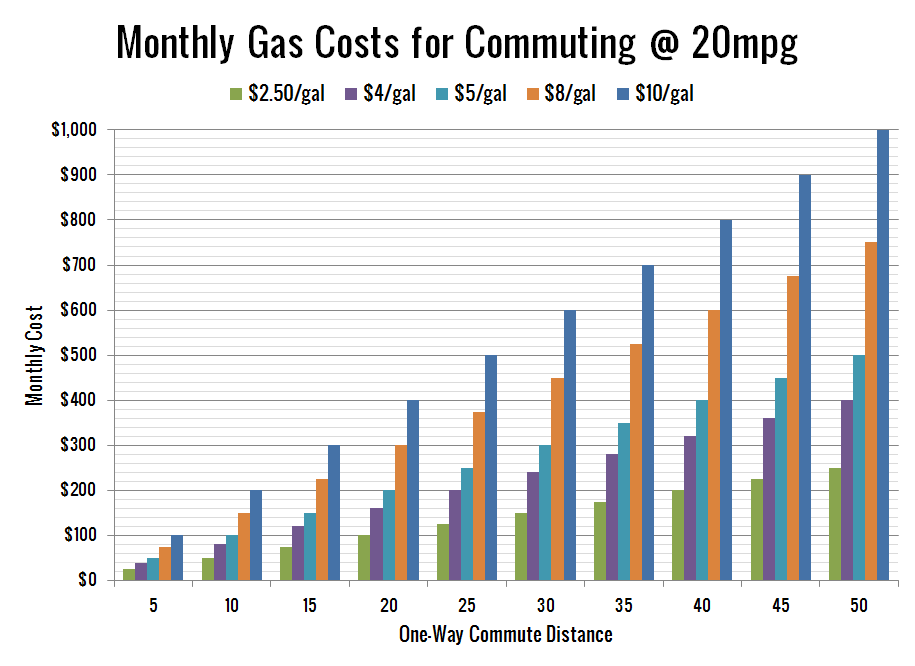
That post also included this handy reference chart:
Finally, from Beating a Dead Horse: Gas Prices
I’m not saying that there aren’t a lot of convincing reasons to want to live “close-in.” I’m also not making some sort of general statement about the overall economics of living further out. Articles such as these are making the claim that gas prices alone will drive people into more expensive in-city real estate. I’m simply saying “prove it.”
True, homes are considerably cheaper today than they were four years ago when we had this discussion last time, but unless you’re commuting daily between Bellingham and Tacoma, the cost of gas (however high it is) is still likely to be dwarfed by the housing costs of moving to a closer-in neighborhood.


RE: Pegasus @ 93 –
The quote from Helenius which ends your comment should also be viewed in context. Helenius didn’t impose a full fiduciary obligation on the trustee. The paragraph following your quote from the Helenius case states:
“We agree with a recent Alaska decision which emphasizes that a trustee’s management responsibilities under a deed of trust are less extensive than those of trustees in other fiduciary settings. McHugh, 583 P.2d at 214. See also S & G Inv. Inc. v. Home Fed. Sav. & Loan Ass’n, 505 F.2d 370, 377 n. 21 (D.C. Cir.1974). The trustee of a deed of trust is not required to obtain the best possible price for the trust property. Cf., e.g., Allard v. Pacific Nat’l Bank, 99 Wn.2d 394, 406, 663 P.2d 104 (1983). Nonetheless, the trustee must “take reasonable and appropriate steps to avoid sacrifice of the debtor’s property and his interest.” McHugh, 583 P.2d at 214.”
The point is that the obligations of the trustee to the grantor of the deed of trust were unclear before and after Helenius. The court in Helenius said the standard was a fiduciary standard, but “less extensive than those of trustees in other fiduciary settings.” That’s about as clear as mud. The Deed of Trust Act was silent on the subject until the revisions of the statute in 2008 and 2009. Arguably the “good faith” language didn’t add or subtract from the nature of the trustee’s duties prior to 2008, but merely attempted to clarified what was otherwise a very unclear standard.
Rate this comment:
0
0
RE: One Eyed Man @ 101 – I wouldn’t go that far. The 2008 arguably didn’t change anything, as I’ve addressed, but even though the prior standard is unclear, I think most courts would find good faith to be a lower standard than some quasi-fiduciary standard. After all, that’s only the standard a real estate agent has to meet! :-D
http://apps.leg.wa.gov/rcw/default.aspx?cite=18.86.030
Actually, it’s probably even lower, because we have to act honestly too!
Rate this comment:
0
0
RE: One Eyed Man @ 101 – Ya sure. That’s why the court keeps using the term fiduciary throughout the opinion……….and the court says the standard must be equally applied to both sides, uses the word diligence and says “not only in good faith”. Do you think “not only in good faith” implies a standard beyond good faith and that is no longer true? Do ya think anyone today that is getting foreclosed is getting the same equal treatment that the one bringing the foreclosure who is paying the trustee? Who can just prove standing by signing a piece of paper saying he has standing to foreclose when in reality no one can probably produce a chain of that right to prove it? That law did not change by accident.
Rate this comment:
0
0
RE: Pegasus @ 94 –
Still selling tin foil hats to pump your aluminium stocks? Even assuming that evil banksters planned and conspired to make liar loans and sell them without full disclosure, that doesn’t make the liar loan borrower less of a criminal. The borrower’s fraud was part and parcel of the intertwined multiple frauds resulting in the financial crisis. Without the fraudulent loan apps they loans never would have been made. The rich may generally get favorable treatment in America, but they’re getting the same treatment as the average Joe, liar loan borrowers this time. And its a lot harder to prove bankster conspiracy and fraud than it is to prove a fraudulent loan app.
Rate this comment:
0
0
By Pegasus @ 103:
I think you may have it on the reason why the statute was amended the next year. As I noted in my blog piece, the 2008 legislation was introduced by the same legislator who introduced the extremely poorly drafted distressed property legislation. These are the only two piece of legislation of his I’m familiar with, but if these are any guide as to the quality of his work, it’s a good thing he dropped out of the legislature.
Back on point, an acting “independently” standard probably drove the trustees nuts. While the Cox case also used that term, it wasn’t as prominent as in the statute (as evidenced by the focus today on the term fiduciary). Let’s say a debtor has an offer on their property to sell it on March 15, but the foreclosure is set for March 1. The trustee has seen the offer and thinks it’s a good one. The bank says to foreclose anyway. Assuming the trustee was to act “independently,” they would be more likely to continue the sale than if they only needed to act in good faith. They would also be more likely to lose a client if they continued a sale. So the choice they would have faced under the “independently” standard was losing a client or being sued for not acting independently.
Rate this comment:
0
0
There are apparently already calls to release some of the strategic oil reserves. President Obama has already proven weak in that area, and an election is looming, so it’s very likely, but perhaps not quite so soon. We need to get closer to the election.
http://bottomline.msnbc.msn.com/_news/2012/02/24/10497255-geithner-well-tap-oil-reserves-if-we-have-to
Rate this comment:
0
0
[...] I told you that this gas prices nonsense would rear its head again. In other news… It’s a FRENZY! You know it has to be true because Pyramid Expert J. Lennox Scott says so! [...]
Rate this comment:
0
0