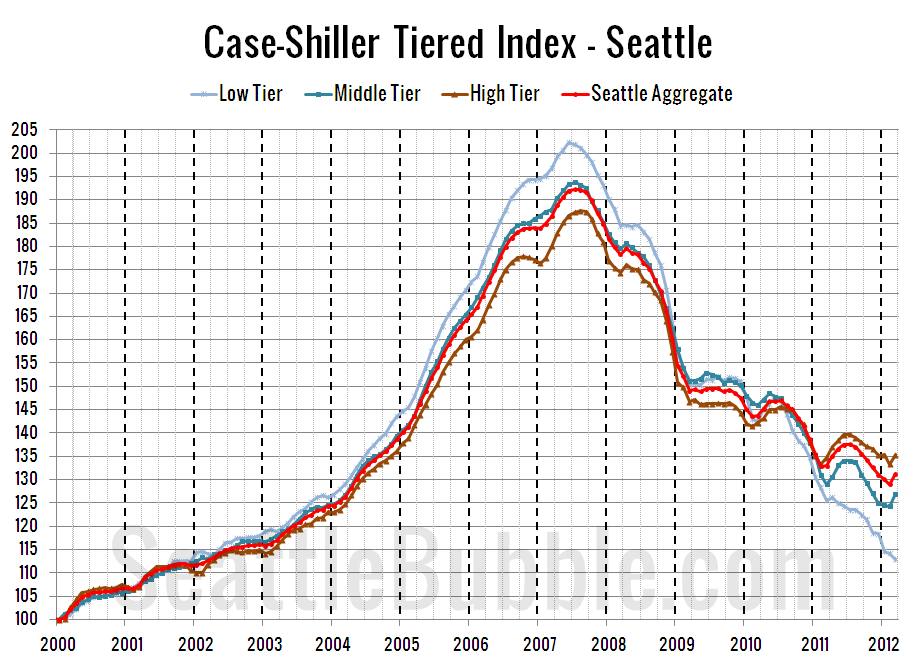
Let’s check out the three price tiers for the Seattle area, as measured by Case-Shiller. Remember, Case-Shiller’s “Seattle” data is based on single-family home repeat sales in King, Pierce, and Snohomish counties.
Note that the tiers are determined by sale volume. In other words, 1/3 of all sales fall into each tier. For more details on the tier methodologies, hit the full methodology pdf. Here are the current tier breakpoints:
- Low Tier: < $232,614 (up 2.0%)
- Mid Tier: $232,614 – $369,281
- Hi Tier: > $369,281 (up 1.2%)
First up is the straight graph of the index from January 2000 through March 2012.
Here’s a zoom-in, showing just the last year:
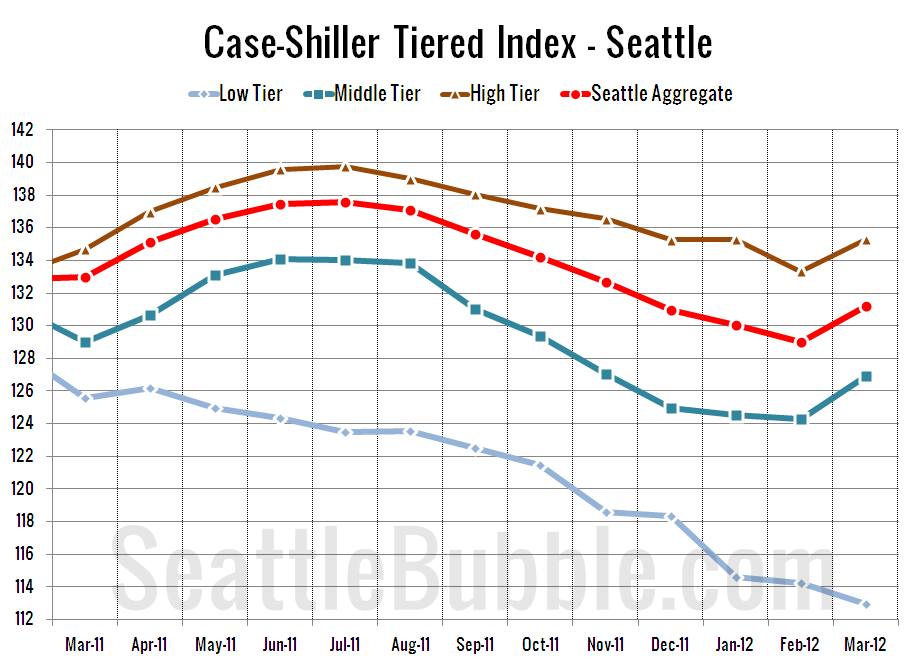
The middle and high tiers both increased between February and March, while the low tier continued to fall. The low tier fell 1.1% MOM, the middle tier rose 2.1%, and the high tier gained 1.5%.
Here’s a chart of the year-over-year change in the index from January 2003 through March 2012.
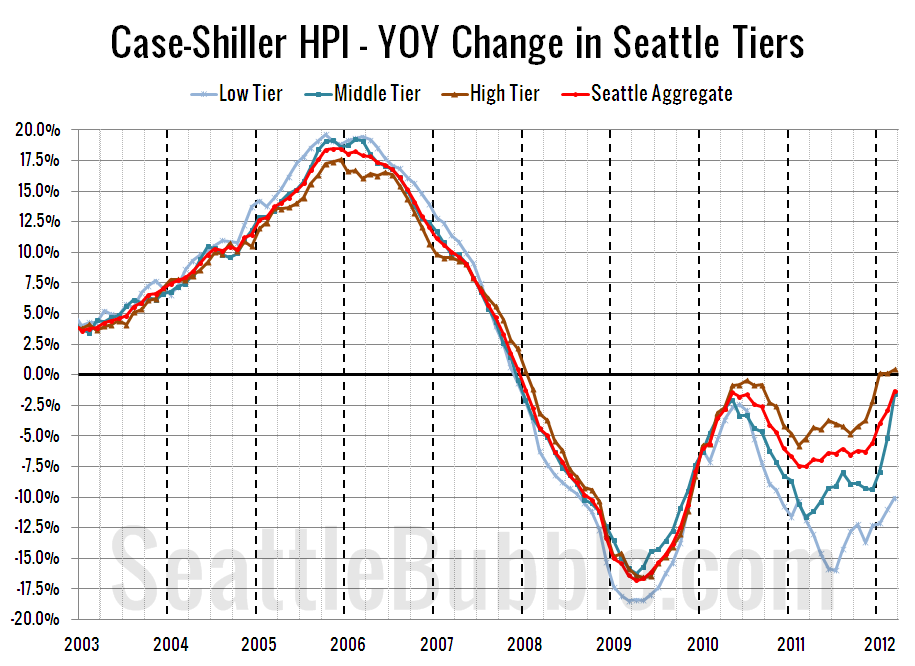
Improvement on all three tiers, with the low tier moving to dead even double-digits, and the high tier moving a bit further into the black. Here’s where the tiers sit YOY as of March – Low: -10.0%, Med: -1.6%, Hi: +0.4%.
Lastly, here’s a decline-from-peak graph like the one posted yesterday, but looking only at the Seattle tiers.
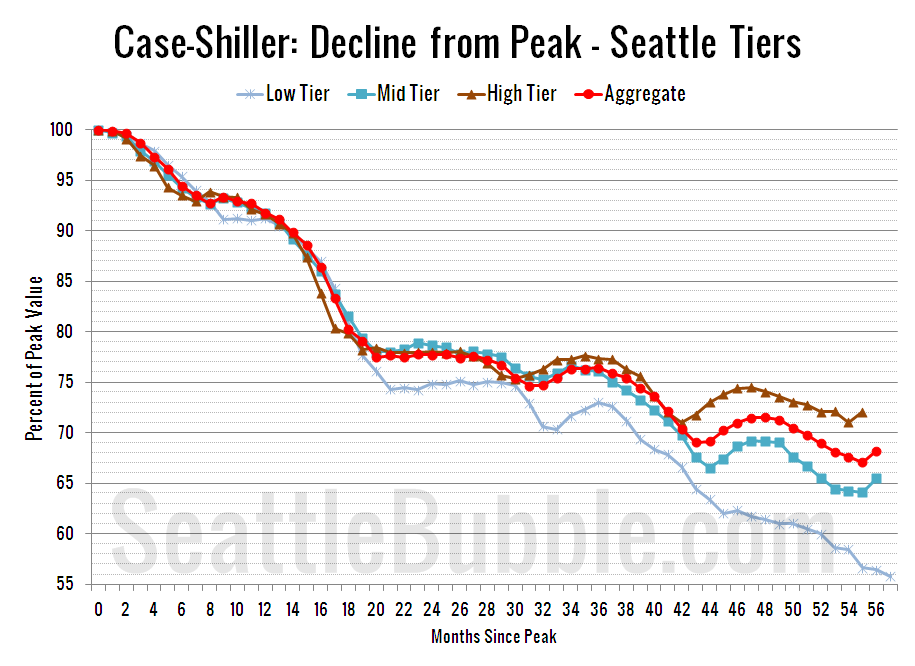
Current standing is 44.2% off peak for the low tier, 34.5% off peak for the middle tier, and 27.9% off peak for the high tier. The low tiers set a new post-peak low point.
(Home Price Indices, Standard & Poor’s, 05.29.2012)


Another Chart Could help Too Tim
The % sales of total sales by tier. It could tell us which tier rules the market in terms of sales numbers.
I.e., if there were 5 high tier homes selling, but 100 low tier homes selling, the indexes would have a literal “impact” meaning for the future predictions of Seattle home sales.
Rate this comment:
0
0
RE: softwarengineer @ 1 – From the post:
Rate this comment:
0
0
So outside the lower third of the market, the “second-leg down” now appears to be over, and the current question is how long those prices will bump along the bottom.
I’m curious what factors are causing the lower tier to continue to fall (or, alternatively, what’s causing the middle and top tier to stabilize). Given that the nominal price at the top of the low tier is actually rising, this means that the prices at the very bottom are dropping even faster, or the distribution of prices within the bottom tier is shifting and more super-cheap homes are selling.
Rate this comment:
0
0
RE: Nicholas Beaudrot @ 3 – Unlike the effect of REOs and short sales on the median, which is 100% clear beyond a shadow of a doubt, I have only strong suspicions that C-S is affected by the mix of REOs and short sales. Those would make up much of the low tier. The months at issue now are January-March, when those sales would make up a higher percentage of the low end sales (because REOs and short sale plug along at about the same level all year long).
Rate this comment:
0
0
RE: Nicholas Beaudrot @ 3 –
Nicholas – This graph may be helpful for you. It shows the distribution of sales for King County by price range and by sold status, ie Short Sales, REO, or Non-Distressed. You can see that of sales under $200K, distressed properties represent 73% of the homes sold.
Above that price point distressed property sales drop off significantly. Down to 39% in the price range of $200-$300K, and then there are very few above $400K at all.
http://4.bp.blogspot.com/-wYpaRCrm9FU/T8apEkKtVpI/AAAAAAAABEQ/jTwEys4qOK4/s1600/King+County+Homes+Sold+By+Price+Range+By+Distressed+Status+April+2012.png
This is the cause of the drag on the lower tier. It is also compounded by the deteriorating condition of some of these homes.
Just for fun:
Number of homes sold under $200K Jan to April:
2007 = 38
2012 = 1,124
(I always exclude mobiles and condos in my residential stats. Statistics compiled but not published by NWMLS)
Rate this comment:
0
0
I think what is happening is they are still trickling out the “good stock” into the market, and desperate buyers who want home that isn’t a junk heap bid these up…whereas the low tier doesn’t have the support of the banks and so is more representative of the “Free Market”.
As in the case of any Regulated Markets, the Middle and High Tiers by supporting artificially high prices in this way, will end up feeling maximal pain in the long run.
Rate this comment:
0
0
Or maybe there just aren’t as many distressed properties in the better hoods? But don’t let the data get in the way…
Rate this comment:
0
0
Did anyone know we had a Pending Home Sales Index to go along with all the other Indexes?
The National Association of Realtors said on Wednesday its Pending Home Sales Index, based on contracts signed in April, fell 5.5 percent to 95.5, its lowest level since December.
Rate this comment:
0
0
By Nicholas Beaudrot @ 3:
I agree that the bubble seems to be pretty much over. The good/simple REO investment properties to pick up in Vegas have dried up with no sign of a new flood coming. The house prices in the two upper tiers in Seattle have stabilized.
But just because the bubble burst is (almost?) complete doesn’t mean prices are “bumping along the bottom”. The prices are just in a reasonable equilibrium with incomes, interest rates etc. Affordability is great, but that factor is perhaps outweighed by people scared away from buying houses by all the bubble talk. The prices might as well dip from this more stable point as they might rise (beyond the long-term 3%/year increase). E.g. Interest rates might rise to cause prices to go down.
I can’t imagine we’d see a repeat of the same bubble within several decades (there’ll be some other bubble which people have a hard time seeing instead), so rather than forecasting an end to the “bumping along the bottom”, I think the better way to think about it is that “things are back to normal”.
Rate this comment:
0
0
RE: Kristian @ 9 – I don’t think we can begin talking about ‘normal’ until the unprecedented intervention of the Federal Reserve and the various GSEs is terminated. I’m not holding my breath.
Rate this comment:
0
0
RE: wreckingbull @ 10 –
Yup, nothing normal in the macro picture. We are at an eqiuilibrium of sorts but there is nothing normal about it. On one hand the world banking system is beginning to crumble at the edges (Spain) while on the other interest rates are likely headed lower for the near term. The 10 year treasury has hit new lows, and mortgage rates typically follow. Other’s “flight to safety” will help us for the next few years as the cash flows in. But eventually we too will be hit.
Rate this comment:
0
0
By David Losh @ 8:
David, no one cares about pending sales, except reporters. They are meaningless because so many short sales fall out. That’s been true for probably at least three years.
Rate this comment:
0
0
RE: The Tim @ 2 –
Tim, You’re Shooting from the Hip
I’m an enginering supervisor manager type and you can down thumb me all the way to a pink slip too, if you worked for me.
“…January’s year-over-year sales gain resulted mainly from sales of lower-cost homes. The amount that sold for less than $200,000 rose 32.4% from a year earlier partially because of improved home affordability, DataQuick noted. In January, the National Association of Realtors affordability broke a new threshold.
Sub-$200,000 sales in Seattle accounted for 38.5% of transactions in January. Sales between $200,000 and $600,000 fell 2.5% in January, representing 52.4% of the market, compared to a year earlier. And sales in the $600,000 to $900,000 range increased 2.8%, accounting for 6.4% of January transactions….”
http://www.housingwire.com/news/seattle-homes-below-200000-gain-buyers-not-so-other-markets
Rate this comment:
0
0
What the heck-
The lower tier goes down because it has no upside.
The middle, and upper tier can rise because of what you can now buy in those price ranges. That brick Tudor people used to pay $700K for can now sell for $500K. That $1.5 Million dollar home can now sell for $999,950.
When you mix together what the middle, and upper tier can sell for they may still be declining, but you wouldn’t see it in a chart of graph.
The lower tier has no flexibility, it can only go lower. The margins on the lower tier are also much tighter, it’s cheaper, and easier to send them back to the bank.
Rate this comment:
0
0
RE: softwarengineer @ 13 –
and you have some good information there.
The thing about the thumbs down is that there is a mind set here. People here are home buyers, and they want to know that things are alright, they made a good choice, or it’s safe to buy.
It is safe to buy, and millions of people across the country have made excellent choices about the properties they purchased. You can’t throw out that fact with the bath water that is data,. and statistics.
To be less obtuse, from time to time, maybe you could have some good news to share.
Rate this comment:
0
0
By David Losh @ 14:
Back in maybe 2006, Skyway was one of the fastest rising areas. Low end housing can go up, but it’s not likely at these volumes.
Rate this comment:
0
0
RE: softwarengineer @ 13 – I’m not sure what your point is there. Tim was explaining how the three C-S tiers are determined. Your information is something else entirely.
Rate this comment:
0
0
By Kary L. Krismer @ 16:
Skyway has a mix of housing stock; not everything in the Skyway area is in the low tier.
Just sayin’ …
Rate this comment:
0
0
RE: Question Mark @ 18 – Correct, but what was driving up the median for that area was the increase in prices on the low end houses. First time buyers and investors were rushing in. And to be clear, what I was referring to in the original post was the median price in the area.
Since then, those houses have fallen at above-average levels. Per Zillow the house I sold there shortly after the peak has dropped over 40% in value. Per Corelogic their high estimate of value is over 50% lower!
Rate this comment:
0
0
RE: Kary L. Krismer @ 19 –
People have a tendency to believe that what’s happening now is going to continue into the future. In 2006, when the real estate market was booming, real estate brokers, shipping clerks, and baristas were all talking about how buying houses was such a smart investment, how you could make phenomenal gains with almost no risk, and that it would go on forever.
Then, for a few years after that you practically couldn’t give houses away. Prices were falling significantly and quickly.
Now, it’s a whole different market. The low tier might be dragging down the whole market, but there’s an awful lot of people out there who don’t qualify financially for anything other than a low tier home, and you have to live somewhere.
There’s all kinds of places out there where you can buy a house, rent it out, and end up with a positive cash flow. Not in hip cool neighborhoods or in neighborhoods with easy commuting distance to places like Amazon or Microsoft, but mostly places south, or in Everett. Some of these places are actually a pretty quick commute, but lesser school districts or places with a lower median income . Skyway is a 15 minute drive to downtown Bellevue, a 20 minute drive to downtown Seattle. White Center’s only a 15 minute drive to downtown, and has a lot more character (and good pizza) than some much more expensive Eastside towns.
The low tier had it’s day. The low tier will have it’s day again.
Rate this comment:
0
0
RE: Ira Sacharoff @ 20 – I would agree with almost all of that, especially the part about some people believing the future will look like the recent past.
Skyway is a great place to commute from to Seattle. You can go I-5, Airport Way, MLK, Rainier, along Lake Washington and 99.
Rate this comment:
0
0
Skyway? White Center? As Charles Barkley would say………..”The best part of arriving in those areas is leaving”…
Rate this comment:
0
0
Parts of Skyway aren’t too bad. It isn’t Medina, but it’s not too bad. The worst thing about it is that part of it is within the city limits of Seattle.
Rate this comment:
0
0
By ray pepper @ 22:
Says the guy who buys houses in South Tacoma?
Actually, White Center has some great places to eat and drink. Some of the best pizza in the Seattle area(Proletariat), Full Tilt Ice cream, Uncle Mike’s BBQ, Big Al’s Brewery,Triangle Pub( Live jazz) the Rosticieria, Salvadoran bakery, the list goes on.
Rate this comment:
0
0
By Kary L. Krismer @ 4:
I agree that this is the (obvious) explanation, no matter how many people downvote your post =)
By the way: Why the factually incorrect headline? In a value-weighted index with a sensible distribution of value this would hardly be possible anyways.
Rate this comment:
0
0
By Ira Sacharoff @ 24:
Skyway and white center… give me a break. My neighbor let the bank foreclose and FLED from white center. The drug dealers wouldn’t leave her alone and the cops got mad that she dared call during donut hour. But hey, all that good food will be comforting when you are recovering from your bullet wounds.
Rate this comment:
0
0
RE: Macro Investor @ 25 – Skyway is actually a fairly low crime area. Nothing at all like what the reputation of White Center is. I used to say that the criminals would go from the worse neighborhoods to the better neighborhoods and leave those of us in Skyway alone!
Rate this comment:
0
0
RE: Macro Investor @ 25 –
Capitol Hill, Ballard, and the U District all have crime rates higher than either Skyway or Whhite Center. That doesn’t make it a haven of safety. There are parts of both Skyway and White Center that are a little more prone to burglaries, but there are also some prettier and safer areas very nearby. The vast majority of people who live in Skyway and White Center are employed, law abiding people. Of course they live there because it’s cheaper. Yes, there are some pockets of blight in both Skyway and White Center, part of that due to their being part of unincorporated King County. But there are also fairly nice places nearby with some of the least expensive housing in the Seattle area.
I’ll wager a pint of Big Al’s Irish Red from White Center that in five years, the median price of a home in White Center will have gained more (or lost less) than the median home in Medina.
Rate this comment:
0
0
By Ira Sacharoff @ 27:
I hope you’re talking about as a percentage! ;-)
Rate this comment:
0
0
RE: Kary L. Krismer @ 16 –
That was then this is now. As you say prices of outlying areas increased dramatically as people moved into more affordable housing, prices went up.
The price of Real Estate is declining across the board, so when you put up a chart of course the low tier will show the decline because there is no upside. In middle to upper tiers people can buy a better house, at a lower price, but there is no upper limit to that.
We have a floor of about $200K, that will go lower.
Rate this comment:
0
0
RE: Ira Sacharoff @ 24 –
ok then……White Center, Skyway, South Tacoma, East Tacoma, Delridge, Twinlakes, and Allentown all get the same Charles Barkley remark..and just because I buy in an area doesn’t mean I would live there..at 50k I will look at virtually anywhere in Pierce or King.
Rate this comment:
0
0
By Ira Sacharoff @ 28:
Yeah, right… been hearing that about white center for 25 years. You’d lose your bet. All that easy money for speculators and renovations didn’t lift white center. The next 5 years are gonna be tight. Drink your beer and think on that ;)
As for skyway, I’m familiar with the area. It wasn’t too bad in the late 80s. But I’ve watched as the central district has spread south, and in my opinion has ruined much of skyway/tukwila and all the way down highway 99 to federal way.
However, if you’re saying there are pockets of good neighborhoods – I agree. But they are becoming smaller isolated islands, and your value is not maintained by encroaching slums.
Rate this comment:
0
0
By Nicholas Beaudrot @ 3:
Apparently 99.9% of RE agents are unaware that home sales are seasonal, and that’s why every Spring, they claim the bottom is in.
Rate this comment:
0
0
By AxlRose @ 7:
We’ve been hearing BS bottom calls for 5-years and counting. What makes this Spring selling season any different? As far as I can tell, more people are under distress and can’t afford to list their homes, so it is restricting supply. And mortage rates are even lower than the unbelievable lows of last Spring. This is tempting people who don’t know any better into going deeply into debt at perhaps the riskiest time in the last 80 years.
Seriously people, open your minds and look at the global economic picture. One little chart showing a typical Spring bounce in a particular area is not enough to risk your financial future over.
Due to the stimulus (which is not sustainable), the U.S. is the best house in a bad neighborhood. But even with unprecedented printing and borrowed fiscal stimulus, GDP was a pathetic sub 2% in the first quarter. This is not your garden variety recession, and it is not your garden variety recovery.
Rate this comment:
0
0
By Kristian @ 9:
I’m not sure how anybody can see the 10-year yield at an unheard of 1.62% and believe things are back to normal. If anything, it’s a sign we’ve reached the most economically risky period yet.
Rate this comment:
0
0
By Kary L. Krismer @ 21:
That looks dangerously close to being a prediction. Nah, on second thought, it’s just Kary pointing out that these people are using extrapolation to predict, which is often dangerous. :)
Rate this comment:
0
0
RE: Jonness @ 36 – Maybe I’m predicting some people will extrapolate? ;-)
Rate this comment:
0
0
RE: Jonness @ 34 – I’m not trying to make a bottom call. I agree that every spring the same thing happens.
If you look at the good neighborhoods, there aren’t as many distressed homes as in less good neighborhoods. That’s a fact. Any trickling out of homes by banks is happening in those less good neighborhoods. That’s all.
Rate this comment:
0
0
RE: Macro Investor @ 32 –
But you are assuming that neighborhoods don’t change, or if they do, they get worse.
Look at Columbia City. Twenty years ago it was pretty blighted, with empty storefronts and gang and drug activity. I believe that White Center is the next Columbiua City, and that it’s part of the way there already. Columbia City is not Sammamish. It’s always going to be more urban and more ethnically and economically diverse. But it’s now thought of as a hip, cool neighborhood that people seek out. If you look at Seattle, you’ll see that there are sought after hip, cool neighborhoods without good schools or a lot of kids in them.Everyone’s got different real estate needs.Some people are looking for playgrounds and good schools. Others are looking for that “walkability” thing, and White Center’s got that. Don’t go by things you saw on the news or that someone you know moved out after getting burglarized. Because if it happens to you, it’s a crime wave. it becomes personal. But if you’re loking for that true “hipster” experience, what Columbia City was 15 years ago and what Capitol Hill was 30 years ago…White Center seems to me like a good bet. And the powers that be notice it too. In the annexation discussions of unincorporated areas, Seattle and Tukwila said ” No way” to annexing Skyway( not so much due to high crime but because there isn’t enough business to generate enough tax revenue) and Renton said ” Maybe, if the county forks up enough money.”, but as far as White Center, bith Burien and Seattle want to annex it. Why? Is it because governments just like to find places to squander money? Or is it that they, like me, see it’s potential?
Rate this comment:
0
0
By AxlRose @ 38:
I agree with that. It’s true. Sorry I misinterpreted your post.
Rate this comment:
0
0
We hit a new all-time record low in the 10-year treasury today! Records go back to the 1800′s, but it’s never been this low before. To put this into perspective, the 10-year yield is about half of what it was when Tim bought his house a year ago. IOW, people are really, really scared right now!
But as bearish as I tend to be when I state we will continue to see periods of growth followed by periods of slowdowns, I think it’s important to understand, we will most likely get past these bearish periods as well and move into periods of growth again.
When things get really bad, it represents a buying opportunity if you know what you are doing. Keep a sharp eye out for good investments. Houses are not the best asset class to be looking at right now, unless you legitimately need a place to live. Then it could make sense.
Columbia Mortgage is offering a 3.375% 30-year fixed with 0 points. We are caught in one heck of a pickle (i.e. liquidity trap).
http://finance.yahoo.com/echarts?s=^TNX+Interactive#symbol=^tnx;range=my;compare=;indicator=volume;charttype=area;crosshair=on;ohlcvalues=0;logscale=off;source=undefined;
Rate this comment:
0
0
RE: Jonness @ 34 –
What makes this year different, pumpkin, is the lowest inventory relative to the previous years.
Rate this comment:
0
0
By 2kt @ 42:
Exactly! It’s a sign of serious economic weakness unlike anything we’ve ever experienced in our lifetimes. Nobody can afford to sell their homes because they are too far underwater. So they just sit there trapped while waiting for another round of deflation.
Meanwhile, the stock market has tumbled (good thing I got stopped out at the peak). We just got the worst jobs number in years. Chinese manufacturing is heading toward the sewer. And Europe is on the verge of economic Armageddon.
And here comes the fiscal cliff of 2013!
So let’s take a look at what the record low interest rate environment is telling us:
http://en.wikipedia.org/wiki/Liquidity_trap
Rate this comment:
0
0
By Jonness @ 43:
I lay the blame for that on the banks refusing to staff up to process short sales. 200 a month is not enough when there are over 9 times that many pending sales waiting to be processed.
Rate this comment:
0
0