Seattle Bubble

News & discussion about real estate & the housing bubble in the Seattle area.

Seattle Bubble - News & discussion about real estate & the housing bubble in the Seattle area.

Entries Tagged as 'closed'

Poll: Guess the maximum 1-month total closed SFH sales in King Co. for 2009

By The Tim on May 17th, 2009 at 12:05 AM · 36 Comments

For reference, 2008’s maximum was 1,592 in June. Here’s the monthly chart since 2000:

King County SFH Closed Sales

Please vote in this poll using the sidebar.

Guess the maximum 1-month total closed SFH sales in King Co. for 2009:

  • 1,250 or less (43%, 53 Votes)
  • 1,251 - 1500 (31%, 38 Votes)
  • 1501 - 1,750 (11%, 13 Votes)
  • 1,750 - 2000 (10%, 12 Votes)
  • 2000 - 2,250 (6%, 7 Votes)
  • 2,251 or more (-1%, 1 Votes)

Total Voters: 123


This poll will be active and displayed on the sidebar through 05.23.2009.

→ 36 CommentsCategories: Polls
Tags: , , ,

One in Three Q1 Pending Sales Failed to Close in 30 Days

By The Tim on May 7th, 2009 at 5:00 AM · 94 Comments

Now that 2009 Q1 + 1 month is in the past, let’s have an updated look at the relationship between pending and closed sales. For previous posts on this subject, hit the ‘pending’ tag archive.

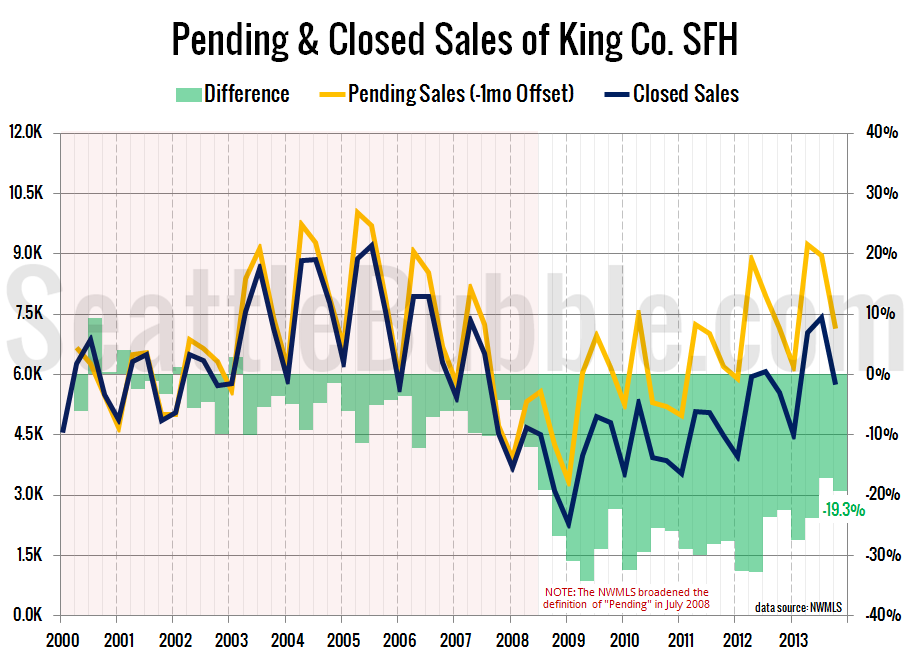
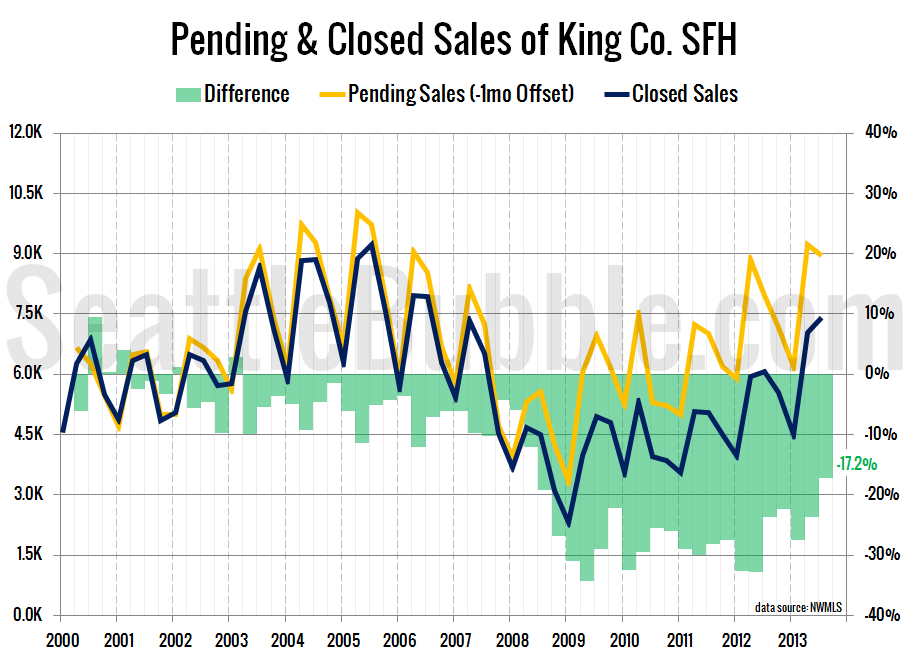
Below is the updated chart including 2009 Q1. It shows quarterly King County SFH pending sales volume from the NWMLS, with closed sales offset by one month (since closings should theoretically take ~30 days). In other words, the pending sales data for Q1 includes January, February, and March, while the closed data is for February, March, and April. The blue and red lines represent pending and closed sales (left axis), while the green bars represent the percent difference between closed sales and pending sales (right axis).

Pending & Closed Sales - King Co. SFH

The 2000-2007 average difference between pending and closed sales for the first quarter was just 8.8%. In 2008, the difference per quarter was 7.5%, 15.9%, 20.7%, and 27.3%. In the first quarter 2009, the gap between the two widened for the fourth quarter in a row, to yet another new record of 35.9%.

Here’s a look at the month-to-month data for all sales (SFH and condos) in King, Snohomish, and Pierce back through the beginning of 2008:

Pending & Closed Sales - King / Snohomish / Pierce

There are two theories as to why this gap is becoming so large, both centered on short sales.

The first theory is that the “pending sales” statistic in the NWMLS end-of-month reports includes all sales that were in “pending” status as of the last day of the month, rather than counting all sales that changed from “active” to “pending” in the given month. This would cause short sales, which typically take longer than 30 days to close, to be counted as a “pending sale” for multiple months, thereby artificially inflating the pending sales data.

The second theory is that the number of short sales as a percentage of total sales is rapidly increasing every month, and therefore more and more closings each month are being delayed beyond the “normal” 30-day period.

In the chart below, I have attempted to visualize the second theory, based on the following:

  1. Fact: the average failure rate 2000-2007 was 5%
  2. Assumption: the excess apparent failed sales above 5% represent distressed sales
  3. Assumption: distressed sales will fail at quadruple the normal rate (20%)
  4. Assumption: distressed sales average 90 days to close

Here’s how King County’s SFH quarterly closed sales would break down over the last four quarters (with each quarter offset +1 month), given the above fact and assumptions:

Hypothetical King Co. SFH Closed Sales Breakdown

Interestingly, the 4-quarter total percentage of distressed sales calculated using the above assumptions comes out to 23%, which is fairly close to the number of foreclosure + short sale transactions reported by Zillow over the last year in the Seattle area. Their national spreadsheet says that 13.9% of the transactions in the Seattle-Tacoma-Bellevue area in the last 12 months were foreclosures, and 12.3% were short sales, for a total distressed sale percentage of 26.2%.

We still have not heard a definitive answer on the way that the NWMLS counts their end-of-month “pending sales” data, so we can’t rule out theory #1 entirely. But either way, the story here appears to be that a large number of short sales in the Seattle area are skewing the formerly-reliable pending sales statistic, making it increasingly difficult to get a true handle on what home-buying demand really looks like.

→ 94 CommentsCategories: Statistics
Tags: , , , , , , ,

One in Four Pending Sales Failed to Close in Q4

By The Tim on February 10th, 2009 at 10:03 AM · 36 Comments

Now that 2008 Q4 + 1 month is in the past, let’s have an updated look at the relationship between pending and closed sales. In Q2, 15.9% of pending sales fell through. In Q3, it was 20.7%.

Below is the updated chart including 2008 Q4. It shows quarterly King County SFH pending sales volume from the NWMLS, with closed sales offset by one month (since most closings theoretically take ~30 days). In other words, the pending sales data for Q4 includes October, November, and December, while the closed data is for November, December, and January. The blue and red lines represent pending and closed sales (left axis), while the green bars represent the percent difference between closed sales and pending sales (right axis).

Pending & Closed Sales - King Co. SFH

The 2000-2007 average difference between pending and closed sales for the fourth quarter was just 5.0%. In the fourth quarter 2008, the gap between the two widened to 27.3%.

Yet again, the number continues to grow, and the local media continues to ignore the increasingly alarming discrepancy. Keep this widening gap in mind when agents quoted in the media refer to increasing pending sales as some sort of indication that the market is turning around. Pending sales may be increasing, but more and more of them are never turning into closed sales.

I realize that last quarter there were some who theorized that this discrepancy was the result of the NWMLS rule change in July that caused homes in “Subject to Inspection” status to be pulled from the publicly-viewable listings. However, I have spoken with numerous individuals that have asked various people at the NWMLS (including their “statistician”) directly about this change, and each one has been assured that the new rule did not affect the way that the end-of-month statistics are compiled (i.e. – the definition of “pending” in the monthly reports has remained consistent, despite the rule change).

Are buyers getting cold feet? Is financing falling through? What explanation is there for one in four pending sales to never reach closing?

→ 36 CommentsCategories: Statistics
Tags: , , , , ,

One in Five Pending Sales Failed to Close in Q3

By The Tim on November 12th, 2008 at 1:26 PM · 37 Comments

With Q3 + 1 month now behind us, it’s time to take another look at the relationship between pending and closed sales. Recall that in Q2, a record-setting 15.9% of pending sales had fallen through and never showed up as closed sales.

Here’s an update. The graph below shows quarterly King County SFH pending sales volume from the NWMLS, with closed sales offset by one month (since most closings theoretically take ~30 days). In other words, the pending sales data for Q3 includes July, August, and September, while the closed data is for August, September, and October. The blue and red lines represent pending and closed sales (left axis), while the green bars represent the percent difference between closed sales and pending sales (right axis).

Pending & Closed Sales - King Co. SFH

The 2000-2007 average difference between pending and closed sales for the third quarter was just 1.6% (3.7% if you disregard the strange data in 2000 when closed sales exceeded pendings somehow in Q3). In the third quarter 2008, the gap between the two widened to just over 20%.

This is a huge difference, and something I’m amazed the local media is not reporting on. It also makes the monthly report on year-over-year pending sales stats increasingly more useless as a measure of market health. So pending sales were up 15% year-over-year in September. Does that really mean much if 20% of those sales never actually close (vs. just 7% the year before)?

The long-term average for 2000-2007 was that only 5% of pending sales failed to show up as closed sales. We are now at four times that rate. This is not something we should be ignoring when attempting to determine the health of the local market.

→ 37 CommentsCategories: Statistics
Tags: , , , , ,

Are More Pending Sales Falling Through?

By The Tim on August 22nd, 2008 at 10:46 AM · 54 Comments

I mentioned this in the comments on a recent post, but I think it’s interesting enough to merit its own post. Since we regularly track pending sales as our measure of monthly sales volume in the monthly charts, I was curious to know whether the credit crunch has caused closed sales volume to diverge from pending.

What you see below is a graph of quarterly King County SFH sales volume according to the NWMLS, with closed sales offset by one month (since most closings take 30 days). The blue and red lines represent pending and closed sales (left axis), while the green bars represent the percent difference between closed sales and pending sales (right axis).

Pending & Closed Sales - King Co. SFH
Click to enlarge

For some reason the first quarter has historically seen the largest difference between pending and closed sales, averaging 8.8% fewer closed sales than pending sales from 2000 through 2007. The first quarter of 2008 stayed close to that figure with 7.5% fewer closed sales than pending.

The second quarter average difference for 2000-2007 was 4.1%. 2008 second quarter closed sales were off 15.9% from pendings, the largest quarterly discrepancy to date.

I think this will be an interesting data set to keep an eye on as the year progresses. 16% of pending sales falling through is certainly not something to ignore when the long-term average 2000-2007 has been just 4-5%.

→ 54 CommentsCategories: Statistics
Tags: , , , , ,