Let’s check out the three price tiers for the Seattle area, as measured by Case-Shiller. Remember, Case-Shiller’s “Seattle” data is based on single-family home repeat sales in King, Pierce, and Snohomish counties.
First up is the straight graph of the index from January 2000 through June 2008.
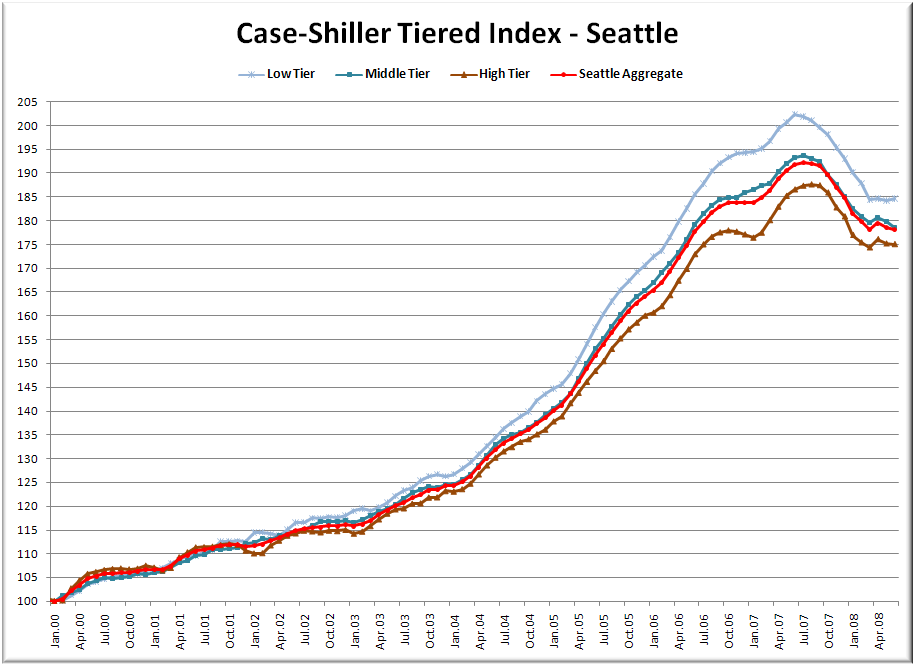
You can see that all three tiers basically flattened out through the spring. The medium and high tiers had that slight bump from March to April, but have since given back the slight gain, while the low tier has been nearly flat.
Here’s a chart of the year-over-year change in the index from June 2002 through June 2008.
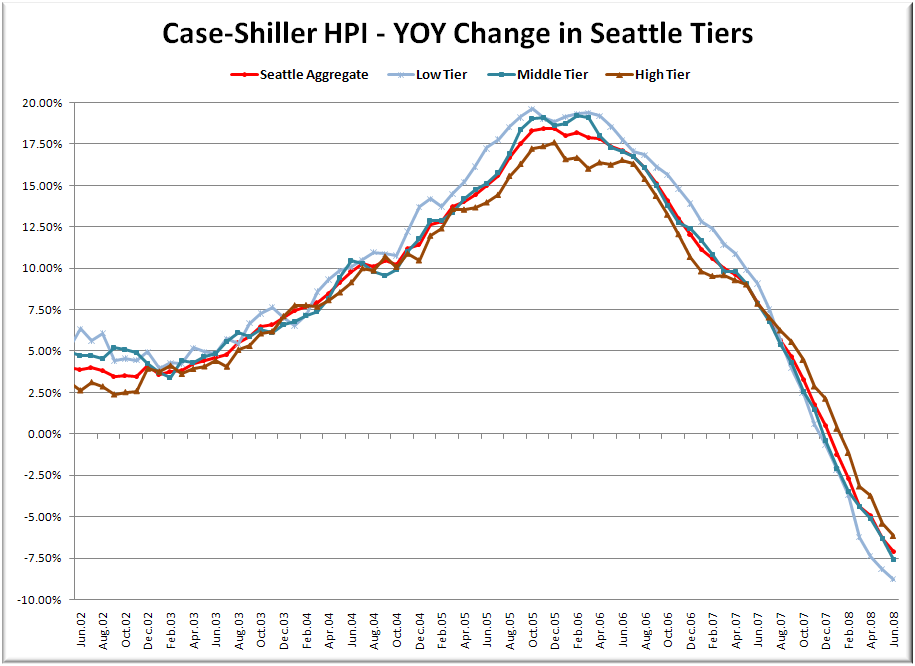
Despite being flat for four months, the low tier continues to perform worst in terms of year-over-year price changes, coming with a nearly 9% drop from June 2007. Here’s where the tiers sit YOY as of June - Low: -8.8%, Med: -7.6%, Hi: -6.2%.
Lastly, here’s a decline-from-peak graph like the one posted yesterday, but looking only at the Seattle tiers.
It’s almost as if the low tier is waiting for the other two tiers to catch up after dropping so severely between months 8 and 9. Looks like another month or so and the mid and high tiers should be pretty close in terms of total decline from peak.
So has the low tier bottomed out, or is the flatness of March-June just the best “spring bounce” that could be mustered? We’ll find out soon enough as we crawl into the summer and fall.
(Home Price Indices, Standard & Poor’s, 08.26.2008)


Jump to the bottom to add your comment. ↓
12 responses so far ↓
1
Charles Dean
// Aug 27, 2008 at 10:37 am
I think it makes sense that the lower priced tier dropped more dramatically. Zero down financing for upper priced homes had gone away months before, but for lower priced homes zero down financing disappeared April 1st. Then the market shifted to FHA financing and things stabilized.
With downpayment assistant programs going away October 1, I would expect this kind of drop to happen again, unless congress is able to pass the legislation that was introduced before their latest recess.
But the thing is that traditionally people who were buying higher priced homes usually have more money, or are selling a lower priced home in order to buy something bigger and better. Therefore they’re able to actually pay a down payment.
So I’m sure we’ll see the higher tier prices follow suit, as those who are selling lower tier houses get less money for their homes and are not able to make as large of a down payment.
2
Garth
// Aug 27, 2008 at 12:13 pm
I would guess that almost none of low tier homes are in seattle, bellevue or redmond proper.
3
TheHulk
// Aug 27, 2008 at 1:18 pm
I also wonder how the volume numbers compare for each tier.
I think the flatness we have seen in the middle and high tiers is a combination of two things: Unrealistic expectations on part of sellers and realtors insisting that there will be a spring bounce.
Fall and the upcoming winter will make at least some of the sellers regret not having lowered prices more aggressively this spring. Those who did manage to sell in the past six months should count themselves as being very lucky (or sensible in accepting what would previously be considered lowball / insulting offers).
4
rose-colored-coolaid
// Aug 27, 2008 at 1:59 pm
Gee, I don’t know if this could be a more obvious dead cat bounce if you actually drew a crude image of cat carcass onto the graphs.
5
softwarengineer
// Aug 27, 2008 at 2:06 pm
ARE THESE PEAK VALUES OF THE FEW PINK PONY HOMES THAT SOLD?
I’m sure if we threw out auto internet [i.e., Autotrader.com sales] out and just took peak prices sold from large dealers; the leveling out could similarly be explained? The cheaper priced sales were suddenly eliminated?
Perhaps, the cheap homes aren’t getting graphed here [just expensive dealer stock], they’re like the foreclosed ones and sellers can’t afford to sell upside mortgages for losses? This phenomena may be skewing the data?
Having numbers of units for each month may help.
6
Jillayne Schlicke
// Aug 27, 2008 at 5:47 pm
Speaking of ponies, I was at a surprisingly quiet Alderwood Mall last night and saw a t-shirt at Fuego with a magical pink and blue pony with cupcakes floating out of its butt.
7
david losh
// Aug 27, 2008 at 6:50 pm
Smart sellers took this Spring to unload. There were lots of properties owned by Real Estate agents in this mix. Many agents told sellers they needed to be 10% below the market analysis to sell. There again I was amazed that many properties sold like business as usual, full price, or close.
There was also the rise in FHA limits that buyers took advantage of. FHA became the new 0% down darling of the industry.
Now I see many properties in the low $300K range with some hitting $250K. There are 222 residential units below $350 from Central Area to 145th, water to water, 131 built before 1998 which takes out town houses. Below $300K there are 68 and 49 built before 1998.
That’s a lot to choose from..
A big surprise is that there are 127 pre 1998 residential units, houses between $350K to $400K.
Add in the town houses for 440 housing units for sale under $400K from the Central Area, I90, to 145th. Not counting down town proper.
475 between $400K to $500K then $500K to $600K there are 361. As long as I went this far there are 239 between $600K to $700K, 344 $700K to a million and over a million 328 houses.
2162 housing units for sale in my little area up from 1770 a few weeks ago.
Before I got carried away counting housing units for sale my point was that the greatest indication of downward pricing was the number of housing units below $300K, Last year $250K was extremely rare. Today there are seven, not counting house boats.
As prices went down those that wanted to buy, who had waited the year to buy, bought what they saw as bargains.
Now it’s the number of units in inventory concerns me. There are also many people who left the market when they didn’t get the bounce. When we also add the shadow inventory of those that would like to sell, cut, and run, who waited to see what would happen this Spring The numbers seems to add up to a lot of properties not worth what a buyer is willing to pay.
8
george
// Aug 27, 2008 at 8:29 pm
“The numbers seem to add up to a lot of properties not worth what a buyer is willing to pay.”
David I wonder if your wording there would work with a lowball offer? “Yea, sure the price seems fair, but if you look at the inventory and direction the market is heading it’s just ‘not worth what a buyer is willing to pay.’”
9
Jackson Wallace
// Aug 28, 2008 at 12:41 pm
David Losh, while I agree that things have declined from the insane peak they rose to, when you look at previous sold at prices on redfin, you see that some of these 300k houses were selling at 175k in say 1999. Starters in Shoreline were averaging 200k in as recently as 2002, not the 300k of now. Anyway, those are the prices in less than choice areas that are truly reasonable, and we’ll either get there, or Seattle will stay perma-expensive. This weather has got to be making people question being here, though, It always has.
10
david losh
// Aug 28, 2008 at 6:41 pm
Yes, it’s the decline in pricing that’s important. Declines in prices coupled with an increase of inventory can make offers more attractive.
It was while counting the low end inventory that I found properties below $300K. It just surprised me. The increasing numbers of lower priced properties I think is a big change from let’s say February. As the inventory grows, and less expensive propertie languish on the market, what’s a seller going to do?
11
rose-colored-coolaid
// Aug 29, 2008 at 7:15 pm
Hrmm, this CS report is strangely empty. It seems that many of the trolls have finally caved to the obvious situation that the market is in, and without trolls making things up these charts become merely interesting rather than controversial.
Cheers all.
12
rose-colored-coolaid
// Aug 29, 2008 at 7:15 pm
I meant the comments, not the report itself. I always enjoy the reports.
Jump to the top of the comments. ↑
Leave a Comment