Posted by: The Tim

Tim Ellis is the founder of Seattle Bubble. His background in engineering and computer / internet technology, a fondness of data-based analysis of problems, and an addiction to spreadsheets all influence his perspective on the Seattle-area real estate market.

23 responses

  1. Headlines seem to be a problem at all newspapers.

    I think, but I’m not positive, that you’re missing the mark on your financing comments. Yes, financing is tougher to get for some people, and for just about everyone what they’ll loan for a given income level is less, but I would suspect that what the banks will loan is still more than the 30% figure used by the affordability index. I bother mortgage brokers with too many questions as it is, or I’d ask one. But historically banks have always been willing to loan more than you should be willing to borrow, it’s just that now it’s not much, much more than you should be willing to borrow. So anyway, I don’t see how financing changes even fits into this, other than reduced borrowing ability is one factor that sent prices down.

    Ideally someone buying shouldn’t be making a decision on how much they’ll pay for a house, or what price range they’ll be looking in, based on how much a bank is willing to lend. Instead it should be based on how much they are able to pay each month, and then apply that to a type of loan they can get that isn’t too exotic (which right now would be even an ARM). So if your budget would comfortably allow $1,500 but the bank is willing to lend you $325,000 for $2,000 a month, you should only be looking to borrow about 75% of that.

  2. People will always complain that homes are too expensive in the Seattle area because it’s a desirable place to live. There was more to that story for a few years when prices really were too high because of all the reasons that have been tossed around on these pages for years, and they probably are still a little too high if you believe this is a “double dip” recession, but even when most reasonable people begin to agree that there is stability in all of the rent/price, income/price, etc… variables there will still be droves of people complaining about prices being too high.

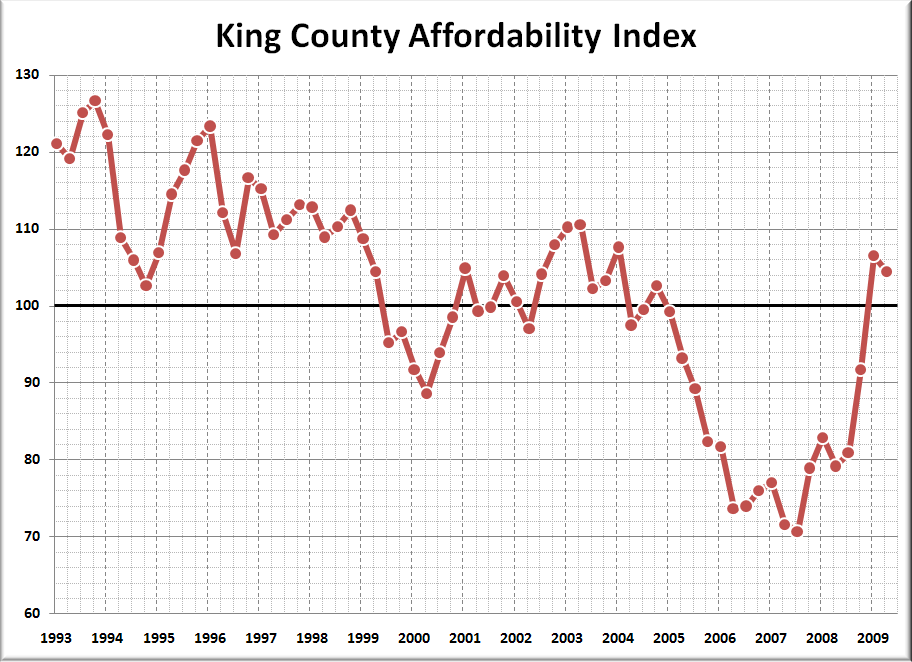
  3. Tim, I reread the Times article, and it seems to say they use a 25% of income for P&I figure, not 30%.

  4. The problem I have with the Seattle market is that 20% down on the median home price here is an incredibly high amount of money! It is pretty difficult for your average King County family to put away $80,000 to $100,000. I think the affordability index would be more realistic if it included FHA loans with 3.5% down, since as house prices drop below the $420,000s that is what the majority of buyers here have to get.

  5. I can’t remember if you made a similar affordability curve using c/s index instead of median? I’m not sure if it would look much different but I put almost zero weigth on any metric that uses the median as some sort of home value/price related metric other than the sales mix.

  6. By patient @ 6:

    I can’t remember if you made a similar affordability curve using c/s index instead of median? I’m not sure if it would look much different but I put almost zero weigth on any metric that uses the median as some sort of home value/price related metric other than the sales mix.

    The right number to use would be the average valuation such as measured by Zillow, which uses something similar to CS. But that would imply buying into the underlying assumption of this affordability measure, which is that no one rents apartments or lives in a condo or townhouse. That’s the only way that the median family would correspond to the median house.

  7. By Nathan @ 5:

    The problem I have with the Seattle market is that 20% down on the median home price here is an incredibly high amount of money! It is pretty difficult for your average King County family to put away $80,000 to $100,000. I think the affordability index would be more realistic if it included FHA loans with 3.5% down, since as house prices drop below the $420,000s that is what the majority of buyers here have to get.

    The thing is though, when you go much higher (a lot higher) than $400,000, the percentage of the downpayment tends to rise dramatically. 20% might be lower than average.

    Perhaps we need something like an affordability index at the C-S tier cutoffs, and you’d use 3.5% down at the lower number, and 30% down at the higher number.

  8. By patient @ 6:

    I can’t remember if you made a similar affordability curve using c/s index instead of median? I’m not sure if it would look much different but I put almost zero weigth on any metric that uses the median as some sort of home value/price related metric other than the sales mix.

    Either way you’re using a number that doesn’t apply to anyone, and then making assumptions as to what they’re going to do that applies to maybe 1% of the population, and finally assuming that somehow comparing that to the income of the entire population of the area as if they’re all somehow part of the home purchasing market. Substituting one number that is highly correlated with another will not really solve the problems with this line of thinking.

  9. Buried in the last paragraph of the Times article is this little nugget; “The Washington Center for Real Estate Research also produces a first-time buyer affordability index, using lower assumptions for income, house price and down payment.

    In King County, that score for the second quarter was 57.0, an indication housing still isn’t affordable for many prospective newcomers to homeownership.”

    Since a large segment of current buyers are first timers, it would seem that housing continues to be too expensive for this segment. Calculating affordability using lower down payments and higher interest rates just kills the rational for the headline splashed the top of the article.

  10. RE: WestSeattleDave @ 11 – That’s exactly what I was referring to. I guess I should have RTFA.

  11. Tim, don’t sweat about the comments section in Seattle Times. It is filled by wackos, nutjobs, and delusional. Until they actually put some admins on that section, it isn’t even worth the electricity to display it.

    If you ever needed a proof on the failures of the American education system, you only need to read the Seattle Times comments section.

  12. By gameboy @ 13:

    Tim, don’t sweat about the comments section in Seattle Times. It is filled by wackos, nutjobs, and delusional. Until they actually put some admins on that section, it isn’t even worth the electricity to display it.

    If you ever needed a proof on the failures of the American education system, you only need to read the Seattle Times comments section.

    100% agree, if I ever want to feel sad about the state of our society, I just read the comments on a seattle times article.

  13. By hdizzle @ 14:

    By gameboy @ 13:
    Tim, don’t sweat about the comments section in Seattle Times. It is filled by wackos, nutjobs, and delusional. Until they actually put some admins on that section, it isn’t even worth the electricity to display it.

    If you ever needed a proof on the failures of the American education system, you only need to read the Seattle Times comments section.

    100% agree, if I ever want to feel sad about the state of our society, I just read the comments on a seattle times article.

    Haha yep, if you look at other comments on other news articles, it resembles a lot of a gang hating. For some reason, not a lot of people can be positive on an article that’s not absolutely happy.

    Great post Tim. Love to read your work as usual even if news paper readers don’t.

  14. Affordability index can be a good “rule of thumb” to guage the direction and strengh of the economy.

  15. All’s I know is my household income is 6 figures, I have no kids, I have 20% down, and I still don’t feel like I can afford a house priced $400K. How people are pulling the FHA trigger with 3.5% down and $70K in household income is beyond me. I mean, what happens if a spouse loses a job or a family member gets ill? Don’t people care about long-term stability in their lives? It appears to me, a lot of people borrow as much as they possibly can at every new moment in time.

    IMO, no houses are affordable right now, because buyers like me have to compete with 10 flaky families overstretching themselves to get a dump on a 6K sq. ft. lot. They do this purely out of ignorance and an inability to control their impulsive behavior disorder. Then when they default, I pay taxes to bail their irresponsible arses out. Meanwhile, the govt. floods the market with borrowed dollars in order to artificially inflate the price of the foreclosed home so that the crazy banker who made the outrageously risky loan can continue to live in a house that I cannot afford to buy.

    This game is crazy.

  16. Good summary Jonness.

  17. RE: Jonness @ 17 – Here here. I couldn’t have put it better myself except for maybe to add I then have to rent the banker’s guest house and chat with him everyday over the fence about how real estate is the best investment you’ll ever make which i now can’t afford on my six figure salary because of the high taxes I pay as a renter without the homeowner’s tax breaks.

  18. RE: Jonness @ 17 – and what is even crazier, is that only a few see it.

  19. RE: Jonness @ 17

    Paragraph 1 – Right on
    Paragraph 2 – First couple of sentences – Correct; not everyone got the memo.
    – Rest of the paragraph – This is what happens when 70% of the economy depends on all of us going to the mall and shop. Remember. “tax breaks” or “rebates” were never meant to be saved; they were meant to get back into the economy by buying platicrap from China. It’s a cycle and breaking it will hurt a lot.

  20. Great post!! You should sticky this in your collection of “must read” articles.

  21. By WestSeattleDave @ 11:

    Buried in the last paragraph of the Times article is this little nugget; “The Washington Center for Real Estate Research also produces a first-time buyer affordability index, using lower assumptions for income, house price and down payment.

    In King County, that score for the second quarter was 57.0, an indication housing still isn’t affordable for many prospective newcomers to homeownership.”

    Since a large segment of current buyers are first timers, it would seem that housing continues to be too expensive for this segment. Calculating affordability using lower down payments and higher interest rates just kills the rational for the headline splashed the top of the article.

    WestSeattleDave — Nice job catching the fine print. That stat hints at underlying shifts in society that thus far seem to be ignored in most discussions of home prices. As a 25 yr old with an interest in becoming a homeowner, let me share my perspective on housing affordability for my generation.

    Support for any asset price level relies on back-fill; sellers need a steady stream of buyers willing AND able to assume ownership at a set price level. As buyers become sellers, there exists a need for replacement buyers. From a long term perspective, this becomes an overwhelmingly generational issue (younger people tend to replace older people as buyers, too few young people, collapse of support for home prices). Seems as though this concept would be particularly acute in Housing.

    The “willing” part usually isn’t the showstopper, it’s the “able” part that tends to get in the way of a purchase. For this reason the affordability index is an extremely important data point when thinking about home prices.

    The score of 57.0 for first-time home-buyers (read: younger people) scratches the surface, by suggesting that many young people flat-out lack the income to handle mortgage payments derived from current price levels, even at depressed interest rates. What it doesn’t address are obstacles standing in the way of the other key components, namely down payment.

    The same low income that makes a mortgage payment unaffordable also contributes to difficulty in building a down payment. Additionally, student loan debt and credit card debt compound the problem by creating near term cash requirements that can crowd out savings.

    Also worth consideration are shifts in how retirement is funded and changes in the tax base. Company (and Gov’t) assisted retirement is increasingly unlikely, meaning younger individuals have an increasing need to allocate personal funds for their own retirement. Changes in population demographics (read: the average age is increasing) also mean that it’s not entirely inconceivable that my generation’s tax burden will increase in order to fund previously committed government obligations like Soc. Security and Medicare, which will also negatively impact the amount of income available for housing.

    Finally, it seems to go unmentioned the wealth loss some in the 20-30 age group has experienced as a result of the housing crash. It isn’t a crazy assumption to guess that on balance many in the 20-30 age group who currently “own” their house purchased during the boom years. Loss in home values have likely wiped out what equity they had in their homes (including the savings they put down on the purchase).

    These issues can more readily be overcome in a high affordability market, but I don’t think Seattle falls into that category.

    These factors are influenced by a lot of uncertainty, so it’s difficult to weigh which ones are material and which are just noise. Since they rarely are brought up in the discussion, maybe they are all just noise. On the flip side, maybe the factors really are important and have been overlooked because the 20-30 age group’s lack statistical representation.

    However, if it happens to be the latter I think we can expect more trouble in the Seattle real estate market. Take a look at this chart http://www.censusscope.org/us/m7600/chart_age.html of age distribution in the Puget Sound metro area, then compare it with this chart http://www.censusscope.org/us/m7160/chart_age.html of the Salt Lake City metro. See the difference in backfill?

    Between affordability and back-fill, I think you’ve got two really crucial statistics needed to predict (guess) home prices, and neither seems in Seattle’s favor.

Leave a Reply

Do you want a nifty avatar picture next to your name, instead of a photograph of Tim's dog? Just sign up with Gravatar, and make sure to use the same email address in the form below. It's that easy!

Sponsors


Seattle Real Estate :: Brent Fosso

Sponsors

  • Home Improvement Forums
  • East Bellevue Real Estate
  • For Sale By Owner
  • Home Builders

Tip Jar

Archives

Performance Optimization WordPress Plugins by W3 EDGE