Organizations like the National Ass. of Realtors and the National Ass. of Home Builders have been throwing around estimates of how many sales have been “stimulated” by the $8,000 tax credit nationwide, and a recent editorial by Washington State Treasurer James McIntire in favor of the inefficient, expensive, and economically stupid program throws out a number of 7,000 “stimulated” sales statewide.
How many sales locally have been “stimulated” by this ridiculous giveaway of tens of billions of dollars we don’t even have? Let’s try to see if we can estimate the number of stimulated single-family house sales for King County, using some trend analysis of closed sales data from 2000 through 2008.
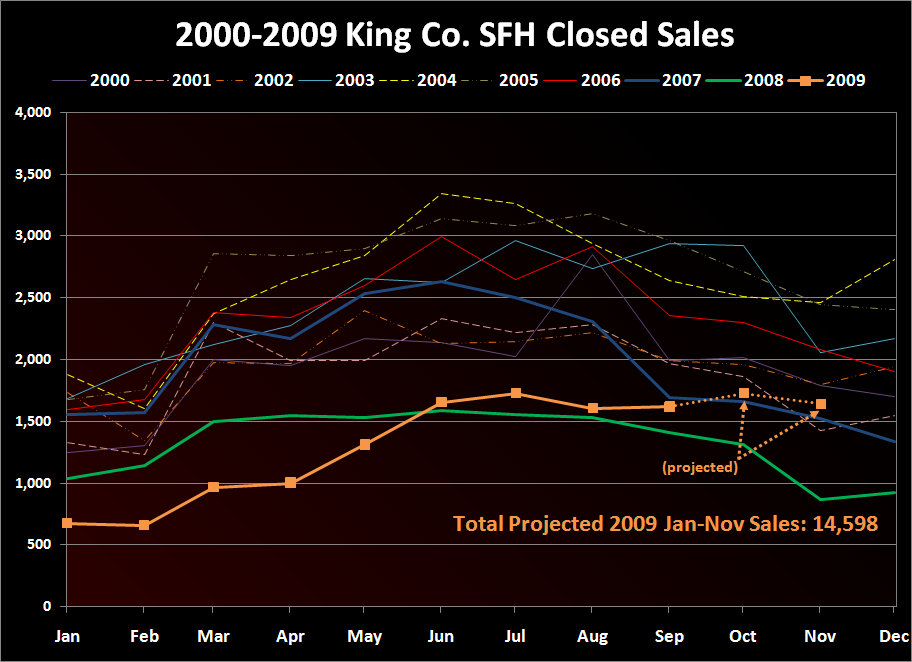
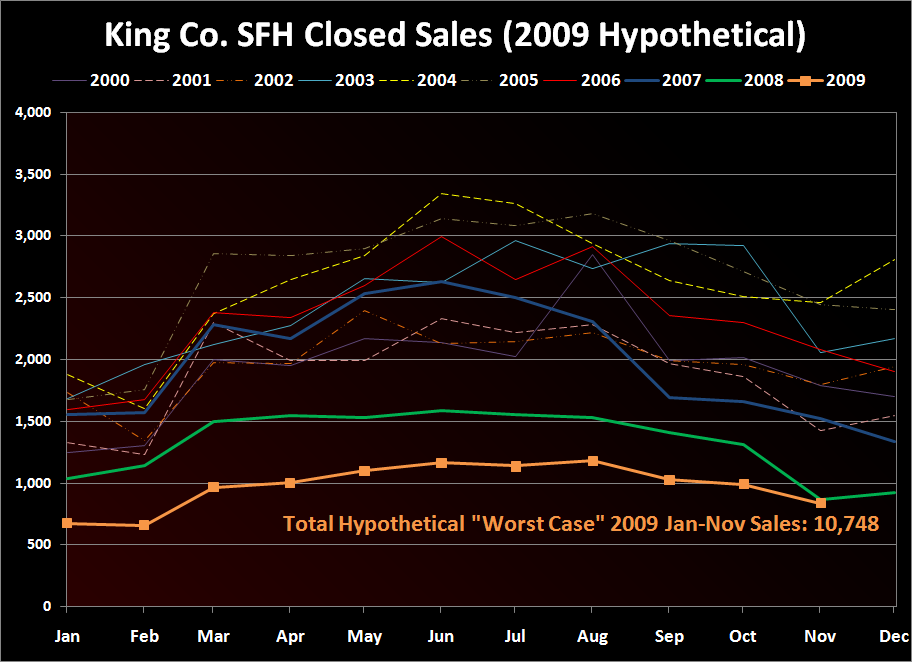
At left above is a chart that includes total closed sales each month from 2000 through 2009, with October and November data this year projected based on the May – September performance. At right above is a chart of a hypothetical “worst case” scenario of sales volume we may have seen without the influence of the $8,000 tax credit, generated by taking the average month-to-month change for each month in 2000-2008, and applying that from month to month in 2009, moving forward from the number of actual sales in April.
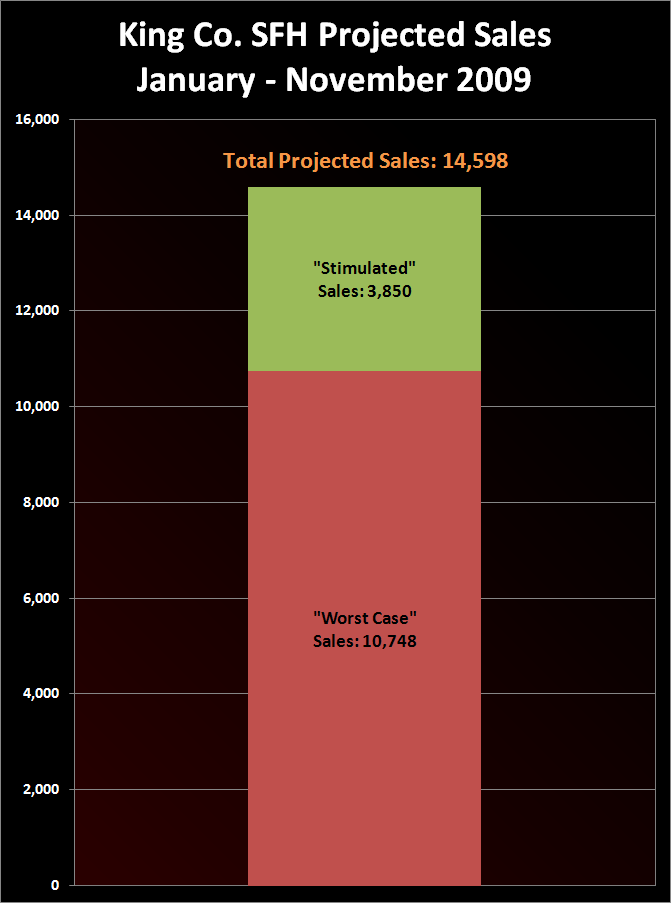
The “worst case” estimate at right above most likely understates the number of sales that would have taken place without the tax credit, since decreasing prices were already beginning to stimulate sales anyway, but for the sake of argument, let’s go with this estimate. Using the above estimates, we arrive at a total number of 3,850 tax credit “stimulated” sales of single-family houses in King County.
If we assume that 100% of the stimulated sales and 75% of the “worst case” baseline sales (i.e. – sales that would have happened anyway without the tax credit) were qualified first-time homebuyers, we can calculate that 11,911 sales will qualify this year for the tax credit. That’s a total cost to (future) U.S. taxpayers of over $95 million, for 3,850 “stimulated” SFH sales in King County—$25,000 per sale.
This is actually quite a bit lower than the nationwide estimates I have seen elsewhere, which put the cost per “stimulated” sale at around $43,000, which means we’re probably over-estimating the number of “stimulated” sales. With 60% as many “stimulated” sales (2,310), the cost per “stimulated” sale comes out to around $40,000.
If we assume that the lower number (2,310) is more reflective of reality and that roughly 90% of these sales were not pulled from thin air, but were in fact merely borrowed from 2010, we can calculate the approximate effect of the expiring tax credit on 2010 sales. Based on those assumptions, once the tax credit expires, we can expect sales to come in roughly 125 to 200 lower than they otherwise would have each month throughout 2010.
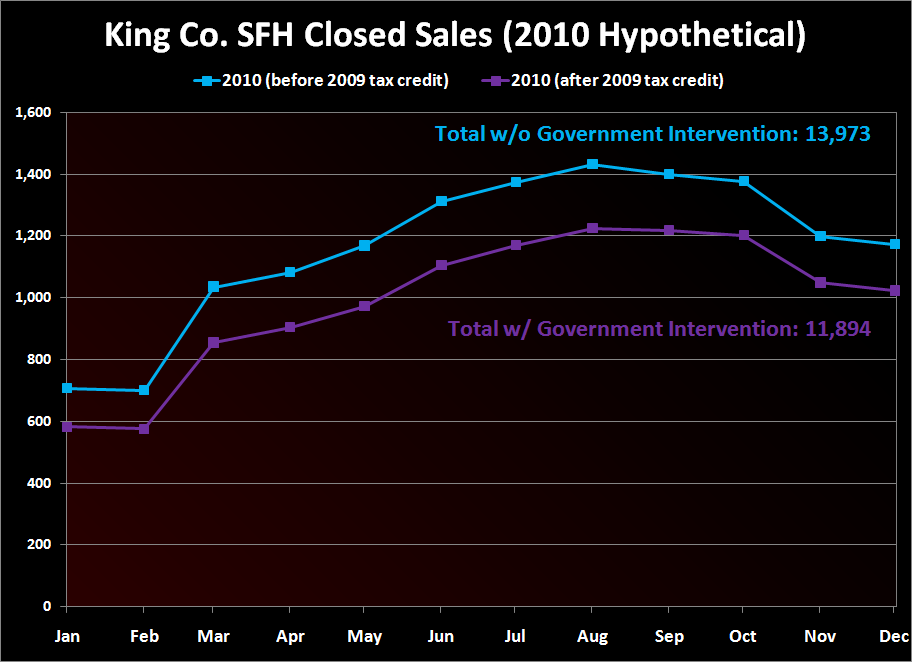
Of course, that assumes that the tax credit will be allowed to expire, which is looking less and less likely. Not that extending it another six months to a year will somehow prevent the market from having to pay back the borrowed sales eventually (at a greater and greater cost the longer it is deferred), but why should pesky little economic realities prevent Congress from spending billions of additional dollars that we don’t have?


Ray Pepper » Oct 16, 2009 at 7:18 am
“money we don’t have?” 95 million…just a drop in the bucket..
Do we have this money to support Pakistan granted yesterday?
http://www.cnn.com/2009/POLITICS/10/15/pakistan.aid.bill/index.html
3 Billion for CFC?
It goes on and on………Focus on the bigger picture of where are money is going. 95 mill is nothing.
S-Crow » Oct 16, 2009 at 7:20 am
Borrowing from future sales as we hear and read about surrounding the Cash for Clunkers program may not be the best comparison to the housing market (I’m not implying this is the sole reason for this analysis). For those with a longer term ownership horizon, interest rates are key. A home purchase has no where near the same dynamics as a car purchase.
Interest rates are goosing the market more than the tax credit in my view. The increase in sales also improves bank balance sheets by getting toxicity off the books. There is a lot at play here: refi activity is high (reflective of activity in our office), sales have improved (reflective of activity in our office) and the banks are moving toxic inventory and the stock market has had one of the most incredible runs (so far) in history under the circumstances……
The Tim » Oct 16, 2009 at 7:21 am
RE: Ray Pepper @ 1 – Ray, the $95 million is the estimate just for King County SFH. The nationwide guesses are around $16 billion, over five times the cost of CFC.
Ray Pepper » Oct 16, 2009 at 7:48 am
RE: The Tim @ 3 –
Yes, I was referring to this area being a drop in bucket. How do you feel about 7.5 billion to Pakistan for this?
“We need to forge a true strategic partnership with Pakistan and its people, strengthen its democratic government, and work to make Pakistan a source of stability in a volatile region,” said Congressman Howard L. Berman, chairman of the House Foreign Affairs Committee.
“Terrorists currently sheltered in Pakistan’s lawless hinterlands are plotting to attack the US. This legislation helps give Pakistan the tools to defeat Al Qaeda.”
Do you truly believe 7.5 billion given to Pakistan will hinder plots against the U.S? Do you believe OUR money will be spent on “tools” to defeat AL Qaeda?
I suggest its another 7.5 bill down the drain, along with billions and billions more flowing to this region in the coming years.
I focus more on funds leaving our Country then those that seek to assist in our stability.
The Tim » Oct 16, 2009 at 7:52 am
RE: Ray Pepper @ 4 – Ray, I agree that is also a big waste. But that’s pretty off-topic. If you want to continue the Pakistan conversation, how about we do it over in the open thread.
Kary L. Krismer » Oct 16, 2009 at 8:01 am
I think it’s totally impossible to estimate how many sales were generated. For one thing, a qualifying first time buyer sale might generate a second sale as the owner of the first home sells.
Whatever it is, I suspect it’s a lot more cost effective than the old $7,500 credit. There I think a lot of people bought and then learned of the credit after the fact. People just didn’t know about that one for some reason.
David Losh » Oct 16, 2009 at 8:01 am
The $8K is a tax credit. It’s money that the purchaser would be paying into the system. The second part is that the money will be circulated back into the economy.
In my opinion the tax credit is secondary to the interest rates. Taken as a whole it seems the economy has been greatly stimulated.
It may seem stupid for people to be swayed by such an obvious ploy, and yes when interest rates tick up prices will fall, but from where we were, to this coming year, the results are pretty clear that a bullet was dodged.
Ray Pepper » Oct 16, 2009 at 8:31 am
RE: The Tim @ 5 –
Hmm. My error..I thought the topic was:
ridiculous giveaway of tens of billions of dollars we don’t even have?
AMS » Oct 16, 2009 at 9:07 am
RE: David Losh @ 7 – Here is a special message written for you:
It’s all numbers, and numbers are numbers, and not much more. Bullets are just lead, and it’s best to dodge them, even if you don’t drive a Dodge.
When it comes to stimulating the economy, some buyers have their pants removed, and they don’t even realize their belt buckle was undone.
dw » Oct 16, 2009 at 9:51 am
So we’re first-time buyers, and since the tax credit was passed we’ve been waiting for its expiry so we can buy. Why? Because it’s inflating prices, and I’d rather pay $8K less than have that $8K applied to my down payment but still causing my mortgage payments to be higher.
Essentially, this is a government incentive not to buyers, but to sellers. Most buyers aren’t going to pocket the $8K; instead they’re going to roll it into their FHA down payment.
If the credit is allowed to expire, I think we’d see prices drop $8-10K, which is a drop in the bucket here in Seattle obviously, but if it means I’m paying $50 less per month for the next 30 years, it’s worth it.
Economically, though, the credit does make sense IF two things happen:
1. The economy grows to the point that it’s getting the $16B back in taxes
2. The housing market starts moving again and is in a position to absorb the $8K surcharge.
Of course, that means the economy has to start growing again (and it looks like we’re in for a multi-year recovery) or taxes will have to go up (and despite the Right’s bellyaching, that ain’t gonna happen, period). So you’re looking at having to keep this incentive on for years and years, further diluting the market.
I kinda like the third option: Go find some other pointless subsidies to slash until you’ve made up the money in the budget. I’m looking at you, agribusiness.
(I should note that we’ve been sitting on the sidelines now for 10 years, renting the whole time. If we’d bought ten years ago, we’d be in great shape now. But in retrospect, we would have had to upside in about 2006, meaning we’d be underwater right now in house #2. Meanwhile, our rents have remained relatively low.)
Scotsman » Oct 16, 2009 at 9:56 am
Forget the math, it’s all about feelings and intentions. Tim, you’ll never win a Nobel with all these “Inconvenient Truths” you keep bringing up.
Scotsman » Oct 16, 2009 at 10:01 am
RE: dw @ 10 –
“or taxes will have to go up (and despite the Right’s bellyaching, that ain’t gonna happen, period). ”
OK, I’ll bite- just how do you see taxes remaining at current levels when current revenues only cover 1/3 of expenditures, trillion dollar plus deficits are projected for the next decade, and the dollar is tanking? How is this sustainable?
AMS » Oct 16, 2009 at 10:04 am
RE: dw @ 10 – You have some of the finance wrong.
If you take the $8k and pay down on the loan, then your net finance amount is the same as if you purchased the home for $8k less. In fact, if you believe that the debt is expensive and should be accelerated, then you are actually better off paying the $8k after the loan is in place, as more of your future payments will go to principal. The computation is on a time-discounted basis. The first $50 has a much greater value than the last $50, 360 months later. A $50 payment 360 months from now has a present value of approximately zero.
Then there is the issue of waiting for what you present to be a wash: $8k now with $8k higher prices, or wait with both go away. Since the net as you present it is zero, having the asset sooner is preferred, unless there is some other reason to delay the purchase.
If you get a good loan, which means low-rate, then you want to delay paying it back as long as possible. Never pay free money back sooner. If this is the case, then you’ll take the $8k and not apply it to the principal.
Finally the $8k does not go toward the down payment. It is a income tax credit that is administered by the IRS. You must pay today, and depending on your tax situation, you may or may not receive a tax refund next year. You may need to pay more, but most people get a refund.
Kary L. Krismer » Oct 16, 2009 at 10:10 am
By dw @ 10:
First, thanks for your admission at the end of the post.
I would tend to agree with you that the credit is offset by higher prices. That’s why I call most first time homebuyer programs “second time homebuyer” programs. That’s who benefits.
But the one thing I liked about this program above all the others is that the money wasn’t available at closing. Thus, it’s not just rolled into the FHA down payment, as you thought, but more importantly, it helps qualified buyers to buy, rather than qualifying buyers to buy. I think that’s a huge difference.
On the topic of expiration, the more I think about it, the more I like the idea of the credit expiring at the rate of $1,000 or $2,000 a month for 8 or 4 months. I’m still concerned about the impact of a sudden expiration.
AMS » Oct 16, 2009 at 10:17 am
RE: Kary L. Krismer @ 14 – “I’m still concerned about the impact of a sudden expiration.”
Do you see the sudden expiration favoring buyers or sellers, or neither?
Kary L. Krismer » Oct 16, 2009 at 10:42 am
RE: AMS @ 15 – My concern is an over-reaction of price downward, so that would favor buyers. I’m also concerned about volume, and a downward trend there would also favor buyers.
I prefer stable markets.
AMS » Oct 16, 2009 at 10:56 am
RE: Kary L. Krismer @ 16 – “I prefer stable markets.”
Oh, yes, that’s right. I remember discussing this with you…
“I’m also concerned about volume, and a downward trend there would also favor buyers.”
What’s my biggest concern is total gross dollar volume going down while prices go down. I don’t know that this favors buyers, but sellers are getting slammed.
AMS » Oct 16, 2009 at 11:03 am
RE: Kary L. Krismer @ 16 – Which one has lower financial risk, renting or buying?
Kary L. Krismer » Oct 16, 2009 at 11:04 am
RE: AMS @ 17 – It favors buyers because sellers become more desperate.
Having your house on the market is not a fun experience. And it’s even less fun when there are almost no buyers coming through.
Kary L. Krismer » Oct 16, 2009 at 11:07 am
RE: AMS @ 18 – Risk of what?
Risk of loss of value–lower risk for renting.
Risk of inflation–lower risk for buying.
Risk of deflation–lower risk for renting.
Risk of being thrown out of your home if you’re one month late–lower risk (none actually) for buying.
AMS » Oct 16, 2009 at 11:09 am
RE: Kary L. Krismer @ 19 – I note that when the market was going up like a rocket ship, buyers seemed far happier. Oh, sellers were even happier, yet, I suppose. I do know that I saw lines of buyers when the prices were much higher.
AMS » Oct 16, 2009 at 11:10 am
RE: Kary L. Krismer @ 20 – Risk of paying for a roof that needs to be replaced?
softwarengineer » Oct 16, 2009 at 11:21 am
Tim, I Visited the IRS Website On This very Topic Today, and Its Clarification Was Like Honey on a Windshield
Don’t Count Your Mortgage Tax Credit Chickens as Earned Income Credit Until the 2009 Pubs Come Out.
Many of the recent rushed homebuyers [especially FHA with low FICO scores, who paid little income tax in 2009] may have a big unpaid tax credit [if their 2009 income tax paid is less than $8000?] bill in their stocking from Santa Obama this Christmas?
Here’s the IRS take in part on the tax credit, with no reference to “Earned Income” type [a tax credit you get even if you paid no taxes]:
“….Burke: There is an income limitation. So, the credit starts to phase out for people whose income is more than $75,000, or $150,000 if they’re married, filing jointly.
Branscome: Mm-hmm. So, bottom line — what’s the difference between the 2008 credit and the 2009 credit?
Burke: The 2008 credit is an interest-free loan. You have to pay it back. The 2009 credit is more, and you don’t have to pay it back. And you have a choice as whether to claim it on your 2009 return or go back and claim it on your 2008 tax return and get the refund now….”
The rest of the URL:
http://www.irs.gov/newsroom/article/0,,id=205928,00.html
deejayoh » Oct 16, 2009 at 11:27 am
By Scotsman @ 12:
I’ll just observe that when we run deficits with a republican president, it’s congresses fault. When we run deficits with a democratic president, it’s the president’s fault. when we run surpluses with a democratic president Newt Gingrich is responsible. And when we run surpluses with a republican president… oh, wait – that never happens.
softwarengineer » Oct 16, 2009 at 11:29 am
RE: softwarengineer @ 23 –
More From IRS
States in Part:
“…Information for Individuals
Some of the provisions of the law primarily affect individuals.
Making Work Pay Tax Credit. This tax credit means more take-home pay for many Americans. To make sure enough tax is withheld from their pay, taxpayers can use the IRS withholding calculator. See Making Work Pay for more.
First-Time Homebuyer Credit Expands. Homebuyers who purchase in 2009 can get a credit of up to $8,000 with no payback requirement. ALERT: Potential buyers need to close on a home before Dec. 1, 2009, to qualify for this tax credit.
Money Back for New Vehicle Purchases. Taxpayers who buy certain new vehicles in 2009 can deduct the state and local sales taxes they paid or other taxes and fees they paid in states with no sales tax.
Education benefits. The new American opportunity credit and enhanced benefits for 529 college savings plans help families and students find ways to pay higher education expenses.
Enhanced Credits for Tax Years 2009, 2010. Find details on the earned income tax credit and the additional child tax credit.
Increased Transportation Subsidy. Employer-provided benefits for transit and parking are up in 2009.
Up to $2,400 in Unemployment Benefits Tax Free in 2009. Individuals should check their tax withholding.
$250 for Social Security Recipients, Veterans and Railroad Retirees. The Economic Recovery Payment will be paid by the Social Security Administration, Department of Veterans Affairs and the Railroad Retirement Board.
Energy Efficiency and Renewable Energy Incentives. See what individuals can do to reap tax rewards.
Health Coverage Tax Credit. The credit increases from 65 percent to 80 percent of qualified health insurance premiums, and more people are eligible….”
The rest of the URL:
http://www.irs.gov/newsroom/article/0,,id=204335,00.html?portlet=6
NOTE: The IRS makes it clear to “make sure enough tax is withheld from their pay” then it talks possible mortgage tax credit. It talks First Time Home tax credit separate from earned income tax credit too.
softwarengineer » Oct 16, 2009 at 11:38 am
It Is an Earned Income Type Tax Credit, In Writing Too
I used the IRS websheet button I found above, states in part:
“…First-time homebuyers may be able to take advantage of a tax credit for homes purchased in 2008 or 2009. The credit:
Applies to purchases that close after April 8, 2008, and before Dec. 1, 2009.
Applies only to homes used as a taxpayer’s principal residence.
Reduces a taxpayer’s tax bill or increases his or her refund, dollar for dollar.
Is fully refundable, meaning the credit will be paid out to eligible taxpayers, even if they owe no tax or the credit is more than the tax owed….”
The rest of the URL:
http://www.irs.gov/newsroom/article/0,,id=204671,00.html
dw » Oct 16, 2009 at 11:38 am
By Scotsman @ 12:
Because raising taxes requires two things of politicians:
– Talking to their constituents like they’re adults
– A willingness to lay their butts on the line and risk their political careers for what’s right
On the latter, I’m coming to believe that 80% of all American politicians, given the choice between their careers and doing the right thing, would choose their careers. On the former, well, Obama at least tried to talk to America like adults during the health care debate, and he had what’s-his-name screaming “YOU LIE” like some five year old who didn’t get any ice cream.
And here in this state we’re way over a barrel financially, and still we’re about to pass I-1033 because we’re overtaxed.
In summary, Americans have turned into a bunch of stupid babies. Maybe we need some of Ayn Rand’s corporate big brains to bail us out, because they’re about the only ones left who have a smidge of rationality.
Scotsman » Oct 16, 2009 at 11:39 am
RE: deejayoh @ 24 –
Right- and when we bankrupt the country with a democrat president, house, and congress…… it is, of course, George Bush’s fault. Unless Sarah Palin is available……
But please, no changes until Obama gives me my house and free gas. I deserve it. Really.
Scotsman » Oct 16, 2009 at 11:44 am
RE: dw @ 27 –
“Because raising taxes requires two things of politicians:
– Talking to their constituents like they’re adults
– A willingness to lay their butts on the line and risk their political careers for what’s right”
Well, OK, in a perfect world that might be true. In the current reality they just attach tax increases to some other bill and pass the whole mess late on a Friday afternoon, making sure they don’t actually take effect for a year or so.
How come nobody ever talks about cutting spending is the more interesting question.
Ira Sacharoff » Oct 16, 2009 at 11:56 am
By Scotsman @ 28:
So, let me understand this correctly:
If Obama gives you a house and free gas, you’ll put a Re-elect Jim McDermott sign on your front lawn, and wear a ” “I heart big government” tee shirt?
AMS » Oct 16, 2009 at 11:58 am
RE: softwarengineer @ 26 – I hope others are listening when I suggest that they need to consult with a good attorney, a good finance person, and so on before any real estate agent.
Also, while it is nice to read all those IRS publications, a real tax professional (a properly selected CPA, Tax Attorney, or Enrolled Agent when dealing with the IRS) knows the law and what the IRS publishes. I cannot stress enough how important it is to have a paid professional to take care of tax issues, including dealing with any IRS problems. The IRS publications often do not explain how to best take full advantage of the tax code.
AMS » Oct 16, 2009 at 12:00 pm
RE: Ira Sacharoff @ 30 – It’s called marketing! One must wear a tee shirt to pay for that house. The government has learned a lot from Google’s advertising model.
dw » Oct 16, 2009 at 12:10 pm
By Kary L. Krismer @ 14:
So I’m confused here. I thought what was happening was that the $8000 was just getting applied straight to the down payment. Is it not?
AMS » Oct 16, 2009 at 12:21 pm
RE: dw @ 33 – Read the last paragraph of my message to you here: AMS @ 13.
Going further, the seller does not know if any buyer qualifies, and even if the buyer says he qualifies, that may or may not be true.
Scotsman » Oct 16, 2009 at 4:24 pm
RE: Ira Sacharoff @ 30 –
Heh, heh– you’re a sly one. Now if all I had to do was wear the t-shirt, I”d go for it. But supporting
McDermott, that’s over the line.
Or I could just follow their lead, say one thing and then do the opposite after I’d gotten what I wanted. Yeah, that’s the ticket, a bit of their own medicine! And the mythical “they” could pay for it all.
mukoh » Oct 16, 2009 at 4:39 pm
RE: dw @ 33 – DW, this is a tax credit. i.e. you close on a house tomorrow then re-do your 2008 return and get half of it back, then when you do 2009 you can apply to get the other half of it back, depending on how much you had paid in taxes.
AMS » Oct 16, 2009 at 4:44 pm
RE: mukoh @ 36 – I am not sure where this 50/50 concept came from.
“First-time homebuyers who purchase a home in 2009 can claim the credit on either a 2008 tax return, due April 15, 2009, or a 2009 tax return, due April 15, 2010. The credit may not be claimed before the closing date. But, if the closing occurs after April 15, 2009, a taxpayer can still claim it on a 2008 tax return by requesting an extension of time to file or by filing an amended return. News release 2009-27 has more information on these options. (2009-27 here: http://www.irs.gov/newsroom/article/0,,id=205416,00.html )”
Source: http://www.irs.gov/newsroom/article/0,,id=204671,00.html
Jonness » Oct 17, 2009 at 11:57 am
By Scotsman @ 12:
Perhaps at the personal level, it will prove to be sustainable in gold. At the national level, I can only provide my best wishes to the walking dead. Then again, thinking in terms of taking personal responsibility for one’s own decisions, whatever the country gets, it deserves. The key here is, can the nation learn from the outcome, rebuild, and restore its former glory?
Jonness » Oct 17, 2009 at 1:58 pm
Contrary to what is being claimed, I believe the $8K can be applied to the downpayment and closing costs if you don’t mind getting a government subprime loan (see conditions).
http://www.hud.gov/news/release.cfm?content=pr09-072.cfm
Then again, what other kind of loan is an unemployed strawberry picker who wishes to leverage up as we head into the winter downturn going to qualify for? 80% of the loans out there currently come compliments of Uncle Sam. His subprime loans are currently seeing record levels of distress and default. Even his prime loan outlets are deathly ill. In truth, the consensus view of the housing market is nothing more than an illusion that works for those unwilling to open the curtains so they can peer outside the box.
http://www.snpnet.com/morethantalk/wp-content/uploads/2007/06/head-in-sand.jpg
The majority of people working in the housing industry are currently existing on a form of government welfare. If the govt. pulls this welfare, the real economy will exact its toll, and Big Brother Bank will take another hit. Thus, we will head back to reality–Hades. Since the current administration is fully aware of the risks, I expect them to provide an extension of the tax giveaway and other such costly programs.
I don’t consider the $8K to be free money though, because, after pulling off the disguise, it’s a loan that needs to be paid back by John Q. Public. A true free money giveaway would occur if the government shut off the housing welfare valve. But as I stated above, I don’t believe that’s the outcome of highest probability.
AMS » Oct 17, 2009 at 2:20 pm
RE: Jonness @ 39 – How much of this is actually happening?
The bottom line, however, is that the $8k is collected from the IRS after the sale. I am not sure how many non-profits want to lend the cash hoping to recover later. When the sellers where funding the non-profits, it was fairly quick and easy–just pump up the price, and gift part of it back through the non-profit.
Jonness » Oct 17, 2009 at 5:00 pm
By AMS @ 40
It’s not just HUD buyers that can use this money upfront for the purchase of the home. FHA lenders can provide bridge loans to buyers allowing them to put 100% of the $8K tax credit toward the cost of purchasing the home (closing costs and supplemental downpayment). Whether or not the lender chooses to do so is fully up to the discretion of the lender. Thus, it might pay to shop around.
Depending upon one’s profession, informing people that there is no way to use the money up front could be considered irresponsible. If there is a 1% chance, then there is a 1% chance. If there is an 80% chance, then there is an 80% chance. Either way, the prospective buyer should be informed by his paid representative.
Then again, I’m not in the business, so perhaps the laws have changed since May? I’m simply pointed out what I believe to be a discrepancy from the common consensus.
Jonness » Oct 17, 2009 at 5:08 pm
RE: @ – Sorry HUD includes FHA. I meant non-profit.
Jonness » Oct 17, 2009 at 5:09 pm
I think my previous post was flagged. I meant non-profit in place of HUD.
Also, according to HUD, “although buyers can only qualify for a tax credit once they close on a house, they can determine in advance how large a credit they will receive by providing tax documents to their lenders or local housing agencies.”
AMS » Oct 17, 2009 at 6:04 pm
RE: Jonness @ 41 – Do we need to get into semantics here. The IRS will not pay the $8k until after closing. You cannot use money that is paid after closing at closing, right? I guess this discussion could quickly get to the definition of ‘loan.’
Jonness » Oct 18, 2009 at 12:03 am
By AMS @ 44:
Perhaps it’s you who is getting into semantics. What is the difference between using the money for the $8K bridge loan to buy a house and using the money from the FHA loan? In both cases, you get to spend the money prior to actually having to earn and possess it. When it physically touches your bank account is of zero importance if you desire the $8K up front to purchase a home. What’s important is whether or not the $8K is available.
Personally I could care less when the people get the money. The point is, it’s commonly claimed the $8K can’t be used up front in the loan. As far as I can tell, that’s not always true. Then again, I’m not a lender, so what do I know? I would say the ultimate authority here on the subject is S-crow if he cares to chime in.
Herman » Oct 18, 2009 at 2:05 am
Tim’s article is built on the wrong premise. The point was not to add new sales. The point was to add $8k to the recorded price of whatever sales occurred, “stimulated” or not.
This is on the premise that nobody wants to buy a house when the market is in decline. In a normal world, the government would prefer a predictable, annual 3-4% price gain. (The recent exuberance and crash is a lesson for them not to let wall street sell them on the benefits of a 10% annual price gain)
A nominal, predictable price gain creates a comfortable buying and selling situation where everyone wins. Wild fluctuations do the opposite.
Tacking $8k onto the sales prices at the low end is just a lame attempt to smooth the correction out. Plus, it pumps up the value of the banks’ portfolios of foreclosed assets and thus is another great way to launder money through the taxpayer into the bankers.
In the end, this is just one more way the .gov is dropping printed and borrowed money from a helicopter into the economy. Always remember, for those that get the first infusions this represents a windfall — and only after time, as the money trickles out into the economy, does it become currency devaluation.
Herman » Oct 18, 2009 at 2:10 am
In other words, a better article would examine how national prices would have looked this year with a median that is $8k lower than it was. And how the revenues from Citibank’s foreclosure sales would have looked with an $8k delta per each.
AMS » Oct 18, 2009 at 10:35 am
RE: Jonness @ 45 – What happens in the case the IRS does not pay as expected?
Kary L. Krismer » Oct 18, 2009 at 10:48 am
RE: Jonness @ 45 – The state started a program to provide for a loan at closing, but the IRS wouldn’t go along with the requirement that the state be paid the refund directly. I don’t know if other states made that a condition or not. As far as I know, there’s no private bridge loan that would make the funds available.
Lamont » Oct 18, 2009 at 3:45 pm
I expect that the response to the stimulus happens near the beginning of the deal and then as it becomes the ‘new normal’ that the stimulus doesn’t do much good — then you get a little bit of a ‘buying panic stimulus’ right before the stimulus expires followed by the hangover. So as time goes on I’m not sure that we’re buying anything with the homeowner credit…
Jonness » Oct 18, 2009 at 8:57 pm
By AMS @ 48:
According to HUD, you bring your financial records to the bank in order to determine your refund amount beforehand.
Other than that, it’s a 15 year loan, so you have your choice on how to pay it off.
http://www2.seattlepi.com/articles/406684.html
Jonness » Oct 18, 2009 at 9:20 pm
Sorry. That should be IF it’s a 15 year loan, you have you choice on how to pay it off. Truthfully, I have no idea how private lenders would issue the loans.
Judging from Kary’s post, you are probably correct that there are few of these loans out there.
Jonness » Oct 18, 2009 at 9:34 pm
I’m wrong about the way the loans are structured. I was thinking they were like a 2nd, but this is not the case.
“Unlike loans from state and local agencies or nonprofits, the bridge loans provided by private, for-profit FHA-approved lenders must be structured in the form of a personal loan or line of credit. These loans are collateralized by the tax credit and cannot be structured as a second mortgage.”
I’ll ask a loan officer friend if she knows whether these loans are material or lip service.
Kary L. Krismer » Oct 18, 2009 at 9:50 pm
RE: Jonness @ 53 – Now that I read that, I do seem to recall the FHA approving certain types of loans as being okay for making up part of the 3.5% down. And Washington’s loans would have been within that certain type. It wasn’t the FHA that nixed Washington’s plans.
Like I said earlier, I’m pretty sure some other states started these programs, I just don’t know if they got held up the same way Washington’s did. My guess would be not all of them did get held up.
AMS » Oct 18, 2009 at 11:07 pm
RE: Kary L. Krismer @ 54 – Yes, FHA did approve the ‘loans’ as not ‘loans.’ The logic, if I remember right, is that you are simply giving someone money that they already are qualified for, if everything goes as planned. With the correct assumptions (i.e. everything is ok), essentially the capital accrues to the new homeowner right away, but of course the IRS doesn’t pay at closing.
That said, we still have the question of whether you can use cash that you don’t have today to pay today–is the fronting of this money a loan? If so, then clearly you are not using the IRS money, but rather you are using approved loaned funds.
This quickly gets to semantics, the definition of loans, when the credit should be granted (just about all individuals are cash basis accounting), and so on.
I still maintain that you cannot use the $8k funds that are paid after closing at closing. Yes, you may be able to get someone to front the funds, can I say, “take out another loan?”
AMS » Oct 18, 2009 at 11:14 pm
RE: Jonness @ 52 – To say that the lender can approve borrowed funds up to the the amount of the *expected* credit is one thing, but to say that the funds from the credit, that are clearly paid after the closing, is yet another.
I will maintain that you cannot use funds that are paid after closing at closing–again we have the semantics of the loan issue which you suggested was no big deal. However I guess one might suggest you are borrowing money that is already your capital, or at least very soon to be (nearly instantly if accrual based accounting; otherwise very soon, under a year).
As always, there is risk when a lender lends funds.
Kary L. Krismer » Oct 19, 2009 at 9:06 am
What’s interesting is that the FHA approved this about the same time as they finally did in the very questionable “charity” transactions where part of the down payment was provided by the seller, funneled through a charity that kept part of the proceeds. The moves seem inconsistent.
AMS » Oct 19, 2009 at 9:27 am
RE: Kary L. Krismer @ 57 – The seller funded issue was prohibited first, and then they backed off a bit.
The difference with the first-time home buyer credit is that it’s the buyer’s money, rather than the seller likely funding an inflated price. The money the seller paid didn’t need to be paid back, as the seller was immediately funding the non-profit. And the non-profit was giving the money to the buyer for the down payment. However the already very small down payment approached zero.
The IRS doesn’t work that way.
Jonness » Oct 19, 2009 at 8:09 pm
AMS, I believe you are correct. I called a loan specialist friend of mine today, and she said none of the big banks are issuing these loans, and she’s not aware of whether any of the smaller banks will issue them. She doubts it though. Several other loan specialists said the same thing emphasizing that the banks are extremely fearful of lending money on a low-down mortgage that isn’t 100% guaranteed by the government.
The original plan was to send the borrower’s tax credit directly to the lender, but that got nixed. Thus, the new plan was a half-baked replacement with no actual stimulative value.
I was thinking getting the money right away would be a gain, because you could make a larger downpayment. However, now that I think about it, putting the money toward the mortgage after you receive from Uncle Sam also has its merits. In addition, $8K is not a lot of money. IOW, a person probably shouldn’t put so much down they go to zero, so if you can’t afford to float this yourself, why is a bank going to touch it?
Sorry for any confusion I caused. It didn’t make sense to me that I keep reading about this law on the Internet, but nobody ever mentions it.
The near expiration of the tax credit is getting extremely interesting. If it is not extended, I think sales will drop. But if it is extended, I’m guessing it won’t have as big of an impact as it originally did, because people are starting to expect it and factor it into the house price.
AMS » Oct 19, 2009 at 8:36 pm
RE: Jonness @ 59 – Thanks for the follow up!
That said, let’s look at this: “In addition, $8K is not a lot of money”
The amount is 10% bounded by $8k. For this blog it’s assumed to be $8k, as the bottom prices in the area are generally, essentially always, above $80k. I also look at Michigan, including Detroit, where the amount is generally closer to the 10%. Let’s say the $8k isn’t very significant, overall, in the Seattle area, but in Michigan it’s a much bigger impact. Take an ~$70k loan and pay down $8k, and it can be significant.
That said, cheap money should always be paid as slow as possible.