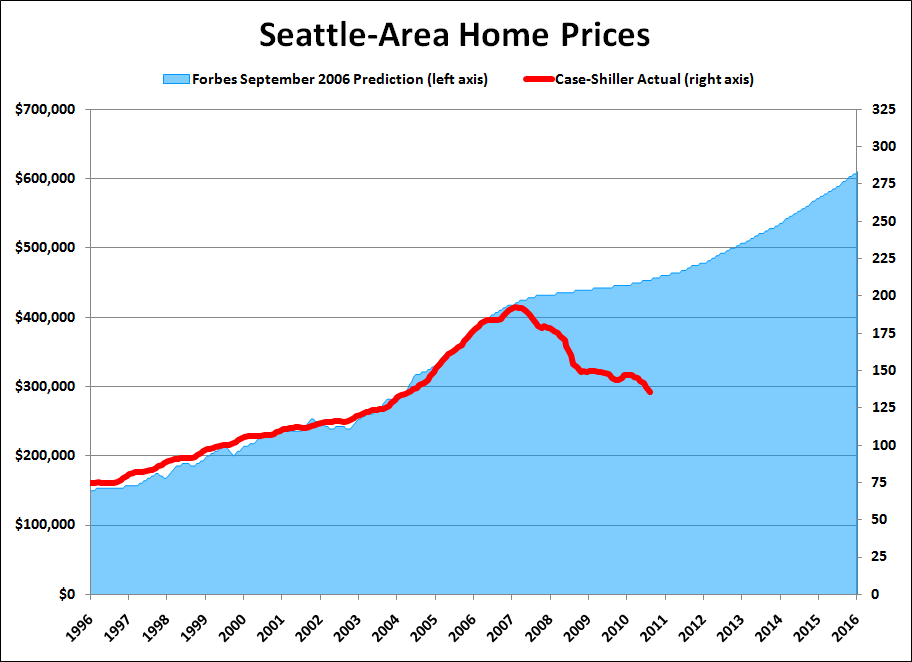
Today’s flashback comes from September 2006, when Forbes tackled the question: How Low Will Real Estate Go?
Get used to it—the seller’s market is closing up shop. The days of fat, fast home value increases are gone. Pack away those flipping fantasies.
“The boom is definitely over, there’s no debate about that,” said Mark Zandi, chief economist of West Chester, Pa.-based research firm Moody’s Economy.com. “Now the question is more how hard is it going to land, if it lands at all.”
…
But that’s just today’s pain. What about six months from now? A year? Five years?
…
To get a sense of how home prices will perform in various parts of the U.S., we turned to Moody’s Economy.com for historic and predicted median home prices in 15 major metropolitan areas. We looked back ten years and forward another ten.
Here’s their prediction for Seattle home prices through 2016, with the actual performance of Seattle-area home prices as measured by the Case-Shiller home price index overlaid on their forecast in red.
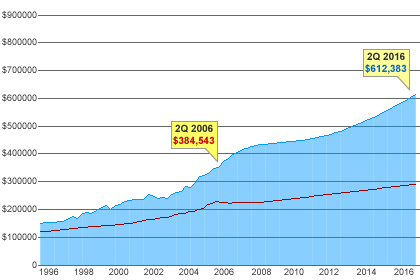
Here’s what I had to say about their forecasts at the time:
Sanity check: According to Moody’s Economy.com, in the next ten years, home prices in Seattle will overtake Miami, Boston, Washington, and New York?!? Okay I don’t care how intricate your formula is, if you think home prices in Seattle will be higher than in New York City, I think you’ve intricate-ed yourself right off your rocker.
But that’s just my ignorant, non-economist opinion. I don’t have any intricate formulas to back it up.
Here’s what one local real estate agent had to say about the forecast at the time:
When I went to the underlying article, I had to say to myself, why would we be second guessing Forbes and Moody’s? Surely they have the data to deliver the most reliable results.
Yes, why would we be second guessing them? Why indeed. And don’t call me Shirley.


“why would we be second guessing them?”
Because their track records are crap, and both are bought and paid for by interested parties?
What do I win?
Rate this comment:
0
0
Moody’s!!!!! Ha, ha, ha, ha. What a total joke of a company. You can’t be serious when you cite Moody’s as any credible authority on anything. Worse, if you read the Senate’s report on the rating agencies, you know that Moody’s was hugely complicit in fraud, and sold whatever reputation they had down the river for quick profits. I suppose folks that write opinion piices or ” probing analyses” need to quote some “authority” but anyone with any credibility, or doing anything more that writing a fluff piece, should know better than to cite Moody’s.
Rate this comment:
0
0
Their chart for Washington DC might not be that far off! ;-)
But rather obviously those who made those graphs didn’t know what they were doing. You can tell that just by noting that Seattle wasn’t charted as being 18 months behind San Diego. :-D
Rate this comment:
0
0
Of course Moody’s thought this, they personally stamped all of the mortgages as AAAAA+++++ WILL BUY AGAIN!!!!!!!
Rate this comment:
0
0
Note: Post updated to include a reproduction of their chart created directly in Excel instead of a hacked-together photoshop’ed overlay job of their original image.
Rate this comment:
0
0
Ohhhh, nice chart. Patriotic!
How about Moody’s is right, and CS is wrong, because like NAR/NWMLS CS hasn’t updated their data sets yet? After all, this is Forbes and Moody’s we’re talking about. Trusted icons. Prices are still climbing, except for those pesky REO/short sales/foreclosures which we all know don’t count. ‘Cause they aren’t real sales, they’re . . . . outliers!
Everything you think you know is wrong.
Rate this comment:
0
0
RE: The Tim @ 5 – Didn’t the original chart show reality being above their predictions for a short time? I don’t remember it matching up as well.
Rate this comment:
0
0
RE: Kary L. Krismer @ 7 – I was doing some hokey eyeballing of the two lines in an image editing program to line them up by stretching the Case-Shiller overlay in the original image. For this one I actually recreated the Moody’s data in Excel and plotted it next to the Case-Shiller line in a more appropriate manner, with the dates lining up as they should.
Rate this comment:
0
0
Let’s be reasonable in attacking Forbes and Moody’s. It’s not like anyone in the whole wide world was able to anticipate the completely unpredictable housing market crash? Who coulda knowed? Several years of double-digit appreciation followed by slightly lower, mid to high single digit appreciation seemed completely sustainable at the time. They had STATISTICS to back them up…STATISTICS. We should all just admit that nobody could have seen this coming, give a couple billion more dollars to the people who caused it, and then figure out ways to pretend we are implementing preventative solutions for the future.
Rate this comment:
0
0
By Still Anonymous @ 9:
Ahh, thanks. I needed a good laugh, enough to scare the cat.
Rate this comment:
0
0
And that local agent you linked to at the bottom left another whopper in the comments section.
“Sorry to say it guys, but the fact that they are predicting different results around the Country, makes it more credible that our area IS in fact going to almost double in the next ten years.”
Rate this comment:
0
0
thanks for the article.
next time, someone says “but said so”, i’m going to point to this article.
Rate this comment:
0
0
RE: BillE @ 11 – “Double” is the new “half”.
Rate this comment:
0
0
RE: The Tim @ 8 –
So the Case Shiller data from 1996 to 2007 matched exactly to Moody’s data? Seems odd, unless they were using Case Shiller vs some other method of calculating home prices, like median home price. Do you know what they define “Seattle Area” as?
Big question is how likely is it that short sales and bank owned properties will continue at these levels through 2016. At present, non distressed properties are running 4% lower than same period 2006 levels based on median price King County.
Has their been a poll as to when people expect to have run through foreclosure inventory? Is that before or after 2016?
Rate this comment:
0
0
Hilarious! Thanks for sharing.
Rate this comment:
0
0
Gotta give some respect to Ardell for leaving that post up, in all seriousness. I don’t have that kind of strength of character.
If I were on record being that wrong about something, I’d hire 4chan to nuke the site from orbit, and then tell people I knew what was coming all along.
Rate this comment:
0
0
Home Prices are not “falling” as much as some would lead you to believe.
http://www.realtown.com/Ardell/blog/seattle-real-estate/north-seattle-home-prices
Rate this comment:
0
0
RE: ARDELL @ 17 –
I don’t get the point of your post. Foreclosure, or short sales, and Bank Owned Properties are the market place of today. Yes they are selling at extremely high prices because once again peope have hope, or they are buying into a school.
What people pay for property has nothing to do with value.
Rate this comment:
0
0
By David Losh @ 18:
Actually David, what you think of the value of something has nothing to do with value. Participants in the market determine value, not those observing it or even those assisting transactions.
Rate this comment:
0
0
RE: ARDELL @ 17 –
I read your analysis. Are you calling a bottom?
Your approach is very interesting. If I understand, what you’re saying is that by removing certain classes of less desirable housing from your calculation- those that have fallen the most- you can show that the average drop in price is not as dramatic.
I would assume that the next step is to remove all data points that are below the previously calculated average. Doing so would allow you to (most likely) show prices moving up! I’m sure Kary would applaud this approach, as he is particularly sensitive to median constructs and such- especially those that show housing prices continuing to fall. Why, with a little finesse I’ll bet you can single handedly resurrect the “spring bounce!”
Truth be told I’m a bit surprised by this effort of yours. I’ve noticed a distincly more bearish attitude in your posts lately. I hope this excercise cheered you up.
Rate this comment:
0
0
RE: Scotsman @ 20 – My approach is to attempt to determine the market for the type of house at issue. If it’s a short sale I would look primarily at short sales. If it’s a bank owned I would look primarily at bank owned. If it’s a normal sale, I would only look at normal sales, unless the market in the particular neighborhood was perhaps dominated by bank owned and short sales.
Is that so difficult to understand?
(BTW, I haven’t read Ardell’s piece, so I can’t comment on what she’s doing. But it wouldn’t surprise me that parts of Kirkland are not very affected by short sales or bank owned properties.)
Rate this comment:
0
0
RE: Kary L. Krismer @ 19 – RE: Kary L. Krismer @ 21 –
People will over pay for anything if the financing is right. If I can buy a Mercedes? for $10K cash or $20K financed at 10 years at 10% I’ll take the financing. That’s what we have going on today.
Now let’s look at actual value, and my best example is town house units in Seattle. I am fascinate by the hillside at Issaquah, but let’s be serious. You take a duplex of fourplex, tear it down and put in four to six housing units. They all need to be maintained, and they are joined at the hip. Let’s put land value, because we can set land value can’t we? Or is that also forbidden? Well let’s do it any way at $400K, and $600K. So just to be fair let’s put construction cost, and sales cost at three times land value, and Bob’s you uncle you get those units at $300K.
Now we have that value and we can putz around with location, or quality, or whatever. How about 5 years from now? how about ten?
Now you are telling me that these units are worth what some one will pay. Who in their right mind would pay $300K for one of these housing units? If we just use a little logic it would tell me that in five to ten years you will have a diverse group of owners who will be fighting about every little thing that has to be done to maintain the property.
Next let’s take Real Property as an asset class in general. Let’s say property holds it’s value, let’s pretend. Your saying that maintaining the property doesn’t cost that much, OK fine. Next you have the mortgage that doubles the amount you pay for the property. You pay $600K for a $300K property. How many times do you think people will step up to make that type of illiquid investment?
Numbers and statistics are just numbers. You have to know your product, and the value in order to make money in the Real Estate business. If you don’t know value you shouldn’t be advising people about it.
Rate this comment:
0
0
RE: Blurtman @ 2 –
The biggest surprise in this litigious post-bubble apocalypse, is that Moody’s, S&P and Fitch’s got off scot-free.
Rate this comment:
0
0
By David Losh @ 22:
The value of the land would also fluctuate. You could even argue that the reduction in values that we’ve had since 2007 has been almost entirely a reduction in land values.
Value is not something that is static. It changes over time.
Rate this comment:
0
0
RE: Kary L. Krismer @ 24 –
Static is different from a constant. The land value is a constant. Once again, just because people over paid for land it still remains the basis of a value to what you can build on it. Single family, duplex, apartments, and commercial, are all uses. Then you have what gets built as also having a value.
Look it, it’s simple that there is of course a core value of property. If it were all what people are willing to pay we would still be having a strong financial market. There is more than enough money in our economy to continue to pay whatever a property will bear.
The fact we are even in a place discussing a deflation of property pricing is a strong indication that somewhere along the line pricing far exceeded core value.
Rate this comment:
0
0
RE: David Losh @ 25 – David – I find your posts fascinating…
Do you believe having raw land rezoned changes its value?
Rate this comment:
0
0
RE: David Losh @ 25 – “The land value is a constant.” If we’re using definitions I’m familiar with, his statement doesn’t make sense to me. The value of land is set by the market, with the mostly true constraint that the supply is constant (see Hawaii). But value is set by the relationship between supply and demand and demand does change significantly over time. As the demand changes, so will the value of land. My non-RE expert take on residential land is that it has historically appreciated at about 1%/year in real terms (i.e. price changes are ~inflation + 1%), barring a significant change in related factors (rezoning, closing of town’s only factory, new Google office opening next door, etc.).
Maybe you’re using the word value to refer to utility, and even then, I would say that utility depends on many of those other factors that I was holding steady in the 1%/year appreciation estimate. The utility of a square foot of dirt changes as the community around it changes and as its legal status changes. But it is not constant in any way I understand the word constant.
Rate this comment:
0
0
RE: Scotsman @ 20 -Scotsman,What I’m saying is attached housing, townhomes, are not included as “single family homes” in most of King County. So to include them in Seattle is equally not appropriate even though Seattle chooses to classify them as Single Family Homes,when the rest of the County calls them condos.
What I’m saying is the median for a Single Family Home is $444,000 WITH short sales and bank owned property WITHOUT the townhomes. When you introduce a new product, that is basically small lot “affordable” housing to the extent that it becomes 25% of the “homes” sold, you can’t include that different product in the median calculation. It’s apples and oranges.
If comparing price changes in Seattle to the Eastside, do you really think it is fair to include townhomes in Seattle and not on the Eastside?
If you are buying a townhome, it does you no good to include non-townhomes in the mix and if you are NOT buying a townhome, it does you no good to include them in the mix. It’s like mixing condos with single family and striking a median price. The result becomes of no value to anyone.
As to short sales and bank owned, I use the same rule of thumb as appraisers. At some point you include them IF there are enough of them to influence home prices. The generall guideline is 1/3rd. So at 15%, they do not have a strong influence. Though I do note the median with and without them for information purposes.
Now if you are looking to buy a townhome in Seattle, you would exclude short sales and bank owned property, as they were almost 50% of the sold mix. Mostly due to the “year built” than the style itself.
Rate this comment:
0
0
RE: ARDELL @ 28 –
Ardell – you stated “Now if you are looking to buy a townhome in Seattle, you would exclude short sales and bank owned property, as they were almost 50% of the sold mix. ”
From the stats you posted on realtown, it would appear that you made an error in your calculations. 148 Townhomes, of which 45 were REO – that’s ~1/3, not 50% – and even when you add in shortsales, you specified that there was no major concentration in any particular type so I don’t see how this makes 50%
From your numbers Townhomes made up ~50% of the *REO* properties, but that’s not the same as 50% of the *Townhomes*
Rate this comment:
0
0
Before doing anything…repeat this to yourself.
The median price of a previously owned single-family home in America today is $157,000
….
Then, and only then, when you have internalized this fact.
Think about it some more.
Rate this comment:
0
0
[...] Friday Flashback: Why Second-Guess Forbes & Moody’s? – As you can probably guess, I love pretty much the entire Friday Flashback series. It’s a near-endless supply of amusement to me to look back at the over-confident nonsense spewed by real estate professionals before the bubble burst, despite all of the obvious signs that were practically screaming that prices were headed for a crash. [...]
Rate this comment:
0
0